Parshat Beshalach5 min read

The Water Turned Bitter at Marah Before Manna and Quail Came

Three days without Torah turned water bitter at Marah, manna fell hot each morning, and quail arrived at night under a darkened face of heaven.

Curated by Arthur · Told by Maggid ·
Table of Contents
  1. Bitter Water After Silent Scrolls
  2. Bread Ground for Angels
  3. Quail Under a Darkened Face
  4. A Shepherd Ordered Not to Fear His Flock
  5. Day Portion, Night Portion, Public Voice
The Water Turned Bitter at Marah Before Manna and Quail Came Click for full size

Bitter Water After Silent Scrolls

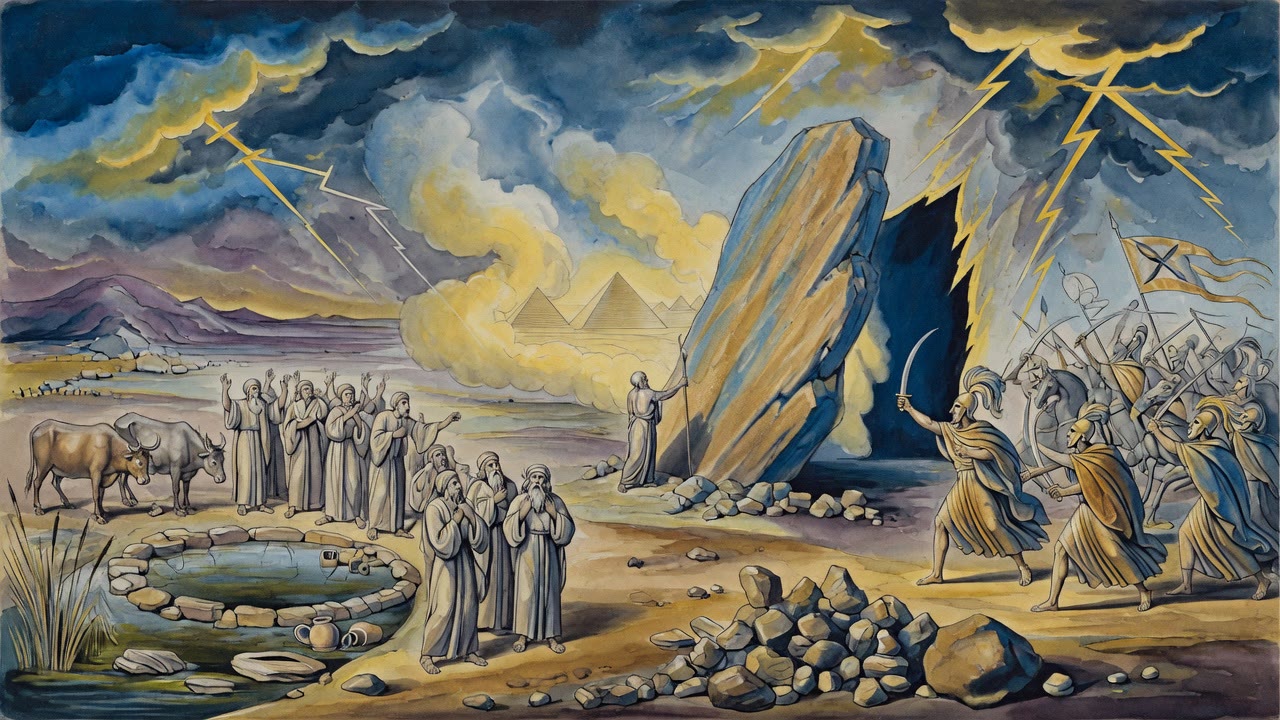
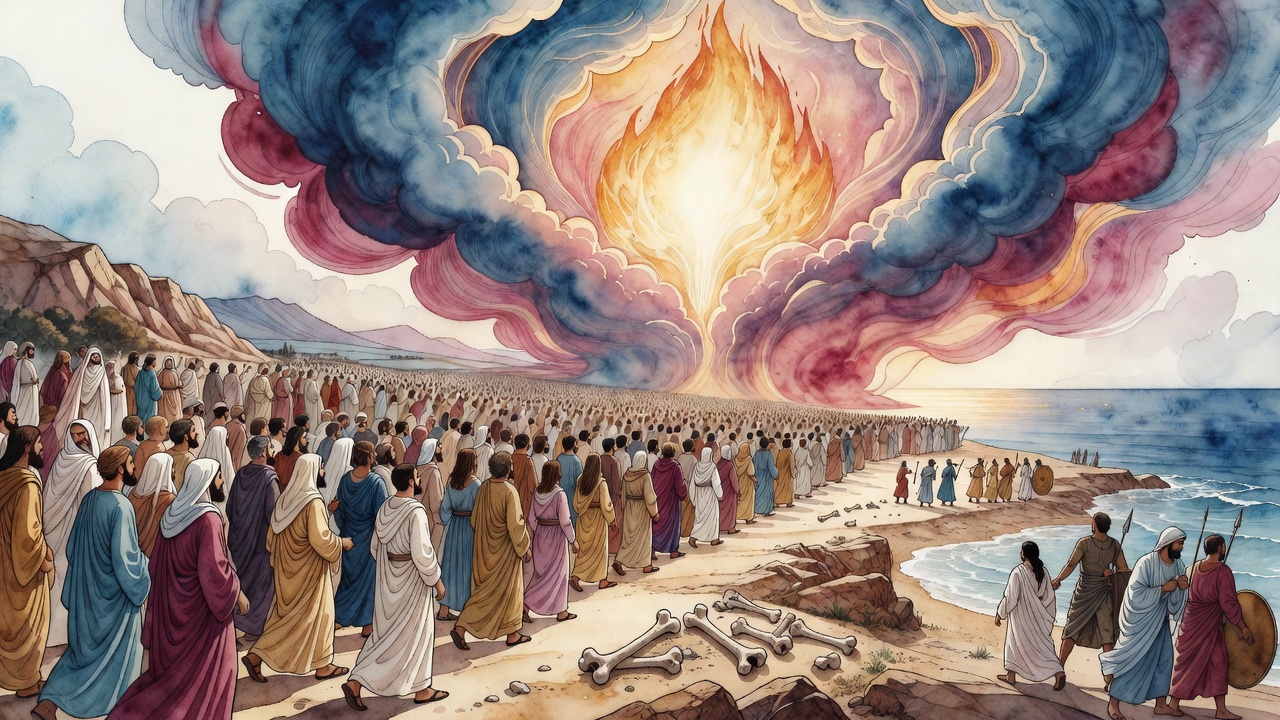
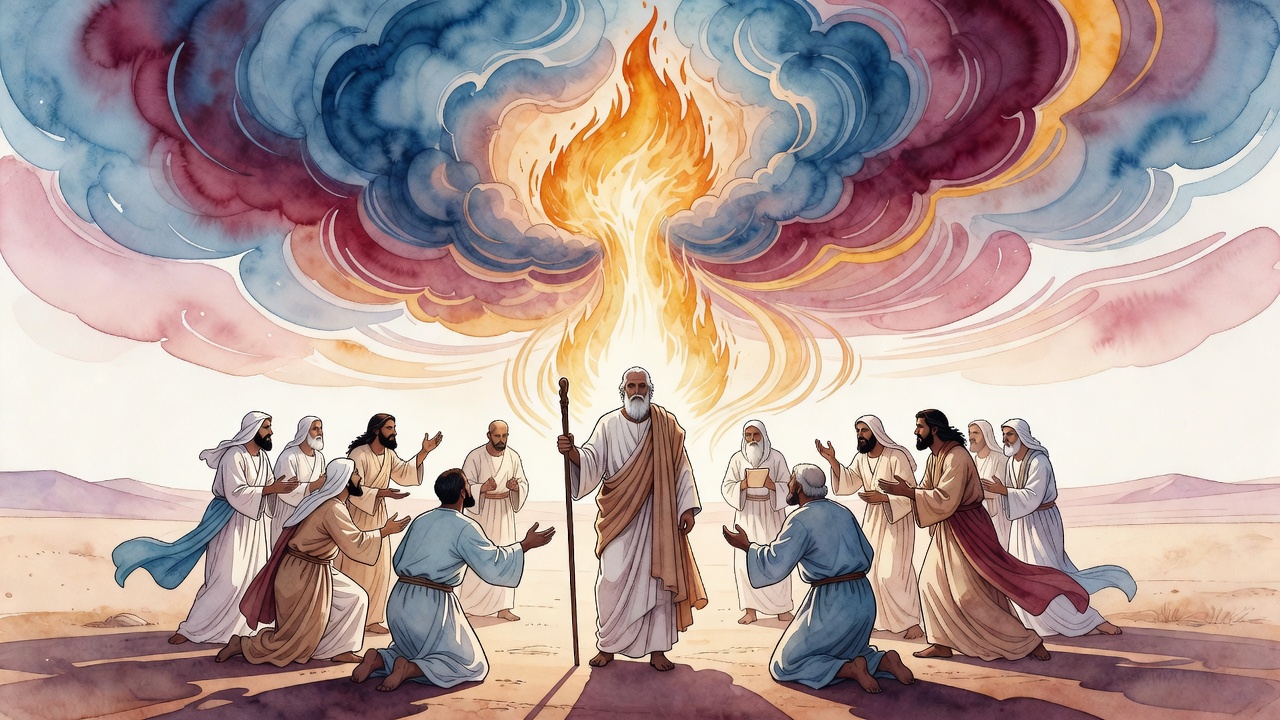
At Marah the wells tasted of neglect. For three days the people had not studied Torah, and the lack of water answered that silence. Prophets and elders later fixed public reading for Saturday, Monday, and Thursday so three days would never again pass without the Teaching. From Marah the camp moved to Elim. From far off, palms promised rest. Close up, seventy stunted trees and twelve wells struggled in barren sand. The same scant water that barely fed seventy palms then satisfied sixty myriads for several days. Scarcity bent around Israel the way a reed bends around a flood. First bitterness, then surplus from a thin source. The desert kept rewriting what enough meant.

The custom of thrice-weekly reading turned a one-time failure into a standing guard. Scrolls would open in public so mouths would not go dry of words and then of water. Marah became a calendar as much as a place.

Bread Ground for Angels

Manna fell by the day's measure only. Travelers would not haul tomorrow's load. Food arrived hot. Faith had to rise each morning with the portion. While the people still lay abed, God rained the food created on the second day of creation and ground by angels. Mills in the third heaven still grind manna for the pious of the future world. Those who ate it grew equal to angels in strength. Like angels, they had no need of easing themselves until sin returned ordinary flesh to ordinary waste. The name "bread of the angels" named both kitchen and effect.

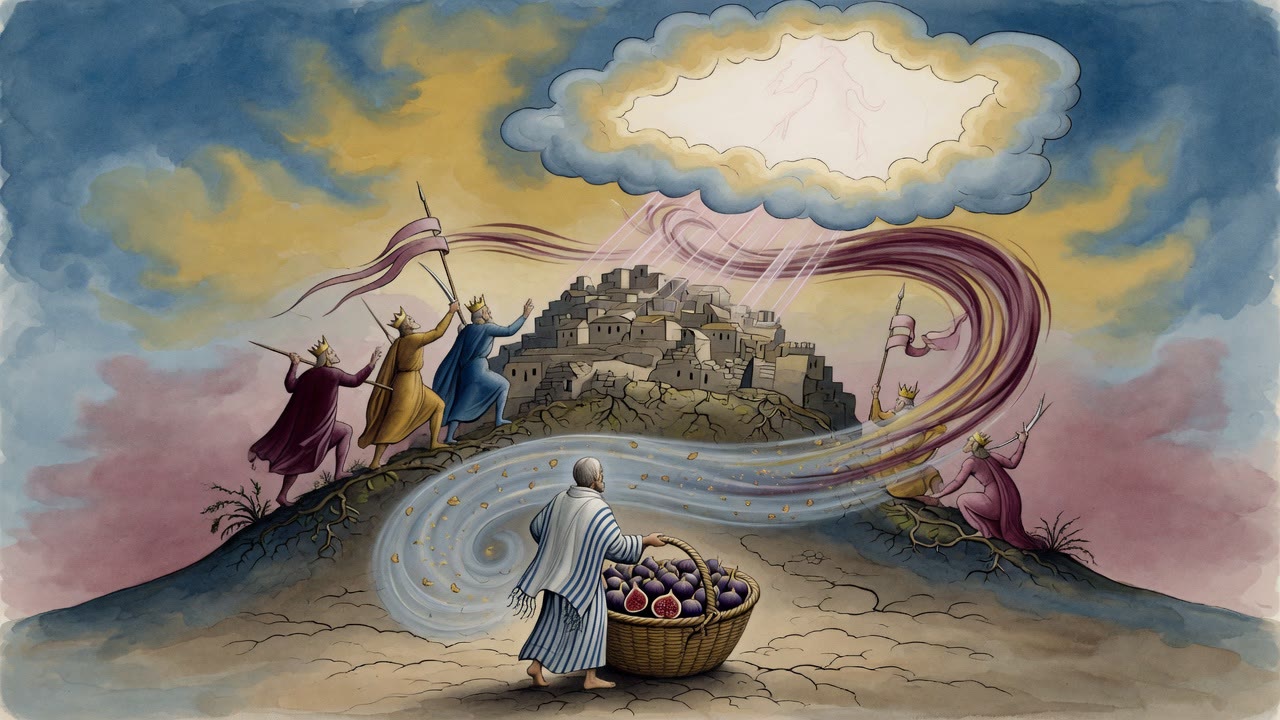
Some broke the rule against storing. Dathan and Abiram saved manna for the next day. Worms bred from the hoard and marched in a long train from tent to tent until the whole camp saw the crime. The first Sabbath also slipped. Had Israel kept that Sabbath, no nation would ever have ruled them. The pair who hoarded and the many who broke rest wrote weakness into a food that had been pure gift. Heaven's kitchens sent perfection. Human jars and human calendars could still spoil it.

Quail Under a Darkened Face

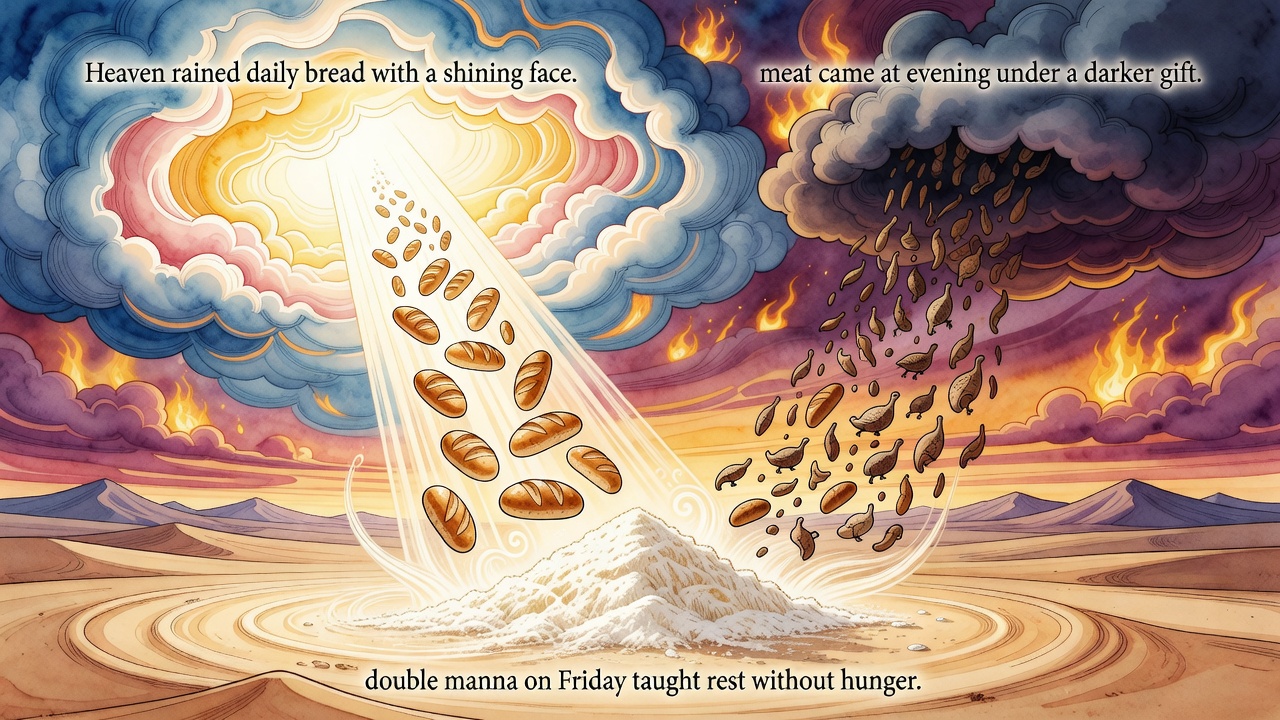
Craving for meat drew a different sky. Toward evening thick swarms of quail rose from the sea and covered the camp, flying not two ells above the ground, easy to seize. Manna had come in the morning with a radiant countenance. Quail came at evenfall with a darkened mien. Bread was a justified desire. Flesh arrived as concession under night's cover. From that split schedule Moses set two meals a day, morning and evening, meat for the later table, and taught a blessing after manna that praised the King of the world who provides for every creature with everlasting grace.

The difference in face, radiant and darkened, taught more than menu. One food answered need. The other answered demand that pressed past need. Both filled mouths. Only one arrived with open light.

A Shepherd Ordered Not to Fear His Flock

Anger at Moses rose with hunger and thirst. He prayed anyway. "O Lord of the world! I am surely doomed to die. Thou biddest me not to be offended with them, but if I obey Thy words, I shall certainly be killed by them." God answered with a command harder than any rod. "Try thou to act like Me; as I return good for evil, so do thou return to them good for evil, and forgive their trespass; go on before the people, and We shall see who dares touch thee." Moses showed himself. The people rose from their seats in reverence. God reminded him how often the order had been the same. Lead as a shepherd leads a flock. Height of office existed for their sake. Grace, goodwill, and mercy in heaven's sight would find Moses only along that path.

The threat of stones met a man ordered to walk first. Reverence returned when he obeyed the posture of a shepherd rather than the posture of a judge nursing wounds. Leadership in the wilderness was not a prize for thick skin alone. It was a daily choice to match God's own return of good for evil.

Day Portion, Night Portion, Public Voice

Marah's bitterness taught a calendar of reading. Manna taught a calendar of trust. Quail taught the difference between gift given gladly and gift given under shadow. Moses stood between a people ready to kill its shepherd and a God who insisted the shepherd walk first. Worms from hoarded bread exposed private theft. Public Torah on three days of the week tried to keep the next Marah from forming in the mouth.

The wilderness did not only empty stomachs. It timed them. Morning light and evening dark became theology a tongue could taste. A nation that had left brick yards learned that freedom still came in measures, hot, daily, and easy to ruin by a hidden jar under a bed. Sixty myriads drank from wells meant for seventy palms. The same people could still starve their own future by three days without words and one night of greedy jars.


← All myths
From the tradition

Sources

5 sources

The texts behind this telling. Some cards carry a translation of the source; others are our own retelling of it, and each card says which. Every card links out to the original.

Legends of the Jews 1:81Legends of the Jews

Retold in our words. Read the original at the link below.The Legends of the Jews by Louis Ginzberg (1909) · Public Domain

The Israelites knew that feeling all too well, not just physically, but spiritually too. Their journey through the desert wasn't just about finding oases; it was about finding connection. they were wandering in the wilderness after the Exodus. A moment came in Marah where the water was… undrinkable. Bitter. Why? Well, the sages tell us it wasn’t just happenstance. The Midrash, and particularly Ginzberg's retelling in Legends of the Jews, suggests a fascinating reason: for three whole days, the people had neglected studying the Torah, the sacred scroll containing God's teachings.

Just three days without engaging with their spiritual heritage, and suddenly, even water turns against them. According to Legends of the Jews, this incident became a pivotal moment. The prophets and elders of Israel established a new custom: reading from the Torah during public services on Saturdays, Mondays, and Thursdays. The goal? To make sure that no more than three days ever passed without the people connecting with God's word. What a beautiful solution!

From Marah, they moved on to Elim. Now, picture this: from afar, Elim looked like paradise, a lush haven promising respite. Palm trees swaying in the breeze. a mirage, perhaps?

As the Israelites drew nearer, the truth became clear. There were only seventy palm trees, not nearly enough to provide ample shade or fruit for such a massive group. And even worse, these palm trees were stunted, struggling to survive because of a lack of water. Twelve wells were present, yes, but the soil was so barren, so sandy, that the water wasn’t enough.

Disappointment must have washed over them like a wave. Had they escaped slavery only to face hardship after hardship in the desert?

But here's where the story takes another turn, evidence of the unwavering grace watching over them. The meager water supply at Elim, barely enough for those seventy struggling palm trees, miraculously satisfied sixty myriads of people. Sixty myriads! That's hundreds of thousands of people sustained by what seemed like an impossible trickle.

As Legends of the Jews points out, this episode reveals God's incredible intervention, a divine favor ensuring the survival of Israel despite seemingly insurmountable odds. How often are we sustained by blessings we don't even fully recognize, miracles hidden in plain sight, perhaps even in the bitterest of circumstances?

Full source
Legends of the Jews 1:90Legends of the Jews

Retold in our words. Read the original at the link below.The Legends of the Jews by Louis Ginzberg (1909) · Public Domain

Jewish tradition teaches us there was a deeply profound reason behind this daily dispensing of divine sustenance.

Several reasons, actually. The Sages tell us that one purpose was purely practical: to avoid the burden of carrying extra food during their desert wanderings. But beyond convenience, there was something even more important at play.

The tradition says the manna was given to them fresh and hot each day. a warm, miraculous meal appearing daily just as you need it. That's a gift that keeps on giving, both literally and spiritually.

Here's the real kicker: it was all about cultivating faith. By relying on God's provision day after day, the Israelites were constantly reminded of their dependence on Him. It was a daily exercise in trust. A continuous lesson in humility.

But where did this manna come from anyway? Ginzberg, in his Legends of the Jews, tells us this wasn't just any ordinary bread. Oh no. This manna was something special. It was created on the second day of creation itself! And it was ground by angels in the third heaven. Angels!

The Zohar tells us that in that third heaven, these celestial beings are perpetually grinding manna, not just for the Israelites of old, but for the righteous in the world to come. In Olam Ha-Ba (עוֹלָם הַבָּא), the World to Come, manna will once again be their sustenance.

It’s no wonder that the manna is also called “bread of the angels.” As we find in Midrash Rabbah, this heavenly bread, prepared by angels, gave those who ate it a taste of the angelic realm. It made them strong, like angels. And, get this, it was so pure that it dissolved completely in the body. No waste!

It sounds incredible. But the Sages tell us this was indeed the case. It wasn’t until the Israelites sinned that they became like ordinary mortals, subject to the, ahem, less glamorous aspects of human existence.

It was about faith, dependence, and a glimpse into a more perfect world, a world where even our most basic needs are met with miraculous grace. Maybe, just maybe, that's a world we can strive to create, even here and now.

Full source
Legends of the Jews 1:100Legends of the Jews

Retold in our words. Read the original at the link below.The Legends of the Jews by Louis Ginzberg (1909) · Public Domain

The stakes might be higher than we imagine.

You’re wandering in the desert, sustained only by miraculous bread falling from the sky – manna. God gives very specific instructions about it: gather only what you need for the day. Well, according to the Legends of the Jews, as retold by Ginzberg, the Israelites were given a very important set of "exhortations and promises" when they decided to keep the Sabbath. Because of their observance, no nation would ever have been able to exercise authority over them. It all came down to keeping the Sabbath holy.

The story goes deeper than that. It wasn't just the Sabbath. Some Israelites also broke another crucial commandment related to the manna itself: they hoarded it, saving it for the next day.

Who were these rule-breakers? None other than the infamous Dathan and Abiram. These weren't just random folks; they were repeat offenders, known for not heeding God's word. They thought they could get away with it, hiding their little stash.

But here’s where the story takes a delightfully Hebrew Bible turn. They were mistaken. Their secret sin became… painfully obvious. The saved manna bred great swarms of worms. And these worms, in a long, wriggling parade, marched from Dathan and Abiram’s tents to everyone else’s. Talk about a public shaming!

So what does this tell us? It's a potent reminder that even seemingly small acts of disobedience can have significant consequences. And sometimes, the universe has a funny way of making sure those consequences are on full display. Perhaps it is also a reminder that the smallest acts of goodness can ripple out and affect the world in ways we can't imagine.

What instructions are we ignoring, thinking no one will notice? Maybe, just maybe, it's time to check our tents for worms.

Full source
Legends of the Jews 1:105Legends of the Jews

Retold in our words. Read the original at the link below.The Legends of the Jews by Louis Ginzberg (1909) · Public Domain

The Israelites certainly did, wandering in the desert after the Exodus. They had manna, that miraculous bread from heaven, but they yearned for meat. They grumbled, they complained, and they wished... and God, in His infinite patience, listened.

In Ginzberg's, Legends of the Jews, God granted their wish, but with a subtle message woven into the gift. Toward evening, thick swarms of quails – birds,! – rose up from the sea, covering the entire camp. They flew low, barely a few amot (ells, or cubits) above the ground, practically begging to be caught. A flurry of wings, a cacophony of squawks, and a people scrambling for a taste of something new.

Unlike the manna, which appeared in the morning with a radiant blessing, the quails arrived at night. Ginzberg tells us God provided the manna with a "radiant countenance," because their desire for bread was justified. But the quails? They came under the cloak of darkness, a sign of God's, shall we say, complicated feelings about this particular request. manna, the staple, arrived with the dawn, full of light and hope. Quail, the luxury, came with the dusk, perhaps hinting at the darkness of unchecked desire.

This difference in timing, morning versus evening, wasn't lost on Moses. He saw it as a lesson, a divine nudge toward moderation and gratitude. According to Legends of the Jews, Moses instituted a custom: two meals a day. Manna in the morning to nourish the body and soul, and meat in the evening, a carefully portioned indulgence.

And with this new custom came a new prayer, a bracha (blessing). This prayer, which Moses taught the people, was to be recited after eating the manna. It's a beautiful expression of gratitude: "Blessed be Thou, O God our Lord, King of the world, who in Thy bounty, dost provide for all the world; who, in Thy grace, goodwill, and mercy, dost grant food to every creature, for Thy grace is everlasting. Thanks to Thy bounty we have never lacked food, nor ever shall lack it, for Thy great name's sake. For Thou suppliest and providest for all; Thou art bountiful, and nourishest all Thy creatures which Thou has made. Blessed be Thou, O God, that dost provide for all."

This prayer, as we find in Legends of the Jews, is a powerful reminder to appreciate the blessings we receive. It urges us to see the divine hand in our daily sustenance, not just when we get the things we crave, but in the simple, reliable gifts that keep us going. What does it mean to be truly grateful for the everyday miracles in your life? What "manna" are you taking for granted? Perhaps the story of the quails is a gentle nudge to reflect on the difference between need and want, and to offer thanks for the abundance that surrounds us, both day and night.

Full source
Legends of the Jews 1:108Legends of the Jews

Retold in our words. Read the original at the link below.The Legends of the Jews by Louis Ginzberg (1909) · Public Domain

They'd just given him a hard time, no doubt. You can almost picture him throwing his hands up in exasperation, turning to God with a plea. According to Legends of the Jews, Moses prayed for God to help the people in their distress and to stand by him. He was in a bind, see?

He essentially said, "Lord, I’m a goner! You tell me not to get mad at them, but if I do what you say, they’ll probably kill me!" Can you feel the weight of that? The sheer frustration?

God, in His infinite wisdom, gave Moses some pretty profound advice. "Try to act like Me," He said, "as I return good for evil, so do thou return to them good for evil, and forgive their trespass; go on before the people, and We shall see who dares touch thee." God, the ultimate power, advocates forgiveness and turning the other cheek. It's not just about being a pushover; it's about a higher level of being. It’s about mirroring the Divine.

So, Moses, taking a deep breath and summoning his courage, went back to the people. And what happened? They rose reverently from their seats. They respected him.

God then chided Moses gently. "How often have I told thee not to be angry with them, but to lead them, as a shepherd leads his flock; it is for their sake that I have set thee on this height, and only for their sake wilt thou find grace, goodwill, and mercy in My sight."

Leadership isn't about power; it's about service. It's about putting the needs of others before your own. And sometimes, it's about forgiving those who have wronged you.

This little snippet from Legends of the Jews reminds us that even the greatest leaders face moments of doubt, frustration, and fear. But it’s in those moments, when we choose compassion and forgiveness, that we truly embody the divine spark within us. It’s a lesson for Moses, sure, but also a lesson for all of us navigating our own challenging relationships and leadership roles.

Full source