5 min read

Michael Carried Israel's Crises Before Heaven

Michael stands at God's right, buries Adam, warns Laban, and carries Egypt's crushed child before the heavenly throne as witness.

Curated by Arthur · Told by Maggid ·
Table of Contents
  1. The Right Hand of the Throne
  2. He Buried Adam First
  3. He Stopped Laban in the Dark
  4. He Carried Egypt's Evidence
  5. Fire Became an Advocate

Michael stands on the right side of the Throne.

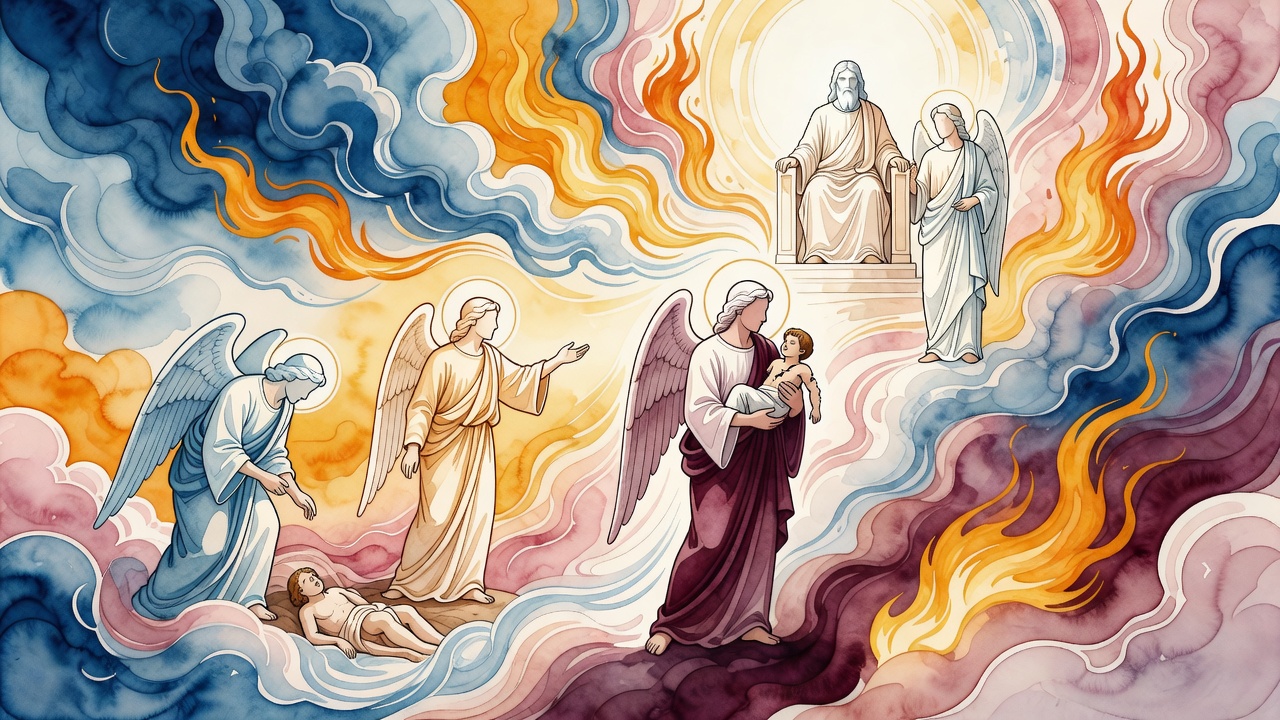
That is the first thing to know. Before he descends into grief, mud, pursuit, or blood, he belongs to the order of heaven. Four camps of ministering angels surround the Holy One. Gabriel holds the left. Uriel stands before. Raphael guards behind. Michael leads the right, the side of life, the side that moves toward defense.

Then the cries begin below.

The Right Hand of the Throne

The angels change according to their mission. Sent outward, they become winds. Ministering above, they become flame. Michael can stand among fire and hail before the Pargod, the heavenly curtain, and he can also enter the dust where human bodies fail.

His greatness is not distance. It is readiness.

In the court above, he has rank. In the world below, he takes assignments no lesser creature would ask for. He does not only carry messages. He handles what crisis leaves behind. A corpse. A hunted family. A mother screaming beside a brick mold. Wherever the covenant looks breakable, Michael appears at the edge of the break.

He Buried Adam First

The first human death left the world speechless.

Adam lay still, and nobody on earth knew how to bury the image of God. Michael asked permission to prepare the body himself. When permission came, he descended with the host of angels. Paradise filled with fragrance. The trees burst into bloom. The scent was so strong that nearly everyone sank into sleep.

Seth stayed awake.

He watched heaven teach earth the rites of death. Michael did not treat Adam as discarded clay. He tended him as the first father, the first fallen king, the first body to prove that dust would receive back what God had shaped from it.

He Stopped Laban in the Dark

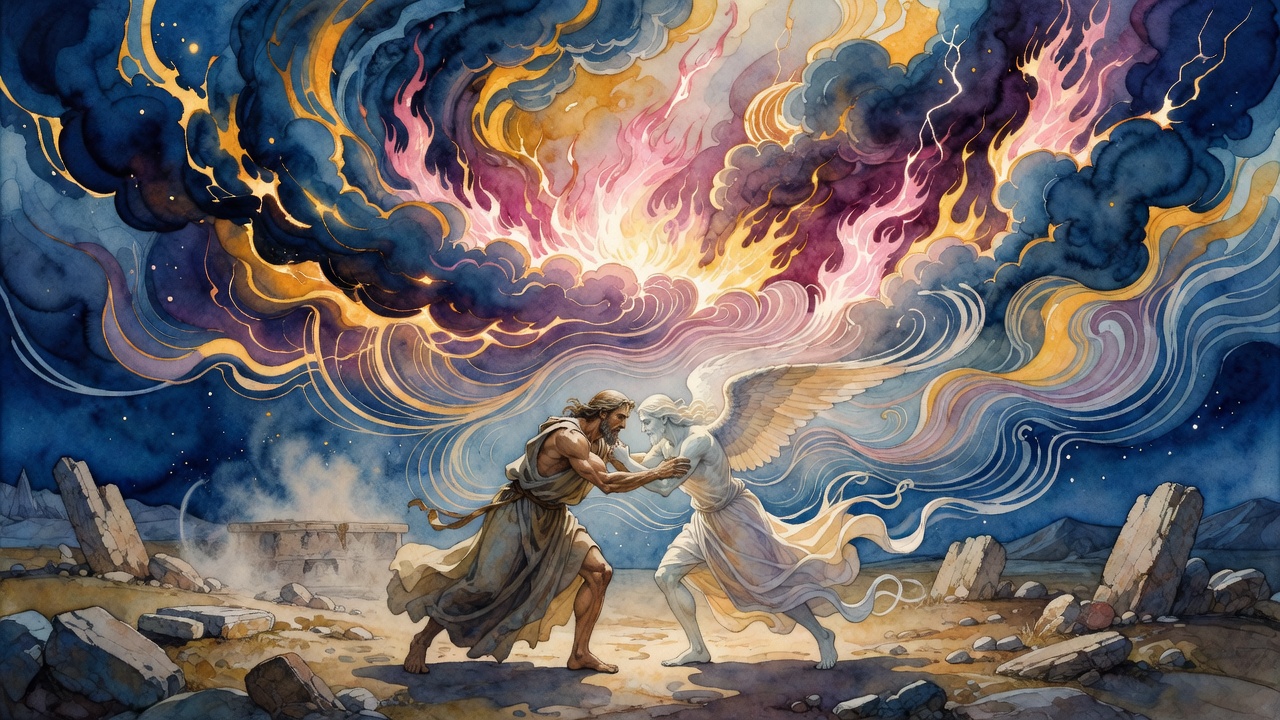
Generations later, Jacob fled from Laban with wives, children, servants, flocks, and the fear that a furious father-in-law could outrun him. Laban woke, gathered his men, and chased. His intention was not reconciliation. He meant to kill Jacob and take back what had left his house.

Night covered the road.

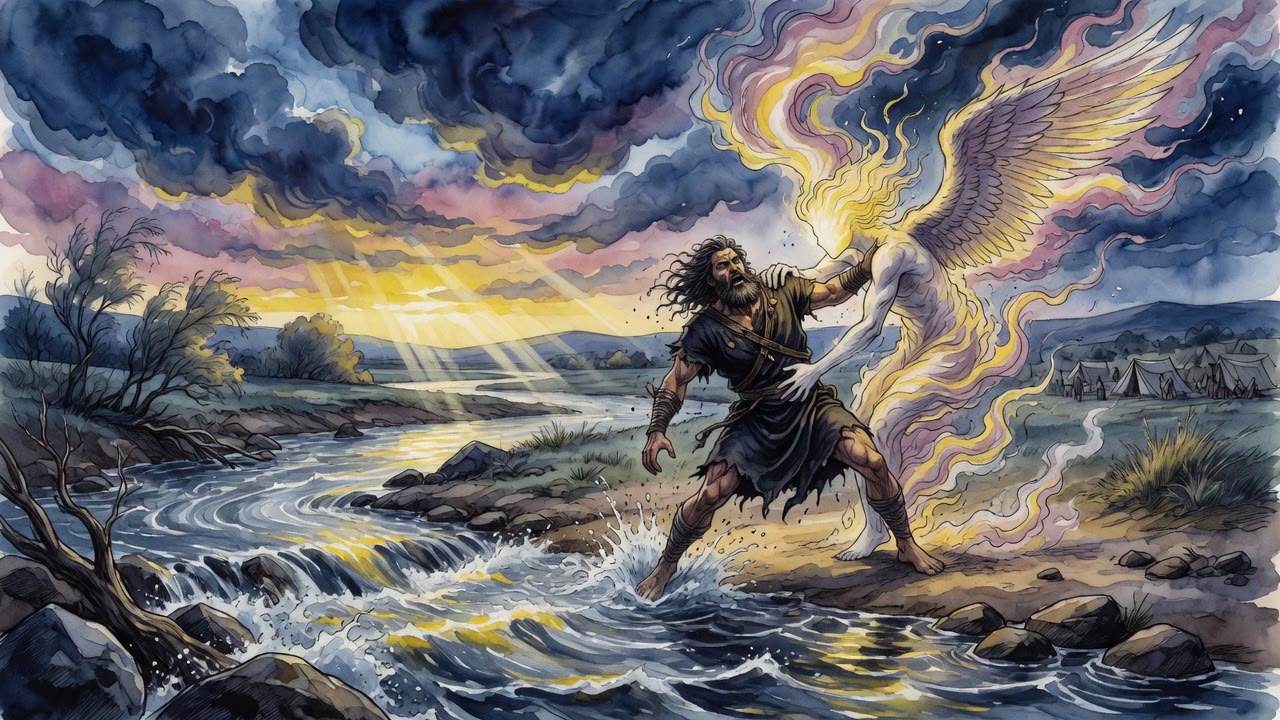
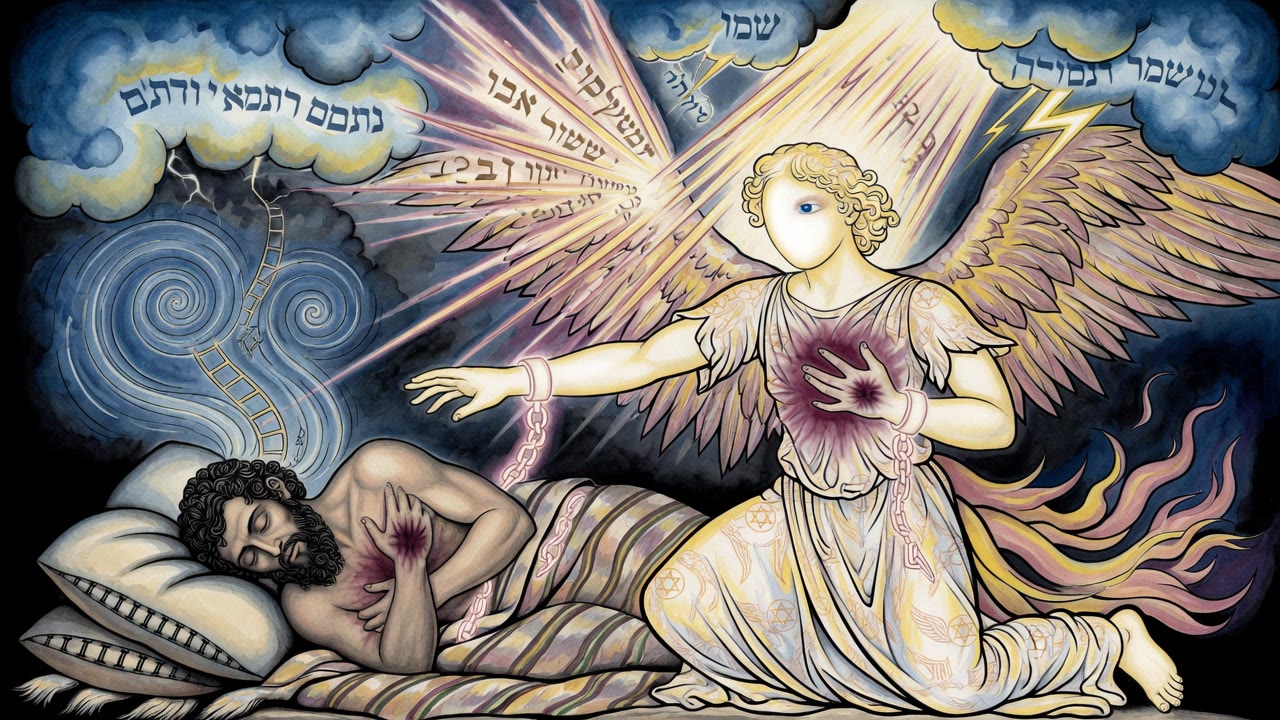
Michael reached Laban before Laban reached Jacob. The warning was blunt. Harm Jacob, and death will meet you. Laban could still argue in the morning. He could still complain about stolen household gods and daughters taken without farewell. He could not cross the line Michael drew in the dark.

Jacob slept because heaven had already intercepted the danger.

He Carried Egypt's Evidence

In Egypt, the suffering was not hidden in royal ledgers. It was in heels torn by straw, backs bent under impossible quotas, children pressed into labor before they had strength to cry properly.

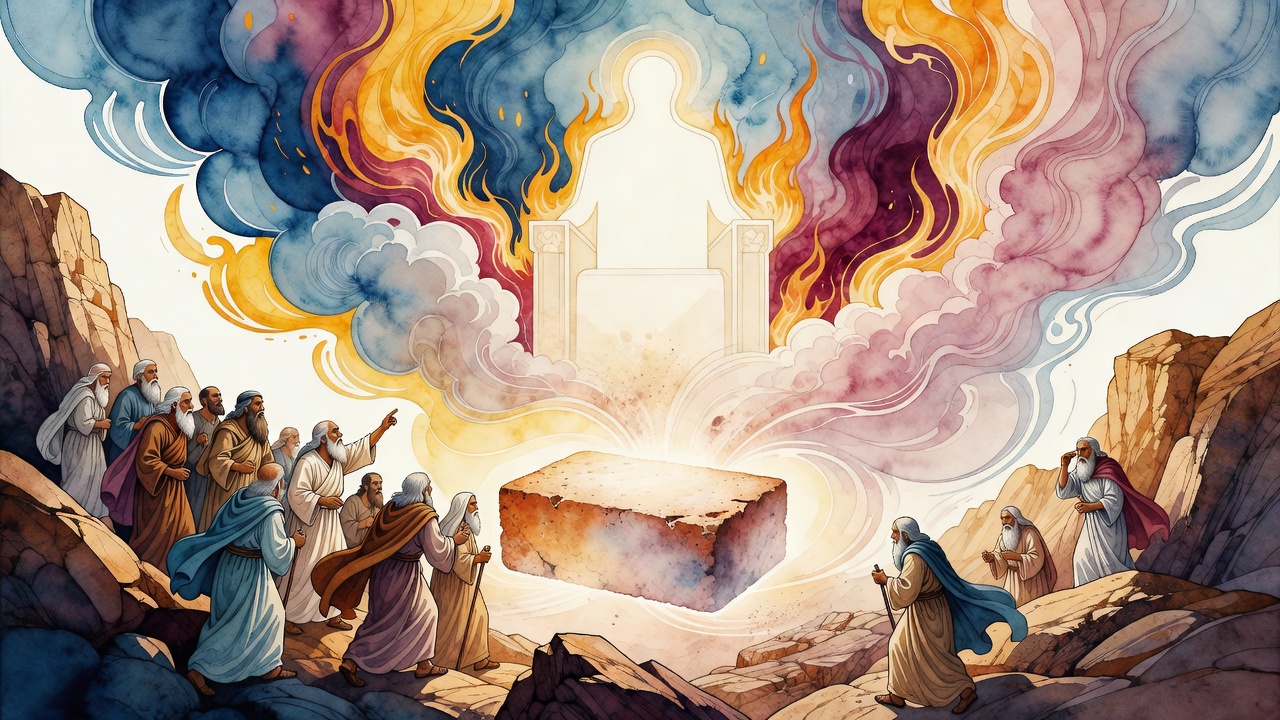
Rachel, granddaughter of Shuthelach, was pregnant and still treading mortar beside her husband. The labor pains came in the mud. Her child slipped into the brick mold, trapped where Pharaoh had turned human birth into building material. Her cry climbed higher than the smoke of the kilns.

Michael descended. He lifted the child, brick and all, and carried the evidence before the Throne of Glory. Egypt could call it work. Michael showed heaven what it was.

Fire Became an Advocate

Michael's pattern is steady. He does not erase every danger before it touches Israel. Adam still dies. Jacob still faces Laban. The enslaved still bleed into mortar. But Michael makes sure the crisis is not unseen, unmarked, or undefended.

On the right side of the Throne, life has an advocate. In the garden, that advocate kneels beside the dead. On the road, he bars a killer. In Egypt, he carries a crushed infant upward until no heavenly court can pretend not to know.

He also stays long enough for the human side of the scene to matter. Adam is not a symbol when Michael prepares him for burial. Jacob is not a doctrine when Michael stops Laban on the road. Rachel's child is not an example when Michael lifts the brick mold from the mud. The angel's greatness is measured by how close he comes to bodies under pressure.

Some angels sing without interruption. Michael sings, then descends.

His right-side station remains visible in every descent. Michael does not come as a wandering force. He comes from order, bearing heaven's memory into places where earthly power tries to erase the weak.


← All myths

From the tradition

Sources

4 sources

The texts this telling draws on, in full. Open a card to read inline, or expand it for a wider, quieter read.

Legends of the Jews 2:119Legends of the Jews

He doesn't just offer condolences. He asks God for permission to personally prepare Adam's body for burial. for a second. The head honcho angel, requesting to handle this deeply human, deeply sorrowful task.

Permission granted. What happens next is straight out of a mystical painting. Michael descends to Earth, and he’s not alone. He brings all the angels with him. Can you picture that? A celestial entourage arriving in the terrestrial Paradise, the original Gan Eden (the Garden of Eden, paradise).

The world responds! According to Legends of the Jews, as retold by Ginzberg, all the trees burst into bloom, filling the air with an intoxicating fragrance (Ginzberg, Legends of the Jews, 1:61). It’s so powerful, it lulls everyone into a deep sleep. everyone except Seth, Adam's son.

Why Seth? Was he immune to the angelic perfume? Was he simply too grief-stricken to succumb? The text doesn't say, but it adds another layer of intrigue to this already extraordinary moment.

Then, God speaks directly to Adam’s lifeless body. It’s a powerful, almost jarring moment. He doesn't offer empty platitudes. Instead, there's a directness, a raw honesty. "If thou hadst kept My commandment," God says, "they would not rejoice who brought thee hither." Ouch.

But it doesn't end there. It's not just about regret. There's also a promise, a seed of hope planted in the soil of sorrow. God continues, "I will turn the joy of Satan and his consorts into sorrow, and thy sorrow shall be turned into joy." (Ginzberg, Legends of the Jews, 1:61). This isn't just about the past; it's about the future, about cosmic justice.

And the final promise? Adam will be restored to his dominion. He will even sit upon the throne of his seducer, while Satan and his followers face their ultimate fate. That's a powerful image of redemption and reversal. So, what does this all mean? It’s more than just a story about death and burial. It's a reminder of consequences, yes, but also a evidence of hope, restoration, and the enduring promise of divine justice. Even in the face of profound loss, the seeds of redemption are already being sown.

Full source
Legends of the Jews 6:156Legends of the Jews

Jacob certainly did. Fresh from his somewhat…complicated…dealings with Laban, his father-in-law (and uncle!), he was on the run, trying to get back home. But Laban wasn't about to let him go without a fight.

In Legends of the Jews, Laban woke up bright and early, gathered all the folks from his city, and took off after Jacob. And get this – he wasn't just planning a stern talking-to. The text says he intended to kill Jacob!

Hold on, because divine intervention is about to enter the scene.

Before Laban could reach Jacob, the archangel Michael himself appeared to Laban! Can you imagine? Michael, one of the highest-ranking angels, showing up with a warning. He told Laban to watch himself, to not even think about harming Jacob. The consequence? Death. Pretty serious stuff.

Now, this part is fascinating. The story points out that God only reveals himself to non-Jews in extraordinary circumstances, and even then, it's done "clandestinely," in the dark. The text contrasts this with how God appears to Jewish prophets – openly, in broad daylight. It's a powerful statement about the relationship between God and his chosen people, a recurring theme throughout Jewish tradition.

Why this distinction? Is it about deservingness? Perhaps. Or is it about the nature of revelation itself? The idea that true understanding, the kind that changes a person at their core, requires openness and a willingness to see the divine even in the mundane. Something that Laban, in this moment of blind rage and pursuit, clearly lacked.

So, Laban, faced with the archangel's warning, was forced to reconsider his murderous plan. But what happens next? We'll have to save that for another time. For now, let's just think about this encounter. What would we do if an angel showed up and told us to change course? Would we listen? And what does it say about us if we only hear the divine whispers in the dark, instead of seeing the light all around us?

Full source
Pirkei DeRabbi Eliezer 4:3Pirkei DeRabbi Eliezer

A fascinating and imaginative work of Jewish literature, the angels created on the second day of creation are quite the versatile bunch. When they're sent as messengers, they transform into winds, and when they're ministering before the Holy One, blessed be He, they become fire! It's all right there in (Psalms 104:4): "Who maketh his angels winds; his ministers a flaming fire."

The story doesn't stop there. Oh no, it gets even more vivid.

Four distinct camps of ministering angels, each with its own role and leader, constantly singing praise before the Holy One. Michael leads the camp on His right, Gabriel commands the camp on His left, Uriel stands before Him, and Raphael guards the rear. And in the very center of it all? The Shekhinah, the Divine Presence, of the Holy One, blessed be He.

He is sitting on a throne, "high and exalted," as Pirkei DeRabbi Eliezer so beautifully puts it. This isn't just any throne; it's suspended in the air! Its appearance is described as being the color of amber, and upon His head rests a crown. The Ineffable Name – that's the unspeakable, holiest name of God – is emblazoned on His forehead.

The vision gets even wilder. One half of His glory is fire, the other hail. At His right hand is life, at His left, death. He holds a scepter of fire, and a veil – the Pargod – is spread before Him. His eyes, we are told, "run to and fro throughout the whole earth." And within the veil, the seven angels created first minister constantly.

His footstool? Also fire and hail. Fire flashes around the throne, and righteousness and judgment form its very foundation. The throne itself is like sapphire, with four legs. Attached to each leg are the four holy Chajjôt – that’s the Hebrew word for "living creatures". These beings are the Cherubim, each with four faces and four wings, just as Ezekiel described in his vision (Ezekiel 1:6).

It's quite a picture, isn't it? A whirlwind of fire, wind, and angelic beings all centered around the Divine Presence. What are we meant to take away from such a powerful image? Perhaps it’s a reminder of the sheer, overwhelming power and majesty of the Divine, and the intricate, awe-inspiring order of the cosmos. It's a vision that encourages us to look beyond the everyday and contemplate the mysteries that lie just beyond our grasp. And maybe, just maybe, to catch a glimpse of the Divine within ourselves.

Full source
Pirkei DeRabbi Eliezer 48:18Pirkei DeRabbi Eliezer

Pirkei DeRabbi Eliezer, a fascinating work of aggadic literature, gives us a glimpse, a chilling, visceral snapshot of their suffering.

Rabbi Akiva, a towering figure in Jewish tradition, paints a particularly harrowing picture. He reminds us that the Egyptian taskmasters were merciless. Their sole focus was extracting labor, forcing the Israelites to meet impossible quotas: "And the tale of the bricks, which they did make heretofore, ye shall lay upon them" (Exodus 5:8). It wasn't just about building cities; it was about breaking spirits.

Families forced to gather straw in the wilderness, loading it onto donkeys, onto themselves, even onto their wives and children. The rough straw, piercing their heels, blood mingling with the mortar. This was raw, agonizing work.

Then comes Rachel, granddaughter of Shuthelach. She's heavily pregnant, near childbirth, yet there she is, alongside her husband, treading the mortar. Can you feel the desperation? The exhaustion? In that moment, amidst the mud and the blood, she gives birth. The child, tragically, becomes entangled in the brick mold.

Her cry, Pirkei DeRabbi Eliezer tells us, ascended before the Throne of Glory. A powerful image, isn't it? A mother's anguish, so profound it pierces the heavens.

The angel Michael himself, a messenger of immense power, descends. He doesn't offer immediate relief, not in the way we might expect. Instead, he takes the brick mold, with its clay and the trapped child, and brings it up before the Throne of Glory. Why? Perhaps to serve as a tangible, irrefutable evidence of the Israelites' suffering. A reminder of the cost of Pharaoh's oppression.

That very night, the Holy One, blessed be He, descended. "And it came to pass at midnight that the Lord smote all the firstborn in the land of Egypt" (Exodus 12:29). Was Rachel's cry the catalyst? Pirkei DeRabbi Eliezer doesn't say explicitly, but the implication is clear. The divine response, the final plague, was inextricably linked to the suffering of the Israelites.

What does this story, found in Pirkei DeRabbi Eliezer, teach us? It's more than just a historical account. It’s a reminder that even in the darkest of times, when suffering seems unbearable, our cries are heard. That even in the midst of oppression, the divine is present, witnessing, and ultimately, acting. It urges us to see the humanity in every story, to connect with the pain of the past, and to recognize the power of hope, even when surrounded by bricks and blood.

Full source