5 min read

Mordecai's Dream and Esther's Prayer Before the King

Mordecai dreams of a snake rising against Israel, then sends Esther toward the king as she prays through terror and fading holy strength.

Curated by Arthur · Told by Maggid ·
Table of Contents
  1. The Snake Rises
  2. The Wind Finds Its Prey
  3. The Message Goes in the Open
  4. Esther Walks Toward the Idols
  5. The Prayer Refuses to Die

Mordecai fell asleep with tears still wet on his face.
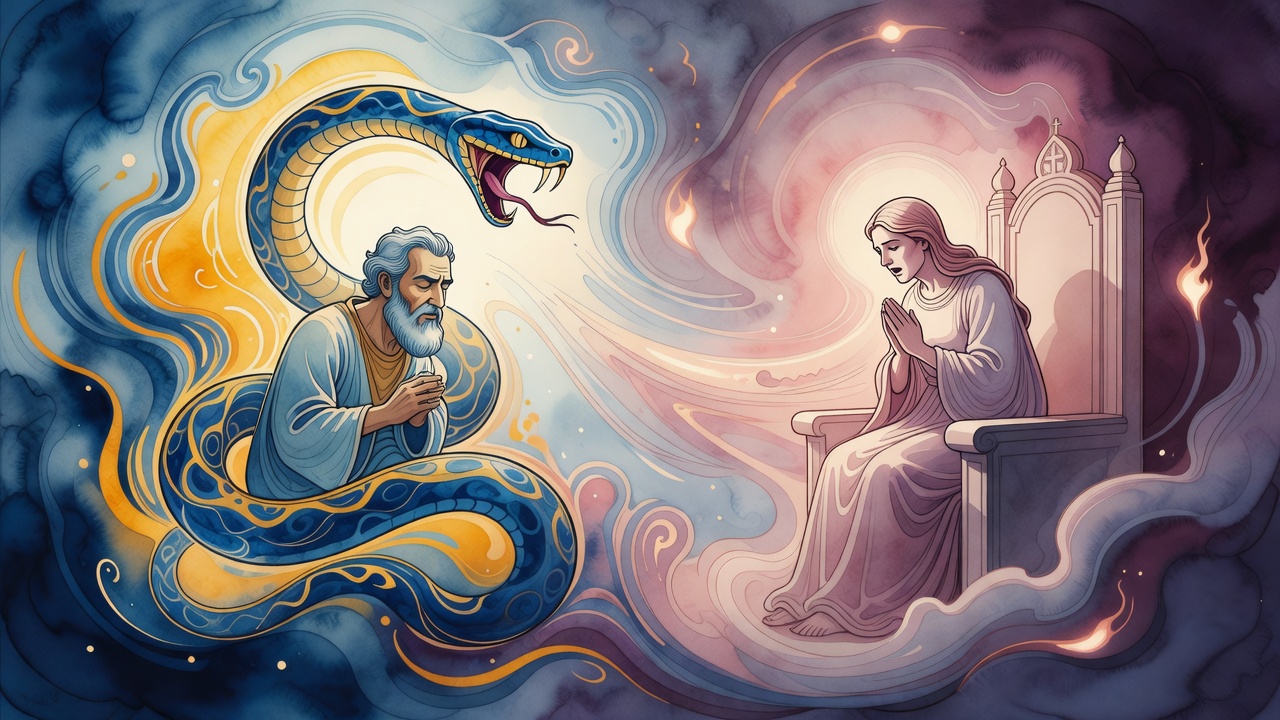
He had been praying for the Jews scattered through the king's provinces, for the misery of exile, for a Temple that still lived in memory even while its stones lay broken. His body gave out before his pleading did. Sleep took him where waking prayer could not.

The Snake Rises

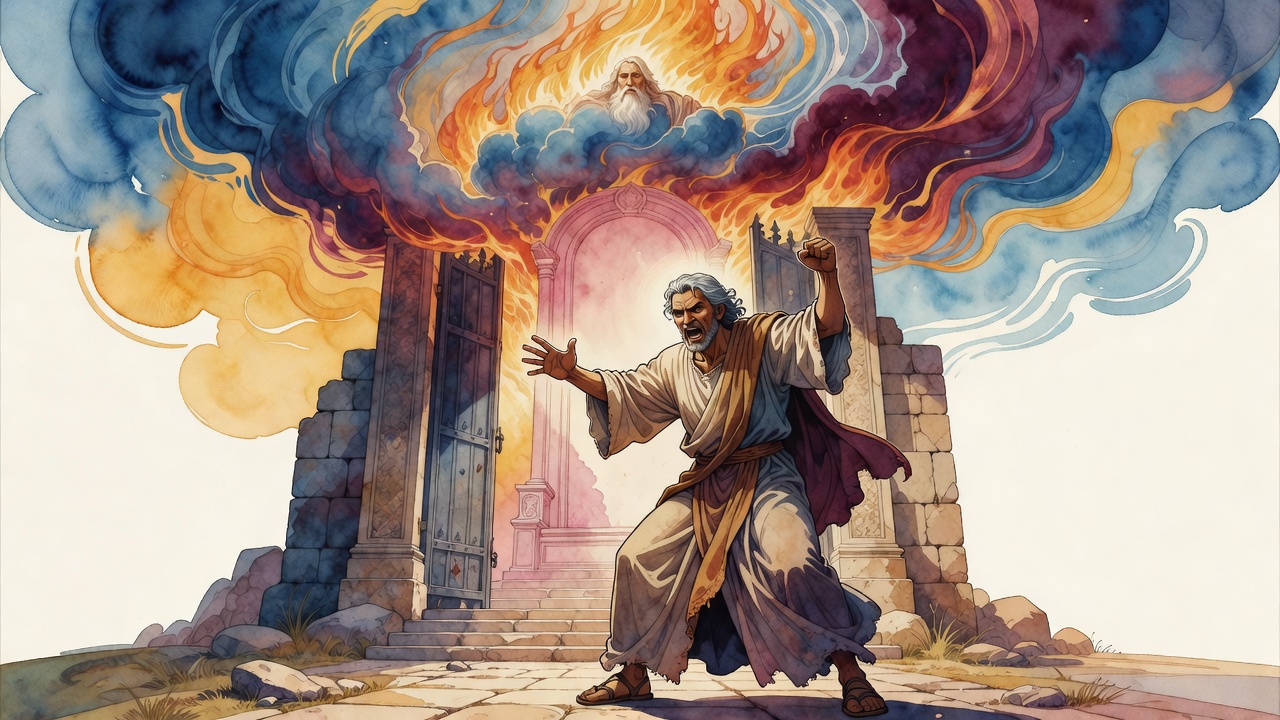
He stood in a desert place he did not know. Nations crowded the sand, many peoples pressed together in a restless mass, their borders blurred by dust and fear. A little distance away stood one nation alone.

Small. Despised. Separated from all the rest.

Then the ground stirred among the nations. A snake lifted its head, then its neck, then more of its length than any creature should possess. It kept rising. It thickened as it climbed, gathering force from the multitude around it, until its shadow stretched toward the small nation apart from the crowd.

Clouds closed over that nation. Darkness folded itself around Israel like a prison cloth. The snake bent toward them, ready to strike, and nothing in the desert moved to stop it.

The Wind Finds Its Prey

The wind arrived from four corners at once.

It did not whisper over the sand. It came dressed for judgment, wrapping the snake the way a garment wraps a man. The serpent twisted inside it, huge and helpless, all its strength suddenly useless. The wind tightened. The body broke apart.

Fragments scattered like chaff. The desert swallowed them. No scale, no fang, no torn skin remained. The clouds lifted from the little nation, and sunlight returned as if someone had opened a locked gate above them.

Mordecai woke with the dream inside him. He did not treat it as a private fear. He carried it the way a man carries sealed evidence, waiting for the day when the signs would name themselves.

The Message Goes in the Open

When the decree came, the dream found its face.

Haman had risen in the court like the snake in the desert. He did not want tribute, apology, or rank. He wanted Israel erased. Mordecai heard the decree and knew the cloud had lowered. The small nation stood apart again, and the serpent had opened its mouth.

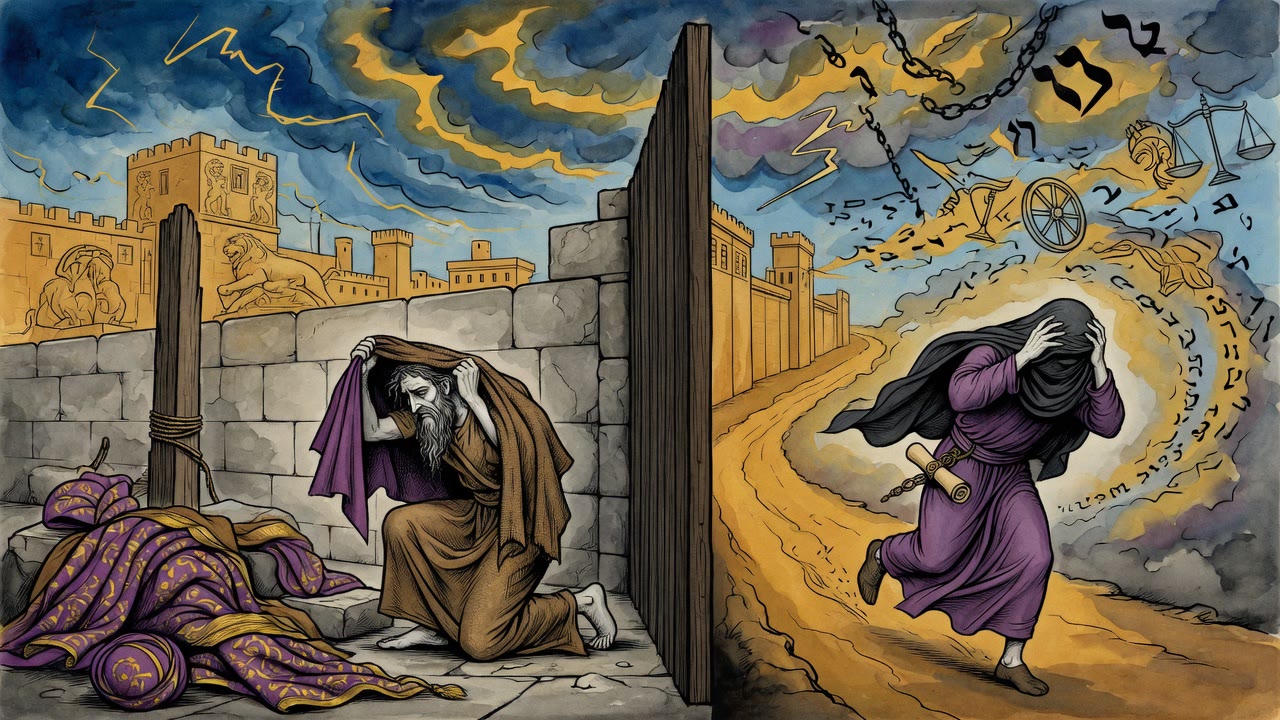
He needed to reach Esther without feeding the palace another secret. Walls had ears, curtains had servants behind them, and a queen could be destroyed by the wrong whisper in the wrong corridor. So Mordecai spoke with Hathach in the open, where suspicious men often hear less because they think nothing hidden would dare stand in daylight.

The message was plain and dangerous. Esther could not remain silent because she wore a crown. The crown had placed her closer to the blade, not farther from it. Haman came from the old enemy of Israel, and his hunger was older than his office. If she entered the king's chamber uncalled, she might die. If she stayed outside it, her people would.

Esther Walks Toward the Idols

Esther received the words and felt the palace become narrower.

She asked for fasting. No bread. No water. No royal softness. If she had to step toward death, she would not go fattened by the king's table while Israel starved under a sealed decree. Three days hollowed her body and sharpened her prayer.

Then she dressed like a queen. Jewels flashed at her throat. Her train dragged behind her, heavy enough that an attendant had to bear it. Two others steadied her on either side, because splendor can be armor and burden at the same time.

The path to the king passed through a chamber of idols.

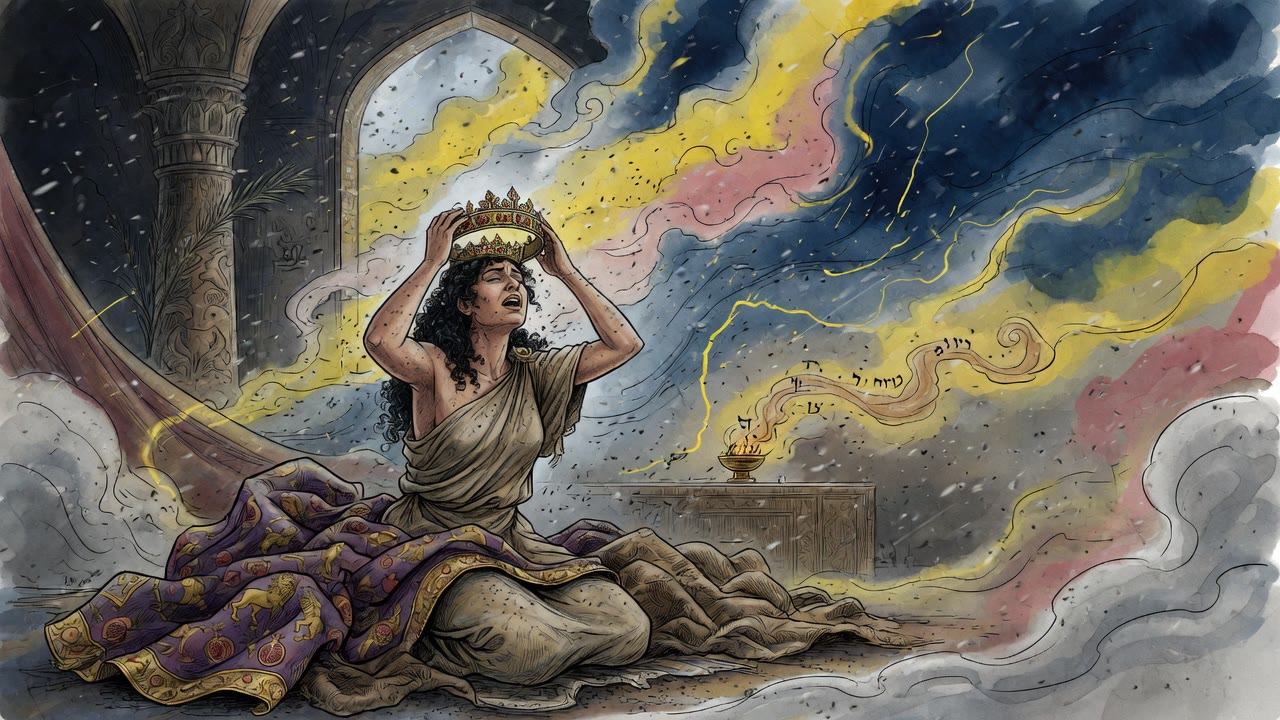
There the air changed. The holy spirit that had accompanied her withdrew. No trumpet sounded. No wall split. The loss was worse because it was silent. The queen stood among carved powers that could not speak, and the living nearness of God receded from her.

The Prayer Refuses to Die

Esther did not turn back.

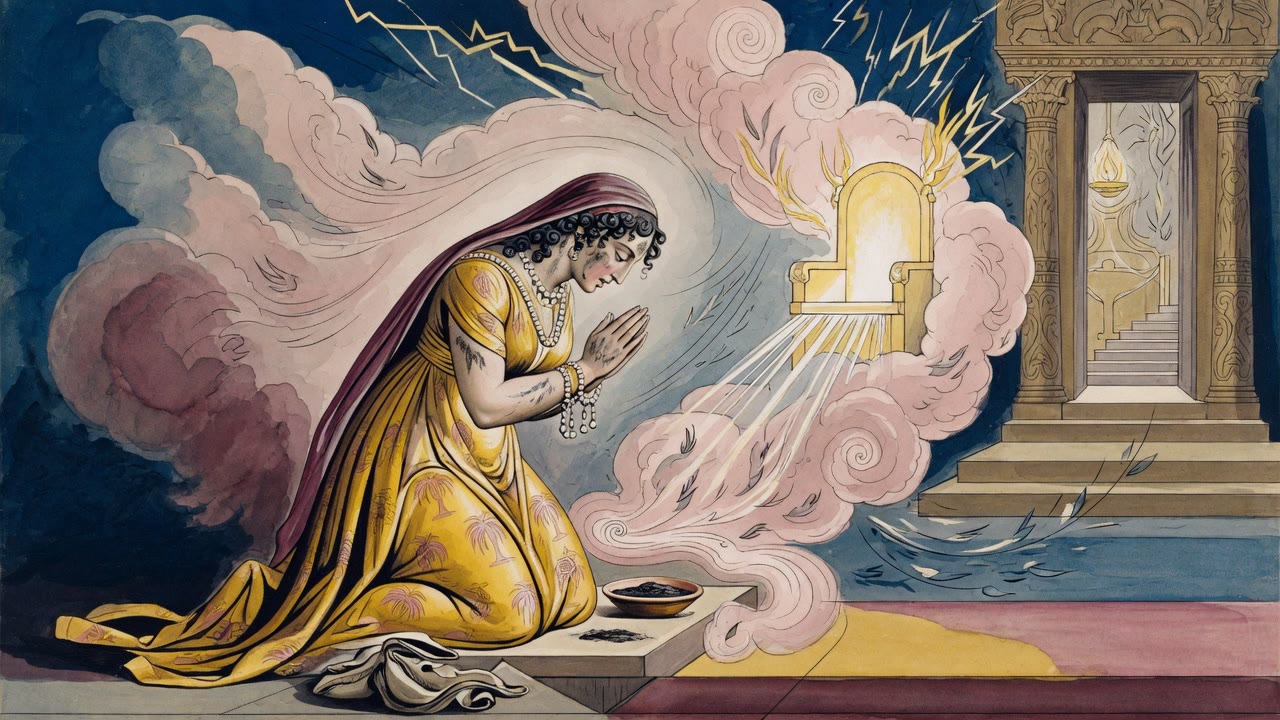
She called on the God who searches heart and reins, the God who knew what no courtier could see under the jewels and paint. She invoked Abraham, Isaac, and Jacob, not as names polished for a ceremony, but as fathers whose merit still had weight in heaven. Let their righteousness stand beside her. Let her petition not be pushed away. Let her request not fall empty to the floor.

Past the idols, past the silence, past the weakness in her knees, she moved toward the inner court. Mordecai's dream stood behind her like a second sight. The snake was not a riddle anymore. The clouds were not symbols anymore. They had become dates, edicts, guards, and a king who might lower his scepter or let her die where she stood.

The hurricane had not yet come. Esther walked as if her own breath might become its first wind.


← All myths
From the tradition

Sources

3 sources

The texts this telling draws on, in full. Open a card to read inline, or expand it for a wider, quieter read.

Legends of the Jews 12:165Legends of the Jews

Mordecai, in the Book of Esther, certainly did. He had to communicate with Esther, his niece and now Queen, without raising suspicion. So how did he do it?

Well, according to Legends of the Jews, by Louis Ginzberg, Mordecai and Hathach, Esther's loyal servant, took a page out of Jacob's book. Remember Jacob, from Genesis? When he wanted to discuss leaving his father-in-law Laban with his wives, Leah and Rachel, he did it out in the open (Genesis 31:4). The idea was that any eavesdroppers would assume they were just chatting about the weather. Sneaky. Through Hathach, Mordecai conveyed a dire warning to the Queen. He revealed that Haman, the story's villain, was an Amalekite – a descendant of Amalek, Israel's ancient enemy. Like his ancestor, Haman sought nothing less than the total annihilation of the Jewish people. Mordecai urged Esther to break protocol, to risk her own life, and plead with the king on their behalf. To strengthen his plea, he reminded her of a powerful dream he once had.

Dreams in Jewish tradition aren't just random firings of neurons. They can be messages, prophecies, glimpses into the divine plan. So, what was this dream of Mordecai's?

Ginzberg recounts that Mordecai, overwhelmed by the suffering of the Jews in the Diaspora – the galut, their exile – had been pouring out his heart in prayer, begging God to redeem Israel and rebuild the Temple. Exhausted, he fell asleep and was granted a vision.

He found himself in a desolate, unfamiliar desert. There, a multitude of nations were mixed together. But one nation, small and despised, remained isolated, a short distance away. Suddenly, a snake emerged from the midst of the other nations. It rose higher and higher, growing larger and stronger with each passing moment. Its target? That vulnerable little nation. Darkness and impenetrable clouds enveloped the Jews, and the snake was on the verge of devouring them.

Can you feel the tension rising?

But then! A hurricane erupted from the four corners of the world! It enveloped the snake like a garment, crushing it into pieces. The fragments scattered like chaff before the wind, until not a trace of the monster remained. And with that, the darkness vanished, and the sun shone brightly upon the little nation once more.

What does it all mean? The dream, no doubt, was a powerful symbol of the threat facing the Jewish people, but also an assurance of ultimate salvation. Would Esther understand it? Would she have the courage to act? That, my friends, is where the story truly takes off.

Full source
Legends of the Jews 12:181Legends of the Jews

The Book of Esther tells us the broad strokes, but Jewish tradition fills in the emotional depth, the internal struggles, and the sheer courage it took to face such a daunting task.

In Legends of the Jews, (Ginzberg), Esther didn't just waltz into the throne room. First, she prayed. And it wasn't a simple, rote recitation. She pleaded with God, saying, "O God, Lord of hosts! Thou that searchest the heart and the reins, in this hour do Thou remember the merits of Abraham, Isaac, and Jacob, that my petition to Thee may not be turned aside, nor my request be left unfulfilled." She invoked the patriarchs, the very foundation of the Jewish people, asking that their righteousness pave the way for her success.

Then, imagine the scene: Esther, surrounded by three attendants, one on each side and one bearing her magnificent train, heavy with jewels. But Ginzberg tells us that her chief adornment wasn’t the finery. It was the ruach (spirit) hakodesh, the holy spirit, poured out upon her.

Here's where the story takes a heartbreaking turn. As soon as she entered the chamber filled with idols – remember, she's married to a Persian king who doesn't share her faith – the ruach hakodesh departed. Can you imagine that feeling? Suddenly, the divine support vanishes.

In that moment of utter vulnerability, Esther cries out, "Eli, Eli, lamah azabtani!" – "My God, my God, why have you forsaken me!" These are the words of (Psalm 22:2), King David's cry of anguish, and their presence here emphasizes the sheer desperation of Esther's situation. She’s questioning why she must suffer for actions taken under duress, actions that go against her very being.

She continues, lamenting her fate: "Shall I be chastised for acts that I do against my will, and only in obedience to the promptings of sore need? Why should my fate be different from that of the Mother? When Pharaoh only attempted to approach Sarah, plagues came upon him and his house, but I have been compelled for years to live with this heathen, and Thou dost not deliver me out of his hand."

She's comparing her situation to that of Sarah, Abraham's wife, whose beauty caused kings to desire her. But God protected Sarah immediately. Esther, however, has been living with a non-Jewish king for years. Where is the divine intervention she so desperately needs?

Finally, she pleads her case: "O Lord of the world! Have I not paid scrupulous heed to the three commands Thou didst specially ordain for women?" Tradition teaches that these three commandments are challah (separating a portion of dough for God), niddah (observing the laws of family purity), and hadlakat nerot (lighting Shabbat (the Sabbath) candles). She is reminding God of her faithfulness, even within the confines of a difficult and dangerous situation.

Esther's story, amplified by these midrashic (rabbinic interpretive commentary) details, becomes more than just a historical account. It's a deeply human story of faith, fear, and the courage to do what's right, even when feeling utterly alone. It makes you wonder: In our own moments of crisis, what are the "merits" we can draw upon? What are the commandments we hold dear? And how do we find the strength to persevere, even when the ruach hakodesh seems distant?

Full source
Esther Rabbah 8:5Esther Rabbah

“Mordekhai told him everything that had befallen him [karahu]” (Esther 4:7). He said to Hatakh: ‘Tell her that the descendant of karahu6Amalek, the subject of the verse in (Deuteronomy 25:18). has come against you; that is what is written: “That he encountered you [kareḥa] on the way”’ (Deuteronomy 25:18).Alternatively, “that had befallen him” in a dream, indicating that he reminded her of a dream that he had dreamed along these lines during the second year of the reign of Aḥashverosh. He saw, and behold, a great and powerful earthquake, panic in the world, and fear and trembling for all its residents. And behold, two great serpents each bellowing toward the other and they waged a war, and all the nations of the world fled due to their noise. There was among them a certain small nation, and all the nations attacked the small nation to eliminate any memory of it from the earth. On that day there was darkness for the entire world, and that small nation was very distressed and they cried to God. The serpents were waging war furiously and there was no one to separate between them. Mordekhai saw, and behold, there was a certain spring of water that passed between these serpents and it separated between them, preventing the war they had been waging. The spring swelled and became a raging stream, like the flow of the Mediterranean Sea, that gradually inundated the land. He saw and the sun shone for the entire land and the world was illuminated. The small nation was elevated, the dominant were lowered, and peace and truth were found throughout the land. It was from that day forward, Mordekhai kept that dream that he had dreamt, and when Haman was causing him distress, he said to her [Esther] by means of her emissary: ‘This is the dream that I told you in your youth. Now, arise and ask for mercy from the Holy One blessed be He, and come before the king and entreat him on behalf of your people and your family.’

Full source