Retold in our words. Read the original at the link below.Townsend 1989 translation of Midrash Tanhuma, S. Buber Recension · CC-BY
A question: An Israelite involved in a litigation with his neighbor, is prohibited from going to a heathen judge for judgment, since it is said: now these are the ordinances which thou shalt set before them (Exod. 21:1). It is taught by R. Simeon the son of Azzai: Even if you should discover a non-Jewish court where the law is identical with the law in an Israelite court, you are prohibited from bringing the case before them, since it is said: Which thou shalt set before them. Before them, and not before non-Jews, before them, and not before ignorant men.
Bar Kappara said in a lecture: Whence do we derive the rabbinic dictum: “Be deliberate in judgment”? We do so from the words: Neither shalt thou go up by steps unto Mine altar, that thy nakedness be not uncovered (Exod. 20:23). Which are followed by the words: Now these are the ordinances.
It is taught: Thy nakedness be not uncovered (ibid.). Is, then, the nakedness of the priests uncovered? Does it not say: And thou shalt make them linen breeches to cover the flesh of their nakedness? Therefore this verse implies that even as the Holy One, blessed be He, warned the priests not to take big strides to hasten into the Temple (and thus, even with pants on, “reveal” their nakedness to the floor), so He warned the judges that they should not be quick to render judgment, as is said: Seek justice, relieve the oppressed (ashru hametz) (Isa. 1:17). (That is,) ashre (“happy”) is the judge hehamitz (“who delays”) his judgment (does not hasten).
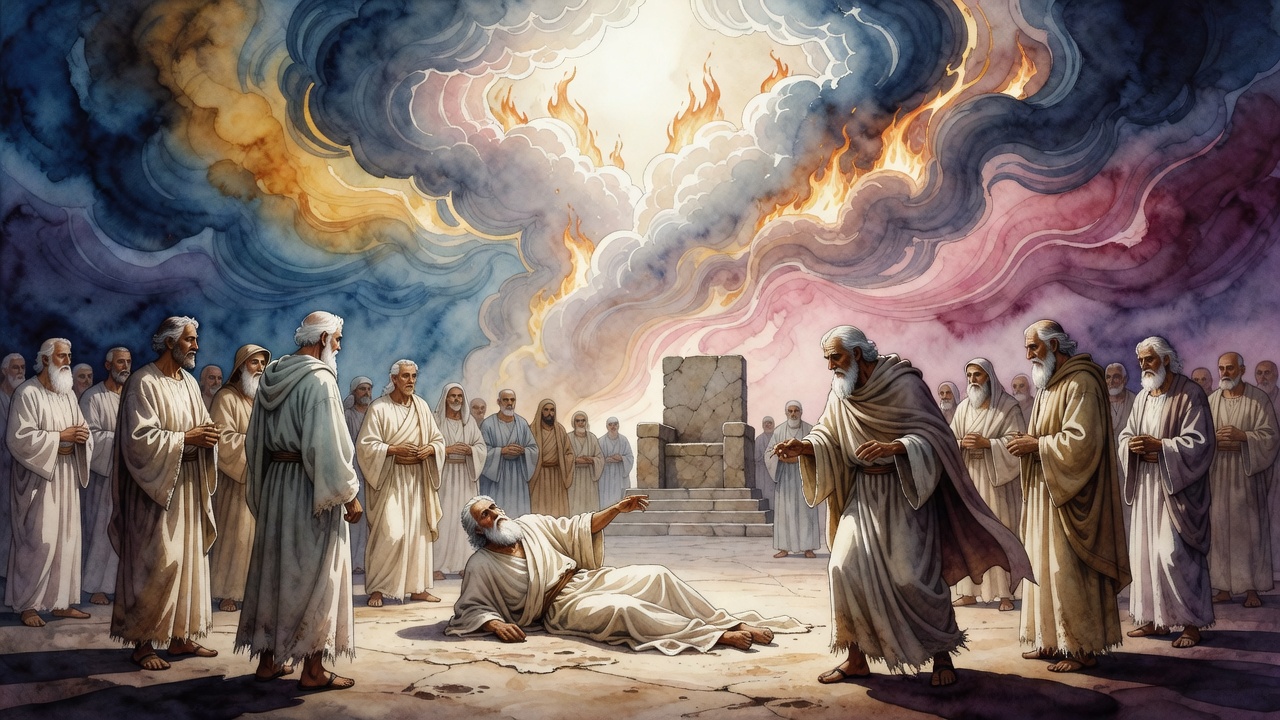
Our rabbis teach that the verse Then both the men, between whom the controversy is, shall stand before the Lord (Deut. 19:17). The law indicates that the litigants must stand while they are being judged, for they should consider themselves as though standing before the Holy One, blessed be He, as it is said: Stand before the Lord.
Our rabbis teach us that the verse In righteousness shall thou judge thy neighbor (Lev. 19:15) implies that you should strive to judge your neighbor, who is your companion in Torah and in the performance of the commandments, justly.
R. Ulla the son of R. Elai was involved in a lawsuit before R. Nahman. R. Joseph sent a message to him: “Our friend, our colleague, Ulla, is our equal in Torah and in the performance of good deeds.” Nahman asked himself: “Why did he send this message to me? Does he want me to favor him? Perhaps he wants his case judged first, or maybe he wishes to influence the decision.”
R. Ulla said: The disagreement was with regard to the litigants themselves, but all agree that witnesses must testify while standing, for it is written: And the two men shall stand. Just as to sit (is contrary to the law), the testimony of witnesses is invalidated if they are seated. However, a scholar may testify while seated.
Rabba the son of Bar Hanah said: If a rabbinical scholar possesses evidence in law, he must bring it to the attention of the presiding judge. But if the judge is his inferior (in knowledge), he need not bring it to him.
R. Shisha the son of R. Idi said: We have learned that if a man finds a sack or a basket which he is not accustomed to carrying, he need not carry it to the court. This is so only in regard to property, but in the case in which a forbidden act has been committed, (he must give evidence) for There is no wisdom, no understanding, no counsel against the Lord (Prov. 21:30).
Whenever the name of the Holy One is profaned, the honor of the scholar is not considered. R. Yemar possessed some testimony in behalf of Mar Zutra and appeared before Amemar. He told him to be seated. R. Ashi said to Amemar: Did not Ulla say in regard to litigants (that it is permissible to be seated), but that witnesses must testify while standing? He answered: They are both positive commandments. However, the positive commandment enjoining respect for the Torah (i.e., the scholar) is more important.
R. Samuel the son of Nahmani said: R. Jonathan declared: Every judge who renders a just verdict causes the Shekhinah (the Divine Presence) to hover over Israel, as it is said: God standeth in the congregation of God. But every judge who renders an unjust verdict causes the Shekhinah to depart, as it is said: For the oppression of the poor, for the sighing of the needy, now will I arise, saith the Lord (Ps. 12:6). R. Samuel the son of Nahmani said: From every judge who takes money from one and gives it to another unjustly, the Holy One, blessed be He, takes the soul away, as it is said: Rob not the weak, because he is weak, neither crush the poor in the gate; for the Lord will plead their cause (Prov. 22:22).
R. Samuel the son of Nahmani said that R. Jonathan also stated: A judge should always see himself as though a sword rested between his thighs and the netherworld was open beneath him, as it is said: Every man hath his sword upon his thigh, because of dread in the night (Song 3:8). Dread in the night refers to the dread of the netherworld, which is as dark as the night. R. Josiah taught that there are those who say in the name of R. Nahman: Why is it written: O house of David, thus saith the Lord: Execute justice in the morning (Jer. 21:12)? Is justice rendered only in the morning and not during the day? This means that the verdict must be as clear to you as the morning light when you announce it, but if it is not, you must not announce it.
R. Hiyya the son of Abba concluded from the verse Say unto wisdom: “Thou art my sister” (Prov. 7:4) that if the verdict is as clear to you as the fact that your sister is forbidden to you, announce it; but if it is not, do not announce it. R. Joshua the son of Levi said: If ten men sit in judgment, responsibility for the verdict rests upon the neck of each of them. And judge righteously (Deut. 1:16). R. Joshua the son of Levi interprets this verse to mean: One must confirm the justice of the decision before announcing it.
Ye shall hear the small and the great alike (ibid., v. 17). R. Simeon the son of Lakish said: A lawsuit involving a perutah must be considered as important as one involving a hundred maneh. Why need this be stated? Is this not a matter of course? It is mentioned simply to remind you to consider a case only in its proper order. One verse says: And I charged your judgments (Deut. 1:16), while another verse says: And I command you (ibid., v. 18). R. Simlai stated: These verses are a warning to the community to act respectfully to the judges who preside over it, and a warning to the judges to bear patiently with the community. To what extent? R. Hanan said that R. Shabbetai stated: As the nursing father carrieth the suckling child (Num. 11:12). Who is a shrewd scoundrel? R. Hanina says: One who explains his case to the judge before the other litigant arrives.
And place such over them to be officers of thousands and officers of hundreds, officers of fifties and officers of tens (Exod. 18:21). The officers of thousands were six hundred in number, the officers of hundreds were six thousand, the officers of fifties were twelve thousand, and the officers of tens were sixty thousand. Thus we find that the total number of men who acted as judges in Israel were seventy-eight thousand six hundred in all. It is taught that R. Eliezer the son of Jacob said: I heard that the court has applied punishments and fines that were not derived from the Torah. This was not done to transgress the Torah but to fashion a fence around the Torah.
It happened once that at a time of crisis a man rode a horse on the Sabbath during the period of Greek rule. They dragged him to the court, and he was sentenced to stoning. This verdict was executed not because it was the correct penalty, but because the situation demanded it. At another time it happened that a man had sex with his wife beneath a fig tree (i.e., in public). They brought him to the court and ordered him flogged. This was not because it was the appropriate penalty, but because conditions at the time demanded it.
R. Simeon the son of Menasya said: When two men come before you with a case at law, you may tell them to depart and settle the matter between themselves before you have listened to their case or even after you have heard it. That is, if you have not yet reached a decision as to which one will receive the favorable verdict. However, if you have already heard the case and arrived at the decision to be rendered, you are not permitted to tell them to settle the matter between themselves, as it is said: The beginning of strife is as when one letteth out water; therefore leave off contention, before the quarrel break out (Prov. 17:14). This indicates that before the circumstances are made known to you, you are permitted to drop it (the case), but after the matter at issue is disclosed, you are not permitted to drop it.
R. Judah the son of Lakish declared: If two men come before a judge to decide a case and one of them is easygoing, while the other is a harsh person, you are permitted to say to them: “I cannot become involved between you.” That is so if you have not yet heard their plea or even after you have heard their plea, but have not yet decided who is in the right. For if the harsh one should be found guilty, he might harm the judge. But if you have heard their plea and know which side the law favors, you are not permitted to say “I cannot become involved between you,” as it is said: Ye shall not be afraid of the face of any man (Deut. 1:17).
R. Joshua the son of Karha said: Whence do we know that if a disciple, sitting before his master, observes something that points out the innocence of the poor man and the guilt of the rich man, he must not keep silent? It is said: Ye shall not be afraid of the face of any man (ibid.). This means that one should not refrain from speaking out because of any man. Witnesses must know against whom they are testifying and before Whom they are testifying and Who in the future will call them to account. As is it is said: Then both the men, between whom the controversy is, shall stand before the Lord (ibid. 19:7). Judges must also realize, as they judge, before Whom they are judging and Who in the future will call them to account, as it is said: God standeth in the congregation of God; in the midst of the judges He judgeth (Ps. 82:1). Thus Jehoshaphat said to the judges: Consider what ye do; for ye judge not for man, but for the Lord (II Chron. 19:6). A man might say: What interest do I have in this argument? Therefore Scripture says: And He is with you in giving judgment (ibid.). Hence a judge must decide a case only in accordance with what he has witnessed (i.e., determined from the evidence) with his own eyes.
Rabba said to Rav Pappa and to R. Huna the son of R. Joshua: If one of my legal decisions comes to your attention and you find it to be inaccurate, do not tear it up before you have consulted me. If I have a valid explanation for it, I will tell you what it is, but if not I will reverse my decision. After my death do not abrogate my decision, for if I were present I might have had an explanation for it. Do not deduce any law from my decision, for a judge must be guided only by what his own eyes witness (i.e. the evidence that comes before him).
R. Joshua the son of Karha said: It is commendable to arbitrate a matter, since it is written: Execute the judgment of truth and peace in your gates (Zech. 8:16). Certainly, whenever there is absolute justice peace cannot prevail, and where there is peace there cannot be absolute justice. Through what kind of justice does peace prevail? It is in the justice achieved through arbitration. Scripture states concerning this matter: If there should arise a matter too hard for thee in judgment (Deut. 17:8) (arbitrate).

 Click for full size