5 min read

Moses Raised His Hands and Israel Lived by Looking Up

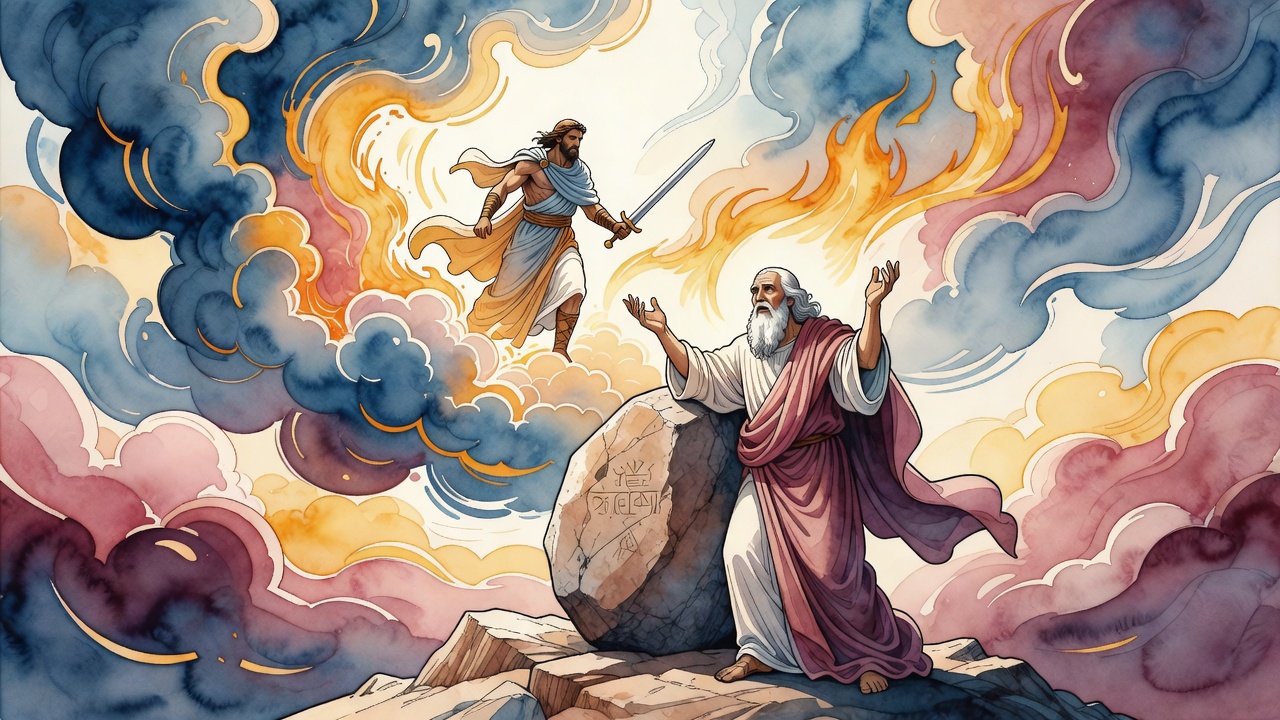
Moses could not hold his own arms in the air. They put a rock under him, and what took his weight was the deeds of Abraham, Isaac, Jacob, and the mothers.

Curated by Arthur · Told by Maggid ·
Table of Contents
  1. Go Out From Under the Cloud
  2. The Hands Went Down
  3. What Was Pressing on His Hands
  4. Until the Sun Set
  5. The Bronze Thing on the Pole
Moses Raised His Hands and Israel Lived by Looking Up Click for full size

Go Out From Under the Cloud

The clouds of glory traveled with the camp, and under them nothing reached Israel. Not the sun. Not the sand. For a nation a few weeks out of Egypt, still learning what free legs felt like, that cover was the difference between a people and a rumor.

Then Amalek came at them at Rephidim, and Moses turned to Joshua with an order that had a knife in it.

"Choose men for us, and go out from under the cloud, and do battle with Amalek."

Out from under it. Past the edge of the one thing that had been keeping them alive, onto open sand where a sword is only a sword and a man's footing is his own problem. Joshua chose his men. Then he walked them out through the last of the shade into ordinary daylight, because that was where the fighting had to happen.

The Hands Went Down

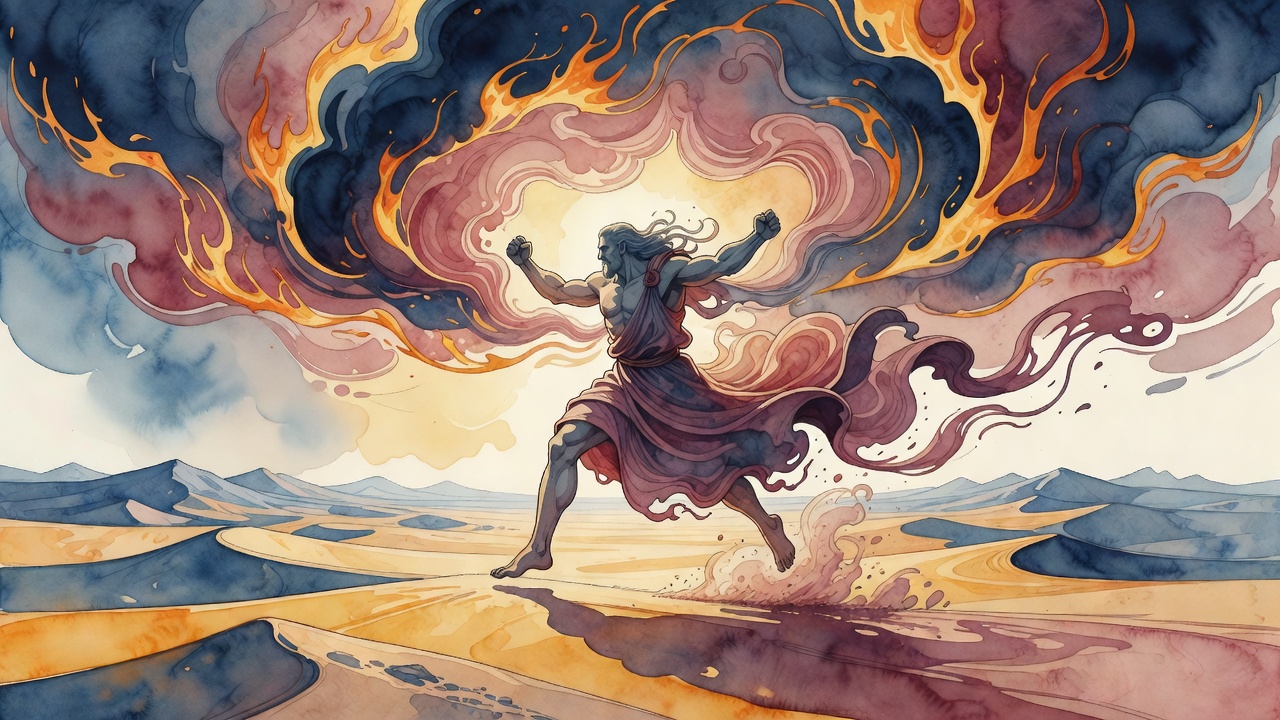
Moses climbed the hill with the staff and put his hands up, and from the moment the lines closed below him he did not eat.

He prayed through the morning. He prayed through the middle of the day, when the valley went white with dust and the shouting came up the slope in pieces. Everything down there followed his arms. Up, and Israel pushed forward. Down, and Amalek came on.

By afternoon the arms were failing.

What Was Pressing on His Hands

It was not muscle. The sin of Israel had settled onto those hands and was pushing them toward the ground, and there was nothing in the living generation strong enough to push back. So Moses reached past the living generation.

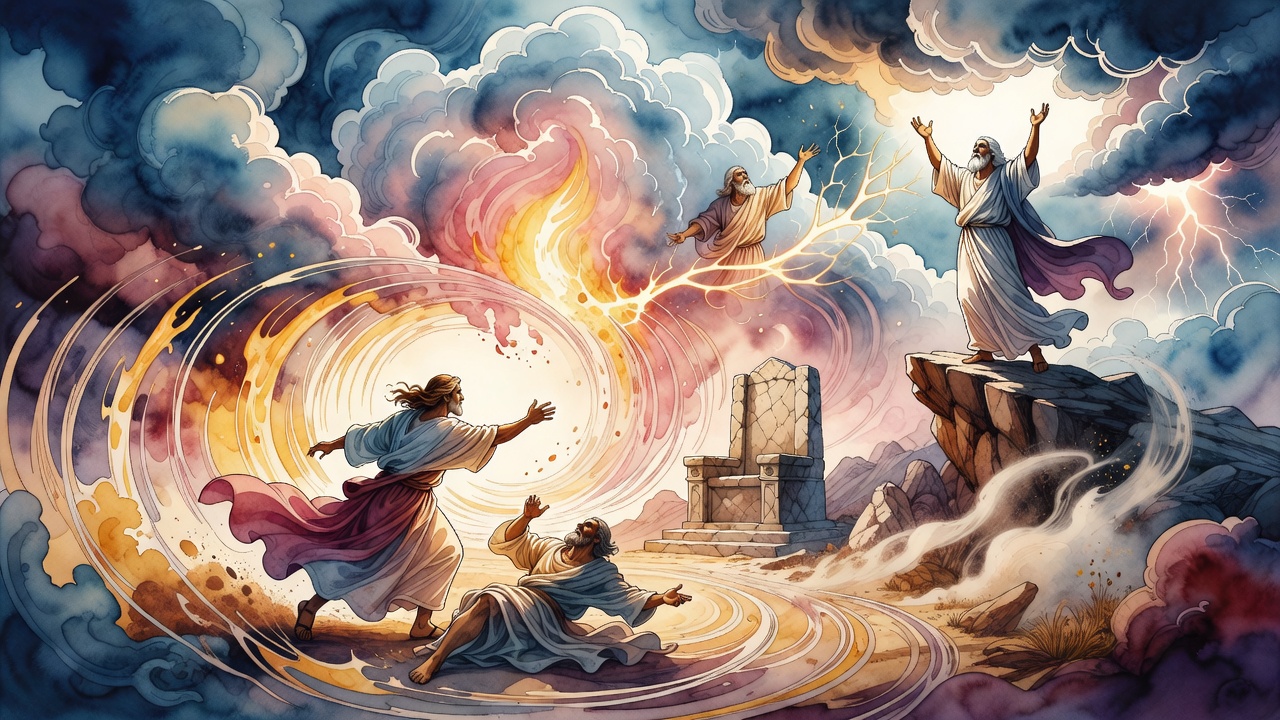
Aaron and Hur took a stone and set it under him, and he sat down on it.

It was an ordinary rock. Anyone walking past would have seen a tired old man sitting on a rock in the middle of a battle. What actually held him were the deeds of the fathers, Abraham and Isaac and Jacob, who is called the Stone of Israel, and under him, where he sat, the deeds of the mothers, Sarah and Rebecca and Rachel and Leah. Moses had run out of the present and sat down on the past, and the past took his weight.

Until the Sun Set

The hands stayed up. Not on his strength, and up anyway, all the way to sundown, while below him Joshua did the day's work outside the cloud with the men he had picked that morning.

Then the light went and Amalek broke and pulled back into the desert.

Moses came down the hill with arms he could not feel. Joshua came back in under the cover with other men's blood drying on him. Nobody moved the stone.

The Bronze Thing on the Pole

Years later and further into the same desert, the snakes came.

They came out of the sand into a complaining camp and bit whoever was nearest, and people died in the open where the whole camp could see it. There was no army to send out this time and no hill worth climbing. A man bitten in the leg at noon was a corpse by dark, and the burning in the wound gave him the entire afternoon to think about it.

God told Moses to make a saraf, a fiery serpent, and set it up on a pole. Moses hammered one out of bronze and raised it where the camp could see it.

A snake of metal kills nobody and cures nobody. It hung up there in the heat with no more power in it than a tent pin. But a man on the ground with the venom climbing his leg would lift his head and look at it, and in looking he put himself back into the hands of the One who had ordered the thing made. He looked, and he lived.

The bronze stayed on the pole. Men who had been flat on the sand an hour earlier stood up in a camp that was still full of snakes, and not one of them had been saved by anything but the angle of his own head.


← All myths
From the tradition

Sources

3 sources

The texts behind this telling. Some cards carry a translation of the source; others are our own retelling of it, and each card says which. Every card links out to the original.

Mekhilta Tractate Amalek 1:18Mekhilta DeRabbi Yishmael

Retold in our words. Read the original at the link below.Mechilta, translated by Rabbi Shraga Silverstein · CC-BY

When Amalek attacked the Israelites at Rephidim, the first nation to wage war against the newly freed slaves, Moses turned to his student Joshua with a command (Exodus 17:9): "Choose men for us and go out and do battle with Amalek." Rabbi Yehoshua (who shared the biblical Joshua's name) explained what Moses really meant by "go out."

The Israelites in the wilderness were surrounded by the clouds of glory, the miraculous divine canopy that sheltered them on all sides. Inside those clouds, they were untouchable. No arrow could reach them, no sword could find them. The clouds were not just weather phenomena; they were a supernatural shield provided by God Himself. To "go out" meant to leave that protection.

Moses was telling Joshua: step outside the cloud. Leave the safety of God's miraculous barrier and face Amalek on the open field, soldier against soldier, sword against sword. This was not because God had abandoned Israel. Moses himself would stand on the hilltop with the staff of God raised in his hands. But the battle against Amalek required human courage alongside divine support. Joshua had to be willing to leave the shelter and fight.

The teaching reveals something profound about the rabbinic understanding of warfare and faith. The clouds of glory protected Israel from the elements and from casual threats. But when a nation rose in deliberate war against God's people, the response required more than passive shelter. It required a warrior willing to step beyond the miraculous boundary and engage the enemy directly. Joshua's willingness to leave the cloud, to risk his life in open combat with Amalek, was itself an act of faith as powerful as any miracle.

Full source
Mekhilta Tractate Amalek 1:32Mekhilta DeRabbi Yishmael

Retold in our words. Read the original at the link below.Mechilta, translated by Rabbi Shraga Silverstein · CC-BY

The verse (Exodus 17:12) describes Moses during the war against Amalek: "and his hands were steadfast until the sun set." Two sages read the strange image differently. R. Yehoshua takes it plainly as a record of endurance: Moses remained occupied with prayer and fasting from the start of the battle until sundown, and his steadfast hands reflect a body held firm by devotion through a long day of supplication.

R. Eliezer Hamodai reads a deeper struggle into the words. He says the sin of Israel weighed Moses' hands down so heavily that he could no longer hold them up on his own strength. What did Moses do? He turned to the merit of the ancestors. The verse continues, "and they took a stone and they placed it beneath him, and he sat upon it." R. Eliezer treats each phrase as an allusion. "They took a stone" recalls the deeds of the patriarchs, for Jacob is called the Stone of Israel (Genesis 49:24). "And he sat upon it," using a feminine form for the stone, recalls the deeds of the matriarchs.

In this reading Moses, unable to prevail on present merit alone, leans on the accumulated merit of the patriarchs and matriarchs. The physical stone beneath him becomes a support drawn from the covenantal past, lifting hands that the people's failings had pulled toward the ground.

Full source
Mekhilta Tractate Amalek 1:26Mekhilta DeRabbi Yishmael

Retold in our words. Read the original at the link below.Mechilta, translated by Rabbi Shraga Silverstein · CC-BY

The Mekhilta draws a direct parallel between Moses' raised hands and another puzzling episode: the bronze serpent in the wilderness. When poisonous snakes attacked the Israelites, God told Moses: "Make for yourself a saraf, a fiery serpent" (Numbers 21:8). Moses fashioned a bronze snake and mounted it on a pole. Anyone who had been bitten could look at it and live.

The Mekhilta asks the same piercing question it asked about Moses' hands: "Does a snake put to death or bring to life?" Obviously not. A metal sculpture has no medical properties. Staring at a bronze figure does not neutralize venom.

The answer follows the same logic. When the bitten Israelites looked up at the serpent on the pole, they were not gazing at the metal. They were looking heavenward. They "affirmed their faith in Him who commanded Moses to do thus." The act of lifting their eyes and trusting in God's instruction, that was what healed them. The Holy One Blessed be He then "wrought healings for them."

The Mekhilta places these two stories side by side to establish a principle. Whether the instrument is a hand or a serpent, the mechanism is identical. God does not embed power in objects. He embeds it in faith. The raised hand and the bronze snake are both devices designed to make people look up, literally and spiritually. The healing and the victory come not from what they see, but from the One they remember when they see it.

Full source