5 min read

Moses Stares at a Door Too Small for Israel

Sixty myriads cannot fit at the Tent door. God answers with stretched heavens, Sinai chariots, and a future Jerusalem that climbs to the Throne.

Curated by Arthur · Told by Maggid ·
Table of Contents
  1. The Narrow Mouth of the Tent
  2. Sinai Held the Chariots
  3. Speech Moves Behind the Curtain
  4. Jerusalem Climbs Firmament by Firmament
  5. The Nations Seize a Hem
Moses Stares at a Door Too Small for Israel Click for full size

The Narrow Mouth of the Tent

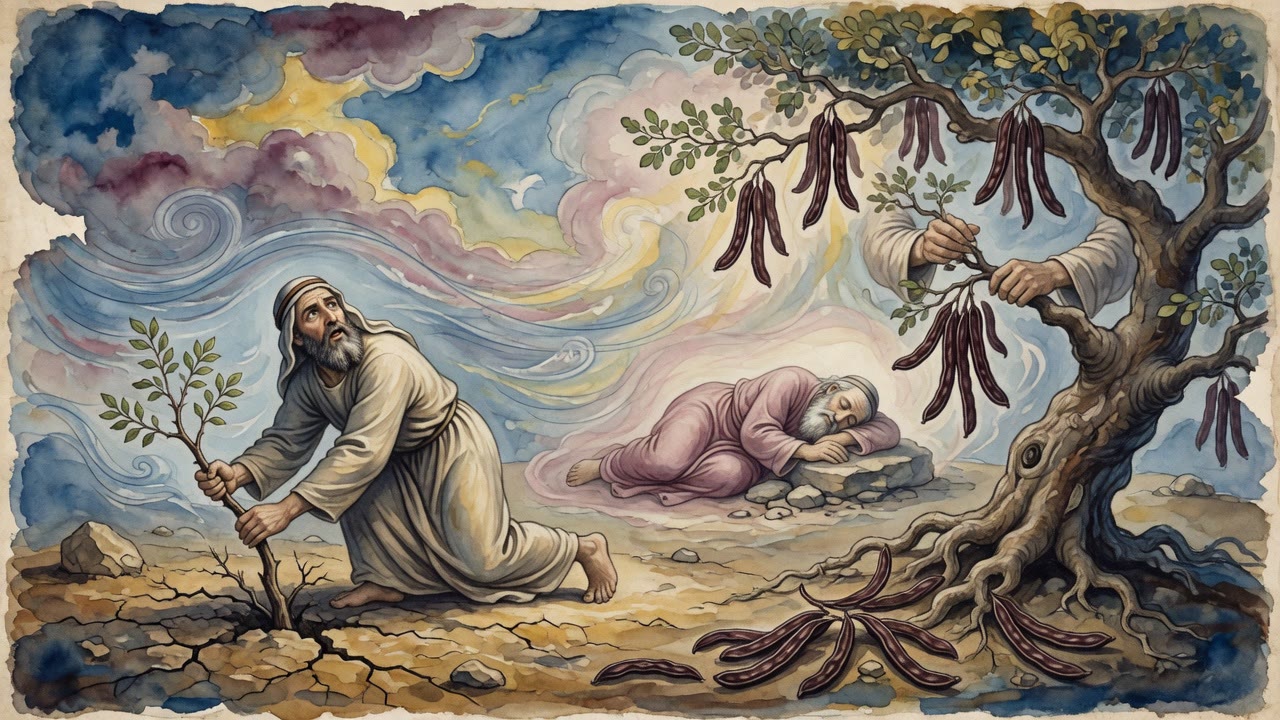
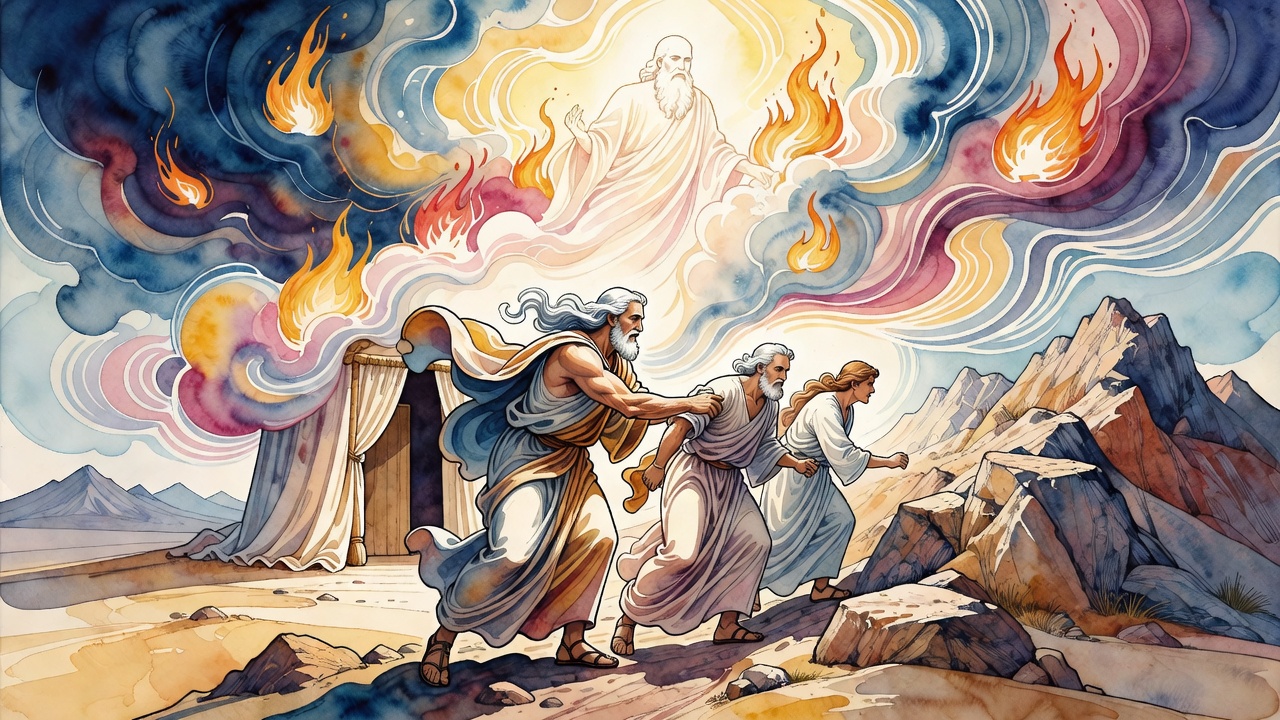
Moses looks at the entrance of the Tent of Meeting and does the arithmetic in his body before he does it in his mouth. Sixty myriads of men. Sixty myriads of youths. A plot the size of a two-se'ah field. The door is a fact. The crowd is a fact. The two will not meet without crushing someone.

"Master of the world," he says, "impossible."

God does not scold the math. He answers with a different scale. "These heavens, no wider in your sight than the pupil of an eye, I stretched from one end of the world to the other. So too, in the days to come, I will widen Zion." Moses's hands still know the weight of people. God's answer does not erase that weight. It promises a room that can grow under it. The leader who counted plagues and seas now counts shoulders and finds the doorway wanting.

Sinai Held the Chariots

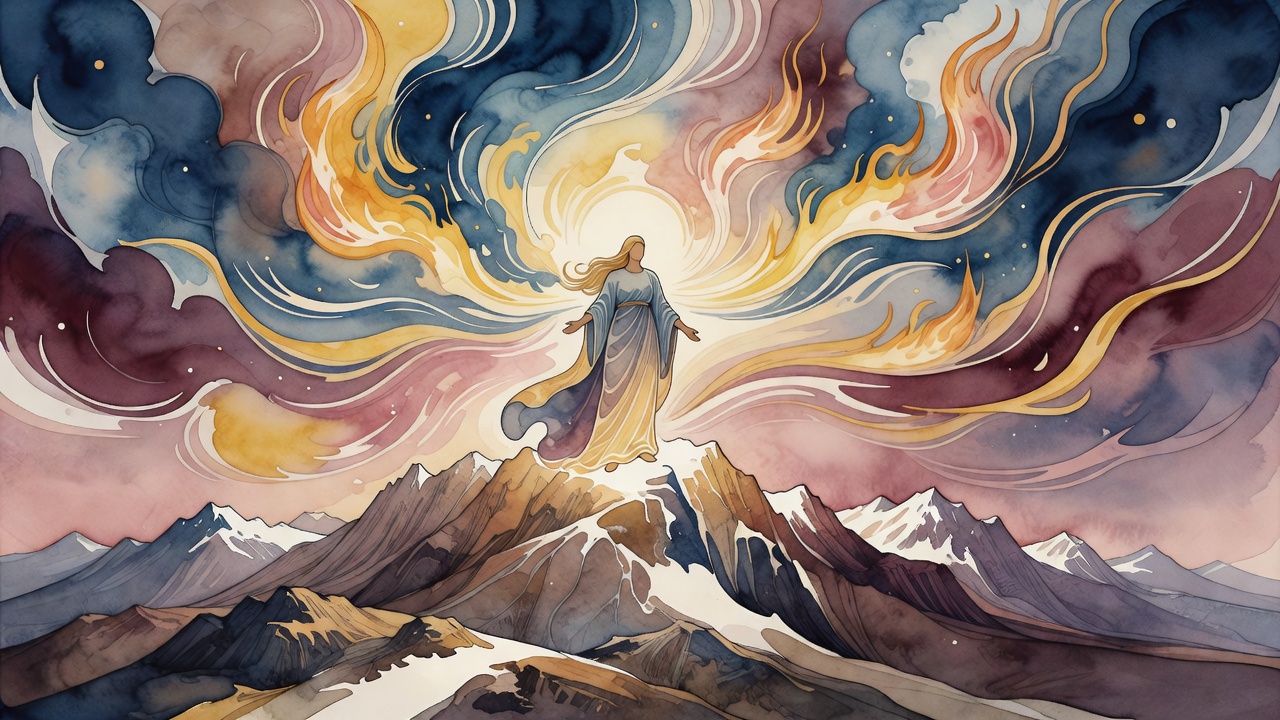
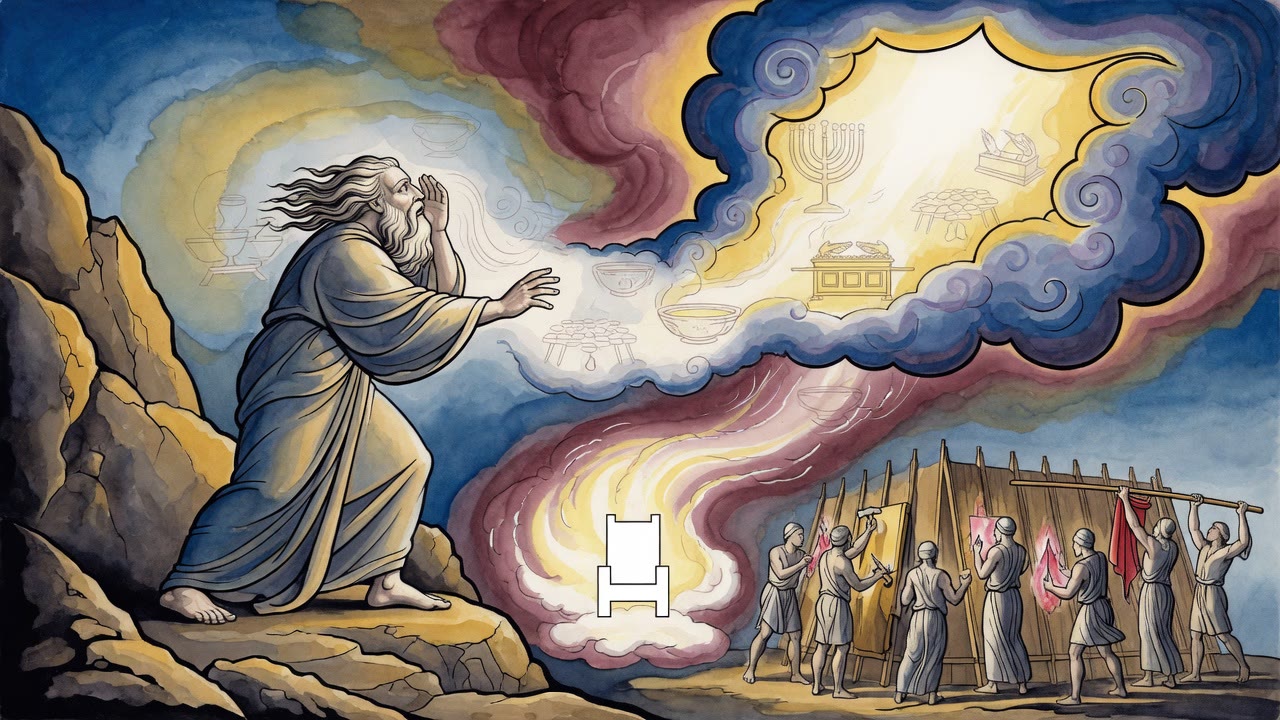
Learn it from Sinai, says Rabbi Avdimi of Haifa. When God descended to give the Torah, twenty-two thousand chariots came down with Him, each like the chariot Ezekiel beheld, and the mountain held them all by miracle. Space is not only dirt and cubits. Space answers the One who calls a mountain by six names and makes each name a deed.

It is the Mountain of God, where judgment sat. It is Bashan, the mountain where He came. It is the Mountain of Peaks, where rival mountains were disqualified like a blemished priest. It is the Mountain of Desire, the peak God craved for His dwelling. It is Horeb, where the sword of justice was drawn bare. It is Sinai, where the nations made themselves hateful and sealed their own sentence.

A mountain that can wear six names can wear an army of chariots. A door that looks small can still gather a people if Heaven decides to stretch. Moses, who once climbed that peak alone, now learns the peak's secret was never scarcity of rock but surplus of will. The chariots did not wait for a wider summit. The summit made itself large enough.

Speech Moves Behind the Curtain

Before the Tent rose, God's word found Moses in scattered places: the bush, Midian, Egypt, the mountain. Once the Tent stood, the Holy One chose modesty. "To walk humbly with your God." Speech drew inward, behind the curtains.

The sages hear the king's daughter clothed in gold brocade and set Moses inside that verse as ruler of Torah, with Aaron as the gold settings woven through the cloth. Hiddenness is not absence. Hiddenness is a room with a door that still opens for the right man at the right hour.

Moses, who once received words in open wilderness, now enters a veiled place and hears from within. The people still gather at the mouth. The Voice chooses the inner room. The narrow door becomes less a failure of architecture and more a school of approach: come close, then closer, then inside. Public thunder gives way to private speech without losing authority.

Jerusalem Climbs Firmament by Firmament

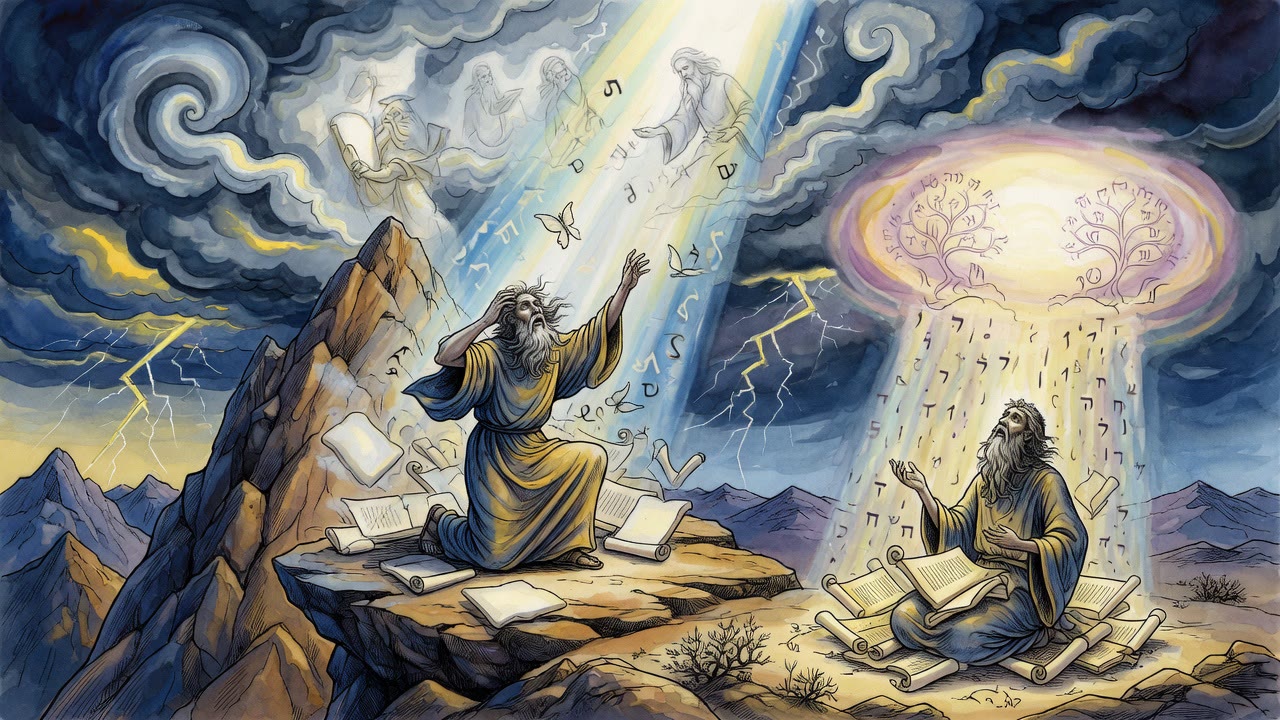
The promise does not stop at a widened courtyard. God will widen Jerusalem until it climbs through firmament after firmament, up to the seventh, until it reaches the Throne of Glory. The righteous fly there on clouds, each beneath his own canopy.

Then God walks among them, sits in their midst, and they point with a finger: "Behold, this is our God; we waited for Him, and He saved us." The crowd that could not fit at a desert door will one day fill a city that has outgrown the sky.

Every soul from the first Adam until the resurrection will press in and cry that the place is too narrow. The answer will still be the same command that answered Moses: enlarge the place of your tent. The complaint becomes liturgy. The widening becomes the reply forever. Zion learns to grow the way the pupil-heavens once grew under a single command.

The Nations Seize a Hem

Rabbi Joshua ben Levi turns the lens outward. Had the nations grasped how much good the Temple brought them, they would have ringed it with camps to guard it. Solomon prayed that even the foreigner from a distant land be answered there. Through Israel's merit rain falls and the sun rises.

In the world to come, the nations seize the hem of a Jew's garment and say, "Let us go with you, for we have heard that God is with you." The door that once looked too small becomes a gate the world wants to enter.

Moses's first objection still stands in the body as a true human fear. The answer is not that the fear was foolish. The answer is that Heaven measures room differently, and has always planned a city that can climb. He turns back toward the Tent mouth with a new kind of calm: the crowd is still huge, the door is still small, and the One who stretched the pupil-heavens has not finished stretching. Somewhere a future finger will point, and the God who saved will sit among the saved without running out of space.


← All myths
From the tradition

Sources

3 sources

The texts behind this telling. Some cards carry a translation of the source; others are our own retelling of it, and each card says which. Every card links out to the original.

Midrash Tanchuma Buber, Tzav 16:1Midrash Tanchuma Buber, Tzav

Translation of the source text.Midrash Tanchuma (Buber), Public Domain, on Sefaria · CC-BY-SA

(Leviticus 8:3:) "AND ASSEMBLE THE WHOLE CONGREGATION etc." He said to him: To where? He said to him: To the entrance of the Tent of Meeting. Moses our master said to Him: Master of the world, sixty myriads of men and sixty myriads of young men, how shall I make them stand at the entrance of the Tent of Meeting, when it is only the size of a two-se'ah plot, yet You say, "And assemble the whole congregation"?

The Holy One, blessed be He, said to him: And about this matter you are astonished? These heavens, are they not like the pupil (cataract) of the eye? Yet I made them from one end of the world to the other, [as it is said,] "Who stretches out the heavens like a curtain, [and spreads them like a tent to dwell in]" (Isaiah 40:22). And likewise in the time to come I will do thus for Zion. All [those] multitudes from the first Adam until the dead come to life, how shall they stand? And they are destined to say, "The place is too narrow for me; make room for me, that I may dwell" (Isaiah 49:20). What shall I do for them? I shall widen it, as it is said, "Enlarge the place of your tent" (Isaiah 54:2).

From where do you learn this? From Mount Sinai. Once the Holy One, blessed be He, was revealed upon it, what is written? "The chariots of God are myriads, thousands upon thousands, etc." (Psalms 68:18). Said Rabbi Avdimi of Haifa: I have taught in my teaching, once the Holy One, blessed be He, was revealed on Mount Sinai to give the Torah, twenty-two thousand chariots descended with Him. Said Rabbi Berekhyah [the Priest]: For the Holy One, blessed be He, foresaw that none would stand firm in their conviction (literally, "in their waters") except the tribe of Levi; therefore He descended corresponding to the camp of the Levites.

Said Rabbi Yannai: If so, what is "the chariots of God are myriads"? Rather, twenty-two thousand chariots descended with the Holy One, blessed be He, and each and every chariot was like the chariot that Ezekiel son of Buzi saw, and it (Sinai) held them, rather, it was a miraculous deed. The Holy One, blessed be He, said: Widen, lengthen, and receive My children, My faithful children. And so you find for the world to come, that the Holy One, blessed be He, will widen Jerusalem, as it is said, "[and it became wider] and wound about upward, etc." (Ezekiel 41:7), until it ascends to the heavens. And "upward" means nothing other than the heavens, as it is said, "For Your kindness is great above [the heavens]" (Psalms 108:5).

Once it reaches the heavens, it says, "The place is too narrow for me, etc." (Isaiah 49:20). Even so, the Holy One, blessed be He, raises it up from the heavens to the firmament, and from the second to the third, and from the third to the fourth, and from the fourth to the fifth, and from the fifth to the sixth, and from the sixth to the seventh. Said Rabbi Eleazar ben Yaakov: until it reaches the Throne of Glory. And how do they ascend? The Holy One, blessed be He, brings clouds, and they cause them to fly, as it is said, "Who are these that fly like a cloud?" (Isaiah 60:8). And each and every one of the righteous has a canopy of his own, as it is said, "And the Lord will create over [every] dwelling place of Mount Zion and over its assemblies [etc., for over all the glory shall be a canopy]" (Isaiah 4:5).

Once it reaches the Throne of Glory, the Holy One, blessed be He, says to them: I and you shall walk together in the world, as it is said, "And I will walk among you" (Leviticus 26:12). And the Holy One, blessed be He, sits in the midst, and the righteous point to Him with the finger, as it is said, "And it shall be said on that day: Behold, this is our God; we have waited for Him, and He will save us, etc." (Isaiah 25:9). And it says, "For this is God, our God forever and ever; He will lead us beyond death" (Psalms 48:15). Because the nations say, "And He shall say: Where are their gods?" (Deuteronomy 32:37), therefore Israel say, "For this is God, our God [forever and ever]; He will lead us beyond death."

Full source
Midrash Tanchuma Buber, Bamidbar 3:1Midrash Tanchuma Buber, Bamidbar

Translation of the source text.Midrash Tanchuma (Buber), Public Domain, on Sefaria · CC-BY-SA

"And the LORD spoke to Moses in the Sinai desert, in the Tent of Meeting" (Numbers 1:1). Before the Tent of Meeting was set up, He spoke with him in the bush, as it is said, "And [the angel of the LORD] appeared to him in a flame of fire from the midst of the bush" (Exodus 3:2). [Afterward He spoke with him in Midian, as it is said, "And the LORD said to Moses in Midian" (Exodus 4:19).] Afterward He spoke with him in Egypt, as it is said, "And the LORD said to Moses and to Aaron in the land of Egypt" (Exodus 12:1). And afterward He spoke with him in Sinai, as it is said, "And the LORD spoke to Moses on Mount Sinai" (Leviticus 25:1). Once the Tent of Meeting was set up, He said: Modesty is fitting, as it is said, "And to walk humbly with the LORD your God" (Micah 6:8). He began to speak with him in the Tent of Meeting.

And likewise David says, "All glorious is the king's daughter within; [her clothing is of gold brocade]" (Psalms 45:14). "The king's daughter", this is Moses, as it is said, "And I will hand over Egypt into the hand of a harsh lord" (Isaiah 19:4), these are the plagues that came upon the Egyptians; "and a strong king shall rule over them" (ibid.), this is Moses, who is the king of Torah, which is called "strength," as it is said, "The LORD will give strength to His people" (Psalms 29:11). Therefore, "all glorious is the king's daughter within." "Her clothing is of gold brocade", this is Aaron, as it is said, "And you shall make settings of gold" (Exodus 28:13). From here our Rabbis said: Every bride who conceals herself, even an Israelite woman, is worthy to be married to a priest and to raise up high priests, as it is said, "Her clothing is of gold brocade" (Psalms 45:14).

The Holy One, blessed be He, said: Thus it is fitting that He speak from within, as it is said, "[And when Moses entered the Tent of Meeting to speak with Him, he heard the voice speaking to him" (Numbers 7:89). Rabbi Joshua ben Levi said: Had the nations of the world known how beneficial the Temple was for them, they would have surrounded it with camps in order to guard it, for it was more beneficial for them than for Israel. For thus Solomon arranged in his prayer, "And also concerning the foreigner who is not of Your people Israel, but comes from a distant land for the sake of Your great name and Your mighty hand and Your outstretched arm, and they come and pray toward this house, then hear from heaven, from the place of Your dwelling, and do according to all that the foreigner calls to You, so that all the peoples of the earth may know Your name and fear You as does Your people Israel, and that they may know that Your name is called upon this house that I have built" (II Chronicles 6:32-33). But when he comes concerning Israel, what is written? "And give to each man according to all his ways, whose heart You know" (ibid. 6:30). Solomon said: Master of the worlds, if he is worthy, give to him; if he is not worthy, do not give to him.

And do not say only of the Temple, rather, were it not for Israel, no rain would come down upon the world, nor would the sun shine; for by their merit the Holy One, blessed be He, brings benefit to the world. And in the world to come the nations of the world will see how the Holy One, blessed be He, is with Israel, and they will come to cleave to them, as it is said, "In those days, when ten men from all the languages of the nations shall take hold of the corner of the garment of a Jewish man, saying, 'Let us go with you, for we have heard that God is with you'" (Zechariah 8:23).]

Full source
Midrash Tanchuma Buber, Bamidbar 7:1Midrash Tanchuma Buber, Bamidbar

Translation of the source text.Midrash Tanchuma (Buber), Public Domain, on Sefaria · CC-BY-SA

Another interpretation (of Numbers 1:1): "And the LORD spoke to Moses in the wilderness of Sinai." Six names were given to it: Mountain of God, Mount Bashan, Mountain of Peaks (Gavnunim), Mountain of Desire (Ḥemed), Mount Horeb, Mount Sinai.

"Mountain of God", because God sat upon it in judgment, as it is said (Exodus 21:1): "And these are the ordinances which you shall set before them."

"Mount Bashan", the mountain where (sham) the Holy One came (ba).

"Mountain of Peaks (Gavnunim)", the mountain upon which He disqualified all the mountains. From where? Just as you say (Leviticus 21:20): "or a hunchback (gaven) or a dwarf."

"Mountain of Desire", for upon it the Holy One desired (ḥamad) to dwell, as it is said (Psalms 68:17): "The mountain which God desired for His dwelling."

"Mount Horeb", for upon it the sword (ḥerev) was unsheathed, as it is said (Leviticus 20:10): "The adulterer and the adulteress shall surely be put to death," (and Numbers 35:16): "The murderer shall surely be put to death."

"Mount Sinai", for upon it the nations of the world became hateful (nisne'u) to the Holy One, and He gave them their sentence, as it is said (Isaiah 60:12): "And the nations shall be utterly destroyed (ḥarov yeḥeravu)." Rabbi Abba bar Kahana said in the name of Rabbi Yoḥanan: "And the nations shall be destroyed from Horeb", for they received their sentence there.

Full source