Parshat Ki Tisa5 min read

Moses Forgot Forty Days of Torah on the Mountain

For forty days Moses learned Torah and forgot it. God poured it into him as a gift, and Ha-Satan (the Accuser) hunted the treasure across earth, sea, and death.

Curated by Arthur · Told by Maggid ·
Table of Contents
  1. Night Study That Would Not Stick
  2. The Gift After the Failure
  3. Two Stones, One Measure
  4. The Accuser Comes Hunting
  5. A Falsehood That Was Loyalty
  6. Descent With Full Hands
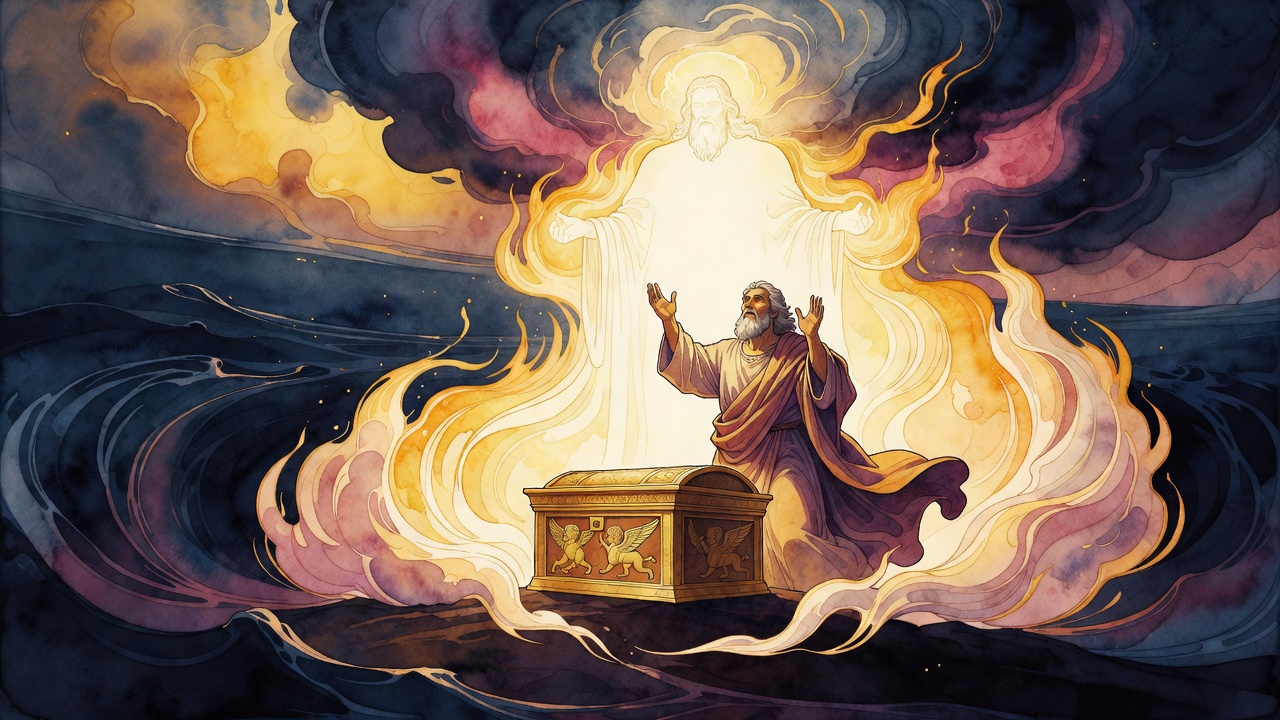
Moses Forgot Forty Days of Torah on the Mountain Click for full size

Night Study That Would Not Stick

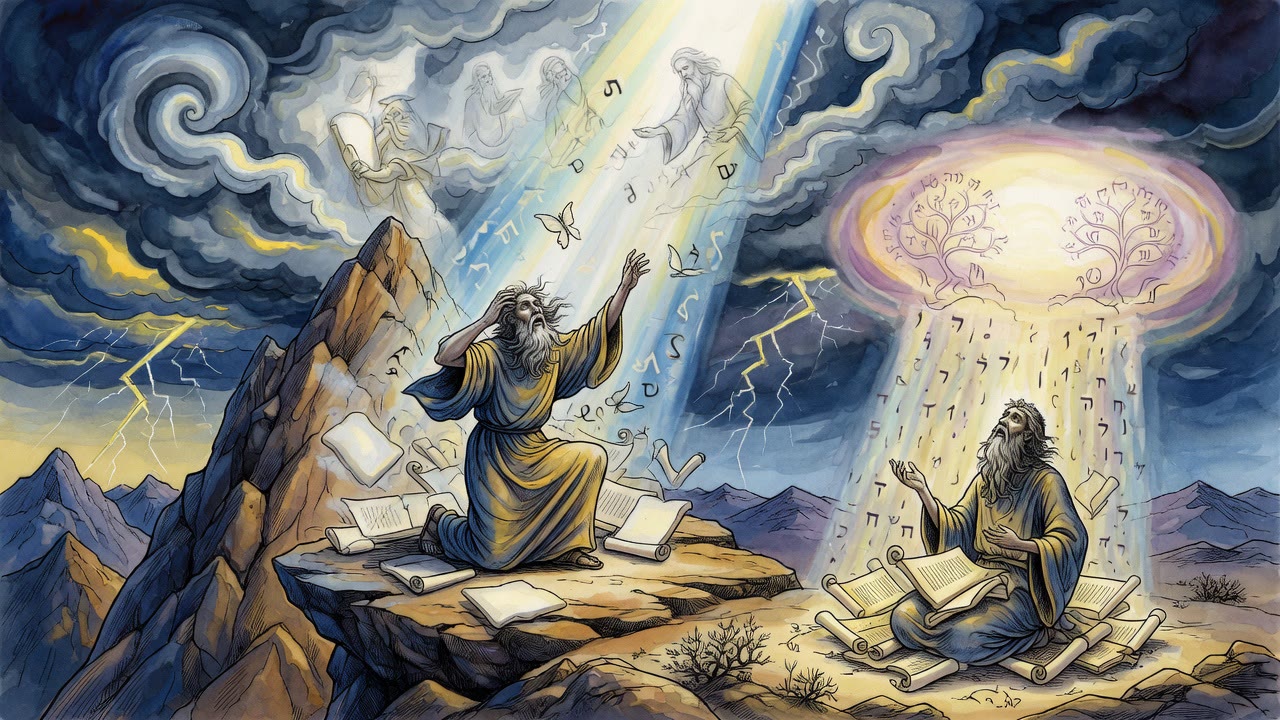
Moses gave the mountain both halves of the clock. He studied Torah night and day, shaped a ruling in his mind, closed his eyes, opened them, and found the ruling gone. Another teaching came. It slipped. Forty days of divine curriculum drained out of him like water through a cracked jar. The man appointed to carry law to a nation could not carry the morning's lesson into the afternoon.

At last he said the failure out loud, without costume. "O Lord of the world! Forty days have I devoted to studying the Torah, without having profited anything by it." Rabbi Abahu told the same grind from the inside: all forty days, study and forget, study and forget, until the cry came up raw. "Master of the universe, I have forty days and I do not know anything." This was not laziness. It was the report of a mind that had done everything effort can do and still stood empty.

The Gift After the Failure

God did not answer with a memory trick or a longer lecture. When the forty days were complete, He gave the Torah as a gift, a matanah. "He gave to Moses" (Exodus 31:18): the sages leaned their whole weight on that verb. Rabbi Yohanan said it simply. At first Moses learned and forgot, until it was given to him as a gift. Then the words held. He remembered everything, and he could go down.

No one learns the whole Torah in forty days. Its measure is longer than the earth and broader than the sea (Job 11:9). What Moses received were the kelalim, the fundamental principles, a skeleton that can hold endless flesh. Even the skeleton would not stay until the gift landed. The problem was never only size. It was reception. Something in Torah wants to be bestowed, not seized, and the forgetting was the proof.

Two Stones, One Measure

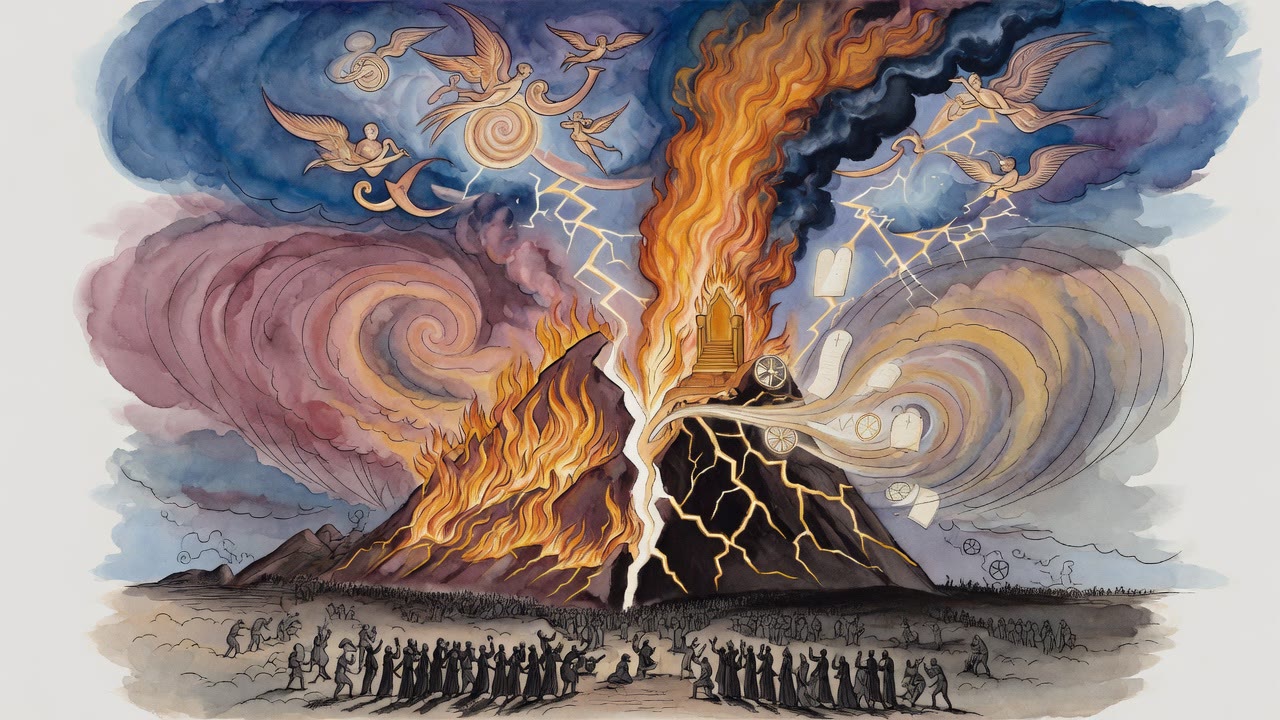
The tablets he carried down were their own commentary on the transfer. Two stones, the sages taught, standing for pairs: heavens and earth, bride and groom, this world and the World to Come. The written word for tablets can be read in the singular, and Rabbi Chanina caught the hint. Neither stone was larger than the other. The covenant was balanced to the letter.

And why stone at all? For the merit of Jacob, called the stone of Israel (Genesis 49:24). The Torah came to rest on the patriarch who had been pressed, bent, and exiled, and had not cracked.

The Accuser Comes Hunting

While Sinai burned with the gift, Ha-Satan, the Accuser who works the heavenly court for God, had been kept busy elsewhere. Heaven timed his absence. He did not witness the giving, and he stood in no position to file an early charge against a people whose golden calf was already taking shape in the valley below.

When he finally asked where the Torah was, God told him, "I gave the Torah to Earth." So the Accuser went hunting. He asked the earth. He asked the sea. He asked the abyss, and Destruction, and Death. The dark places that know every ending could only answer, "We have heard the fame thereof with our ears" (Job 28:22). No one could point to the treasure. He came back to God with empty hands, and God sent him to Moses.

A Falsehood That Was Loyalty

The Accuser stood before the man who had just finished forgetting and receiving, and demanded the Torah's location. Moses answered with a shrug that was really a rank. "Who am I, that the Holy One, blessed be He, should have given me the Torah?"

God called it out to his face. "O Moses, thou utterest a falsehood." Moses did not retreat. He spoke upward, past the Accuser's ear. "O Lord of the world! Thou hast in Thy possession a hidden treasure that daily delights Thee. Dare I presume to declare it my possession?" The denial was not amnesia. It was a man refusing to treat heaven's treasure as private loot in front of the court's own prosecutor.

The answer pleased God so well that He named the treasure after the man who would not claim it. Torat Moshe, the Torah of Moses. The student who lost every lesson for forty days carries the title no genius ever earned by recall alone.

Descent With Full Hands

Moses walked down the stone slope with a mind finally full, knowing exactly how it had refused to fill on its own. Below him the camp was already restless, and the first tablets would not survive what he found there. But the terms of the transfer were fixed for good. If Moses had kept every line by force of genius, Israel might have believed Torah was a prize for the strongest student. Instead the strongest student lost the lesson daily until heaven changed the terms, and every later learner who loses a page overnight stands inside his story.

The tablets in his arms held the whole bargain: given, not grasped, balanced stone against stone, and signed with the name of a man who swore he owned nothing.


← All myths
From the tradition

Sources

3 sources

The texts behind this telling. Some cards carry a translation of the source; others are our own retelling of it, and each card says which. Every card links out to the original.

Legends of the Jews 2:93Legends of the Jews

Retold in our words. Read the original at the link below.The Legends of the Jews by Louis Ginzberg (1909) · Public Domain

Moses receiving the Torah on Mount Sinai is often remembered as a moment of instantaneous understanding. But some stories suggest a different picture, one where Moses struggled, really struggled, to grasp God's teachings. The text recounts that Moses devoted himself "both night and day" to studying the Torah, yet "he still learned nothing." Can you imagine the frustration? He'd learn something, and then poof, it would vanish from his mind. After forty days of this, Moses, understandably, cried out to God in despair.

What did God do? He bestowed the Torah upon Moses. That's it. Suddenly, Moses understood. He remembered everything. Now he could descend from Sinai and share this incredible gift with the Israelites.

The story doesn't end there. Enter Satan, the accuser. According to this legend, Satan was kept busy elsewhere during the revelation at Sinai, so he didn't know what had happened. The text suggests that God strategically kept Satan away so that he couldn't accuse the Israelites of their impending sin with the Golden Calf!

When Satan finally gets around to asking where the Torah is, God tells him, "I gave the Torah to Earth." So Satan goes on a wild goose chase. He asks the Earth, the sea, the abyss – even Destruction and Death! But no one knows where it is. As it says in (Job 28:24) and 22, respectively, "He looketh to the ends of the earth, and seeth under the whole heaven" and "We have heard the fame thereof with our ears." Finally, he returns to God empty-handed.

God then directs Satan to Moses. When Satan asks Moses where the Torah is, Moses replies with incredible humility, "Who am I, that the Holy One, blessed be He, should have given me the Torah?"

Now, here's where it gets really interesting. God essentially calls Moses out, saying, "O Moses, thou utterest a falsehood." But Moses defends himself, saying, "O Lord of the world! Thou hast in Thy possession a hidden treasure that daily delights Thee. Dare I presume to declare it my possession?"

God, pleased with Moses' humility, declares that the Torah will be named after him. And so, it became known as the Torat Moshe, the Torah of Moses.

It's a powerful reminder that even the greatest among us, like Moses, can struggle with learning and understanding. It also highlights the importance of humility. Moses' initial difficulty in retaining the Torah and his subsequent humility in denying its possession ultimately led to him being forever associated with it.

The Zohar, the central text of Kabbalah, often emphasizes the hidden meanings within the Torah. This story adds another layer to that idea. It shows us that the Torah isn't just a set of laws and stories; it's a living, breathing entity that requires humility and dedication to truly understand. And as Ginzberg retells it in Legends of the Jews, it's a reminder that even our struggles can be a path to deeper connection with the divine.

Full source
Shemot Rabbah 41:6Shemot Rabbah

Retold in our words. Read the original at the link below.The Sefaria Midrash Rabbah, 2022 · CC-BY

Rabbi Abahu tells us that for all forty days Moses spent up on the mountain, he was studying Torah… and forgetting it just as quickly. Can you imagine the frustration? "Master of the universe," Moses pleaded, "I've been up here for forty days and I don't know anything!"

So, what did the Holy One, blessed be He, do? After those forty days, He gave Moses the Torah as a gift, a matana. This is alluded to in the verse "He gave [vayiten] to Moses" (Exodus 31:18). But wait a minute… Did Moses actually learn the entire Torah in forty days? I mean,

The answer, according to the Rabbis, is no. Instead, the Holy One blessed be He, taught Moses the fundamental principles, the kelalim. That's why it says, "as He concluded [kekhaloto] speaking with him" (Exodus 31:18). He got the gist. The big picture. The core concepts.

Then there were the tablets. "The two tablets of Testimony…" Why two? Shemot Rabbah gives us a beautiful series of correspondences. They correspond to the heavens and the earth, mirroring the cosmos in covenant. They correspond to the bride and groom, representing the sacred union between God and Israel. They correspond to the two attendants, the groomsman and maid of honor, who attend to the bride and groom, witnessing and supporting the covenant. They correspond to this world and the World to Come, hinting at the Torah's relevance to both our present lives and our eternal destiny. A profound mirroring.

Rabbi Ḥanina points out something interesting about the word for tablets, luḥot. It's written without a vav, which could allow it to be read in the singular, as luḥat. What does this subtle difference imply? That neither tablet was larger than the other, suggesting a perfect balance and equality.

And why stone? Why "stone tablets"? One explanation is rather sobering: because most of the punishments in the Torah are by stoning. A constant reminder of the seriousness of the covenant, perhaps.

But there are more comforting explanations too. The tablets are stone due to the merit of Jacob, who is referred to as the "stone of Israel" in (Genesis 49:24). According to this, Jacob is the foundation stone of the Jewish people. The Torah, therefore, rests upon the solid foundation of our ancestor Jacob.

Finally, Shemot Rabbah offers a challenging thought: Anyone who does not render his life like this stone – meaning, anyone who doesn't live a hard, demanding life – will not merit the Torah. This isn't about physical hardship necessarily, but about the inner strength and resilience needed to truly confront the Torah's teachings and integrate them into our lives.

So, the next time you feel overwhelmed by the vastness of knowledge or the challenges of life, remember Moses on Mount Sinai. Remember the gift, the matana, the fundamental principles that can guide us. And remember the stone – the foundation, the resilience, the commitment to a life of meaning.

Full source
Yalkut Shimoni on Torah 391:5Yalkut Shimoni on Torah

Translation of the source text.Torat Emet (Yalkut Shimoni) · CC-BY-NC

(Exodus 31:18) "And He gave to Moses when He finished." Rabbi Yohanan said: at first Moses would learn Torah and forget it, until it was given to him as a gift, as it says, "and He gave to Moses when He finished."

Full source