Parshat Noach5 min read

Noah's Flood Year Closed on the Day It Opened

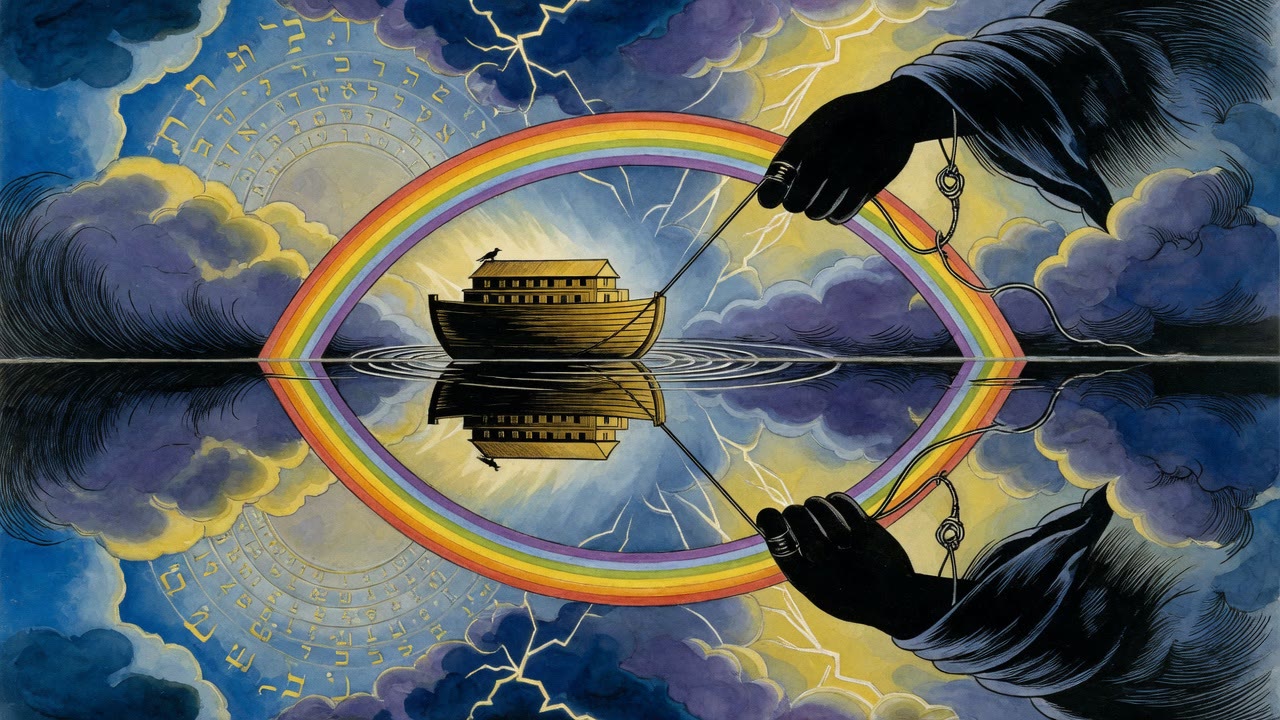
The flood began and ended on the same calendar day. Noah counted the mirrored year from inside the hull, and the bow held judgment on a leash.

Curated by Arthur · Told by Maggid ·
Table of Contents
  1. The Man Who Still Walked
  2. Forty Days of Rain, Then the Long Stillness
  3. The Day That Folded Back on Itself
  4. A Bow Set, Not a Weapon Loosed
  5. Spring After the Long Equality

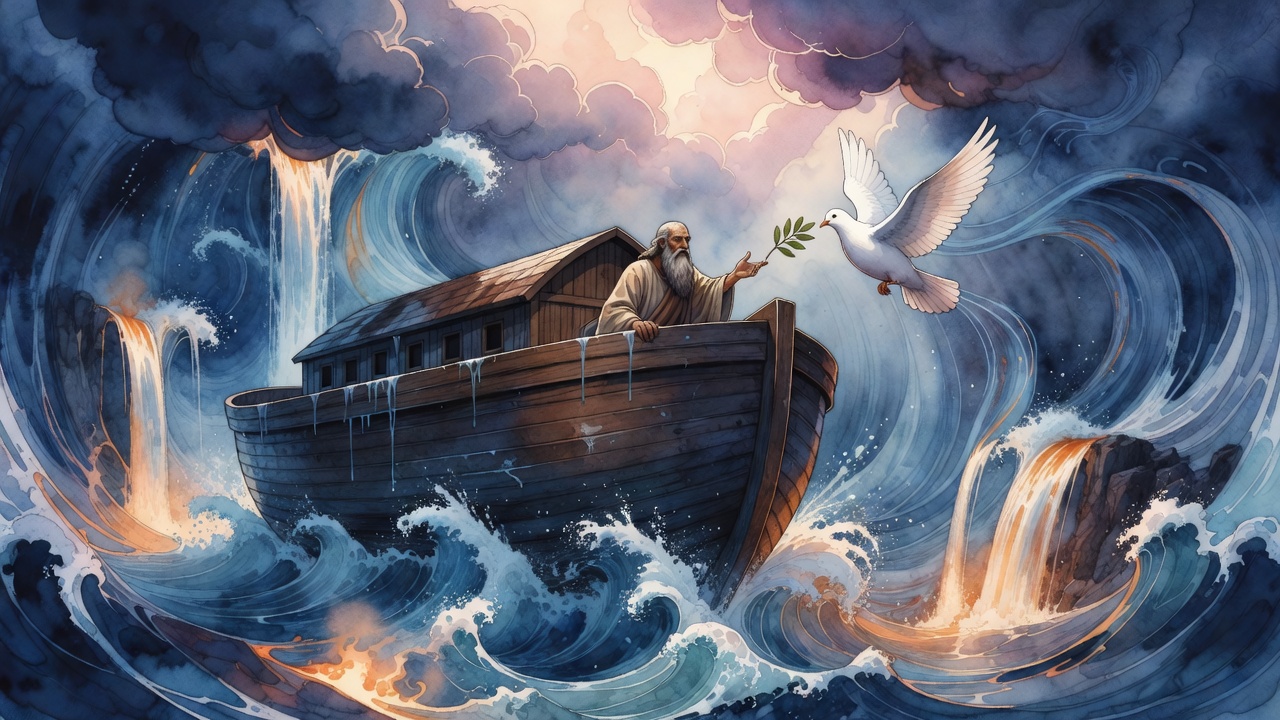
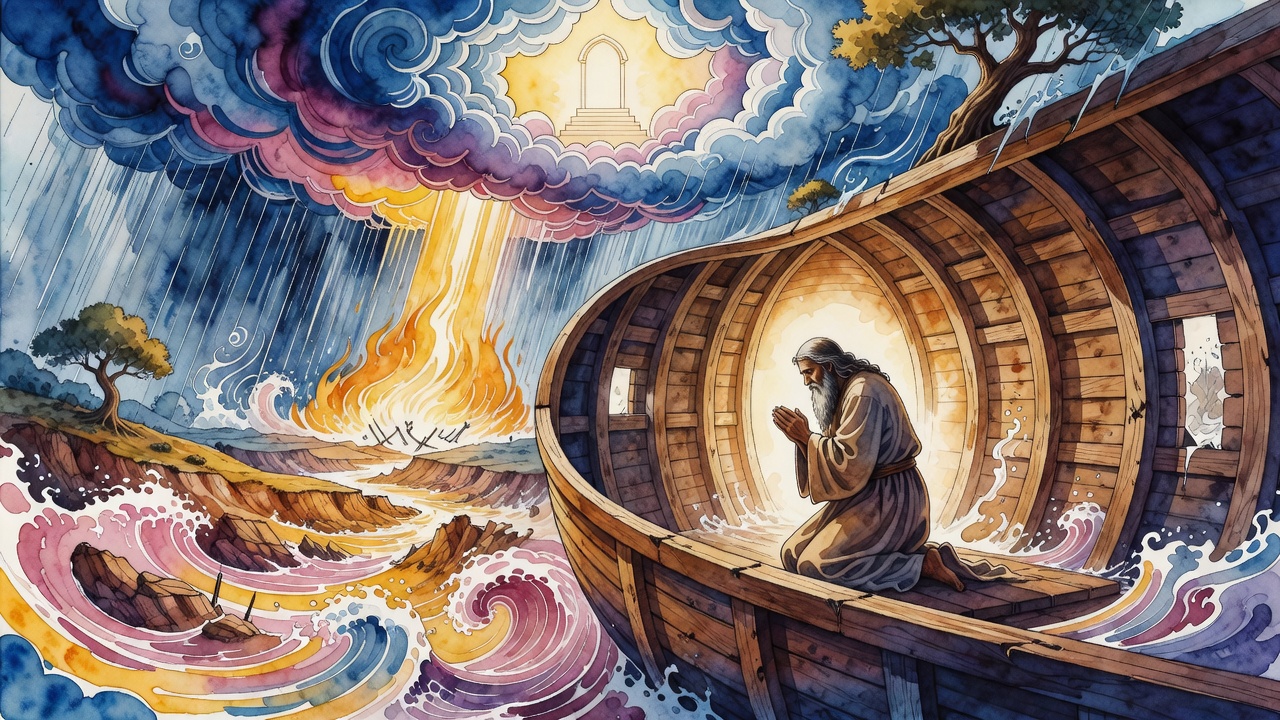
Noah pressed his palm to the pitch and felt the hull flex under a weight no carpenter had ever measured. The rain had stopped, but the world outside still pushed. Water stood above the mountains. The ark did not ride free; it hung between a gray sky and a drowned earth, and the man who built it counted days the way a drowning man counts breaths.
Noah's Flood Year Closed on the Day It Opened Click for full size

He knew the date the flood began the way a wound knows its hour: the twenty-seventh day of the seventh month, in the six hundredth year of his life. The cataracts of heaven had opened, and fountains had burst upward from the lowest deep. For forty days the downpour did not negotiate.

The Man Who Still Walked

Before a single drop fell, the Torah had already said why this man was inside the boat. Noah was righteous, blameless in his generation; Noah walked with God (Genesis 6:9), while the earth was corrupt and filled with violence (Genesis 6:11). He was not chosen by elimination, the last decent man left standing when every neighbor had disqualified himself. Righteousness, in the older reading, breeds. As bodies beget bodies, a mind bent toward goodness begets goodness, and Noah kept generating it in a world that had stopped. One household still moved in step with heaven, and that gait, held while the whole age ran the other way, became a hull with rooms for every living kind.

Forty Days of Rain, Then the Long Stillness

Noah did not sleep through the first forty. He fed animals that stamped and moaned, wiped foam from the beams, watched his sons' faces dim in the lamp oil. When the rain thinned, the world gave no answer back. One hundred and fifty days of full flood followed, a still violence with nothing green left to contradict the water.

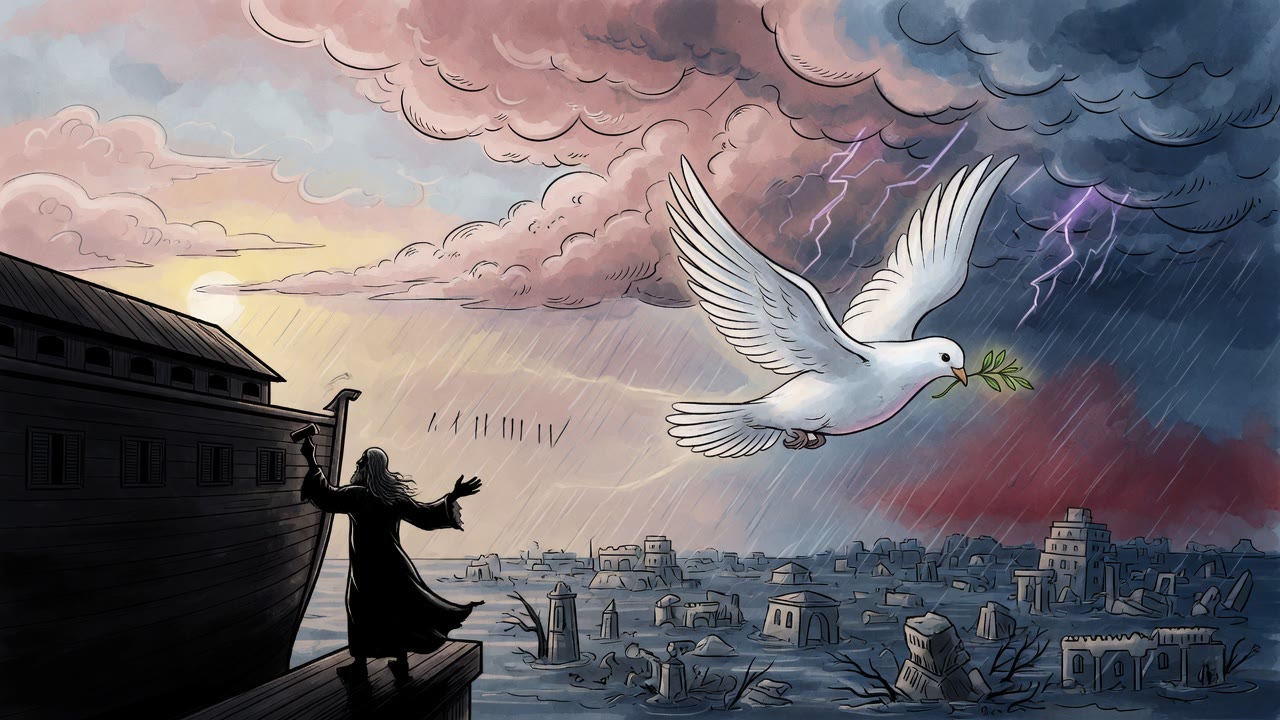
Forty days after the rains eased, he opened the window, and light cut a hard line across the hold. No land. No bird call. He marked the wall with a knife, lines stacking into weeks, weeks into the strange calm of a sea without a shore. When the decrease finally came, it took one hundred and fifty days as well. Rise and fall met like a pulse. The moon waxes and wanes in equal spans, and judgment, even while it emptied a world, kept the same discipline. The deep itself kept time when it was told to rise and told to sink.

The Day That Folded Back on Itself

A full year later, on the twenty-seventh of the seventh month again, the ark rested. Not gently. Wood scraped mountain. Noah staggered; his wife caught a rail; the animals screamed once and went quiet, as if the floor of the world had come back under their hooves.

He climbed to the window. Mist, stone, a slope black with wet. The earth was not yet a garden, but it had a body again, and spring waited under the mud. The calendar had not drifted by a single day. Destruction and return locked on one hinge. The world was not handed a random mercy, tossed like dice. It received a scheduled one, signed in dates kept to the day, and those numbers were the leash on the flood, the proof that chaos still answered to a clock.

A Bow Set, Not a Weapon Loosed

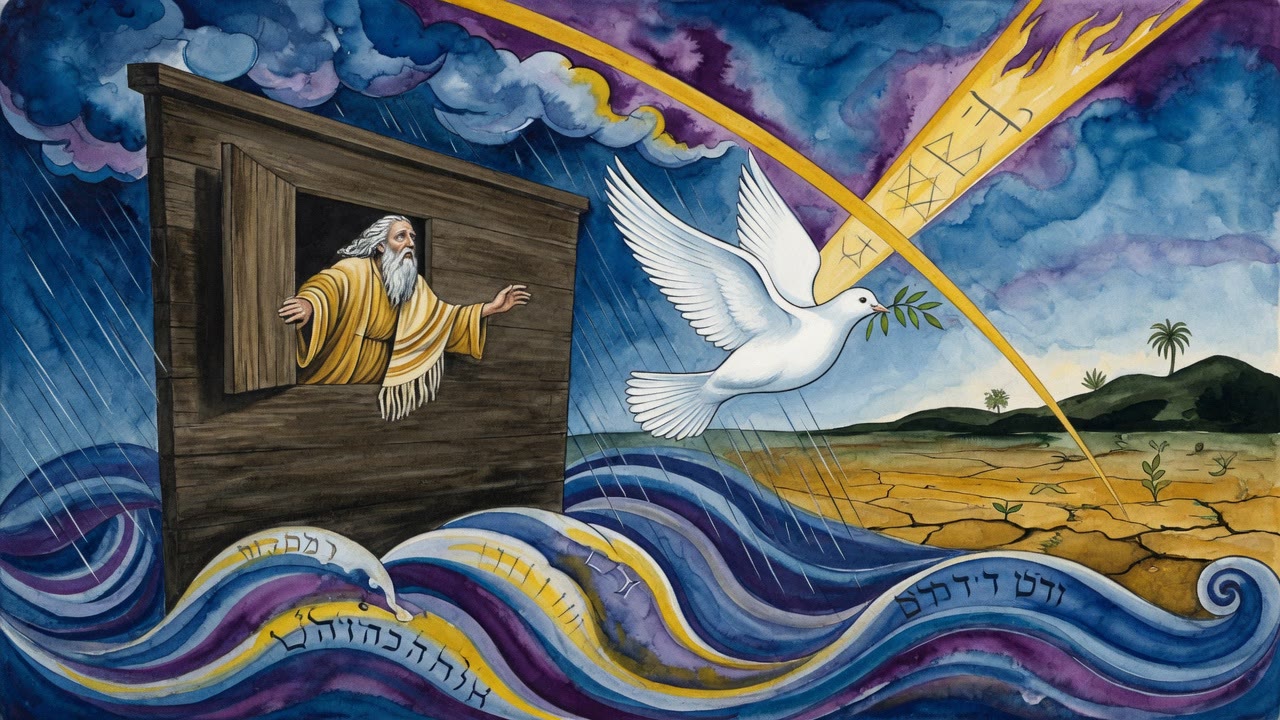
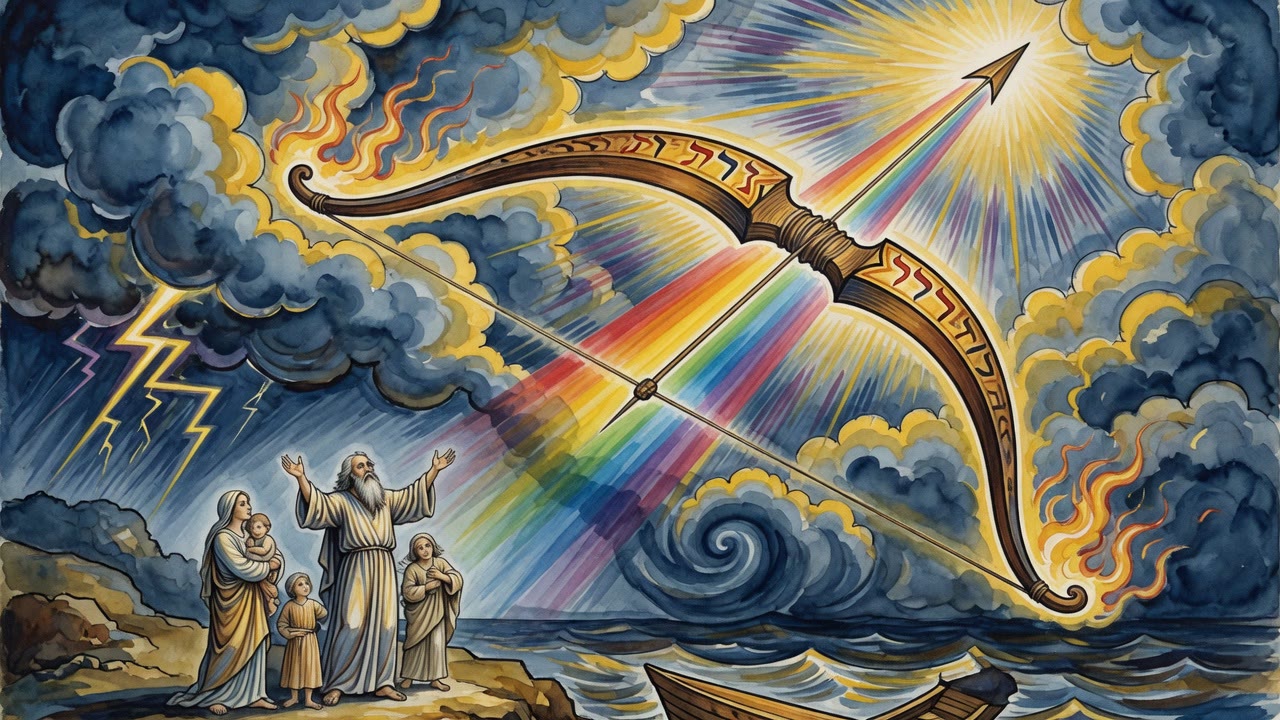
When dry ground finally held his feet, Noah built an altar, and the sky answered the smoke with a shape that was neither fire nor cloud. God set a bow in the cloud as the sign of a covenant with every living creature (Genesis 9:13), a promise never again to cut off all flesh by water.

A trick of sun on mist cannot carry an everlasting oath. Rainbows vanish at night though the clouds remain; they fail under heavy overcast at noon. The bow God set is something else: mercy braided through judgment and held under control. A bow is not the wound. The arrow is the wound, and an arrow strikes one part of a target while the rest of the field still stands. Whatever anger comes after this, it will be measured, and the whole earth will never again be taken by water. The bow is a bridle on the clouds, an invisible restraint that keeps the air from dissolving into a second deluge. Local storms may still come. The total claim on flesh and breath will not.

Spring After the Long Equality

Grass pushed through silt. The birds left the roof and did not come back. His sons argued about vineyards and directions. The second sowing of the world began under a man who had counted a mirrored year in the dark.

He still woke some nights to the sound of rain that was not there. But the mountain under the ark held, and the bow, when it showed, looked to him like judgment with the string unpulled. The flood had taught him the terror of water without an edge. The year had taught him that even terror keeps time. The twenty-seventh day sits in the year like a nail driven through two seasons, and on that nail hang both the rising deep and the grounded hull.


← All myths
From the tradition

Sources

3 sources

The texts behind this telling. Some cards carry a translation of the source; others are our own retelling of it, and each card says which. Every card links out to the original.

The Midrash of Philo 6:2The Midrash of Philo

Retold in our words. Read the original at the link below.The Works of Philo Judaeus, trans. C. D. Yonge, London, H. G. Bohn, 1854-1890 · Public Domain

The Midrash of Philo draws our attention to a fascinating detail: the repetition of numbers in describing both the coming of the flood and its eventual retreat. Specifically, it points out that the flood began on the twenty-seventh day of the seventh month in Noah's six hundredth year. Then, a year later, on the very same day – the twenty-seventh of the seventh month – the ark came to rest. What does this mirroring suggest?

In Philo, this symmetry is no accident. It tells us something about the divine order, about the way God metes out both destruction and renewal. The earth was returned to its former glory, blooming anew, precisely one year after the cataclysm began. Think of the symbolism: a return to springtime, to verdant life, after a year of watery chaos.

The numerical echoes don't stop there. The flood's initial downpour lasted forty days, "the cataracts of heaven being opened and fountains bursting upwards from the lowest depths of the earth." Then, after a sufficient lull in the rains, Noah opened the window of the ark forty days later, signaling a glimmer of hope.

Consider this: the period of the flood's inundation lasted one hundred and fifty days, and its gradual decrease also spanned one hundred and fifty days. The Midrash of Philo marvels at this "equality of the arrangement."

Why all this numerical repetition? Philo uses the metaphor of the moon, waxing and waning in equal measure, to explain this divine pattern. Just as the moon progresses to fullness and then retreats, so too do divine chastisements operate with a certain regularity. This suggests that even in moments of divine judgment, there is an inherent order, a balance maintained.

This idea challenges the notion of a capricious or arbitrary God. Instead, it presents a Creator who acts with purpose and precision, even in moments of apparent chaos. The Midrash of Philo concludes by asserting that God "preserves a regular order, banishing all irregularity from the divine borders."

What are we to make of all this? Perhaps the takeaway is that even in the face of overwhelming destruction, there is a deeper structure at play. The numbers themselves become evidence of divine consistency, a reminder that even after the flood, the world is still governed by a rational, ordered force. Perhaps the numbers are there to remind us that even destruction has its limits and that renewal is always possible.

Full source
The Midrash of Philo 13:2The Midrash of Philo

Retold in our words. Read the original at the link below.The Works of Philo Judaeus, trans. C. D. Yonge, London, H. G. Bohn, 1854-1890 · Public Domain

The Torah tells us that after the flood, God set a bow in the clouds as a sign of the covenant with Noah, a promise never again to destroy all life with a flood (Genesis 9:13). But what kind of bow is it, exactly?

Some folks see it simply as the rainbow The familiar version gives us, what some call "Jupiter’s belt" because of its shape. But Philo of Alexandria, the 1st-century Jewish philosopher, wasn't so sure. In The Midrash of Philo, he delves deep into this symbol, questioning its very nature.

Philo asks, if this bow is "the bow of God," shouldn't it have its own distinct essence? After all, God says, "I will set my bow in the clouds." Something "set" by God, he argues, must be more than just a fleeting appearance of sunlight on a wet cloud – a phaenomenon, as he calls it, that is "non-existent and incorporeal.": We never see rainbows at night, even when there are clouds. And even during the day, when the sky is completely overcast, rainbows are often absent. So, Philo challenges, how can this always-elusive phenomenon be the enduring symbol of God’s covenant?

He suggests that the bow might signify something far deeper: God's mercy tempered with justice. Even in moments of divine "bitterness," there won't be a total annihilation. The image of the bow, he says, suggests a restraint, a moderation. The flood itself, though devastating, wasn't "an unmeasured vehemence."

Philo points out that a bow isn't a weapon in itself; it's an instrument. It launches an arrow which strikes only a part of the target, leaving the rest unharmed. This, he suggests, symbolizes that any future divine judgment will never be total; the whole Earth will never again be consumed by a deluge.

So, what is this bow, then? Philo sees it as a symbolic representation of God's invisible power, "dissolved according to the figure of tranquility, and condensed in accordance with a cloud." It's a divine force that prevents the clouds from completely dissolving into water, preventing another catastrophic flood. It's like a bridle, checking the air's "rebellious" tendency to overfill and saturate the world with water.

This bow isn't just a weather phenomenon; it's a constant reminder of God's promise, a symbol of divine restraint and enduring mercy. Maybe next time you see a rainbow, you'll think of Philo, and the deeper meaning he found hidden within those vibrant colors.

Full source
The Midrash of Philo 11:1The Midrash of Philo

Retold in our words. Read the original at the link below.The Works of Philo Judaeus, trans. C. D. Yonge, London, H. G. Bohn, 1854-1890 · Public Domain

These are the kinds of questions that our sages wrestled with, poring over every word of the Torah for hidden meanings.

Let's consider Noah. The familiar story is this: the flood, the ark, the animals two-by-two. But before all that, the Torah tells us (Genesis 6:9) that Noah "was a righteous man, blameless in his generation; Noah walked with God." Simple enough. But the Midrash of Philo, a fascinating collection of interpretations attributed to the great philosopher Philo of Alexandria, digs deeper. It asks: why was Noah chosen? Was it simply because everyone else was wicked? Or was there something more profound at play?

The Midrash (rabbinic interpretive commentary) suggests that God chose Noah for two crucial reasons. First, yes, the men of that age were undeniably wicked. "And all the earth was corrupt in the sight of God," as (Genesis 6:11) states, "and the earth was filled with iniquity." The world was drowning in its own moral failings.

This is key, the Midrash doesn't stop there. It goes on to say that God was also "imposing a law upon the will." What does that mean? It suggests that true righteousness isn't just about avoiding evil; it's about actively choosing good. It's about cultivating virtue with intention and dedication.

Think of it this way: for someone truly devoted to virtue, virtue itself becomes a kind of "generation." Just as humans beget other humans, minds beget virtues. Noah, in his unwavering commitment to righteousness, was generating goodness in a world desperately in need of it. He wasn't just a passive recipient of divine favor; he was an active participant in creating a more virtuous world.

That's why the Torah emphasizes that Noah was "a just man, perfect, and one who pleased God." Justice, perfection, and grace before God – these aren't just labels; they're the hallmarks of a life dedicated to cultivating virtue. They are the very qualities that allowed Noah to weather the storm, both literally and figuratively.

Perhaps it's a reminder that righteousness isn't a static state. It's a continuous process of striving, of choosing good over evil, of actively cultivating virtue within ourselves and the world around us. It's about recognizing that even in the darkest of times, one person, through the power of their will and their commitment to righteousness, can make all the difference.

And maybe, just maybe, that's the real message of the story of Noah. Not just a tale of flood and salvation, but a profound lesson about the power of human virtue to transform the world.

Full source