6 min read

Pharaoh Tried to Drown the Torah and the Fish Knew It

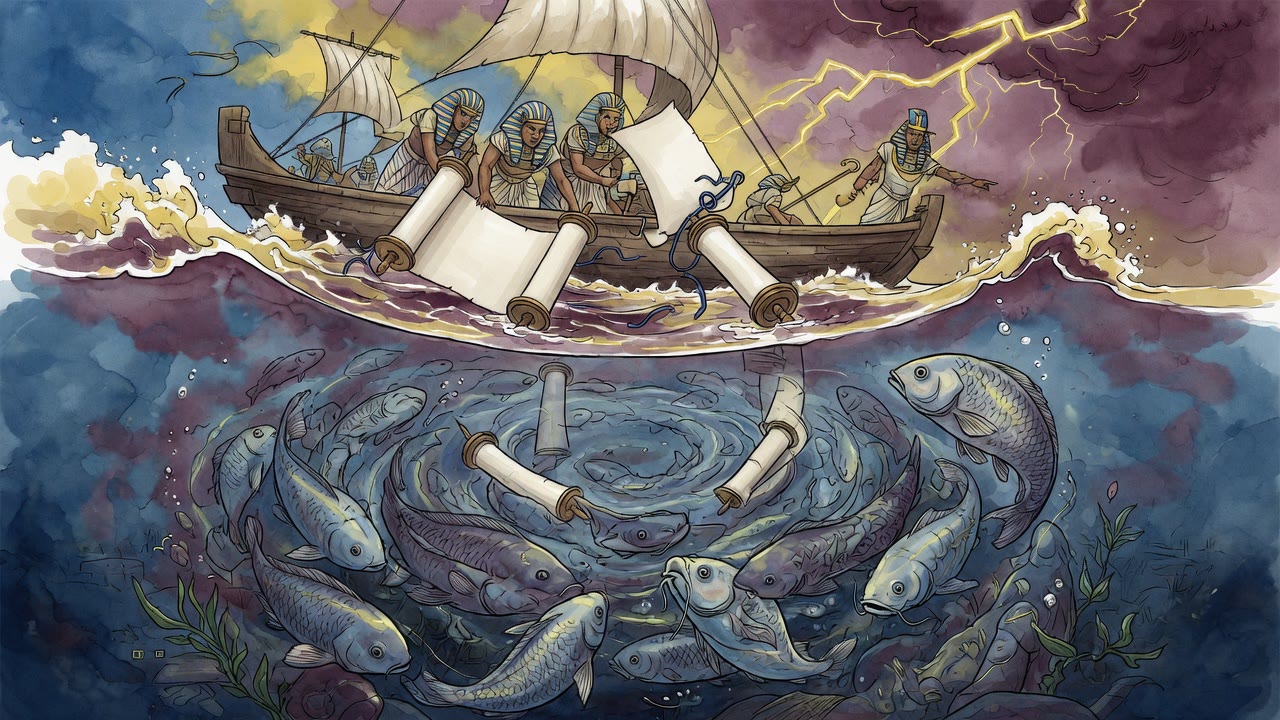
Pharaoh ordered every Hebrew boy thrown into the Nile. The Tikkunei Zohar connects that decree to the fish that swallowed Jonah. Both were the same act.

Curated by Arthur · Told by Maggid ·
Table of Contents
  1. The Order That Was Really an Erasure
  2. The Connection to Jonah
  3. The Prophet Who Had Already Tried This
  4. What the Fish Held
  5. The Torah That Could Not Be Drowned

The Order That Was Really an Erasure

Pharaoh gave a simple order: every newborn Hebrew son was to be thrown into the Nile. The text of Exodus states it without commentary, without explaining the logic that led from enslaved labor to systematic infanticide. Pharaoh had decided that the problem with the Israelites was that there were too many of them, and the solution was to stop the next generation before it started.

The Tikkunei Zohar, compiled in thirteenth-century Spain, refused to let the decree stay at the level of population policy. It read the order as something stranger and more specific. Pharaoh was not trying to reduce a labor pool. He was trying to swallow something whole.

The Connection to Jonah

The Tikkunei Zohar connected Pharaoh's decree to a verse from the book of Jonah: "And the Lord appointed a great fish to swallow Jonah." The fish swallowed the prophet. Pharaoh decreed that the Nile swallow the Hebrew sons. The two swallowings were the same act, the mystics argued, because what was being swallowed in both cases was the same thing.

Moses was among the sons who were supposed to be thrown into the water. Moses was the one through whom the Torah would be given. The decree against the Hebrew boys was, at its deepest level, a decree against the Torah that one of those boys would eventually carry down from the mountain and give to the world.

Jonah was a prophet. Jonah was running from a mission he did not want to fulfill. The great fish was appointed to stop the flight, to hold the prophet inside the place of darkness until he was ready to complete what God had sent him to do. Both swallowings were attempts to contain something that could not be contained in the end.

The Prophet Who Had Already Tried This

Jonah's story had a prelude that made the connection sharper. He had been the student of Elisha, the great prophet whose presence alone was enough to keep the Aramean armies from entering Israel. When Elisha died, they invaded. The protective field of his prophecy disappeared from the world and the enemies moved in.

Jonah had been sent to warn Jerusalem, and Jerusalem had repented, and God had spared them, and Jonah had found this infuriating. He had delivered a prophecy of destruction and the destruction had not come because God was merciful. This, Jonah felt, undermined the prophetic enterprise. If prophecies of doom could be reversed by repentance, what was the use of prophesying doom?

So when the next mission came, the mission to Nineveh, Jonah ran. He went to Joppa and found there was no ship available. Then a ship appeared, pushed back to port by a miraculous wind from two days out at sea, as if the whole nautical world were rearranging itself to give Jonah his escape route. He took it as a sign of divine approval. He boarded and descended into the hold to sleep.

He was wrong about what the sign meant. The same God who had rearranged the wind to bring the ship back had sent the storm that was already gathering, the storm that would throw Jonah into the water and into the belly of the fish where he would have nothing to do but pray.

What the Fish Held

The Tikkunei Zohar was interested in the Hebrew text of the swallowing verse. The fish that swallowed Jonah was dag gadol, a great fish. And the word dag, fish, in the grammatical form it appeared, contained within its letters additional resonance. The fish was not simply a large sea creature that happened to be at the right place. It was a divine instrument, appointed, sent, deployed to swallow the prophet and hold him until the prophet was ready to go back to work.

Pharaoh thought he was doing something similar: containing the threat, swallowing the population, eliminating the possibility of a people who carried the Torah into the future. He had the Nile. He had the Egyptian army. He had overwhelming force. What he did not have was what the great fish eventually had to give up: the prophet came back out on the third day, intact, ready to complete his mission.

The Torah That Could Not Be Drowned

The infant Moses floated in a basket on the Nile, the very water Pharaoh had designated as the instrument of destruction. Pharaoh's own daughter pulled him out. The decree against the Hebrew sons became the mechanism of its own defeat: the boy who would receive the Torah at Sinai survived in the water because a member of Pharaoh's family found him there and chose to keep him alive.

What the Tikkunei Zohar saw in both the fish and the Nile was the same principle operating at two different scales. You cannot drown what has been appointed to surface. You cannot swallow what has been appointed to be delivered. The fish held Jonah three days and then released him on dry land. The Nile held Moses in a basket and delivered him to the palace of the man who had ordered the killing.

Both swallowings ended the same way: the thing being swallowed came back out, carrying what it had always been carrying, and completed what it had been sent to do.


← All myths
From the tradition

Sources

3 sources

The texts this telling draws on, in full. Open a card to read inline, or expand it for a wider, quieter read.

Tikkunei Zohar 106:8Tikkunei Zohar

Tikkunei Zohar turns to Pharaoh, Jonah and the Great Fish.

The Tikkunei (spiritual repair) Zohar connects Pharaoh to the story of Jonah and the whale (or, more accurately, the great fish). It quotes, "And Y”Y appointed a great fish to swallow Jonah" (Jon. 2:1). Why? Because Pharaoh, in his cruelty, wanted to wipe Israel off the map. He wanted to annul them, erase them completely. The text draws a parallel between Pharaoh's genocidal intentions and the image of being swallowed whole. It’s a powerful metaphor for feeling utterly overwhelmed and consumed by external forces. That verse from Exodus (1:22), “.every born son you shall throw into the river…” – that's the manifestation of that desire to obliterate.

The Tikkunei Zohar doesn't stop there. It explores the Hebrew text itself. The verse in Jonah says, "And Y’Y’ appointed a great fish, to swallow Jonah." But the text emphasizes something crucial: it doesn’t just say "to swallow Jonah," but "to swallow ‘ET’ Jonah." Et (את) is a Hebrew word that's often untranslated, a grammatical marker. So, why is it there?

In this passage, the inclusion of et is key. It comes to include the "Faithful Shepherd." Who's that? Well it’s the one "by whose hand the Torah is destined to be given." That's Moses!

And not just Moses, but the entire Torah itself. The text continues: "which is ‘from Aleph (א) to Tav (ת) first and last of the alphabet’." Aleph and Tav are the first and last letters of the Hebrew alphabet, so this phrase encompasses the entirety of the Hebrew language, and by extension, the entire Torah.

So, what does this all mean? The fish isn't just trying to swallow Jonah, but also Moses and the entire Torah! It’s an attack on the very foundation of Jewish law and tradition. It’s an attempt to silence the voice of truth and justice.

Wow. Pretty heavy stuff. But it also offers a glimmer of hope. Because even though the forces of oppression might try to swallow us whole, even though they might try to erase our history and silence our voices, the Torah – the teachings and wisdom passed down through generations – remains. It is always there, ready to be rediscovered and reinterpreted.

And maybe, just maybe, that's enough to keep us afloat.

Full source
Legends of the Jews 8:19Legends of the Jews

The end of Elisha's life, the great prophet, was a real turning point for the Israelites. The Talmud (Sotah 13a) tells us that as long as Elisha was around, the Aramean armies couldn't even set foot in Palestine. It was only when he was being buried that they dared to invade. His death marked a significant loss, not just spiritually, but strategically.

Elisha had so many disciples during his long life – Among those thousands, one name stands out: Jonah.

Jonah had a bit of a… complicated relationship with prophecy. He was first tasked with anointing Jehu as king, a pretty important gig. But then he was told to warn the people of Jerusalem about their impending destruction. The thing is, they repented! They did teshuvah, they turned back to God. And God, being merciful, spared them. Wonderful news. Well, not for Jonah's reputation. Because the prophecy didn't come true, he got labeled a "false prophet" by some Israelites. Ouch. According to Ginzberg's retelling in Legends of the Jews, this experience really colored Jonah's perspective.

So, when God then tells Jonah to go to Nineveh, a major Assyrian city, and prophesy its downfall, Jonah panics. He thinks, "Wait a minute. I know these Ninevites. They’re probably going to repent too! And if they do, God will forgive them, and I'll look like a false prophet again! I'll be the laughingstock of two nations!"

Can you blame him for trying to avoid that fate? The text suggests he knew the people of Nineveh would repent. To escape this potential embarrassment, Jonah decides the best course of action is to flee to the sea. He figures, "If I'm out on the water, there's no one around to hear my prophecies, so I can't be accused of being wrong."

It’s such a human response, isn’t it? To run from a difficult situation, to try to control the narrative. But as we all know (spoiler alert!), you can't really run from God. Jonah's journey, as recounted in the Book of Jonah, is so much more than just a fish story; it's a powerful exploration of free will, divine mercy, and the challenges of being a messenger of God. And maybe, just maybe, a little bit about the universal fear of public humiliation.

Full source
Legends of the Jews 8:20Legends of the Jews

Before the big fish, there's this fascinating little prelude, a kind of "Jonah tries to flee" masterclass.

Jonah gets the divine call, a mission from God. But instead of heading where he's told, he decides to hop on a boat to Tarshish – basically, the opposite direction. He's trying to get away! He arrives in Joppa (modern day Jaffa), hoping to find a ship. But wouldn’t you know it, there's nothing there! No vessel in sight.

God, it seems, isn't quite ready to let Jonah go. To test him, to show him, perhaps, that you can't outrun the Divine, a storm brews. And this storm doesn't just happen – it miraculously pushes a ship that was already two days out at sea back to Joppa.! A ship, already well on its way, forced back to port by a divine wind.

Jonah, interpreting this as a sign of approval, sees this as his golden ticket to escape. He’s so excited about this “opportunity” to leave the land that he pays for the entire cargo of the ship upfront! We're talking a hefty sum here – four thousand gold denarii, according to the tale. That's one expensive getaway!

He sets sail, feeling pretty smug, I imagine. He's outsmarted God. Wrong.

Only a day out from shore, a truly terrifying storm erupts. But here's the kicker: it only targets Jonah's ship. All the other vessels are fine. Just Jonah’s. As Ginzberg retells it in Legends of the Jews, this was no ordinary storm. This was a carefully orchestrated lesson.

What's the lesson? Well, it’s pretty clear. As we find in Midrash Rabbah, God is Lord over everything! Heaven, earth, and sea. There's nowhere you can go to hide from Him.

It makes you think, doesn't it? About the times we try to run from what we know we should be doing. About the futility of trying to hide from something bigger than ourselves. And about the gentle, but persistent, ways the universe has of nudging us back on course. Jonah learned his lesson the hard way, tossed about on a stormy sea. What about us?

Full source