Retold in our words. Read the original at the link below.The Minor Tractates of the Talmud, trans. A. Cohen, Soncino Press (1965) · CC-BY
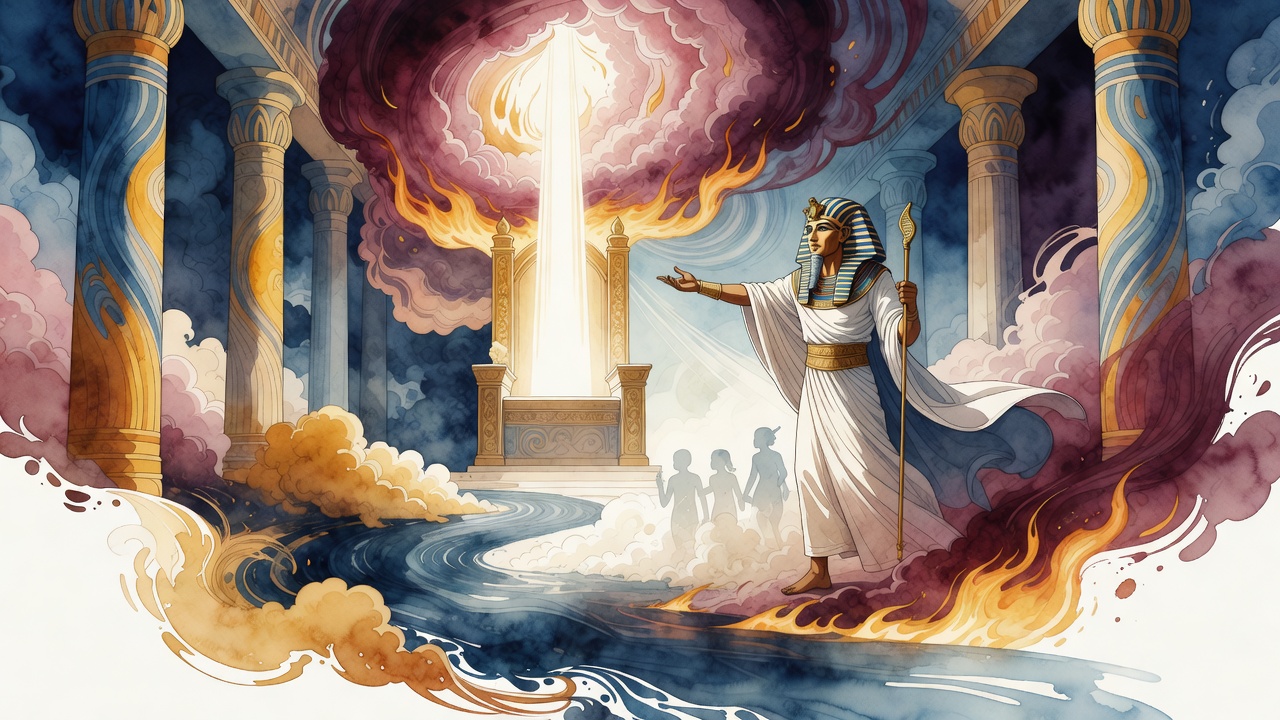
R. JOSE SAID: HE WHO HONOURS THE TORAH IS HIMSELF HONOURED BY MANKIND, as it is stated, For them that honour Me I will honour, and they that despise Me shall be lightly esteemed.11 Sam. 2, 30. ‘Me’ is here identified with the Torah, a doctrine frequent in the Zohar and other mystical literature.Another interpretation2Omitted in V, but inserted by GRA. of For them that honour Me I will honour: this refers to Pharaoh king of Egypt who paid honour to Him Who spoke and the world came into being by going out at the head of his council of ministers. His servants said to him, ‘Usually kings go out behind their ministers, but you go out at their head!’ He replied, ‘Am I going out to meet a [28a] king of flesh and blood? No, I go to meet the Presence of the King of kings, the Holy One, blessed be He’. Therefore the Holy One, blessed be He, paid Pharaoh honour, and He Himself meted out retribution to him, as it is stated, I have compared thee, O my love, to a steed in Pharaoh’s chariots.3Cant. 1, 9. This verse in no wise proves the point that God Himself inflicted punishment upon Pharaoh. GRA substitutes for this verse Hab. 3, 15, quoted in the preceding paragraph. This latter verse suggests that God set forth on His horses in order to requite Pharaoh; cf. Sanh. 94b (Sonc. ed., p. 634).
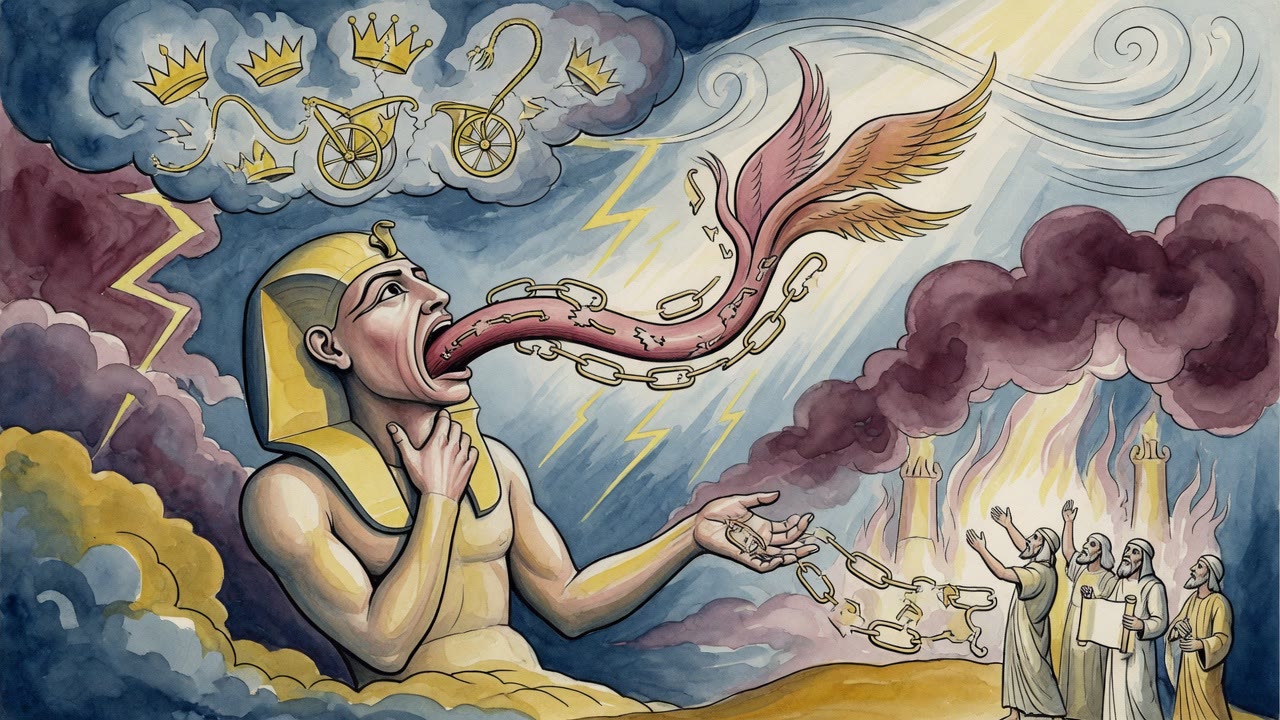
R. Pappias said: The congregation of Israel praised the horses and chariots of Pharaoh, as it is stated, Thou hast trodden the sea with Thy horses.4Hab. ibid. This verse too offers no proof for R. Pappias’ statement, and it has been suggested that Cant. 1, 9 should be read here as indicating the high esteem in which Pharaoh’s steeds were held, since God likens His love for Israel to a highly prized mare among Pharaoh’s chariots. The text of the passage is evidently in disorder and Schechter gives it up as hopeless. [Bacher, Ag. d. Tannaiten I, p. 319, n. 3, thinks that the appropriate quotation is Hab. 3, 8.]R. Joshua b. Ḳorḥah said: When Pharaoh came to the Red Sea he was riding on a stallion, and the Holy One, blessed be He, appeared to him on a mare,5To lure Pharaoh’s stallion to follow headlong into the sea; cf. Midrash Rabbah, Song of Songs, on I, 9 (Sonc. ed., p. 71). as it is stated, To a steed in Pharaoh’s chariots. But did He not ride upon a cherub, as it is stated, And He rode upon a cherub, and did fly; yea, He did swoop down upon the wings of the wind?6Ps. 18, 11. The cherub appeared to the steeds of Pharaoh in the form of a mare, and they followed her into the sea.And they that despise Me shall be lightly esteemed: this refers to Sennacherib who behaved contemptuously before Him Who spoke and the world came into being, as it is stated, By thy servants hast thou taunted the Lord, and hast said: With the multitude of my chariots am I come up to the height of the mountains, to the innermost parts of Lebanon; and I have cut down the tall cedars thereof, and the choice cypress-trees thereof; and I have entered into his farthest height, the forest of his fruitful field. I have digged and drunk water, and with the sole of my feet have I dried up all the rivers of Egypt.7Is. 37, 24f. Therefore the Holy One, blessed be He, meted out punishment to him by an angel who shaved his head and beard,8Cf. Sanh. 96a (Sonc. ed., p. 646). so that he returned shamefacedly to his land.9In the MSS. quoted in Schechter’s edition the words ‘who shaved … land’ are omitted, and in their place is quoted the appropriate verse from Is. 37, 36, And the angel of the Lord went forth and smote in the camp of the Assyrians, etc.R. ISHMAEL THE SON OF R. JOḤANAN B. BEROKA SAID: HE WHO LEARNS IN ORDER TO TEACH, etc.10From Aboth 4:6 (Sonc. ed., IV, 5, p. 46). He used to say: It is not incumbent upon you to undertake to finish the whole of the Torah, yet you are not free to keep aloof from it.11An adaptation of R. Ṭarfon’s dictum in Aboth 2:21 (Sonc. ed., II, 16, p. 24). But he who greatly amasses [knowledge of the Torah] accumulates abundant reward.R. ELEAZAR B. ḤISMA SAID: THE LAWS CONCERNING BIRD-OFFERINGS AND THE PURIFICATION OF WOMEN ARE THE ESSENTIAL ORDINANCES.12From Aboth 3:23 (Sonc. ed., III, 18, p. 41). R. Joḥanan b. Nuri said: The halakoth, the laws of ritual purity and of menstrual women and bird-offerings are the essentials of the Torah. He used to say: The arranging of the table13To set out the Shewbread (cf. Lev. 24, 5ff). According to GRA, the provision of a large and lavish table to feed the scholars and the needy. and the establishment of a Beth Din14To administer justice and establish law and order in the community. as well as its upkeep bring welfare to the world.
R. Joḥanan b. Dehabai said: If a man says, ‘This law is not acceptable’,15Reading נראית for נבראת. The statement is a denial of the authenticity and Divine origin of the Torah; cf. Sanh. 99a (Sonc. ed., pp. 671f). he has no share in the world to come. He used to say: Keep not aloof from a pursuit which is limitless or from a task which is endless.16i.e. the study of the Torah. This is an exposition of R. Ṭarfon’s dictum in Aboth 2:21 (Sonc. ed., II, 16, p. 24). The author may well be R. Ṭarfon himself. [This may be illustrated by] a parable. To what is the matter like? To a man who was [hired] to carry away the waters from the sea and pour them out on the dry land. The sea did not grow less nor was the dry land filled up; so the man became dispirited. Whereupon people said to him, ‘You fool! why are you dispirited? Continue to draw your pay of one golden dinar daily’.
R. ELIEZER B. SHAMMUA‘ SAID: LET THE HONOUR OF YOUR DISCIPLE BE AS DEAR TO YOU AS YOUR OWN, AND THE HONOUR OF YOUR COLLEAGUE AS THE REVERENCE FOR YOUR TEACHER, AND THE REVERENCE FOR YOUR TEACHER AS THE REVERENCE OF HEAVEN. Whence do we know that the honour of a disciple should be as dear as one’s own honour?17As corrected by the Commentators. V. reads, ‘It teaches that … as the honour of his colleague’. All may derive it from Moses our teacher who said to Joshua, Choose for us men.18Ex. 17, 9. E.V., choose us out men. It is not stated, ‘Choose for me’ but Choose for us, proving that he regarded Joshua as an equal, although he was the master and Joshua his disciple.Whence do we know that the honour of a colleague should be as dear as [the reverence for] one’s teacher? As it is stated, And Aaron said unto Moses: Oh my lord.19Num. 12, 11. But was not Moses his younger brother? But he acknowledged Moses as his master.20By addressing him as my lord.And whence do we know that the reverence21The text has ‘honour’, but the intent is ‘reverence’ as set out at the beginning of the passage. for a teacher should be as dear to one as the reverence of Heaven? As it is stated, And Joshua the son of Nun, the minister of Moses from his youth up, answered and said: My lord Moses, shut them in.22ibid. XI, 28. He then considered his teacher’s honour as equal to that of the Divine.23Joshua regarded disobedience to his teacher Moses as disobedience to the Divine command.For24This word is deleted by GRA as the passage has no connection with what has gone before; but cf. the commentary of B.Y. at first they said, ‘Corn [is plentiful] in Judah, straw in Galilee, and chaff beyond the Jordan’. Later, however, they said, ‘In Judah there is no corn [only straw], in Galilee there is no straw but only chaff, and beyond the Jordan there is neither the one nor the other’.25The passage describes in metaphor the state of learning which prevailed in Judah and the provinces, and proceeds to contrast the attainments of the early generations with the later, showing how the standard had deteriorated in the course of the years. Cf. ‘Erub. 53a (Sonc. ed., pp. 370ff). Schechter considers this passage out of place here and suggests its transference to XXVIII, 2.

 Click for full size