4 min read

Rabbi Akiva Watched a Lion Spare the Spider

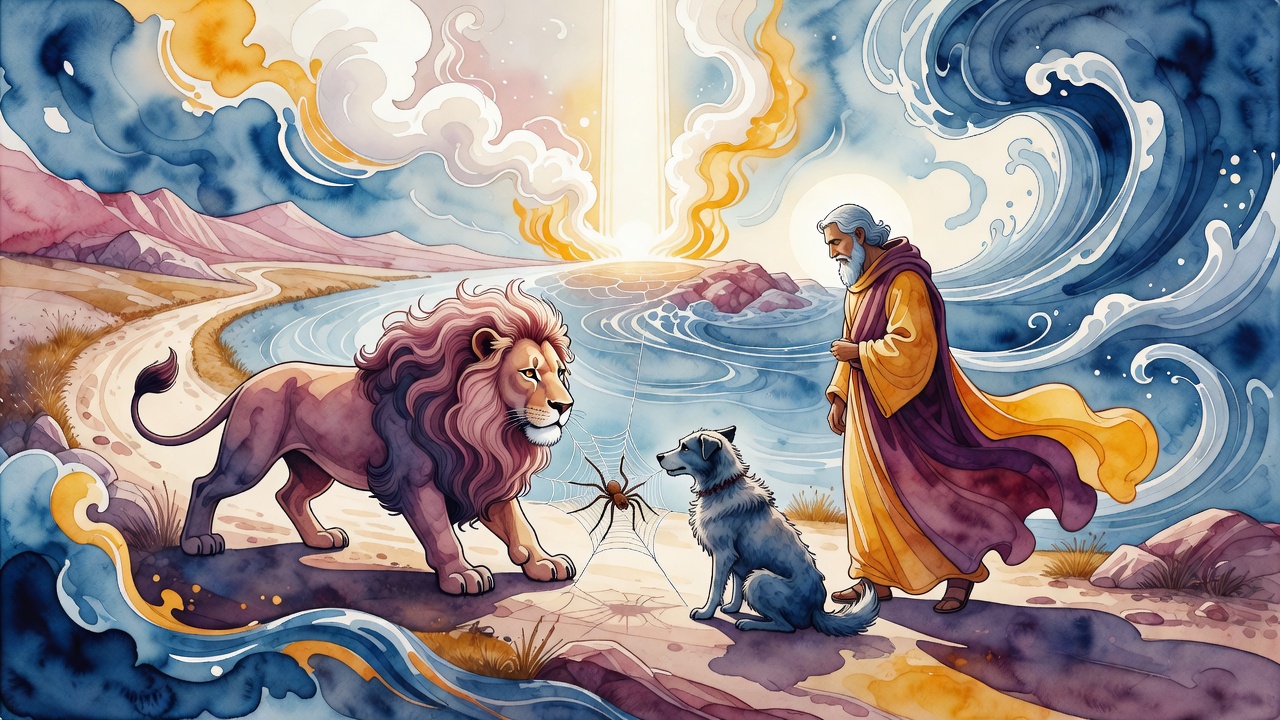
A lion ordered a dog to kill a spider. The spider went to the lion for help, and the lion took its side. Akiva stood in the road and watched it happen.

Curated by Arthur · Told by Maggid ·
Table of Contents
  1. The Spider Went to the Lion
  2. Akiva Stopped in the Road
  3. The Sea, Great and Wide on Both Hands
  4. Each One Dies Outside Its Own Water

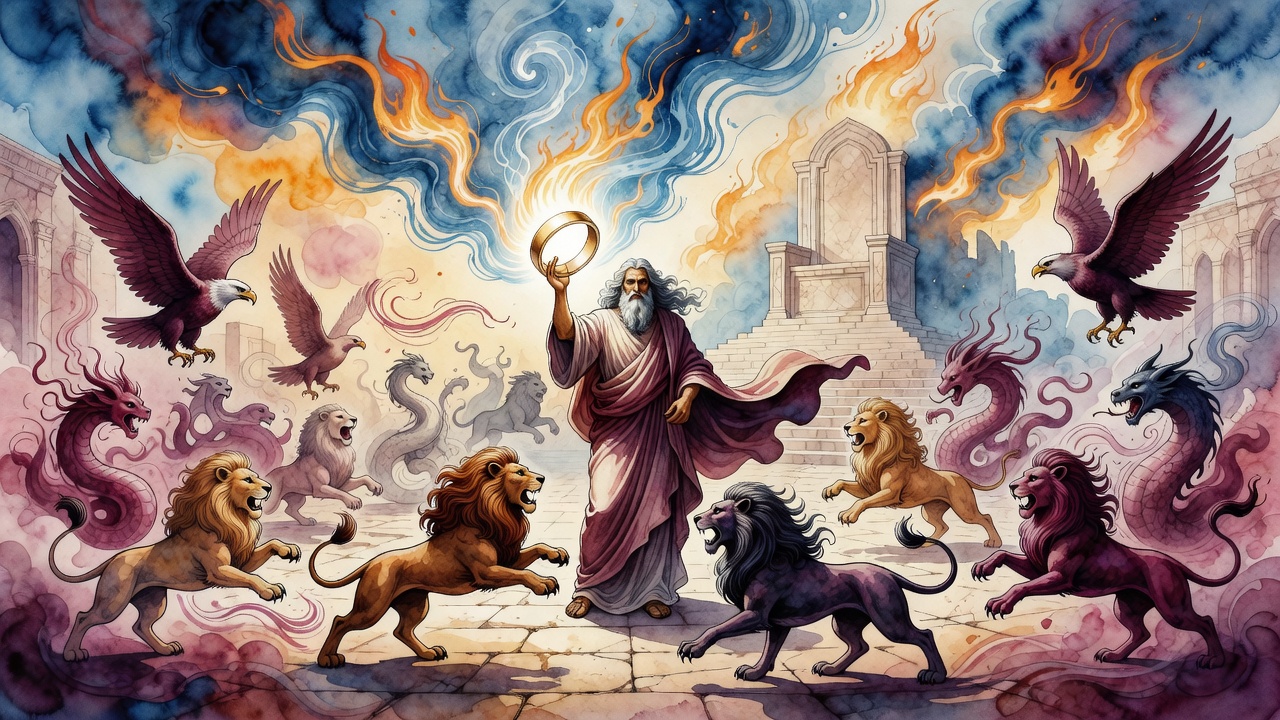
Three of them were in the same place at the same time, which should already have been the end of the story. A lion. A dog. A spider, no bigger than a knuckle of bread, sitting out in the open where anything could reach it.
Rabbi Akiva Watched a Lion Spare the Spider Click for full size

The lion gave the order. Kill it, he told the dog.

The dog lowered its head.

The Spider Went to the Lion

The spider did not run. It did not go under a stone or up a thread into the branches, which is what a spider is built to do and what it would have had time to do.

It went to the lion.

It went to the one who had just condemned it, crossed the ground between them, and asked him for help. There is no record of what it said, only that it asked, and that the lion listened, and that the lion changed his mind on the spot and took the small thing's side.

Then the dog, who had been sent to do the killing, came over and stood with the lion. All three of them held there together. Nothing was torn. Nothing bled. The dog waited, the lion waited, and the spider stayed exactly where it was in the open with the two of them around it, and after a while the three of them went their separate ways, and not one of them had harmed another.

Akiva Stopped in the Road

Rabbi Akiva was there for all of it. He had stopped when he saw the lion, the way anyone stops, and then he stayed for the rest because of what the lion did not do.

He was a man who had started learning his letters as an adult, standing next to children, after a lifetime of pasturing other men's flocks. He knew what it was to be the smallest thing in a room and to have to ask.

He said it out loud, standing in the road with the dust settling.

"How many are Your works, O LORD. In wisdom You have made them all" (Psalms 104:24).

Not wonder at the animals. Wonder at the arrangement. Somebody had set a limit inside a lion, and the limit had held while a spider walked toward its mouth.

The Sea, Great and Wide on Both Hands

He was working his way through that psalm, and the psalm goes on to the sea, great and wide on both hands, with things creeping in it beyond counting. When he came to that verse he was at the water, looking at it.

There are great creatures out there, he said. There are great creatures on the land behind me.

He turned it over the way a man turns over a problem with a real answer in it.

Each One Dies Outside Its Own Water

Bring the sea creatures up onto the sand and they die. Drive the land creatures down into the water and they die. Not because either is weak. Because each one was made for the place it is in, and the same body that carries it through its own element kills it in the other.

The lion had not eaten the spider. The sea does not come up the beach after the ox. Both facts belong to the same order, and Akiva had now seen it twice, once in a spider that asked the wrong animal for help and got it, and once in a shoreline that has been holding its line since the third day.

He said the verse again, into the noise of the water this time, where nobody could hear it.

"How many are Your works, O LORD. In wisdom You have made them all."


← All myths
From the tradition

Sources

3 sources

The texts behind this telling. Some cards carry a translation of the source; others are our own retelling of it, and each card says which. Every card links out to the original.

Midrash Tehillim 104:13Midrash Tehillim

Retold in our words. Read the original at the link below.Rabbi Mike Feuer, Jerusalem Anthology · CC-BY

Midrash Tehillim, a collection of homiletic interpretations on the Book of Psalms, gives us a glimpse into just that kind of wonder, through the eyes of none other than Rabbi Akiva, one of the most important figures in Jewish history.

A lion, a spider, and a dog are hanging out. Sounds like the start of a bad joke. But stick with me. The lion, being a lion, tells the dog to attack the spider. But then, get this, the spider asks the lion for help! And the lion actually helps the spider. And then, in turn, the dog helps the lion. They coexist. They don't harm each other.

Rabbi Akiva, witnessing this unlikely truce, this bizarre instance of interspecies cooperation, is struck by a profound realization. He exclaims, "What greatness your works are, Lord, you have made them all with wisdom!" It's a moment of pure awe, recognizing the divine hand in even the smallest interactions of the natural world.

The story doesn't end there.

Later, Rabbi Akiva arrives at the sea, vast and wide, teeming with life. He observes the creatures that live there, and he reflects on the creatures that live on land. And he realizes something fundamental: Each creature is perfectly suited to its environment. If a sea creature were to venture onto land, it would perish. And if a land creature were to plunge into the depths of the ocean, it would meet the same fate.

Again, he's overcome with that same sense of wonder. "What greatness your works are, Lord, you have made them all with wisdom!"

What's so powerful about these observations?

It's not just about the physical world, is it?

It's about the delicate balance of everything. About how seemingly disparate elements can coexist and even support one another. About how each of us, like those creatures in the sea and on the land, has our own unique place in the world, our own specific environment in which we can thrive.

The Midrash, the interpretive tradition, isn’t just telling us about animals and oceans. It’s whispering something deeper. It’s inviting us to see the hand of the divine in the everyday. To find that spark of awe in the mundane.

It’s reminding us that even in a world that often feels chaotic and fragmented, there is a profound order, a hidden wisdom, that connects us all. And that, perhaps, the key to understanding it all lies in simply…paying attention.

So, the next time you see something unexpected, something that challenges your assumptions about how the world works, remember Rabbi Akiva and his lion, his spider, and his vast, wide sea. Remember to pause, to marvel, and to ask yourself: "What greatness your works are, Lord, you have made them all with wisdom?"

Full source
Midrash Tehillim 103:10Midrash Tehillim

Retold in our words. Read the original at the link below.Rabbi Mike Feuer, Jerusalem Anthology · CC-BY

Midrash Tehillim, a collection of rabbinic interpretations on the Book of Psalms, offers a fascinating perspective on this internal struggle, particularly in its commentary on Psalm 103. It starts with a rather stark warning: "Woe to the dough that testifies against itself that it is bad." Rabbi Chiyah uses this analogy to suggest that we can sometimes be our own worst enemies, quick to judge ourselves and succumb to negative impulses.

Here's the thing: the yetzer hara (the evil inclination) isn't a permanent fixture. It's transient, fleeting. As the verse in Psalms says, "For the wind passes over it and it is gone, and its place knows it no more" (Psalms 103:16). Midrash Tehillim interprets this to mean that the evil inclination is temporary, like a gust of wind that disappears without a trace. We won't recognize its place anymore! The temptation fades, the urge dissipates, leaving only.. what?

Well, that's where the "kindness of the Lord" comes in. "The kindness of the Lord is from everlasting to everlasting" (Psalms 103:17). Rabbi Yochanan expands on this, saying "The kindness is from the world to the world." It's a constant, an unwavering presence that stands in stark contrast to the fleeting nature of the yetzer hara. This kindness, this chesed (Lovingkindness), isn’t just for us, but extends through generations.

The Midrash (rabbinic interpretive commentary) then adds a layer of complexity. While God's kindness is eternal, its manifestation, specifically through acts of charity (tzedakah), has a ripple effect that lasts for three generations: "And His righteousness to children's children" (Psalms 103:17). So, while divine kindness itself is boundless, our actions, particularly acts of tzedakah, create a legacy of righteousness that impacts our descendants.

What does all this mean for us today? Perhaps it's a reminder that we're not defined by our fleeting temptations. The yetzer hara is part of the human experience, but it doesn't have the final word. Instead, we can focus on cultivating the "kindness of the Lord," both within ourselves and in our actions towards others. And when we falter, as we inevitably will, we can remember that this, too, shall pass. The wind will blow, the temptation will fade, and God's unwavering kindness will remain, offering us a chance to start anew, generation after generation.

Full source
Shemot Rabbah 50:2Shemot Rabbah

Retold in our words. Read the original at the link below.The Sefaria Midrash Rabbah, 2022 · CC-BY

The ancient rabbis certainly thought so.

We find this idea beautifully illustrated in Shemot Rabbah, a collection of rabbinic interpretations on the Book of Exodus. It uses a verse from Proverbs (9:9), "Give to the wise person, and he will grow wiser," as a lens through which to view the actions of Noah, Moses, and Betzalel.

Remember the story? God tells him, "From every pure animal, take for yourself seven of each, a male and his mate; and of the animals that are not pure, two, a male and his mate" (Genesis 7:2). So, Noah does. But according to this Midrash (rabbinic interpretive commentary), when he emerges from the ark and offers sacrifices, he's not simply following orders. Instead, as the Midrash says, "he scrutinized [hitbonen]" the situation. He asks himself why God specified a larger number of pure animals. He reasons that it must be so that he can offer them as sacrifices! And so he does, as we read "He took from each species of pure animal and offered burnt-offerings on the altar" (Genesis 8:20).

The Midrash highlights that Noah didn't just blindly obey; he used his wisdom to understand God's will more deeply. He took initiative. "Give to the wise person, and he will grow wiser," indeed!

Next up: Moses. The Midrash connects him to another verse in Proverbs (21:22): "The wise goes up to the city of the mighty." This is understood to mean Moses ascending to receive Torah from God. He then brings that wisdom down to the people, enriching their lives. He doesn't just passively receive; he actively transmits and enhances the understanding of the Torah for the benefit of Israel. He makes it alive.

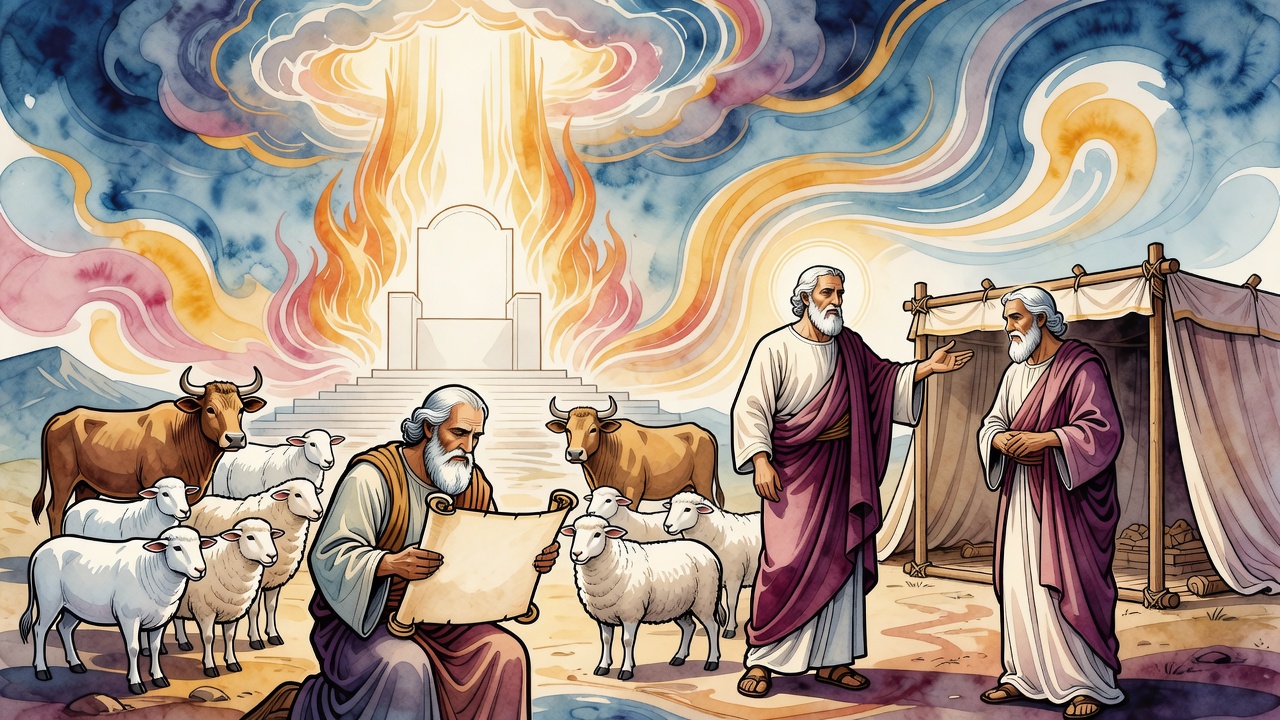
But perhaps the most compelling example is Betzalel. Now, Betzalel was the artisan chosen to construct the Mishkan, the Tabernacle, a portable sanctuary for God's presence. God instructs Moses to have Betzalel build the Tabernacle. Moses, in turn, relays this instruction to Betzalel.

But Betzalel, as the Midrash tells it, asks a critical question: "What is the purpose of this Tabernacle?" Moses explains that it's for God to dwell amongst them and teach them Torah. Betzalel then raises a crucial point: "Where will the Torah be placed?" Moses responds that they'll build the Ark after the Tabernacle.

Now, here's where Betzalel's wisdom truly shines. He respectfully disagrees! He says, "Our master, Moses, it is not in keeping with the honor due the Torah to do so; rather, we will craft the Ark and the Tabernacle thereafter."

Wow.

Betzalel understands that the Torah, God’s word, is of utmost importance and should be given priority. He’s not just a craftsman; he’s a thinker, a theologian, a man of deep insight. This is why, the Midrash concludes, it was said, "Betzalel crafted the Ark." He understood the deeper meaning and purpose behind the physical construction.

So, what can we learn from these three figures? It's not enough to simply follow instructions. True wisdom lies in understanding the why, in questioning, in seeking deeper meaning, and even in respectfully suggesting improvements, even to divine instructions. It's about taking an active role in our spiritual lives and striving to understand God's will with all our hearts and minds. Perhaps, that is how we, too, can grow wiser.

Full source