Satan Had to Ask Permission Before Touching Job
Job's children were still at the table when the court opened above him. The Accuser asked for the wall around the man. God said the body was off limits.
Table of Contents
 Click for full size
The Court Named Job First
Job did not hear the first accusation. His cattle grazed. His children ate together in their house. His servants moved through an ordinary day. Far above them a court had opened.
The angels stood before God. Among them came Ha-Satan (הַשָּׂטָן), the Accuser, not as a rebel with a kingdom of his own, but as a prosecutor entering the court where he belonged. He had been going to and fro in the earth. He had seen Abraham, who did not take it ill that he lacked even a burial place for Sarah. He had seen Job, and he had an old grudge.
God named Job first. Upright. God-fearing. A man who turned away from evil. Like whom there is none in the earth.
The Accuser did not deny it. He sharpened it. "If You will put him into my hand, I shall succeed in turning his heart away from You." Of course Job served. His house was full. His fields were guarded. His children were alive. Strip the wall away, and the pious man would curse the One who had blessed him.
Permission came with a fence around it. "Touch what he has, but not his body." The Accuser could not move one finger beyond the line God drew.
Messengers Before the Last One Finished
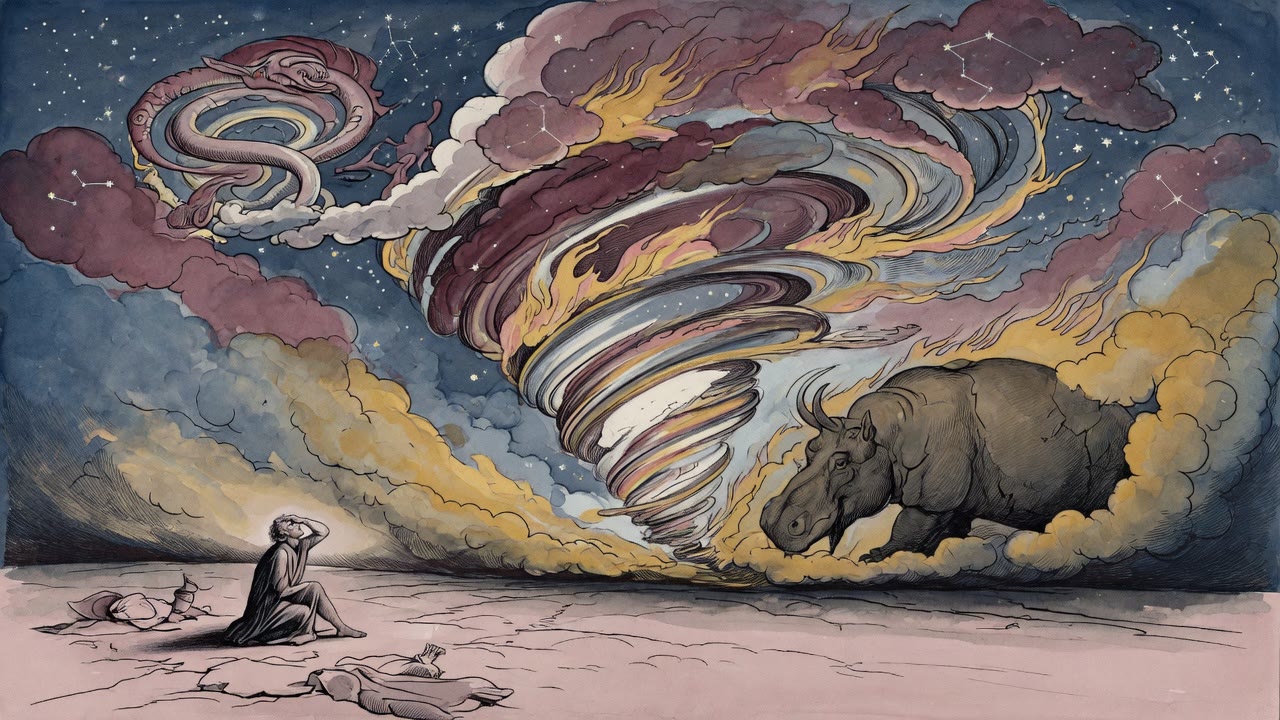
Down on earth the line did not feel like mercy. It felt like disaster arriving in waves, each messenger reaching Job before the last one had finished speaking. Fire fell. Raiders came. Servants died. Herds vanished. A wind struck the house where his children were eating together, and the walls collapsed on sons and daughters whose names the book barely lets the mouth hold.
Job tore his robe. He shaved his head. He fell to the ground.
The Accuser had waited for the curse. Job gave him dust and silence, then words that cut in the opposite direction. Naked he had come from his mother's womb. Naked he would return. God had given. God had taken. The Name of God remained blessed.
The Line Moved to His Skin
The court gathered again. The Accuser returned from the earth, and God pointed to Job's grief as evidence. The man had lost everything and still had not cursed.
"Skin for skin," the Accuser answered. A person will surrender possessions, children, honor, nearly anything, while breath still sits inside the body. Touch the bone. Touch the flesh. Then the mouth will show what the heart contains.
A second permission came, narrower and more terrible. "His life must be spared."
Job's body became the field. Sores rose from the soles of his feet to the crown of his head. He sat among ashes with a potsherd in his hand, scraping himself because no other relief remained. The man once known at the city gate now sat outside the shape of human dignity, reduced to skin, pain, and the stubborn pulse God had not allowed the Accuser to take.
Bread Bought With Hair
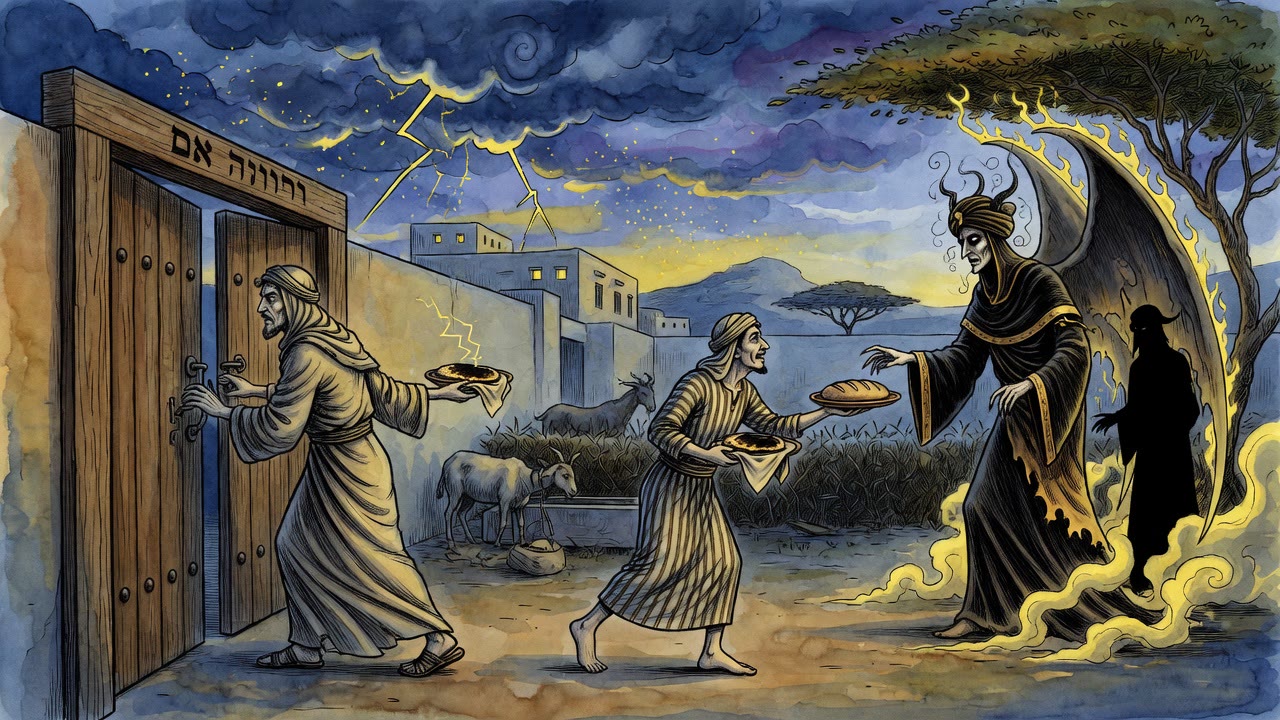
His wife stood near him. She had not been protected from the ruin. She had buried children too. She took work as a water-carrier. When her master learned she shared her bread with Job, he dismissed her. To keep her husband from starving, she cut off her hair and bought bread with it. It was all she had left to pay. The merchant who took the hair was the Accuser himself, pressing the trial through the person Job still loved.
She came back with bread and shame in her hands. "Had you not deserved this misery, it had not come upon you," the merchant had told her. That speech was more than she could bear. Her voice broke where Job's had not. "Curse God and die," she said.
It was not an argument. It was a cry from a woman crushed under the same falling roof. She had watched piety fail to protect a home. She had watched righteousness turn into hunger. Her husband sat in ashes, alive only because heaven had forbidden the last blow.
Job answered hard, but he did not curse. He named foolish speech and held his mouth back from sin. He looked past her and spoke to the one he divined standing behind her. "Why do you not meet me frankly? Give up your underhand ways." The Accuser had a human voice now, familiar and wounded, close enough to make obedience feel almost cruel. He still did not get the sentence he had come for.
Friends Who Built a Second Court
Then the friends arrived. They sat with him seven days before speaking. That was their finest hour. Dust on their heads. Garments torn. No explanations, only presence beside a man whose suffering had made language look small.
When they finally opened their mouths, they built another courtroom. Job must have sinned. God must be punishing. The world must still be legible, because if a righteous man could be crushed without knowing why, then every clean formula trembled.
Job refused their comfort because it was not comfort. He wanted an answer from God, not a neat verdict from men afraid of mystery. He did not know the heavenly wager. He did not know the Accuser had asked and been limited. He knew only boils, graves, hunger, and friends who defended heaven by accusing the wounded.
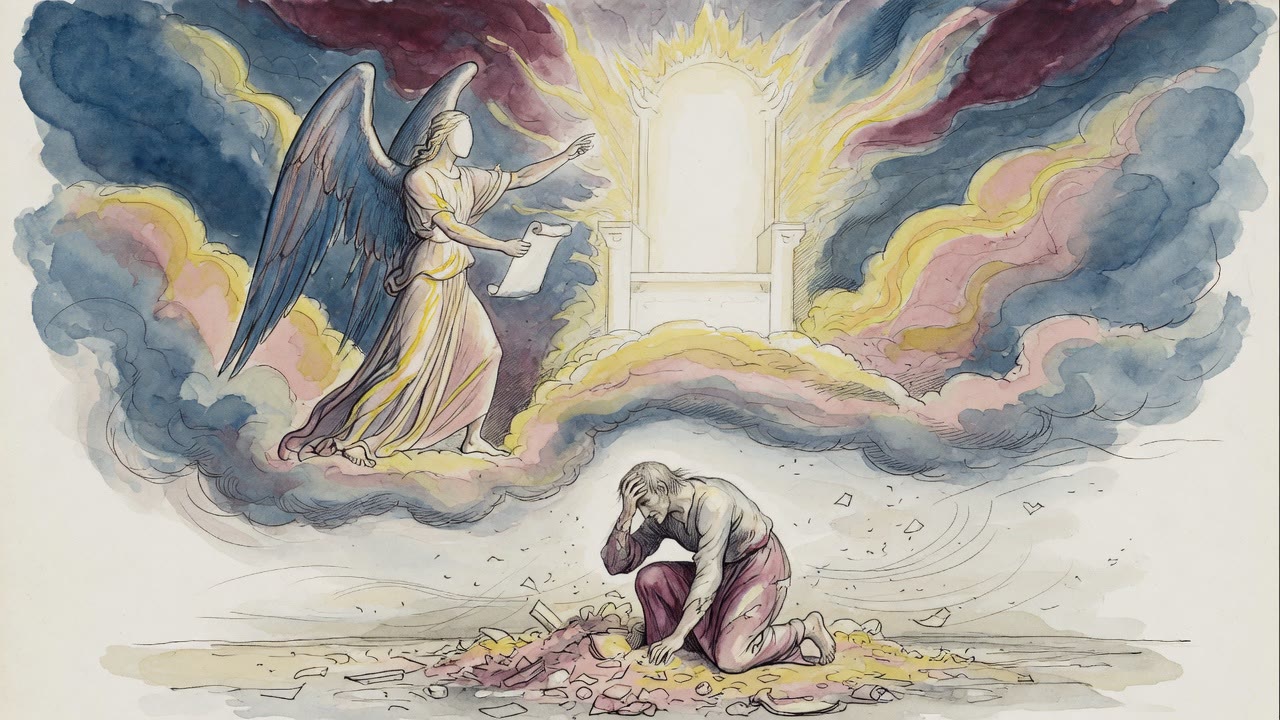
Above the pit, while he scraped, an angel argued for a soul. "Deliver him from going down to the pit." Accusation is real in that court. So is a defender. Job heard none of it. He heard the potsherd on his skin. He heard his own mouth refusing one sentence.
The Accuser left marks on Job's body. He did not get Job's soul. The first charge had already failed. The herds were gone, the children were gone, the wife's hair lay in another man's hand, and still the curse did not come. Job would protest. He would demand. He would curse the day of his birth. He would not perform cheerful piety for anyone. The prosecutor could afflict. He could not own the answer. The line God had drawn held, even when it had moved all the way to the bone.
← All myths