Shimon Juggled Eight Torches at the Water Drawing
Oil spat from eight wicks over the Court of the Women. He caught every torch, then put them down and pressed his mouth to the floor.
Table of Contents
 Click for full size
Eight Arcs of Fire
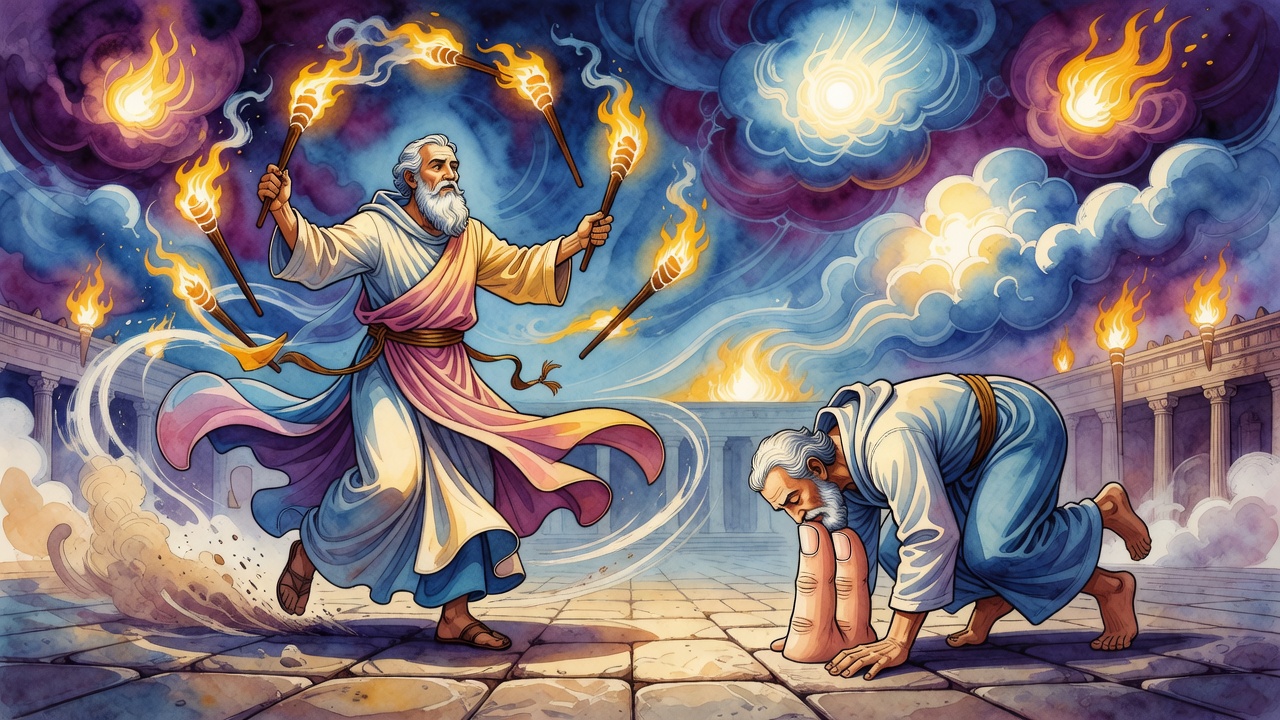
Rabbi Shimon ben Gamaliel stepped into the Court of the Women with eight torches already lit. Oil spat. Sparks climbed the night air. Crowds pressed the balconies and the lower courts until breath itself seemed crowded. The Levites had begun on the fifteen steps, harps and lyres and cymbals under a ceiling of sound so thick no corner of Jerusalem kept its private dark.
He did not wait for a hush. He juggled. He threw the first torch high, then the second, then the third, until eight arcs of fire cut the space above his hands. Flame rose. Flame fell. No torch kissed its neighbor. No wick died in the catch. Heat brushed his sleeves. A child on a shoulder pointed and lost the words. He moved as if joy had a craft and he still remembered the pattern.
The Court That Refused Shadow
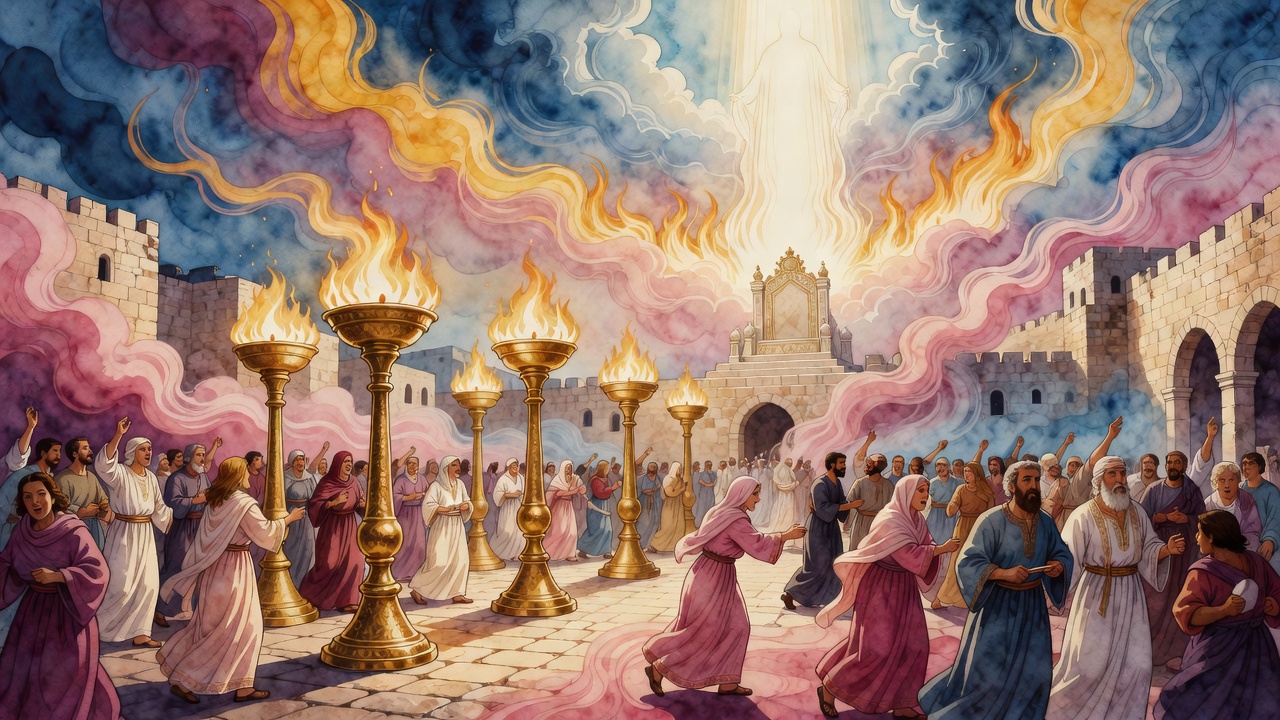
Four golden lamp-stands stood in the court, each crowned with four bowls. Young priests climbed ladders with cruses of oil, one hundred and twenty log in each vessel, and fed wicks woven from worn drawers and girdles of the priesthood itself. When those lamps took, courtyards across the city answered. Roofs caught the glow. Alleys lost their night. A man far from the Temple could read a face by the light of the water-drawing feast alone.
Holy men and men of rank danced with torches of their own. They shouted praises between the songs. The Levites held the steps from the Court of Israel down to the women, instruments without number, voices stacked on voices. This was Simchat Beit HaShoevah (שמחת בית השואבה), the Rejoicing of the House of the Water Drawing, the nights of Sukkot when the city learned that worship could sweat and laugh and still be holy.
Shimon kept the eight in motion. Oil smoked. The fire never tangled.
Two Thumbs on Stone
When the dancing thinned for a breath, he stopped the torches and set them aside. Then he bowed. Not a nod. Not a polite fold at the waist. He lowered his whole body on two thumbs, flesh against stone, until his lips touched the floor of the court. The psalm lived in the act: servants taking pleasure in her stones (Psalms 102:15). He rose on those same thumbs without help from knee or palm. Dust clung to his mouth. He wiped it once and did not apologize for the dirt of devotion.
Other sages watched. None matched the prostration. Later they said this was what stooping properly meant. In the court, under living light, the line was not a joke. It was the measure of a body that had given everything it owned to joy before God.
Trumpets cut the air from the upper gate. Two priests held silver instruments and waited for the signal that would end the night's dance and open the water's road.
The Rooster and the Turn West
At the first crow they blew one long blast, one broken blast, one long blast. The procession moved east with trumpets at every few steps. When the company reached the East Gate, faces turned back toward the Temple, west, against the habit of an older error.
"Our fathers who stood in this place turned their backs to the Temple and their faces to the east, to the rising sun," the voices said. "But we, our eyes are toward God."
Rabbi Yehudah held that they doubled the claim until it rang: for God, and unto God the eyes. The lamps still burned behind them. The city still glowed. The procession that had spent the night in fire now claimed a direction for the morning water, a refusal of the star that had once stolen the gaze.
Shimon walked among them with soot on his hands and the memory of eight orbits still in the muscles of his arms. The water would be drawn. The libation would rise. The feast would keep its name because joy had not been treated as a lesser offering.
Soot on the Thumbs
By the time gray light thinned the lamp-glow, throats were raw and sandals were dark with oil and dust. A priest on a ladder lowered an empty cruse. A Levite set a harp against a step and flexed fingers that no longer felt separate from the strings. Somewhere a courtyard that had never been this bright cooled toward ordinary day.
Shimon's thumbs still carried the press of stone. His palms still knew the weight of torches caught at the last instant before a fall. No decree had forced the juggling. No enemy had been driven back by the bow. The night had asked for more than correct sacrifice. It had asked for a sage willing to look foolish in firelight so that pleasure in the stones would not stay a verse on a page.
Jerusalem held the afterimage: a city without a dark court, an elder under spinning flame, lips on the floor, and a people turning west at dawn to say where their eyes belonged. The water went up. The songs went quiet. The light that had spilled past every wall left a residue in the eyes of anyone who had stood under it and watched a teacher play with fire as if play itself were a form of prayer.
← All myths