5 min read

Sixty Thousand Angels Crowned Israel at Sinai

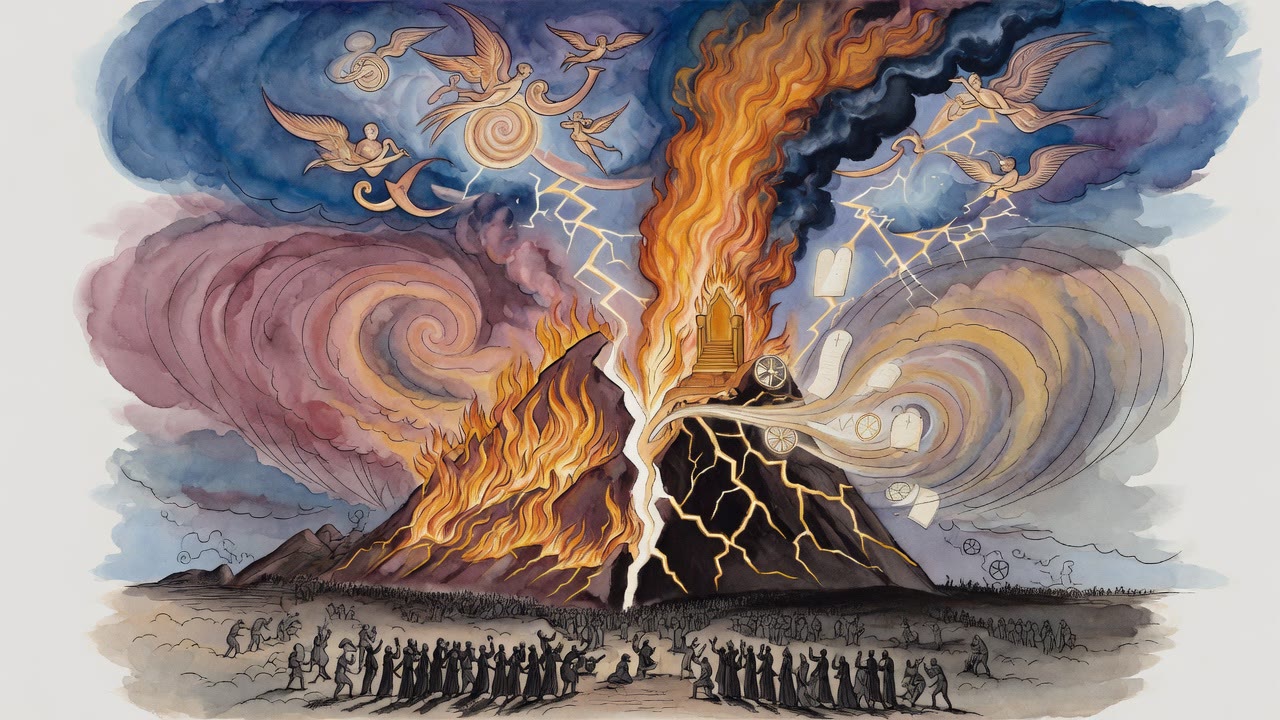
When Israel answers we will do and we will hear, angels strap armor and set wreaths on every head while honor settles like a garment on the mountain.

Curated by Arthur · Told by Maggid ·
Table of Contents
  1. The Answer on the Mountain
  2. Armor, Linen, Name
  3. Light That Does Not Blind
  4. Gold Head, Iron Feet
Sixty Thousand Angels Crowned Israel at Sinai Click for full size

The Answer on the Mountain

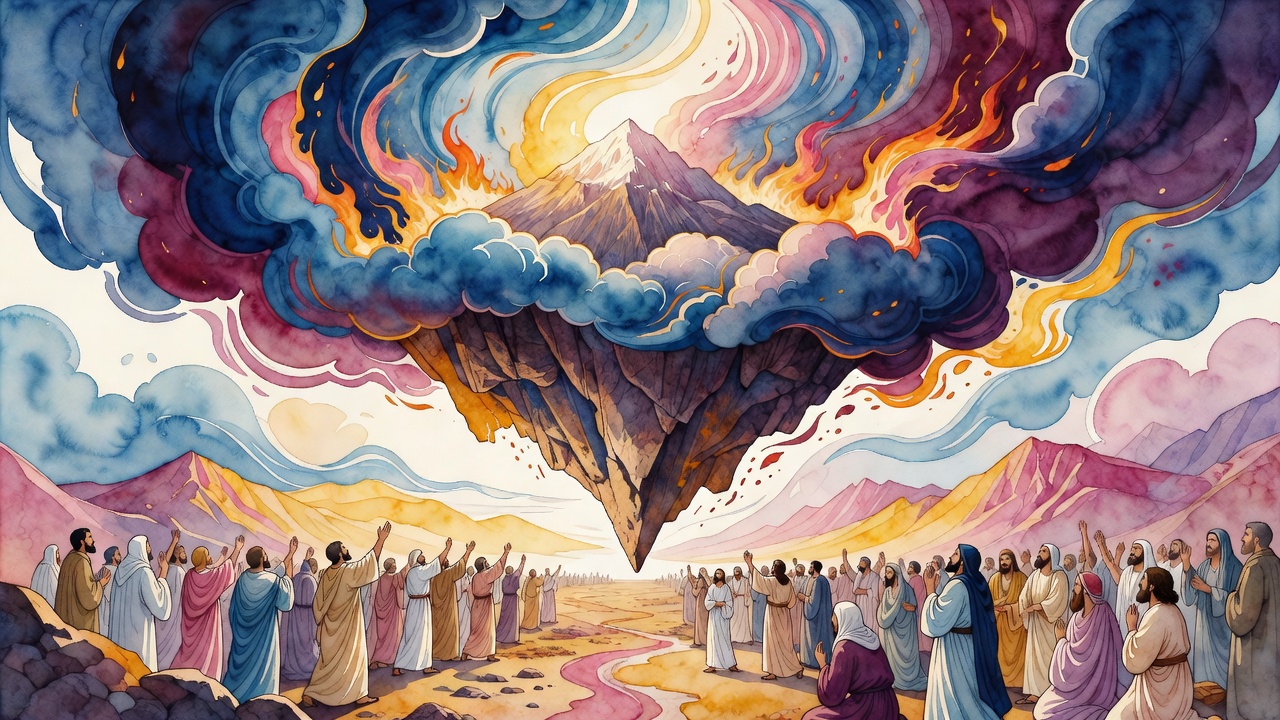
Israel opened its mouth and the mountain held the sound. All that the Lord has spoken we will do and obey (Exodus 24:7). No committee. No delay dressed as wisdom. The words left the people as one body, and heaven moved before the echo died. Thunder had already written fear into their bones. Now speech wrote loyalty on top of fear.
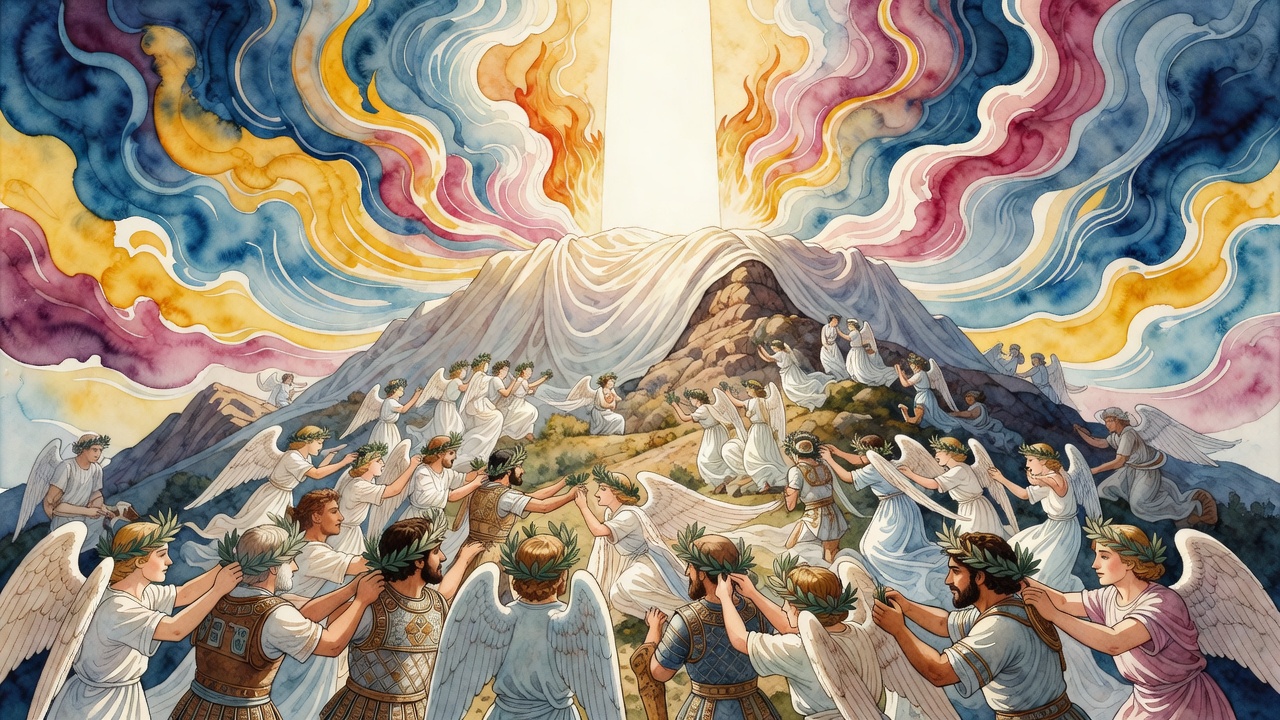
R. Abba son of Kahana says the Holy One loved them at once and sent two angels to each person: one to strap on armor, one to set a crown. R. Johanan counts sixty thousand guardian angels descending with God, chariots in myriads, wreaths for every head (Psalm 68:18). Honor became a thing you could feel on the scalp. A man who had mixed mortar in Egypt felt metal settle on his hair and did not know whether to laugh or fall.

The angels did not ask for resumes. The answer was the resume. We will do and we will hear: action first, understanding second, a sequence that still scandalizes people who want the full contract before the first step.

Armor, Linen, Name

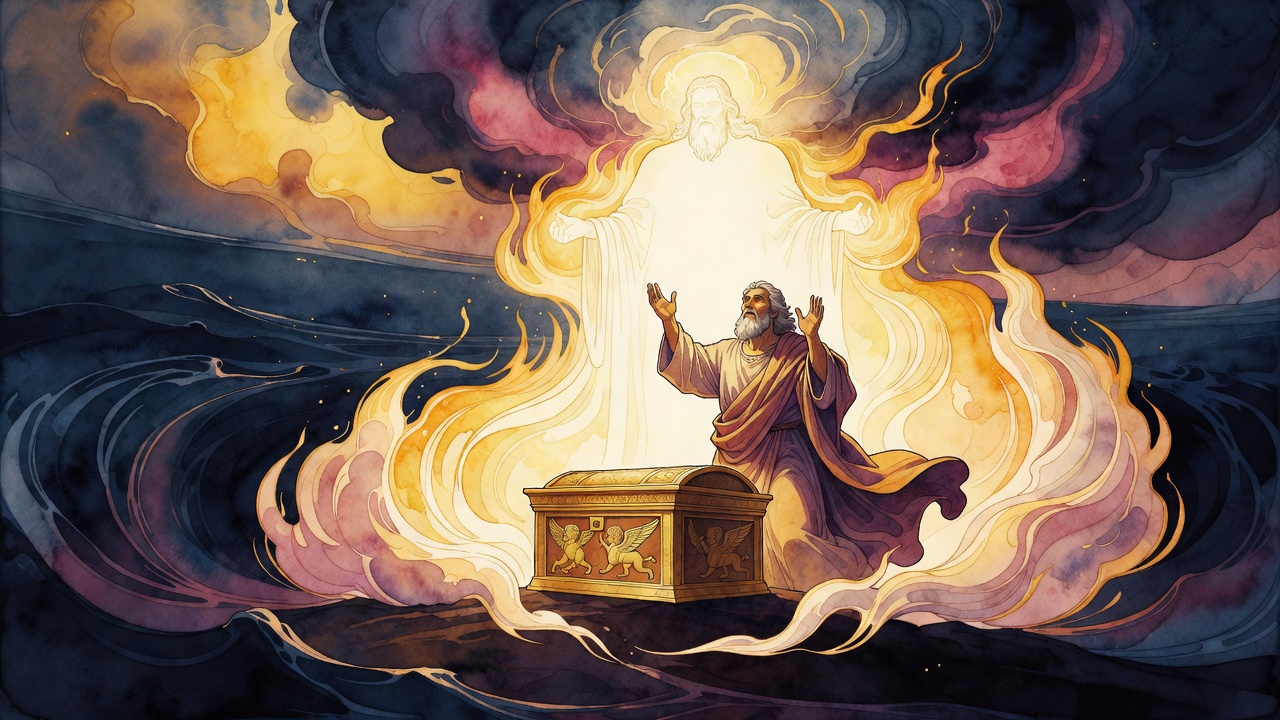
R. Simeon hears royal garments, richly woven work laid on a people that had left brick and whip only weeks before (Ezekiel 16:10). R. Huna of Sepphoris hears fine linen wound as armor. R. Simeon son of Yohai presses further: armor and the Tetragrammaton (the four-letter Name of God) encircling them, the Name itself worn like a belt against shame. Letters of fire become clothing. Clothing becomes defense.

Fools carry away shame, the proverb says; the wise inherit honor (Proverbs 3:35). At Sinai the proverb put on bodies. Idolaters left empty-handed. Israel left marked. The difference was not ancestry alone. It was the answer spoken under thunder. Joshua will later inherit honor from Moses in a different register: shoe removed, sun halted, kings defeated. Here the whole people inherits at once, a national coronation without a human king.

Light That Does Not Blind

Elsewhere the same tradition asks why God wants olive oil beaten for the light when His own light already fills worlds (Exodus 27:20). A person in the dark can see a lit room; a person in a lit room cannot see into dark. God sees both. The sun at full force can ripen fruit and still be too much for flesh. Even so, the Holy One says He desires a light from Israel, a small flame Israel can bear to tend.

The crowns at Sinai and the lamp in the Tent are one demand from two angles: wear the honor, keep the light. Do not wait for a cosmic glare you cannot stand. Guard a flame you can touch. Beaten oil is not glamorous. It is work. Honor without work is a wreath that slips off when the wind rises.

Gold Head, Iron Feet

Daniel's vision of kingdoms still waits in the wings: gold for Babylon, silver for Media, brass for Greece, iron mixed with clay for Edom (Daniel 2). The midrash maps those metals onto the Tabernacle gifts, then promises oil for the light as salvation rising from servitude. Empires wear their metals. Israel wears wreaths that no empire issued. Nebuchadnezzar's statue will terrify later generations. Sinai's crowns are older than that fear.

On the mountain the four kingdoms have not yet marched. The people only know the weight of a crown that was not forged in a palace. When later empires press, the memory of that weight becomes a counterclaim: honor inherited at Sinai is not the same as gold stolen from a dream-statue's head. Brass and iron can break. The Name girded around a people is a different kind of metal.

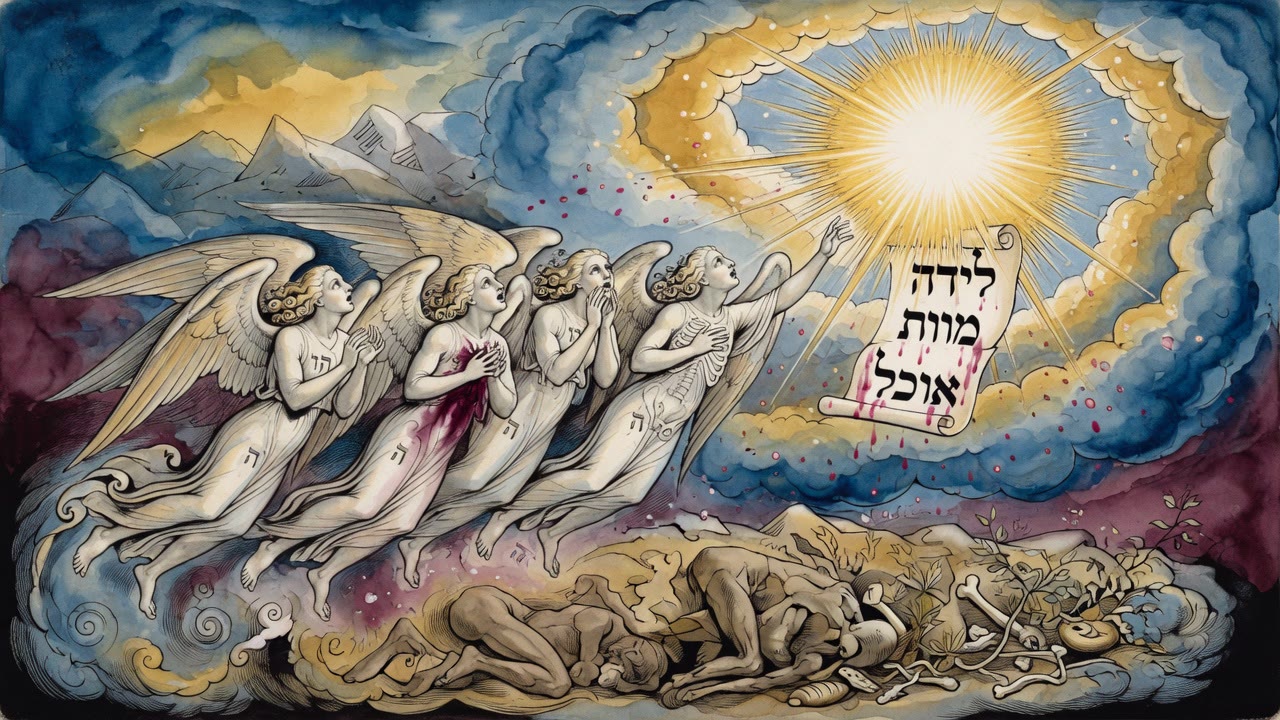
Night fell on the mountain with armor still imagined on shoulders. Some would later trade the wreath for a calf of gold. That betrayal does not erase the hour when sixty thousand angels moved because a nation spoke. The Maggid keeps both: the crowning and the knowledge that crowns can be dropped.

A woman near the base of the slope felt the wreath settle and laughed once, sharp, then covered her mouth as if joy itself might be irreverent. A boy tried to touch the armor at his shoulder and found only air and the certainty that something had been fastened he could not see. Faith is sometimes a weight without a picture. Sinai specialized in both: pictures of smoke and weight without iron.

Hours later the crowns were still the talk in every tent cluster. Some feared they would vanish by morning. Some feared they would stay and demand a life equal to the gift. Both fears were reasonable. Honor that arrives by angel still has to be worn by a human neck the next day, when the mountain is quieter and the manna is the only miracle on the ground.


← All myths

From the tradition

Sources

4 sources

The texts behind this telling. Some cards carry a translation of the source; others are our own retelling of it, and each card says which. Every card links out to the original.

Midrash Tanchuma, Tetzaveh 11Midrash Tanchuma

Retold in our words. Read the original at the link below.Townsend 1989 translation of Midrash Tanhuma, S. Buber Recension · CC-BY

This is the thing that thou shalt do unto them (Exod. 29:11). Scripture says elsewhere in allusion to this verse: The wise shall inherit honor; but as for the fools, they carry away shame (Prov. 3:35). The wise shall inherit honor refers to the Israelites, and the fools they carry away shame alludes to idolaters. When did Israel inherit honor? When she accepted the law.

R. Johanan stated: Sixty thousand guardian angels descended at Sinai with the Holy One, blessed be He, as it is said: The chariots of God are myriads, even thousands upon thousands (Ps. 68:18). They placed a wreath upon the head of each Israelite. R. Abba the son of Kahana held: When the Israelites stood at Sinai and proclaimed: All that the Lord hath spoken will we do, and obey (Exod. 24:17), the Holy One, blessed be He, loved them immediately and sent two angels to each of them; one to strap on his armor and the other to place a crown upon his head.

R. Simeon was of the opinion that He clothed them in royal garments, as is said: I clothed thee also with richly woven work (Ezek. 16:10). R. Huna of Sepphoris maintained: He girded them with armor, as it is said: I wound fine linen (ibid.). R. Simeon the son of Yohai insisted: He girded them with armor and encircled them with the Tetragrammaton. Therefore, The wise shall inherit honor (Prov. 3:35) refers to the Israelites who received this honor because of the events at Sinai. But as for fools, they carried away shame (ibid.) alludes to the nations of the world, who earned their fate at Sinai. Whence do we know this? R. Johanan said: Because it is stated: Yea, those nations shall be utterly wasted (Isa. 60:12), it is written about them: They shall be utterly wasted. Therefore, But as for fools, they carry away shame.

Another explanation of The wise shall inherit honor. This verse refers to David and his son Solomon, who built the Temple and inherited honor. As for fools, they carry away shame alludes to the nations that destroyed the Temple. The Holy One, blessed be He, put them to shame. Proof of this is contained in the verse: O Lord, in the city Thou wilt despise their semblance (Ps. 73:20). Why is the word ba’ir (“in the city”) used? There is a proverb which states: The brigand is hung at the place of his crime, And therefore, O Lord (in the city), Thou wilt despise their semblance. Hence, for fools, they carry away shame. The wise shall inherit honor refers to Moses and Aaron, and Fools, they carry away shame alludes to Dathan and Abiram. Why is that so? When the manna descended for the Israelites, Moses said to them: Let no man leave of it till the morning (Exod. 16:19). Everyone did not listen to Moses; some of them permitted some of it to remain. Those that did so were Dathan and Abiram. R. Joshua of Sikhnin said in the name of R. Levi: What is meant by And it bred worms, and rotted (ibid., v. 20). It means that the source of worms (kelanin) went from the tent of Dathan and Abiram into the tents of the Israelites. Hence, Fools, they carry away shame. Another explanation of The wise shall inherit honor. This refers to the tribe of Levi, while Fools, they carry away shame alludes to Korah and his supporters (who rebelled against Moses). Another explanation of The wise shall inherit honor. This alludes to Aaron and his sons, through whom the high priesthood was firmly established in accordance with the decree: And this is the thing that thou shalt do unto them.

Full source
Midrash Tanchuma, Tetzaveh 9Midrash Tanchuma

Retold in our words. Read the original at the link below.Townsend 1989 translation of Midrash Tanhuma, S. Buber Recension · CC-BY

And this is the thing that thou shalt do unto them (Exod. 29:1). Scripture says elsewhere in reference to this verse: The wise shall inherit honor (Prov. 3:35). Fitting, is the honor accorded to the wise men who labor in the Torah. The Torah says: Riches and honor are with me; yea, enduring riches and righteousness (Prov. 8:18). You find that though thirty-six generations passed by between Adam and Jabez, the word honor is employed only in reference to Jabez, as it is said: And Jabez was more honorable than his brethren (I Chron. 4:9). Why was he referred to as honorable? Because he was one of the wise men who arranged public assemblies to discuss problems of law, as is said: And the families of scribes that dwelt at Jabez: the Tirathites, the Shimeathites, the Succathites. These are the Kenites that came of Hammath, the father of the house of Rechab (I Chron. 2:55). R. Judah the son of Shalum stated in the name of R. Aibu: Two descendants of Adam were similarly honored, etc.

Another explanation of The wise shall inherit honor. This refers to Joshua, who inherited honor from Moses, our master, when the Holy One, blessed be He, said to him: As I was with Moses, so I will be with thee (Josh. 1:5). The Holy One, blessed be He, said to Moses: Put off thy shoes from off thy feet (Exod. 3:5), and to Joshua He said: Put off thy shoe from off thy foot (Josh. 5:15). Concerning Moses it is written: Then sang Moses and the children of Israel (Exod. 15:1), and about Joshua it is said: Then spoke Joshua to the Lord, in the day when the Lord delivered (Josh. 10:12). Moses led them out of Egypt, while Joshua led them into the Holy Land. Moses slew Sihon and Og, while Joshua slew thirty-one kings. Moses halted the revolution of the sun in the war with Amalek, as it is said: And Moses lifted up his hand (Exod. 17:11). The word lifted up refers to his halting of the revolution of the sun, as it is said: The deep uttereth its voice, and lifteth up its voice on high (Hab. 3:10). Joshua did likewise, as is said: Sun, stand thou still upon Gibeon; and thou, moon, in the valley of Aijalon (Josh. 10:12). Moses erected an altar, as it is said: And Moses built an altar (Exod. 17:15), and Joshua did likewise: Then Joshua built an altar (Josh. 8:3). Moses wrote the law, as is said: And Moses wrote this law (Deut. 31:9), and Joshua did also, as it is said: And Joshua wrote these words in the book of the law of God (Josh. 24:26). And so this was in every instance.

However, we find that he did not live the same number of years as Moses, our teacher. It is written about Moses: And Moses was one hundred and twenty years old when he died (Deut. 34:7), while Joshua passed away at the age of one hundred and ten years. Why did he live ten years less? Because he spoke ten words before Moses, his master, spoke, as it is said: And Joshua the son of Nun, the minister of Moses from his youth up, answered and said: “My lord Moses, shut them in” (Num. 11:28). That is why He shortened his life ten years. From this verse you learn that no pupil is permitted to speak before his master, and that anyone who teaches anything before his master does, or even if he does not teach but simply tells others what the law is before his master has stated it, will find his life’s span shortened. Another explanation of the verse The wise shall inherit honor. This alludes to Aaron and his sons, through whom the priesthood was established.

Full source
Midrash Tanchuma, Tetzaveh 8Midrash Tanchuma

Retold in our words. Read the original at the link below.Townsend 1989 translation of Midrash Tanhuma, S. Buber Recension · CC-BY

Pure olive oil beaten for the light (Exod. 27:20). You find that a person standing in the dark can observe what is transpiring in a lighted place. However, anyone standing in a lighted place is unable to observe what is happening in the dark. The Holy One, blessed be He, however, can see in the dark or in the light, as it is said: He knoweth what is in the darkness, etc. (Dan. 2:22).

R. Judah the son of Eleazar said: On that day He set (the sun) within its casing. Whence do we know that? That is what is written: In them hath he set a tent for the sun (Ps. 19:5). At the time of the summer solstice, however, it leaves its casing in order to ripen the fruits. However, the world is hardly able to tolerate the sun. Why? Because its light is so intense. The Holy One, blessed be He, said: Though you are unable to endure the light that I created, I desire a light nevertheless. Why did they prepare the olive oil? They noticed that the trees had produced excellent olives, and so they took them and crushed them. The first oil pressed out was set aside for the lamp, and the second was set aside for the meal-offering in order to fulfill the verse: Pure olive oil beaten for the light.

The Holy One, blessed be He, said to Moses: Tell the Israelites that in this world my sons are responsible for the light in the Sanctuary and must kindle it, but in the Messianic days, because of that lamp, I will bring you a Messiah who is likened unto a lamp, as it is said: There will I make a horn to shoot up unto David, there have I ordered a lamp for Mine anointed (Ps. 132:17).

Whosoever offereth the sacrifice of thanksgiving honoreth Me; and to him that ordereth his way aright will I show the salvation of God (ibid. 50:23). R. Menahem the son of Yosé said: This verse alludes to those who light lamps in dark alleys for the benefit of the public. R. Simeon the son of Lakish declared: Saul was worthy of kingship because his grandfather lit lamps in dark alleys for the sake of the public. One verse tells us: And Ner (“light”) begot Kish (I Chron. 8:33), and another verse says: Kish was the father of Saul, and Ner the father of Abner was the son of Abiel (I Sam. 14:51). In this verse he was called Abiel, but because he lit lamps in dark alleys for the public good he was also called Ner (“light”). The Holy One, blessed be He, declared: In this world you require a light, but in the future, Nations shall walk at thy light, and kings at the brightness of thy horizon (Isa: 60:30).

Full source
Midrash Tanchuma, Terumah 7Midrash Tanchuma

Translation of the source text.Midrash Tanchuma -- Torat Emet · Public Domain

"And this is the offering which you shall take," and so forth (Exodus 25:3). Gold, corresponding to the kingdom of Babylon, of which it is written: "You are this head of gold" (Daniel 2:38). Silver, corresponding to the kingdom of Media, of which it is written: "and ten thousand talents of silver" (Esther 3:9). Bronze, corresponding to the kingdom of Greece, which is the lowest of them all. "And rams' skins dyed red," corresponding to the kingdom of Edom, as it is said: "And the first came out ruddy" (Genesis 25:25). The Holy One, blessed be He, said: Even though you see four kingdoms growing arrogant and coming against you, I will cause salvation to sprout for you from the midst of subjugation. What is written after it? "Oil for the light" (Exodus 25:6) -- this is the king Messiah, as it is said: "There I will make a horn to sprout for David; I have set up a lamp for My anointed" (Psalms 132:17).

And Daniel was seeing these four kingdoms and was afraid, as it is written: "My spirit was grieved in the midst of my body, I Daniel, and the visions of my head troubled me" (Daniel 7:15). And what did Daniel see? When Nebuchadnezzar saw the dream, Daniel came and interpreted it and said to him: The image that you saw -- "You are this head of gold" (Daniel 2:32); "its breast and its arms of silver" (Daniel 2:32) -- this is the kingdom of Media, "and after you shall arise another kingdom inferior to you" (Daniel 2:39); "its belly and its thighs of bronze" (Daniel 2:32) -- this is the kingdom of Greece, "and a third kingdom of bronze, which shall rule over all the earth" (Daniel 2:39); "its legs of iron" (Daniel 2:33) -- this is the fourth kingdom, which is the kingdom of Edom, "and the fourth kingdom shall be strong as iron" (Daniel 2:40), it shall rule over all the earth like iron which crushes everything. And why is its rule compared to iron and clay? Our Rabbis, of blessed memory, said: This kingdom is destined to use coinage of clay. Another interpretation: Why is it compared to iron and clay? Because it is destined to use iron and clay. Just as iron is hard, so the kingdom is hard. Just as clay is easily broken, so it will be broken suddenly: "and its breaking is like the breaking of a potter's vessel that is shattered without pity, so that there is not found among its fragments a shard with which to take fire from the hearth or to scoop water from a cistern" (Isaiah 30:14).

Another interpretation: Why is Babylon compared to clay? Because it is destined to use vessels of clay.

And he was seeing the king Messiah, for thus Daniel says: "You watched until a stone was cut out without hands, and it smote the image" -- ben Lakish: this is the king Messiah. "And it smote the image" -- every kingdom that worships an image in the shadow of death. And by what merit does the king Messiah rule by the stone? By the merit of the Torah, over which Israel labors, as it is said: "tablets of stone, written with the finger of God" (Exodus 31:18).

Another interpretation: by the merit of Jacob, of whom it is written: "from there is the Shepherd, the Stone of Israel" (Genesis 49:24). Another interpretation: Why by the stone? To break the heart of stone, as it is said: "And I will remove the heart of stone from your flesh" (Ezekiel 36:26). "And it smote the image" -- for it destroys all the nations, as it is said: "And he shall smite the earth with the rod of his mouth," and so forth (Isaiah 11:4). And at that moment Israel dwell in quiet and security in the world, as it is said: "And they shall dwell upon it securely, and shall build houses and plant vineyards, and dwell securely" (Ezekiel 28:26).

Full source