Parshat Yitro5 min read

God Held the Mountain Over Israel Like a Barrel

God uprooted Sinai, inverted it over Israel, and offered Torah under a sky that could bury them. They answered we will do and we will hear.

Curated by Arthur · Told by Maggid ·
Table of Contents
  1. One Heart at the Foot of the Rock
  2. The Wager Under the Stone
  3. We Will Do and We Will Hear
  4. The Objection in the Study House
  5. The Mountain That Wanted to Rise

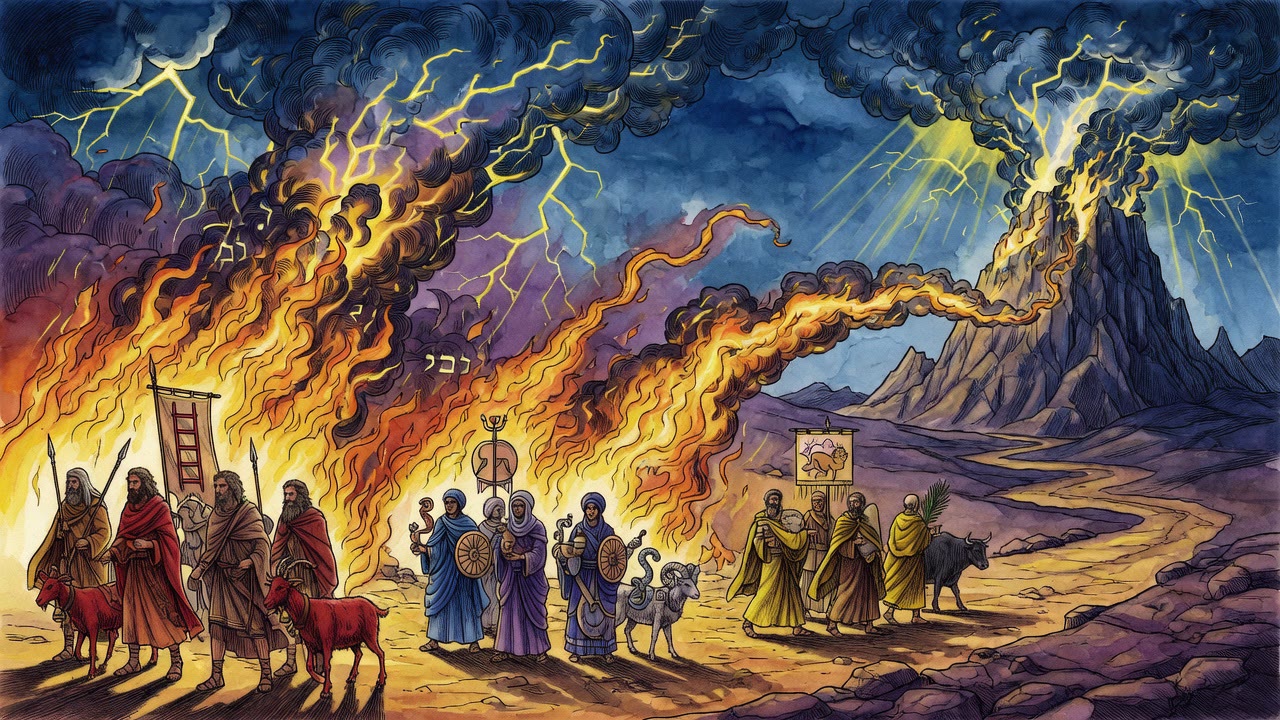
The mountain left the ground.

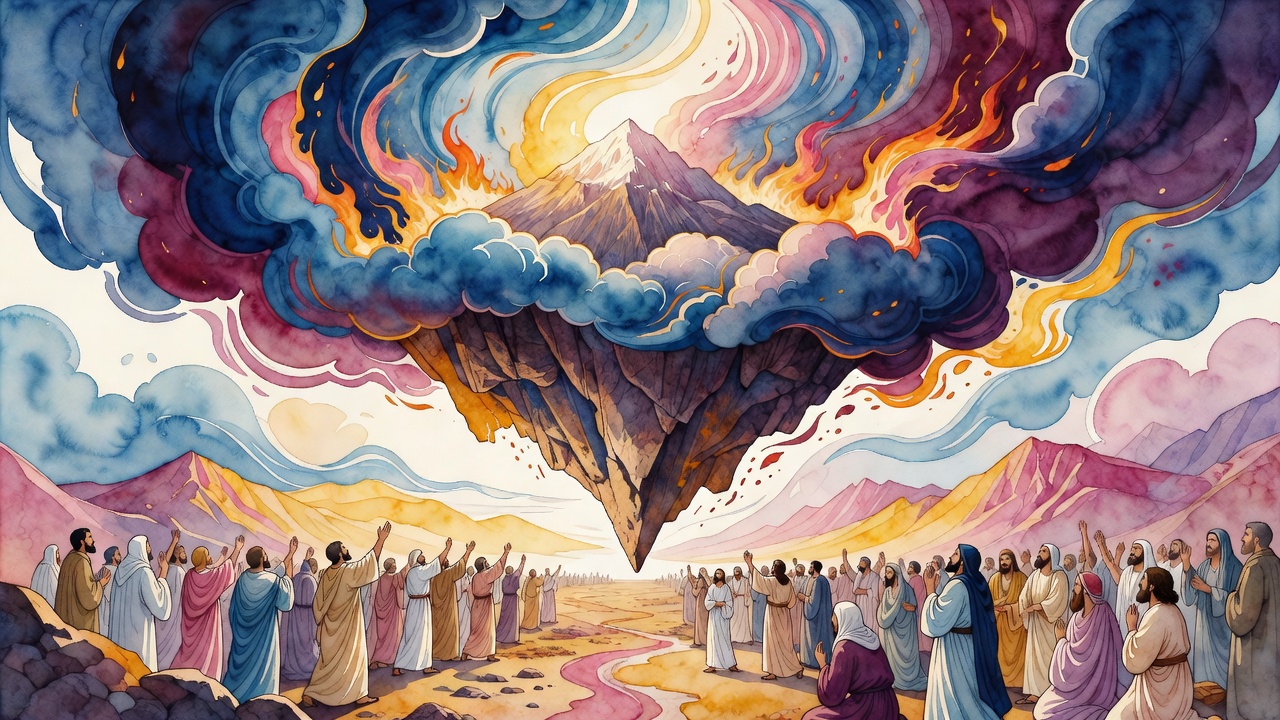
God Held the Mountain Over Israel Like a Barrel Click for full size

God tore Sinai free of its roots, turned it over like a barrel, and held the inverted mass above the heads of Israel. Rock filled the sky. Dust rained into open mouths. Children grabbed the robes of adults. The people who had taken their places at the foot of the mountain (Exodus 19:17) now stood under a suspended death.

"If you accept the Torah, good," the voice said. "If not, here will be your burial."

One Heart at the Foot of the Rock

They had not arrived as a mob. All through the wilderness the Torah speaks of the people in the plural: they journeyed, they camped, they quarreled. At Sinai the grammar breaks. "And Israel encamped there" (Exodus 19:2), one verb, singular, as though the whole nation had become a single person. The sages heard a fact inside the grammar: for the first time since Egypt, the people were of one heart.

Rabbi Eliezer added what grammar alone could not carry. At that hour the nation stood whole. No blind among them, for all the people saw. No mute among them, for all the people answered together. No deaf among them, for they said all that the Lord has spoken we will do and we will hear. Every defect of body and mind had been lifted, so that a whole people could stand upright under the word.

The Wager Under the Stone

Other nations had already heard the offer and refused it. Israel stood last in line. And behind the offer stood an older bargain, set from the beginning of creation: if Israel accepts the Torah when it is offered, the world stands. If not, the world returns to chaos and void.

So the shadow of the mountain did not move with the sun. Sandals stuck. A woman pressed her palm over her child's skull as if a hand could hold off basalt. An old man recited the plagues under his breath, as if Egypt's wounds could argue for mercy now. The rock stayed where God held it. The offer never softened into a suggestion.

We Will Do and We Will Hear

Israel answered with two words that outran caution. Na'aseh v'nishma, we will do and we will hear (Exodus 24:7). Doing first, understanding second, pledged while the sky was still made of stone.

The mountain settled back onto its roots. Knees unlocked. The dust of almost-burial stayed on their teeth, and the Torah was no longer a scroll in heaven. It was a yoke on necks that had just accepted it under a pressure no court would call free.

The Objection in the Study House

Centuries later, Rav Aha bar Yaakov looked at that scene and said what a lawyer would say: this is a standing protest against the Torah. A contract signed under coercion does not bind. If Israel accepted only because a mountain hung over their heads, the acceptance could be contested.

The sages did not wave the objection away. Rava answered it from the book of Esther. In the days of Ahasuerus, with no mountain in the sky and a human enemy at the gates, the Jews "confirmed and accepted" (Esther 9:27). They confirmed in Persia what they had accepted at Sinai, this time under an open sky. The coerced covenant was ratified by a free one.

And the tradition kept a counterweight beside the barrel. The same teachers taught that God and Israel chose each other on the same day, two parties standing and declaring at once, the way a marriage contract is made rather than a royal decree issued. Duress and courtship, both preserved, neither canceling the other.

The Mountain That Wanted to Rise

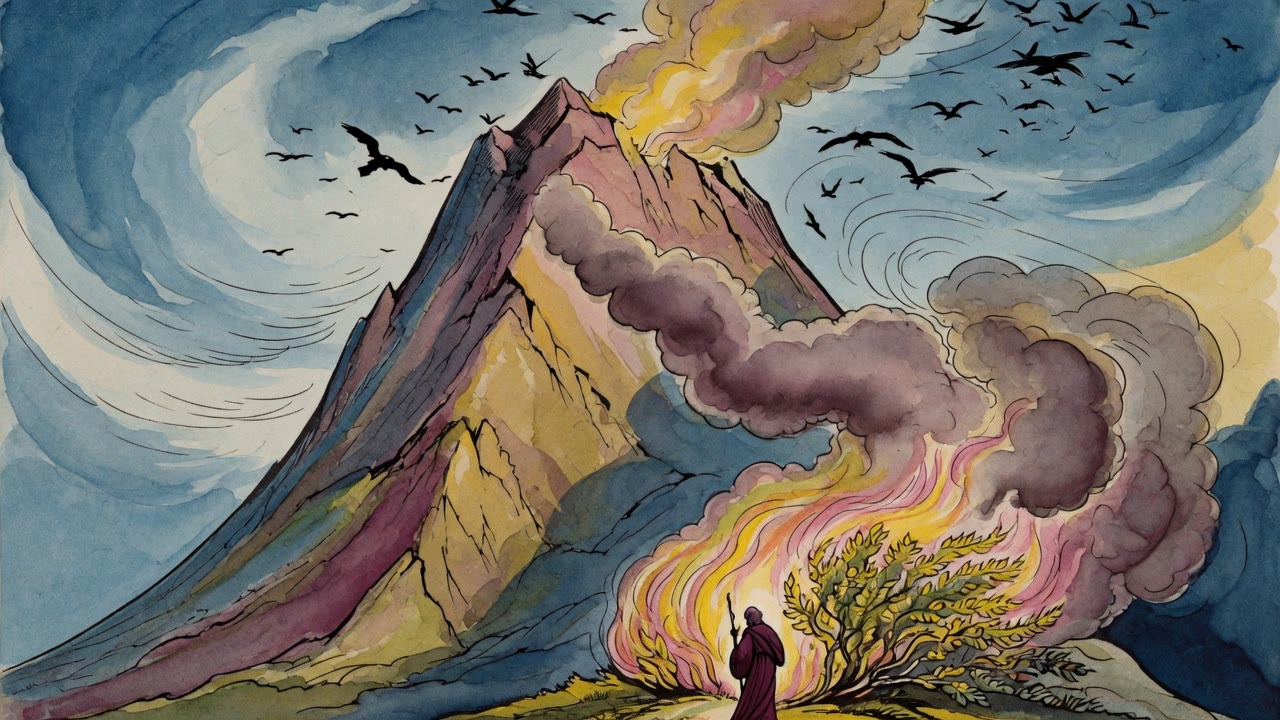
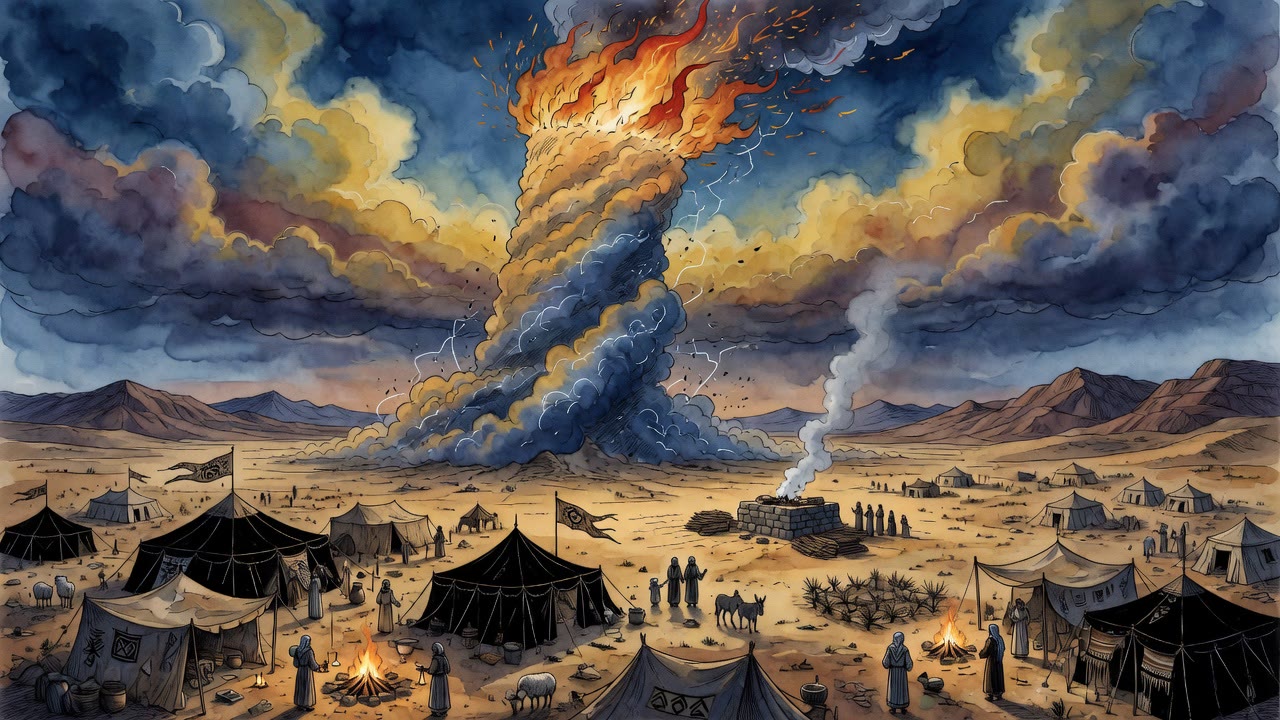
Sinai had wanted this day before Israel ever arrived. When Moses first approached it, the birds overhead refused to land on it. The mountain strained toward him as he came near, settling only when his foot touched its slope, and out of its bush burned a fire that blossomed instead of consuming.

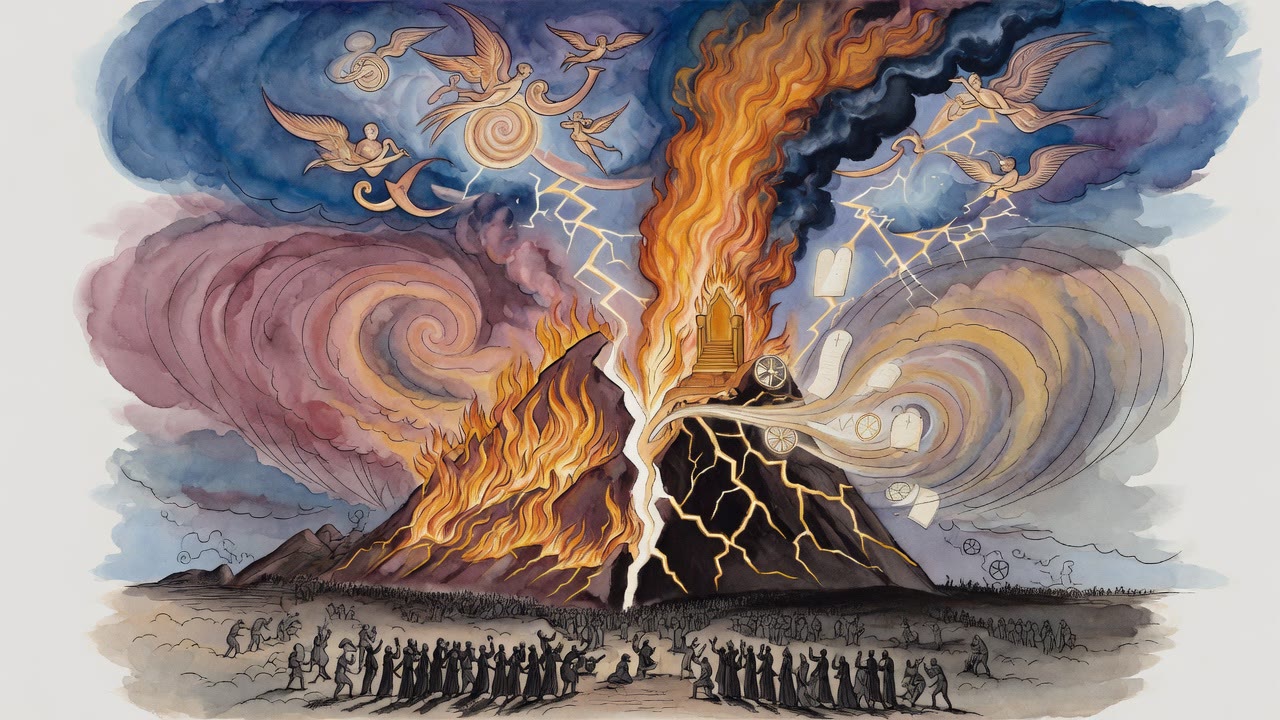
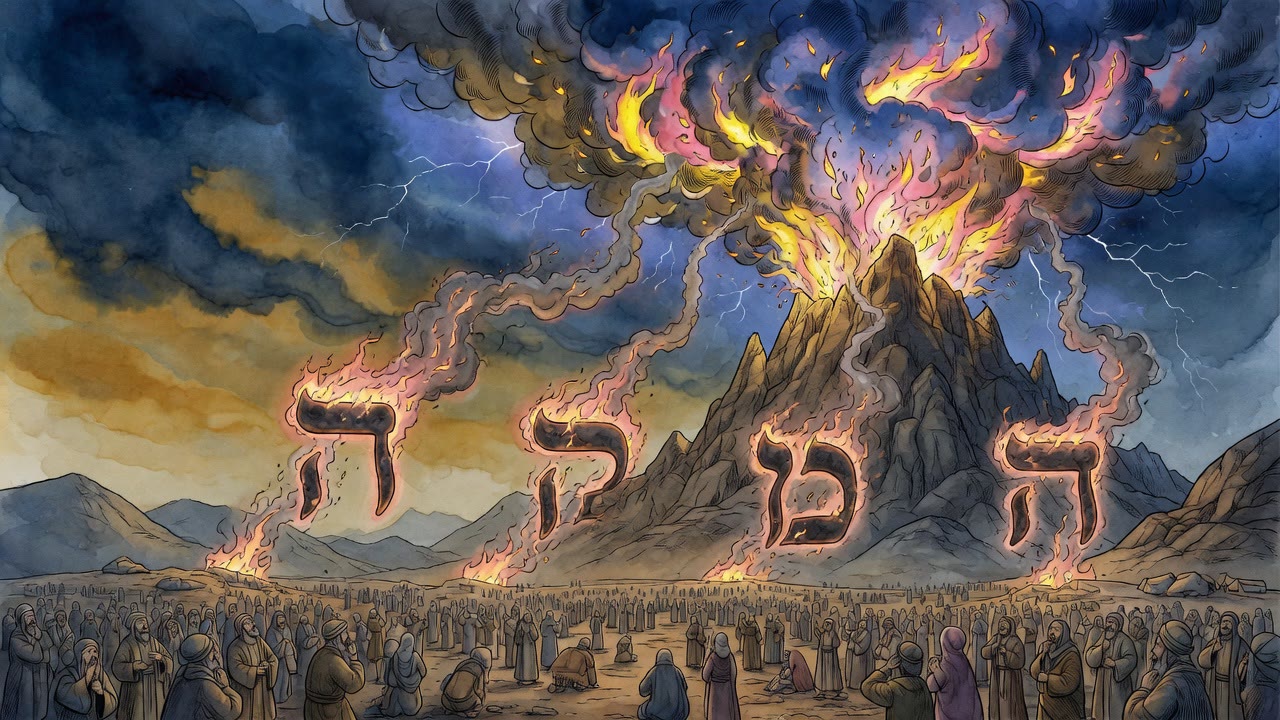
Some tellings push the day of the giving past the barrel entirely. In them Sinai is uprooted not as a threat but as an ascent, lifted above the earth while the heavens open, its summit brought into the midst of the people so that the Lord is revealed upon it.

One uprooted mountain, two memories. In the first it hangs over Israel like a lid. In the second it rises toward an open heaven with the people gathered at its foot. Between them stands the question every generation answers again: whether the Torah was pressed down on Israel, or Israel was lifted with the mountain. The dust on their teeth said one thing. The two words they answered said the other.


← All myths
From the tradition

Sources

7 sources

The texts behind this telling. Some cards carry a translation of the source; others are our own retelling of it, and each card says which. Every card links out to the original.

Shabbat 88aTalmud Bavli, Shabbat

Translation of the source text.William Davidson Edition - Vocalized Aramaic + William Davidson Edition - English · CC-BY-NC

and according to the Rabbis, they established eight months that were lacking. The Gemara cites another objection. Come and hear that which was taught in a baraita in the anthology called Seder Olam: In the month of Nisan during which the Jewish people left Egypt, on the fourteenth they slaughtered their Paschal lambs, on the fifteenth they left Egypt, and that day was Shabbat eve. From the fact that the New Moon of Nisan was on Shabbat eve, we can infer that the New Moon of Iyyar was on the first day of the week, and the New Moon of Sivan was on the second day of the week.

This is difficult according to the opinion of Rabbi Yosei, who holds that the New Moon of Sivan was on Sunday. The Gemara answers that Rabbi Yosei could have said to you: Whose is the opinion in this baraita? It is the opinion of the Rabbis. Therefore, this baraita poses no difficulty to the opinion of the Rabbi Yosei.

The Gemara cites another objection: Come and hear from that which was taught, that Rabbi Yosei says: On the second day of Sivan, Moses ascended Mount Sinai and descended. On the third day, he ascended and descended. On the fourth day, he descended and did not ascend Mount Sinai again until he was commanded along with all of the Jewish people. And the Gemara asks: How is it possible that he descended on the fourth day?

Since he did not ascend, from where did he descend? Rather, this must be emended: On the fourth day, he ascended and descended. On the fifth day, he built an altar and sacrificed an offering. On the sixth day, he had no time.

The Gemara asks: Is that not because he received the Torah on the sixth day of the month? Apparently, this baraita supports the opinion of the Rabbis. The Gemara rejects this: No, he had no time due to the burden of preparing for Shabbat. The Gemara adds: A Galilean taught, while standing above Rav Ḥisda: Blessed is the all-Merciful One, Who gave the threefold Torah: Torah, Prophets, and Writings, to the three-fold nation: Priests, Levites, and Israelites, by means of a third-born: Moses, who followed Aaron and Miriam in birth order, on the third day of the separation of men and women, in the third month: Sivan.

On whose opinion is this homily based? It is based on the opinion of the Rabbis, who hold that the Torah was given on the third day of separation and not on the fourth day. The Gemara cites additional homiletic interpretations on the topic of the revelation at Sinai. The Torah says, “And Moses brought forth the people out of the camp to meet God; and they stood at the lowermost part of the mount” (Exodus 19:17).

Rabbi Avdimi bar Ḥama bar Ḥasa said: the Jewish people actually stood beneath the mountain, and the verse teaches that the Holy One, Blessed be He, overturned the mountain above the Jews like a tub, and said to them: If you accept the Torah, excellent, and if not, there will be your burial. Rav Aḥa bar Ya’akov said: From here there is a substantial caveat to the obligation to fulfill the Torah. The Jewish people can claim that they were coerced into accepting the Torah, and it is therefore not binding.

Rava said: Even so, they again accepted it willingly in the time of Ahasuerus, as it is written: “The Jews ordained, and took upon them, and upon their seed, and upon all such as joined themselves unto them” (Esther 9:27), and he taught: The Jews ordained what they had already taken upon themselves through coercion at Sinai. Ḥizkiya said: What is the meaning of that which is written: “You caused sentence to be heard from heaven; the earth feared, and was silent” (Psalms 76:9)?

If it was afraid, why was it silent; and if it was silent, why was it afraid? Rather, the meaning is: At first, it was afraid, and in the end, it was silent. “You caused sentence to be heard from heaven” refers to the revelation at Sinai. And why was the earth afraid?

It is in accordance with the statement of Reish Lakish, as Reish Lakish said: What is the meaning of that which is written: “And there was evening and there was morning, the sixth day” (Genesis 1:31)? Why do I require the superfluous letter heh, the definite article, which does not appear on any of the other days? It teaches that the Holy One, Blessed be He, established a condition with the act of Creation, and said to them: If Israel accepts the Torah on the sixth day of Sivan, you will exist; and if they do not accept it, I will return you to the primordial state of chaos and disorder.

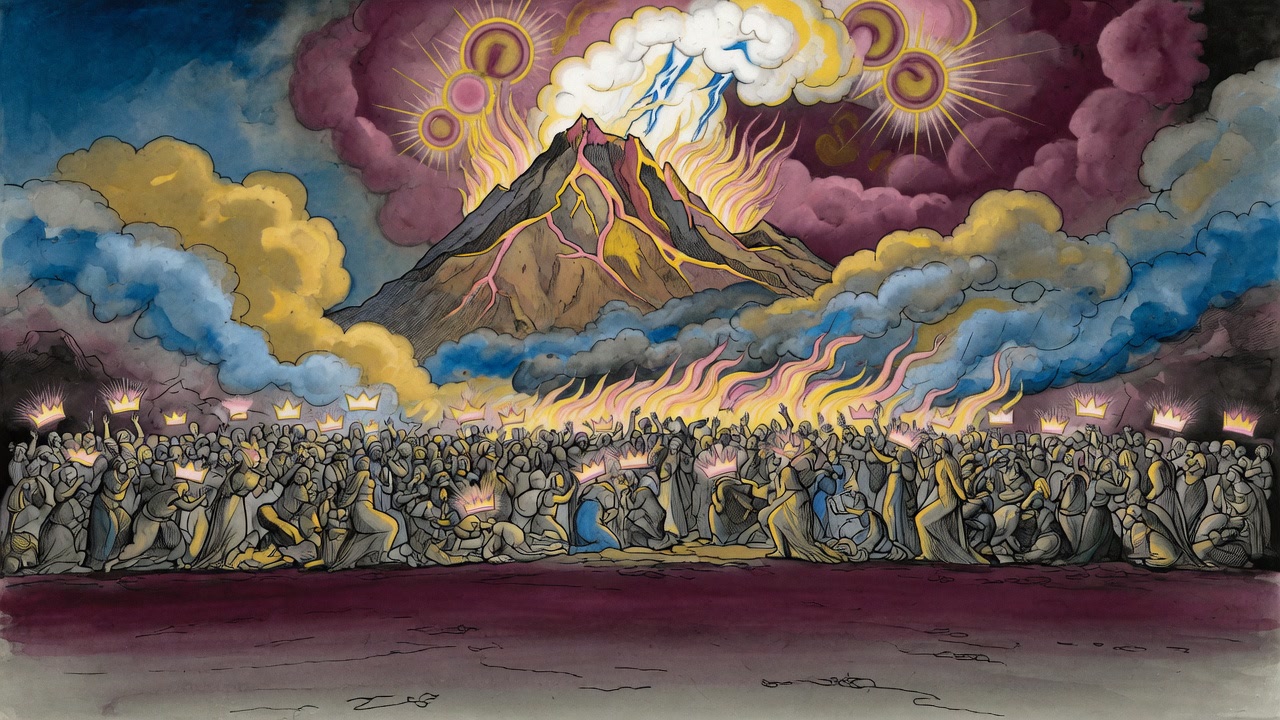
Therefore, the earth was afraid until the Torah was given to Israel, lest it be returned to a state of chaos. Once the Jewish people accepted the Torah, the earth was calmed. Rabbi Simai taught: When Israel accorded precedence to the declaration “We will do” over the declaration “We will hear,” 600,000 ministering angels came and tied two crowns to each and every member of the Jewish people, one corresponding to “We will do” and one corresponding to “We will hear.”

And when the people sinned with the Golden Calf, 1,200,000 angels of destruction descended and removed them from the people, as it is stated in the wake of the sin of the Golden Calf: “And the children of Israel stripped themselves of their ornaments from Mount Horeb onward” (Exodus 33:6). Rabbi Ḥama, son of Rabbi Ḥanina, said: At Horeb they put on their ornaments, and at Horeb they removed them. The source for this is: At Horeb they put them on, as we have said; at Horeb they removed them, as it is written: “And the children of Israel stripped themselves of their ornaments from Mount Horeb.”

Rabbi Yoḥanan said: And Moses merited all of these crowns and took them. What is the source for this? Because juxtaposed to this verse, it is stated: “And Moses would take the tent [ohel]” (Exodus 33:7). The word ohel is interpreted homiletically as an allusion to an aura or illumination [hila].

Reish Lakish said: In the future, the Holy One, Blessed be He, will return them to us, as it is stated: “And the ransomed of the Lord shall return, and come with singing unto Zion, and everlasting joy shall be upon their heads” (Isaiah 35:10). The joy that they once had will once again be upon their heads. Rabbi Elazar said: When the Jewish people accorded precedence to the declaration “We will do” over “We will hear,” a Divine Voice emerged and said to them: Who revealed to my children this secret that the ministering angels use?

As it is written: “Bless the Lord, you angels of His, you mighty in strength, that fulfill His word, hearkening unto the voice of His word” (Psalms 103:20). At first, the angels fulfill His word, and then afterward they hearken. Rabbi Ḥama, son of Rabbi Ḥanina, said: What is the meaning of that which is written: “As an apple tree among the trees of the wood, so is my beloved among the sons. Under its shadow I delighted to sit and its fruit was sweet to my taste” (Song of Songs 2:3)?

Why were the Jewish people likened to an apple tree? It is to tell you that just as this apple tree, its fruit grows before its leaves, so too, the Jewish people accorded precedence to “We will do” over “We will hear.” The Gemara relates that a heretic saw that Rava was immersed in studying halakha, and his fingers were beneath his leg and he was squeezing them, and his fingers were spurting blood.

Rava did not notice that he was bleeding because he was engrossed in study. The heretic said to Rava: You impulsive nation, who accorded precedence to your mouths over your ears. You still bear your impulsiveness, as you act without thinking. You should listen first.

Then, if you are capable of fulfilling the commands, accept them. And if not, do not accept them. He said to him: About us,

Full source
Sifrei Devarim 343Sifrei Devarim

Translation of the source text.Vocalized Edition · CC-BY-NC

Another interpretation: "And he said: The LORD came from Sinai" (Deuteronomy 33:2). When the Holy One, blessed be He, was revealed to give the Torah to Israel, it was not to Israel alone that He revealed Himself, but to all the nations. First He went to the children of Esau and said to them: Do you accept the Torah? They said to Him: What is written in it? He said to them: "You shall not murder" (Exodus 20:13). They said: The very nature of those people and of their father is to murder, as it is said: "And the hands are the hands of Esau" (Genesis 27:22), and: "By your sword you shall live" (Genesis 27:40). He went to the children of Ammon and Moab and said to them: Do you accept the Torah? They said to Him: What is written in it? He said to them: "You shall not commit adultery" (Exodus 20:13). They said to Him: Our very nature is sexual immorality, as it is said: "Thus were both the daughters of Lot with child by their father" (Genesis 19:36). He went to the children of Ishmael and said to them: Do you accept the Torah? They said to Him: What is written in it? He said to them: "You shall not steal" (Exodus 20:13). They said to Him: The very nature of our father was to be a brigand, as it is said: "And he shall be a wild man" (Genesis 16:12). And so He asked each and every nation whether they would accept the Torah, as it is said: "All the kings of the earth shall give You thanks, O LORD, for they have heard the words of Your mouth" (Psalms 138:4). Might one think they heard and accepted? The verse states: "And I will execute vengeance in anger and fury upon the nations that have not hearkened" (Micah 5:14). Not only did they not hearken, but even the seven commandments that the children of Noah accepted upon themselves they could not uphold, until they cast them off. When the Holy One, blessed be He, saw this, He gave them to Israel. So too Israel accepted the Torah with its interpretations and its fine details. Therefore it is said: "And he said: The LORD came from Sinai, and rose from Seir unto them" (Deuteronomy 33:2).

Full source
Mekhilta Tractate Bachodesh 1:23Mekhilta DeRabbi Yishmael

Retold in our words. Read the original at the link below.Mechilta, translated by Rabbi Shraga Silverstein · CC-BY

Throughout the book of Exodus, whenever the Israelites traveled, the Torah uses the plural form, "they journeyed," "they encamped", because the people moved in discord and settled in discord. Quarreling was their default state. But when Israel arrived at the foot of Mount Sinai, something extraordinary happened. The Torah switches to the singular: "and it encamped" (Exodus 19:2), as though the entire nation were one person.

The Mekhilta reads this grammatical shift as a theological statement. For the first time since leaving Egypt, the Israelites were of one heart. Every other encampment had been fractured by complaint, rebellion, or internal division. Here, standing before the mountain where they would receive the Torah, they achieved a unity so complete that Scripture could describe them as a single entity.

The midrash (rabbinic interpretive commentary) also notes that God told the people they would remain at Sinai for an extended period. And, the Israelites camped at the base of the mountain for nearly a full year, twelve months minus ten days. This was no brief stop on the journey. Sinai was a prolonged dwelling, a place where the nation was forged through shared revelation and shared law.

Finally, the phrase "opposite the mountain" is interpreted as meaning "to the east of the mountain." Wherever Scripture uses the word "opposite" (neged) in a spatial sense, the Mekhilta understands it as indicating the eastern side. The Israelites positioned themselves facing the rising sun, awaiting the dawn of a new covenant.

Full source
Mekhilta Tractate Bachodesh 9:4Mekhilta DeRabbi Yishmael

Retold in our words. Read the original at the link below.Mechilta, translated by Rabbi Shraga Silverstein · CC-BY

Rabbi Eliezer teaches that the wording of the Torah at Sinai comes to apprise us of the exalted, healed state of Israel at the moment they received the Torah. According to this reading of the Mekhilta DeRabbi Yishmael, the entire nation stood whole and unblemished before God, every defect of body and mind lifted from them so that all could receive His word together. The midrash then proves this point limb by limb, drawing each from a verse.

There were no blind ones among them, for Scripture says "And all the people saw," and the blind cannot see. There were no mutes among them, as derived from (Exodus 19:8) "And all the people answered together," for the mute cannot answer. There were no deaf ones among them, as derived from (Exodus 24:7) "All that the L-rd has spoken, we shall do and we shall hear," for the deaf cannot hear. There were no large or lame ones unable to stand, as derived from (Exodus 19:17) "And they stood at the foot of the mountain," for all were able to stand upright. And there were no fools among them, no one lacking understanding, as derived from (Deuteronomy 4:35) "You have been shown to know," for true knowledge requires a sound mind. The cumulative force of the verses is that revelation found Israel perfected, every person made fit in body and intellect to stand at Sinai and take the Torah into themselves.

Full source
Mekhilta Tractate Pischa 12:8Mekhilta DeRabbi Yishmael

Retold in our words. Read the original at the link below.Mechilta, translated by Rabbi Shraga Silverstein · CC-BY

The Mekhilta reveals a breathtaking symmetry in the covenant between God and Israel. The verse in Deuteronomy says, "And the Lord has affirmed this day to make you His chosen people, as He spoke to you" (Deuteronomy 26:18). But when did God first make this promise? The rabbis traced it back to a single electrifying moment at Mount Sinai: "Then you shall be to Me chosen above all the peoples" (Exodus 19:5).

What makes this teaching remarkable is the word "affirmed." In Hebrew, the root implies a mutual declaration, a two-sided commitment. Israel did not simply receive the covenant passively. They chose God at the same moment God chose them. The Mekhilta frames the relationship not as a decree imposed from above, but as a mutual pact, almost like a marriage contract, where both parties stand before one another and say: "I am yours."

This interpretation challenged any notion that Israel was a passive vessel for divine will. The rabbis insisted that the covenant required active participation from both sides. God needed Israel's consent just as Israel needed God's protection. The exodus from Egypt was not merely a rescue. It was a courtship, culminating in the moment at Sinai when both parties affirmed what had been building since the plagues: a permanent, unbreakable bond between the Creator of the universe and a nation of former slaves.

Full source
Legends of the Jews 4:158Legends of the Jews

Retold in our words. Read the original at the link below.The Legends of the Jews by Louis Ginzberg (1909) · Public Domain

As Moses neared the mountain, he immediately sensed its holiness. He saw that even the birds passing overhead wouldn't dare land upon it.

It gets even more dramatic. As Moses approached, the mountain itself began to move, as if eager to greet him! This colossal, immovable object shifting, straining forward, only to settle back down the moment Moses' foot touched its surface. It's like the mountain was saying, "Welcome, Moses. We've been waiting for you."

Then, there it was: the burning bush. Not just any fire,. This was a "wonderful burning bush," as Ginzberg describes it, with flames leaping from its upper branches. But here's the truly miraculous part: the bush wasn't consumed. It continued to blossom even as it burned. A fire that creates life, that sustains rather than destroys. It defies everything we know about the natural world.

The celestial fire, we're told, has three unique characteristics. It produces blossoms, it doesn't consume what it surrounds, and it's black in color. Black fire!

Now, who was behind this awe-inspiring sight? According to the legend, the fire Moses saw was actually the angel Michael. He had descended as a precursor, paving the way for the Shekinah (שכינה), the divine presence itself, to descend.

Why all this spectacle? Well, God wanted to speak with Moses. But Moses, ever the diligent shepherd, was preoccupied with his duties. He wasn't inclined to pause his work. So, God used the burning bush, this extraordinary phenomenon, to grab his attention. It was a divine interruption, a cosmic "excuse me!" that brought Moses to a standstill. And only then, when Moses was fully present, did God speak.

What does this tell us? Perhaps that sometimes we need those interruptions, those moments of the unexpected, to truly connect with something greater than ourselves. Maybe we need our own burning bush to pull us away from the everyday and remind us of the divine spark that exists within the world, and within ourselves. Just like Moses, maybe we need to stop, look, and listen for the voice that's calling to us.

Full source
Shemot Rabbah 28Shemot Rabbah

Translation of the source text.Midrash Rabbah -- TE · Public Domain

"And Moses went up to God" (Exodus 19:3), this is what is written (Psalms 68:19): "You ascended on high, you took captivity captive." What is the meaning of "You ascended"? You were exalted, you wrestled with the angels of on high. Another interpretation: "You ascended on high," that no creature ruled from on high as Moses ruled.

Rabbi Berekhyah said: The tablets were six handbreadths in their length. As it were, in the hand of Him who spoke and the world came to be were two handbreadths, and in the hand of Moses two handbreadths, and two handbreadths separated between hand and hand. Another interpretation: "You ascended on high, you took captivity captive." It is the way of the world that one who enters a province takes a thing upon which the eyes of the people of the province are not set, but Moses went up to the heights and took the Torah, upon which all were setting their eyes. Thus: "You ascended on high, you took captivity captive." One might think that because he captured it he took it for nothing; the verse teaches (Psalms 68:19): "You took gifts among men" [reading 'You took' as 'You purchased'], it was given to him by purchase.

One might think he was obligated to give money for it; the verse teaches "gifts," it was given to him as a gift. At that hour the ministering angels sought to harm Moses. The Holy One, blessed be He, made the cast of Moses' face resemble Abraham. The Holy One, blessed be He, said to them: Are you not ashamed before him? Is this not the one to whom you descended and ate within his house? The Holy One, blessed be He, said to Moses: The Torah was given to you only by the merit of Abraham, as it is said: "You took gifts among men," and the "man" spoken of here is none other than Abraham, as it is said (Joshua 14:15): "the greatest man among the Anakim." Thus: "And Moses went up to God."

Full source