Translation of the source text.Torat Emet (Yalkut Shimoni) · CC-BY-NC
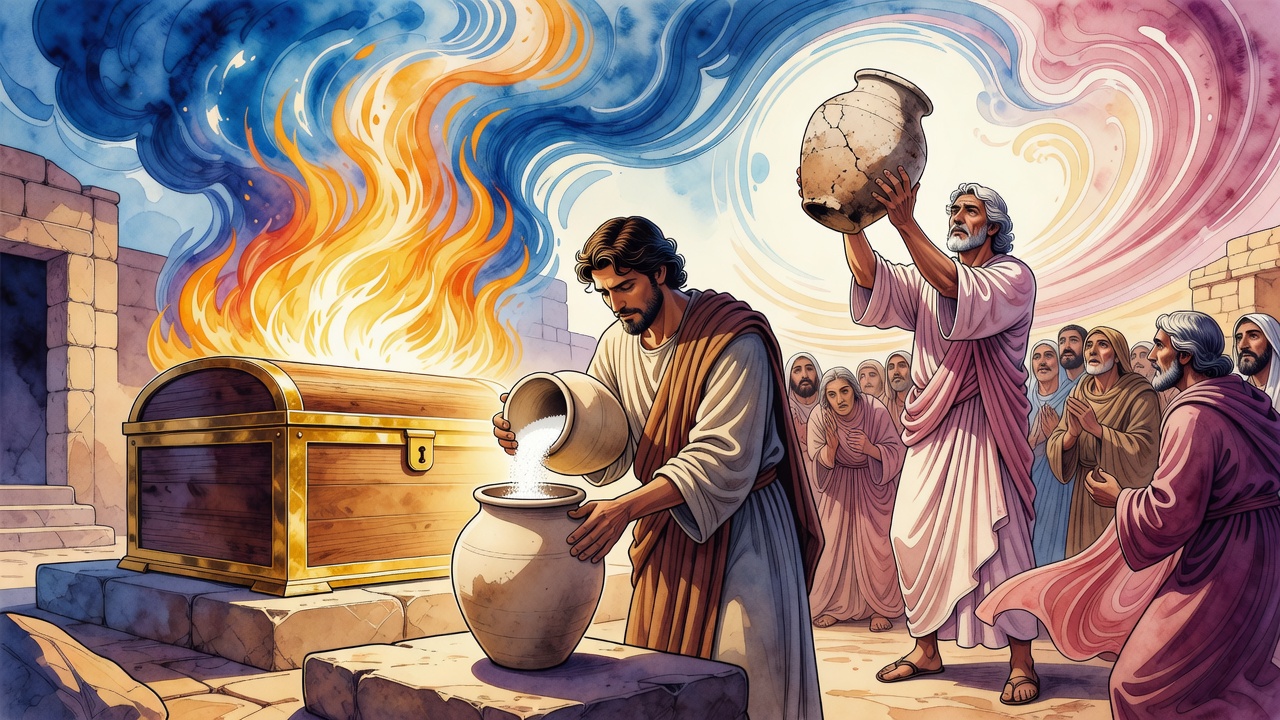
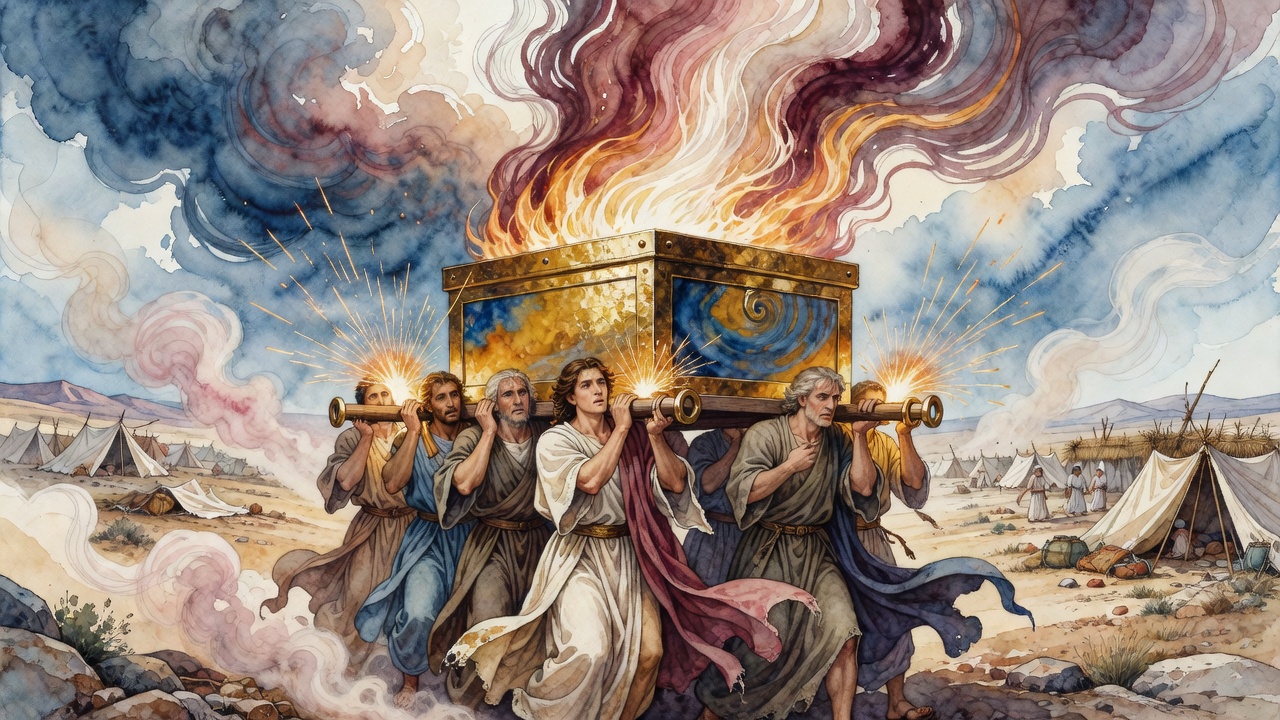
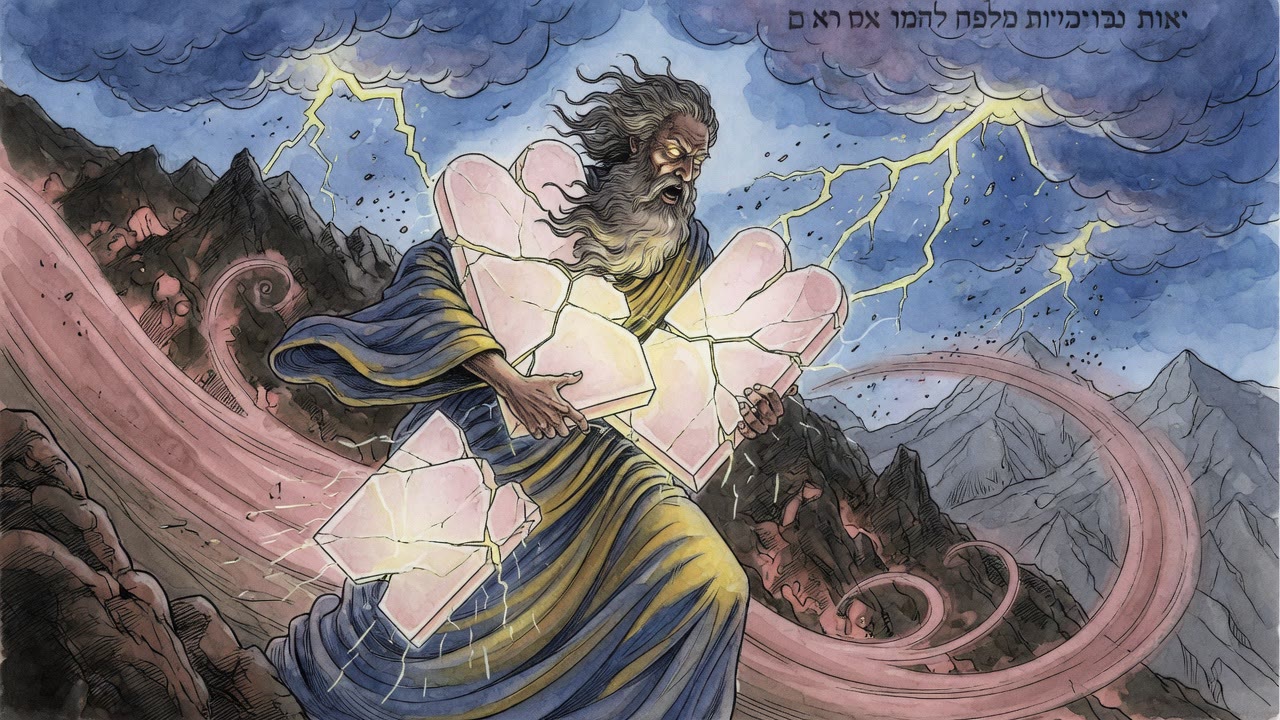
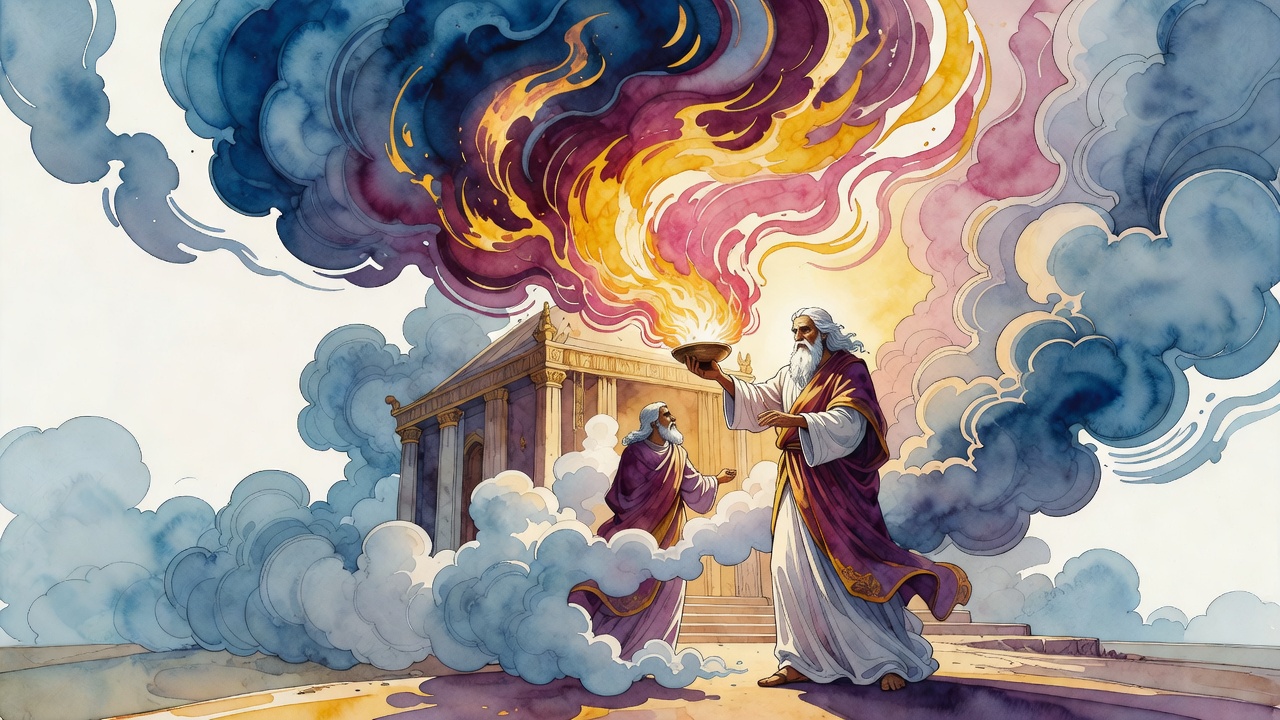
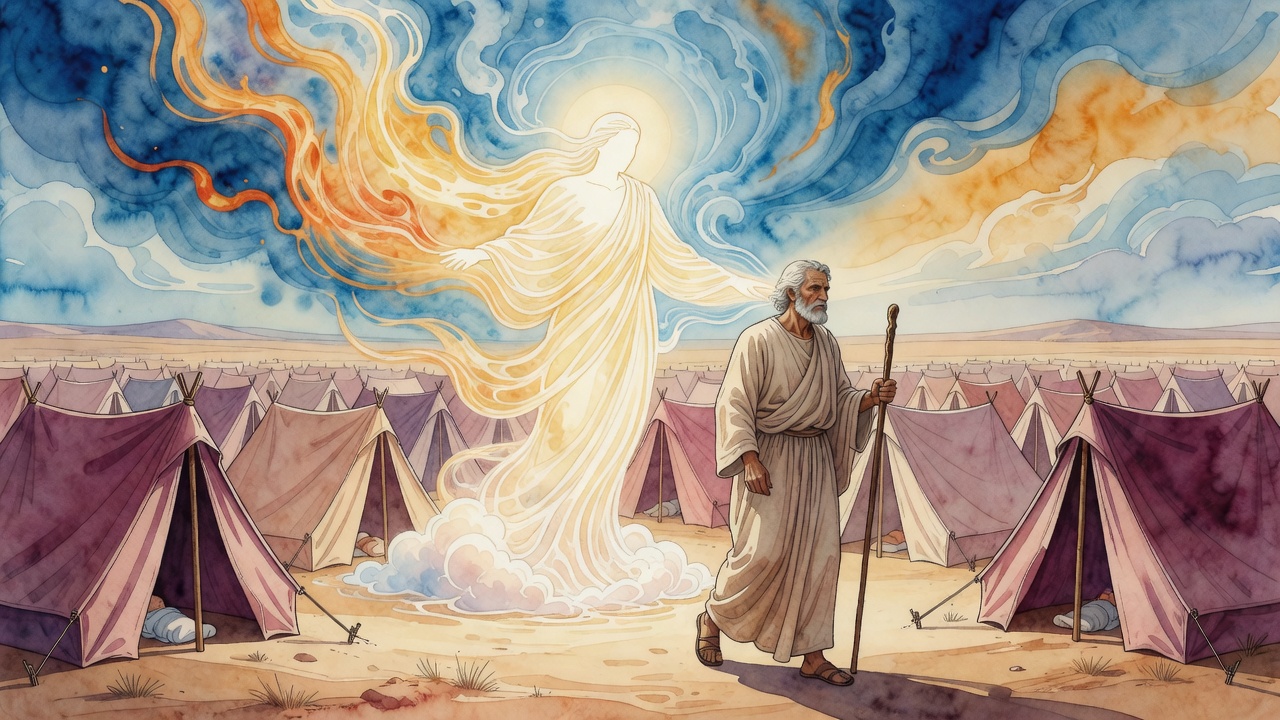
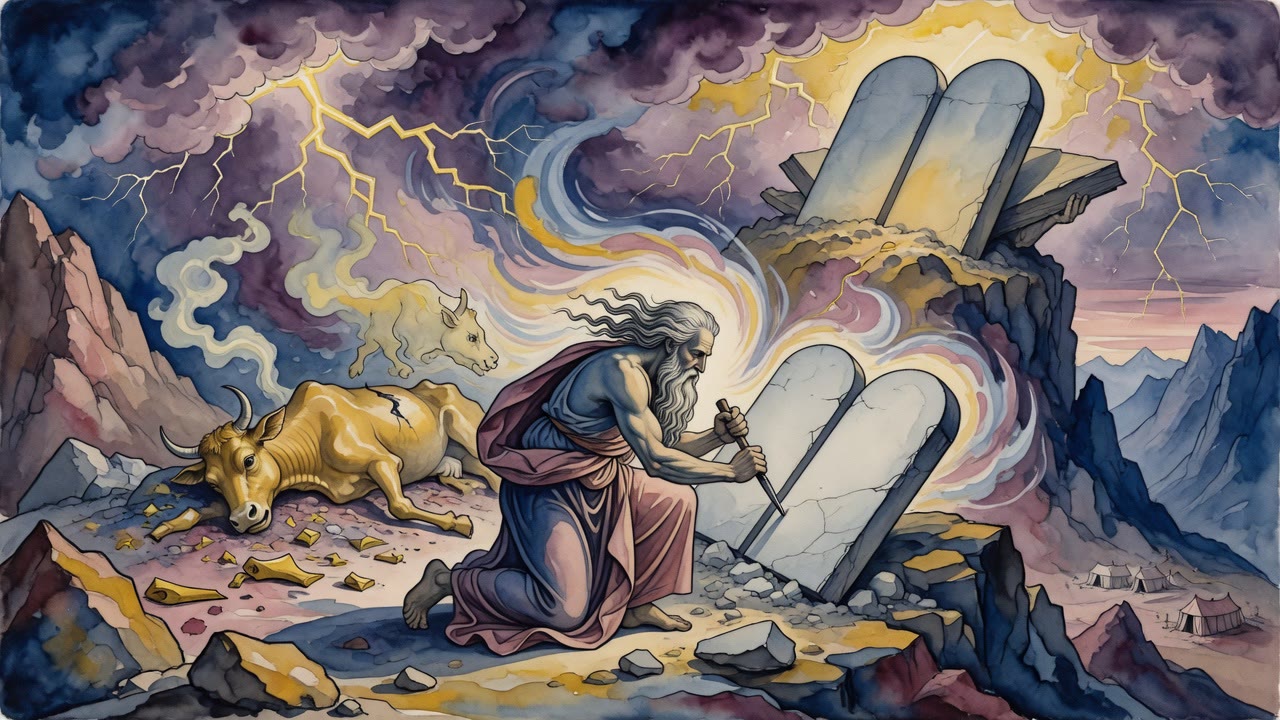
"Two tablets" (Exodus 31:18): corresponding to heaven and earth, corresponding to groom and bride, corresponding to the two best-men, corresponding to this world and the world to come; therefore "two tablets of testimony, tablets of stone," by the merit of Jacob, of whom it is written "from there is the Shepherd, the Stone of Israel" (Genesis 49:24). "They were the work of God" (Exodus 32:16). Every single day a heavenly voice goes forth from Mount Horeb and says: Woe to creatures for the disgrace of the Torah. "The work of God": for they are the handiwork of the Holy One, blessed be He. What is "graven" [harut]? Rabbi Yehuda says: Freedom [herut] from the kingdoms. Rabbi Nehemiah says: Freedom from the angel of death. Our masters say: Freedom from sufferings. "And the people sat down to eat" (this is written at remez 141). The Holy One, blessed be He, said to Moses: They have risen to make sport with idol-worship, and you sit? Go down. At that hour Moses came to descend and saw the angels of destruction, and he was afraid of them, as it is said "For I was in dread of the anger and the wrath" (Deuteronomy 9:19). What did he do? He went and grasped the throne, as it is said "He holds fast the face of His throne" (Job 26:9), and the Holy One, blessed be He, shielded him and spread the radiance of His Presence over him. Come and see how much sins cause: yesterday Moses was vanquishing them, and now he is afraid of them. There are five angels of destruction: Anger, Fury, Wrath-breaker, Destroyer, and Heat. Moses mentioned the three patriarchs and three departed; Anger and Heat remained. Moses said before the Holy One, blessed be He: Master of the universe, You stand against one and I against one, as it is said "Arise, O LORD, in Your anger" (Psalms 7:7). The Holy One, blessed be He, said to him: Go down, it is a descent for you. He said: Why? Because your people have acted corruptly. Moses said to Him: now they are my people and not Your people? "Turn from Your fierce anger" (Exodus 32:12). Rabbi Shimon ben Yohai said: Moses did not budge from praying until the Holy One, blessed be He, was reconciled to him. The Holy One, blessed be He, said: In this world, because the evil inclination was present in you, you sinned before Me; but in the world to come I will uproot it from you, as it is said "And I will remove the heart of stone from your flesh" (Ezekiel 36:26). "And the people sat down to eat and to drink and rose up to make sport." Let a person guard against excessive idle talk and frivolity. Rabbi Akiva said: Jesting and lightheadedness accustom a person to lewdness. "Sport" means nothing but idol-worship, as it is said "And the people sat down" and so forth. "Sport" means nothing but bloodshed, as it is said "Let the young men now arise" and so forth (2 Samuel 2:14). "And now do not scoff" and so forth; "Hear the word of the LORD, you men of scorn" and so forth. The Holy One, blessed be He, said to Israel: My children, I am He who sat nine hundred and seventy-four generations before the world was created until I expounded and searched, refined and tested all the words of the entire Torah. And from the day the world was created until that hour, I sat upon My throne of glory: a third of the day I read and study, a third of the day I judge judgment, and a third of the day I do charity, sustaining and providing for all who come into the world. And there is no sport before Me except for one hour, when the nations of the world say, Come and let us make war against Him, as it is said "Why do the nations rage," and it says "He who sits in heaven laughs." And in another place too there is before Me a laughter that is not laughter, as it is said "Take to yourself spices" (Exodus 30:34), and galbanum is nothing but foul-smelling; rather, because the Holy One, blessed be He, has abundant mercy upon Israel always, both upon the wicked among them and upon the worthy among them. And when is there before Me a laughter that is not laughter? When the wicked of Israel devour the worthy among them, as it is said "The wicked plots against the righteous and seeks to slay him," and it is written "the LORD laughs at him." Aaron knew within himself that a great matter had come upon Israel through him, and he stood and tied an iron belt about his loins and went around all the camps of Israel: whoever did not know prayer, he taught him prayer; whoever did not know the Shema, he taught him the Shema; whoever was not versed in the body of Torah, he brought him into the body of Torah. And not Aaron alone, but anyone who teaches Torah in public to Israel for the sake of Heaven, the Omnipresent has mercy on him and grants him wisdom, understanding, knowledge, and insight, and grants him a portion with the three righteous ones, Abraham, Isaac, and Jacob. A person should always conduct himself by eighteen virtues: pleasant in his entering, pious in his sitting, in humility, in awe, wise in Torah, sharp in good deeds, well-received and accepting of others and acknowledging the truth and speaking truth in his heart and confessing and forsaking and loving the Holy One, blessed be He, with complete love even when things go ill for him, sighing over the honor of the Holy One, blessed be He, and over the honor of Israel all his days, desiring and yearning and longing for the honor of Jerusalem and the honor of the Temple and for the salvation that will soon sprout and for the ingathering of the exiles, with the holy spirit in his words, as it is said "For there is yet a vision for the appointed time." A person should be pleasant in his entering the study house so that he may be beloved above and cherished below and so that he may fill out his days. A person should increase words of Torah, for you have no greater reward than this. A person should ask and answer in his sitting in the study house, so that his wisdom may increase and so that he not come to drowsiness, as it is said "and slumber clothes a man in rags" (Proverbs 23:21), for you have no quality as harsh in the world as one who dozes in the synagogue and the study house. A person should ask about the verse even though everyone mocks him, as it is said "If you have been vile in lifting yourself up" and so forth (Proverbs 30:32). They say to a person: before you ask for mercy that words of Torah enter your innards, ask for mercy over the transgressions you have committed, that they be forgiven you; and from this a person will hear and remember it from the four that precede it. Moreover, anyone who increases jesting, idle talk, and frivolity brings fierce anger into the world and the fruits diminish; and if he was within the family and the family members rejoice in him, he exiles the whole family; and likewise the people of the courtyard, the people of the alley, the people of the neighborhood, the people of the city, he exiles the whole city, as it is said "Swearing and lying" and so forth, "therefore the land mourns." Why? Because they do not rebuke Israel, as it is said "Yet let no man contend" and so forth (Hosea 4:4); should a priest meet him and laugh with him, he shares with him in the punishment, and likewise a prophet and a prince, as it is said "And you shall stumble this day, and the prophet also shall stumble with you; My people are destroyed for lack of knowledge" (Hosea 4:5-6). The sages taught: Be humble toward every person, and toward the people of your household more than toward every person. Go and learn from the Holy One, blessed be He, for so it was: a hundred and twenty days from the day the Torah was given until the Day of Atonement; the first forty days Moses went up on high, and so forth. A parable: to a king who married a woman, and he loved her with complete love. He sent and brought one of their kin to make him a messenger between him and her, and he showed him all his bridal canopies and chambers and hidden places. He said to him: My son, go say to the woman, I need nothing of you, only make yourself a small canopy, so that I may come and dwell with you in your quarter, so that my servants and the members of my household may know that I love you with complete love. While the king was busy sending the woman many gifts, they came and told him: your wife has played the harlot with another. Immediately the king set everything down from his hand, and the messenger was thrust back, as it is said "Go down, for your people have acted corruptly"; and it is written "While the king was at his table" (Song of Songs 1:12) he should have said "my nard gave its stench," yet he said "my nard gave its fragrance." Rather, since Israel accepted the kingship of the Holy One, blessed be He, upon themselves and said "We will do and we will hear" (Exodus 24:7), He remembered the first and overlooked the last. What is written of Aaron? "The Torah of truth was in his mouth." And would it enter your mind that Aaron worshiped idols? Rather, he did not worship; he only delayed until Moses should come. And some say: just as Jacob our father intended "and they gave to Jacob all the foreign gods," Jacob keeping the Torah before it was given to him, so Aaron intended; yet even so Scripture accounted it to him as if he had worshiped idols, as it is said "And the LORD struck the people" and so forth. The middle forty days Moses took the tent, as it is said "And Moses would take the tent" (Exodus 33:7), and Israel observed mourning over themselves all those days, until the Holy One, blessed be He, said to Moses: Moses, what shall those poor ones do? They are banned to Me, banned to you; banned to the master, banned to the disciple. Return, and enter the camp, as it is said "And the LORD spoke to Moses... and he returned to the camp," teaching that the Holy One, blessed be He, released his ban for him and returned the tent to the camp. The forty days that Moses went up on high to bring the Torah to Israel, Israel observed all those days with fasting; and the last day of all of them they decreed a fast and lodged in fasting. The next day they agreed and went up before Mount Sinai and were weeping toward Moses, and Moses was weeping toward them, until their weeping rose before the Holy One, blessed be He. At that hour the mercy of the Holy One, blessed be He, was stirred, and He accepted them in repentance, and the holy spirit brought them good tidings from before Him. He said to them: My children, I swear by My throne of glory that this weeping shall be for you a weeping of joy, and it shall be for you a day of atonement and pardon, for you and for your children's children until the end of all generations. "And he shattered them beneath the mountain" (Exodus 32:19). Moses gazed at the tablets and saw that the writing had flown off from them, and he cast them from his hands. Immediately he was struck dumb and could not return a word. At that hour a decree was enacted upon Israel that they should learn it through pain and through subjugation and through wandering and through confusion and through hardship and through their lacking sustenance. And on account of that pain which they suffer, the Holy One, blessed be He, will in time to come repay them their reward in the days of the Messiah, doubled and redoubled, as it is said "Behold, the Lord GOD will come with might, and His arm rules for Him; behold, His reward is with Him" (Isaiah 40:10), and it says "Who has preceded Me, that I should repay him?" (Job 41:3): to my benefit my cow's leg was broken, so that my wage might be complete. And likewise Aaron said: had it not been for Korah, that covenant would not have stood firm upon me, as it is said "a memorial to the children of Israel, that no stranger draw near" and so forth; he said: to my benefit my cow's leg was broken. Moses said before the Holy One, blessed be He: Master of the universe, let me go down before You and execute judgment upon them; if all of them worshiped with a whole heart, let all of them die in one day. He went down from before Him, took the calf and burned it. "And Moses stood in the gate of the camp" and so forth (Exodus 32:26-27). I call heaven and earth to witness against me that the Holy One, blessed be He, did not say to Moses, Stand in the gate of the camp and say, Whoever is for the LORD, to me; thus said the LORD, the God of Israel. Rather, Moses reasoned an a-fortiori argument within himself: if I say to them, slay each man his brother, Israel will say to me, did you not teach us thus, a Sanhedrin that puts one person to death in a week is called destructive, and why are you killing three thousand in one day? Therefore he hung the matter upon the honor of Heaven above. Moses turned back and asked for mercy. He said: Master of the universe, You are righteous, You are pious, and all Your deeds are in faithfulness; let Your abundant mercies roll over Your children; on account of three thousand who worshiped with a whole heart, shall six hundred thousand die, those of twenty years, those of eighteen, those of fifteen, those of ten, those of three, those of two, those of one year, and how many proselytes and how many slaves were added to them, so that the matter has no end? Immediately the mercy of the Holy One, blessed be He, was stirred and He was reconciled with them. A parable: to what is the matter like? To a king before whom his firstborn son sinned, and he seized him in his hand and put him into the hand of his servant. He said to him: Go out and slay this one and give him to the beast and to the dogs. What did that servant do? He took him out from before him and set him in his own house, and ran and came and stood before him. At the end of thirty days, when the king's heart was good upon him and his servants and the members of his household were reclining before him, when he lifted his eyes and did not see his firstborn son, grief and groaning entered his heart, and no creature recognized it in him except his servant, the steward of his house. Immediately he ran, and they brought before him a beautiful crown that had been set before him; he took it and placed it on the head of his servant, the steward of his house. To this Moses the righteous was likened. Since he stood in prayer in four and five places and saved Israel from death, the Holy One, blessed be He, said to him: Moses, since you stood before Me and saved Israel from death, the crown of Torah that is set aside for Israel and their children and their children's children for the Torah they performed, behold it is set aside for you forever, as it is said "And the children of Israel saw the face of Moses" (Exodus 34:35). Lest you say, since Moses entered his eternal home that radiance of face and that crown were taken from him, the teaching states "And there has not arisen a prophet since in Israel like Moses" and so forth (Deuteronomy 34:10): just as the face above, its light is upon them forever and to all eternity, so the radiance of Moses, as it is said "And Moses was a hundred and twenty years old when he died; his eye was not dim" and so forth. And not Moses alone, but every Torah scholar who sits and occupies himself with Torah from his youth until his old age and dies, has not yet died but is alive forever and to all eternity, as it is said "and the soul of my lord shall be bound in the bundle of the living" (1 Samuel 25:29). And why did Scripture pair it to say "with the LORD your God"? Rather, to tell you: just as the LORD your God lives and endures forever and to all eternity, so a Torah scholar who sits and occupies himself with Torah from his youth until his old age is alive forever and to all eternity; and where is his seat? Beneath the throne of His glory. And not this alone, but the reward of Moses is as though he had created them; therefore it is said "And he remembered the days of old, Moses His people" and so forth (Isaiah 63:11). And every sage of Israel who has within him words of Torah in their truth, and desires and yearns and is distressed for the honor of Jerusalem and the honor of the Temple and for the salvation that will soon sprout and for the ingathering of the exiles, with the holy spirit in his words, "Where is He who put His holy spirit within him?", that Torah scholar needs neither sword nor lance nor spear nor anything to guard him; rather the Holy One, blessed be He, guards him Himself, and the ministering angels stand around him with swords in the hands of all of them, guarding him, as it is said "the high praises of God in their throat and a two-edged sword in their hand" (Psalms 149:6).

 Click for full size