5 min read

Solomon the King Who Needed Daily Reminders of the Law

Seven men had one job: remind Solomon of Torah's rules for kings before he sat down each day. The wisest man alive still needed people to keep him honest.

Curated by Arthur · Told by Maggid ·
Table of Contents
  1. The Throne That Required a Herald
  2. What the Throne Actually Did
  3. When Wealth Became Its Own Problem
  4. The Prophecy He Tried to Beat
  5. What the Torah Said About Solomon

The Throne That Required a Herald

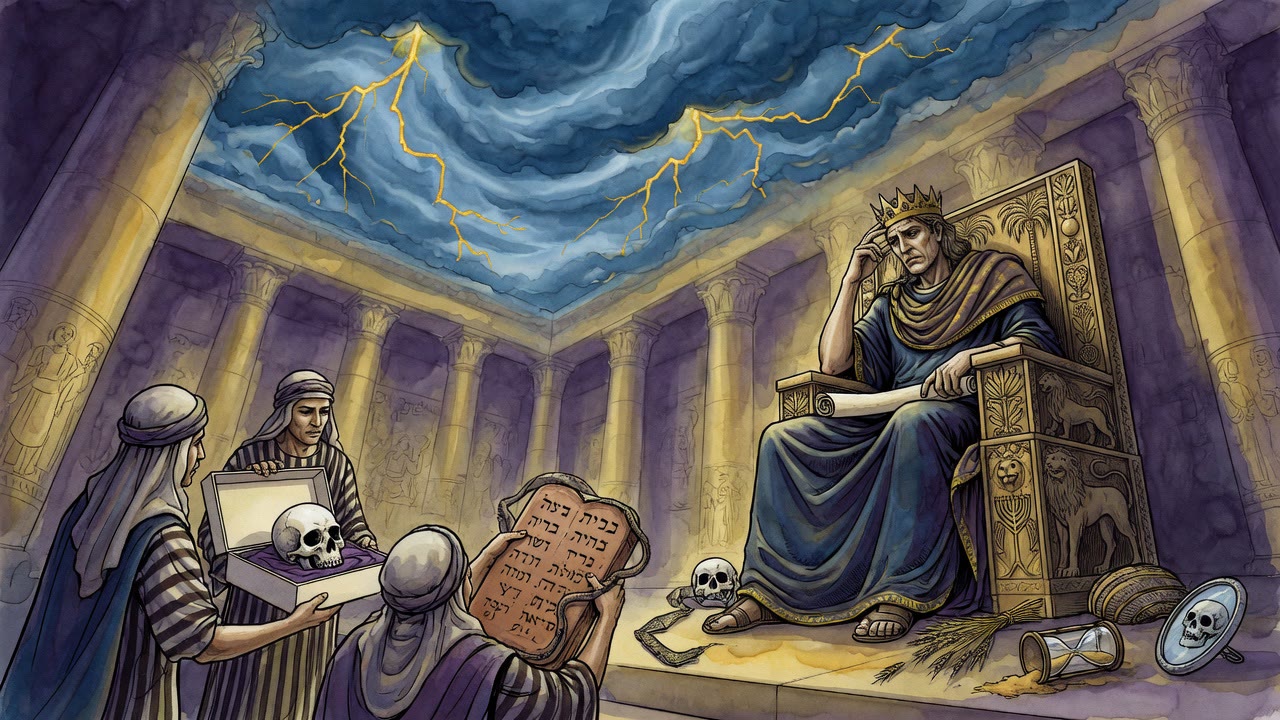
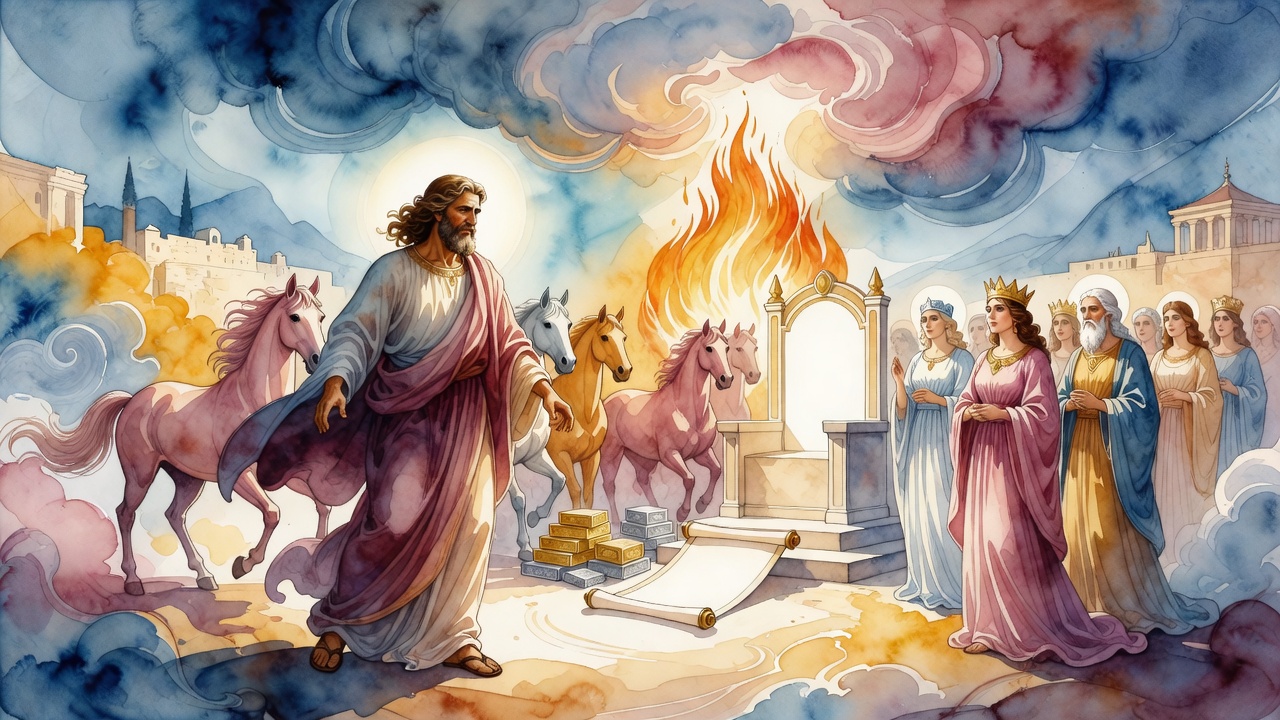
Before Solomon could sit down, the herald had to speak. Every morning, before the king settled into his famous throne, the one with the golden lion and the golden eagle and the mechanical arms that helped him ascend the six steps, a designated official read aloud the Torah's laws concerning kings. The same laws, every morning. You shall not multiply horses. You shall not multiply wives. You shall not greatly multiply silver and gold for yourself.

Seven men rotated through this duty in Ginzberg's account from Legends of the Jews. Their only job was to remind the wisest man in the world of rules he already knew. The fact that they were needed at all is the whole point of the story.

What the Throne Actually Did

The throne itself was an act of instruction. Each of the six steps had animals positioned on either side, twelve animals total, all in gold. At the first step, a golden ox and a golden lion faced each other. At each subsequent step, different animals, bears, eagles, leopards, wolves. At the top sat a golden dove holding a golden hawk in its talons.

Each pair had a meaning. Each step required Solomon to walk between the animals and consider what they represented about justice, about power, about the proper conduct of a king. The throne was not merely decorative. It was a machine for reminding the king, through the act of sitting down, that his authority came with conditions. The seven men spoke. The throne spoke. Everything in Solomon's court was designed to speak to him constantly about what his position required.

When Wealth Became Its Own Problem

For a time, the reminders held. Then the wealth accumulated past what the reminders could contain. Solomon acquired horses from Egypt, which the Torah specifically prohibited for the king. He married wives from foreign nations, which the Torah warned would turn his heart. His silver became so abundant that the tradition says silver lost its value in Jerusalem during his reign, not metaphorically, but in the marketplace.

The rabbis did not portray this as sudden corruption. They showed it as gradual erosion. Each acquisition came with a rationalization. He was expanding trade. He was securing alliances. He was using his wisdom to understand that the rules were written for smaller kings who needed the guardrails more urgently. That was the specific failure the tradition wanted to preserve: not that he stopped believing in the rules, but that he became convinced he understood them well enough to apply them differently.

The Prophecy He Tried to Beat

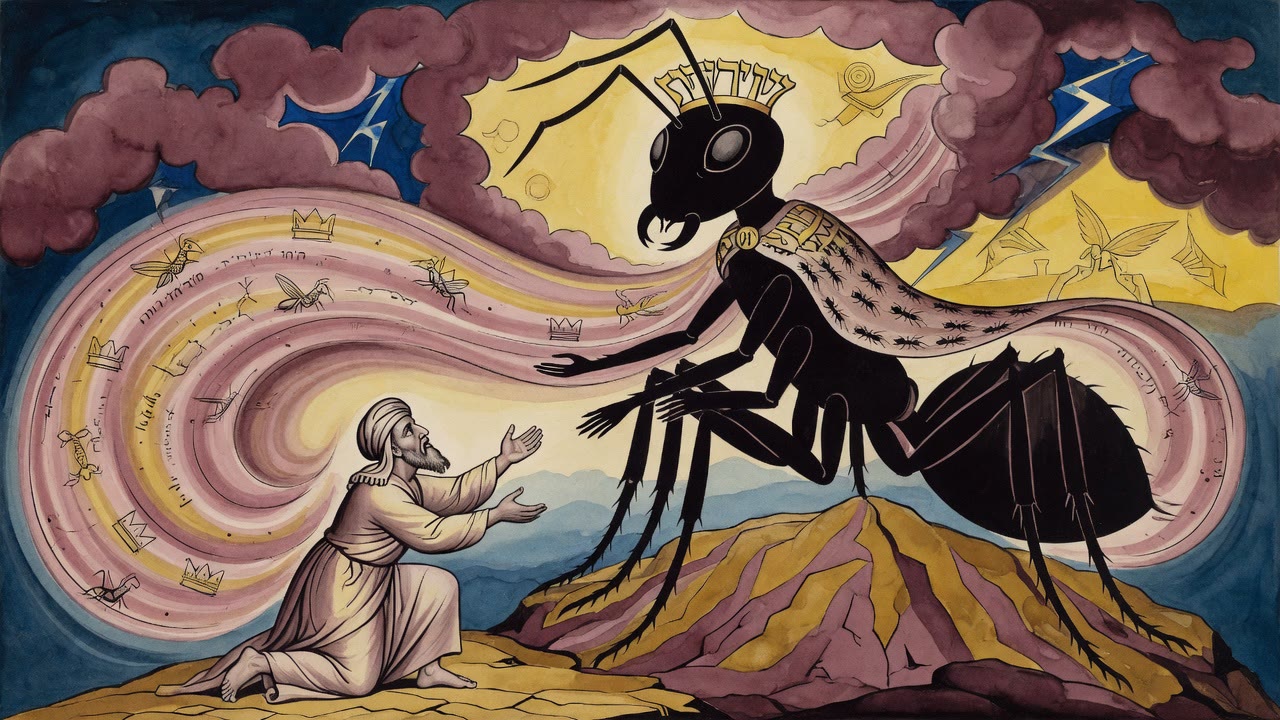
There is a story in which Solomon learned from astrologers that his daughter was destined to marry a poor man. He locked her in a tower on a remote island to prevent the prophecy from coming true. That night a young man, cold and exhausted, found a large bird, killed it for warmth, and climbed inside the carcass to sleep. In the morning, wind carried the carcass to the top of the tower. The young man climbed out, found Solomon's daughter, and they married.

When Solomon discovered what had happened, he asked the young man who he was. The young man was poor. The prophecy had fulfilled itself anyway. Solomon's response, in the tradition's telling, was to accept this as a lesson about the limits of wisdom applied to circumventing what was written. He had been wiser than any man alive and had failed to outmaneuver a destiny.

What the Torah Said About Solomon

Midrash Tehillim, a collection of rabbinic homilies on the Psalms compiled in late antique Palestine, found Solomon in the opening of Psalm 119: blessed are those who keep God's testimonies, who seek God with a whole heart. The verse was not written about Solomon. The Midrash brought Solomon to it anyway.

What the rabbis found there was a distinction between receiving Torah and living it. Solomon received. The seven men who read the daily reminders, the throne with its twelve animals, the whole architecture of his court had been designed to help him live it. The question the Midrash pressed was whether wisdom, taken alone, is enough to sustain obedience. The answer, in Solomon's case, was that it was not.


← All myths

From the tradition

Sources

5 sources

The texts this telling draws on, in full. Open a card to read inline, or expand it for a wider, quieter read.

Legends of the Jews 5:109Legends of the Jews

Legends of the Jews turns to Solomon Had a Dedicated Team to Keep Him Humble.

Solomon, radiant in his royal garments, approaches his magnificent throne. It wasn't just a chair; it was a symbol of power, responsibility, and divine mandate. But before he could even settle in, a herald steps forward.

This wasn't just any courtier. These were seven specially appointed individuals whose sole purpose was to keep Solomon grounded, to ensure he didn't let his power corrupt. As Solomon placed his foot on the very first step of the throne, the first herald boomed out, reciting the law for kings: "He shall not multiply wives to himself." A direct quote from (Deuteronomy 17:17), a potent reminder against succumbing to worldly desires.

Step two. Another herald. Another warning: "He shall not multiply horses to himself." Again, (Deuteronomy 17:16). This wasn’t about equestrian enthusiasm; it was about avoiding military might for its own sake, relying on God instead.

The ascent continued. Step three: "Neither shall he greatly multiply to himself silver and gold." The third verse from that same passage of Deuteronomy, 17:17. Wealth can corrupt, the herald implied.

Each step brought a new reminder, a new check on his power. At the fourth step, he was told, "Thou shalt not wrest judgment." At the fifth step, "Thou shalt not respect persons." And at the sixth, "Neither shalt thou take a gift." These are all based on core principles of justice and fairness found throughout the Torah. The heralds were ensuring impartiality was upheld.

Finally, Solomon reached the seat of the throne. Just as he was about to sit, the seventh herald cried out, a phrase that must have echoed in Solomon's ears every single day: "Know before whom thou standest."

Powerful, isn't it?

It's a potent reminder that even the wisest, most powerful individuals are accountable. They are accountable to the law, to the people, and ultimately, to something far greater than themselves. This wasn't just about rules; it was about maintaining a moral compass, about ensuring justice and righteousness prevailed in the kingdom.

So, the next time you face a decision, big or small, remember Solomon and his seven heralds. Ask yourself: What are the principles that should guide me? And perhaps most importantly: Before whom do I truly stand?

Full source
Legends of the Jews 5:108Legends of the Jews

Not just any throne, but a marvel of engineering and symbolism, a machine practically alive with gold and precious stones.

Solomon approaches the first step. The moment his foot touches it, the whole contraption springs to life. A golden ox, yes, a golden ox!, rises and guides him to the next step. Then, the ox hands him off to the beasts guarding that second step, and they, in turn, escort him to the next.

This isn't just a staircase; it's a journey, a ritual. According to Legends of the Jews, retold by Ginzberg, this elaborate process continues step by step, each level guarded by different creatures. Up, up, up Solomon goes.

By the time he reaches the sixth step, eagles swoop down, taking him the rest of the way and gently placing him upon the throne itself. Can you imagine the awe?

But the spectacle doesn't end there. As soon as he's seated, a giant eagle, a truly majestic creature, places the royal crown upon his head. A fitting symbol of power, no?

Then, a huge snake, seemingly part of the machinery itself, coils around, forcing the lions and eagles upward until they form a protective circle around the king's head. It’s a breathtaking image – power, majesty, and a hint of the wild, untamed world, all surrounding the wise ruler.

And wait, there's more! A golden dove descends from a pillar, carrying in its beak the most precious of burdens: the sacred scroll. This isn’t just any scroll; it’s the Torah, the embodiment of Jewish law and wisdom. The dove presents it to Solomon, a reminder, Ginzberg tells us, that even a king is bound by the laws of the Scriptures, to "have the law with him and read therein all the days of his life."

The scene culminates in a flourish of natural beauty. Twenty-four vines, intertwined to form a shady arbor, arch over the king's head. And, as Solomon makes his ascent, sweet, aromatic perfumes waft from two golden lions. The senses are completely overwhelmed.

It's quite a throne, isn't it? More than just a seat of power, it's a symbol of divine connection, earthly authority, and the importance of wisdom and law. It makes you wonder, doesn't it, about the stories we tell ourselves about power, leadership, and the responsibilities that come with them? Perhaps there's a lesson in Solomon's throne for all of us, no matter how humble our own seats may be.

Full source
Legends of the Jews 5:130Legends of the Jews

Solomon, in all his glory. The king whose wisdom was legendary, whose wealth was unparalleled, whose temple stood as a evidence of divine favor. Yet, even he wasn't immune to the temptations of the world.

The story goes that as Solomon’s riches grew, so did his forgetfulness of God. He started collecting wives – going directly against the instructions laid out for kings in the Torah. And not just wives, but horses too, and mountains of gold. Essentially, he was doing everything Deuteronomy explicitly warned against.

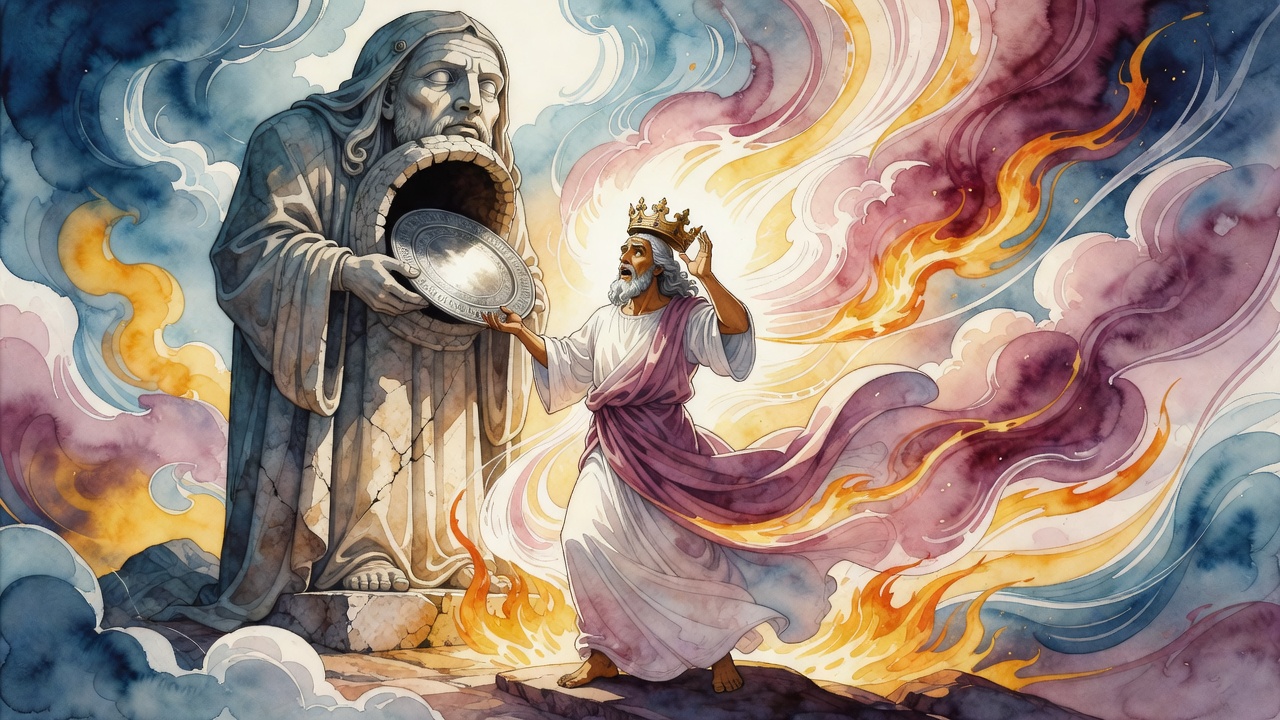
The scene. The Book of Deuteronomy itself – personified, no less! – steps before God. "Look, O Lord," it says, "Solomon is trying to erase a Yod from me!" A Yod, the smallest letter in the Hebrew alphabet, but immense in its significance.

Deuteronomy is referring to the passage, "The king shall not multiply horses unto himself, nor shall he multiply wives to himself, neither shall he greatly multiply to himself silver and gold" (Deuteronomy 17:16-17). According to this tradition, Solomon’s actions were so egregious, so directly opposed to divine law, that it was as if he were trying to literally tear a letter from the very scroll of the Torah itself.

God’s response? It’s "As thou livest," He declares, "Solomon and a hundred of his kind shall be annihilated ere a single one of thy letters shall be obliterated."

Whoa.

It's a powerful reminder that even the most powerful figures are accountable. No amount of wisdom or wealth can excuse disobedience to divine law. The integrity of the Torah, even down to the smallest letter, is paramount. This isn't just about following rules; it's about the very foundation of faith and covenant.

What do we take away from this? Maybe it's a warning to ourselves, regardless of our own status or accomplishments. Are we allowing the allure of the material world to cloud our spiritual vision? Are we, in our own ways, perhaps trying to erase a little Yod here and there? It’s a question worth pondering.

Full source
Legends of the Jews 6:3Legends of the Jews

There's a fascinating tale in Legends of the Jews, as retold by Ginzberg, that dances right on that very question. It involves King Solomon, his daughter, and a prophecy that seemed inescapable.

It begins with Solomon, the wisest of men, learning from astrologers that his daughter was destined to marry a poor man. Now, Solomon, being a king, wasn't thrilled with this cosmic forecast. So, what did he do? He locked his daughter away in a tower, attended only by eunuchs, thinking he could outsmart fate itself.

As The familiar version gives us, fate has a funny way of working. The princess, despite her gilded cage, did indeed meet a man, fell in love, and yes, even married him! The eunuchs, upon noticing her pregnancy, realized the prophecy had come to pass. The princess confessed to her marriage, and Solomon summoned the man.

Here's the twist. The man, the "poor man" of the prophecy, turned out to be a scholar, blessed with both wisdom and beauty. Solomon, recognizing the hand of fate, and perhaps seeing the inherent goodness in his son-in-law, thanked God. He recognized that the prophecy wasn't necessarily a curse, but simply a path. A path that led his daughter to a worthy partner.

It makes you wonder: did Solomon's attempt to thwart destiny actually set the stage for it to unfold exactly as it was meant to?

But the story doesn't end there. The shadow of future division loomed large even in Solomon's time. We're talking about the eventual split of the kingdom into Judah and Israel.

The Legends of the Jews, drawing on earlier sources, paints a scene where Solomon, the day after his wedding to the Egyptian princess, oversleeps. We're talking serious oversleeping. So much so that he neglects the Temple service! His head lay upon the pillow, and beneath it, the very key to the Temple itself!

Enter Jeroboam, leading eighty thousand Ephraimites. Imagine the scene: Jeroboam confronting the king, publicly calling him out on his negligence. It's a bold move, to say the least.

And how does God respond? Not with anger toward Solomon, but with a rebuke to Jeroboam! "Why dost thou reproach a prince of Israel?" God asks, according to Ginzberg. "As thou livest, thou shalt have a taste of his rulership, and thou wilt see thou are not equal to its responsibilities."

It's a fascinating glimpse into the complex relationship between leadership, responsibility, and divine judgment. Jeroboam, in his zeal, is reminded that leadership isn't just about pointing out flaws, but about bearing the weight of responsibility. It's a heavy burden, one that Solomon, despite his wisdom, sometimes struggled with.

These two stories, seemingly disparate, are woven together by the theme of destiny and responsibility. Can we escape our fate? Or are we simply players in a larger drama, guided by forces beyond our understanding? And what does it truly mean to be a leader, to bear the weight of a kingdom, and to answer to a higher power? Food for thought, wouldn't you agree?

Full source
Midrash Tehillim 119:2Midrash Tehillim

Midrash Tehillim, a collection of rabbinic interpretations of the Book of Psalms, dives right into this very idea. It starts with the verse, "Blessed are those who keep His testimonies, who seek Him with the whole heart." Simple enough. But as always with Jewish wisdom, the beauty is in the unpacking.

The Midrash (rabbinic interpretive commentary) then throws us a bit of a curveball: "If Nazareth has raised you, it has also raised you." Now, what does Nazareth have to do with seeking God with all your heart? The interpretation here isn't literal. Instead, it's a play on words, a classic midrashic technique. The idea is that if a seemingly insignificant place like Nazareth. And remember, Nazareth wasn't exactly known as a center of Jewish learning, can elevate you, then surely, the pursuit of wisdom and God's teachings can elevate you even further. It's about recognizing potential, even in unexpected places.

Then, the Midrash turns to the wisdom of Solomon, drawing from the Book of Proverbs. "Listen, my sons, to the instruction of a father and pay attention to gain understanding. For I give you sound teaching; do not abandon my instruction." (Proverbs 4:1-2). It’s a father’s plea, a teacher’s urging. Don’t just hear the words, understand them. Embrace the teachings. Don't let them go in one ear and out the other.

Solomon doesn't stop there. "He taught me and said to me, take hold of my words with all your heart; keep my commands, and you will live." (Proverbs 4:4). See that phrase? "With all your heart." There it is again! It's not enough to just know the rules, to simply check the boxes. You have to internalize them, let them shape your being. Your very life depends on it.

He continues: "Do not forsake wisdom, and she will protect you; love her, and she will watch over you." (Proverbs 4:6). Wisdom isn’t just a set of facts; it’s a companion, a guardian. Love it, cherish it, and it will watch over you. Imagine wisdom as a protective embrace, always there, guiding your steps.

And the punchline from Proverbs: "Hold on to instruction, do not let it go; guard it well, for it is your life." (Proverbs 4:13). This isn't just about memorizing verses or following rituals. It's about making wisdom a part of who you are. It’s about recognizing that instruction, Torah, is not a burden, but a gift, a source of life itself.

The Midrash circles back to the initial verse, reinforcing the point: "Therefore it is said, 'Blessed are those who keep His testimonies.'" It all comes back to that wholehearted commitment.

Finally, the Midrash concludes with another gem from Proverbs: "When you walk, they will guide you; when you sleep, they will watch over you; when you awake, they will speak to you." (Proverbs 6:22). Instruction isn't something you engage with only during study or prayer. It's a constant presence, a guiding light in every aspect of your life. It's there in your waking moments, your slumber, and everything in between. It’s a beautiful image of how wisdom becomes intertwined with our very being.

So, what does it all mean? It suggests that seeking God with all your heart isn't a passive act. It's an active, engaged, and lifelong pursuit. It's about embracing wisdom, cherishing instruction, and letting it guide you every step of the way. It's about making the teachings a part of you, so much so that they become inseparable from your very essence. And maybe, just maybe, that’s where true blessing lies.

Full source