Parshat Mishpatim6 min read

The Angel Went Ahead and Cleared Israel's Road

God offered Moses an angel to lead the way. Moses refused anyone but God. Years later Joshua met the same captain and the angel wept.

Curated by Arthur · Told by Maggid ·
Table of Contents
  1. I Desire No One but You
  2. What an Angel Cannot Do
  3. The Captain Weeps Before Joshua
  4. The Road Clears Anyway

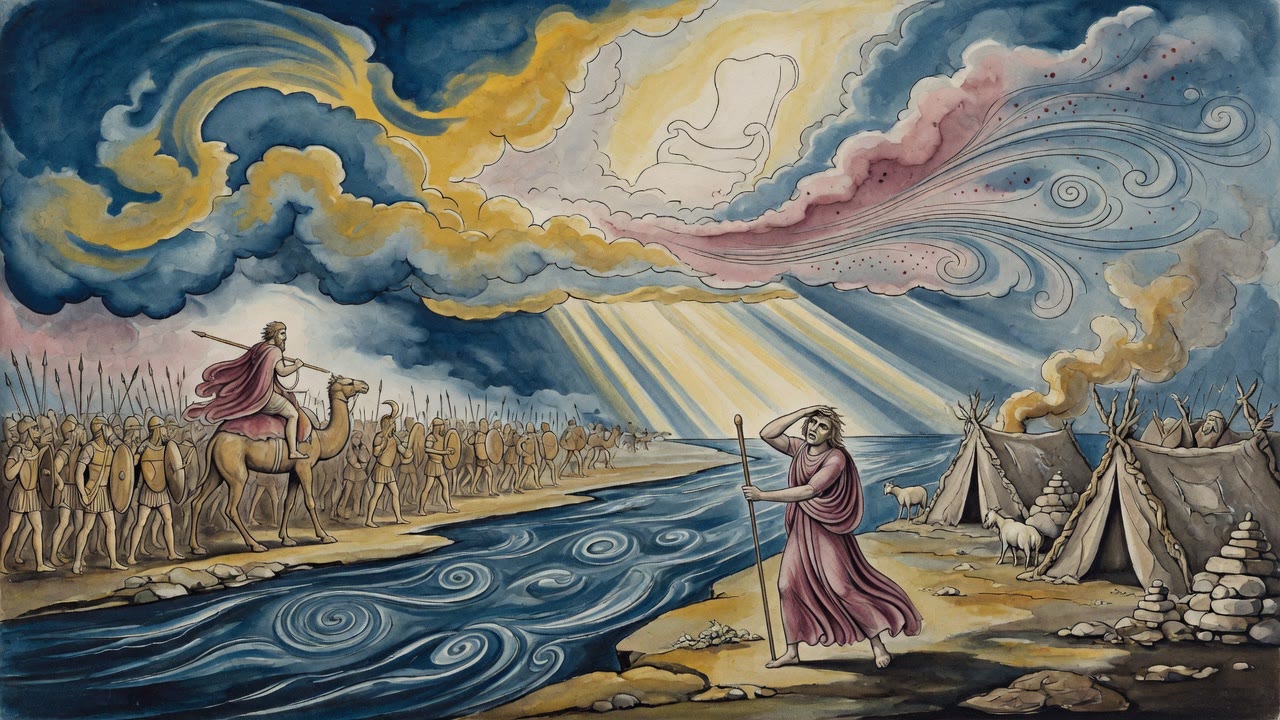
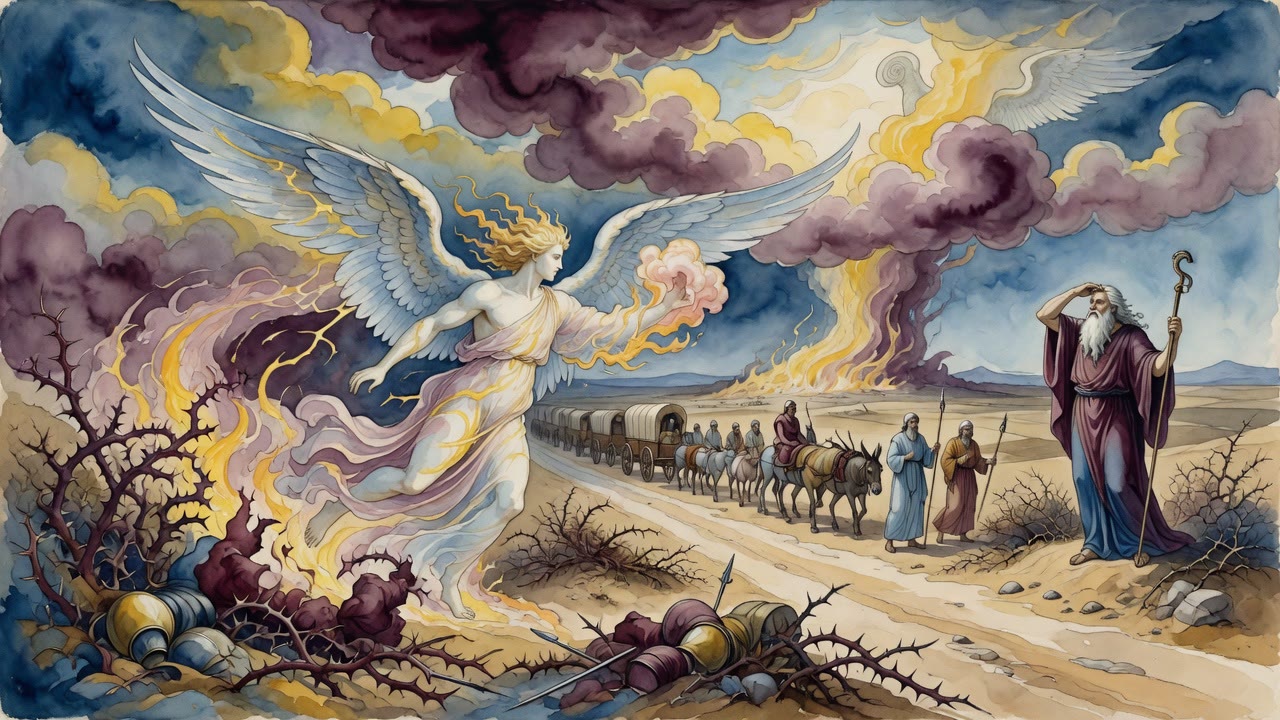
Moses heard the offer and did not bow. The Holy One said He would send an angel before him on the road, a messenger to clear the way and keep him by the way into the place prepared. Moses set his feet in the dust and answered like a man who has already stood in fire and will not trade the Presence for a deputy, no matter how bright the sword.
The Angel Went Ahead and Cleared Israel's Road Click for full size

"If You send it before me alone, I do not desire it. Let the Lord go in the midst of us."

He wanted no captain between the people and the Name. An angel can guard. An angel cannot forgive. Moses had watched this people break a calf and stand again under mercy. He would not hand them to a sinless messenger who cannot lift a face in pardon when the next failure comes.

I Desire No One but You

"I do not wish an angel to accompany us, only You," Moses said. "If You will not go with us, we shall not leave this place. How else will it be known that I and Your people have found favor, if You do not go with us?"

He planted the camp where it stood. No packing. No march. The threat was real: better stalled under God than moving under a substitute. Heaven answered that even without the angel, a hornet would go ahead. Poison poured into Amorite eyes until the eye split and the warrior fell. Bodies trembling. Faces black as furnace soot. Men tall as cedars, strong as oaks, bound and set before Israel the way a father binds an enemy and places him before his son to finish.

Still Moses held the claim. Guide us Yourself. The Name in the midst, not only the Name riding inside a messenger. The road could open by force of hornets and still be the wrong kind of leading if the Presence stayed away.

What an Angel Cannot Do

The warning came with the offer and did not soften it. Take heed of him. Hearken to his voice. He will not pardon your transgressions. He is of the class that does not sin, and a messenger does only what he is sent to do. Forgiveness stays with the One who lifts countenance. David would later cry that if the Lord marked iniquities, who could stand, and that with God there is forgiveness so that He may be feared. Moses already knew that arithmetic in his bones.

A guardian matched to a person's path can walk beside the righteous and help him speak truth when truth costs. An angel can walk beside the one who chooses lies and lead him further into the lie. Camps of angels can fill a road until a thousand fall at one side and ten thousand at the other. One angel can cry honor before a man so that spirits keep their distance. None of that is the same as the Presence that forgives. Moses refused the upgrade that was actually a demotion, a bright escort that could not clean a stain.

He had gone up Sinai. He had held tablets. He would not settle for a captain of hosts when the King Himself had once come down.

The Captain Weeps Before Joshua

Years later, outside Jericho, with the Jordan already crossed and the manna nearly done, Joshua lifted his eyes and saw a man standing opposite him with a drawn sword. The blade caught the late light. Joshua went toward him with his own hand near his weapon and asked the only question a commander can ask at a border.

"Are you for us, or for our adversaries?"

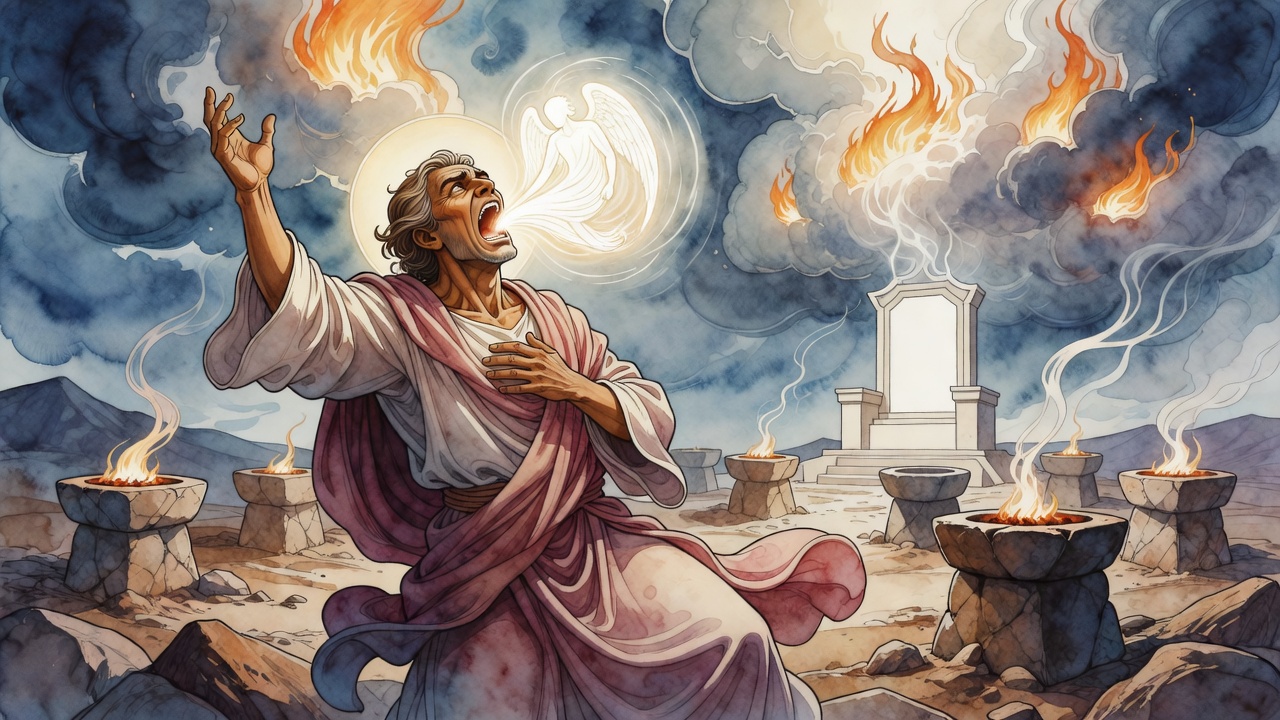
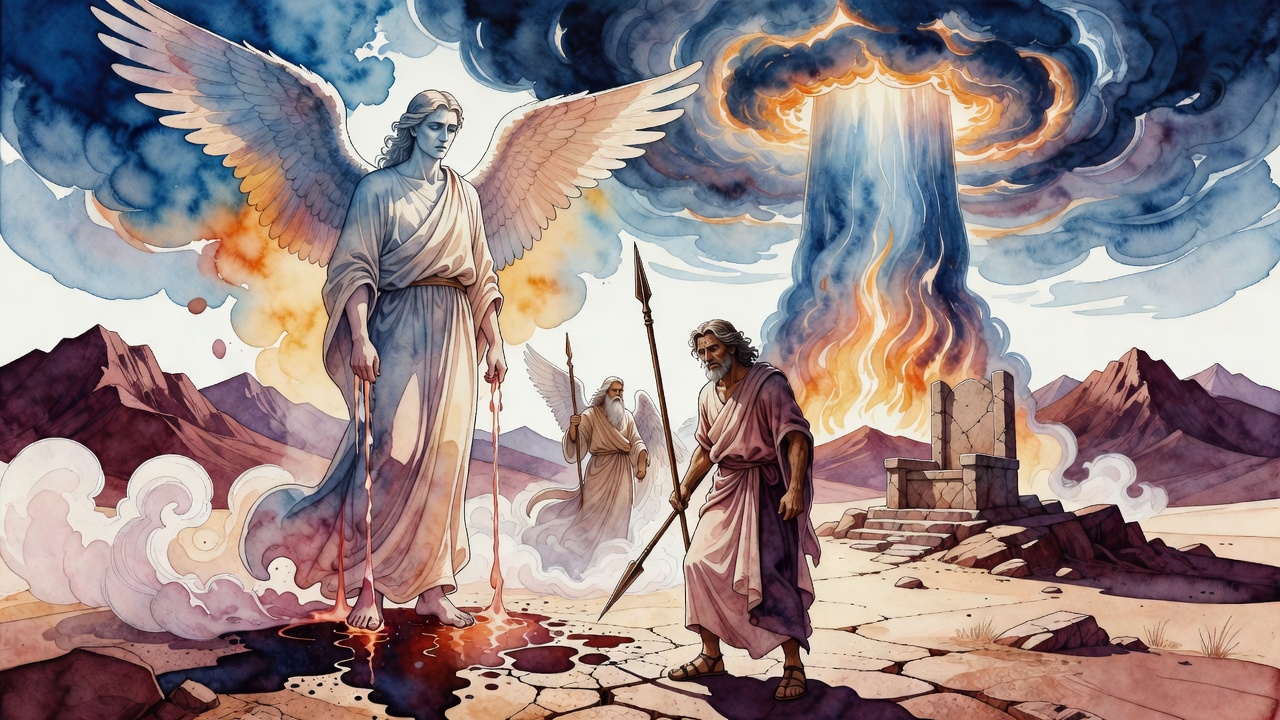
The angel began to cry from the nails of his feet, weeping without stop, a sound too large for a human throat, and answered that he was captain of the hosts of the Lord, and that he had come now. Twice he had come to lead Israel. He was the one who came in the days of Moses, and Moses rejected him, not wishing that escort. Now he had come again, sword out, mission unfinished.

Joshua fell on his face. The ground took his palms and his forehead. Dust stuck to the wet at the edges of his eyes. "What does my lord say to his servant?" The same road Moses would not yield to a messenger, Joshua received on his knees with the sword still bright above the dust. He removed his shoe. The place was holy. The captain who had been refused once stood accepted, still only a messenger, still unable to pardon, still mighty enough that the span from heaven to earth is no more than the palm of such a hand.

The Road Clears Anyway

Even after Moses' refusal, the promise of an angel on the way did not vanish from the law's mouth. Keep the charge, and a keeper goes before you, before everyone who holds the teaching. The earthly house would match a heavenly house prepared above. The Amorites still fell. Their guardian above was struck before their roots below. Fruit destroyed from above, roots from beneath. The people walked into a land whose kings had wanted every strip of its fruit and called themselves kings only if they held a piece of it.

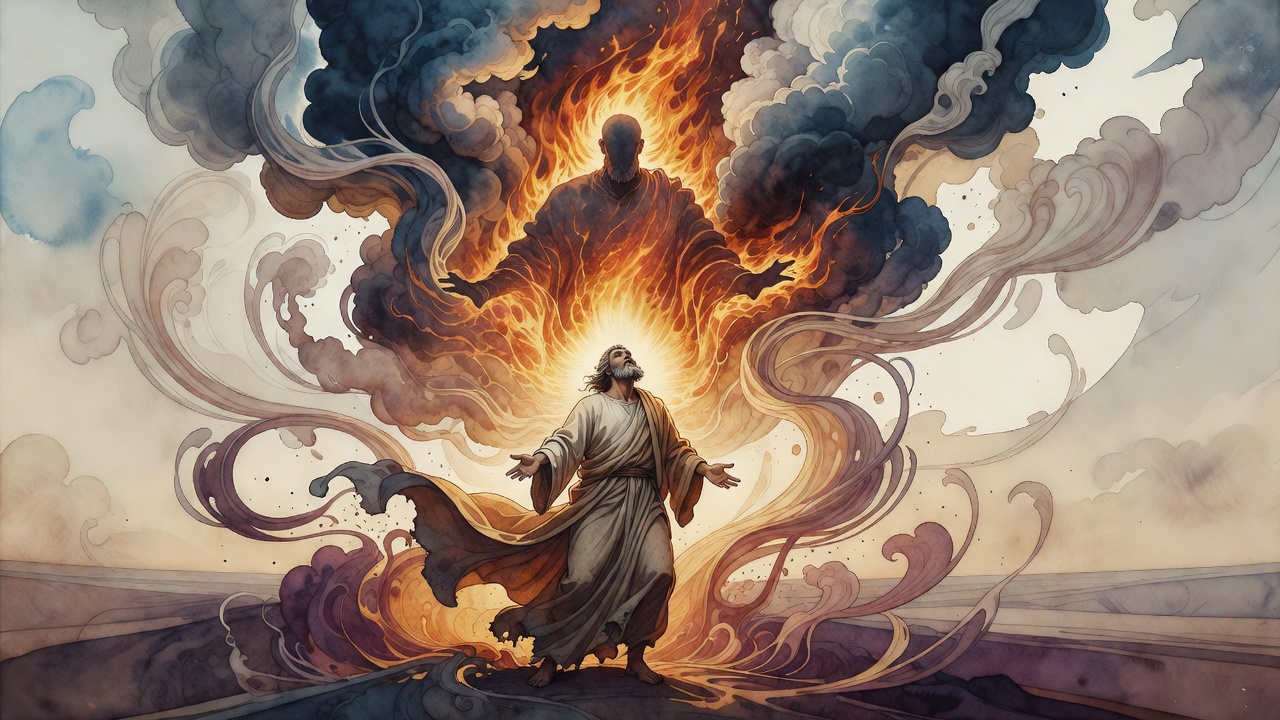
An angel's hand can span distances a man cannot pace in a lifetime. One of them once stretched out the form of a hand and seized a prophet by the hair of his head and lifted him between earth and vision. Might like that still only runs on command. Moses wanted the Commander in the midst of the camp. Joshua accepted the captain and bowed. Between them the road of Israel was argued in two keys: refusal that demands God Himself, and bowing that takes the messenger when the first generation is gone and the walls of Jericho wait.

The angel who wept at Joshua's question carried both visits in his mouth. Rejected once. Received once. Still only a messenger, Name in him, pardon not in him, sword drawn for a people that would learn both kinds of leading the hard way.


← All myths
From the tradition

Sources

3 sources

The texts behind this telling. Some cards carry a translation of the source; others are our own retelling of it, and each card says which. Every card links out to the original.

Midrash Tanchuma, Mishpatim 18Midrash Tanchuma

Retold in our words. Read the original at the link below.Townsend 1989 translation of Midrash Tanhuma, S. Buber Recension · CC-BY

Behold, I sent an angel before thee (Exod. 23:20). The Holy One, blessed be He, said to Moses: I will send an angel before you but not before them. Whereupon Moses replied: If you send it before me alone, I do not desire it. Rather Let the Lord, I pray thee, go in the midst of us (Exod. 34:9). Observe the difference between the early generations and the later ones. When the Holy One, blessed be He, said to Moses: Behold, I will send an angel before you, he replied: I desire no one but You, whereas, when Joshua the son of Nun beheld an angel, he prostrated himself on the ground, as it is said: And Joshua fell on his face to the earth, and bowed down. And he said to him: “Art thou for us, or for our adversaries?” (Josh. 5:13–14).

R. Isaac queried: What did the angel do when he heard the question: Art thou for us, or for our adversaries? He began to cry out from the nails of his feet (i.e., to weep uncontrollably), and he said to him: Nay, I am captain of the hosts of the Lord; I am now come (ibid.). Twice I have come to lead Israel, I am he who came in the days of Moses your master, and he rejected me because he did not wish me to accompany him, and now I have come once again. Forthwith Joshua fell on his face to the earth, and bowed down, and said unto him: What saith my lord unto his servant? (ibid., v. 14). However, though Moses rejected him, the Holy One, blessed be He, said to him: I send an angel before thee to keep thee by the way (Exod. 23:20), and, as well, before everyone who observes the law.

R. Simeon the son of Lakish stated: It is written: He will cover thee with His pinions, and under His wings shalt thou take refuge; His truth is a shield and a buckler (Ps. 91:4). He said to him: We will make a shield for you and for all who observe the law, since His truth is a shield and a buckler. Therefore to keep thee indicates that He will guard you by means of the law.

To keep thee by the way, and to bring thee into the place which I have prepared (Exod. 23:20). This one verse from Scripture makes it evident that the earthly Temple corresponds to the heavenly Temple.

Take heed of him, and hearken unto his voice (ibid., v. 21). Why? Because you are not worthy to hear My voice. Listen to the voice of the angel even though he is unable to forgive your transgressions. Why is he not able to do so? He is of the class (of creatures) that do not sin. Thus it is written: For he will not pardon your transgressions (ibid.).

Another explanation of He will not pardon your transgressions. Why not? For he is only a messenger, and a messenger can only do what he is sent to do. I alone can lift up countenances (i.e., grant pardon), as it is said: The Lord lift up His countenance unto thee (Num. 6:26). David cried out: Master of the Universe, you trust us into the keeping of an angel who cannot pardon us, but if Thou, Lord, shouldest mark iniquities, O Lord, who can stand? (Ps. 130:3). If You should say: Forgiveness is not available to you, For with Thee there is forgiveness that Thou mayest be feared (ibid., 4), therefore do not place over us the angel who is guardian of the Inner Sanctum, since it is said: For he will not pardon your transgressions. Why? For it is said My name is in him (Exod. 23:21) (i.e., he is only my messenger). R. Simeon the son of Lakish said: The name of the Holy One, blessed be He, is coupled with every angel, as it is said: For My name is in him.

Moses declared: I do not wish an angel to accompany us, only You. If You will not accompany us, we shall not leave this place, as it is said: For wherein now shall it be known that I have found grace in Thy sight, I and Thy people? Is it not in that Thou goest with us? (ibid. 33:16). The Holy One, blessed be He, replied: Be assured that even if the angel does not accompany you, I shall send a hornet ahead of you.

How do we know this? Because the Amorites perished. R. Levi said: The Holy One, blessed be He, attached two hornets to each of the angels, and they went ahead and poured poison into the eyes of an Amorite. His eye would split open, and the man would fall to the ground and die. R. Aha the son of Rab stated: Their bodies trembled, and they became weak in the presence of the Israelites, who then slew them. Our sages stated: Their faces turned black as the soot of a burning furnace, and they became weak in the presence of the Israelites, who killed them.

R. Abba the son of Kahana maintained: The Holy One, blessed be He, bound them before the Israelites, and they attacked and killed them, as it is said: So the Lord our God delivered into our hand Og (Deut. 3:3). He delivered them into their hands just as a man binds his son’s enemy and places him before his son. You should not maintain that the Amorites were small of stature. Observe what is written about them: Yet destroyed I the Amorite before them, whose height was like the height of the cedars, and he was strong as the oaks; yet I destroyed his fruit from above, and his roots from beneath (Amos 2:9). I destroyed his fruits from above refers to their guardian angel, and his roots from beneath alludes to the Amorites.

And so He would do in the future, He would punish their guardian angels and then the kings of the nations, as it is said: And it shall come to pass in that day, that the Lord will punish the host of the high heaven on high, and the kings of the earth upon the earth (Isa. 24:21). The Holy One, blessed be He, said to Israel: In this world I will send an angel to make the peoples of the world flee from you, but in the future I will lead you and I will send Elijah before you, as it is said: Behold, I will send you Elijah the prophet before the coming of the great and terrible day of the Lord (Mal. 3:24).

Full source
Tanchuma, Mishpatim 19Midrash Tanchuma

Translation of the source text.Midrash Tanchuma -- Torat Emet · Public Domain

"Behold, I send an angel" (Exodus 23:20). This is what the verse says: "For He will command His angels concerning you, to guard you in all your ways" (Psalms 91:11). If a person performs one commandment, one angel is given over to him. If he performs two commandments, two angels are given over to him. If he performs all the commandments, many angels are given over to him, as it is said, "For He will command His angels concerning you." And who are these angels? They are those who guard him from the harmful spirits, as it is said, "A thousand shall fall at your side, and ten thousand at your right hand" (Psalms 91:7).

"And ten thousand at your right hand." Why a thousand on the left and ten thousand on the right? Because the left side does not need many angels, since the name of the Holy One, blessed be He, is written in the tefillin, and the tefillin are placed on the left, as it is said, "And you shall bind them for a sign upon your hand" (Deuteronomy 6:8).

Rabbi Yehoshua ben Levi said: What is the meaning of "A thousand shall fall at your side"? The Holy One, blessed be He, gives over to each and every one of Israel eleven thousand angels who guard him and make a way for him, and one of them proclaims before him and says: Give honor to the image of the Holy One, blessed be He, for the whole world is full of spirits and harmful demons.

Full source
Midrash Tanhuma-YelammedenuMidrash Tanchuma

Retold in our words. Read the original at the link below.Townsend 1989 translation of Midrash Tanhuma, S. Buber Recension · CC-BY

What does it mean to say something is "angelic?" We usually mean beautiful, kind, maybe a little ethereal. But in Jewish mysticism, angels aren't just gentle spirits. They're forces. Powers. So immense, in fact, that – get this – the distance from heaven to earth is said to be no more than the palm of one of their hands!

I know. It's. Where does this idea come from? Well, as Midrash (rabbinic interpretive commentary) Tanhuma-Yelammedenu, Bereshit 5, tells us, these ministering angels are forces beyond our comprehension.

They're active participants in the world. Remember the prophet Ezekiel? He had some pretty wild visions. And according to (Ezekiel 8:3), one of these mighty angels actually reached down from heaven and grabbed him by the hair! "He stretched out the form of a hand," it says, "and took me by the hair of my head." Can you imagine the sheer force required for that?

This image is meant to convey the unlimited nature of God’s angels. If even the distance from heaven to earth is nothing compared to the size of an angel’s hand, how much more so is God even more powerful and beyond comprehension?

But here's the crucial point: even with all this might, these angels are still just messengers, servants of the Divine. They are not deities in their own right. They are malakhim, literally “messengers.”

This is where the story gets really interesting. In other mythologies – Babylonian, Canaanite, Greek – gods often have similar powers. Immense size, control over elements, the ability to intervene in human affairs. But Judaism insists on something different. These beings, these angels, are not independent powers. They operate solely at God’s command. Their power derives entirely from God.

This is a key element in maintaining the monotheistic vision. The angels' might emphasizes God's even greater, unimaginable power.

So, what are we left with? A paradox, perhaps. A vision of angels so vast they seem to defy comprehension, yet so firmly rooted in service to something even greater. It's a reminder that even the most awe-inspiring forces we encounter are ultimately part of a larger, more mysterious whole. It’s a way of trying to understand our place in the universe, acknowledging both our insignificance and our connection to something infinitely powerful.

Next time you look up at the night sky, remember the angels. Remember their immense size, their awesome power. But most importantly, remember who they serve. It might just change the way you see everything.

Full source