6 min read

The Elders Who Burned After They Ate at Sinai

Seventy elders climbed Sinai, ate and drank before the Presence, and earned fire that waited until the people lusted. Moses stood alone until new elders rose.

Curated by Arthur · Told by Maggid ·
Table of Contents
  1. Bread in the Hand of Heaven
  2. The Voice That Circled the Camp
  3. The Fire That Found Its Day
  4. Seventy New Names
The Elders Who Burned After They Ate at Sinai Click for full size

Bread in the Hand of Heaven

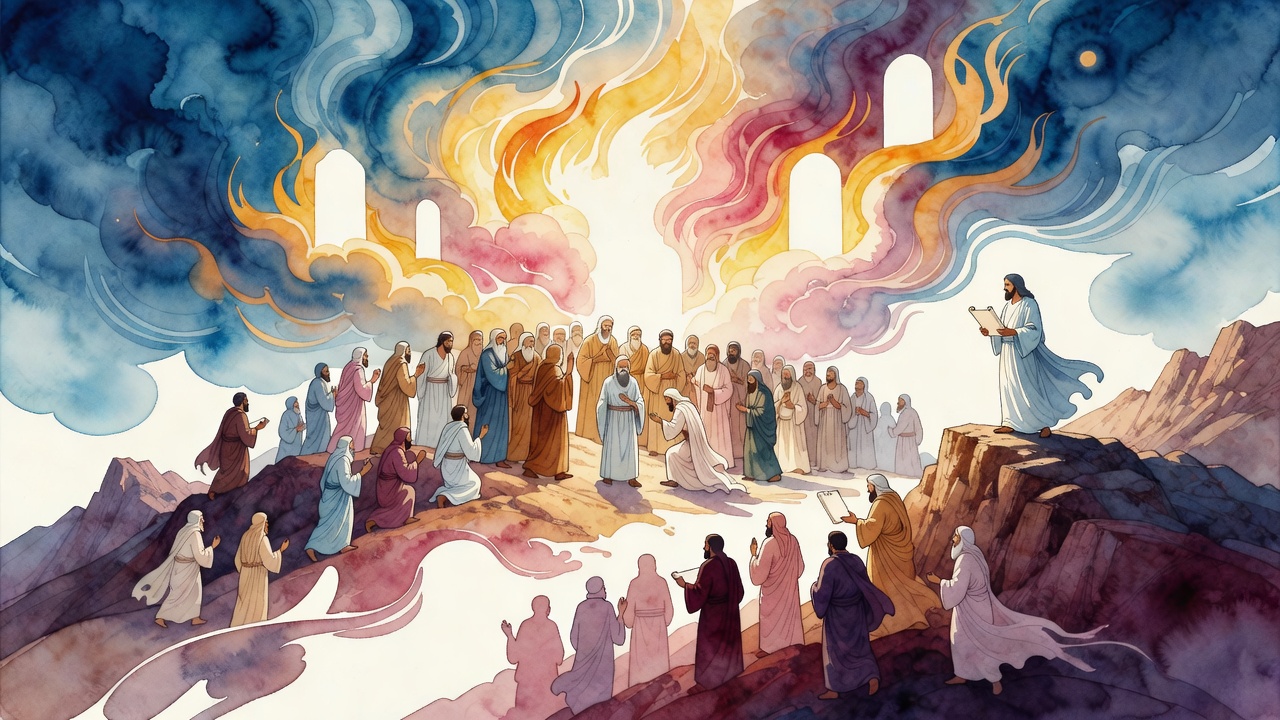
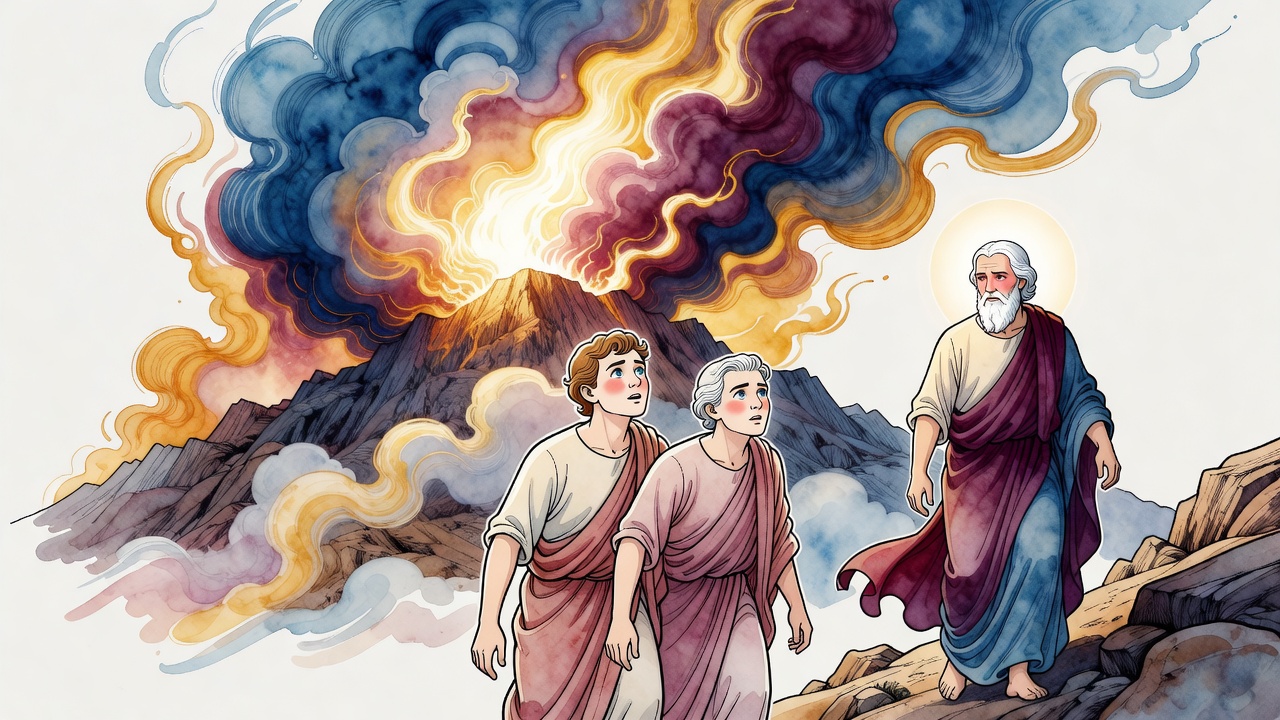
Moses counted them as they climbed. Seventy men. Gray heads. Soft hands that had once mixed mortar in Egypt and now gripped the rock of Sinai. Behind them came Nadab and Abihu, the high priest's sons, walking as if the mountain already belonged to their lineage.

They beheld the Shekhinah (שכינה), the dwelling Presence. Scripture says they ate and drank. Not a feast laid on stone. A crust. A servant chewing bread while the King sat before him, eyes open, jaw working, as if the light were only weather.

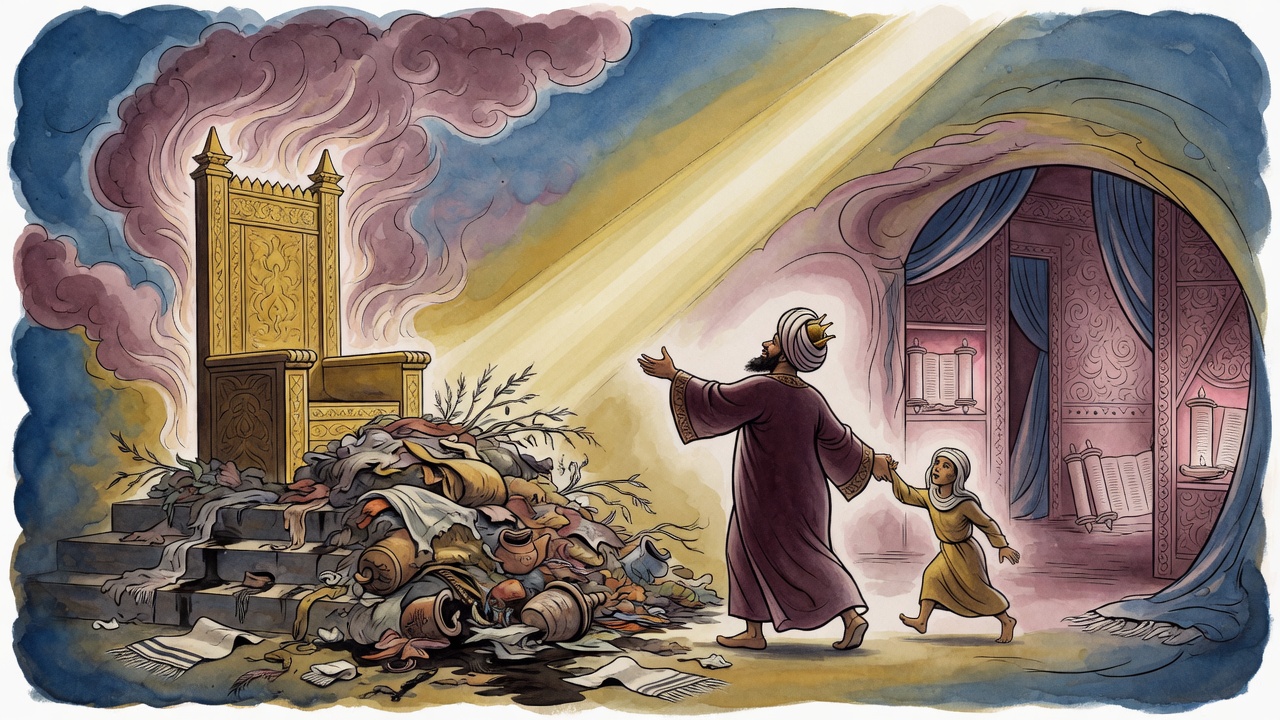
Picture it the way the midrash forces the eye: a servant attending his king with a crust still in his fist, crumbs on the lip, no bow deep enough to match the room. That was their lightheadedness in the Presence. The fire was owed that day. The hand was raised. The Torah was too precious to mar its giving with a breach, so the Holy One stayed the blow. "Upon the nobles He laid not His hand" (Exodus 24:11). The verse hides the truth inside a mercy. The hand was deserved. Justice only waited.

Moses saw their faces lit and did not yet know he was looking at men already marked. The mountain held its heat like a coal under ash.

The Voice That Circled the Camp

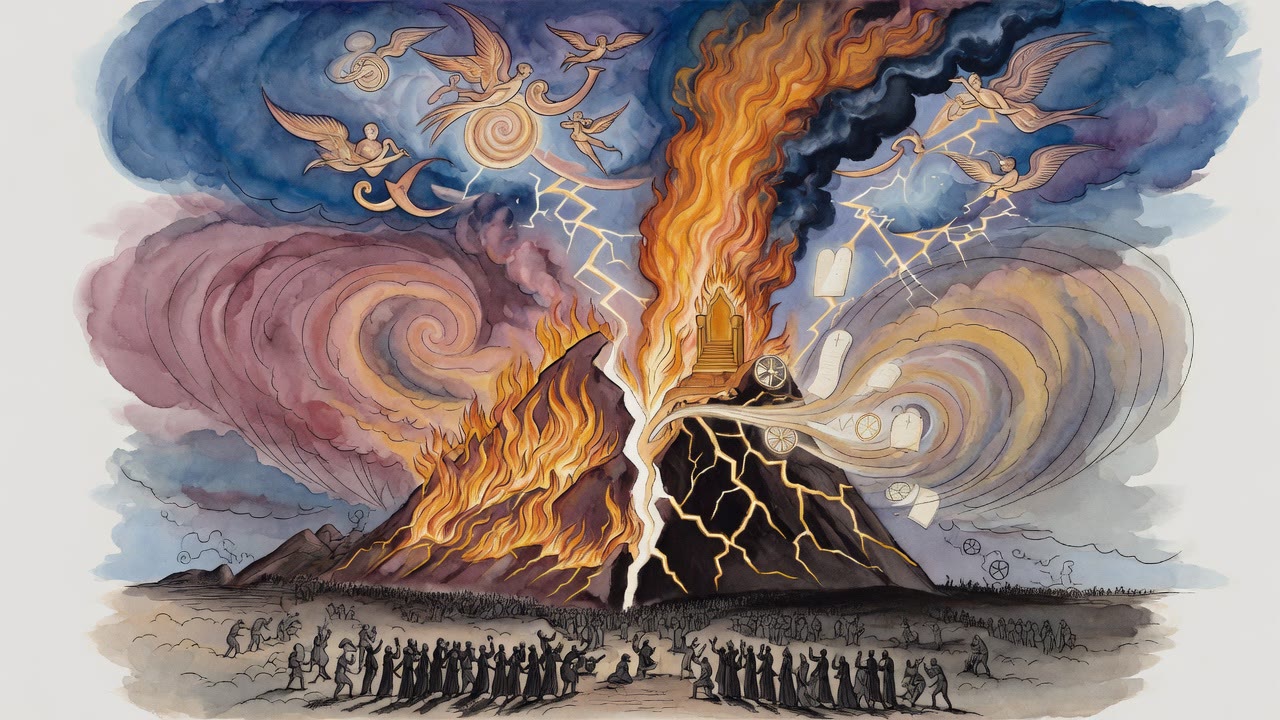
Below, Israel stood in a square of terror. When the word left the mouth of the Omnipotent, it did not drift down like fog. It shot from the right hand of God and met the people from their left, a double strike of sound. The camp measured twelve mil by twelve mil, and the word of Heaven wrapped that whole perimeter, a ring of speech around tents and children and livestock.

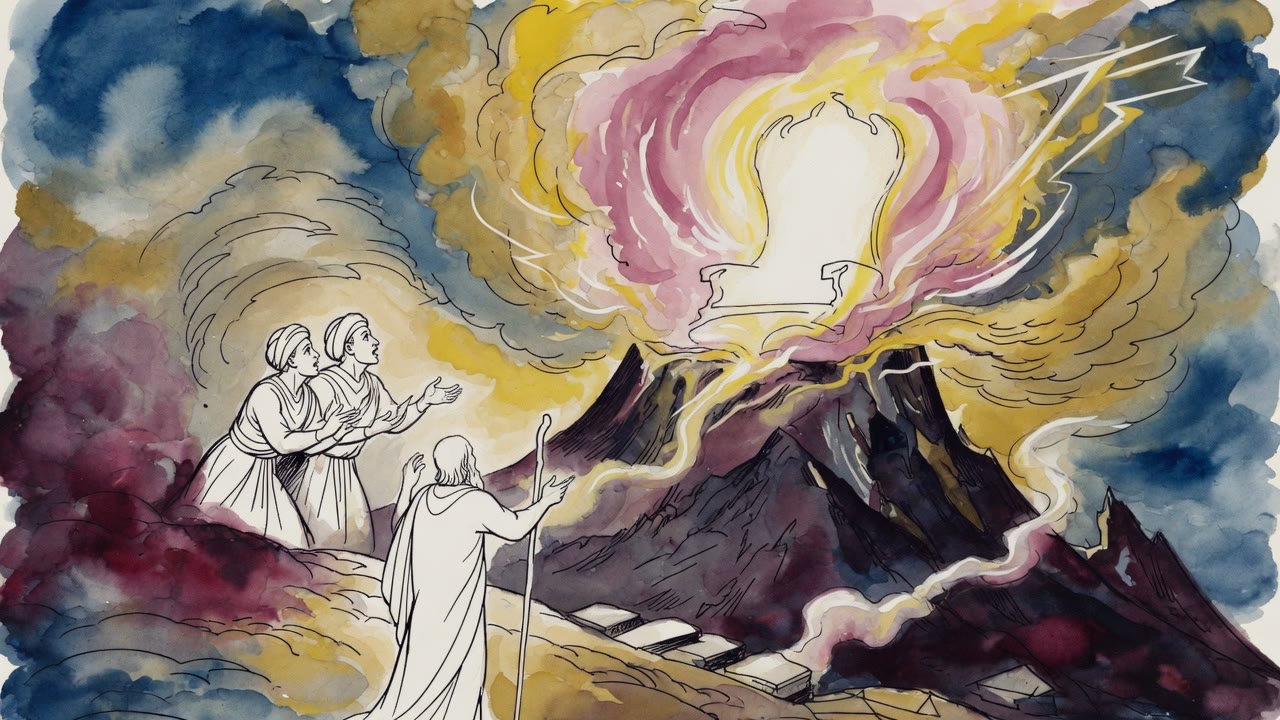
Then the voice reversed. It entered them from the right, rose toward the left hand of God, and was received and engraved into the tablets with shafts of fire, as the psalm would later sing: "The voice of the LORD cleaves with flames of fire" (Psalm 29:7). From one end of the world to the other the sound traveled. Torah was not a private gift. It was a world event.

Mothers pressed infants to their chests. Men who had built bricks under Egyptian overseers now could not hold their own knees. The elders above had treated that moment like a meal stop. The people below could not stand. Distance between mountain and valley was also a distance of awe. The same fire that would one day claim the nobles already moved through the camp as law carved in flame.

Somewhere in that circuit the first tablets took their letters. Somewhere above, seventy men wiped their mouths.

The Fire That Found Its Day

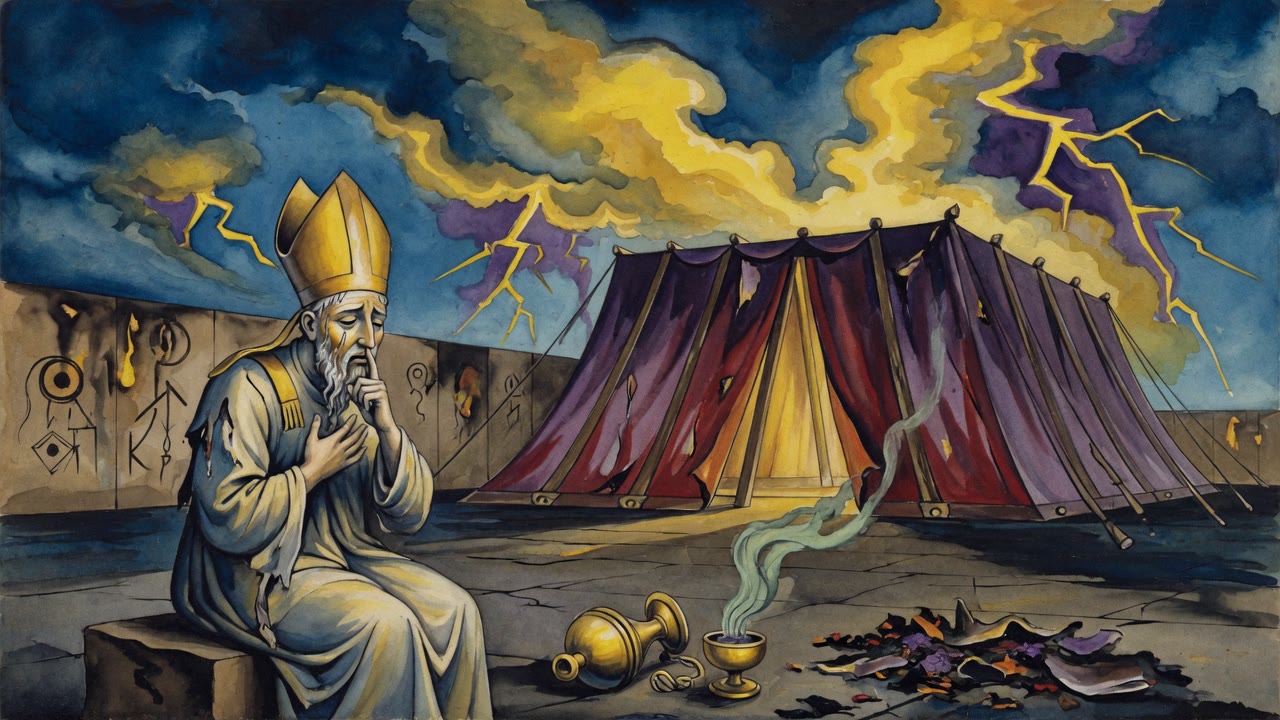
Nadab and Abihu burned later at the Tent's entrance, strange fire answering strange fire. Incense they had not been commanded. Smoke that rose wrong. Their father Aaron was silent when the bodies were carried out. The seventy did not fall with them. Their sentence waited for a different hunger.

In the wilderness the people "lusted a lust" (Numbers 11:4). Herds stood ready at the edge of the camp. The manna already became any flavor in the mouth, sweet or savory as memory required. Still they wept. Rabbi Shimon read the craving under the meat: she'er, forbidden kin. They wept by their families for what Torah had closed. Desire dressed itself as starvation and walked through the lanes at night.

The elders who should have steadied the camp fell into the same heat. Ash where gray heads had been. Leadership gone in a night of appetite. The men who had climbed Sinai with bread in hand met the fire that Sinai had postponed. Moses felt the people press against his ribs like a load no single back could carry. "I cannot bear this people by myself" (Numbers 11:14). The cry was not rhetoric. It was the sound of a man whose council had burned while the manna still fell like mercy ignored.

He stood in the doorway of his tent and counted empty places where advice used to sit.

Seventy New Names

The Holy One did not scold the loneliness. He answered it with work. "Gather for Me seventy men from the elders of Israel" (Numbers 11:16). New elders. Not the first seventy restored from dust. Fresh shoulders under the same yoke. Men who had not eaten lightly before the Presence, or who had learned, by watching ash, what lightheadedness costs.

Moses went through the tribes looking for those who could stand near fire without treating it as bread. He called names at night. He watched eyes for greed and for fear. The Spirit that had rested on him alone was portioned out until prophecy spilled past the planned seventy, two men in the camp prophesying beyond the list, and Joshua flaring with jealousy until Moses said he wished all the people were prophets.

The camp learned that leadership is not inheritance alone. It is replaceable when it fails, and replaceable when it dies for the wrong hunger. The first seventy had climbed. The second seventy were drafted into a ruin. Between them lay the delay of judgment, the longest mercy Moses would ever watch run out.

When the new elders took their seats, the mountain was already behind them. Only the memory of a crust in a noble hand remained, and the knowledge that Heaven can wait, and that waiting is not forgetting.


← All myths
From the tradition

Sources

2 sources

The texts behind this telling. Some cards carry a translation of the source; others are our own retelling of it, and each card says which. Every card links out to the original.

Midrash Tanchuma Buber, Beha'alotcha 27:1Midrash Tanchuma Buber, Beha'alotcha

Translation of the source text.Midrash Tanchuma (Buber), Public Domain, on Sefaria · CC-BY-SA

(Numbers 11:16:) GATHER ME [seventy men from the elders of Israel]. But were there not elders before this? For behold, it is written concerning Mount Sinai (Exodus 24:9): AND MOSES WENT UP [...] AND SEVENTY OF THE ELDERS OF ISRAEL; and this passage came afterward. So where were the elders? Rather, at the time when Israel did those deeds, as it is said (Numbers 11:1): AND THE PEOPLE WERE AS MURMURERS [..., AND THE FIRE OF THE LORD BURNED AMONG THEM], they were all burned at that time. But their burning was like the burning of Nadab and Abihu, for they too had acted lightheadedly when they went up to Sinai, when they beheld the Shekhinah, as it is said (Exodus 24:11): AND THEY BEHELD GOD, AND THEY ATE AND DRANK. But was there eating and drinking there? To what is the matter comparable? To a servant who was attending upon his master, and his crust of bread was in his hand, and he kept biting from it. So did they act lightheadedly, as those who eat and drink. And on that day the elders, together with Nadab and Abihu, deserved to be burned. But because the giving of the Torah was beloved before the Holy One, blessed be He, therefore He did not wish to strike them and to make a breach among them on that day. This is what is written (ibid.): AND UPON THE NOBLES OF THE CHILDREN OF ISRAEL HE LAID NOT HIS HAND, from which we learn that they deserved the laying on of the hand. But after a time they were burned: Nadab and Abihu were burned upon their entering the Tent of Meeting, and the elders were burned when they lusted a lust, as it is said (Numbers 11:4): AND THE RABBLE (ha-asafsuf) THAT WAS IN ITS MIDST [lusted a lust]. What is "the rabble"? Rabbi Shimon ben Menasya and Rabbi Shimon bar Abba: one said, these are the converts who went up with them from Egypt, who were gathered (ne'esafim) unto them, as it is said (Exodus 12:38): AND ALSO A MIXED MULTITUDE [went up with them]. And one said, "rabble" (asafsuf) is nothing other than the Sanhedrin, as it is said (Numbers 11:16): GATHER ME [seventy men]. What is written there (Numbers 11:1)? AND THE FIRE OF THE LORD BURNED AMONG THEM, AND CONSUMED IN THE EDGE (qetseh) OF THE CAMP, among the officers (qetsinim) in the camp. And from where do we know that those elders who went up to the mountain were burned? As it is said (Psalms 106:18): AND A FIRE BURNED IN THEIR COMPANY (edah); and "company" (edah) is nothing other than the Sanhedrin, as it is said (Numbers 15:24): AND IT SHALL BE, IF IT BE DONE [unwittingly] AWAY FROM THE EYES OF THE CONGREGATION (edah); and it is written (Leviticus 4:13): AND IF THE WHOLE CONGREGATION (edah) OF ISRAEL ERR. And they turned back and wept and asked for meat. And if you should say that it was meat that they asked for, but behold, everything they asked for, the manna would become it inside their mouth, as it is said (Psalms 106:15): AND HE GAVE THEM THEIR REQUEST. And if you should say that they had no ox or beast, but is it not written (Exodus 12:38): AND ALSO A MIXED MULTITUDE WENT UP WITH THEM, [AND] FLOCKS AND HERDS? And if you should say they ate them in the wilderness, but is it not written (Numbers 32:1): AND THE CHILDREN OF REUBEN AND THE CHILDREN OF GAD HAD MUCH CATTLE? From here Rabbi Shimon said: it was not meat that they lusted after, for so it says (Psalms 78:27): AND HE RAINED FLESH (she'er) UPON THEM AS DUST; and she'er is nothing other than forbidden relations, as it is said (Leviticus 18:6): NONE SHALL APPROACH TO ANY THAT IS NEAR OF KIN (she'er) TO HIM. This is to say that they sought to permit themselves forbidden relations. And so it says (Numbers 11:10): AND MOSES HEARD THE PEOPLE WEEPING BY THEIR FAMILIES. And when they sought such a thing (ibid.): AND THE ANGER OF THE LORD WAS KINDLED GREATLY. At that hour Moses said before the Holy One, blessed be He (Numbers 11:11): WHY HAST THOU DEALT ILL WITH THY SERVANT? In the past there was with me one who would bear the burden of Israel, but now I am alone, as it is written (Numbers 11:14): I AM NOT ABLE TO BEAR [all this people] ALONE; (Numbers 11:15) AND IF THOU DEAL THUS WITH ME [...]. At that hour the Holy One, blessed be He, said to him: appoint other elders in place of those elders, [as it is said] (Numbers 11:16): GATHER ME SEVENTY MEN.

Full source
Sifrei Devarim 343:13Sifrei Devarim

Retold in our words. Read the original at the link below.Sifrei by Rabbi Shraga Silverstein · CC-BY

The familiar picture has Moses, standing on the mountain, receiving the tablets. But what about the experience of the people below?

Sifrei Devarim 343 gives us a glimpse – a truly mind-bending glimpse – into the sheer, overwhelming power of that moment.

The verse But the Sifrei Devarim, a collection of legal interpretations on the book of Deuteronomy, doesn't just take this literally. It explodes it into a cosmic event.

When the word of God, the Omnipotent, left His mouth, it didn't just float gently down. Oh no. It shot forth from God's right hand, and simultaneously from the left side of the Israelites gathered at the foot of Mount Sinai. It's a divine volley!

But here's where it gets even wilder. The divine word, now a tangible force, encircled the entire Israelite encampment. And we’re not talking about a small circle. The text specifies twelve mil by twelve mil. A mil is roughly equivalent to a mile, so we're talking about a massive perimeter, a square encompassing 144 square miles. The entire camp was literally enveloped in the divine word!

Then, this fiery law, this voice made manifest, reversed its course. It traveled back toward God, entering through the right side of the Israelites, and ascending to the left hand of God. A complete circuit of divine energy!

And what did God do then? He received it with His left hand and, get this, engraved it onto the tablets. It wasn't simply written; it was carved in with the very essence of divine power.

But the spectacle didn't end there. The Sifrei Devarim connects this event to (Psalm 29:7), "The voice of the L-rd cleaves (the tablets with) shafts of fire." The voice of God, this incredibly powerful force, didn't just stay local. It traveled "from one end of the world to the other." This wasn't just about giving laws to a single nation. This was a world-altering event, a moment when the divine voice resonated throughout all of creation.

What does this tell us? Perhaps it suggests that the giving of the Torah wasn't just a historical event, but a cosmic one, a moment that continues to reverberate even now. The Torah, then, isn't just a set of rules, but a living, breathing force, a spark of divine fire that continues to encircle and shape our world.

Full source