Parshat Korach5 min read

The Ground Swallowed Korah and His Household Alive

Korah had once held the keys to Pharaoh's treasure houses. He wanted the altar too. Moses gave him one night to take it back.

Curated by Arthur · Told by Maggid ·
Table of Contents
  1. The Keys He Carried Out of Egypt
  2. The One Word That Bought Them a Night
  3. Dathan and Abiram Would Not Come Up
  4. The Ground Closed Like Water
The Ground Swallowed Korah and His Household Alive Click for full size

The Keys He Carried Out of Egypt

Korah had kept the keys to Pharaoh's treasure houses. He knew their weight, the noise they made against each other, the rooms they opened. He came out of Egypt rich and stayed rich, and in the wilderness his money spoke before he did.
Two hundred and fifty men of name stood behind him when he came for the priesthood. Not the rabble. Princes of the assembly, men whose presence made a mutiny look like a reform. Moses had handed the altar to his own brother, Korah said, and called it a command from heaven. Anyone could see what it really was. He gave it to family.

Hands moved toward stones. Some in that crowd wanted the argument finished before dark.

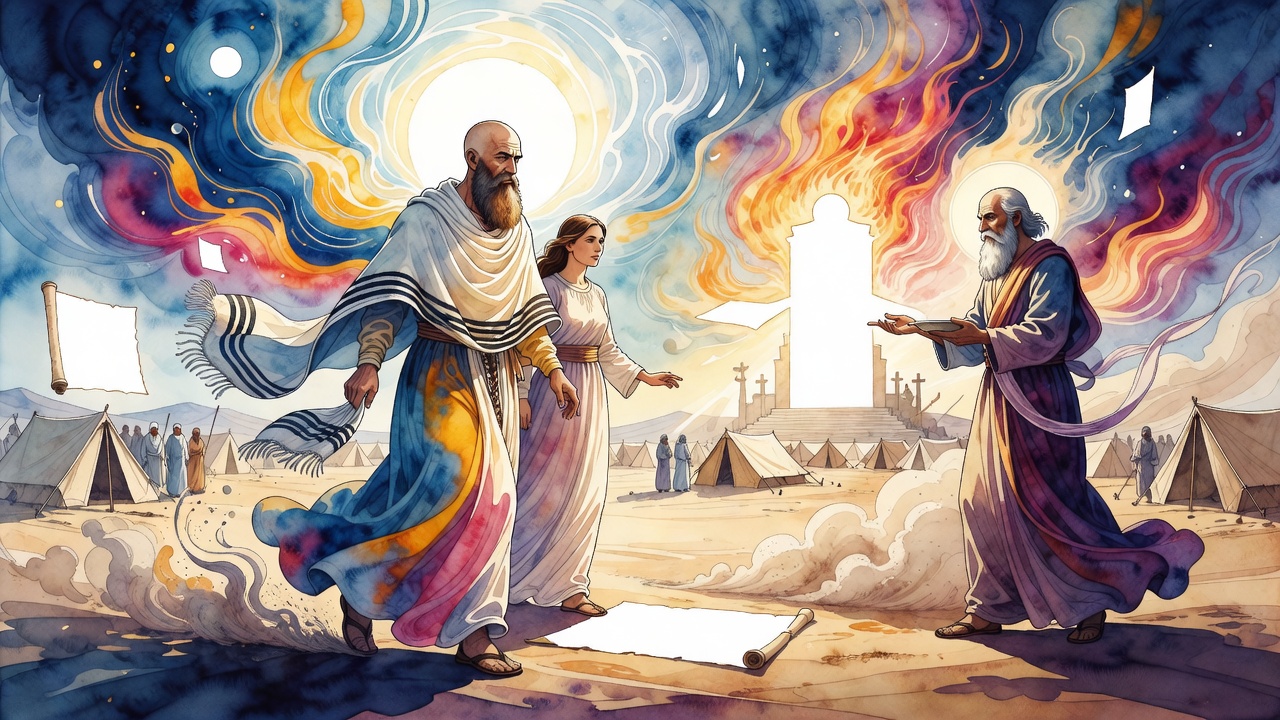
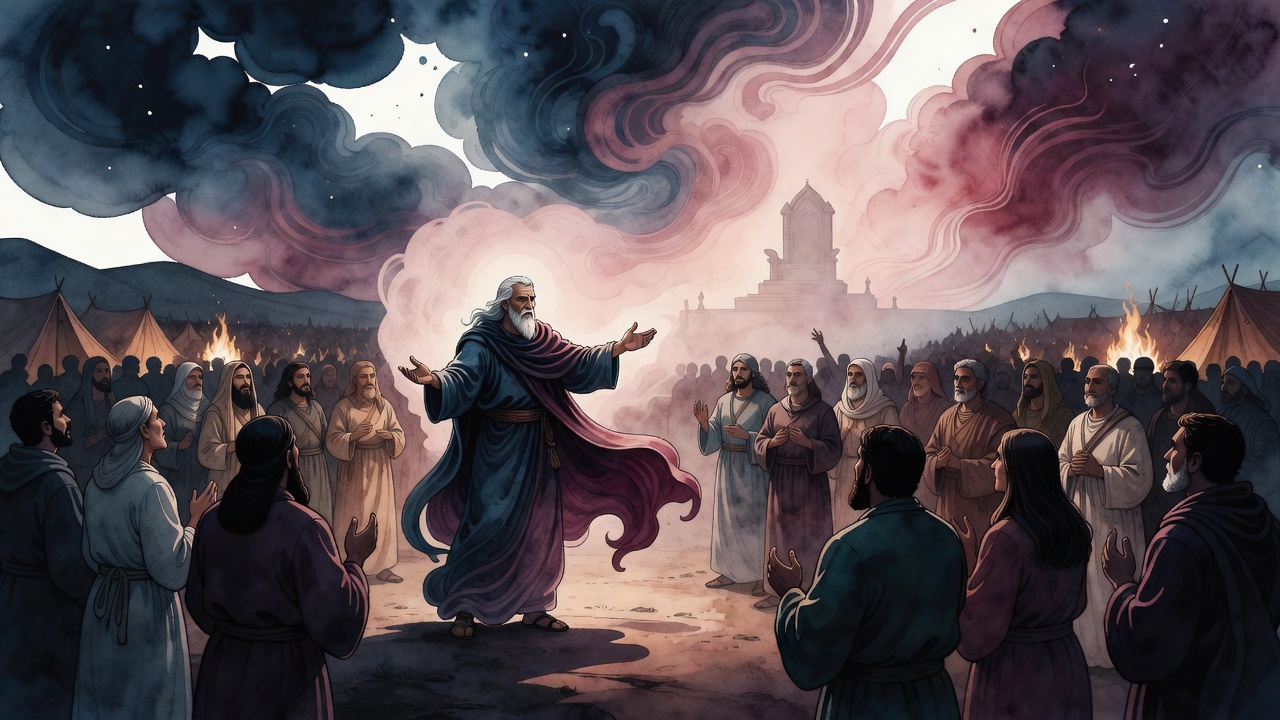
Moses reached for nothing. "Bring fire-pans," he told them. Every man who wanted the incense could fill one and stand with it before God, and God would choose between them. Korah agreed on the spot, the way a man agrees to anything while the wine is still in him.

Then Moses named the hour. Morning.

The One Word That Bought Them a Night

Morning was a mercy, and Korah heard only a delay.

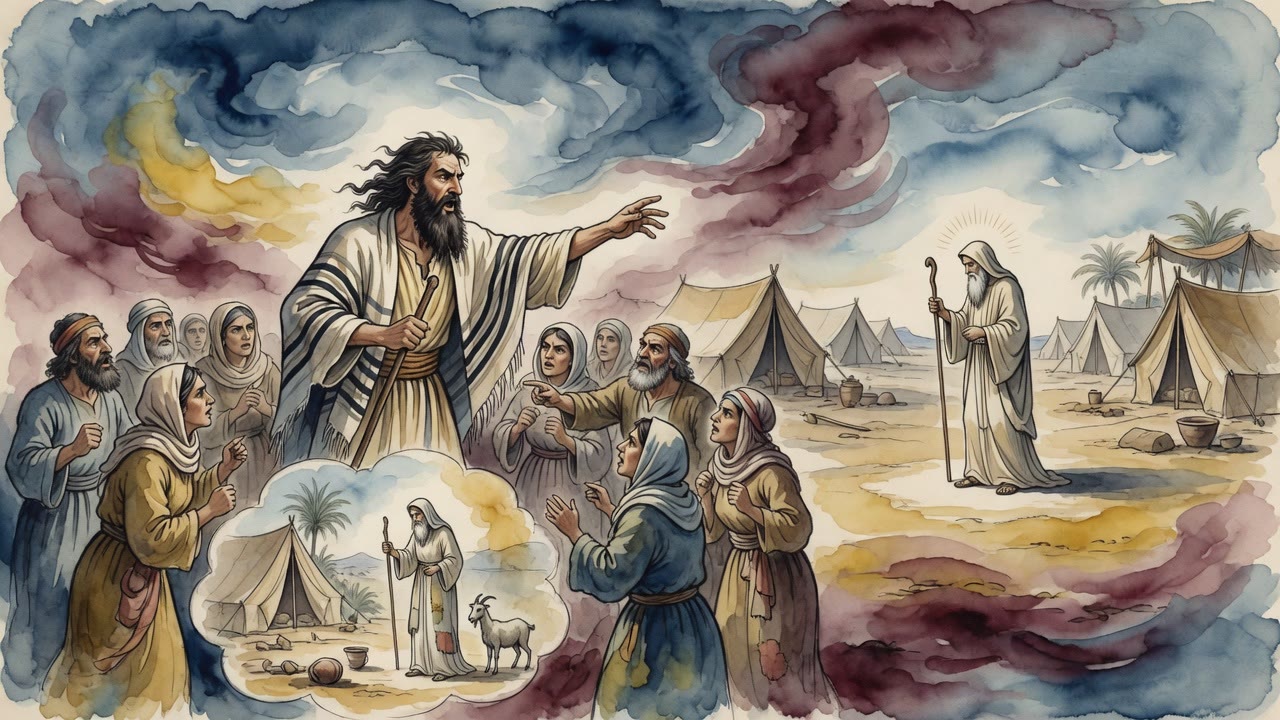
Moses had watched them come at him loud and flushed, and he thought: they have been eating and drinking. Let them sleep it off, and by dawn some of them may want it back. He said as much, in his way. "I have no leave to go in there tonight. Nobody eats and drinks in His presence. We are the ones who have eaten and drunk."

Then he tried the other argument, the one about fences. The Holy One had put boundaries into the world on the first day. Evening, then morning. Light on one side of a line, darkness on the other, and the world still runs on that line. "Can you mix the day into the night?" Moses asked them. "Undo that one first. Then come back and undo Aaron."

Korah went to his tent with the pan in his hand. The night passed. Nobody came back at dawn to take anything back.

Dathan and Abiram Would Not Come Up

Dathan and Abiram refused to climb to the meeting place at all. They sent word that they were not coming, a second rebellion folded inside the first, so Moses went down to them.

He stood in front of their tents with the elders at his back and raised his hands. He did not ask for their deaths. He asked for a sign no one could argue with afterward, and he asked the ground to give it.

Over the heads of the two hundred and fifty, heaven was shouting at them. "Do not believe him. The man is mistaken, and he is walking you into it." They stood there with their pans filled and did not put them down.

The Ground Closed Like Water

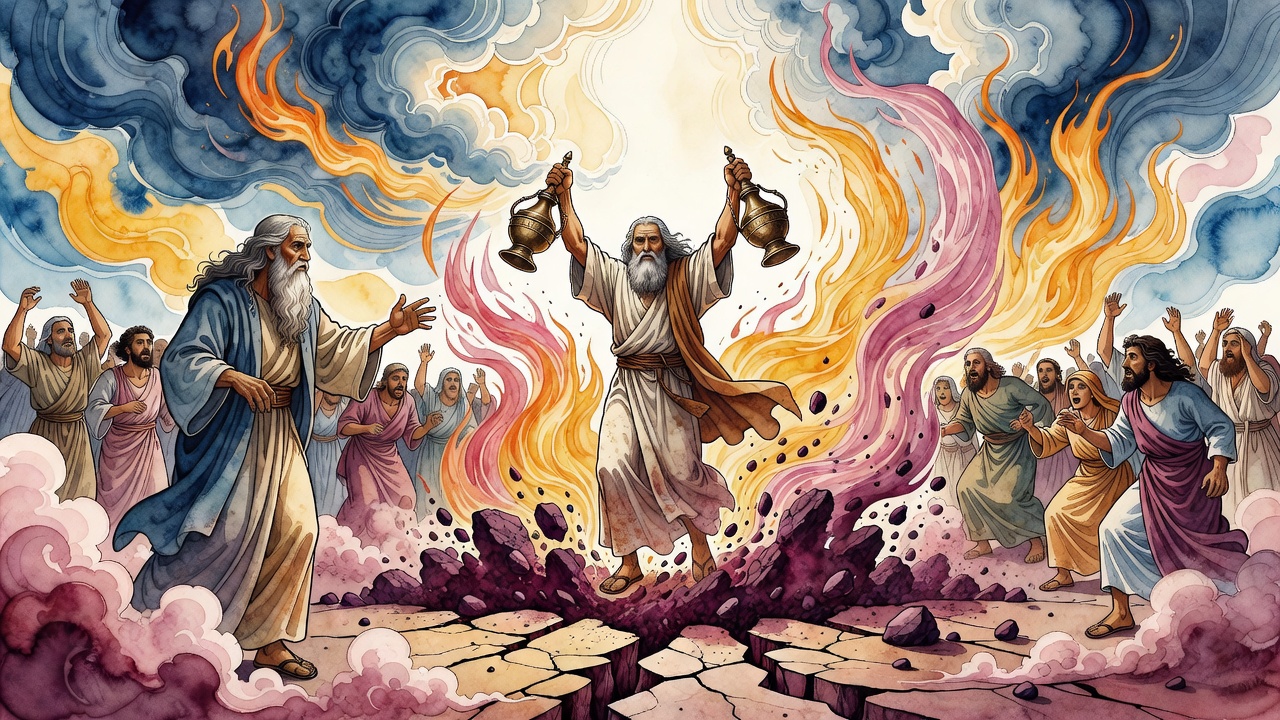
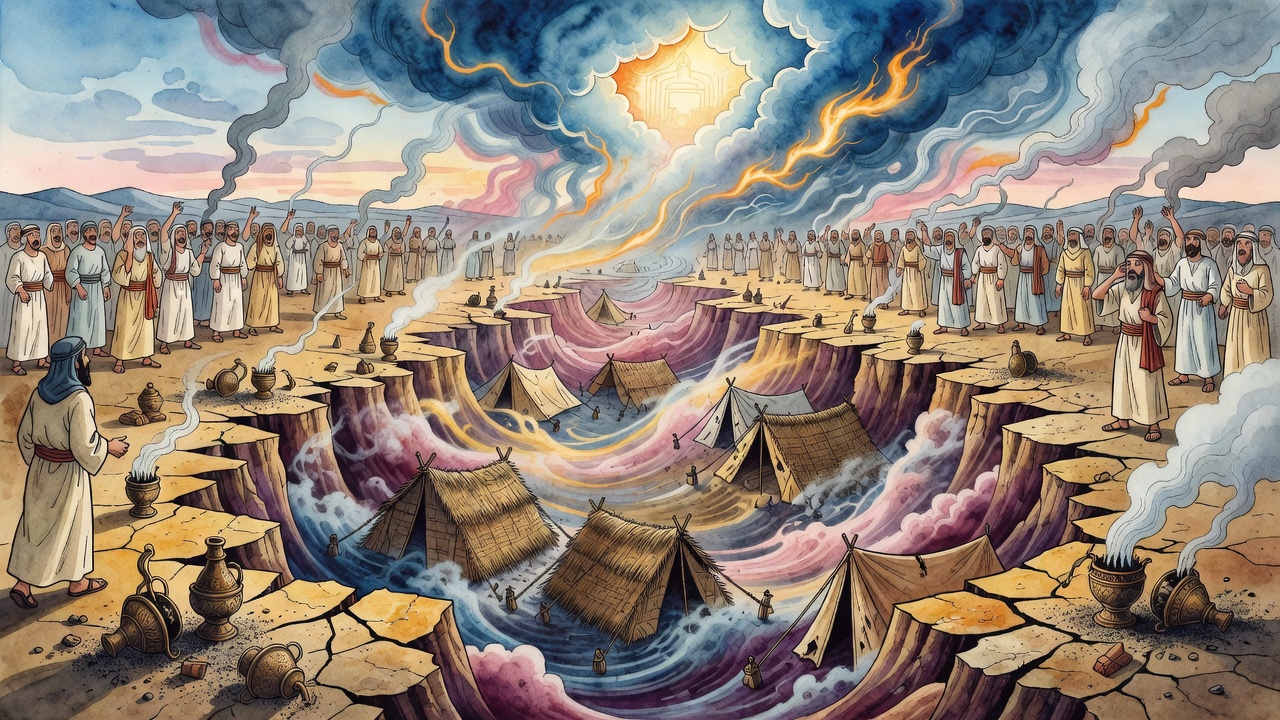
At morning the earth cracked open with a noise like a sea in a storm. The tents went in. Men, wives, children, bedding, jars, the animals tied at the pegs, everything slid down into the split, and the earth swallowed Dathan and Abiram and their households alive off the face of the world (Numbers 16:32). Then the ground closed. Where a camp had stood there was open dirt, unmarked, as though nobody had ever pitched anything on it.

The two hundred and fifty got the other death. Fire came out from before the Lord and took them where they stood with their pans lifted, and Aaron was left standing in the smoke, holding his, untouched. Moses had the bronze beaten flat and nailed over the altar, so that the metal of the rebellion covered the thing the rebels had wanted.

Korah's wife went down after him. The fire that had been set aside for her was so large that when she reached Gehenna, Gehenna (the realm of judgment after death) went out.

Korah had one plea left and never got it out. Samuel the prophet would come from his line one day, generations off, and a man can bargain with a grandson. The words went with the breath.

In Egypt his treasure houses stood locked and full. They had been counted out long before, and not for him. They were for the people walking away.


← All myths

From the tradition

Sources

3 sources

The texts behind this telling. Some cards carry a translation of the source; others are our own retelling of it, and each card says which. Every card links out to the original.

Antiquities III.13-15Antiquities of the Jews (Josephus)

Retold in our words. Read the original at the link below.Antiquities of the Jews, trans. William Whiston · Public Domain

The earth opened its mouth and swallowed men alive. Not in a myth. Not in a metaphor. According to Josephus, the ground beneath the tents of the rebels cracked apart with a sound like a storm-tossed sea, and everything, men, families, possessions, vanished into the deep. When it sealed shut again, it looked as though nothing had ever been there.

Korah was wealthy, eloquent, and from the tribe of Levi, the same tribe as Moses. That was the problem. He believed his lineage and his riches entitled him to the priesthood more than Aaron, Moses's brother, who held the position. Korah's argument was seductive: Moses had given the priesthood not by God's command but by personal favoritism. He gathered 250 of the most prominent men in Israel to back his challenge. The whole camp was buzzing with mutiny. Some were ready to stone Moses.

Moses did not retaliate. He proposed a trial. Let every man who wants the priesthood bring a fire-pan, fill it with incense, and offer it before God tomorrow. God Himself would choose. Korah agreed.

First came the rebels Dathan and Abiram, who refused even to appear. Moses went to them. He stood before their tents, raised his hands to heaven, and prayed, not for his own vindication, but for a sign so unmistakable that no one could ever again confuse human ambition with divine appointment. He asked God to open the ground beneath the rebels and consume them with their households.

The earth shook. The ground split. Dathan, Abiram, and their entire households dropped from the face of the world (Numbers 16:32). Then the 250 men who offered incense were consumed by a fire so bright no natural flame could match it, every one of them destroyed, while Aaron stood untouched. Moses ordered their bronze censers placed on the altar as a permanent reminder: the priesthood belongs to whom God gives it, and ambition without divine sanction ends in annihilation.

Full source
Bamidbar Rabbah 18:7Bamidbar Rabbah

Retold in our words. Read the original at the link below.The Sefaria Midrash Rabbah, 2022 · CC-BY

The ancient Rabbis certainly thought so, and they found wisdom in the story of KORAH's rebellion against Moses.

The text in Bamidbar Rabbah (Numbers Rabbah), a classical Rabbinic interpretation of the Book of Numbers, dives deep into a single word: "Morning." It's in the verse "He spoke to Korah… Morning" (Numbers 16:5). But why "Morning"? What was so significant about that particular time of day?

Moses, ever the insightful leader, suspects that Korah and his followers might be acting rashly, perhaps influenced by a bit too much food and drink. He thinks, "Maybe they said this matter as a result of food and drink." He hopes they might just need a little time to cool down and reconsider. That's why he proposes waiting until morning, believing that with a clear head, they might repent. As Bamidbar Rabbah puts it, "Perhaps, in any case, they will repent. That is why it is stated: 'Morning, the Lord will disclose.'"

There's another layer to this "morning" concept. Moses says, essentially, "Look, I don't have special permission to enter the divine presence right now. It's not like there’s eating and drinking before God. This whole mess is because of us, because we've been indulging."

It’s a fascinatingly human moment. Moses acknowledges that earthly desires and distractions can cloud our judgment and lead us astray.

Then Moses shifts his approach, bringing in a theological argument. He reminds Korah and his followers that HaShem (God) established clear boundaries in the world. "The Holy One blessed be He imposed boundaries in His world. Are you able to mix day and night?"

He points to the very first chapter of Genesis: "It was evening, it was morning" (Genesis 1:5); "God distinguished between the light and the darkness" (Genesis 1:4). These distinctions, these boundaries, are fundamental to the order of the universe. Just as God separated light from darkness, so too has He distinguished Israel from other nations, as it says in (Leviticus 20:26), "I have distinguished you from the peoples to be Mine." And within Israel, He distinguished Aaron, as we find in I (Chronicles 23:13), "Aaron was set apart to sanctify Him with sanctity of the highest order."

Moses is saying: you want to challenge the established order? You want to erase the distinctions that God Himself has put in place?

"If you are able to remove that distinction that He distinguished between light and darkness, you can nullify this."

And that's why he tells them, "Morning, the Lord will disclose who is His, and who is holy, and will bring him near to Him" (Numbers 16:5). The choice is already made. Aaron is already designated. "And whom He shall choose, He will bring near to Him" (Numbers 16:5).

It's a powerful argument about the nature of order, authority, and divine will. But it's also a reminder that sometimes, our judgments and actions are clouded by our own human needs and desires. It begs the question: How often do we challenge the established order based on genuine conviction, and how often is it just because we've had too much to eat and drink, metaphorically speaking?

Full source
Bamidbar Rabbah 18:15Bamidbar Rabbah

Retold in our words. Read the original at the link below.The Sefaria Midrash Rabbah, 2022 · CC-BY

Who was Korah? We find him in the Book of Numbers, leading a rebellion against Moses and Aaron. He challenged their authority, questioning why they held such power. A dangerous move, to say the least, and one that ultimately led to his demise. But the Rabbis, ever keen to find deeper meaning, saw Korah’s story echoed in other parts of the Hebrew Bible.

Bamidbar Rabbah, a collection of Rabbinic teachings on the Book of Numbers, draws a fascinating parallel between Korah and the Book of Job. It quotes (Job 15:28-34), a passage that seems to describe Korah’s fate with uncanny accuracy. Let’s take a look:

“He will dwell in desolate cities, in houses in which one would not live, which are destined to become heaps.”

The Rabbis in Bamidbar Rabbah directly connect this to Korah. They say he was a treasurer in Pharaoh’s palace, holding the keys to vast riches. But as the text points out, what good did it do him? He didn’t truly control them. They were destined for others – “for those who are exiled [golim],” meaning the Israelites who were soon to be freed from Egypt.

The passage continues, “He will not become rich, and his wealth will not endure; nothing of his will extend over the earth. He will not turn away from darkness.” The Rabbis interpret this as Korah’s ultimate destiny: even in death, his wealth would be meaningless, not even passing on to his heirs. He would never escape the “darkness of Gehenna” – a Hebrew term for hell.

And it gets even more intense! “The flame will dry his shoots [yonakto]” – here, the Rabbis offer two chilling interpretations. One suggests that Korah’s wife was so wicked that when she descended into Gehenna, she actually extinguished the flames! An alternative explanation is that the fire designated to burn her was so intense that it extinguished Gehenna itself. Either way, it paints a horrifying picture.

The text goes on, “And they will pass away from the breath of his mouth” – meaning Korah couldn’t even claim that a righteous descendant like Samuel would emerge from him to spare him from punishment. “Let him not trust in futility that misleads,” the passage continues. Here, the Rabbis imagine God warning the 250 men who joined Korah’s rebellion. “Do not believe, he is mistaken! Do not trust him when he has strayed!”

The grim imagery continues: “He will shed his unripe grapes like a vine…He will cast off his blossoms like an olive tree.” The Rabbis connect this imagery to Korah’s wife and children, contrasting them with the blessings described in (Psalms 128:3), which compares a righteous man's wife to a fruitful vine and his children to olive saplings.

Why all this destruction? “For the company of the hypocrite will be desolate, and fire will consume the tents of bribery.” And, the Book of Numbers tells us that “Fire emerged from before the Lord” (Numbers 16:35) and consumed the 250 men who followed Korah.

It’s a powerful, cautionary tale. A story about ambition, rebellion, and the consequences of challenging divine authority. The Rabbis, by connecting Korah’s story to the words of Job, amplify the message: true wealth isn't about material possessions or power, but about righteousness and humility. As we see in Ginzberg's Legends of the Jews, Korah's story is a reminder that pride often comes before a fall, and that true legacy lies not in earthly riches, but in the impact we have on the world and those around us.

Does this Rabbinic interpretation shed new light on the story of Korah? And what lessons can we draw from this ancient tale for our own lives today?

Full source