Parshat Yitro6 min read

The Hidden God Puts On Seven Forms and Is Seen at Sinai

A kindness done in a low place with no witness rose as a thread of light. The Presence wore a robe cut from that cloth. When Israel turned, she wore black.

Curated by Arthur · Told by Maggid ·
Table of Contents
  1. The God With No Face
  2. Seven Forms Hidden in a Body
  3. The Garments Woven From Above and Below
  4. From the Garments, a Throne
  5. The Seven Voices at the Mountain
  6. When the People Saw the Voices
The Hidden God Puts On Seven Forms and Is Seen at Sinai Click for full size

The God With No Face

Nothing looked back.

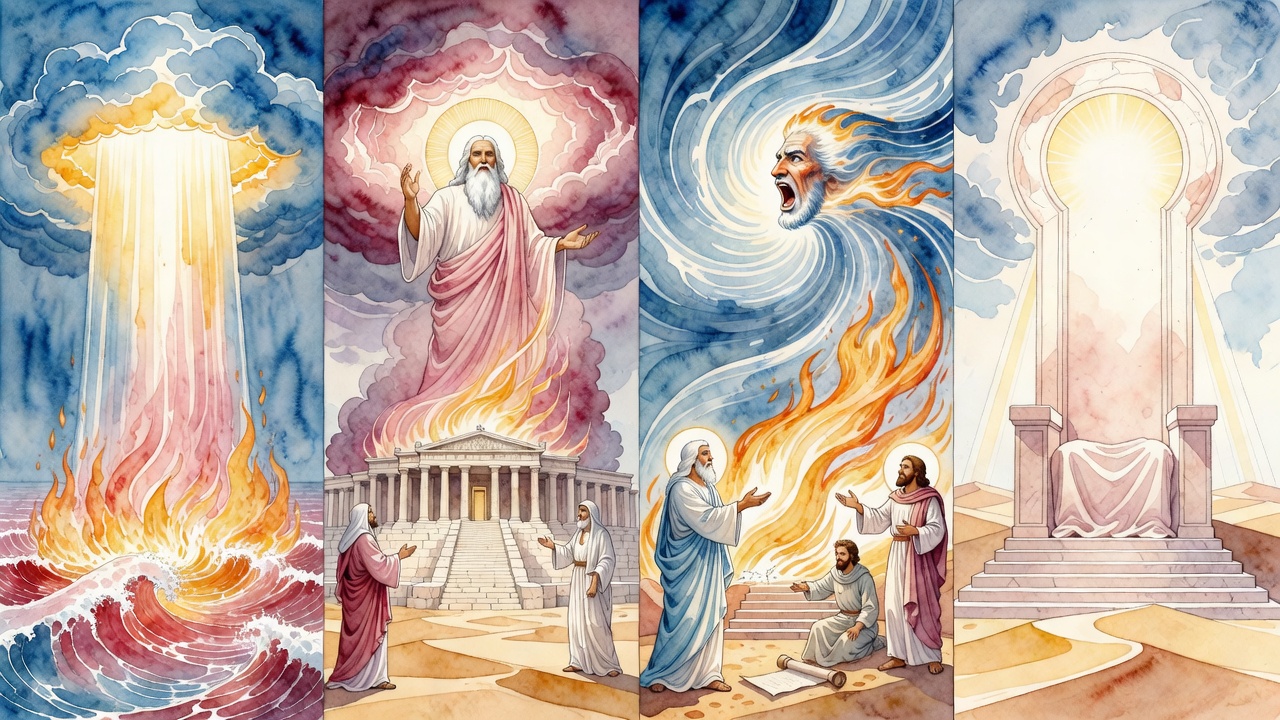
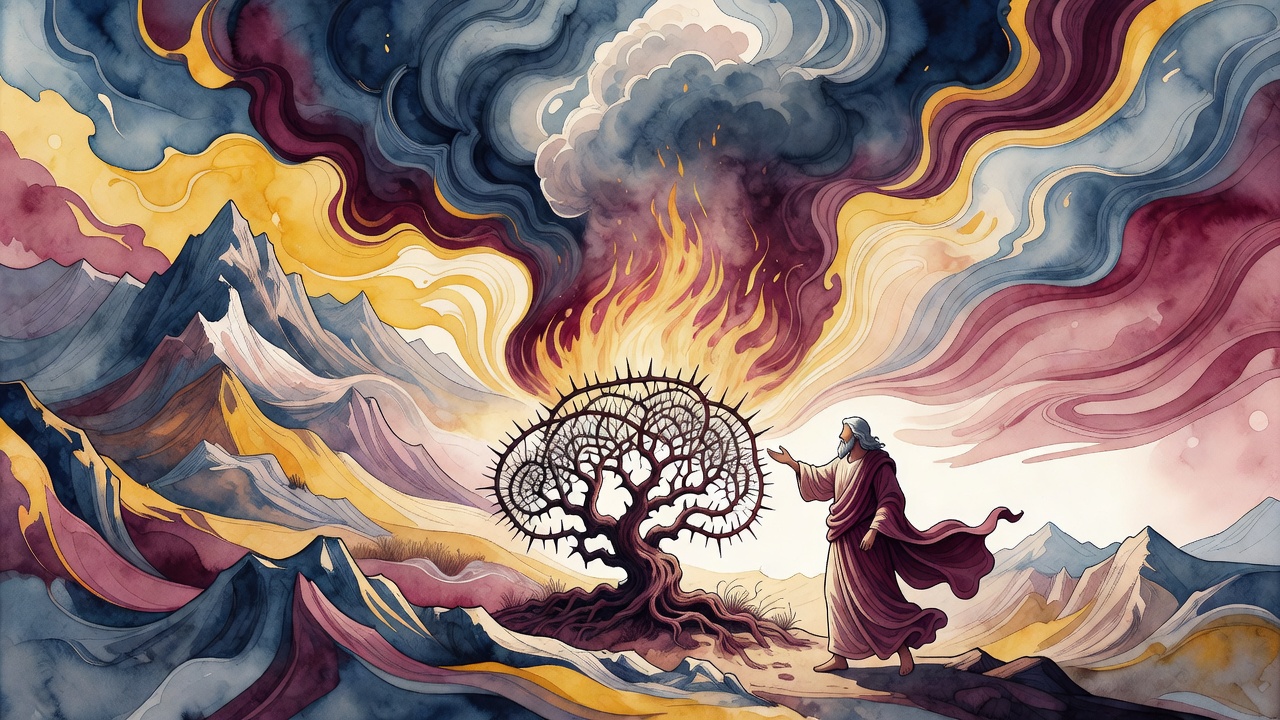
Before the first light, before the waters that light would divide, there was a God so hidden that no eye had ever caught the smallest edge of Him. No angel had. No prophet would. He had no face to turn, no hand to raise, no floor to stand on. The highest creatures sang toward a brightness they could not find, the way a man sings toward a sound with no source. To search for Him was to walk into a room and learn the room had no walls, and then that there was no room at all.

And still He meant to be seen.

Seven Forms Hidden in a Body

So He took form. Not one form. Seven.

Right thigh and left. Right hand and left. The body itself, with the covenant cut into its flesh. And the head above them all. Count them and the sum is six. The seventh came only when the man was joined to his wife and the two of them became one flesh, and the pattern closed.

These seven were the blueprint of a human being. When the first man, Adam, opened his eyes in the garden, he already carried the diagram of the hidden God in his own limbs, "for in the image of God He made the human being." Every person after him walked the earth as a small map of the unseeable, thigh and hand and head, a body that spelled out a shape no one could look at directly.

But a shape is still not a face. A map is not the country.

The Garments Woven From Above and Below

So the hidden God was dressed.

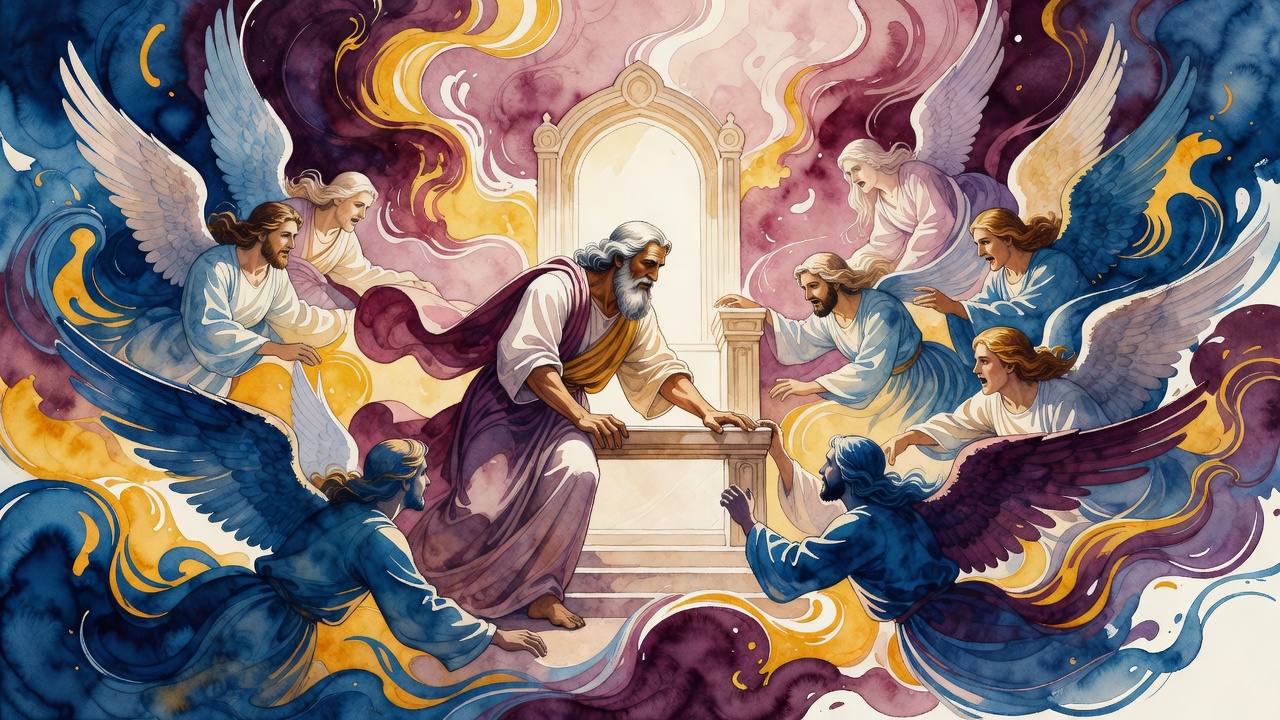
The garments were woven on two looms at once. From above, the threads were angels, holy ones spun into cloth. From below, the threads were the deeds of Israel. Every act of justice, every kindness done in a low place with no witness, rose as a strand of light and was worked into the weave. The clothing of God was stitched, in part, by human hands that never knew they were weaving.

When Israel acted well, the loom below sent up thread of the first light, the radiance of day one, the light that shone before there was a sun to carry it. Out of that light was cut the robe of the Shekhinah (the Divine Presence), the Presence, and she put it on whenever her children shone.

And when they turned to evil, the bright thread stopped rising. The robe of light was taken from her. In its place she was dressed in the black garments of Lilith, and the Presence wore that darkness, and went on wearing it, until Israel turned back and the loom ran bright again.

From the Garments, a Throne

Then the hidden God did something stranger with the cloth.

From those same garments He made the Throne of Glory. From them He made the heaven and the earth. From them He made every creature that crawls and flies and swims between the two. The world was not built from stone or fire. It was cut and sewn from the clothing of God, which had been woven from angels above and from the good deeds of a people below.

So the sky overhead was a hem. The sea was a fold. And somewhere in the weave ran the small bright threads of ordinary human mercy, and they held up the Throne.

The Seven Voices at the Mountain

Then came Sinai.

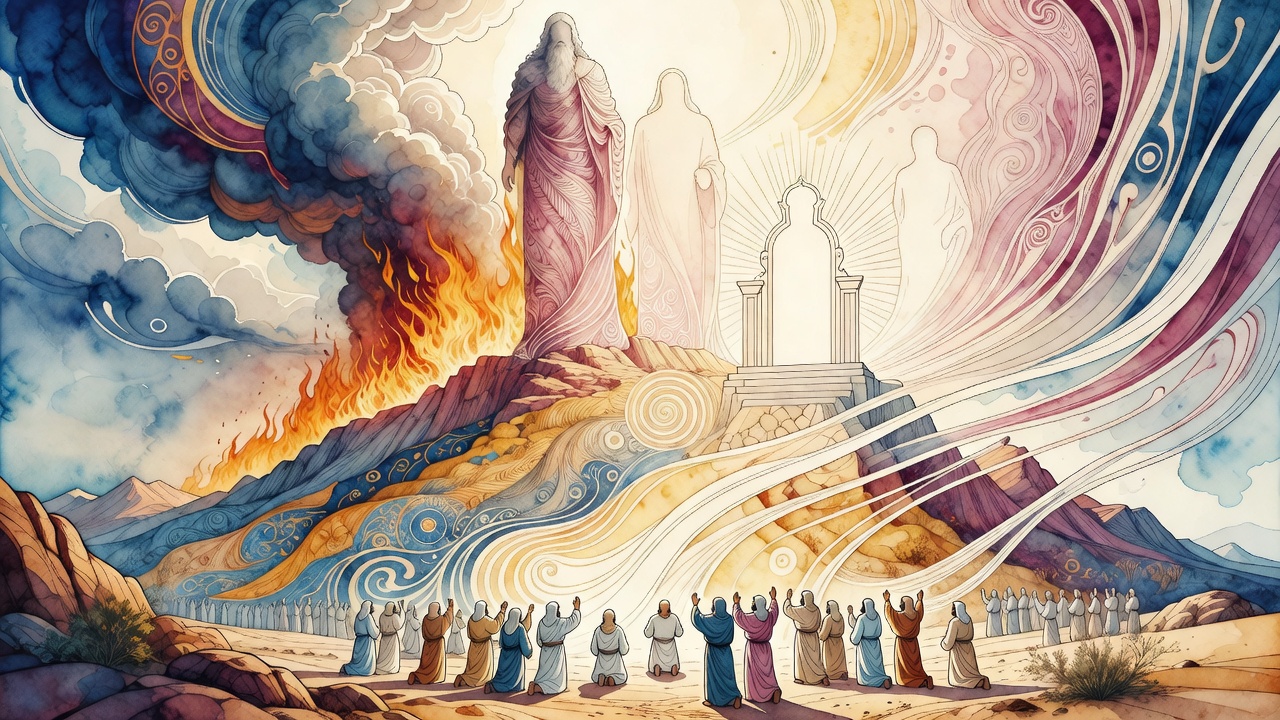
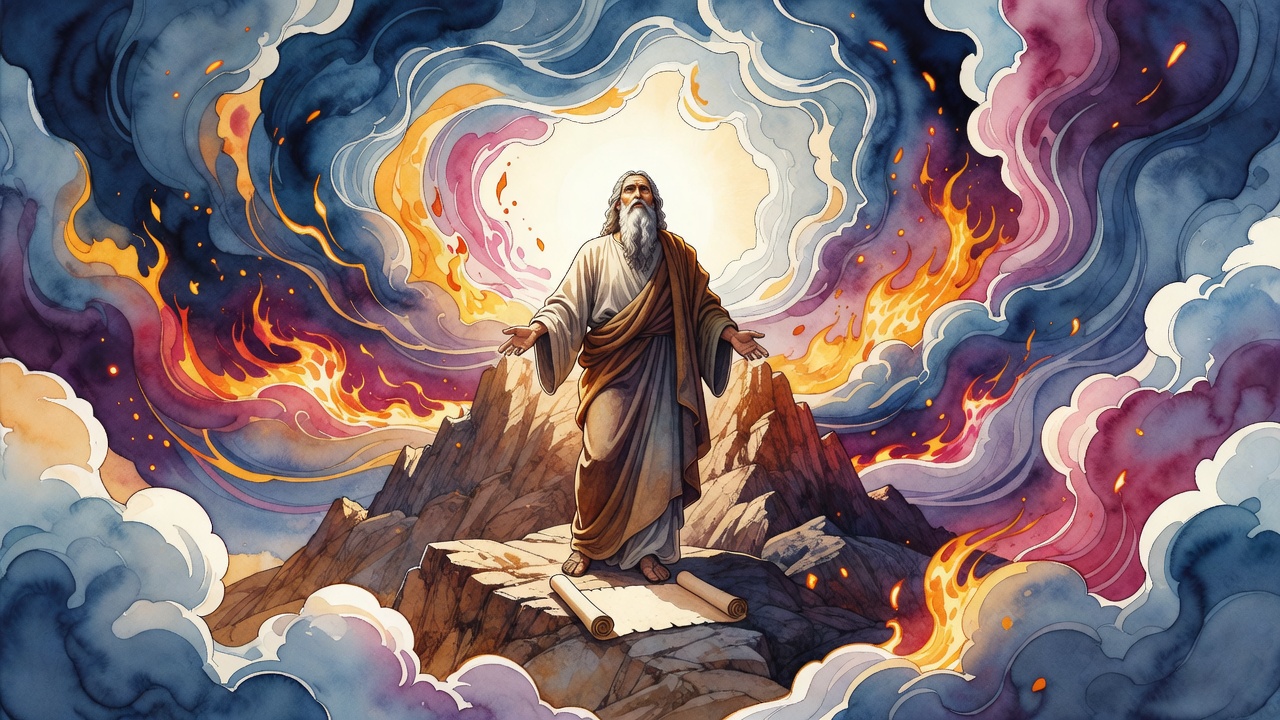
The mountain smoked. The people stood at its foot and waited, and the hidden God, formed and clothed and enthroned, came down to be heard, and then to be seen.

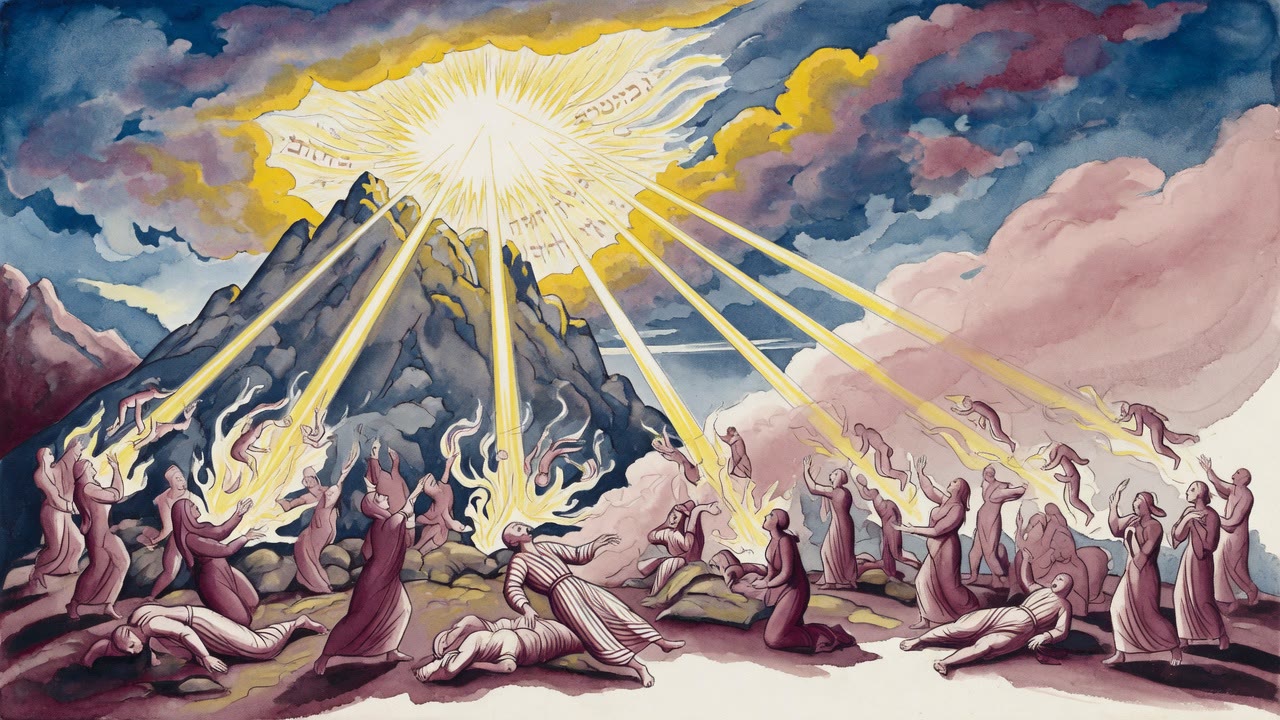
He spoke, and the voice broke upon the waters. He spoke again, and the voice came in raw power. A third time, in majesty. The fourth voice snapped the great cedars like dry reeds. The fifth hewed flames of fire and then held them still, so that fire and water stood side by side in the open air and neither one devoured the other. The sixth shook the whole wilderness until the sand trembled. The seventh bent the wild deer to the ground to give birth and stripped the forests bare, and in each voice the God with no face pressed closer to the edge of the seen.

Seven voices. And in every one of them the Lord of the world was revealed, and the people looked at Him.

When the People Saw the Voices

Here the impossible thing arrived, the thing the whole long descent had been moving toward.

When the voices reached the people, they did not only hear them. "And all the people saw the voices and the torches." Saw them. Sound standing in the open air like a body, where a voice has no body to stand in. The formless had put on a form, and the form could be looked upon, and the whole nation at the foot of the mountain looked.

The utterly hidden had become the plainly visible. The God no eye had ever caught stood in seven thunders before a nation, and they did not turn away. In His hall every creature cries a single word. At the foot of the mountain the people cried it back. "Glory."


← All myths
From the tradition

Sources

3 sources

The texts behind this telling. Some cards carry a translation of the source; others are our own retelling of it, and each card says which. Every card links out to the original.

Sefer ha-Bahir 172Sefer HaBahir

Translation of the source text.Torat Emet Sefer HaBahir · Public Domain

And what are the sons? I have already told you that the Holy One, blessed be He, has seven holy forms, and all of them have their counterparts in the human being, as it is said, "For in the image of God He made the human being" (Genesis 9:6), "In the image of God He created him; male and female He created them" (Genesis 1:27).

And these are they: the right thigh and the left, the right hand and the left, the body with the covenant, and the head, which makes six. But did you not say seven? It becomes seven through his wife, as it is written, "And they shall become one flesh" (Genesis 2:24).

Full source
Tikkunei ha-Zohar 22 (65a)Tikkunei Zohar

Retold in our words. Read the original at the link below.Sefaria-hosted English translation · CC-BY

Tikkunei Zohar turns to The Garments Of The Shekhinah.

These aren't just any clothes. They're woven from holy angels above and, remarkably, from the people of Israel below. Our deeds, our actions, actually contribute to the very fabric of the Divine! The tradition tells us that from these garments, God created the Throne of Glory, as well as heaven and earth and all the creatures within them. That’s quite the closet!

The robe of the Shekhinah, we learn, is made of light. Not just any light, but the light of the very first day of Creation. Think of that primordial burst of energy, the “Let there be light!” moment. According to the myths, that light is reflected in the Shekhinah's robe. And get this: the Shekhinah wears that radiant robe whenever Israel shines its own light through good deeds. When we act with kindness, justice, and compassion,

What happens when we stumble? What happens when we, as individuals or as a community, fall short?

Here’s where the story takes a darker turn. When Israel does evil, the Shekhinah is said to be garbed in the black garments of Lilith. Yes, that Lilith, the figure often associated with the dark feminine, the rebellious first wife of Adam. And the Shekhinah is forced to wear these garments until Israel repents.

The Divine Presence, usually depicted as a radiant bride, forced to wear the clothes of darkness. It highlights the profound connection between our actions and the well-being of the Divine.

Some interpretations, found in texts like Tikkunei (spiritual repair) ha-Zohar 22 (65a), offer a slightly different nuance. They suggest that the Shekhinah puts on these harsh garments to protect Israel. It's a powerful image: the Divine taking on the darkness, shielding us from its full force.

But others see a more troubling implication. The Zohar and other Kabbalistic texts (like Zohar 3:273a) often portray Lilith and the Shekhinah as feminine polar opposites. So, if the Shekhinah is wearing Lilith's garments, does that mean the positive feminine aspect of God is somehow under the power of the dark feminine? It's a question that has sparked much debate and interpretation.

This myth, described by Rabbi Howard Schwartz in Tree of Souls, reminds us that we are not passive observers in the cosmic drama. Our actions have real consequences, affecting not only ourselves and the world around us, but even the very fabric of the Divine. So, what kind of garments are we helping to weave today? What light are we choosing to shine?

Full source
Sefer ha-Bahir 45Sefer HaBahir

Translation of the source text.Wikisource Sefer HaBahir · CC-BY-SA

The master said: What is the meaning of that which is written, "And all the people saw the voices and the torches" (Exodus 20:15)? Now are voices something that can be seen? Rather, "all the people saw the voices": those voices of which David said, "The voice of the LORD is upon the waters; the God of glory thunders" (Psalms 29:3) and onward. "The voice of the LORD is in power" (Psalms 29:4), and Scripture says, "By the strength of my hand I have done it" (Isaiah 10:13), and it says, "My hand also has laid the foundation of the earth" (Isaiah 48:13). "The voice of the LORD is in majesty" (Psalms 29:4), and the verse says, "Splendor and majesty are His work, and His righteousness endures forever" (Psalms 111:3). "The voice of the LORD breaks the cedars" (Psalms 29:5): this is the bow that shatters the cypress trees and the cedar trees. "The voice of the LORD hews out flames of fire" (Psalms 29:7): this is the one who makes peace between the water and the fire, for it hews out the power of the fire and prevents it from licking up the water, and also prevents the water from extinguishing the fire. "The voice of the LORD shakes the wilderness" (Psalms 29:8), as it is said, "And shows lovingkindness to His anointed, to David and to his seed forever" (Psalms 18:51), more than the wilderness. "The voice of the LORD makes the hinds to calve and strips the forests bare, and in His temple everyone says, Glory" (Psalms 29:9), and it is written, "I adjure you, O daughters of Jerusalem, by the gazelles or by the hinds of the field" (Song of Songs 2:7). From this you learn that the Torah was given with seven voices, and in all of them the Lord of the world was revealed to them, and they saw Him; and this is what is written, "And all the people saw the voices."

Full source