5 min read

Israel Falls at Sinai as Each Word Kills

At Sinai each divine word knocks Israel's souls out of their bodies until God must soften the light so a people can stand and live.

Curated by Arthur · Told by Maggid ·
Table of Contents
  1. Too Much Light for a Finite Soul
  2. Why Evil Still Has a Root at the Foot of the Mountain
  3. MaH and BaN Out of Balance
  4. God Softens the Speech
  5. A People That Will Build a Room for Presence

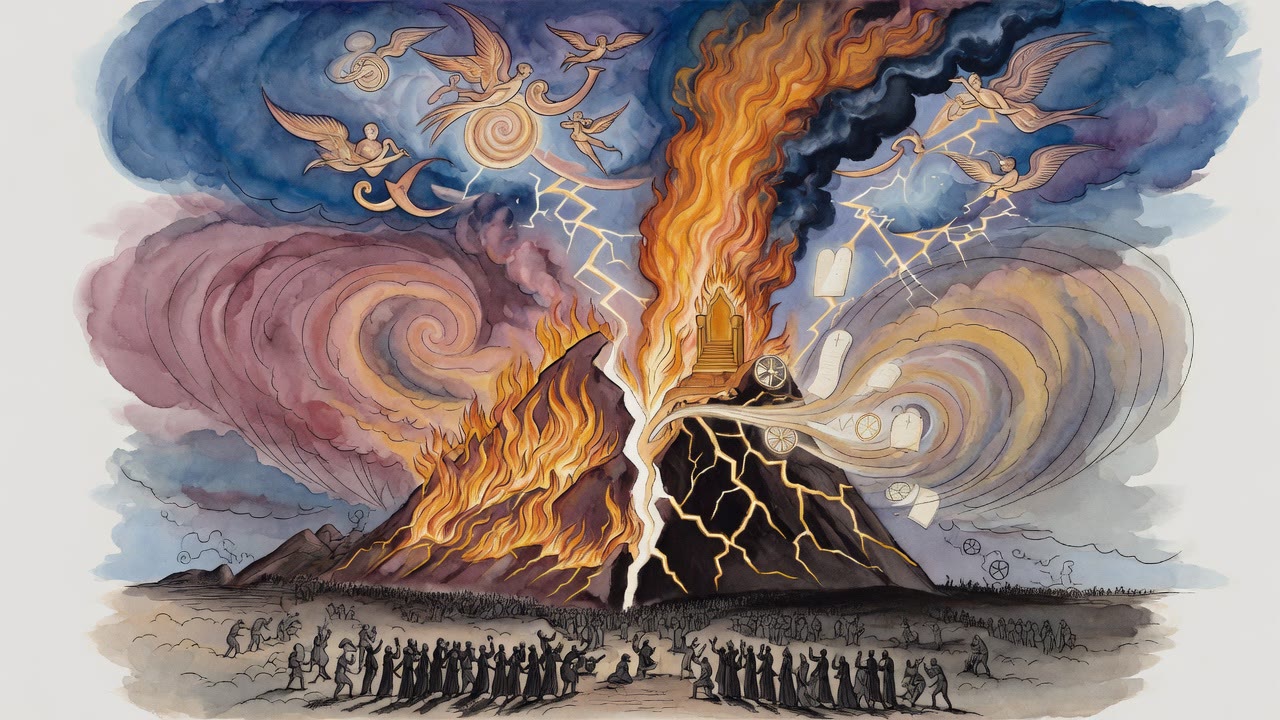
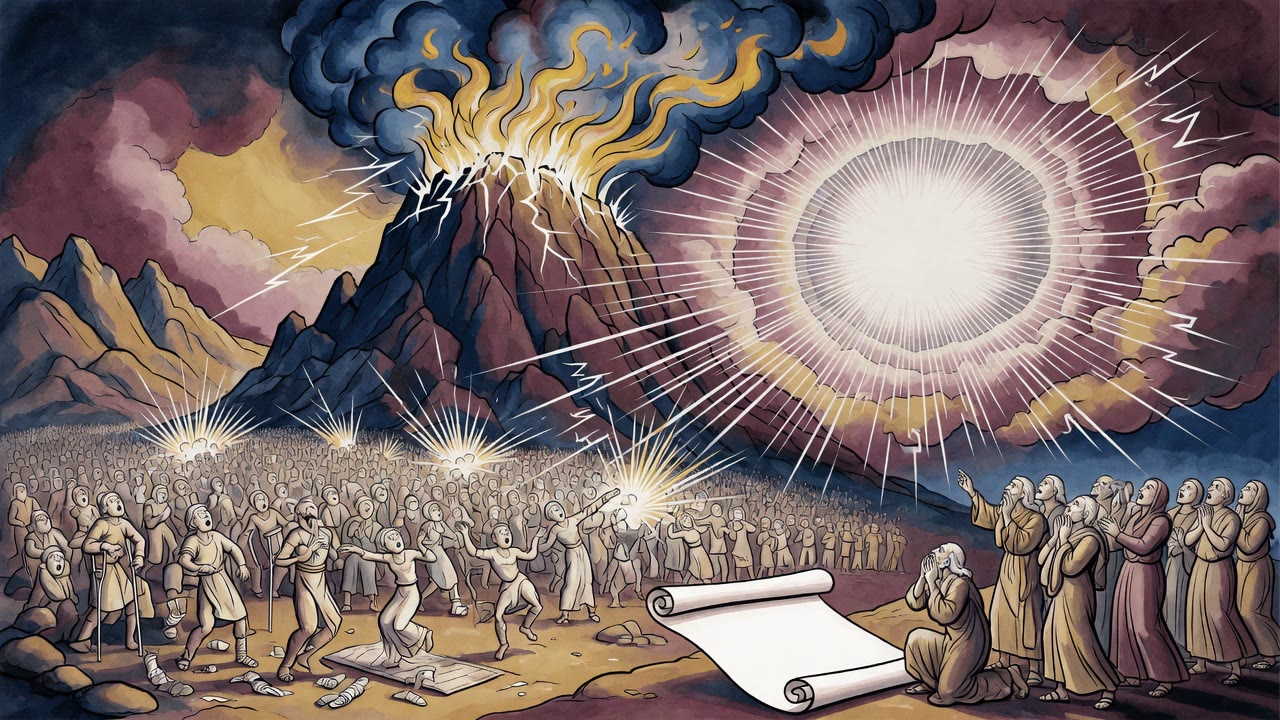
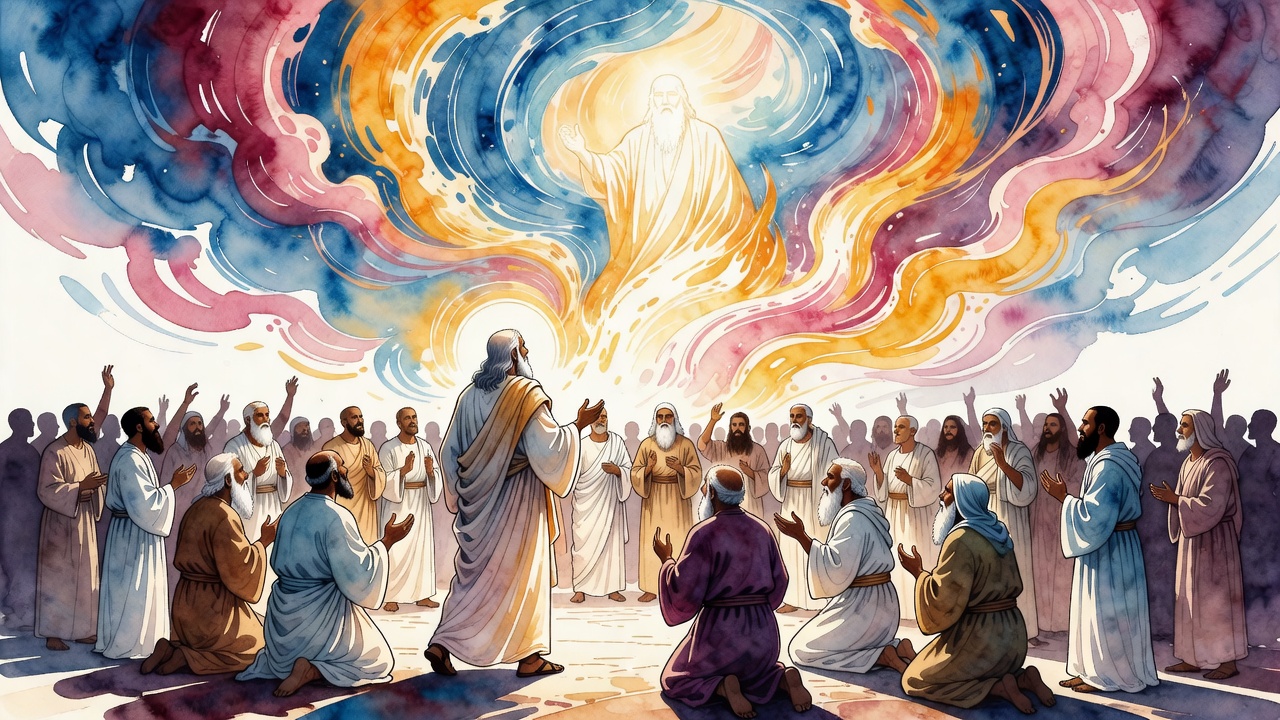
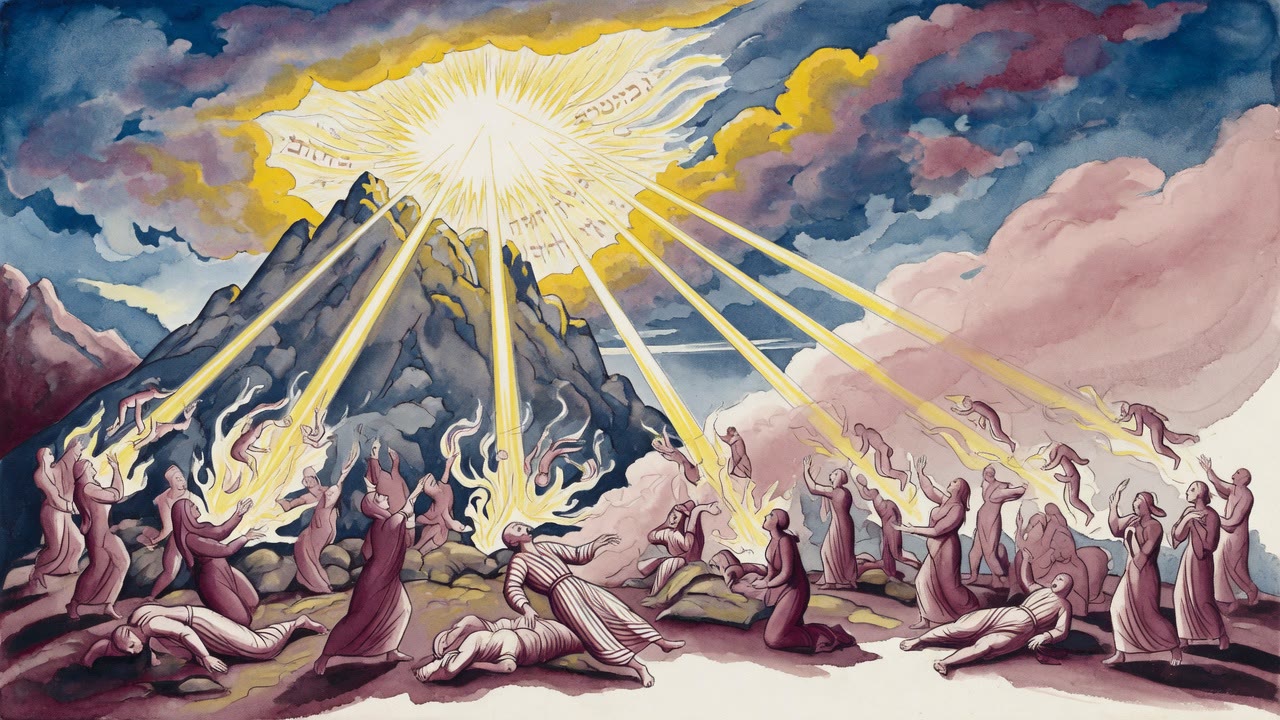
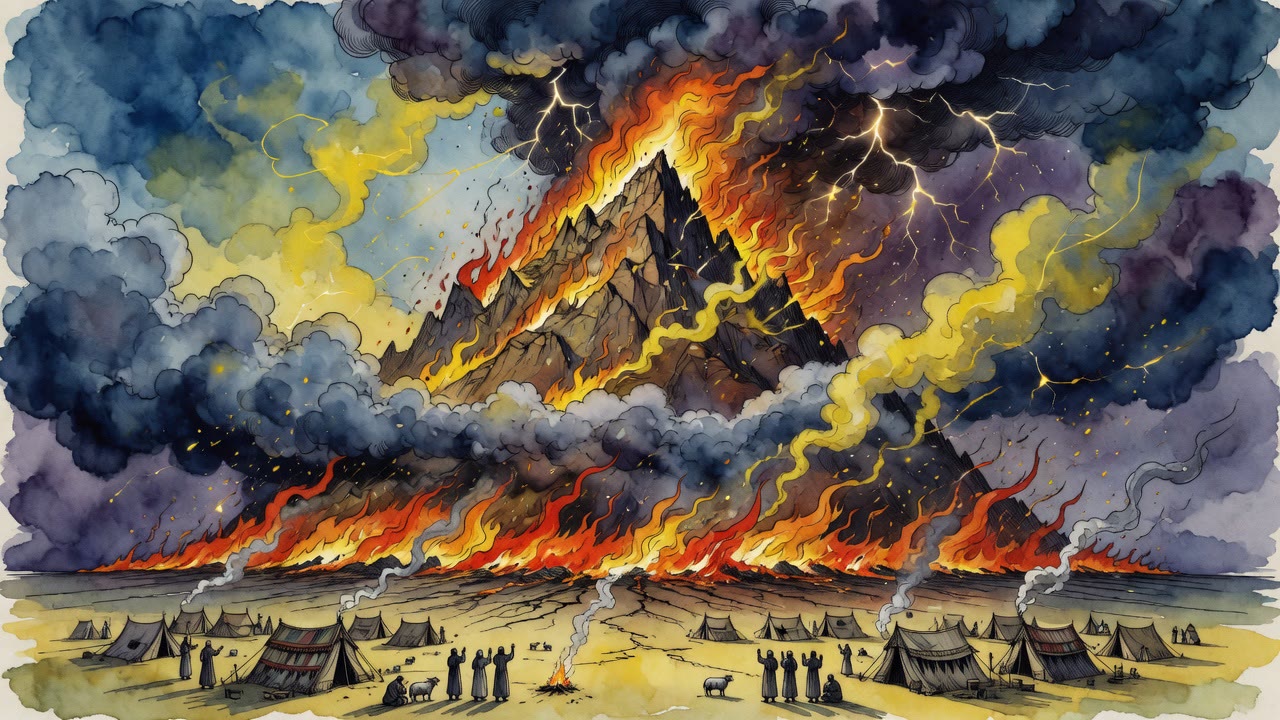
The mountain smokes. Israel stands far off, and still the first word hits like a hand against the chest. Knees fail. Souls leave bodies the way birds leave a tree when a stone lands in the branches.
Israel Falls at Sinai as Each Word Kills Click for full size

Moses stays upright in the blast. Behind him a nation folds into dust and awe.

Too Much Light for a Finite Soul

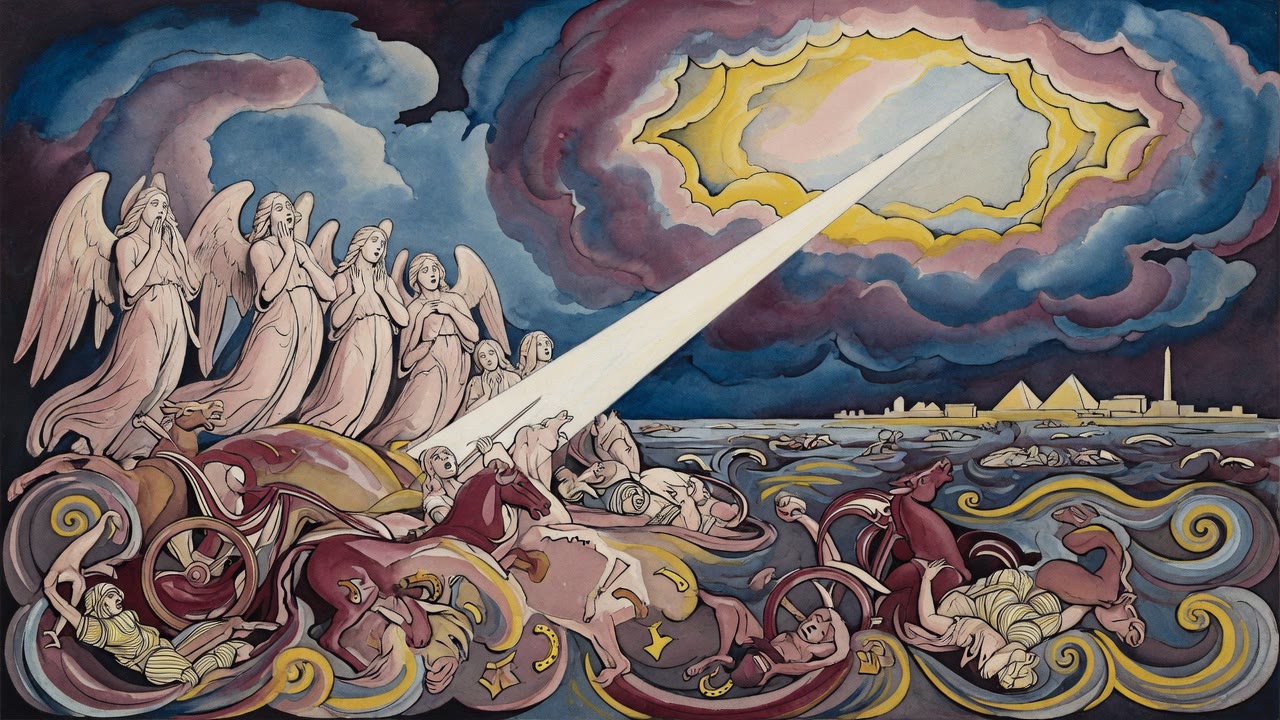
Each utterance is unmediated contact. The Shechinah (the Divine Presence) presses so close that a finite soul cannot hold both body and voice at once. Souls depart. Angels of healing, or the sheer will of God, return them. Then the next word arrives and kills them again with glory.

This is not theater. It is the cost of hearing without a veil. The patriarchs lived as chariots, minds bound to God without a seam. Moses will speak with a throat the Shechinah uses as its own. Israel tastes that unity for a breath and cannot endure it. Flesh was not built for the raw Infinite.

Why Evil Still Has a Root at the Foot of the Mountain

Even here, under the cloud, the old root of evil has not been erased. It was born as contrast, a shadow that lets perfection show itself by what it is not. After repair, that root remains for a different reason: to display how deficiency was healed.

Israel does not yet know this. Israel only knows thunder, shofar, and the terror of being chosen while still half-broken from Egypt. The calf is already a possibility sleeping in gold earrings. Sinai does not delete free will. It raises the stakes of every later choice.

MaH and BaN Out of Balance

Above the camp, the repair of shattered points is unfinished. BaN once emerged alone among the Nekudim, a feminine configuration without its partner, and the asymmetry scarred the worlds. MaH entered later as tikkun (a repair), a masculine current meant to rebalance what stood solo.

At Sinai the imbalance still echoes. Masculine and feminine lights do not yet stand face to face in full peace. Revelation pours, but the vessels of a people just freed from brick and whip are thin. Some light enters. Some light shatters into commandments that will take centuries to inhabit.

The mountain shakes because the lower world is being asked to host what it was not yet trained to hold.

God Softens the Speech

Seeing the people die and return, die and return, God changes the method. The rest of the words arrive through Moses, a buffer of human throat and human ears. The commandments become something a body can stand under without emptying.

This is mercy that looks like distance. A home for God in the physical world cannot be built from corpses of ecstasy. It needs living hands that can later build a mishkan, keep Shabbat, fail, return, and fail again without the mountain killing them each dawn.

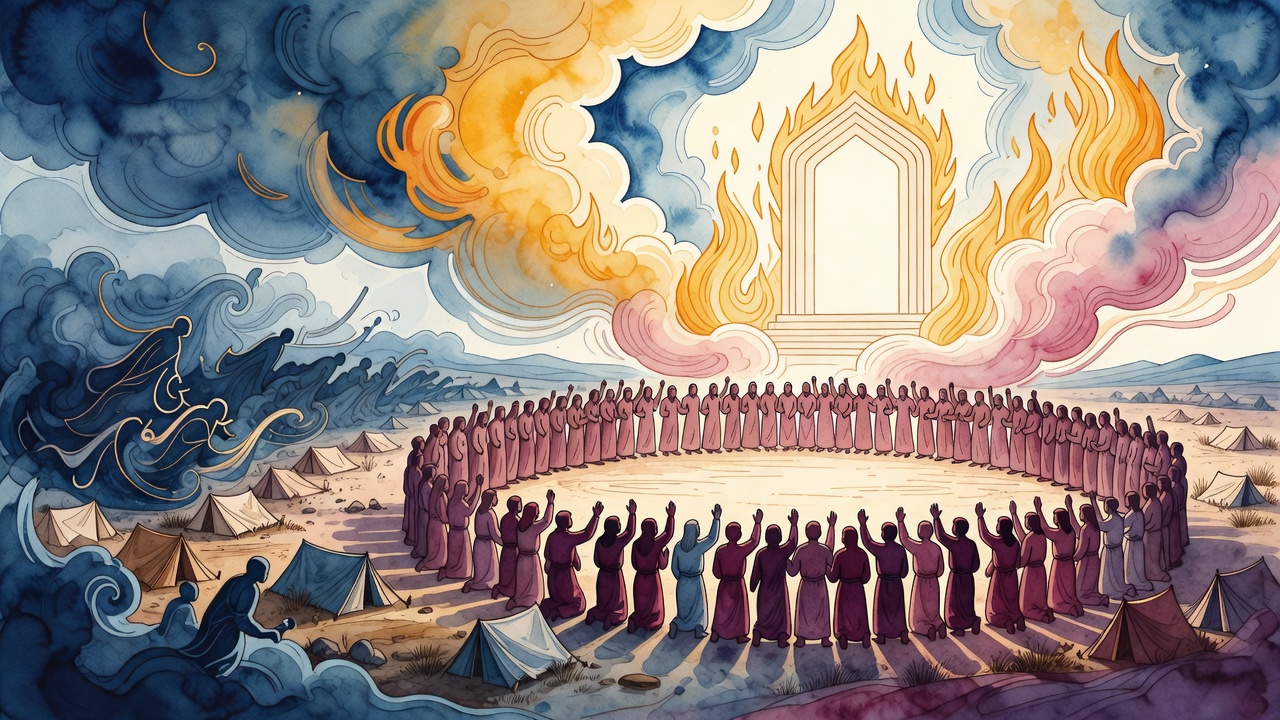
Israel drinks water. Legs steady. The cloud remains, but the killing sweetness of each letter eases into law that can be carried in a cart.

A People That Will Build a Room for Presence

Moses descends with a face that still burns. The people flinch from the shine. In that flinch is the whole future: a nation that has tasted direct speech and must now live by mediated light, study, and the slow work of making earth a dwelling.

The calf will come. The tablets will break. Repair will become the story's main verb. But for this hour the camp is quiet enough to hear a man breathe. Sinai has not finished them. It has started them.

Somewhere above, the goal of all service still waits: coupling, ziyvug, the reunion of lights that once stood alone. The people packing their tents do not know that word. They know only that they fell, rose, and were told to live.

A woman in the third rank catches her child as the second word hits. For a breath both of them are empty shells. When life slams back, the child is crying and the mother is laughing through tears because laughter is what terror does when it has no other door.

Elders who remembered Egyptian overseers discover a different kind of blow. The whip broke skin. This breaks distance. God is no longer a rumor carried by Moses alone. God is weather with grammar, and the grammar is lethal until softened.

Someone at the edge of the camp already fingers a gold earring, not yet planning a calf, only soothing fear with metal that once felt like wealth in Goshen. Sinai does not purge that reflex in a day. Revelation is a beginning, not an ending of the human appetite for manageable gods.

Moses will carry the afterimage of their falling bodies for the rest of his life. When he argues later for mercy after the calf, he will remember how easily a people can die of too much light and how carefully the Infinite chose to speak through a man so they could live long enough to fail and return.


← All myths
From the tradition

Sources

3 sources

The texts behind this telling. Some cards carry a translation of the source; others are our own retelling of it, and each card says which. Every card links out to the original.

Kalach Pitchei Chokhmah 49:8Kalach Pitchei Chokhmah

Retold in our words. Read the original at the link below.138 Openings of Wisdom, trans. Rabbi Avraham Greenbaum, Azamra Institute (2005) · CC-BY

While there aren't easy answers, Jewish mystical thought offers a fascinating perspective. to a concept explored in the Kalach Pitchei Chokhmah, a profound text of Jewish wisdom. It talks about the very "root of evil." Now, that sounds intense. The text suggests that, at its inception, this root was actual evil. The idea isn't that evil is just a misunderstanding or a lack of good. It had a purpose, a reason for being. And that reason,

Wait, what? Evil highlighting perfection? It sounds paradoxical, I know. But bear with me.

The idea is that, to truly appreciate perfection, you need to understand what it isn't. This "root of evil" came into being to demonstrate what deficiencies look like. It acted as a contrast, a shadow against which God's light could shine even brighter. It was the original source of deficiency, born out of the concealment of God's perfection.

It's like appreciating the warmth of the sun only after experiencing a cold winter. Or understanding the beauty of harmony only after hearing discord.

But here's the truly amazing part. According to the Kalach Pitchei Chokhmah, this isn't the end of the story. After the deficiencies – the bad things, the imperfections – are repaired, what happens to this root of evil? Does it just disappear? No. It remains.

But it remains for a completely different reason.

Now, it remains to show us how those deficiencies were rectified. It acts as a roadmap, evidence of the journey from imperfection to wholeness. We get to see, clearly, the path that was taken, the steps that were made, the gradual unveiling of perfection that healed the brokenness.

Think of it like a scar. It's a reminder of a wound, yes, but it's also evidence of the body's incredible ability to heal. The scar doesn't erase the pain, but it tells a story of resilience and recovery.

This is a powerful idea. It suggests that even the darkest parts of our experience can ultimately serve a higher purpose. That even evil, in its own strange way, can contribute to the revelation of God's perfection.

And that revelation, according to the Kalach Pitchei Chokhmah, is a gradual process, a "little by little" unfolding. It's not a sudden, dramatic transformation, but a slow, steady movement towards wholeness. And as that perfection is revealed, it rectifies the deficiencies in that same gradual way.

So, the next time you encounter something difficult, something painful, something that seems inherently evil, remember this: it might be part of a larger story, a story of healing and transformation. It might be a reminder that even in the darkest of times, the light of perfection is slowly, but surely, making its way through.

Full source
Kalach Pitchei Chokhmah 65:9Kalach Pitchei Chokhmah

Retold in our words. Read the original at the link below.138 Openings of Wisdom, trans. Rabbi Avraham Greenbaum, Azamra Institute (2005) · CC-BY

In Kabbalah, the ancient Jewish mystical tradition, that feeling might point to an imbalance between masculine and feminine energies. But what if I told you that this imbalance wasn't always there, and that its emergence is tied to a cosmic drama involving shattered vessels and the painstaking process of repair?

Our story centers on the Nekudim, often translated as "points" or "sparks." Now, these weren't just any sparks; they were primordial configurations of divine light, attempts, if you will, at creation that didn't quite work out the first time. As explained earlier in the text Kalach Pitchei Chokhmah, the problem arose because of something called BaN emerging "on its own."

What's BaN, you ask? It's a complex concept, but for our purposes, The important thing is that it emerged independently within the Nekudim. This initial solo act created a fundamental asymmetry, a lack of equilibrium that needed to be addressed.

Later, MaH was introduced into these Nekudim through a process of tikkun (repair). MaH, in contrast to BaN, represents another facet of the divine, and its introduction was a crucial act of restoration. This tikkun, the introduction of MaH, wasn't just a minor adjustment; it was, as the text emphasizes, "a new state brought about in these worlds."

Now, here’s where the concept of male and female comes into play. According to Kalach Pitchei Chokhmah, every root involving Male and Female from Atzilut (the realm of emanation) downwards depends upon the Balance. This Balance is the "mystery of the joining of MaH and BaN." Think of it as a cosmic dance, where MaH and BaN must find harmony to create true wholeness.

Before this "Balance" was achieved, the raw forces of Kindness and Judgment, powerful as they were, didn't automatically translate into a dynamic of male and female within the Nekudim. Remember, BaN had emerged alone! It was only with the introduction of MaH and the subsequent balancing act that the aspect of male and female truly took root.

Therefore, the text concludes that we must recognize the Balance as the root of this aspect, because male and female, in this sense, derive from the Balance.

So, what does this all mean for us? Perhaps it’s a reminder that true creation, true wholeness, requires balance. It's not enough for individual forces to emerge on their own; they must be integrated, harmonized, brought into equilibrium. Just like the Nekudim needed the joining of MaH and BaN, maybe we too need to seek out the missing pieces within ourselves and our world to find true and lasting balance.

Full source
Tanya, Likkutei Amarim, Chapter 34Tanya (Likkutei Amarim)

Retold in our words. Read the original at the link below.Kehot Publication Society English Translation via Sefaria (CC-BY-NC) · CC-BY-NC

The Tanya's thirty-fourth chapter brings everything together with a single image: the Patriarchs were God's chariot, and you can be too.

Abraham, Isaac, and Jacob never, for a single moment throughout their entire lives, ceased to bind their minds and souls to God with complete self-nullification. They were "chariots", vehicles with no independent will, perfectly subordinate to the divine rider. The prophets after them achieved similar states, each according to their level. Moses surpassed them all. The Zohar says the Shechinah (שכינה) "spoke from Moses' throat", his own voice was God's voice, without any barrier between them.

The Israelites tasted this unity at Mount Sinai. But they could not endure it. The Talmud in Tractate Shabbat says their souls departed with each divine utterance, the intensity of unmediated contact with God was too much for a finite soul to sustain. So God commanded the building of the Mishkan (משכן), the Tabernacle, to create a regulated, sustainable dwelling place for the divine presence.

After the Temple was destroyed, the Tanya says, God has only one dwelling place left: the "four cubits of halachah (Jewish religious law)" (Berachot 8a). Torah law, the study and practice of God's will as expressed in the legal tradition, is now the only sanctuary on earth where God's presence rests.

Rabbi Schneur Zalman concludes with a meditation for the benoni. Say to yourself: "My intellect and the root of my soul are too limited to become a perfect chariot for God. I cannot apprehend God the way the Patriarchs and prophets did. But I can do this: I can study Torah and perform mitzvot (commandments). I can make my body a dwelling place for the divine, not through ecstatic vision, but through consistent, faithful practice."

This is the Tanya's ultimate message. The grand cosmic architecture, the four worlds, the ten sefirot, the divine soul and its garments, all exists for one purpose: so that a finite human being, in a physical body, in this darkest and lowest of worlds, can open a book, study a law, and make that small act into a home for the Infinite. This is what the Tanya calls dirah b'tachtonim (דירה בתחתונים), making this physical world a dwelling place for God. And it is, the Tanya insists, very near to you.

Full source