Parshat Ki Tisa4 min read

The Mob Slew the Elders for the Golden Calf

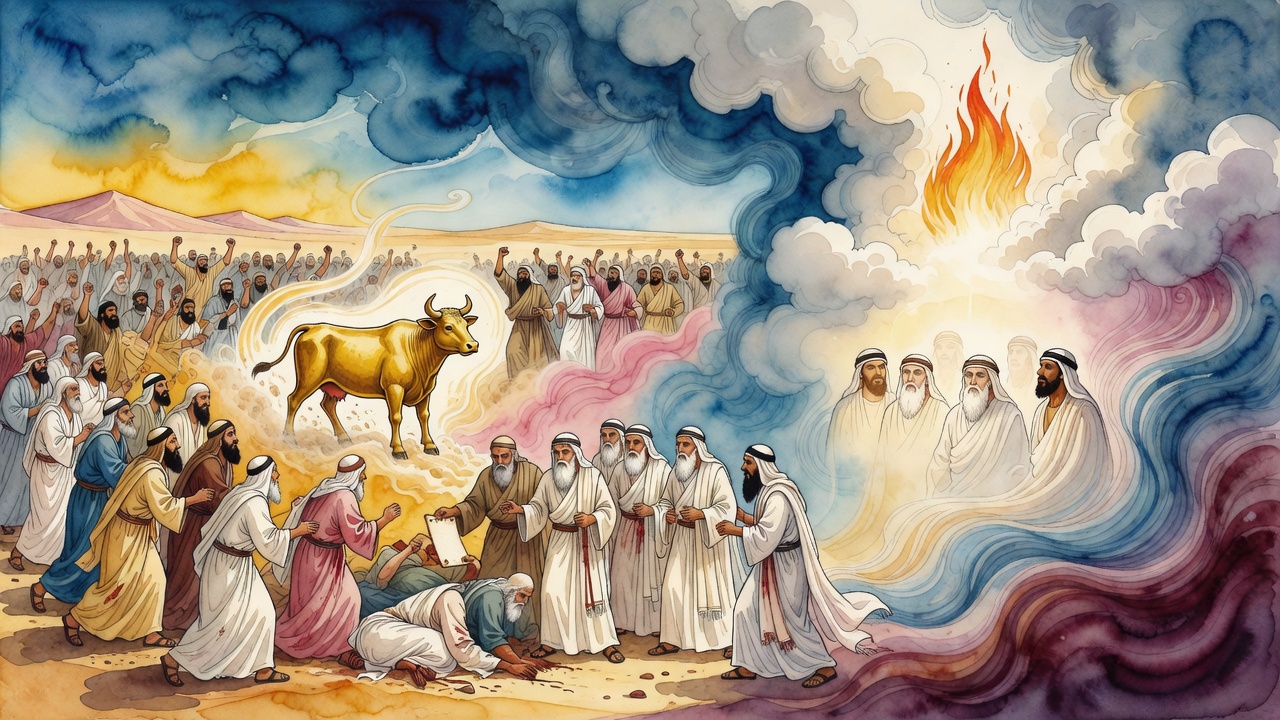
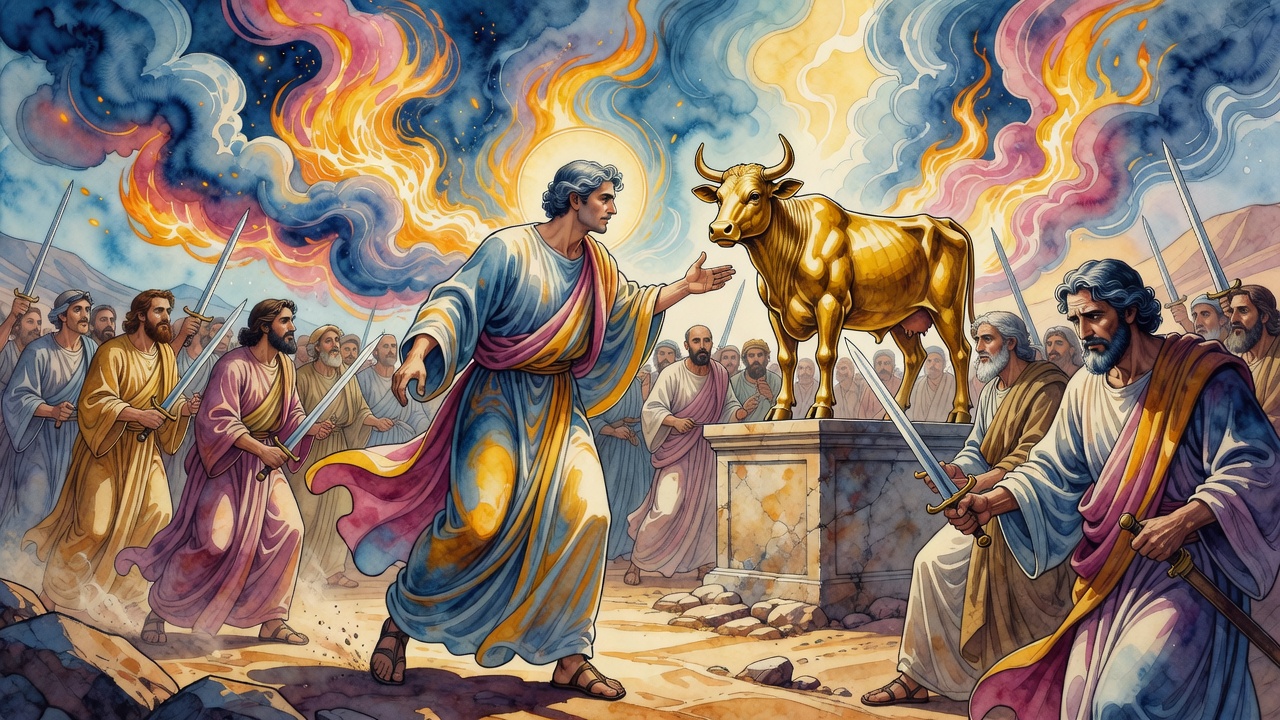
The crowd made the metal bull move and bellow, then told the judges to call it God. The judges said no, and the crowd killed them for it.

Curated by Arthur · Told by Maggid ·
Table of Contents
  1. Thirteen Calves, Not One Panic
  2. The Elders Who Would Not Bow
  3. A Nation of Priests Becomes a Caste of Priests
  4. Thirteen Attributes Against Thirteen Calves
The Mob Slew the Elders for the Golden Calf Click for full size

Thirteen Calves, Not One Panic

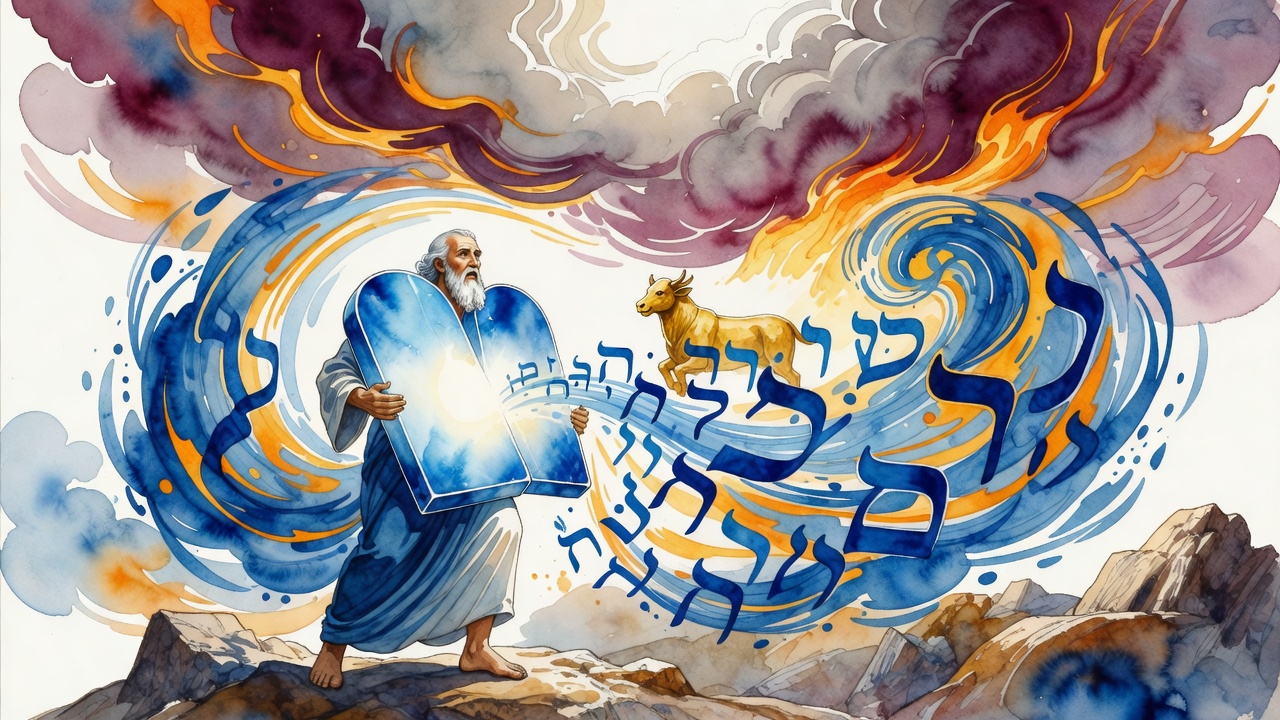
The legends open a darker count than one impatient camp. Thirteen golden calves. A mixed multitude animated metal until it moved like a living bull and shouted, "This is your God, O Israel!" Deception wore the face of a miracle while Moses delayed on the mountain.

They hauled the claim to the Sanhedrin (the high court of elders). Worship the bull, they demanded. Say it led you out. Some mouths even said the Holy One had been captive in Egypt. History was rewritten at the knifepoint of noise and the glitter of gold that had once been Egyptian jewelry on Hebrew ears.

Gold that had been earrings became a theology. Fingers that had packed dough for flight now shaped a bull. Sinai's air held the lowing of an idol under a mountain that still smoked with recent revelation and the memory of a voice without shape.

The Elders Who Would Not Bow

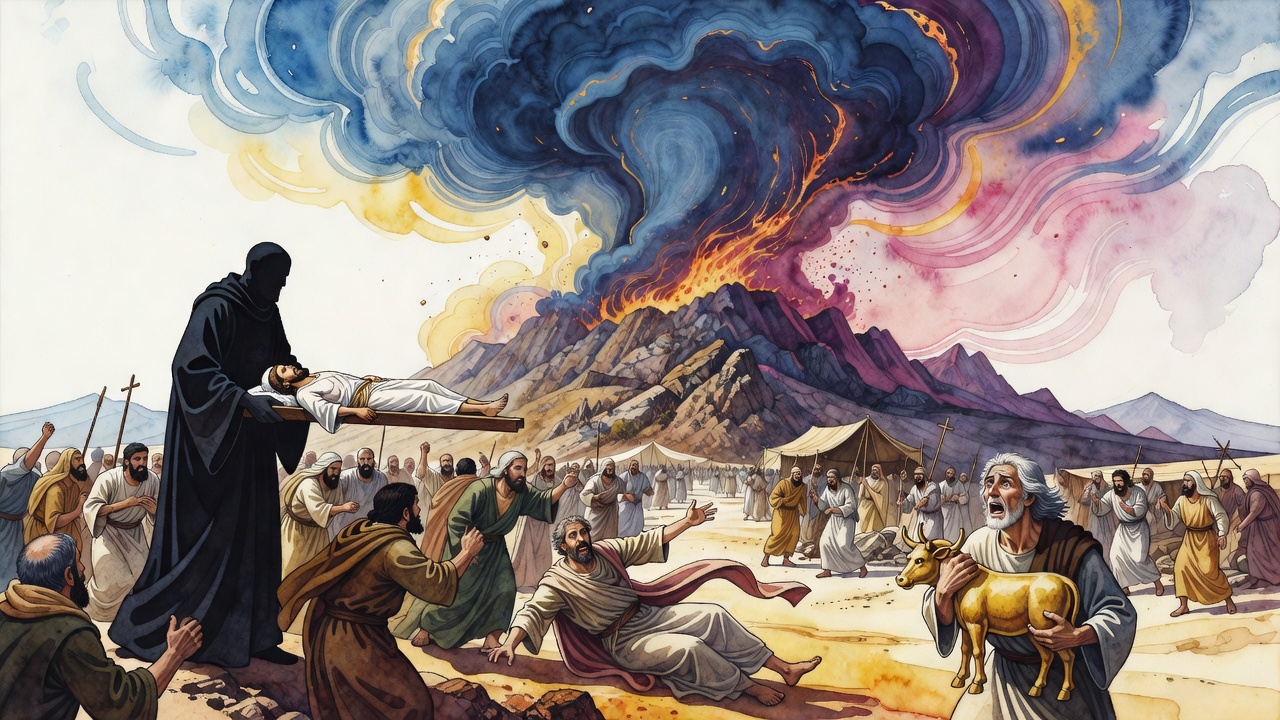
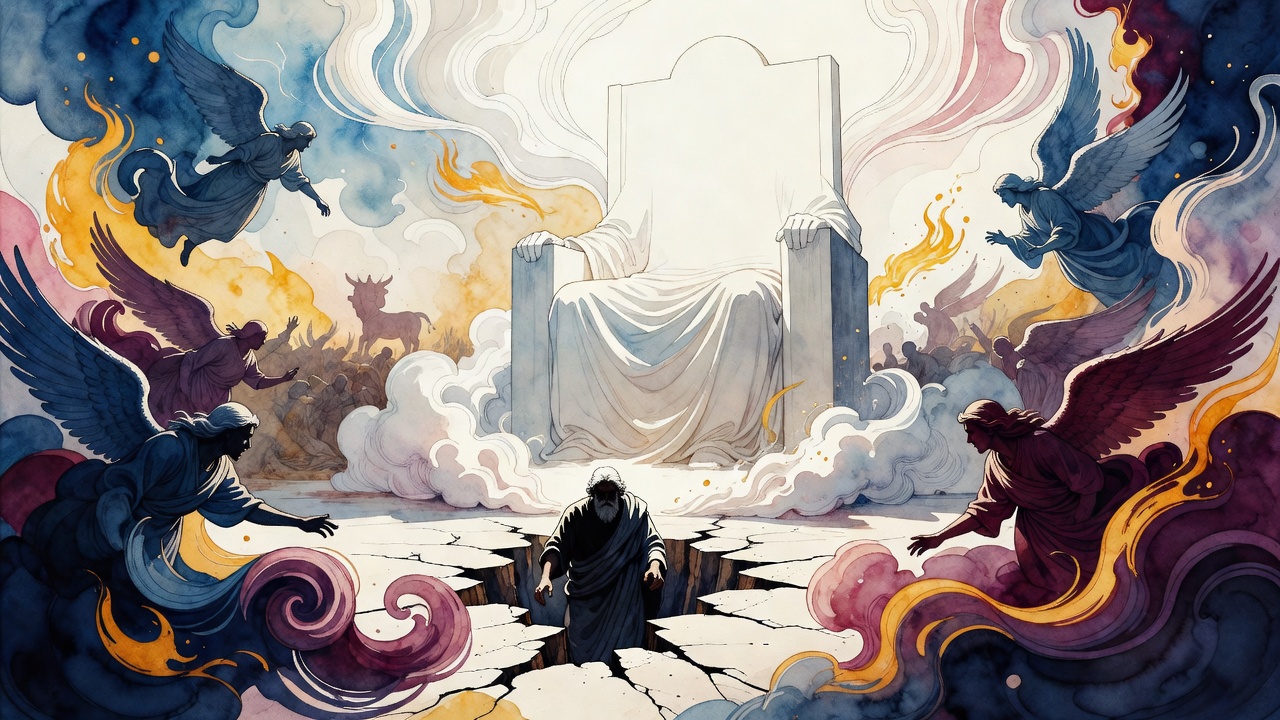
The Sanhedrin refused. Their reward was slaughter by the mob. Loyalty ended in blood on ground that had heard we will do and we will hear only weeks before. The twelve heads of the tribes also refused. They lived, and the legends grant them a divine vision as counterweight to the elders' martyrdom.

Aaron's hands and the people's gold remain in the Torah's frame. The midrashic heat adds a judiciary murdered for saying no. Sinai's betrayal is not only dancing. It is the killing of the men who would not dance when dancing meant bowing to a bull.

Blood of judges mixed with dust that had heard the Ten Words. The tablets in Moses' hands would soon break as if stone itself refused to enter a camp that murdered its teachers for refusing a bull that pretended to breathe.

A Nation of Priests Becomes a Caste of Priests

Before the calf, every Israelite stood in a kind of priesthood of nearness. After it, that universal right shattered. Service concentrated into a priestly line because the camp had proven it could crown a bull and kill anyone who said the crown was a lie.

Moses, when he returned with words, still began with the elders who remained, honoring age even in a generation that had murdered age for gold. The people had once answered with joy, na'aseh v'nishma. Waiting hollowed the vow. A living idol filled the hollow with noise.

Half-shekels later would press repair into coin. First came the knowledge that not every Israelite would stand as priest, because not every Israelite had stood against the bull when standing cost blood and would have cost more.

Thirteen Attributes Against Thirteen Calves

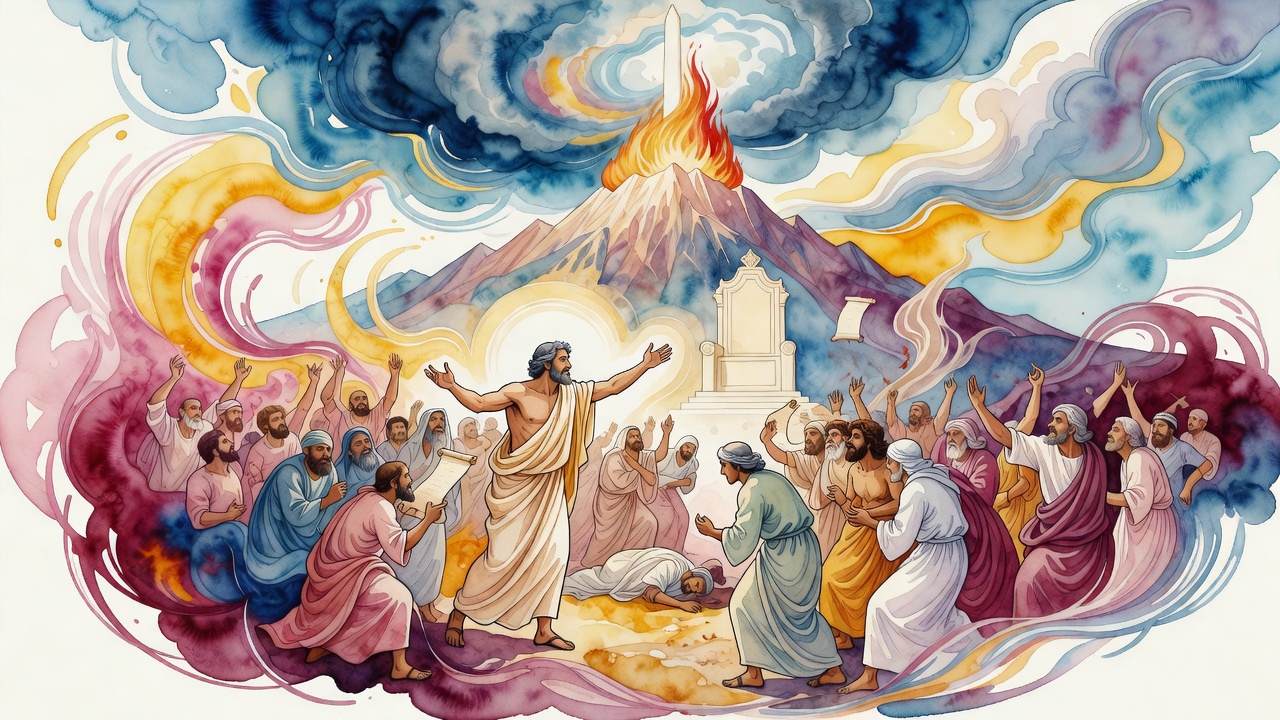
Moses stood before God after the wreck. The seventh time the tradition counts God appearing on earth, He took the form of a hazzan leading prayer and taught Moses the thirteen attributes of mercy. Call Me by these, and I will forgive even atrocious acts when repentance stands up.

The camp that had built thirteen idols was handed thirteen names of compassion as a path back. People grumbled that plunder from Egypt should not fund their own atonement, spiraling through legal analogies of oxen and slander to price a sin that compared God to a grazing beast.

Moses learned the attributes the way a drowning man learns a rope's knots. Each name of mercy was a rung out of a pit dug with jewelry. The slaughtered Sanhedrin could not climb those rungs. The living still could, if they chose repentance over another dance around gold.


← All myths
From the tradition

Sources

4 sources

The texts behind this telling. Some cards carry a translation of the source; others are our own retelling of it, and each card says which. Every card links out to the original.

Legends of the Jews 2:99Legends of the Jews

Retold in our words. Read the original at the link below.The Legends of the Jews by Louis Ginzberg (1909) · Public Domain

Why the Israelites Built Thirteen Golden Calves is the question behind this passage from Legends of the Jews.

Ginzberg, in his monumental work, Legends of the Jews, gives us a fascinating, and frankly, chilling explanation. It wasn't just impatience. It was deception.

In legend, the "mixed multitude" – the non-Israelites who joined the Exodus – played a key role. These folks, seeing the golden calf, somehow animated, behaving like a living creature, shouted, "This is your God, O Israel!" Can you imagine the scene? The confusion, the excitement, the sheer audacity of it all?

Here's where it gets even darker. The people didn't just blindly follow. They went to the Sanhedrin, the seventy elders who were supposed to be the guardians of Jewish law and tradition. They demanded that the Sanhedrin worship the bull, claiming that it, not God, had led them out of Egypt. They even went so far as to say that God, or rather, "Himself," had been in captivity in Egypt! Think about the audacity of that claim. It completely rewrites their history, their understanding of everything.

The Sanhedrin, to their eternal credit, refused to betray their God. And what was their reward? They were slaughtered by the mob. Yes, you read that right. Loyal to the end, they paid the ultimate price for their faith.

And what about the twelve heads of the tribes? They, too, refused to answer the people's summons. They wouldn't participate in this blasphemous act. And for their steadfastness, they were rewarded: they were deemed worthy of beholding a Divine vision.

What does this tell us? It highlights the terrifying power of manipulation, the fragility of faith when confronted with convincing lies, and the courage it takes to stand up for what you believe in, even when facing overwhelming pressure.

It's a story of faith, betrayal, and the ever-present struggle between truth and falsehood. And how do we find the strength to resist?

Full source
Legends of the Jews 2:33Legends of the Jews

Retold in our words. Read the original at the link below.The Legends of the Jews by Louis Ginzberg (1909) · Public Domain

In Legends of the Jews, it all goes back to the Golden Calf.

Imagine, if you will, a world where every single Israelite was a priest, a direct conduit to God. A nation of holy people. But then came the sin, the terrible mistake of worshipping a false idol. And as Ginzberg retells it in Legends of the Jews, that act changed everything. It was after this transgression that most of the people lost their right to the priesthood. That unique, universal connection was broken, and a select group, the priestly caste, took on the responsibility.

So, what happened next?

God gave Moses very specific instructions. He was to transmit God’s words to the people, exactly as they were, in the original lashon hakodesh, the Holy Tongue, Hebrew. No additions, no subtractions, every nuance preserved.

And Moses, ever the faithful messenger, immediately went to the people. He didn't even stop to see his family first! His priority was delivering God’s word. Isn't that amazing?

He began with the elders, always remembering to honor them. As we find in Midrash Rabbah, respect for elders is paramount. Then, in a clear and organized way, he presented the message to everyone – men, women, all the Israelites.

And here's where it gets really powerful. Of their own free will, with hearts full of joy, each Israelite declared their willingness to accept the Torah. They said "Na'aseh v'nishma", we will do and we will understand. They were ready to commit to God's teachings. What an incredible moment of unity and faith!

Moses, upon hearing the people's acceptance, returned to God. Now, God, being omniscient, already knew the answer. But as Legends of the Jews points out, proper etiquette dictates that a messenger reports back to the sender, regardless. It's about respect, about completing the circle of communication.

Then God says something truly profound to Moses: "I will come to thee in a thick cloud and repeat to thee the commandments that I gave thee on Marah, so that what thou tellest them may seem to the people as important as what they hear from Me." God wasn't just concerned about Moses' authority in that moment. He was thinking about the future. "But not only in thee shall they have faith," God says, "but also in the prophets and sages that will come after thee."

God was establishing a lineage of leadership, ensuring that future generations would also trust in the wisdom and guidance of those who came after Moses. This wasn't just about one person; it was about the continuity of faith, the transmission of tradition, from generation to generation. It's a beautiful reminder that we are all part of something much larger than ourselves, a chain of faith stretching back to the very beginning.

Full source
Legends of the Jews 2:124Legends of the Jews

Retold in our words. Read the original at the link below.The Legends of the Jews by Louis Ginzberg (1909) · Public Domain

Moses, standing before God after the devastating sin of the Golden Calf. The people, scared and impatient, had turned away from the covenant, creating an idol of gold in the desert. Heartbreaking. So, how could they possibly hope for redemption?

Well, the story goes that it was the seventh time God had appeared on earth. And this time, He took the form of a hazzan, a precentor, leading prayer in a synagogue. image for a moment – God, embodying the one who guides us in our moments of devotion.

In this guise, God revealed to Moses the secret to forgiveness. "Whenever Israel has sinned," God said, "and calls Me by the following thirteen attributes, I will forgive them their sins." These thirteen attributes, known as the Shlosh Esrei Middot, are a core concept in Jewish theology and prayer. They describe God's character, particularly His capacity for mercy.

What are these attributes? They paint a portrait of a God who is not just powerful, but deeply compassionate. "I am the Almighty God who provides for all creatures," God declares. "I am the Merciful One who restrains evil from humankind. I am the Gracious One who helps in time of need. I am the Long-Suffering to the upright as well as to the wicked." last one for a moment – long-suffering to the wicked.

God continues, "I am Bountiful to those whose own deeds do not entitle them to lay claim to rewards. I am Faithful to those who have a right to expect good from Me; and preserve graciousness unto the two-thousandth generation. I forgive misdeeds and even atrocious actions, in forgiving those who repent."

According to Legends of the Jews, a compilation of rabbinic stories collected by Rabbi Louis Ginzberg, when Moses heard this, especially that God is long-suffering, he immediately prayed, "O forgive, then, Israel's sin which they committed in worshipping the Golden Calf."

And here’s where the story takes an interesting turn. The tale suggests that if Moses had prayed, "Forgive the sins of Israel unto the end of all time," God would have granted it! As we find in Midrash Rabbah, it was a time of immense mercy. But Moses only asked for forgiveness for that specific sin. So, that one sin only was pardoned. God responded, "I have pardoned according to thy word."

Wow.

What does this story tell us? It's not just about a historical event. It's about the nature of forgiveness, the power of prayer, and the importance of asking for what we truly need. It suggests that God's capacity for mercy is boundless, but that we must actively seek it out. We have to name our failings, express our remorse, and turn toward repentance, toward teshuvah (repentance).

And maybe, just maybe, it also hints at the incredible responsibility we carry in our own prayers. Moses, in his humility, perhaps didn't realize the full extent of God's willingness to forgive. He asked for what he thought was possible, but perhaps he could have asked for so much more.

It's a powerful reminder that our prayers matter, that our words have weight, and that even after the biggest mistakes, the possibility of forgiveness and a fresh start is always within reach.

Full source
Legends of the Jews 2:140Legends of the Jews

Retold in our words. Read the original at the link below.The Legends of the Jews by Louis Ginzberg (1909) · Public Domain

The familiar story is this: The Israelites, fresh out of Egypt, get impatient waiting for Moses on Mount Sinai. They demand a god they can see, and Aaron, in a moment of weakness, fashions the infamous Golden Calf. Big mistake. Huge.

In Legends of the Jews, adapted from various Midrashim (rabbinic interpretive commentary), this act was so egregious, so fundamentally a betrayal of their covenant with God, that they deserved death. Plain and simple. They had traded their invisible God, the One who had miraculously freed them from slavery, for a… cow.

So, what happened next? Did God unleash divine wrath? Well, yes, but also, no. There was a way out.

God, in his infinite mercy, offers a path to atonement. He instructs Moses to institute a special offering connected to the second census. Every man over the age of twenty had to offer half a shekel. Half a shekel! Seems small. But the people, initially, were NOT happy. Legends of the Jews recounts how they grumbled. They thought, "We just plundered the Egyptians! Now we have to give up our hard-earned spoils as atonement? This is unfair!"

Their reasoning, as reported by Ginzberg, went something like this: "The law says dishonoring a woman costs fifty shekels. We dishonored God! Shouldn't we pay at least that much? And what about the law concerning an ox that kills a servant? That’s thirty shekels! We compared God to an ox that eats grass – 'we changed our glory into the similitude of an ox that eateth grass' (Psalm 106:20)! So shouldn’t we pay that?"

They didn't stop there. “And what about slander?” they wondered. “We slandered God by saying, 'This is thy God, that brought thee up out of Egypt' (Exodus 32:4) when referring to the calf! Slander costs one hundred shekels!"

They were spiraling, convinced they were doomed to pay exorbitant fines.

But God, knowing their anxiety, reassured Moses. "Ask them why they are afraid," He said, according to Legends of the Jews. "I'm not asking them to pay as much as someone who dishonors a woman, or the penalty for slander, or the owner of a goring ox."

Then, in a moment of profound symbolism, God showed Moses a coin at the fire, a small coin representing half a shekel. This was the price of their redemption. This small offering, from everyone who had experienced the miracle of the Red Sea, would serve as atonement for their souls. It wasn't about the amount of money. It was about the act of participation, of collective responsibility. It was about each individual acknowledging their part in the sin and contributing to the collective healing. As we find in Midrash Rabbah, sometimes, the smallest acts can have the greatest significance.

The story reminds us that repentance isn't always about grand gestures or impossible feats. Sometimes, it's about the small, consistent effort to turn back toward the good, to acknowledge our mistakes, and to contribute to the repair of the world, one half-shekel at a time.

Full source