Parshat Ki Tisa5 min read

Letters Flew From the Tablets When Moses Saw the Calf

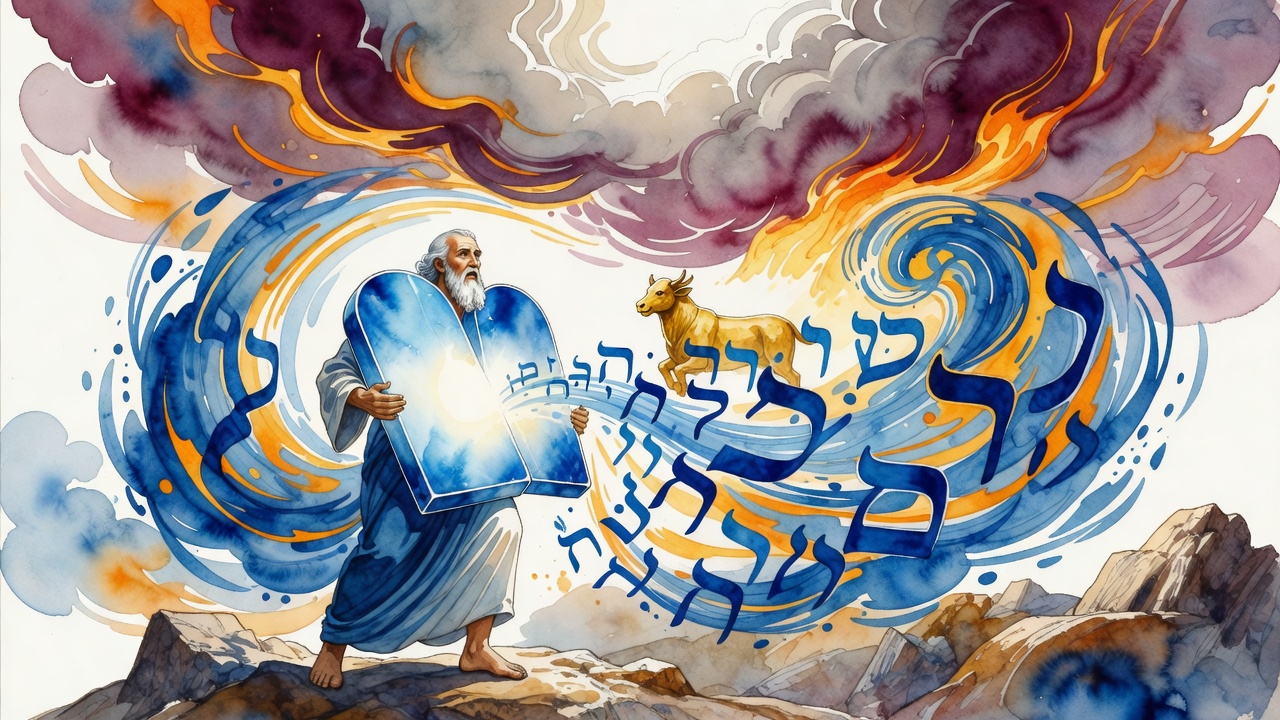
The tablets weighed as much as forty measures of wheat, and Moses carried them down easily. At the camp they turned to dead weight in his hands.

Curated by Arthur · Told by Maggid ·
Table of Contents
  1. Stone That Would Not Stay Written
  2. An Opening Hidden in a Threat
  3. Down Means Wound, Up Means Bandage
  4. What Flew and What Remained
  5. The Door Still in the Speech
Letters Flew From the Tablets When Moses Saw the Calf Click for full size

Stone That Would Not Stay Written

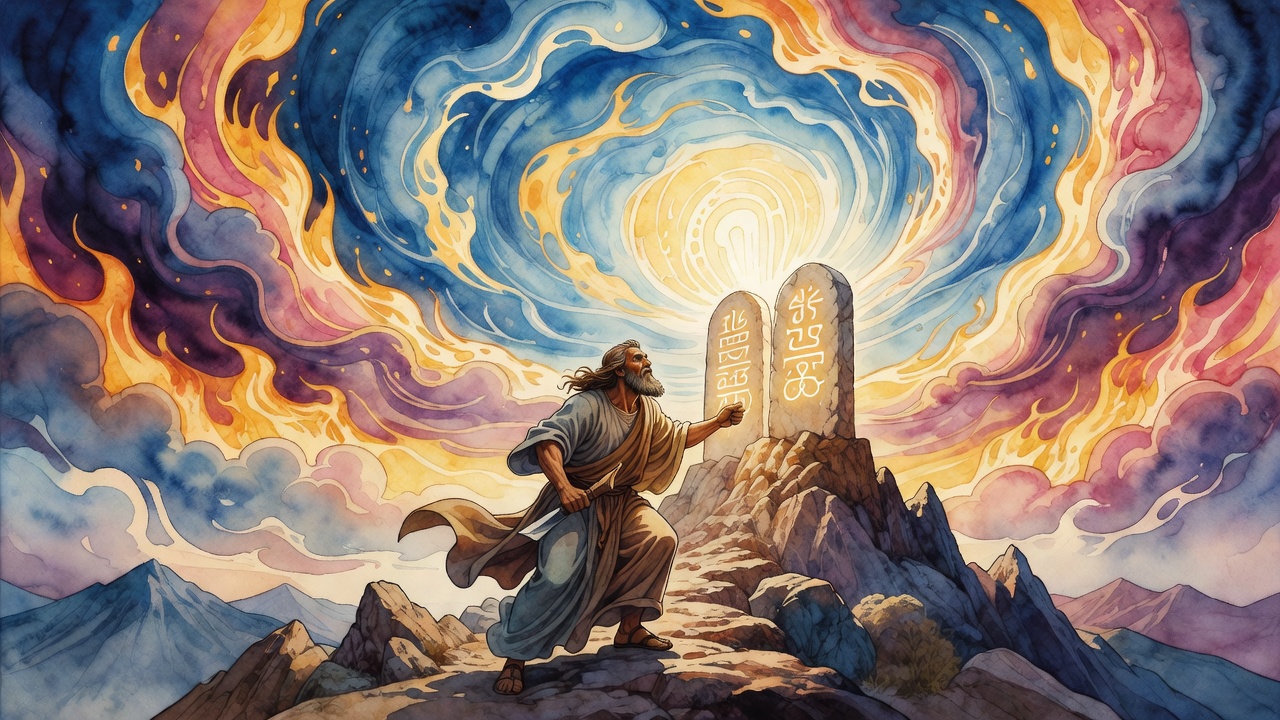
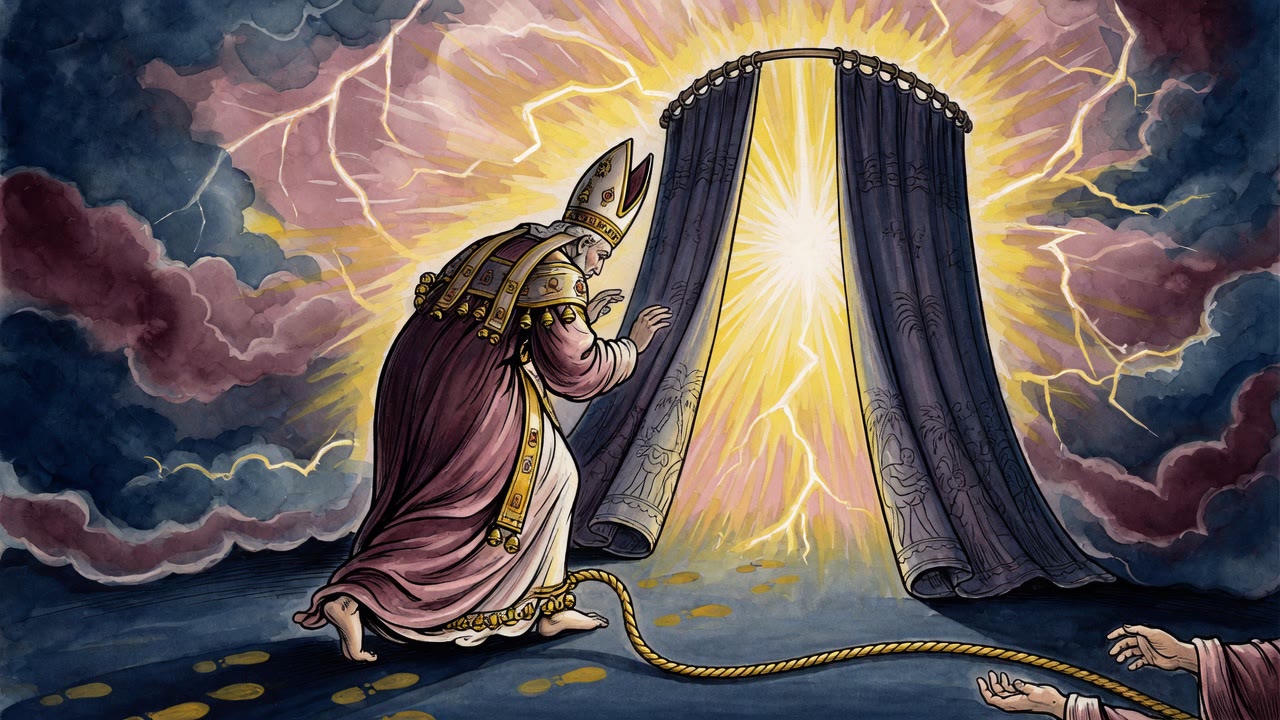
Moses came down the mountain with tablets the midrash calls nearly self-borne. Sapphire, heavy as forty measures of wheat in R. Judah's measure, yet light in his hands while the writing of God remained on them. As he approached the camp and saw the golden calf, the letters flew off. The stone that had been light became a burden. Only then did Moses cast the tables out of his hand and shatter them (Exodus 32:19).

The calf did not merely offend a leader's eyes. It evicted the script from the gift. Holiness refused to ride into an orgy of substitute worship still etched on heaven's stationery. The shards on the slope were not only Moses' temper. They were a document resigning in midair.

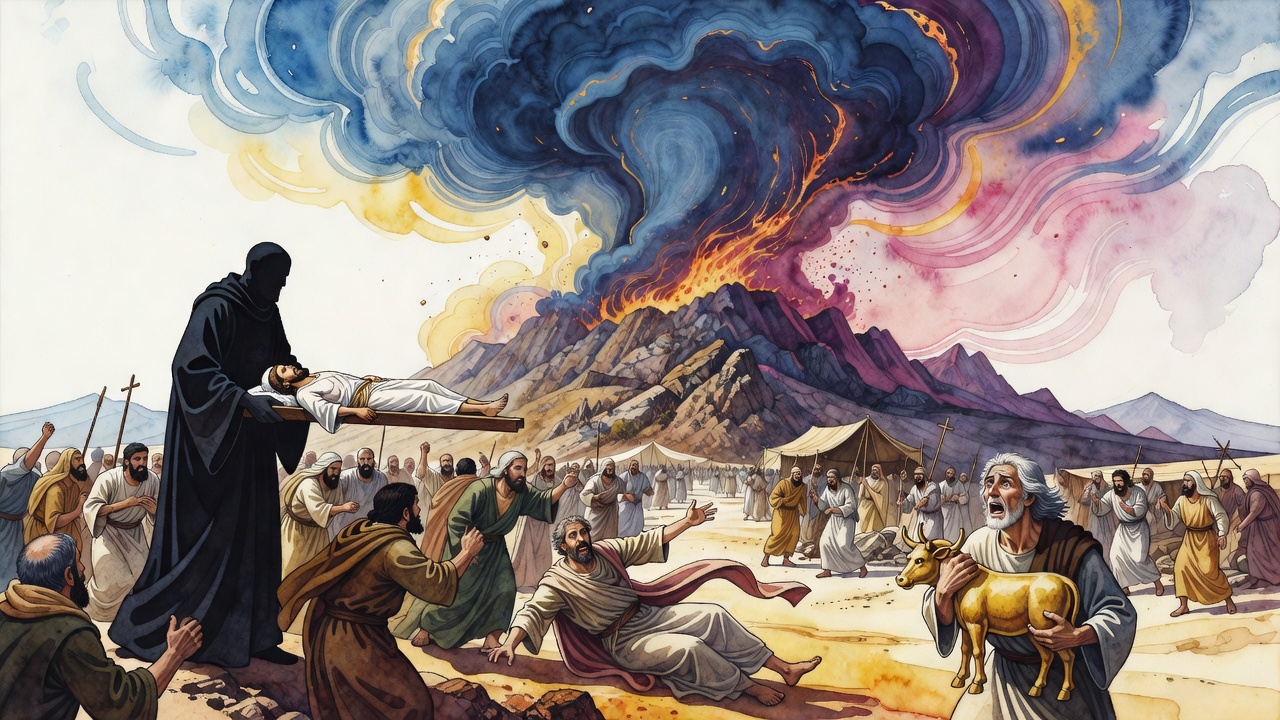
He burned the calf, ground it, strewed it on water, made Israel drink, convened a Levite court, and sorted guilt into sword and plague until about three thousand were gone. The camp that had danced now sorted its dead.

An Opening Hidden in a Threat

Sifrei Devarim hears another drama in God's speech. "Quit Me, and I shall destroy them." The odd command is not a shove. It is hachilotha, an opening. God signals wrath and simultaneously invites intercession, as if to say, I am telling you I will do this, and you may yet stand in the gap. Moses seizes the door. He pleads. He reminds. He refuses to step aside from a people mid-collapse.

The destruction announced does not fall in full. Prayer occupies the opening heaven left on purpose. A single man stands before God for the many, and the many live. Later Moses reasons: if my prayer for the nation worked, how much more would the nation's prayer for me work when I want the Land. The a fortiori becomes his hope at the Jordan he will not cross. The calf crisis teaches him the physics of petition.

Wrath that leaves a handle is already a kind of mercy. Moses grabbed the handle with both hands.

Down Means Wound, Up Means Bandage

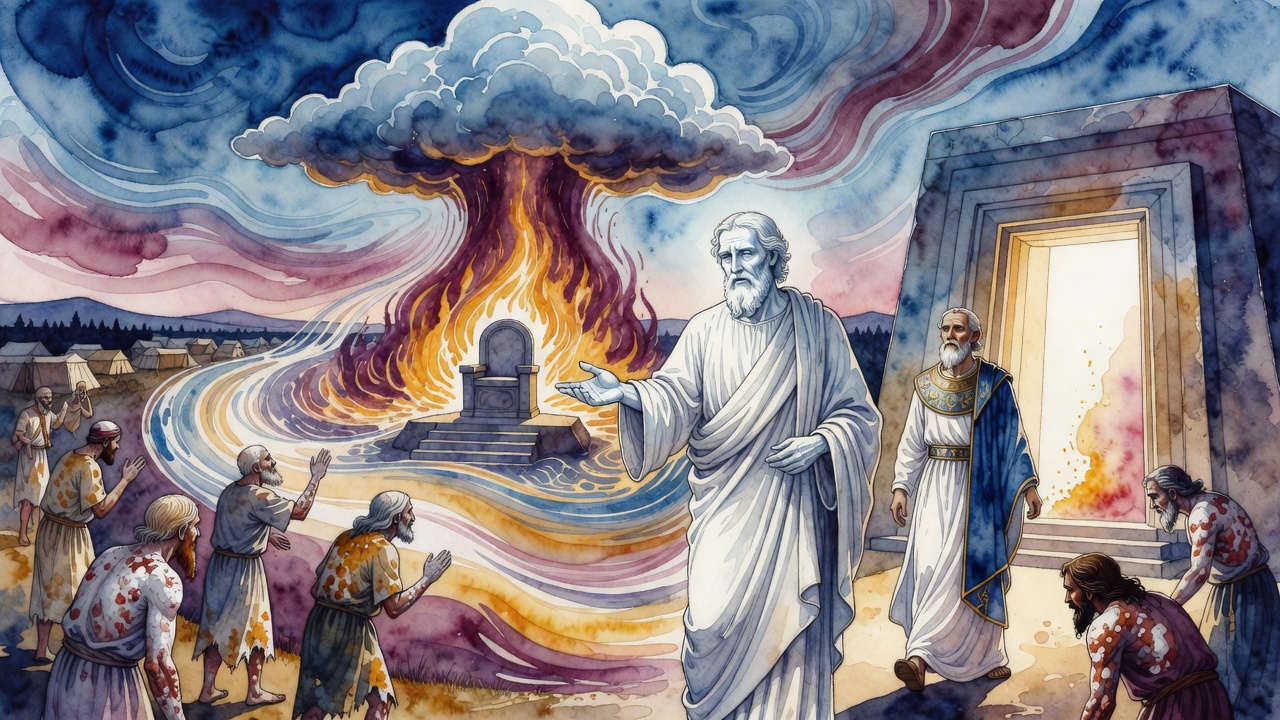
"Go, get thee down" had named the crisis. After judgment in the camp, "Depart, go up hence" named the repair. With the expression that humbled, God exalted. Sin had run through Aaron's "whosoever hath any gold" (Exodus 32:24). Reconciliation later ran through Aaron's bull calf for a burnt offering (Leviticus 9:2). The same household that midwifed the failure midwifed the public sign that resentment was not forever.

Moses asked whether anything else stood against the people. The road opened, with the danger of a consuming moment if God went in their midst without precaution, and with the gift of a Day of Atonement for ongoing cover. Israel stripped the Horeb crowns unwillingly. Forgiveness arrived without costume jewelry pretending the wedding had never been interrupted.

The tenth of Tishri, counted through the one hundred twenty days of Moses' climbs, sealed the pattern: break, plead, second tablets, verbal pardon, calendar of mercy.

What Flew and What Remained

Letters can flee stone. Covenant does not flee the people entirely. The second tablets will be hewn by Moses' hand and written again. The Oral teaching that filled the mountain nights will outlast both pairs of stone. The opening in God's speech will become a template every intercessor learns: listen for the handle inside the threat.

Three thousand dead remain in the story as a refusal of cheap grace. The calf cost blood before it cost only fasting. Levi's sword and heaven's plague were not metaphors. Mercy stood on the far side of sorting, not instead of sorting. Moses could not pray the dead back. He could pray the remnant forward.

Sapphire dust on Sinai and gold dust in Israelite stomachs mark the same week. One was holiness rejecting its own desecration. The other was idolatry forced into the body as a bitter sacrament of exposure.

The Door Still in the Speech

Every later generation that breaks something sacred and then opens a mahzor on Yom Kippur walks a path cut in those days. Letters once flew. An opening once appeared in a sentence of doom. A prophet once refused to quit the people when told to quit. Tablets once grew heavy and then were carved again. The story does not promise that every calf will be followed by easy music. It promises that the God who can evacuate His own writing can also leave a door in His own anger, and that a leader who sees both the flight of letters and the handle in the threat may still bring a people through to pardon's date on the calendar.

That is why the shards were kept in memory beside the whole second tablets. Brokenness and rewriting share one ark of national recall. The calf is not forgotten. Neither is the opening. Neither is the man who stood in it until the word "pardoned" came down the mountain with him.


← All myths
From the tradition

Sources

3 sources

The texts behind this telling. Some cards carry a translation of the source; others are our own retelling of it, and each card says which. Every card links out to the original.

Midrash Tanchuma, Ki Tisa 26Midrash Tanchuma

Translation of the source text.Midrash Tanchuma -- Torat Emet · Public Domain

"And the LORD spoke to Moses: Go," and so forth. This is what Scripture says: "For I will restore health to you," and so forth (Jeremiah 30:17). What is the meaning of "and I will heal you of your wounds" (Jeremiah 30:17)? Rabbi Yehoshua ben Levi said: When they sinned with the calf, they sinned through Aaron, who said to them, "Whoever has gold" (Exodus 32:24). And when the Holy One, blessed be He, was appeased and wished to make known that He held nothing in His heart concerning the calf, He was appeased through Aaron, as it is said: "And he said to Aaron, Take," and so forth (Leviticus 9:2).

And with Moses too: with "Go down" (Exodus 32:7) He was angry at him, and with "Go up" He was appeased. The Holy One, blessed be He, said: With the same expression by which I lowered you, with that same expression I will raise you up, as it is said: "Go up from here" (Exodus 33:1). Another interpretation: "Go up from here." What is written above the matter? "And Moses turned and went down." When they made that deed and Moses came down from the mountain and drew near to the camp and saw the calf that they had made: at the moment when the Holy One, blessed be He, had given him the tablets, they had been carrying themselves. As soon as he went down and drew near to the camp and saw the calf, the letters of the writing flew off from them, and they were found to be heavy in Moses' hands. Immediately, "the anger of Moses burned, and he cast them out of his hands" (Exodus 32:19).

Come and see how great was the strength of Moses. Rabbi Yehudah said: The tablets weighed forty se'ah, and they were of sapphire, and they had been resting on his hands like a light thing. As soon as the writing flew off, they broke. What did he do? "And he took the calf which they had made and burned it in the fire," and so forth. Immediately he judged those who had gone astray, and he seated courts from the sons of Levi, who had not taken part in the deed of the calf. Anyone who had received a warning but for whom there were no witnesses, he would test with water like the suspected wife and put to death, as it is said: "And he scattered it upon the face of the water and made them drink." And anyone for whom there were witnesses and a warning, he was put to death at once, as it is said: "Slay every man his brother." And one for whom there was neither witnesses nor warning was struck down by plague, as it is said: "And the LORD struck the people," and so forth, until about three thousand men were slain.

After he had purged the calf and its worshippers, he came before the Holy One, blessed be He, with supplications and petition, as it is said: "And Moses returned to the LORD and said, Oh, this people have sinned," and so forth; "yet now, if You will forgive," and so forth; "And the LORD said to Moses, Whoever," and so forth; "Now go, lead," and so forth; "and in the day when I visit, I will visit" (Exodus 32:34). "Behold, I sit in judgment over them on the Day of Atonement, and I acquit the innocent and condemn the guilty," as it is said: "and in the day when I visit." Rabbi Hanina said: Whoever says the Merciful One is one who overlooks, his own innards shall be overlooked; rather, He is long-suffering but collects His due. Thus "and in the day when I visit, I will visit." When He had judged and completed the judgment, Moses said: Master of the world, here is the calf and here are its worshippers, I have already purged them; perhaps You still hold something in Your heart against Your people. He said to him: "Go up from here." Solomon said: "Take away the dross from the silver," and so forth (Proverbs 25:4).

"And I will send before you an angel," and so forth, "to a land flowing with milk," and so forth. "And when the people heard this evil tidings," and so forth. "And the LORD said to Moses, Say to the children of Israel, You are a stiff-necked people: one moment," and so forth. And how long is a moment? Rabbi Shmuel bar Abba said: One part of fifty-eight thousand six hundred and fifty of an hour. "And I will know what to do to you." I will give you the Day of Atonement, and it will atone for you. "And the children of Israel stripped themselves of their ornaments": those crowns that they had from Mount Horeb. "And they stripped themselves": against their will.

Full source
Sifrei Devarim 27:2Sifrei Devarim

Retold in our words. Read the original at the link below.Sifrei by Rabbi Shraga Silverstein · CC-BY

There's a beautiful little piece in Sifrei Devarim (a collection of legal Midrashim (rabbinic interpretive commentary), meaning interpretations of the Torah), that gives us a glimpse into this, and it all hinges on a single, evocative word: hachilotha.

hachilotha can be translated in a few ways, but in this context, it means something like "You provided an opening." But what opening are we talking about? The text uses it to describe the moment after the sin of the Golden Calf. Remember that story? The Israelites, fresh out of Egypt, create a golden idol and worship it. God, understandably, is furious.

God says to Moses, "Quit Me, and I shall destroy them" (Deuteronomy 4:14). "Quit Me?" What does that even mean? Was Moses physically holding onto God? Of course not!

The Sifrei Devarim explains that this was God giving Moses an "opening", hachilotha, an invitation to intercede, to stand in prayer for the people. It’s as if God was saying, "I'm telling you I'm going to do this.. but maybe, just maybe, you can change My mind."

So Moses, seeing this opening, this hachilotha, seizes it. He pleads with God, reminds Him of His promises, and ultimately, God relents. Moses's prayer is heard, and the Israelites are spared from immediate destruction.

But the story doesn't end there. Moses has a thought. He reflects on this incredible moment. "If I," he muses, "a single person, could stand before God and have my prayer for the many answered, wouldn't the prayers of the many for me be even more powerful?"

He's thinking about his own desire to enter Eretz Yisrael, the Land of Israel. He knows he won't be allowed to cross the Jordan River. But if his prayer for the entire nation was so effective, surely their prayers for him, one individual, would be even more so!

The Sifrei Devarim presents a classic a fortiori argument, a logical inference. If X (Moses’s prayer for the many) is effective, then surely Y (the many’s prayer for Moses) must be even more so. As we find in Midrash Rabbah, this kind of argument, called a kal v'chomer argument, is a well-known method of interpretation in Jewish tradition.

That our prayers for each other hold such weight. That even God, in a sense, can be swayed by our collective pleas. That even when things seem set in stone, there’s always a potential "opening," a hachilotha, for change, for healing, for compassion.

Who are we praying for? And who is praying for us? Perhaps the real magic lies not just in the words we say, but in the connection we forge with each other, and with the Divine, through the act of prayer itself.

Full source
Midrash Tanchuma, Ki Tisa 31Midrash Tanchuma

Translation of the source text.Midrash Tanchuma -- Torat Emet · Public Domain

"Carve for yourself." When did Moses come down from the mountain? Rabbi Yehudah bar Shalom said: One hundred and twenty days Moses spent with the Holy One, blessed be He. How so? "In the third month after the children of Israel went out," and so forth (Exodus 19:1). On the sixth of the month He gave them the Ten Commandments, and it is written concerning it: "And Moses went up to God" (Exodus 19:3). And he spent there forty days, twenty-four of Sivan and sixteen of Tammuz, behold, forty days. He came down on the seventeenth of Tammuz, saw the calf and broke the tablets, and chastised those who had gone astray on the eighteenth and nineteenth. And he went back up on the twentieth, as it is said: "And it came to pass on the morrow, that Moses said to the people, You have sinned a great sin, and now I will go up to the LORD," and so forth. And it is written: "And Moses returned to the LORD and said, Oh, this people have sinned a great sin," and so forth. He spent there ten days of Tammuz and the whole month of Av, behold, forty days. He went up on the first day of the month of Elul, when He said to him, "Carve for yourself, and be ready by the morning," and so forth; "and he carved, and Moses rose early in the morning and went up." He spent there all of Elul and ten days of Tishrei, and he came down on the tenth. And Israel were dwelling in prayer and fasting, and on that very day it was said to Moses: "I have forgiven according to your word" (Numbers 14:20). And the Holy One, blessed be He, established it as a day of pardon and forgiveness for the generations, as it is said: "For on this day He shall make atonement for you, to cleanse you" (Leviticus 16:30). And immediately He commanded Moses: "And they shall make Me a sanctuary."

"Carve for yourself, and be ready by the morning." So it was at the first time: "And it came to pass on the third day, when it was morning," and so forth (Exodus 19:16). And here: "and let no man be seen." The first tablets, because they were given in public, therefore the evil eye took hold of them and they were broken. And here the Holy One, blessed be He, said to him: There is nothing more beautiful than modesty, as it is said: "And what does the LORD require of you but to do justice, and to love kindness, and to walk humbly" (Micah 6:8).

Full source