Parshat Ki Tisa5 min read

Moses Told Day From Night by Written and Oral Law

On the mountain forty days, Moses knew day by Written Law and night by Oral Law. After one hundred twenty days he brought pardon down on Yom Kippur.

Curated by Arthur · Told by Maggid ·
Table of Contents
  1. A Mountain Without Ordinary Clocks
  2. One Hundred Twenty Days on the Ledger
  3. When the Letters Left the Stone
  4. Down Is Judgment, Up Is Healing
  5. What the Double Clock Protects
Moses Told Day From Night by Written and Oral Law Click for full size

A Mountain Without Ordinary Clocks

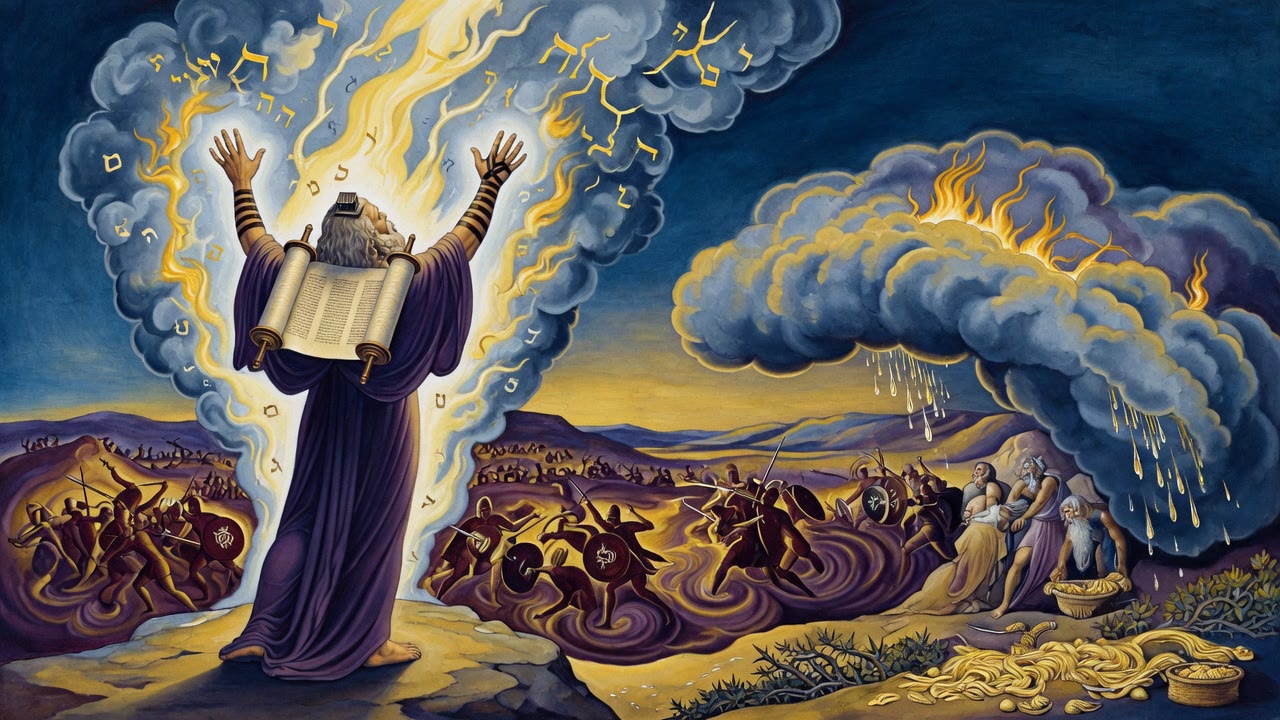
Moses was with the Lord forty days and forty nights (Exodus 34:28). Day and night are alike before the Holy One, for light dwells with Him (Daniel 2:22), and darkness is not dark to Him (Psalms 139:12). How then did Moses know which was which? Midrash Tanchuma answers with curriculum rather than with sunrise. When the Holy One taught him the Written Law, he knew it was day. When He taught him the Oral Law, the Mishnah and the Talmud in the midrash's later tongue, he knew it was night.

Another sign: when he beheld the constellations kneeling and descending, he realized it was day; when he saw the sun bowing, he knew it was night, for the host of heaven worships (Nehemiah 9:6). Torah time and cosmic liturgy replaced the clocks of the camp below.

While Israel would later panic over Moses' delay, Moses was learning that revelation has shifts, day-shift of Written words and night-shift of Oral expanse, and that both are light even when named night.

One Hundred Twenty Days on the Ledger

Rabbi Judah son of Shalum counts Moses' mountain time as one hundred twenty days in three climbs of forty. In the third month after the Exodus, on the sixth day, the Ten Commandments were given. Moses went up and stayed through Sivan and into Tammuz, forty days. He descended on the seventeenth of Tammuz, saw the calf on the following days, broke the tablets, and halted the revelry.

On the twentieth he climbed again, remaining through the rest of Tammuz and all of Av, another forty. On the first of Elul he was told to hew two tablets and be ready by morning. He stayed through Elul and until the tenth of Tishri. On that tenth day he descended while Israel prayed and fasted, and the Holy One said, "I have pardoned according to thy word." That day was fixed as the Day of Atonement for future generations.

The calendar of sin, shards, second tablets, and pardon is not a blur of "forty days" repeated. It is a map from broken stone to Yom Kippur.

When the Letters Left the Stone

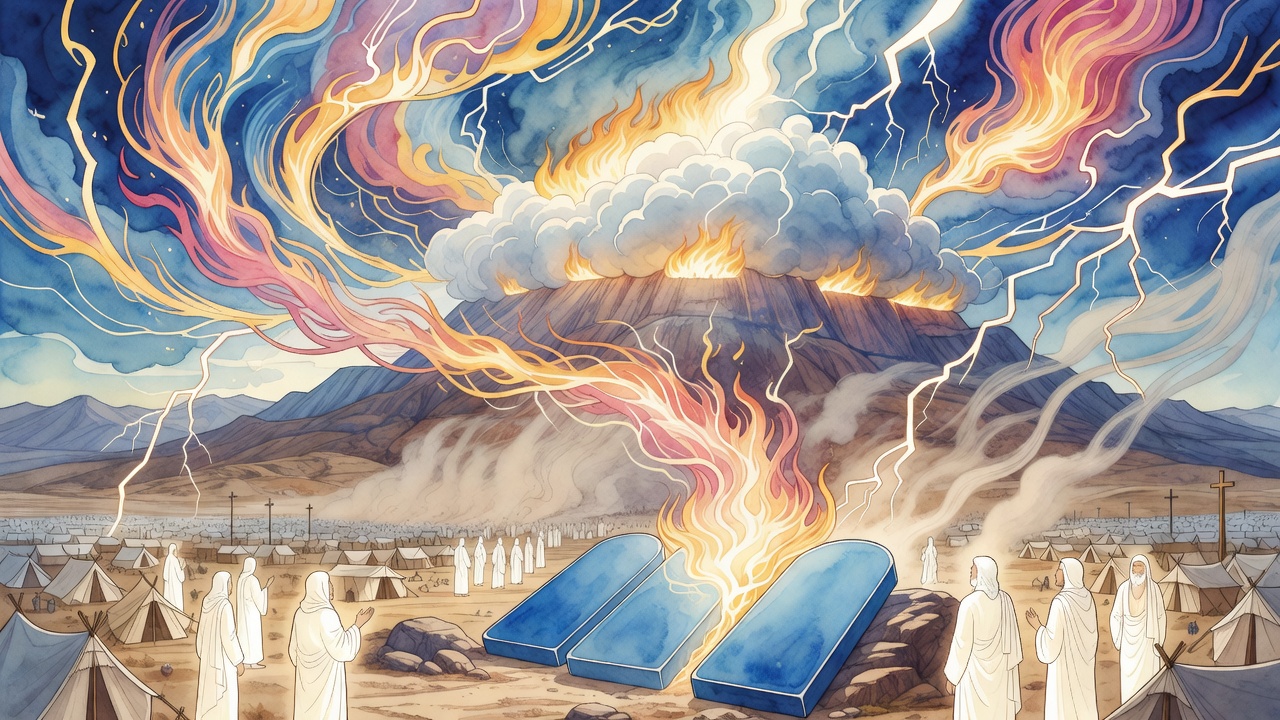
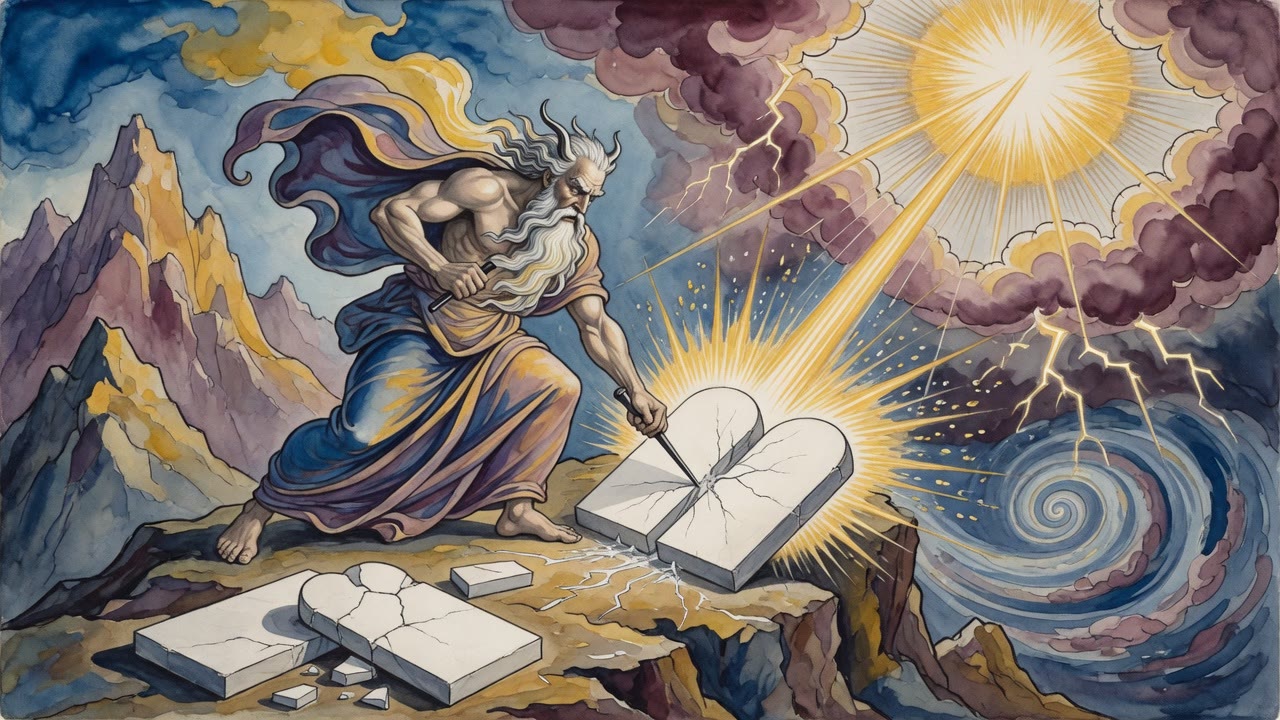
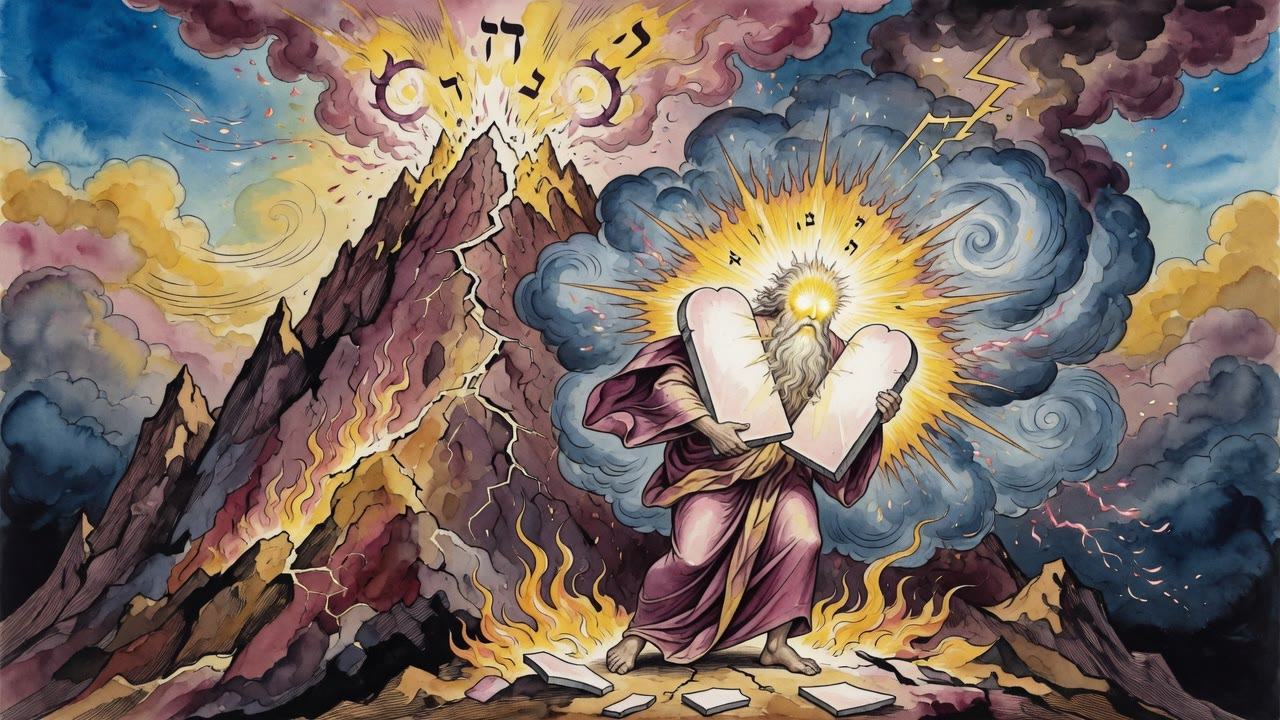
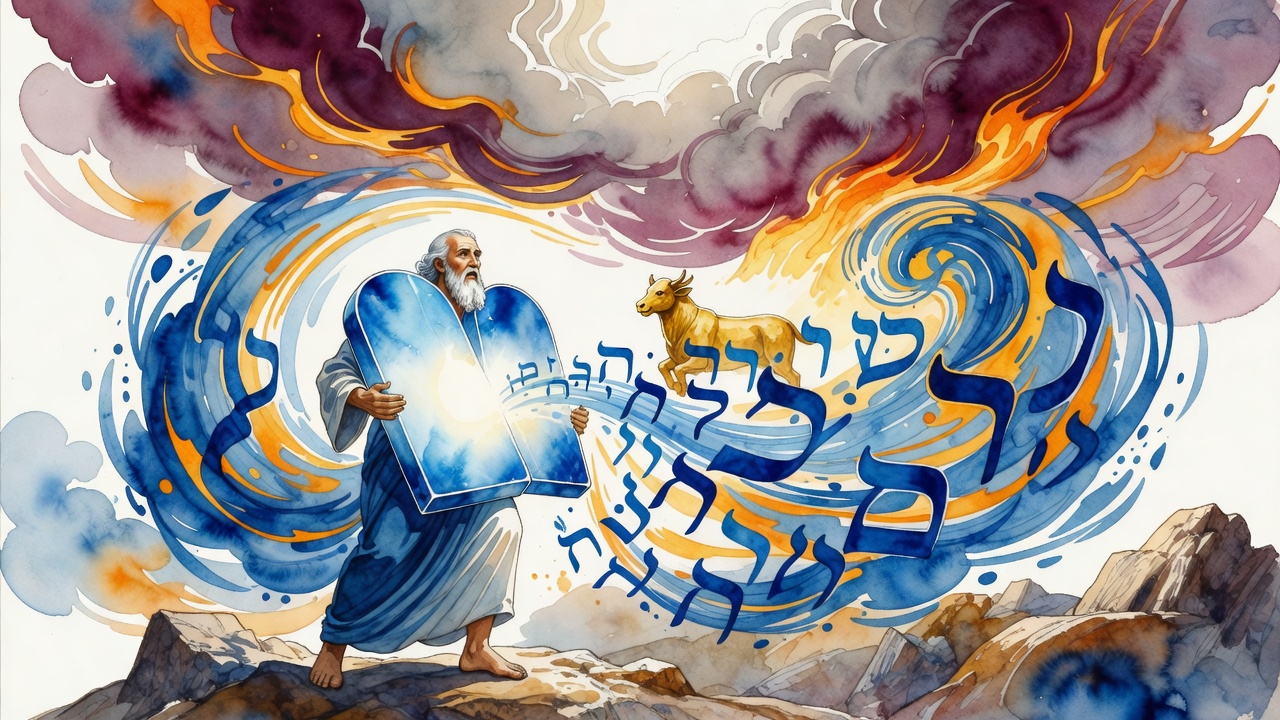
On the first descent, the tablets had been nearly self-borne, light in the hands of a strong man. R. Judah said they weighed as much as forty measures of wheat and were sapphire, yet they sat like a small thing in Moses' grip while the writing remained. When he neared the camp and saw the golden calf, the letters flew from the tablets. The stone became heavy. Moses' anger waxed hot and he cast them from his hands (Exodus 32:19).

The midrash makes the tablets partners in the drama. They would not stay written in the presence of the calf. Holiness vacated the sapphire, and only then could human arms shatter what had been light. Moses burned the calf, tested the people, convened a court from Levi, and about three thousand died by sword or plague according to the tiers of guilt.

Then he climbed again to plead. The mountain that taught him day and night by Torah also taught him how heavy stone becomes when Israel dances around a molten substitute for the Voice.

Down Is Judgment, Up Is Healing

"Go, get thee down" had been the language of wrath. Later, "Depart, go up hence" became the language of reconciliation. With the expression that humbled, God exalted. R. Joshua son of Levi taught that sin through Aaron's "whosoever hath any gold" was answered, when God bore no resentment, through Aaron's bull calf for a burnt offering in the consecration service. The wound and the bandage shared a household.

Moses asked if anything else stood against the people after the calf and its worshippers were gone. The answer opened the road again, with the warning of a moment's consuming presence and the gift of a Day of Atonement to cover the future. Israel stripped off the ornaments, the crowns from Horeb, unwillingly. Pardon did not mean the jewelry of Sinai stayed on as if nothing had cracked.

The man who told day from night by which Torah he was learning finally brought down a calendar date on which pardon itself became law for every generation that would fast and confess.

What the Double Clock Protects

Written by day, Oral by night: the midrash refuses to let Torah be only the tablets that can shatter. While stone letters flew, the larger teaching life of Israel was already being prepared in the dark sessions on the mountain. Day alone would have been a code without a people to carry it. Night alone would have been speech without a public script. Moses lived both clocks until his face and his people could bear the second pair of tablets.

Yom Kippur descends from that arithmetic of one hundred twenty days. Every later tenth of Tishri reenacts a mountain schedule in which wrath, shards, second chance, and verbal pardon were timed as carefully as the plagues of Egypt. The God who needs no sun to tell time taught Moses time by Torah, then taught Israel time by forgiveness.


← All myths
From the tradition

Sources

3 sources

The texts behind this telling. Some cards carry a translation of the source; others are our own retelling of it, and each card says which. Every card links out to the original.

Midrash Tanchuma, Ki Tisa 36Midrash Tanchuma

Retold in our words. Read the original at the link below.Townsend 1989 translation of Midrash Tanhuma, S. Buber Recension · CC-BY

And he was there with the Lord forty days and forty nights (Exod. 34:28). How did Moses know when it was day? When the Holy One, blessed be He, taught him the Written Law he knew it was the day time, and when He taught him the Oral Law, the Mishnah (the earliest code of rabbinic law) and the Talmud, he was aware that it was night time. This was so because day and night are alike in the presence of the Holy One, blessed be He, as is said: And the light dwelleth with Him (Dan. 2:22). And as it is also written elsewhere: Even the darkness is not too dark for Thee, but the night shineth as the day; the darkness even as the light (Ps. 139:12). In what other way did he distinguish between night and day? When he beheld the constellations kneeling and bowing (descending), he realized that it was day, and when he saw the sun bowing, he knew that it was night, as it is written: The host of heave worship Thee (Neh. 9:6).

Full source
Midrash Tanchuma, Ki Tisa 31Midrash Tanchuma

Translation of the source text.Midrash Tanchuma -- Torat Emet · Public Domain

"Carve for yourself." When did Moses come down from the mountain? Rabbi Yehudah bar Shalom said: One hundred and twenty days Moses spent with the Holy One, blessed be He. How so? "In the third month after the children of Israel went out," and so forth (Exodus 19:1). On the sixth of the month He gave them the Ten Commandments, and it is written concerning it: "And Moses went up to God" (Exodus 19:3). And he spent there forty days, twenty-four of Sivan and sixteen of Tammuz, behold, forty days. He came down on the seventeenth of Tammuz, saw the calf and broke the tablets, and chastised those who had gone astray on the eighteenth and nineteenth. And he went back up on the twentieth, as it is said: "And it came to pass on the morrow, that Moses said to the people, You have sinned a great sin, and now I will go up to the LORD," and so forth. And it is written: "And Moses returned to the LORD and said, Oh, this people have sinned a great sin," and so forth. He spent there ten days of Tammuz and the whole month of Av, behold, forty days. He went up on the first day of the month of Elul, when He said to him, "Carve for yourself, and be ready by the morning," and so forth; "and he carved, and Moses rose early in the morning and went up." He spent there all of Elul and ten days of Tishrei, and he came down on the tenth. And Israel were dwelling in prayer and fasting, and on that very day it was said to Moses: "I have forgiven according to your word" (Numbers 14:20). And the Holy One, blessed be He, established it as a day of pardon and forgiveness for the generations, as it is said: "For on this day He shall make atonement for you, to cleanse you" (Leviticus 16:30). And immediately He commanded Moses: "And they shall make Me a sanctuary."

"Carve for yourself, and be ready by the morning." So it was at the first time: "And it came to pass on the third day, when it was morning," and so forth (Exodus 19:16). And here: "and let no man be seen." The first tablets, because they were given in public, therefore the evil eye took hold of them and they were broken. And here the Holy One, blessed be He, said to him: There is nothing more beautiful than modesty, as it is said: "And what does the LORD require of you but to do justice, and to love kindness, and to walk humbly" (Micah 6:8).

Full source
Midrash Tanchuma, Ki Tisa 26Midrash Tanchuma

Translation of the source text.Midrash Tanchuma -- Torat Emet · Public Domain

"And the LORD spoke to Moses: Go," and so forth. This is what Scripture says: "For I will restore health to you," and so forth (Jeremiah 30:17). What is the meaning of "and I will heal you of your wounds" (Jeremiah 30:17)? Rabbi Yehoshua ben Levi said: When they sinned with the calf, they sinned through Aaron, who said to them, "Whoever has gold" (Exodus 32:24). And when the Holy One, blessed be He, was appeased and wished to make known that He held nothing in His heart concerning the calf, He was appeased through Aaron, as it is said: "And he said to Aaron, Take," and so forth (Leviticus 9:2).

And with Moses too: with "Go down" (Exodus 32:7) He was angry at him, and with "Go up" He was appeased. The Holy One, blessed be He, said: With the same expression by which I lowered you, with that same expression I will raise you up, as it is said: "Go up from here" (Exodus 33:1). Another interpretation: "Go up from here." What is written above the matter? "And Moses turned and went down." When they made that deed and Moses came down from the mountain and drew near to the camp and saw the calf that they had made: at the moment when the Holy One, blessed be He, had given him the tablets, they had been carrying themselves. As soon as he went down and drew near to the camp and saw the calf, the letters of the writing flew off from them, and they were found to be heavy in Moses' hands. Immediately, "the anger of Moses burned, and he cast them out of his hands" (Exodus 32:19).

Come and see how great was the strength of Moses. Rabbi Yehudah said: The tablets weighed forty se'ah, and they were of sapphire, and they had been resting on his hands like a light thing. As soon as the writing flew off, they broke. What did he do? "And he took the calf which they had made and burned it in the fire," and so forth. Immediately he judged those who had gone astray, and he seated courts from the sons of Levi, who had not taken part in the deed of the calf. Anyone who had received a warning but for whom there were no witnesses, he would test with water like the suspected wife and put to death, as it is said: "And he scattered it upon the face of the water and made them drink." And anyone for whom there were witnesses and a warning, he was put to death at once, as it is said: "Slay every man his brother." And one for whom there was neither witnesses nor warning was struck down by plague, as it is said: "And the LORD struck the people," and so forth, until about three thousand men were slain.

After he had purged the calf and its worshippers, he came before the Holy One, blessed be He, with supplications and petition, as it is said: "And Moses returned to the LORD and said, Oh, this people have sinned," and so forth; "yet now, if You will forgive," and so forth; "And the LORD said to Moses, Whoever," and so forth; "Now go, lead," and so forth; "and in the day when I visit, I will visit" (Exodus 32:34). "Behold, I sit in judgment over them on the Day of Atonement, and I acquit the innocent and condemn the guilty," as it is said: "and in the day when I visit." Rabbi Hanina said: Whoever says the Merciful One is one who overlooks, his own innards shall be overlooked; rather, He is long-suffering but collects His due. Thus "and in the day when I visit, I will visit." When He had judged and completed the judgment, Moses said: Master of the world, here is the calf and here are its worshippers, I have already purged them; perhaps You still hold something in Your heart against Your people. He said to him: "Go up from here." Solomon said: "Take away the dross from the silver," and so forth (Proverbs 25:4).

"And I will send before you an angel," and so forth, "to a land flowing with milk," and so forth. "And when the people heard this evil tidings," and so forth. "And the LORD said to Moses, Say to the children of Israel, You are a stiff-necked people: one moment," and so forth. And how long is a moment? Rabbi Shmuel bar Abba said: One part of fifty-eight thousand six hundred and fifty of an hour. "And I will know what to do to you." I will give you the Day of Atonement, and it will atone for you. "And the children of Israel stripped themselves of their ornaments": those crowns that they had from Mount Horeb. "And they stripped themselves": against their will.

Full source