Parshat Vayishlach6 min read

The One Staff Passed From Jacob to the Messiah

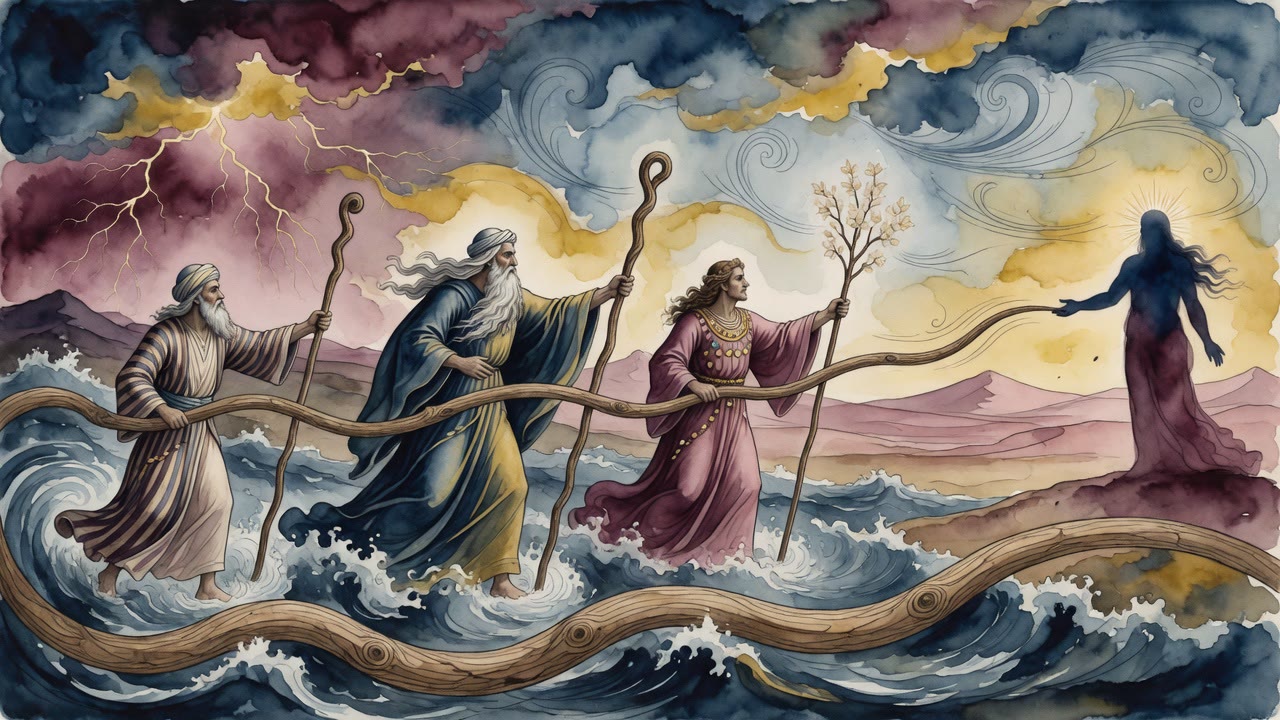
Jacob crossed the Jordan holding one staff. Centuries later that same wood was in Moses's hand, then Aaron's. The Messiah will hold it last.

Curated by Arthur · Told by Maggid ·
Table of Contents
  1. One Staff, Many Hands
  2. Jacob Crosses the Jordan
  3. Into Egypt and Out Again
  4. What the Staff Became
  5. Why Aaron Was Mourned More Than Moses

One Staff, Many Hands

The morning Aaron's rod bloomed, twelve rods lay overnight in the Tent of Meeting and only one changed. By dawn it had sprouted, blossomed, and produced ripe almonds. Moses gathered them all. The book of Numbers records the miracle and moves quickly to other business. The rabbis could not move quickly. They wanted to know about the wood itself: where had it come from, and why had this rod answered while the others went dark?

Over centuries of commentary they arrived at an answer that turned a single wooden staff into one of the longest-running threads in all of Jewish legend. The rod was not Aaron's. Or rather, it had not started as Aaron's. It had passed through so many hands that calling it by any one name was like calling a river by only one of its banks.

It had started with Jacob.

Jacob Crosses the Jordan

Jacob said it himself, near the ford of the Jabbok, the night before he wrestled with the angel. He prayed: I crossed this Jordan with my staff, and now I have become two camps. One staff, and a man who arrived with nothing, who slept on stones and dreamed of ladders, who worked fourteen years for two wives and became the father of twelve tribes. One staff for all of that. The rabbis read the phrase and noticed it: a single specific object, named, remembered, credited. Jacob did not say he had crossed with courage or faith or God's help. He said he crossed with his staff.

That staff went to Judah. When Tamar sat veiled at the crossroads and Judah came to her not knowing who she was, she asked for his pledge. He gave his signet ring, his cord, and his staff. Those three objects became the proof that Judah was the father of her children. The staff identified him. After that, it went south.

Into Egypt and Out Again

When Joseph was viceroy of Egypt and his brothers came bowing before him, the staff had already passed from Judah into a chain of transmission the rabbis trace carefully. It came to Moses. The verse in Exodus says it plainly: the staff of God in his hands. This was not a figure of speech. Moses carried the same wood Jacob had carried across the Jordan, and with it he split the sea, brought water from rock, and held his arms aloft at Rephidim while Joshua fought Amalek below.

From Moses it passed to Aaron. The rod that had turned into a serpent in Pharaoh's court, that had swallowed the rods of the Egyptian magicians, that Moses had used to call down plague after plague on Egypt, this was Aaron's rod as well. Same wood. Different miracles. The almonds were just its latest performance.

What the Staff Became

After Aaron's death, the staff did not stay with the tribe of Levi. Tradition traces it forward: it came to David. The shepherd king kept it. The same staff that Jacob had gripped on a cold night at the Jabbok, that had parted the waters and produced almonds, became part of David's inheritance.

And there the line does not end. The Yalkut Shimoni, reading the verse from Psalm 110 about the staff of God's strength sent forth from Zion, says this refers to the same staff, still moving through history, still waiting. The Messiah will hold it last. This piece of wood that crossed the Jordan in Jacob's hand will be the symbol of final redemption, the same object present at the beginning of the covenant story and at its completion.

The rabbis who worked this out were doing something specific with time. They refused to let objects be discarded. A staff used once and forgotten is furniture. A staff carried across the Jordan, used to part a sea, used to produce flowers in a desert tent, then passed to a shepherd king and eventually to the one who ends history is not furniture. It is the spine of the whole story, holding together what would otherwise feel like separate episodes.

Why Aaron Was Mourned More Than Moses

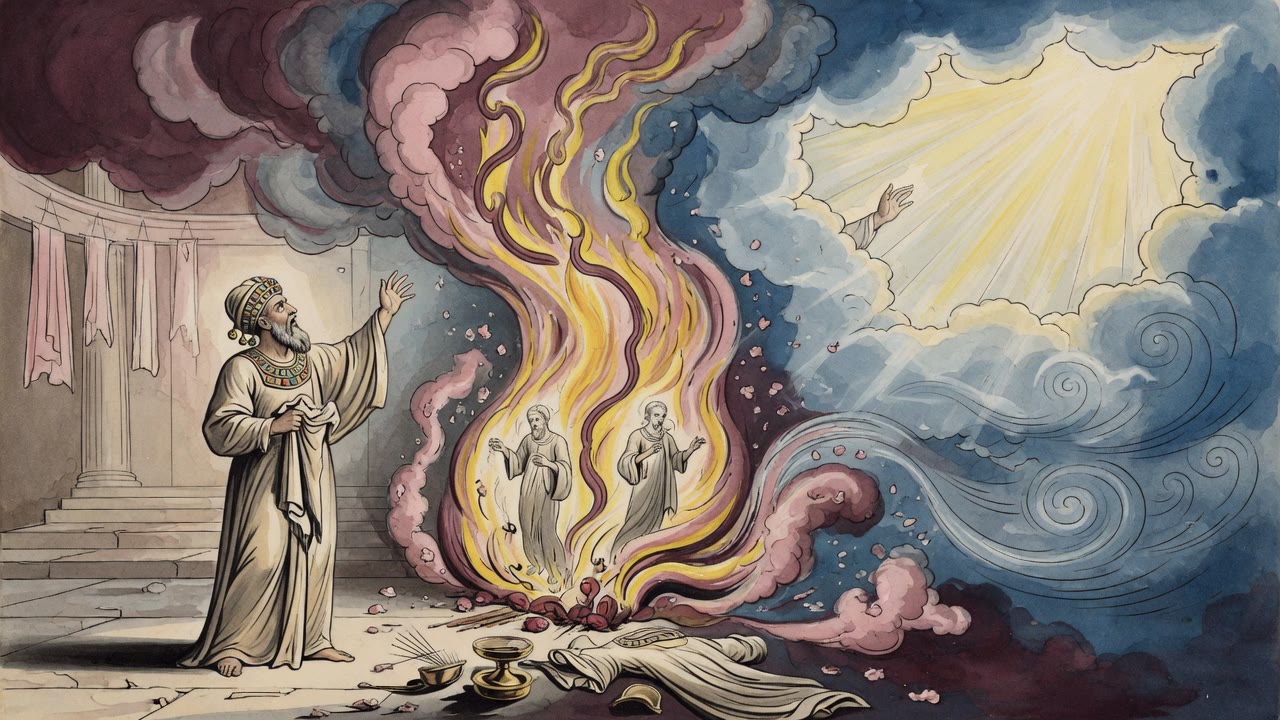
There is a different kind of detail in the Aaron traditions that belongs alongside the story of the staff. When Aaron died, all of Israel mourned for thirty days: men, women, adults, children. When Moses died, the Torah says the Israelites wept for thirty days as well, but the rabbis noticed a difference in tone. Aaron was mourned more deeply, or more universally, or more personally. Why?

Because Aaron had spent his life making peace between people. When two men quarreled, Aaron would go first to one side and say that the other was full of regret. Then he would go to the other side and say the same. When they met again they would embrace, because each believed the other had already softened. Aaron manufactured reconciliations that might never have happened on their own. The people who had been enemies when Aaron found them, and friends when he finished, wept for him as they wept for no one else, because no one else had done for them what he had done.


← All myths

From the tradition

Sources

5 sources

The texts this telling draws on, in full. Open a card to read inline, or expand it for a wider, quieter read.

Yalkut Shimoni on Nach 869:3Yalkut Shimoni on Nach

The Yalkut Shimoni, a compilation of rabbinic commentary on the Bible, in section 869 on Nach (the books of Prophets and Writings), brings up a fascinating idea about the verse "The staff of Your strength G-d shall send forth from Zion" (Psalm 110:2). What exactly is this staff?

The Yalkut Shimoni tells us it's no ordinary walking stick. It's the staff. The one and only. It's the very same staff that belonged to Jacob! Remember when he said, "Because with my staff I crossed this Jordan" (Genesis 32:11)? Yep, that’s the one!

The story doesn't end there. This staff, according to the Yalkut Shimoni, keeps showing up. It was also with Judah – "And your staff that was in your hand" (Genesis 38:18). Then it was in the hands of Moses – "And the staff of God in his hands" (Exodus 4:20). And then Aaron: "And Aaron cast down his staff" (Exodus 7:10). Even David held it: "And he took his staff in his hand" (1 (Samuel 17:4)0).

The Yalkut Shimoni goes on to say that this staff remained with every king of Israel… until the Beit Hamikdash, the Holy Temple in Jerusalem, was destroyed. Then, it was hidden away. Awaiting its time.

And here's the really exciting part: it is prophesied that this very staff will be given to Mashiach, the King Messiah. And with it, the King Messiah will strike down the idolaters! That’s quite a job description for a simple walking stick. It becomes a symbol of divine power, of leadership, and ultimately, of redemption. It's an amazing image, isn't it? The idea that this humble object will be instrumental in bringing about a new era.

Finally, Rabbi Levi offers another perspective. He says that all acts of good and comfort that God will bestow upon us will emanate from Zion. This connects the physical place of Zion with the outpouring of divine blessing.

So, what are we to make of this? Is it a literal staff? Or is it a symbol? Perhaps it’s both. A reminder that even the simplest object can be imbued with profound meaning, carrying the weight of history and the promise of the future. And that sometimes, the greatest power comes in the most unexpected forms.

Full source
Legends of the Jews 5:72Legends of the Jews

The Torah tells us about Aaron, the High Priest, and it paints a pretty clear picture. It wasn't just his position, but his character that earned him such profound respect and affection.

When Aaron died, the Israelites mourned him deeply, even more than they mourned for Moses later on. According to Legends of the Jews, when Israel saw the funeral rites prepared by God and the angels themselves for Aaron, they instituted a thirty-day period of mourning. All of Israel participated: men, women, adults, and children. But why such an outpouring of grief? It wasn't just because they were copying the Divine mourning, or because Moses and Eleazar had arranged ceremonies. No, it was something far more profound.

the people genuinely loved Aaron. They felt his loss keenly. But why more than Moses? After all, Moses was the leader, the lawgiver! The difference, it seems, lay in how they interacted with the people. Moses, as a judge, had to administer justice. He had to make difficult decisions, and inevitably, that created enemies. As Ginzberg recounts in Legends of the Jews, some people couldn't forgive Moses for judgments against them. Sometimes Moses was severe when confronting Israel with their sins.

Aaron? Aaron was different. Pirkei Avot (1:12) tells us that he "loved peace and pursued peace, loved men and brought them near to the Torah.” He was a peacemaker, a unifier. He was approachable. He didn't let his status get in the way of connecting with people, even the lowliest.

In fact, he made it a point to greet everyone first, even those he knew were wicked or godless. How many of us would go out of our way to be kind to someone we knew was behaving badly? The angels lamented Aaron, as noted in Legends of the Jews, as one "who did turn many away from iniquity," and with good reason.

Aaron understood his role as a peacemaker in a very practical way. The Midrash Rabbah elaborates on this. If he heard of a dispute between two men, he would visit each of them separately. He'd paint a picture of the other man's remorse, saying things like, "My son, do you not know what he is doing? He beats his heart, rends his garments in grief, and says, 'Woe is me! How can I ever again look upon my companion against whom I have acted so?'" He would continue until they would forgive each other and greet each other as friends.

And if Aaron heard that a husband and wife were fighting, he'd go to the husband and say something like, "I hear you're having trouble. Before you divorce your wife, consider this: will your next wife be as good? She might throw your past failures in your face." Through his gentle persuasion, Aaron saved countless marriages from falling apart.

The impact of Aaron's kindness was so profound that many couples named their sons after him, acknowledging that his intervention had made their existence possible. According to Legends of the Jews, no less than eighty thousand youths bearing his name participated in the mourning for Aaron. Eighty thousand!

It’s a powerful reminder, isn’t it? That true leadership isn't just about power or authority, but about empathy, kindness, and a genuine desire to bring people together. Aaron's legacy isn't just as a High Priest, but as a role model for how we can all strive to be better humans, to be peacemakers in our own lives, and to leave the world a little bit brighter than we found it. What kind of legacy will we leave behind?

Full source
Legends of the Jews 5:62Legends of the Jews

Take Aaron, for instance, Moses' brother. We know Moses as the lawgiver, the one who spoke to God face-to-face. But Aaron... well, the people loved Aaron. And that’s saying something!

So, what was it about Aaron that made him so beloved? It's a fascinating question when you consider the whole Golden Calf incident. He wasn't exactly perfect, was he?

In Legends of the Jews, a monumental work by Rabbi Louis Ginzberg that compiles centuries of Jewish stories and traditions, the Israelites actually thought at one point that Aaron had surpassed Moses in spiritual stature. They even rejoiced, believing Aaron now possessed a "higher degree of the Holy Spirit." Why?

Because of what he did after the Golden Calf. Aaron, recognizing the gravity of his mistake – that his actions had led the people astray – dedicated his life to atonement, to teshuvah (repentance), to turning things around.

He didn't just sit around feeling guilty. He took action.

Ginzberg tells us Aaron went from house to house, teaching the Shema' (Sh'ma Yisrael Adonai Eloheinu Adonai Echad – "Hear, O Israel, the Lord our God, the Lord is One"), the core declaration of Jewish faith, to those who didn't know it. He taught people how to pray, how to connect with the Divine. And he even introduced those who were capable to the study of Torah. He was bringing the wisdom, the light, to everyone.

But it was more than just religious education. Aaron understood that his mission was to establish peace – shalom. Not just between God and humanity, but between the learned and the unlearned, among scholars themselves, among the ignorant, and even between husband and wife. He was a peacemaker, a bridge-builder, a unifier. He saw the divisions and actively worked to heal them. Aaron recognized that true atonement wasn't just about asking for forgiveness. It was about repairing the fabric of society, mending the tears in relationships, and bringing people closer to each other and to God.

And that, perhaps, is why the people loved him so dearly. He wasn't just a leader; he was a healer. He wasn’t just concerned with the grand pronouncements of the law; he cared about the everyday lives of the people. He taught them, guided them, and fostered harmony. He showed them that even after a mistake, even a big one, we can choose to dedicate our lives to making the world a better place.

So the next time you think about Aaron, remember the Golden Calf, yes, but remember also the tireless work, the dedication to peace, and the profound love he showed for his people. Maybe, just maybe, we can all learn something from that. What kind of legacy do we want to leave behind? What kind of peace can we create in our own lives and communities?

Full source
Mekhilta Tractate Amalek 3:45Mekhilta DeRabbi Yishmael

The verse says that Aaron and all the elders of Israel came to eat bread with Moses' father-in-law "before God." But the Mekhilta raises an obvious question: where was Moses himself during this meal? If Aaron and the elders were eating with Yithro, what was Moses doing?

After all, when Yithro first arrived, Moses had gone out to greet him personally, as the verse states, "Moses went out to his father-in-law." So Moses was clearly present. He had welcomed Yithro, told him the story of the exodus, and witnessed Yithro's offerings. Why, then, does the meal scene mention only Aaron and the elders as the ones eating?

The answer reveals something remarkable about Moses' character. He was not eating because he was serving. Moses stood and waited upon the guests, attending to their needs while they sat and ate before God. The greatest prophet in Israel's history, the man who had spoken to God face to face and split the Red Sea, was acting as a waiter at his father-in-law's table.

Where did Moses learn this behavior? From Abraham. When the three angels visited Abraham at the oaks of Mamre (Genesis 18:8), Abraham did not sit with his guests. He stood over them while they ate, serving them personally. Moses followed his ancestor's example. True greatness, the Mekhilta teaches, is expressed not in being served but in serving others.

Full source
Yalkut Shimoni on Nach 869:3Yalkut Shimoni

3 The Staff of Your Strength G-d shall send forth from Zion. Which staff is this? This is the staff of Jacob about which it is said: "Because with my staff I crossed this Jordan." And this is the staff that was with Judah [as it is said:] "And your staff that was in your hands." And this was the staff that was in the hands of Moses [as it is said:] "And the staff of G-d in his hands." And this was the staff that was in the hands of Aaron [as it is said:] "And Aaron cast down his staff." And this was the staff that was in the hands of David as it is said: "And he took his staff in his hands." And this is the staff that was in the hands of every king until the Beit Hamikdash (the Holy Temple in Jerusalem) was destroyed and it was hidden. And it is promised to be given over into the hands of the King Messiah and with it, [the King Messiah] is prophesied to strike down the idolaters. Therefore, it is said: "The staff of Your Strength G-d shall send forth from Zion." Rabbi Levi says that all acts of good and comfort, which G-d shall do, he shall give from Zion.

Full source