6 min read

The Rainbow Keeps the Covenant Out in Open Sky

A prophet stood in the Temple court wearing a wooden yoke on his neck. Another prophet walked up, tore it off him, and smashed it in front of the crowd.

Curated by Arthur · Told by Maggid ·
Table of Contents
  1. Hananiah Tore the Yoke Off Jeremiah's Neck
  2. The Rule Jeremiah Handed Him
  3. The Threats God Was Willing to Drop
  4. The Mark the Angel Scratched on Sarah's Wall
  5. The Bow He Left Out Where Anyone Can Look
The Rainbow Keeps the Covenant Out in Open Sky Click for full size

Hananiah Tore the Yoke Off Jeremiah's Neck

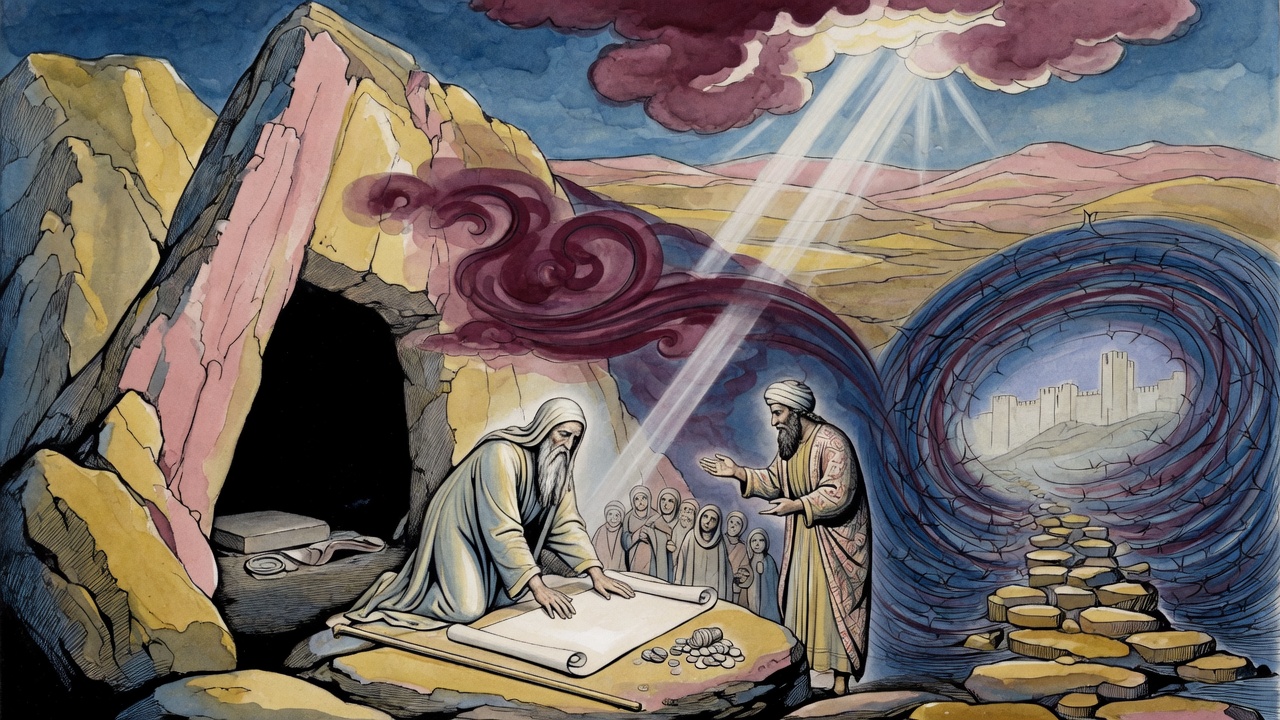
Jeremiah came into the Temple court wearing a yoke. Wooden bars, leather thongs, the whole rig a plow ox carries, strapped onto a man's shoulders because God had told him to put it there. The message did not need words. Babylon is coming, and this is what your neck will look like.

Hananiah son of Azzur walked up to him in front of everyone and pulled it off him.

He broke the bar across his knee. "So says the LORD. In two years I break the yoke of Nebuchadnezzar off the neck of every nation." The vessels stolen out of the Temple, he said, would be back in the same two years. It was the sweeter prophecy by a wide margin, and the crowd in that court had been waiting a long time to hear something sweet.

Jeremiah stood there with the splinters at his feet and did not argue the point. "Amen," he said. "May the LORD do exactly that."

The Rule Jeremiah Handed Him

Then he told Hananiah what the two of them had just wagered.

"I prophesy disaster. If the disaster never comes, I am still not a liar, because God says a hard thing in anger and takes it back. He has done it before and He will do it again. You prophesy peace." Jeremiah let that sit. "When God promises something good, He does not take it back. Not for sin, not for a calf, not for anything. So if your peace does not arrive, there is only one thing left to call you."

A prophet of doom can be wrong and still be honest. A prophet of comfort has no such cover. Hananiah had picked the one kind of prophecy that convicts the man who gets it wrong.

He was dead by the seventh month of that same year.

The Threats God Was Willing to Drop

Twenty generations went by after the world was made, and nobody took the knife.

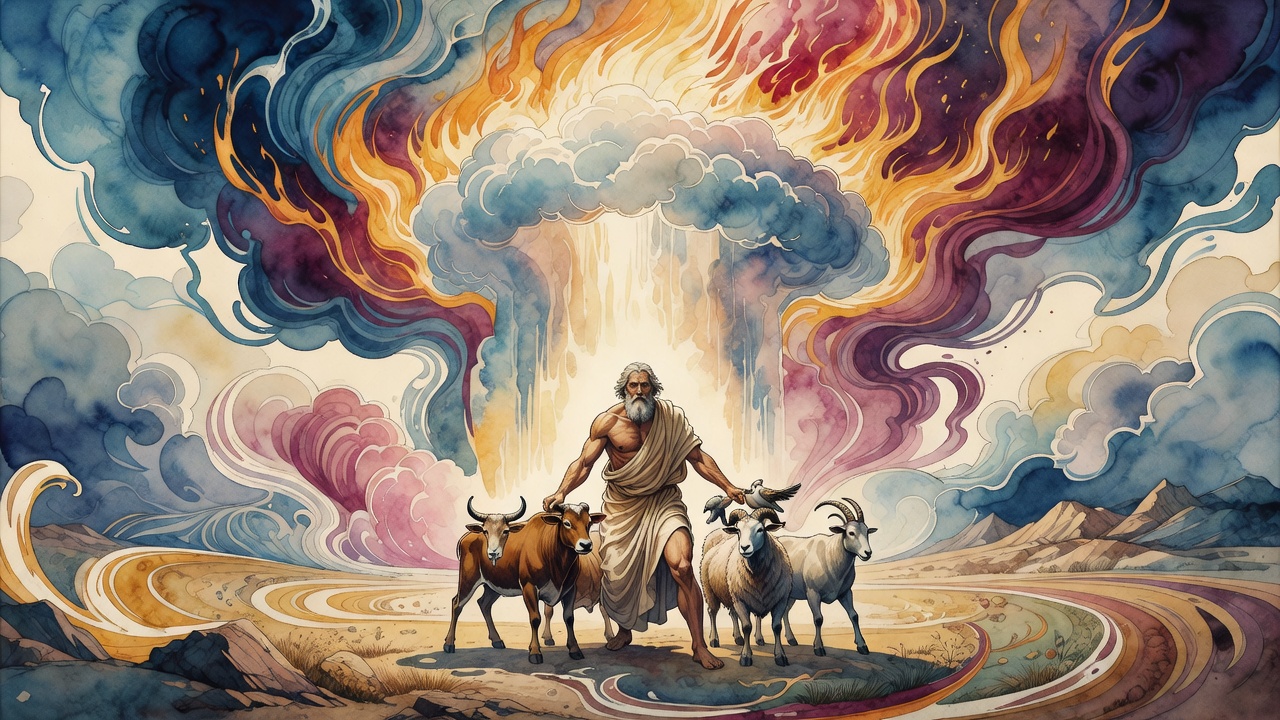
Then God stood in front of Abraham and made him an offer with a floor under it. "Out of you will come seventy who go down into Egypt. Out of them, seventy elders standing in the wilderness. And out of you a man will come who lays the whole Torah open in seventy languages." Then the other half. "I am El Shaddai. If you refuse this, I say dai to the world, enough, and send it back to the emptiness it came out of." Abraham took the knife. The threat never had to land.

It happened again at the mountain. Israel poured a calf and God said, "Let Me alone. I will wipe them out and blot the name off the earth." Moses would not let Him alone. He stood in the gap and argued until he got the sentence he wanted back. "I have pardoned, as you asked." And the land that had been promised to a people who had just built an idol stayed promised. "Go up from here," God told him, "you and the people you brought out of Egypt."

The Mark the Angel Scratched on Sarah's Wall

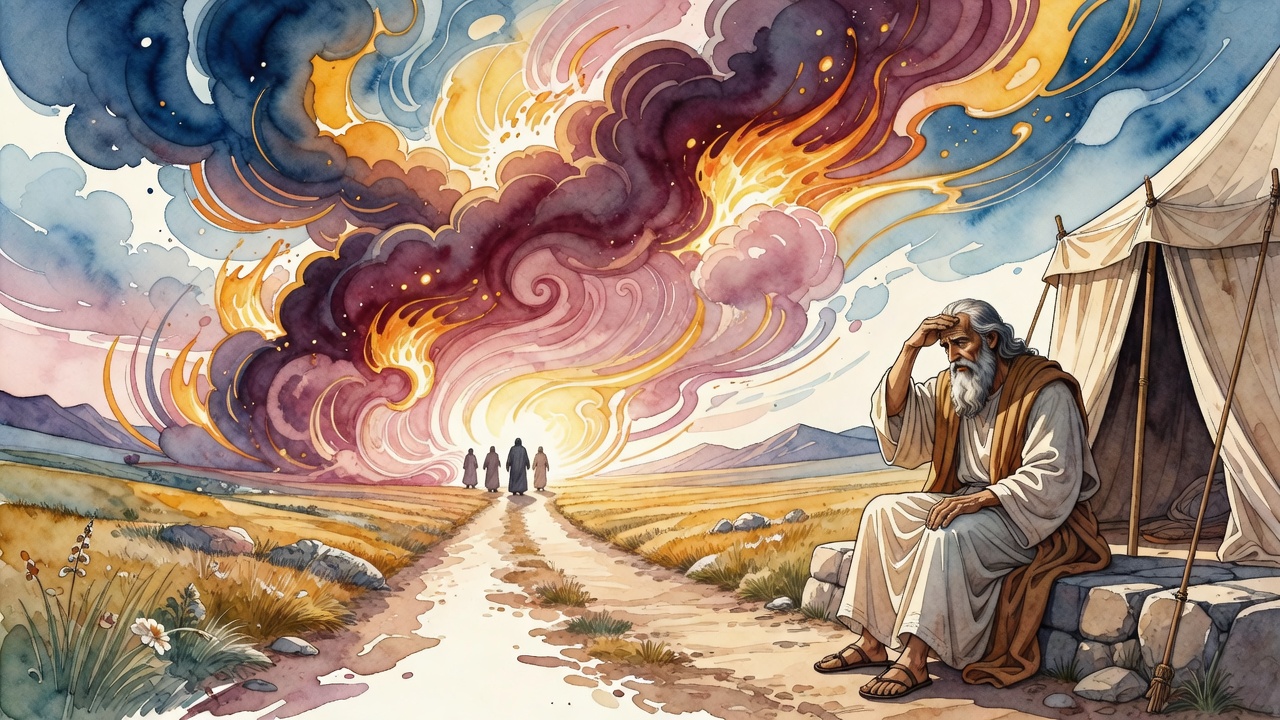
Back at the tent by the oaks, Abraham had run in and told Sarah to hurry, three measures of the good flour, knead it, make cakes for the visitors.

She had her hands in the dough when her body started again.

Decades since the last time. She was ninety and standing over a kneading trough and the blood came back, and she understood before anyone said a word to her what it meant. The bread never reached the table. What Abraham carried out to the three men under the tree was curds and milk and the calf, and no one asked about the cakes.

One of the visitors went to the wall of the tent and scratched a line in it. "When the sun comes back around to this mark," he told her, "you will be carrying a son."

She had already given up on it. She had said so to herself, out loud, in the shade behind the door. But a year later the light crawled across the wall the way light does, slow, indifferent, and it touched the scratch, and the promise came due on the day it had been set for.

The Bow He Left Out Where Anyone Can Look

A man loves his friend while the friend is alive. Then the friend dies and the loving stops, because there is nobody left to love. That is not how it went with Abraham. Abraham died, and the blessing simply moved down to Isaac without a pause.

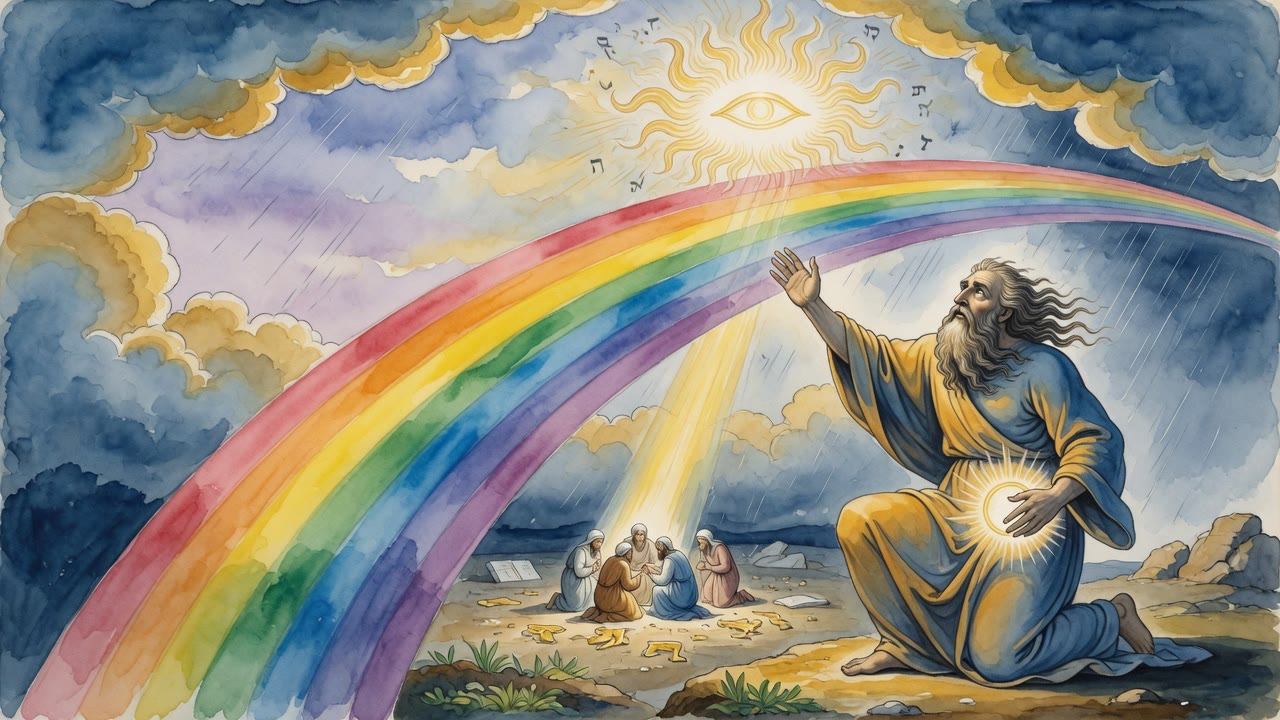
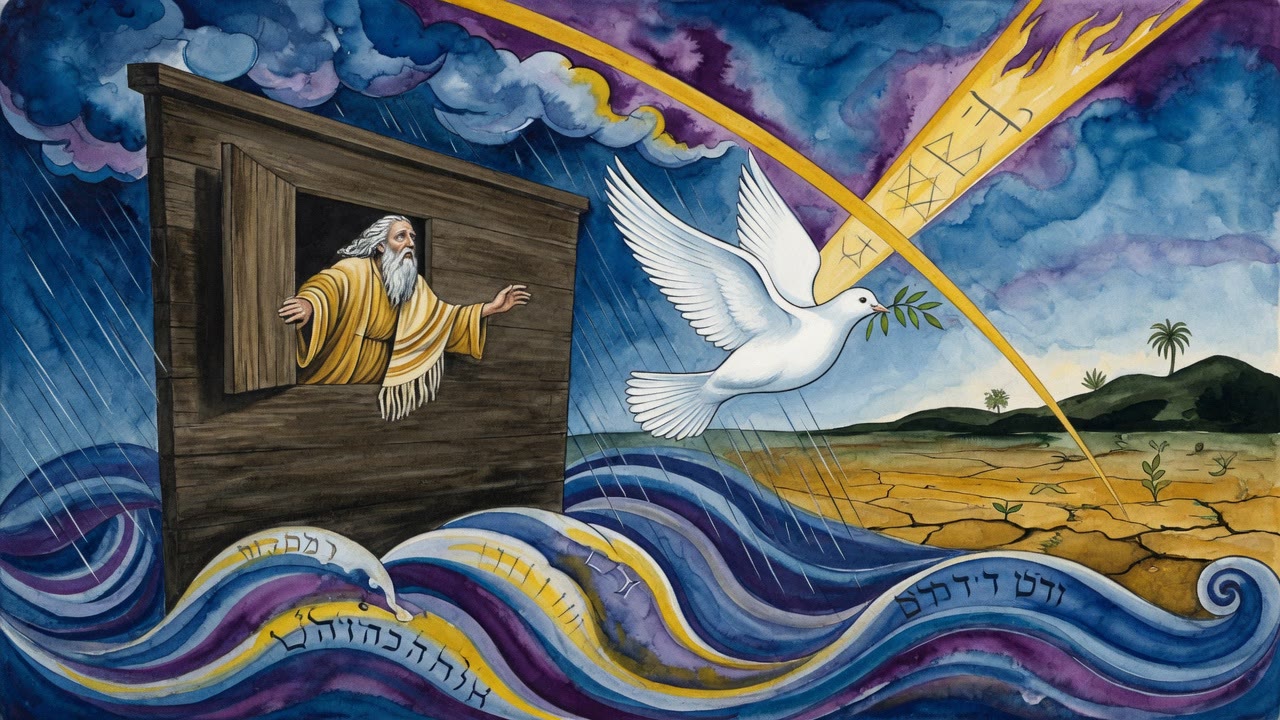
A king can load a friend with silver and gold and fine cloth and send him off, and a storm takes the ship, and the king can do nothing about it from shore. When the ship goes down the sailors throw the cargo over the side first, and the animals after it, and they pull the man out of the water and count that a good day's work. God does not sort the manifest that way. When the flood ended, what the verse says is that He remembered Noah and every living thing with him, the beasts in the hold counted with the man at the tiller.

So the bow went up in the cloud, and it stayed there.

Not in an ark, not in a drawer, not in the keeping of a priest who could lose it. In open sky, over a wet field, where a farmer with mud to his knees can look up at the color and say the words back: blessed is the One who remembers the covenant, and is faithful to the covenant, and keeps His word.


← All myths
From the tradition

Sources

3 sources

The texts behind this telling. Some cards carry a translation of the source; others are our own retelling of it, and each card says which. Every card links out to the original.

Midrash Tanchuma, Noach 6Midrash Tanchuma

Retold in our words. Read the original at the link below.Townsend 1989 translation of Midrash Tanhuma, S. Buber Recension · CC-BY

And God remembered Noah (Gen. 8:1). May it please our master to teach us the benediction recited upon witnessing a rainbow. Thus did our masters teach us: Upon seeing a rainbow, one should recite the benediction: Blessed art Thou, O Lord our God, King of the universe, who doth remember His covenant, is faithful in His covenant, and fulfills His word. This blessing is found in the Mishnah (the earliest code of rabbinic law). How do we know that it is also derived from the Torah? Because it is written: I have set My bow in the cloud, and it shall be as a sign of a covenant (Gen. 9:13).

God’s way is not man’s way. As long as a man’s friend lives, his friendship for him continues, but after his friend’s death, his concern for him ceases. The Holy One, blessed be He, however, does not act in that manner. When Abraham died, the Holy One, blessed be He, continued to love his son Isaac, as it is said: And it came to pass after the death of Abraham that God blessed Isaac, his son (ibid. 25:11). It may happen that a king bestows gifts of silver, gold, and raiment upon his friend, and the friend then sails away. These possessions may be lost when a storm arises, and the king is powerless to protect him from the sea or from pirates. However, when the Holy One, blessed be He, presents a gift to his beloved one He guards it, as it is said: The Lord bless thee and guard thee (Num. 6:24). He blessed Abraham and guarded him, as it is said: And the Lord blessed Abraham in all things (Gen. 24:1). He acted similarly toward Isaac and Jacob.

If a storm should arise after a man boards ship, they hurl the animals and all his possessions into the sea, only the man is saved. Those in charge of the vessel do not have the same concern for the man’s animals and possessions as they have for the man himself, but the Holy One, blessed be He, is as concerned for the beast as for the man, as is said: And His tender mercies are over all His works (Ps. 145:9). Hence, Scripture says: And God remembered Noah and every living thing (Gen. 8:1).

Full source
Midrash Tanchuma, Lech Lecha 19Midrash Tanchuma

Translation of the source text.Midrash Tanchuma -- Torat Emet · Public Domain

"And I will set my covenant between me and you" (Genesis 17:2). This is what Scripture says: "The secret of the LORD is for those who fear him, and his covenant is to make them know it" (Psalms 25:14). Which is the secret that he revealed to those who fear him? This is circumcision, for the Holy One, blessed be He, revealed the mysteries of circumcision only to Abraham. "The secret of the LORD is for those who fear him," this is Abraham, for it was said to him, "For now I know that you fear God" (Genesis 22:12). What is "sod" (secret)? Samekh is sixty, vav is six, dalet is four; this makes seventy. [The letters of the word for "secret" are read as numerals summing to seventy.] The Holy One, blessed be He, said to him: I will raise up from you seventy, as it is said, "With seventy persons your fathers went down to Egypt" (Deuteronomy 10:22); and I will raise up from them seventy elders, as it is said, "Gather to me seventy men of the elders of Israel" (Numbers 11:16). And I will raise up from you Moses, who will expound the Torah in seventy tongues. Therefore it is written: "The secret of the LORD is for those who fear him, and his covenant is to make them know it."

The Holy One, blessed be He, said to Abraham: When I created my world, I kept it turning for twenty generations for your sake, until you would come and take upon yourself circumcision. Now, if you do not take upon yourself circumcision, I am El Shaddai: I will say to the world "Enough" (dai) up to here, and I will return it to chaos and void.

Full source
Midrash Tanchuma, Vayera 13Midrash Tanchuma

Retold in our words. Read the original at the link below.Townsend 1989 translation of Midrash Tanhuma, S. Buber Recension · CC-BY

And the Lord remembered Sarah, as he had said (Gen. 21:1). Scripture states elsewhere in allusion to this verse: God is not a man that He should lie; neither the son of man, that He should repent; when He hath said, will He will not do it? Or when He hath spoken, will He not make it good? (Num. 23:19). R. Samuel the son of Nahman contended: The conclusion of this verse contradicts the beginning. It begins: God is not a man that He should lie, but subsequently it reverses itself by stating: when He hath said, will He not do it? What is meant by God is not a man that He should lie? It indicates that when the Holy One, blessed be He, promises to perform a good deed, He does so. For example: A mortal king may promise his son a gift, but if his son angers him, he will withdraw his promise. However, if the Holy One, blessed be He, promises to do a good deed, He will not retract His promise even though they sin against Him. Scripture states: And He gave them the lands of the nations, and they took the labor of the peoples in possession; that they might keep His statutes and observe His Laws (Ps. 105:44–45), and even though they neglected to keep His commandments and to observe His laws, He gave them the land. Similarly, though the Israelites erected the golden calf, when Moses pleaded for mercy in their behalf, the Holy One, blessed be He, said to him: Depart, go up hence, thou and the people thou hast brought out of the land of Egypt (Exod. 33:1). The Holy One, blessed be He, said: Moses, I am not like a man who promises a gift and then retracts. Hence, it says: God is not a man that He should lie.

What is meant by When He hath said, will He not do it? It means that though He should decide in a moment of anger to inflict misfortune, He might rescind that decision. For example, though He said to Moses: Let Me alone that I may destroy them and blot out their name (Deut. 9:14), He did not do so, for The Lord repented of the evil (Exod. 32:14). Likewise, though He declared: Now, therefore, let Me alone that My wrath may wax hot against them, and that I may consume them (ibid., v. 10), yet he did not do so. Instead, the Holy One, blessed be He, exclaimed: I have pardoned according to thy word (Num. 14:20). Hence, the Holy One, blessed be He, said: I am not a man who threatens to do evil and then haughtily does it.

R. Huna Hakohen (“the priest”) stated in the name of R. Aha: This is proven by what occurred at the time Jeremiah said: Bring your necks under the yoke of the king of Babylon, and serve him and his people, and live (Jer. 27:12). Hananiah the son of Azzur, the false prophet, had prophesied good tidings, as it is said: And they have healed the hurt of the daughters of my people lightly, saying peace when there is no peace (ibid. 8:11), and he had told them also: Behold, the vessels of the house of the Lord shall now shortly be brought again from Babylon (ibid. 27:16). Thereupon Jeremiah exclaimed: I prophesy evil in accordance with the word of the Holy One, blessed be He, while you prophesy good tidings falsely of your own accord. Yet may it be that the Lord fulfill the words which thou hast prophesied, to bring back the vessels of the Lord’s house (ibid. 28:6).

The Holy One, blessed be He, told Jeremiah: Make thee bands and bars and put them upon thy neck (ibid. 27:2), just as, in the future, Nebuchadnezzar will bind them about the necks of My children. And he did so (on himself). However, Hananiah removed them from Jeremiah’s neck and destroyed them, as it is said: Hananiah the prophet took the bar from off the prophet Jeremiah’s neck, and broke it. And Hananiah spoke in the presence of all the people, saying: “Thus saith the Lord: Even so will I break the yoke of Nebuchadnezzar, king of Babylon” (Jer. 28: 10–11). Jeremiah, thereupon, called out to Hananiah: There have been prophets before me and you, but the prophet that prophesieth of peace, when the word of the prophet shall come to pass, then shall the prophet be known, that the Lord hath truly sent him (ibid., v. 9). I have prophesied misfortune, but if my prophecy does not come to pass, I shall not necessarily have lied, for the Holy One, blessed be He, may threaten to do evil and then retract. But you have prophesied good tidings; if your words do not come to pass, then you shall be a false prophet, for when the Holy One, blessed be He, promises to do a good deed He does not retract His promise even though men transgress against Him.

You find also that though the Holy One, blessed be He, told Ezekiel in a moment of anger: As I live, … I will not be inquired of by you (Ezek. 20:3), He later retracted this statement, as it is said: I will yet for this be inquired of by the house of Israel, to do it for them; I will increase them with men like a flock (ibid. 36:37). Hence the words God is not a man that He should lie refer to His promises of good, and the words When He hath said, will He not do it? allude to His threats of misfortune. You know this is so also from what is written concerning the angels’ visit to Sarah: I will certainly return to thee; and, lo, Sarah, thy wife, shall have a son (Gen. 18:10). Zabdi the son of Levi stated: The angel drew a mark upon the wall and told her: When the sun reaches that mark, you will conceive. And when the sun touched the mark, Sarah did conceive, as is said: And the Lord remembered Sarah (ibid. 21:1).

Our sages maintained that she had despaired of ever giving birth to a child and was so astonished by his words, that she said to herself: I am waxed old; shall I have pleasure? (ibid. 18:12)? Thereupon the Holy One, blessed be He, declared: I will make it known to her that she shall beget a child. How did He do this? We read that when the angel came, Abraham told her: Bring quickly three measures of fine meal (ibid., v. 6). R. Judah the son of Shalum commented upon this as follows: While she was kneading the dough, she began to menstruate, and that is why Abraham did not bring the bread, but only curd, milk, and the calf (ibid., v. 8). The Holy One, blessed be He, declared: I have already told Abraham: Thus shall be your seed (ibid. 15:5). What is the meaning of Thus shall be? R. Tanhuma said in the name of R. Aha: These words indicate that the world will never lack thirty righteous men, since the letters in the word yihyeh (“shall be”) total thirty arithmetically. Hence, Scripture says: And the Lord remembered Sarah.

Full source