Parshat Beshalach5 min read

The Sea Mocked Moses Until God Raised the Staff

At the water's edge the sea scorned Moses as younger than itself. Uzza sued in heaven, Nahshon leaped first, and Pharaoh's six hundred chariots sank.

Curated by Arthur · Told by Maggid ·
Table of Contents
  1. Six Hundred for Six Hundred
  2. The Sea Refuses a Man
  3. Nahshon First, Then the Host
  4. Rahab and the Vomited Dead
  5. The Song at the Edge
The Sea Mocked Moses Until God Raised the Staff Click for full size

Six Hundred for Six Hundred

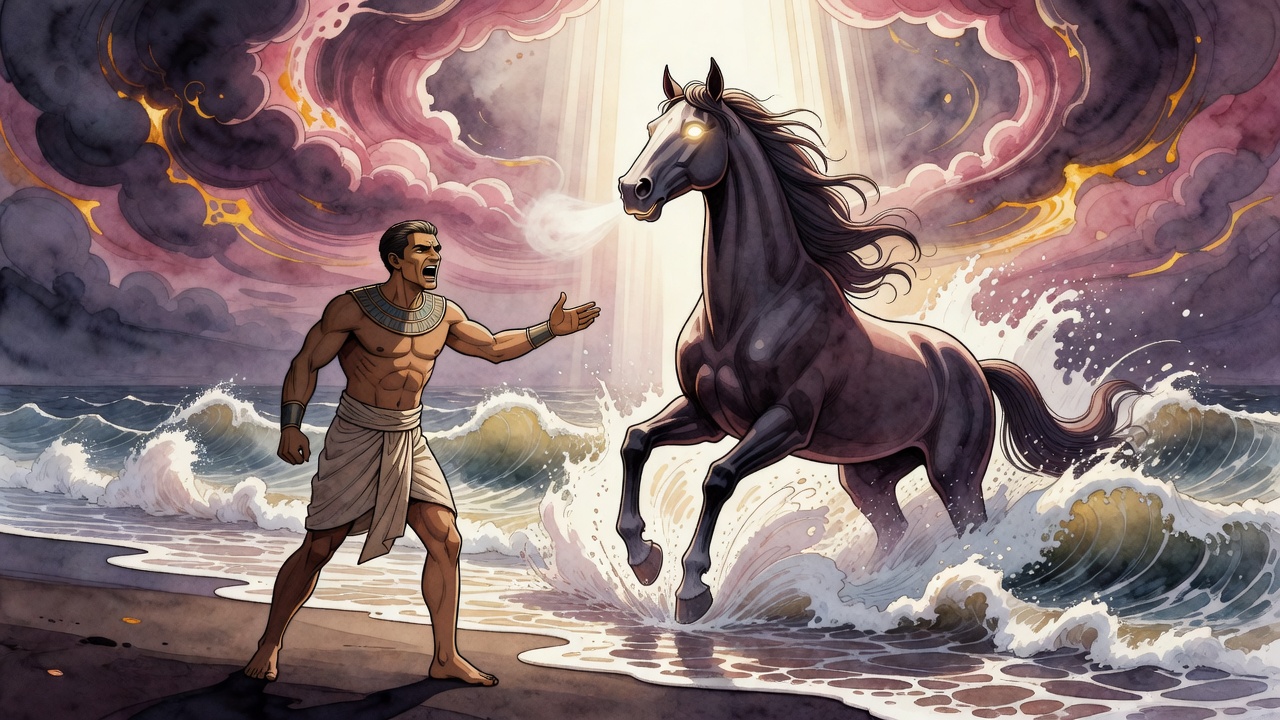
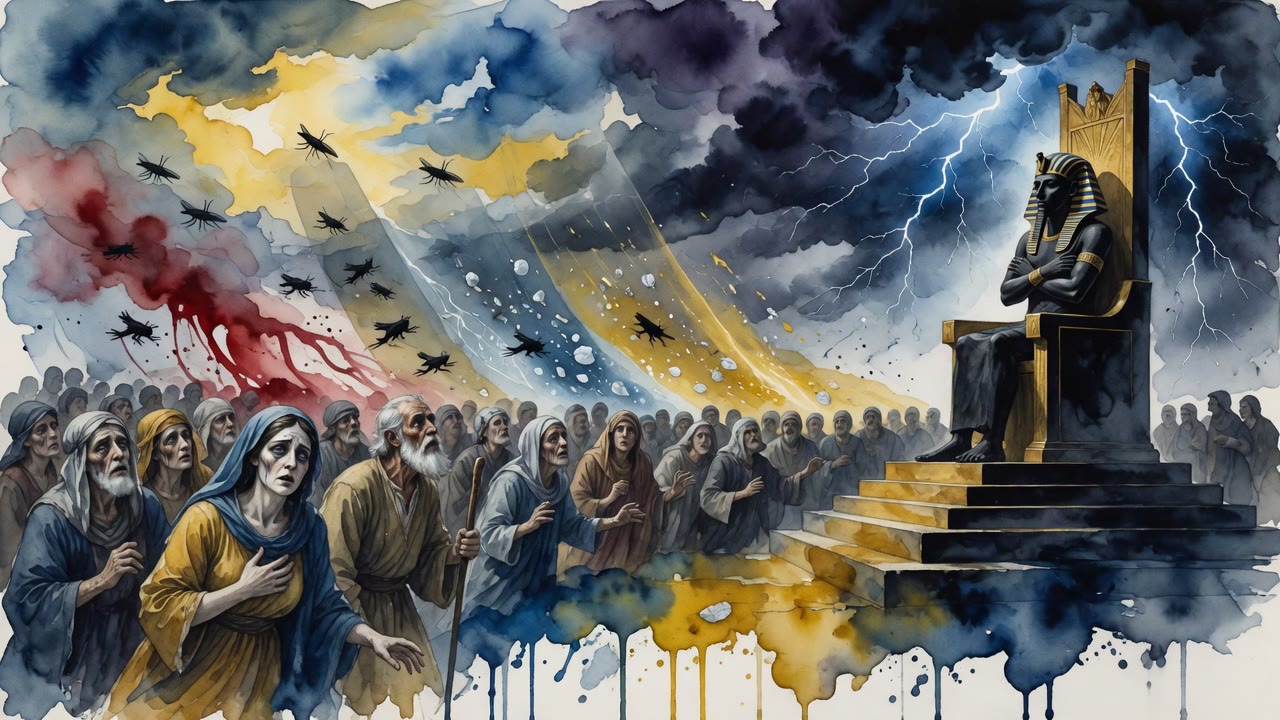
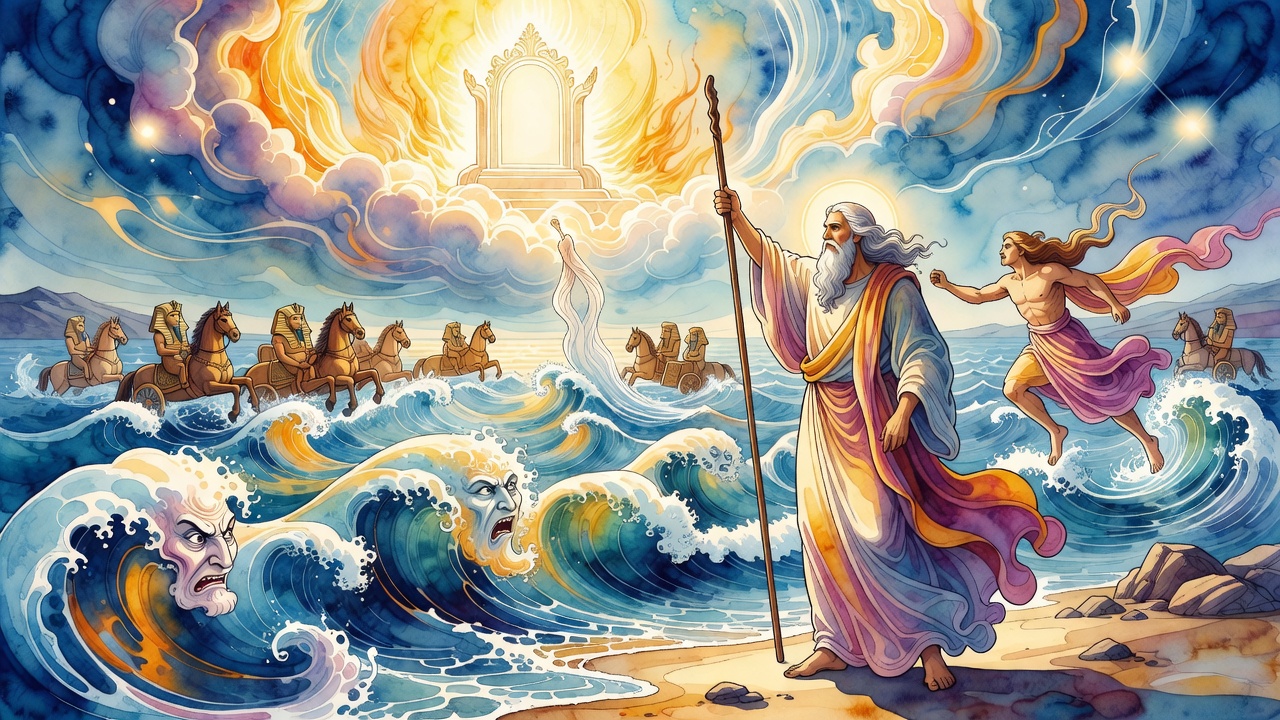
Dust rose behind Israel on the shore of the Reed Sea, a brown pillar of wheels and hate. Pharaoh came with six hundred chosen chariots, iron and horse and the confidence of men who had never failed to catch a slave. The midrash counts the number against the bricks. In Egypt the taskmasters had demanded six hundred bricks a day, and when a man fell short they walled him into the building in place of clay, a screaming stone among mud bricks. Measure rode out to meet measure. The same count that broke backs now drove wheels toward the water.

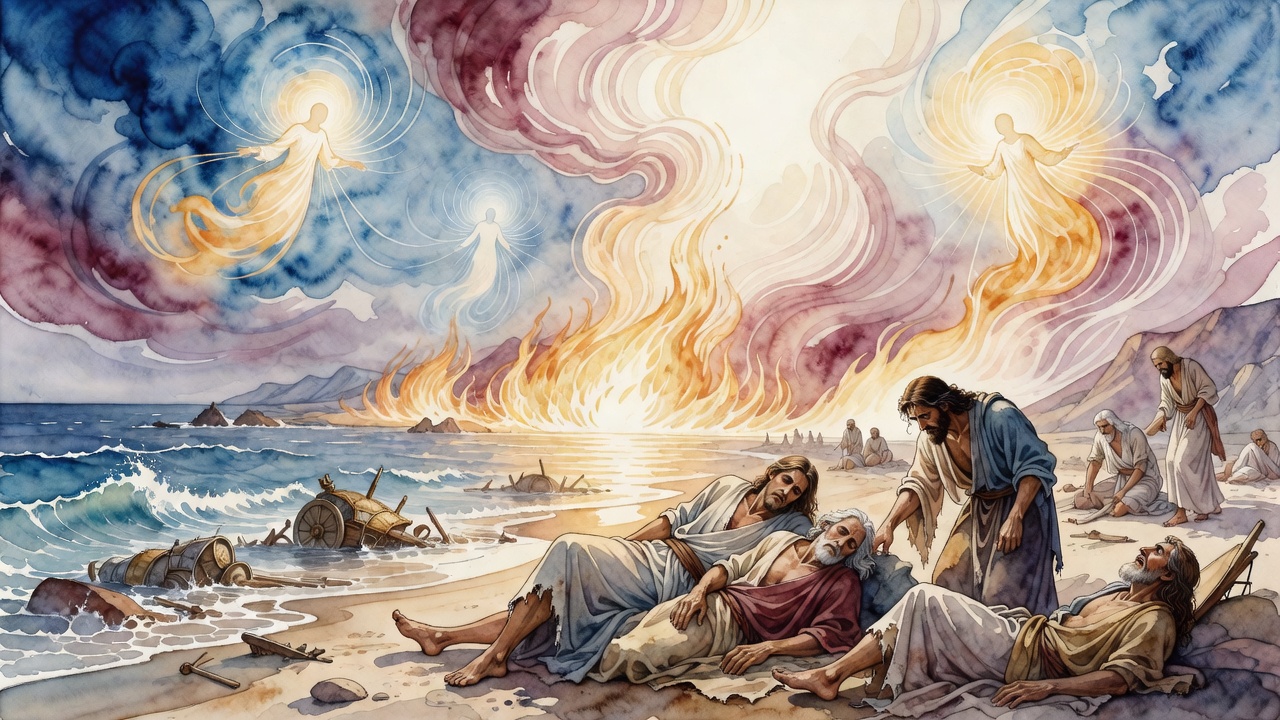
Israel's souls fled their bodies at the sight. Some cried for surrender. Some cried for a grave in Egypt rather than a grave in sand. Ministering angels begged leave to strike the pursuers. The Holy One refused. "I Myself will guard My children," He said, a reward for Abraham, who rose early to do His will on the road to Moriah. Through cloud and fire at the morning watch He threw Egypt into terror, wheel-bindings loose, horses screaming, night and day confused in the eyes of drivers.

The Sea Refuses a Man

"Speak to the children of Israel that they go forward," God told Moses. Moses asked what he himself should do when words alone seemed thin against water. "Take My staff. Go to the sea as My messenger and command it to open."

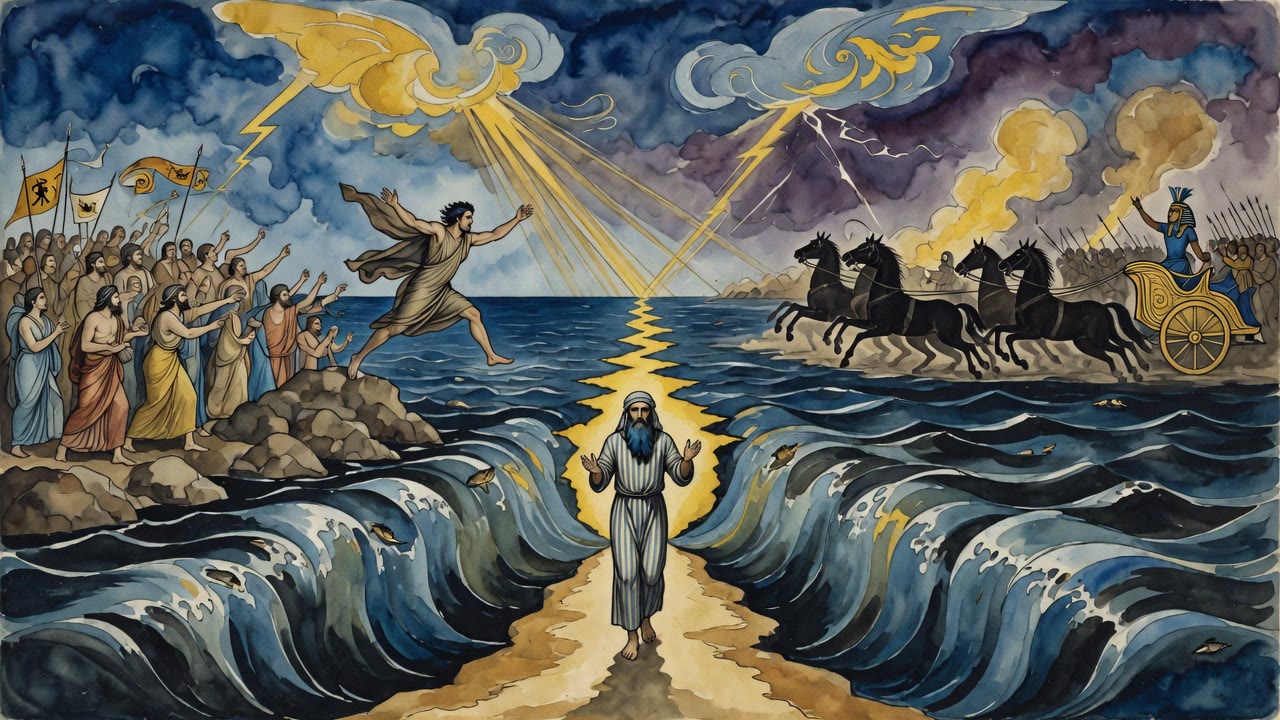
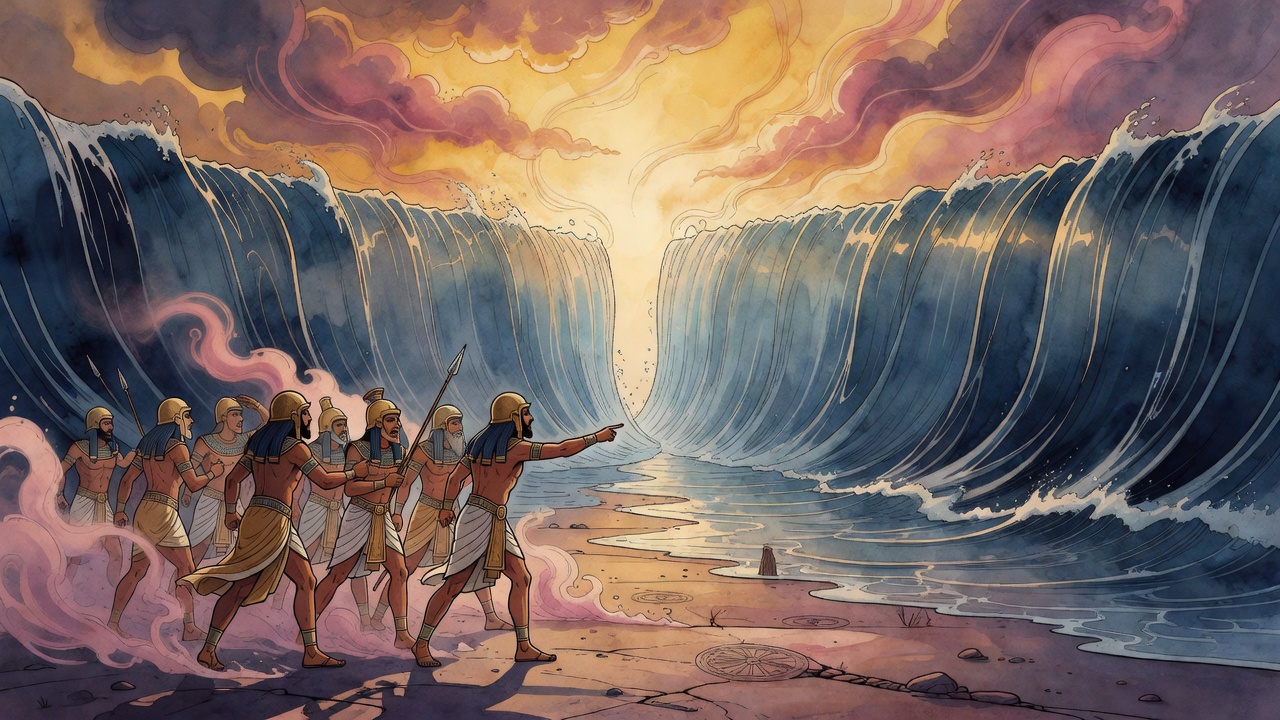
The sea refused like a prince older than courts. "You are born of a woman, and I am older than you by three days. I was made on the third day, you on the sixth." The insult was cosmic seniority weaponized. Moses brought the insolence back to heaven. God answered with a servant's law every household knew: a rebellious slave is flogged with a staff. "Lift your staff and split the sea." Moses stretched out his hand. The waters tore with a sound like fabric under a knife. From the day heaven and earth were made, the sea had never become dry land until Israel needed a road through its heart. Kings of the earth would hear and tremble, because the floor of the deep had changed its nature for a people on foot.

Nahshon First, Then the Host

Even open water did not move frozen feet. Walls of sea stood like glass cliffs, fish staring from side chambers of miracle, and still the camp hesitated at the lip. Nahshon ben Amminadab leaped in up to the nose before the path fully showed, tradition says, faith as first foot. Only then did all Israel follow between the walls. Salvation on earth had a twin case in heaven, argued while salt dried on skin.

Uzza, angelic prince of Egypt, sued before the Throne with a lawyer's precision. The four hundred years were not complete, he argued, only eighty-six since Miriam's birth, named for the bitterness Egypt poured out. The contract of bondage, he claimed, still had ink left. Michael, prince of Israel, fell silent under the arithmetic. God answered the count Himself. The clock had started not with Egypt alone but when Isaac was born, for Abraham's seed would be strangers in a land not theirs. The years were spent. Uzza had no further claim. Heaven closed the case as the last Israelite heel cleared the far mud.

Rahab and the Vomited Dead

At creation the Holy One had commanded the prince of the sea to swallow the world's waters. The prince wept and refused. His name was Rahab, and he was struck down for that refusal, a memory the deep still carried. At the Reed Sea the old power of the waters worked under a new order, no longer free to negotiate.

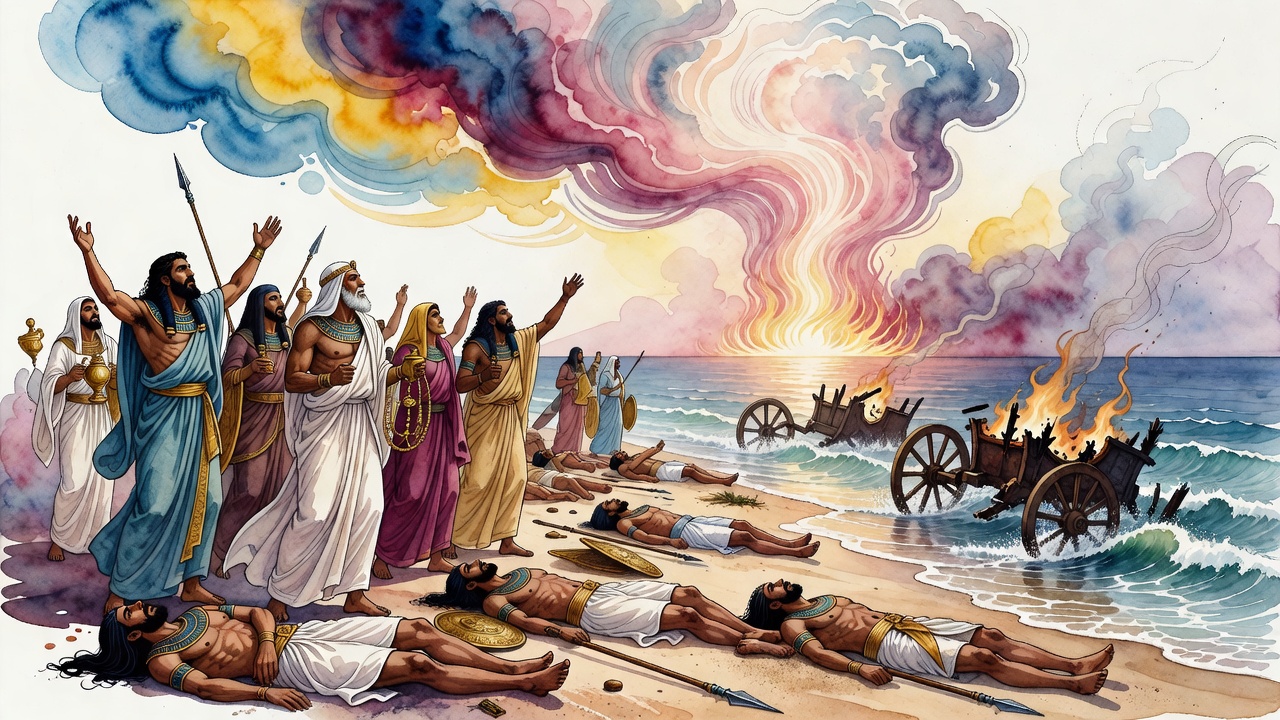
Israel still doubted the enemy was truly dead. Fear invents survivors. The sea vomited the corpses onto the shore in ranks the eye could read. Every man knew his oppressor, the face that had counted his bricks, and stripped the gold before the bodies sank again like stones. On the night of the firstborn, idols of silver and wood had melted and rotted first, gods failing before masters. Pharaoh had run the streets crying for "Moses my friend," begging him to leave while the dead of Egypt filled houses. The Egyptians had thought themselves shrewd: enslave Israel with water, for God had sworn never again to flood the earth. "Fools," He answered, "you yourselves shall go to the flood." The oath against a world-drowning did not protect an army that chose the sea as weapon.

The Song at the Edge

When the time came to sing, courtesy stalled the first note. Israel told Moses to begin. He told the many to begin, honor circling like birds afraid to land. They opened together and named mercies: mothers who birthed in the field without pain, angels who washed and anointed hidden infants, earth that swallowed babies and spit them out beyond Egypt's reach. Moses took up his own thread, from pitch-daubed ark to coal that scarred his mouth when Gabriel turned his hand from gold, and ended bound to the line, "The LORD is my strength and song."

Dry land in the sea's heart closed behind a people and over an army. The staff had answered the mockery. The count of bricks had answered in chariots. The shore held gold, silence, and the first free breath of a nation that had walked where fish used to rule.


← All myths

From the tradition

Sources

4 sources

The texts behind this telling. Some cards carry a translation of the source; others are our own retelling of it, and each card says which. Every card links out to the original.

Midrash Vayosha 6Midrash VaYosha

Translation of the source text.Otzar Midrashim, New York 1915, Public Domain · CC-BY-SA

"Pharaoh's chariots and his host", Our Sages, of blessed memory, said: When Israel was in Egypt, the Egyptians enslaved them with every hard labor in the world, with mortar and with bricks. And every single day they would tell Israel that each and every one of them was to make six hundred bricks; and whenever Israel fell short by even one, they would set the man into the wall in place of what he had fallen short. Corresponding to this, the Egyptians were struck when they pursued them with six hundred chariots, as it is said, "And he took six hundred chosen chariots" (Exodus 14:7). And when Israel saw that the Egyptians were journeying after them, they were terrified and their souls flew out of them. The ministering angels said before the Holy One, blessed be He: "Master of the Universe, let us go down and take vengeance upon Egypt and guard Your children from their hand." But the Holy One, blessed be He, answered them: "I Myself will go down and guard My children Israel, as a reward for Abraham their father having done My will, as it is said, 'And Abraham rose early in the morning' (Genesis 22:3)." And when that hour arrived at which Abraham had stood in prayer before Him, the Holy One, blessed be He, looked into the camp of Egypt in the pillar of fire and cloud, and troubled them and shook them, as it is said, "And it came to pass, that in the morning watch the LORD looked unto the host of the Egyptians" etc. (Exodus 14:24). Therefore it is said, "Pharaoh's chariots and his host hath he cast into the sea: his chosen captains also are drowned in the Red sea" (Exodus 15:4).

"The depths have covered them", Our Sages, of blessed memory, said: Blessed and praised be the name of the Holy One, blessed be He, who created His world with wisdom and with understanding. To His wonders there is no investigation and to His understanding there is no number, as it is written, "He gathereth the waters of the sea together as an heap: he layeth up the depth in storehouses" (Psalms 33:7). When the Holy One, blessed be He, created His world, He said to the prince of the sea: "Open your mouth and swallow all the waters that are in the world." He said before Him: "Master of the Universe, it is enough that I stand within my own," and he began to weep. The Holy One, blessed be He, kicked him and slew him, as it is said, "He divideth the sea with his power, and by his understanding he smiteth through Rahab" (Job 26:12) (thus the name of the prince of the sea is Rahab, Bava Batra 74b). What did the Holy One, blessed be He, do? He subdued them, and the sea received them (the waters of the world), as it is said, "Or who shut up the sea with doors" etc. (Job 38:8). The sea said to Him: "Master of the Universe, if so, the sweet waters will mingle with the salt." He said to it: "Each and every one shall be a storehouse on its own," as it is said, "He layeth up the depth in storehouses" (Psalms 33:7). Come and see how many kindnesses the Holy One, blessed be He, did with Israel when they went in the wilderness: He would go before them by day in a pillar of cloud to lead them the way, and by night in a pillar of fire to give them light, etc. And furthermore, there were there serpents and scorpions and fiery serpents, and the Holy One, blessed be He, out of the abundance of love with which He loved Israel, would send to the serpents that they should make themselves like an eagle, and Israel would pass over them as a man who passes over an eagle. And still, out of the great dread of the serpents that were in the wilderness, and out of the fear and dread they had of the Egyptians, they said to Moses: "You say that the Egyptians have drowned in the sea; we are afraid lest they come up out of the sea just as we ourselves came up. If it is Your will, show them to us dead, and let us see vengeance upon our enemies." Immediately Moses said before the Holy One, blessed be He: "Master of the Universe, out of the great fear and dread they have of the Egyptians, they do not believe that they were drowned in the sea. If it is Your will, do wonders for them and show them to them, and let them see vengeance upon their foes." Immediately the Holy One, blessed be He, said to the prince of the sea: "Cast them onto the dry land." The prince of the sea said: "Master of the Universe, is there a master who gives a gift to his servant and then takes it from him?" The Holy One, blessed be He, said to the prince of the sea: "I will repay you one and a half times as many as them." He said before Him: "Master of the Universe, is there a servant who sues his master at law for what is owed to him?" The Holy One, blessed be He, said to him: "The brook Kishon shall be a surety for you." Immediately the sea cast them out onto the shore of the sea, and Israel saw them, and each and every one recognized his enemy, and they took all their silver and their gold. And after they had seen their vengeance, the Holy One, blessed be He, sank them like a stone. Therefore it is said, "The depths have covered them: they sank into the bottom as a stone" (Exodus 15:5).

"Thy right hand, O LORD, is become glorious in power", Our Sages, of blessed memory, said: At the hour when the Holy One, blessed be He, brought the plague of the firstborn upon the Egyptians in Egypt, the plague came first upon their gods and upon their images: those that were of silver and of gold and of brass and of tin and of lead melted and dissolved, and all the images of wood rotted and broke. When Pharaoh saw this, he arose at midnight and called for Moses and Aaron, and went crying through all the streets of Israel, saying: "Where do Moses and Aaron dwell?" And the little children of Israel would mock him and say to him: "Where are you going, and whom do you seek?" And he would say to them: "I seek Moses my friend," and they would say: "Here he dwells," and others would say: "Here he lives," and others would say: "In another place," until he found the house. And he said to him: "Moses! Arise, get you out from among my people." Moses said: "Are we thieves, that we should go out by night? The Holy One, blessed be He, told us, 'And none of you shall go out at the door of his house until the morning' (Exodus 12:22)." He said to him: "I beg of you, arise, go out quickly."

"And it came to pass at midnight" (Exodus 12:29), this is what was said by the Holy Spirit through David, as it is said, "At midnight I will rise to give thanks unto thee because of thy righteous judgments" (Psalms 119:62). Rabbi Yochanan said: This teaches that David said before the Holy One, blessed be He: "Master of the Universe, I give thanks before You for that night on which You wrought a miracle for Israel in Egypt." And David said: Come and see what the Holy One, blessed be He, did in Egypt for Israel, blessed be His name and exalted be His remembrance, that He did not complete His judgment in Egypt until He had made His judgments known to Moses and to Israel. The Holy One, blessed be He, said to Moses: "Moses, go and say to them, to My children: Know that I am going out into the midst of Egypt, and I Myself will exact punishment from them and will slaughter their firstborn in a single hour; and you, slaughter your Passover offerings and put the blood of the Passover upon the lintel and upon the two doorposts and upon the roofs of your houses and upon the walls, and this shall be a sign for life." A parable: to what is the matter like? To a king who had a flock, and set apart some of them for life and some of them for death. What did he do? He took the red dye and marked those that he had set apart for life, but those that he had set apart for death he did not mark. So too the Holy One, blessed be He: the flock that He wished to slaughter were these Egyptians, and the flock that He set apart for life were Israel, upon whom He put the red dye, the sign for life is this blood, as it is said, "And they shall take of the blood, and strike it on the two side posts and on the upper door post" (Exodus 12:7). And so Israel did: they slaughtered their Passover offerings and put of the blood upon the lintel and upon the two doorposts and upon the walls of their houses. Moses said to them: "Thus the Holy One, blessed be He, said to me: 'This is the ordinance of the Passover: there shall no stranger eat thereof' (Exodus 12:43)." When Israel heard the words of the Holy One, blessed be He, they stood upon their feet with joy and with songs, and they circumcised in haste all the uncircumcised who were among them, and the Holy One, blessed be He, hastened and healed them. When it was midnight, the Holy One, blessed be He, passed through the midst of Egypt and saw Israel sullied with the blood of circumcision, and their houses sullied with the blood of the Passover; He blessed them and said to them: "My children, be alive for the coming year," as it is said, "And when I passed by thee, and saw thee" etc., "I said unto thee when thou wast in thy blood, Live" (Ezekiel 16:6).

And Rabbi Yehoshua ben Levi said: When Moses said to Pharaoh, "Know that the firstborn of Egypt shall die in the night," he began to mock him and said: "How many will the firstborn of Egypt be, two hundred or three hundred?" And this fool did not know that all of them were firstborn, because they were steeped in lewdness and were all bastards, and each and every one was a firstborn to his father [and if he was not a firstborn, the eldest of the house died]. And once the firstborn and the chief ones of the house in place of the firstborn had died, and Pharaoh saw that most of his sons and the sons of his servants and the sons of his handmaids had died, Pharaoh said in his heart: "Moses never told me a falsehood." And he said to his servants: "All the days that Moses was with me, I would appease him, and he would pray for us and we would be healed; now I grew angry with him and said to him, 'See my face no more' (Exodus 10:28). It is fitting that I myself should go." Immediately he arose from his bed in great weeping and went with his princes to the door of Moses' house. Pharaoh cried out in a loud voice and wept in bitterness of soul and called to Moses: "Moses, my friend! I beg of you, pray for me before the Holy One, blessed be He." And Moses and Aaron and all Israel were eating their Passover offerings and drinking wine reclining, and saying songs and praises to the Holy One, blessed be He, and sitting in their houses, and none of them went outside, for thus the Holy One, blessed be He, had said to them: "And none of you shall go out at the door of his house until the morning" (Exodus 12:22).

And when Pharaoh called at the door of Moses, he said to him: "Who are you, and what is your name?" He said to him: "Pharaoh the abased." Moses said to him: "Why have you come to me yourself? Is it the way of a king to rise at night and to go around to the doors of men?" Pharaoh said to Moses: "I beg of you, my lord, come and pray for us now, [and if not] there will not remain a man in Egypt." He said to him: "I cannot go out, for the Holy One, blessed be He, commanded us and said to us, 'And none of you shall go out at the door of his house until the morning' (Exodus 12:22)." Pharaoh said to Moses: "I beg of you, come to the window and speak with me," and so he did. And Pharaoh said to him: "Did you not say to me yesterday, 'And all the firstborn in the land of Egypt shall die' (Exodus 11:5), and now nine portions are dead?" Moses said to him: "Even so, if you wish, I will teach you a thing and you will be saved and not die. Raise your voice and say: 'Children of Israel! Behold, you are in your own authority. Arise, go out from among my people. Until now you were the servants of Pharaoh; from here onward, behold, you are in the authority of the LORD. Go, serve the LORD your God.'" And so he did several times, and the Holy One, blessed be He, caused the voice of Pharaoh to be heard in all the land of Egypt, as it is said, "And Pharaoh rose up in the night, he, and all his servants, and all the Egyptians; and there was a great cry in Egypt; for there was not a house" etc. (Exodus 12:30), "And he said, Arise, get you out from among my people."

Moses said to Pharaoh: "Why do you trouble yourself?" He said to him: "I am afraid lest I die, since I am a firstborn." And Moses said to him: "Do not fear of this matter; for something greater than this you are prepared" (to drown in the sea). And do not say that Pharaoh alone was urging, but rather all the Egyptians were urging, as it is said, "And the Egyptians were urgent upon the people, that they might send them out of the land in haste; for they said, We be all dead men" (Exodus 12:33). Rabbi Shmuel bar Nachmani said: With this cunning the Egyptians came upon Israel, to enslave them under their hand and to subdue them. They said: "If we enslave them with fire, their God is able to fight against us with fire, just as He brought upon Sodom and upon Gomorrah; but let us enslave them with water, for He is not able to fight against us with water, since He has already sworn that He will not bring a flood upon the world." And the Holy One, blessed be He, said to them: "Fools! I swore that I would not bring a flood upon the world; by your lives, you yourselves shall go to the flood." Therefore He drowned them in the sea. Therefore it is said, "Thy right hand, O LORD, is become glorious in power: thy right hand, O LORD, hath dashed in pieces the enemy" (Exodus 15:6).

Full source
Midrash Vayosha 2Midrash VaYosha

Translation of the source text.Otzar Midrashim, New York 1915, Public Domain · CC-BY-SA

"Speak to the children of Israel that they go forward" (Exodus 14:15). And Moses answered before the Holy One, blessed be He: "Master of the Universe, and I, what shall I do?" He said to him: "Take the staff that I gave you and go to the sea on My errand, and say to it: 'I am the messenger of the Former of Creation. Reveal your paths to My children, that they may pass through you.'"

Immediately Moses went to the sea and told it the words of the Holy One, blessed be He. And the sea answered Moses: "I will not do according to your words, because you are one born of a woman; and not only that, but I am greater than you by three days, for I was created on the third day, and you were not created until the sixth day." Immediately Moses brought back the words of the sea to the Holy One, blessed be He. And the Holy One, blessed be He, said to him: "A servant who rebels against his master, what is done to him?" Moses said to Him: "They flog him with a staff." The Holy One, blessed be He, said to him: "You too, lift up your staff and stretch out your hand over the sea and split it." Immediately Moses stretched out his hand over the sea and split it.

And the Israelites were afraid to enter the sea, until Nahshon ben Amminadab leaped and went down first into the sea, and after him all Israel came into the midst of the sea, and the waters were a wall to them on their right hand and on their left.

"And the Lord saved" (Exodus 14:30), etc. Our Sages, of blessed memory, said: Were the Israelites then delivered on that day into the hand of Egypt, that it says "And the Lord saved on that day Israel from the hand of Egypt"? Rather, when Israel went out from Egypt, Uzza, the prince of Egypt, stood before the Holy One, blessed be He, and said before Him: "Master of the Universe, this nation that You are bringing out of Egypt, I have a case of law against them. If it is Your will, let Michael, the prince of Israel, come and contend with me before You." At that hour the Holy One, blessed be He, said to Michael: "Go out and contend with him before Me."

Uzza, the prince of Egypt, opened before the Holy One, blessed be He, and said: "Master of the Worlds, You decreed concerning this nation that they should be enslaved under the hand of my nation four hundred years, and there have not yet passed of them but eighty-six years from the day Miriam was born, and therefore she was called Miriam, after the name that the Egyptians embittered (mareru) their lives, and as You exist, so let Your decree exist, and the time of their going out has not yet arrived."

When Michael heard this, he was silenced and had no answer for Uzza. Uzza requested permission to return Israel to Egypt. When the Holy One, blessed be He, saw that he wished to return Israel to Egypt, He said to him: "For what reason do you wish to return My children to Egypt, to serve your children? Were My children obligated to serve your children except on account of one matter, which Abraham their father spoke when I said to him, 'I am the Lord who brought you out of Ur of the Chaldeans, to give you this land to inherit it,' and he said before Me, 'Master of the Worlds, by what shall I know that I shall inherit it?' And concerning this I said to him, 'Know surely that your seed shall be a stranger in a land that is not theirs.' Did I say to him that they would be strangers in the land of Egypt? I said only 'in a land that is not theirs.' It is revealed and known that from the day Isaac was born they were strangers, and those four hundred years have already passed, and you have no further permission to enslave them." And this is what Scripture says: "And the Lord saved on that day Israel from the hand of Egypt, and Israel saw the Egyptians dead upon the shore of the sea" (Exodus 14:30).

Full source
Midrash Vayosha 4Midrash VaYosha

Translation of the source text.Otzar Midrashim, New York 1915, Public Domain · CC-BY-SA

"Then Moses sang" (Exodus 15:1). The Sages said: when Israel came to give song to the Holy One, blessed be He, they said to Moses: "Moses our teacher! Say it first, and afterward we will say it." Moses immediately answered Israel: "You say it first, and afterward I will say it, for I am one and you are many, and the honor of the many is greater than that of one." Immediately Israel and Moses opened together and said: "Let us sing to the LORD, who performed for us signs and wonders. When the Egyptians decreed against us and said, 'Every son that is born you shall cast into the river' (Exodus 1:22), our mothers would go out into the field, and You would cast a deep sleep upon them, and they would give birth without pain; and angels would come down from heaven and wash us and anoint us, and they would clothe us in colored garments and place in our hands two pieces, one of butter and one of honey. And when our mothers saw us washed and anointed and clothed in silk, they would give praise to Your great name and say: 'Blessed is the Omnipresent, who has not withheld His kindness and His truth from the seed of Abraham our father,' and they would say: 'Behold, they are in Your hand; do with them as You wish,' and they would go their way. And when the Egyptians saw us, they came to kill us, and You in Your mercy would command the earth, and it swallowed us up and spat us out in another place (see Sotah 11, Exodus Rabbah 1 and 23, Yalkut Ezekiel remez 354), and You would save us from their hand. And when we grew up, we would enter Egypt in groups, and each and every one recognized his father and his mother and his family. All this You did for us, and before You we will sing." Therefore it is said: "Then Moses and the children of Israel sang this song to the LORD, and they spoke, saying, 'I will sing to the LORD, for He is highly exalted'" (Exodus 15:1).

"The LORD is my strength and song" (Exodus 15:2). The Sages said: Moses said to Israel: "You have given thanks to the Holy One, blessed be He, who performed for you signs and wonders; I too will give praise and thanks to the Holy One, blessed be He, who performed for me signs and wonders. When Miriam my sister came and said to my father, 'My father! It was told to me in prophecy that a son will come forth from you who will redeem Israel from this servitude.' And when my mother bore me, she hid me, as it is said: 'And when she could no longer hide him, she took for him an ark of bulrushes and daubed it with clay and with pitch, and she put the child in it, and she laid it in the reeds by the river's brink. And his sister stood far off, to know what would be done to him' (Exodus 2:3–4). And the Holy One, may His name be exalted forever and ever, brought down great heat in Egypt, until the daughter of Pharaoh came down to bathe at the river, and she saw the ark among the reeds, and she sent her maidservant and took it, and opened it and saw me and had compassion on me. And the Holy One, blessed be He, gave me favor in her eyes so that she did not put me to death, and she took me to nurse at her breasts; and the Holy One, blessed be He, gave me the understanding that I did not wish to nurse at her breasts from impure milk, and she returned me to my mother's bosom and gave her great wages on my account. And when I was three years old, the daughter of Pharaoh clothed me in colored garments and sent me to her father. And when Pharaoh saw me, that I was comely, he took me into his bosom, and I took the crown from upon his head and placed it upon my own head. And all the magicians of Egypt and her wise men were sitting before him, and they said to him: 'This child who took the crown from upon your head and placed it upon his own head, we fear that he is the one who is destined to take this kingdom from your hand.' Some of them said to kill me by the sword, and some of them said to burn me, until one of them, Yitro was his name, answered and said: 'This child has no understanding; but if it is your wish, let me say one thing before you: let them place before this child a gold dinar and a coal of fire; if he stretches out his hand and takes the dinar, you will know that he has understanding, and you shall execute judgment upon him; but if he stretches out his hand and takes the coal, you will know that he is a boy and that folly is bound up in his heart, and you shall leave him be.' When Pharaoh and his servants heard this, the matter was good in their eyes, and they did so, and they placed the dinar and the coal in one bowl. And I wished to take the dinar, but Gabriel came and pushed my hand into the coal, and I took it and put it into my mouth, and because of this I am of uncircumcised lips (Exodus 6:12). And when I grew up, I went out to see the oppression of my brethren, and I saw an Egyptian man striking a Hebrew man of my brethren, and I killed him and buried him in the sand (Exodus 2:11–12). And when Pharaoh heard this, he sought to kill me, and he brought a sharpened sword the like of which there was not in all the world, and he struck me with it ten times, and the Holy One, blessed be He, performed a miracle for me, and my neck became like a pillar of marble, and the sword did not prevail against me; and I fled to Yitro, and he too imprisoned me in a pit for seven years. When I came out of Egypt, I was forty years old, and I stood by the well and found Tzipporah the daughter of Yitro, and I saw that she was exceedingly modest, and I said to her that I would take her for a wife. And she told me her father's custom and said to me: 'Every man who has sought to marry one of my father's daughters, he tests him with a certain tree that he has in his garden, and when they reach the tree, it immediately swallows him' (see Pirkei de-Rabbi Eliezer 40; see also the entry "Hashkem"). I said to her: 'This tree, from where did he have it?' She said: 'It is a staff that the Holy One, blessed be He, created on the eve of the Sabbath [in the six days of creation] when He created His world, and the Holy One, blessed be He, entrusted it to Adam the first man, and Adam the first man entrusted it to Enoch, and Enoch entrusted it to Noah, and Noah entrusted it to Shem, and Shem entrusted it to Abraham, and Abraham entrusted it to Isaac, and Isaac entrusted it to Jacob, and Jacob brought it down to Egypt and entrusted it to Joseph his son. And when Joseph died, the Egyptians plundered his house and brought that staff into Pharaoh's palace; and Yitro was one of the great magicians of Egypt, and he saw that staff and coveted it in his heart and stole it and brought it to his house. And upon that staff is engraved the Ineffable Name and those ten plagues that the Holy One, blessed be He, brought upon the Egyptians, and written upon it was DeTZaKh ADaSh BeAḤaB. And for many days and many years the staff lay in the house of Yitro my father, until he once took it in his hand and entered the garden and thrust it into the ground; and he returned to the garden to take it and found that it had blossomed and put forth a bud and yielded almonds (cf. Numbers 17:23), and he left it there, and with it he would test everyone who sought to marry one of his daughters.' And when I heard her good words, and I saw that the shepherds had driven away Tzipporah and her sisters, I saved them from the hand of the shepherds, and I also drew water for them and watered their flock; and they came to Reuel their father, and I came with them, and they entered first and I stood outside. When Yitro saw them, he said to them: 'Why have you come so quickly today?' (Exodus 2:18). And they said: 'An Egyptian man delivered us from the hand of the shepherds' (Exodus 2:19). And I heard from outside that they testified concerning me that I was an Egyptian; and because I did not enter and say 'I am a Hebrew man,' I will not merit to enter the Land of Israel. And since the daughters of Yitro said 'An Egyptian man delivered us,' he said to them: 'A man who did kindness for you, is this the recompense you have repaid him? Call him, that he may eat bread' (cf. Exodus 2:20). When I entered the house, I ate and drank, and I spoke to Yitro that he should give me Tzipporah his daughter for a wife. And he answered me: 'If you can bring me the staff that stands in my garden, I will give her to you.' And I went and searched the garden and found it and brought it in my hand. Immediately Yitro reflected and said: 'Surely this is a man, a prophet, of whom all the wise men of Egypt divine that a prophet is destined to come forth from Israel, by whose hand Egypt and all the Egyptians within it will be laid waste.' Immediately Yitro grew angry with me and seized me and put me into a pit that was within his house. Tzipporah said in her heart: 'How can I save the righteous man from a strange death?' She said to her father: 'Father, is it your wish to listen to me? You are a man who has no wife, and you have seven daughters; if it is your wish, let my six sisters stand in the house, and I will go with the flock; and if not, let my six sisters go with the flock, and I will tend the house.' Her father said to her: 'You speak well; let your sisters go with the flock, and you sit in the house and keep my house and all that I have.' And every day Tzipporah would sustain me from all the delicacies of her father Yitro, until I completed seven years in the pit. After seven years Tzipporah said to her father: 'I remember, my father, that once you took a man who brought you the staff and cast him into the pit, and you committed a great sin in the matter. If it is your wish, open the pit and look: if he is dead, take him out from there and cast his carcass outside, so that his body not rot in your house; and if he is alive, you will know that he is a perfectly righteous man.' He said to her: 'My daughter, you speak well; do you by chance remember what his name is?' She said to him: 'I remember that his name is Moses son of Amram.' Immediately Yitro went and opened the pit and called, 'Moses! Moses!' I answered and said to him, 'Here I am,' and he brought me out from there and kissed me on my head and said: 'Blessed is the Omnipresent, who kept you in the pit seven years. I testify concerning Him that He kills and gives life, and I testify concerning you that you are a perfectly righteous man, and that by your hand Egypt is destined to be laid waste, and by your hand the Holy One, blessed be He, is destined to bring Israel out of Egypt, and by your hand the Egyptians are destined to be drowned in the sea, Pharaoh and his army.' And he gave me much wealth and Tzipporah his daughter for a wife, and he made this condition with me: that whatever I would beget in his house should be half Jews and half Ishmaelites. After a time Tzipporah conceived and bore Gershom as my portion; I circumcised him, and he nursed at his mother's breast for two years. In the third year Eliezer was born. I said: 'What shall I do now? They will not allow me to circumcise him.' Immediately I took my wife and my sons to return to the land of Egypt. At that hour Ha-Satan came in the form of a serpent and met me and swallowed me from my head down to the circumcision, and he was never able to touch the covenant of circumcision. Tzipporah reflected in her heart and said: 'I know that this thing is only because of the sin that we did not circumcise our son Eliezer.' Immediately Tzipporah took a flint and cut off the foreskin of her son, and took some of the blood and cast it at my feet (cf. Exodus 4:25). At that hour a heavenly voice went forth and said to the serpent: 'Spit him out,' and so he did; and this is what Scripture says: "So He let him alone; then she said, 'A bridegroom of blood,' because of the circumcision" (Exodus 4:26). Behold, my wife saved me from two deaths. When I came to Egypt, Datan and Aviram, who were the heads of Israel, met me and said: 'Have you come to kill us, or perhaps you have come to do to us as you did to the Egyptian?' Immediately I returned to Midian and stood there two years, until the Holy One, blessed be He, was revealed to me at Horeb and told me to bring the children of Israel out of Egypt. And all this the Holy One, blessed be He, did for me, and therefore I am obligated to sing before Him; and therefore it is said: "The LORD is my strength and song, and He has become my salvation; this is my God, and I will glorify Him, the God of my father, and I will exalt Him" (Exodus 15:2).

Full source
Pirkei DeRabbi Eliezer 52:7Pirkei DeRabbi Eliezer

Retold in our words. Read the original at the link below.Pirke de Rabbi Eliezer, trans. Rabbi Gerald Friedlander, London (1916) · CC-BY

A reader can gloss over it, but let's really consider it for a moment.

The scene: millions of people, fleeing for their lives, trapped between an advancing army and a vast, unforgiving sea. Then, seemingly against all odds, the waters part.

Pirkei DeRabbi Eliezer, in chapter 52, highlights this as nothing short of a world-altering wonder. It wasn't just a convenient escape route, but a fundamental shift in the very nature of reality.

The passage points out that from the moment God created the heavens and the earth, the waters of the sea had never been turned into dry land. Never! Until that moment. Until the children of Israel needed it most. That's a pretty powerful statement.

"From the day when the heavens and the earth were created, the waters of the sea had not been changed into dry land until Israel went forth from Egypt and passed over on dry land in the midst of the sea," the verse states. It then directly quotes (Exodus 15:19): "But the children of Israel walked on dry land in the midst of the sea." It's not just a story; it's presented as a break in the cosmic order.

And the impact wasn't limited to the Israelites. The text continues, "All the kings of the earth heard (thereof) and trembled, because there had been nothing like it from the day when the world had been created." The world noticed. The established order shuddered. (Exodus 15:14) confirms: "The people heard, they trembled." Every ruler, every kingdom, suddenly had to contend with the knowledge that the impossible was, in fact, possible. That the natural laws they relied upon could be bent, broken, reshaped by a power beyond their comprehension. What does that do to your authority? To your sense of control?

The splitting of the Red Sea wasn’t just about saving a people from slavery. It was a demonstration of divine power so profound that it reverberated across the entire world. It was a moment that challenged the very foundations of reality, reminding us that even the most immutable laws can be rewritten when necessary.

So the next time you read the story of the Exodus, don't just think about the escape. Think about the audacity. Think about the sheer, breathtaking miracle of a sea turning into dry land, and the kings of the earth trembling at the sound of it. What would you do if you heard about something like that? What would you think? And how would it change what you believe is possible?

Full source