The Sealed Room Where God Builds Every Body Twice
Two schools fought over the order God assembles a body in, and the winner found the resurrection hiding in the tense of Job's complaint.
Table of Contents
 Click for full size
The House of Shammai Builds the Dead Backward
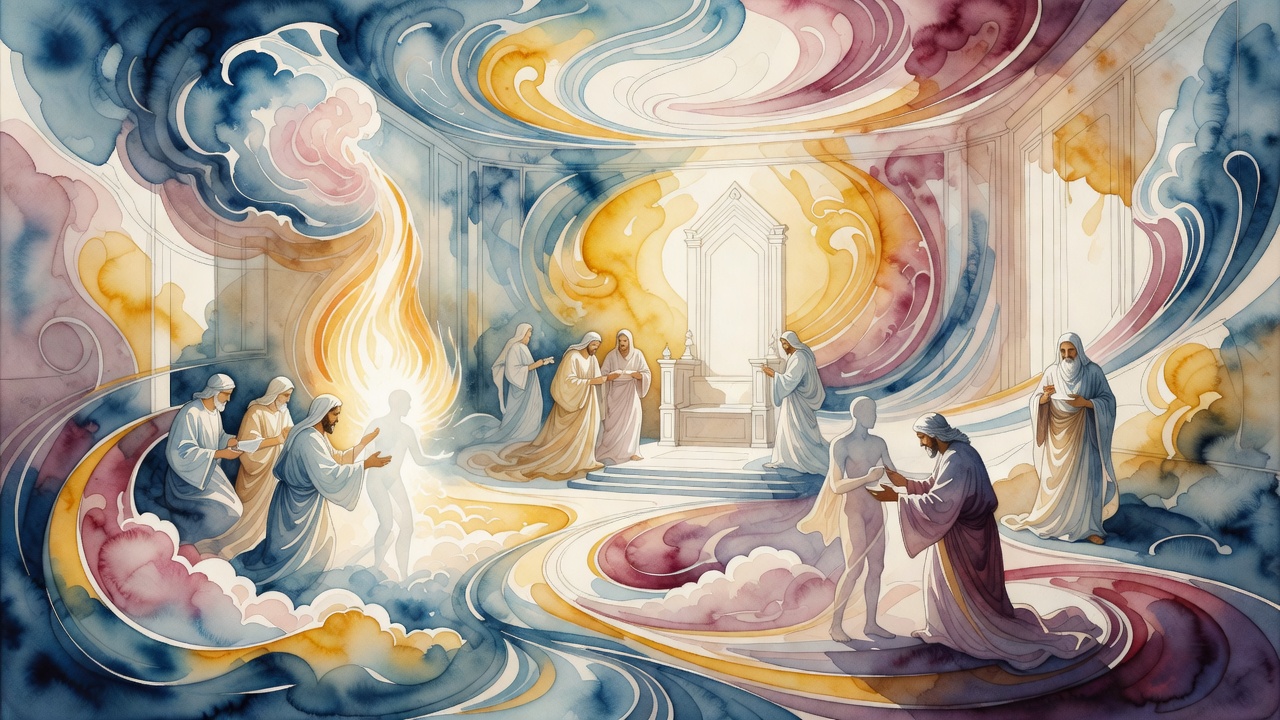
A man of Beit Shammai stood up on the bench and said that God does not build the same way twice. In this world a person begins as skin and flesh, and the sinews and bones come last, driven in like a frame raised inside finished walls. In the world to come the order reverses. Bones first, skin thrown over them at the end.
He had a witness. Ezekiel had walked into a valley of scattered bones and counted the stages out loud as they assembled: "there were sinews upon them, and flesh grew, and skin covered them from above, but there was no spirit in them" (Ezekiel 37:8).
Rabbi Hiyya bar Abba answered from the side of the room. He did not argue with the prophet, only with what the prophet had been watching. Those bodies were not being built, he said. They were being dressed. "Picture a man walking into a bathhouse. What he takes off last, he puts on first when he comes out."
Beit Shammai kept the prophet and lost the proof.
The Verbs Job Left Standing in the Future
Then Beit Hillel answered with a smaller claim, harder to knock over. God builds the same way twice. Skin and flesh first, sinews and bones last, in this world and the next.
Their witness was Job on the ash heap, scraping himself with a shard, arguing with his maker about the terms of his own manufacture. "Please, remember that You have fashioned me like clay," Job said (Job 10:9). Then his grammar slipped. He did not say hitakhtani, You poured me out like milk. He said tatikheni. You will pour me out like milk. You will curdle me like cheese, clothe me with skin and flesh, cover me with bones and sinews (Job 10:10-11), every verb pointing forward into a time that had not arrived.
A man cursing the day he was born had described his own second assembly.
Doors and Keys and Hinges on a Locked Room
What they were arguing about sat behind a door none of them could open.
A woman's body fills with blood, and the blood keeps one road out and takes it every month. Then, by the will of the Holy One, one refined drop falls into it, and the building begins. Milk in a bowl stays loose until somebody stirs in rennet. Then it sets and will not go back. No barber cuts his own hair, said Rabbi Avin.
Rabbi Eliezer, Rabbi Yehoshua, and Rabbi Akiva stood over the locked room and each reached for a different part of the house. Doors, said Rabbi Eliezer: "For it did not shut the doors of my belly" (Job 3:10). Keys, said Rabbi Yehoshua, and nobody inside can turn them, since "God remembered Rachel, and God heeded her, and He opened her womb" (Genesis 30:22). Rabbi Akiva went down to the iron. A house swings on hinges, tzirim (צירים), and the same word comes out of a woman when the child turns: "She crouched and gave birth, as her pangs of labor overcame her" (I Samuel 4:19).
Around the thing being made God hung a cloud for a garment and fog for swaddling. Three months of narrow limits, three months of a bar across the door, three months of a voice on the far side saying, "You shall come this far and not continue" (Job 38:11). The sea took that sentence when it burst out of the womb of the world, and the child shoulders the same bar with the same arrogance.
The Child Arrives Covered and Is Kissed Anyway
Then the doors give.
What comes through is smeared with blood and every foul thing a body carries. Rabbi Aivu turned the word in the verse over. Not the foam of your waves. The filth of your waves, and the filth is what they are proud of. They wipe it and wrap it and kiss it, and they kiss it hardest if it is a boy.
Rabbi Abahu added the part nobody had said out loud. The Holy One did the woman a kindness by starting with skin, because had He begun with sinews and bones, the frame would have torn through her belly and come out ahead of the child. She screams as it is. In the world coming she will not, since Isaiah saw a woman deliver before her first pang (Isaiah 66:7).
A Land Deeded to Men Already Buried
The argument had started over bones. It ended over a deed.
On the far side of the Jordan, Moses laid the land out for a generation that would cross without him, and he did not say the country God swore to your fathers to give to you. He said to give to them. To Abraham, Isaac, and Jacob, lying in a cave at Hebron, who had crossed that country as strangers and owned no part of it but their own graves.
A promise worded that way cannot be closed out by dirt. If the land goes to them it goes into their hands, and hands need bodies, and the bodies are underground with the pieces already cut and lying together. The builder who raises a person out of one drop behind a bolted door has the easier job in a grave.
When the fathers come up out of that field, their faces will not be the faces they went down with. Seven lights wait for the righteous who come before the Shechinah (שכינה), the divine presence: the sun at full strength, the moon, the brightness of the firmament (Daniel 12:3), stars, lightning, lilies, and an olive tree still green when the orchard has gone bare.
At Hebron the field lies quiet. The deed on it names men who cannot yet sign for it, and the ground packed over them is one more bar across one more door.
← All myths