6 min read

The Second Temple Fell After One Cruel Feast

A mistaken invitation, a public humiliation, and a room of silent sages set Jerusalem on the road to fire, siege, and ruin.

Curated by Arthur · Told by Maggid ·
Table of Contents
  1. The Wrong Man Took a Seat
  2. The Sages Let Shame Stand
  3. The Blemish Became a Trap
  4. Nero Read the Arrows
  5. The Storehouses Burned From Within
  6. One Feast Reached the Temple

The servant brought the wrong enemy to dinner.
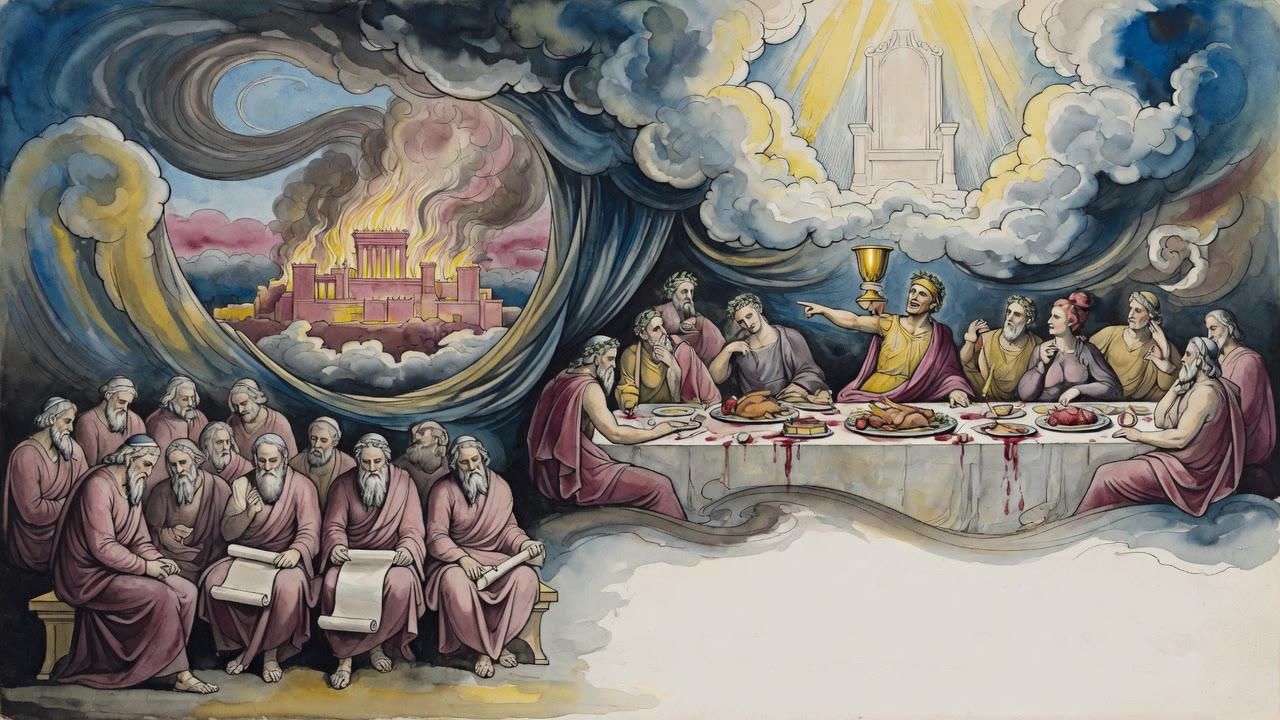
A wealthy man in Jerusalem had prepared a feast, the kind with lamps bright enough to make every cup shine and couches arranged for people who expected honor. He wanted his friend Kamtza at the table. The servant heard the name and fetched Bar Kamtza instead, the man his master hated.

Bar Kamtza walked into the room and found, for a brief foolish moment, a world repaired. Perhaps the invitation meant the quarrel had ended. Perhaps the host had softened. Perhaps old enemies could sit under one roof in Jerusalem and let food do what arguments could not.

Then the host saw him.

The Wrong Man Took a Seat

The room tightened before anyone moved. Guests looked down at their plates. The sages sat among them, men whose words carried weight in courts, study houses, and homes. Bar Kamtza had not stormed the feast. He had been invited by mistake, dressed for peace, and placed in public view.

The host ordered him out.

Bar Kamtza did not answer with rage. He tried to buy a corner of dignity. "Let me stay," he pleaded, "and I will pay for what I eat and drink." The host refused. Bar Kamtza raised the price. "I will pay for half the feast." No. "I will pay for all of it. Only do not shame me in front of everyone."

Money could not purchase mercy from a man who wanted humiliation more than reimbursement. The host took Bar Kamtza by the hand, stood him up before the city's honored guests, and threw him into the street.

The Sages Let Shame Stand

Outside, Bar Kamtza counted the faces he had just left behind. The host hated him. That was old news. Hatred can be endured when it is honest about itself. The sharper blade was the silence of the sages.

They had heard the offers and watched a man beg not to be disgraced in public. Not one rose. Not one said, enough.

In that silence, Bar Kamtza built his verdict. If the rabbis sat there and did nothing, they approved. His shame hardened into revenge.

He went to the Roman emperor and spoke the sentence that turns private cruelty into public disaster: "the Jews are rebelling against you."

The emperor asked for proof. Bar Kamtza knew how to make one. "Send an offering to their Temple," he said, "and see whether they accept it."

The Blemish Became a Trap

The imperial animal traveled toward Jerusalem as a test disguised as piety. Bar Kamtza walked beside it long enough to wound it where Roman eyes would not care and priestly eyes could not ignore. A blemish at the lip. A mark at the eye. Small enough for politics. Fatal enough for the altar.

Jerusalem now faced a trap with fire inside it. Refuse the offering, and Rome would hear rebellion. Accept the offering, and the Temple service would be bent around fear. Some argued that danger to life required the sacrifice to be offered anyway. Others feared what would happen if a blemished animal entered the altar's order.

Then came another terrible hesitation. Bar Kamtza had made himself dangerous. Some wanted him killed before he could carry the story back.

The decision stalled under law, fear, and misread mercy. Bar Kamtza lived. The offering was refused. The accusation reached its mark.

A feast had become a file in the court of empire.

Nero Read the Arrows

Rome sent Nero toward Jerusalem, and the city seemed already marked before his soldiers struck it. He shot arrows to the east, west, north, and south. Each fell toward Jerusalem. The air itself appeared to point at the city.

Nero stopped a child and asked for the verse learned that day. The child recited words from Ezekiel: God would place vengeance upon Edom by the hand of Israel. Nero heard more than a school lesson. He heard a sentence against Rome after Rome had served its purpose.

He understood the danger of being heaven's instrument. A hammer is not innocent because a hand swings it. Nero fled. Vespasian came next. Jerusalem closed its gates.

Inside the walls, rage did not become courage. It became hunger.

The Storehouses Burned From Within

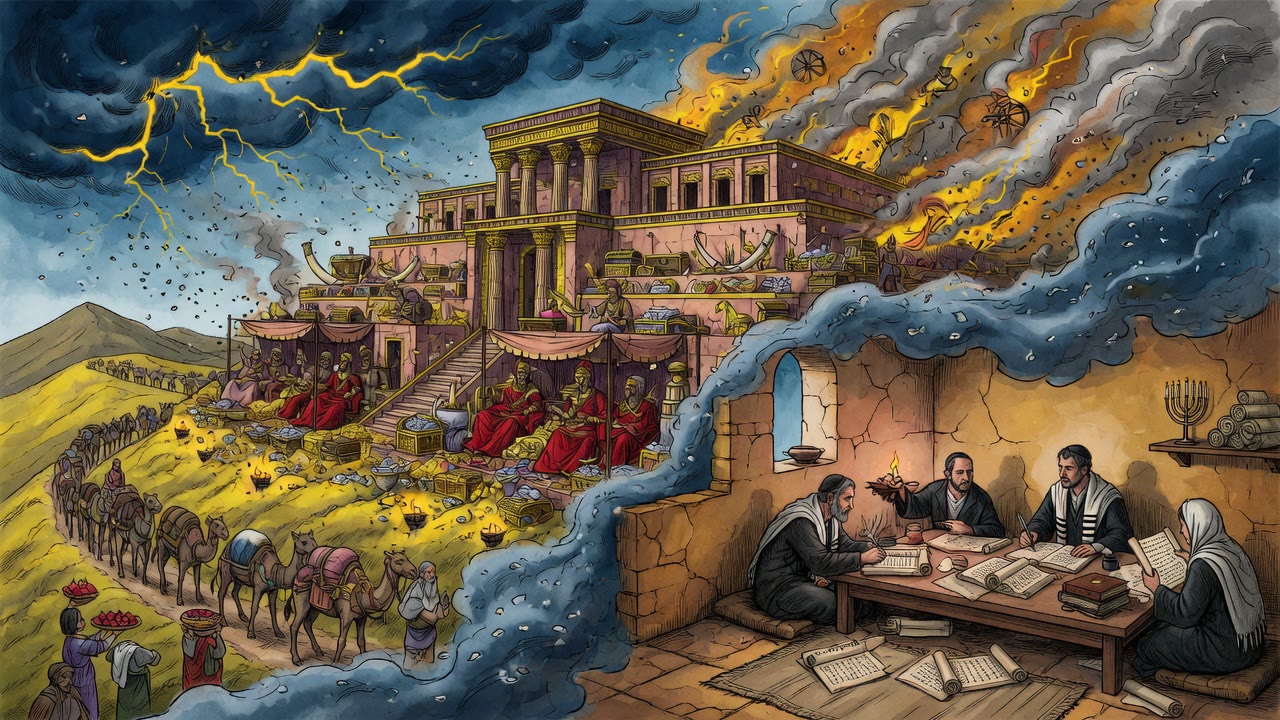
The city had food enough to last. That should have mattered. Grain and supplies sat in storehouses, the difference between endurance and panic. Zealots burned them to force the people into war. If no bread remained, no one could choose surrender.

Smoke rose from salvation.

Rabban Yohanan ben Zakkai walked through the streets and saw what the city had become. People boiled straw in water and drank it to stay alive. Rome stood outside the walls, but the famine had been invited in by Jewish hands. The old feast returned in a darker form: once again, someone else's body paid for another man's certainty.

Yohanan went to his nephew Ben Batiach, one of the men with power among the zealots, and asked to leave the city. "No living body could pass through the gates," Ben Batiach told him.

"Then take me out as a corpse."

Students placed their teacher in a coffin and carried him toward the gate. Guards wanted to pierce the body to prove death. They wanted to shove it, strike it, test it. The plan survived by a thread. The coffin passed out of Jerusalem while the city behind it kept starving.

One Feast Reached the Temple

From outside the walls, Yohanan would face Rome and ask for Yavneh and its sages. Not Jerusalem. Not the Temple. A seed. A place where Torah could breathe after the stones fell.

The fire did come. The Second Temple, standing at the center of Jewish service until 70 CE, was destroyed while the city tore itself apart under siege. Rome delivered the blow, but the old wound in the tale had opened earlier, in a banquet hall where one man begged not to be shamed and learned that a room full of honored people could become furniture.

Baseless hatred, sinat chinam, did not need to begin with armies. It began with a host who preferred cruelty to peace, a humiliated guest who chose revenge over restraint, and sages whose silence let shame stand in public like a verdict.

The servant had brought the wrong man to dinner. By the end, everyone in Jerusalem was seated at the table.


← All myths
From the tradition

Sources

4 sources

The texts this telling draws on, in full. Open a card to read inline, or expand it for a wider, quieter read.

Gittin 55bTalmud Bavli, Gittin

And what is the reason that the Sages said that if it is known that the sin-offering was obtained through robbery, it does not effect atonement? It is so that people not say that the altar consumes stolen property. The Gemara attempts to clarify the two explanations. Granted, according to the opinion of Ulla, that the concern stems from the fact that the priests will be distraught, this is the reason that the tanna teaches the halakha with regard to a sin-offering: The priests partake of the meat of a sin-offering.

If they find out that they ate an animal that was forbidden to them, i.e., an offering slaughtered counter to halakha, they are likely to become distraught. But according to the opinion of Rav Yehuda, that the concern is about the honor of the altar, why does the mishna mention specifically the case of a sin-offering; shouldn’t the same concern apply to a burnt-offering, as well, as it too is burned on the altar?

The Gemara answers: The mishna is speaking utilizing the style of: It is not necessary, and the mishna should be understood as follows: It is not necessary to teach the halakha in the case of a burnt-offering, which is entirely consumed on the altar. In that case, people will certainly say that the altar consumes stolen property. But even in the case of a sin-offering, where only the fat and the blood go up to be consumed on the altar and the rest is consumed by the priests, even so they issued a decree and said that the stolen sin-offering does not effect atonement, so that people should not say that the altar consumes stolen property.

The Gemara further clarifies the two understandings: We learned in the mishna: Rabbi Yoḥanan ben Gudgeda testified about a sin-offering that had been obtained through robbery but that is not publicly known to have been obtained in that manner, and said that it effects atonement for the robber who sacrifices it, for the benefit of the altar. Granted, according to the opinion of Ulla, it works out well, as he understands that the Sages instituted that if it was not publicly known that the sin-offering was obtained through robbery, it does effect atonement.

But according to the opinion of Rav Yehuda, it should have stated just the opposite, namely, that if it was publicly known that the sin-offering was obtained through robbery, it does not effect atonement. The Gemara answers: That is also what the mishna is saying: If it is not known that the sin-offering was obtained through robbery, it effects atonement, but if this is known, it does not effect atonement, for the benefit of the altar.

Rava raises an objection from what was learned in a mishna (Bava Kamma 74a): If one stole an animal and consecrated it, and afterward he slaughtered or sold it, he pays double payment like a thief (see Exodus 22:3), but he does not pay fourfold or fivefold payment, as one must ordinarily pay when he slaughters or sells an ox or a sheep that he stole from another person (Exodus 21:37). And it is taught in a baraita with regard to this mishna: If one slaughtered an animal outside the Temple in a case like this, he is punishable by karet for having sacrificed an offering outside the Temple.

And if you say that the owner’s despair of recovering an item that was stolen from him does not by itself enable the thief to acquire the stolen item, what is the relevance of mentioning karet? The punishment of karet should not apply, as the thief cannot consecrate an animal that does not belong to him. Rav Sheizevi said: This means that he is liable to receive karet by rabbinic law. Those who heard this laughed at him.

Is there such a thing as karet by rabbinic law? Rava said to them: A great man has spoken, do not laugh at him. What Rav Sheizevi means is karet that comes to him through the words of the Sages, who declared that the thief’s consecration is valid. It is the Sages who placed the animal in his possession, so that he would become liable for it.

Rava said: Although I agree with Rav Sheizevi, this matter is certainly a dilemma for me. When the Sages placed the animal in his possession, did they do so from the time of the theft or from the time of the consecration? What is the difference between these possibilities? There is a difference with regard to its wool and with regard to its offspring.

If the animal was placed in his possession from the time of the theft, the wool that it grows and the offspring that it births are his, and he is not required to return them to the animal’s owner. But if the animal becomes his only when he consecrates it, he is required to return them. What is the halakha? Rava then said, in answer to his own question: It stands to reason that the Sages placed the animal in his possession from the time of the consecration.

This is so that the sinner not profit from his crime. Otherwise, the thief would benefit from the rabbinic decree that was instituted to increase his liability. MISHNA: The law of Sicarii [Sikarikon] did not apply in Judea in the time that people were being killed in the war. From the time that people were being killed in the war and onward, the law of Sicarii did apply there.

What is this law of Sicarii? If one first purchased land from a Sicarius, who extorted the field from its prior owners with threats, and afterward the buyer returned and purchased the same field a second time from the prior landowner, his purchase is void. The prior owner of the field can say that he did not actually mean to sell him the field. By contrast, if he first acquired the field from the prior owner and afterward he returned and purchased the same field from a Sicarius, his purchase stands.

Similarly, if one first purchased from the husband the rights to use a field belonging to his wife, and afterward he returned and purchased the same field from the wife, so that if the husband were to predecease or divorce her, the purchaser would then own it fully, his purchase is void. The woman can claim that she did not wish to quarrel with her husband and to object to the transaction but that in truth she did not agree to the sale.

By contrast, if he first acquired the field from the wife, and afterward he returned and purchased the same field from the husband, his purchase stands. This is the initial version of this mishna. Later, the court of those who came after the Sages who composed that mishna said: With regard to one who purchased a field from a Sicarius, he must give the prior owner one-fourth of the field’s value. When does this apply?

At a time when the prior owner is unable to purchase the field himself. But if he is able to purchase it himself, he precedes anyone else. Rabbi Yehuda HaNasi later convened a court, and they counted their votes and determined that if the field remained before, i.e., in the possession of, the Sicarius for twelve months, whoever first purchases the field acquires possession of it, but he must give the prior owner one-fourth of the field’s value.

GEMARA: The Gemara challenges the mishna’s assertion that the law of Sicarii did not apply in Judea in the time that people were being killed in the war: Now if in the time that people were being killed in the war, there were no Sicarii stealing land, is it possible that from the time that people were being killed in the war and onward there were Sicarii? Rav Yehuda said: The mishna is saying that in the time that people were being killed in the war they did not apply the law of Sicarii, but rather they would confirm the purchases of land made from the Sicarii.

The reason for this is in accordance with what Rabbi Asi said: The gentile authorities issued three decrees during and in the aftermath of the war that ended in the destruction of the Temple. The first decree was that anyone who does not kill a Jew should himself be killed. The second decree was that anyone who kills a Jew should pay four dinars as a fine. The last decree was that anyone who kills a Jew should himself be killed.

Therefore, during the time of the first and second decrees, the time when people were being killed in the war, since the gentile would kill Jews, then the owner of the field, owing to the danger posed to his life, would fully transfer ownership of his field to the Sicarius. Then, during the time of the last decree, after the time when people were being killed in the war, anybody whose field was stolen by a Sicarius would say to himself: Now let him take the field; tomorrow I will claim it from him in court.

Although the gentile had the advantage and could force the owner to give him the field, the assumption is that the owner did not fully transfer possession of the field to him, as he thought that he would still be able to recover it in court. § Apropos the war that led to the destruction of the Second Temple, the Gemara examines several aspects of the destruction of that Temple in greater detail: Rabbi Yoḥanan said: What is the meaning of that which is written: “Happy is the man who fears always, but he who hardens his heart shall fall into mischief” (Proverbs 28:14)?

Jerusalem was destroyed on account of Kamtza and bar Kamtza. The place known as the King’s Mountain was destroyed on account of a rooster and a hen. The city of Beitar was destroyed on account of a shaft from a chariot [rispak]. The Gemara explains: Jerusalem was destroyed on account of Kamtza and bar Kamtza.

This is as there was a certain man whose friend was named Kamtza and whose enemy was named bar Kamtza. He once made a large feast and said to his servant: Go bring me my friend Kamtza. The servant went and mistakenly brought him his enemy bar Kamtza. The man who was hosting the feast came and found bar Kamtza sitting at the feast.

The host said to bar Kamtza. That man is the enemy [ba’al devava] of that man, that is, you are my enemy. What then do you want here? Arise and leave.

Bar Kamtza said to him: Since I have already come, let me stay and I will give you money for whatever I eat and drink. Just do not embarrass me by sending me out.

Full source
Talmud, Gittin 55bHebraic Literature (1901)

A man in Jerusalem held a grand banquet. He had a friend named Kamtza and an enemy named Bar Kamtza. He sent his servant to invite Kamtza. The servant, confused by the similar names, invited Bar Kamtza instead.

Bar Kamtza arrived in good faith. The host looked up from his table, saw his enemy walking in, and ordered him out in front of every guest.

"Now that I am here," Bar Kamtza said, quietly, "do not insult me. I will pay for whatever I eat and drink."

"I want neither your money nor your presence. Leave."

"I will pay the entire expense of your feast. Only do not shame me in front of these guests."

The host refused. Bar Kamtza was thrown out.

As he walked into the street, Bar Kamtza did a dangerous thing. He counted the Rabbis who had been sitting at that table, watching in silence. "Many sages were present," he thought, "and not one rose to defend me. This humiliation must have pleased them."

That private grievance became a public disaster. Bar Kamtza went to the Roman emperor and whispered that the Jews had rebelled. The emperor was skeptical. "How can I know?" Send a sacrifice to their Temple, Bar Kamtza said. See whether they accept it.

The emperor dispatched a perfect calf. On the road, Bar Kamtza secretly inflicted a small blemish, a scratch invisible to Roman eyes but fatal to the priestly inspection. At the Temple, the animal was rejected.

The Rabbis debated whether to sacrifice it anyway, to preserve peace with Rome. They decided not to. Rome took the rejection as proof of rebellion. The Second Temple fell.

Gittin 55b remembers: Jerusalem was destroyed because of the distance between Kamtza and Bar Kamtza, the shame at one dinner table that no one stood up to stop.

Full source
Gittin 56aTalmud Bavli, Gittin

The host said to him: No, you must leave. Bar Kamtza said to him: I will give you money for half of the feast; just do not send me away. The host said to him: No, you must leave. Bar Kamtza then said to him: I will give you money for the entire feast; just let me stay.

The host said to him: No, you must leave. Finally, the host took bar Kamtza by his hand, stood him up, and took him out. After having been cast out from the feast, bar Kamtza said to himself: Since the Sages were sitting there and did not protest the actions of the host, although they saw how he humiliated me, learn from it that they were content with what he did. I will therefore go and inform [eikhul kurtza] against them to the king.

He went and said to the emperor: The Jews have rebelled against you. The emperor said to him: Who says that this is the case? Bar Kamtza said to him: Go and test them; send them an offering to be brought in honor of the government, and see whether they will sacrifice it. The emperor went and sent with him a choice three-year-old calf.

While bar Kamtza was coming with the calf to the Temple, he made a blemish on the calf’s upper lip. And some say he made the blemish on its eyelids, a place where according to us, i.e., halakha, it is a blemish, but according to them, gentile rules for their offerings, it is not a blemish. Therefore, when bar Kamtza brought the animal to the Temple, the priests would not sacrifice it on the altar since it was blemished, but they also could not explain this satisfactorily to the gentile authorities, who did not consider it to be blemished.

The blemish notwithstanding, the Sages thought to sacrifice the animal as an offering due to the imperative to maintain peace with the government. Rabbi Zekharya ben Avkolas said to them: If the priests do that, people will say that blemished animals may be sacrificed as offerings on the altar. The Sages said: If we do not sacrifice it, then we must prevent bar Kamtza from reporting this to the emperor.

The Sages thought to kill him so that he would not go and speak against them. Rabbi Zekharya said to them: If you kill him, people will say that one who makes a blemish on sacrificial animals is to be killed. As a result, they did nothing, bar Kamtza’s slander was accepted by the authorities, and consequently the war between the Jews and the Romans began. Rabbi Yoḥanan says: The excessive humility of Rabbi Zekharya ben Avkolas destroyed our Temple, burned our Sanctuary, and exiled us from our land.

The Roman authorities then sent Nero Caesar against the Jews. When he came to Jerusalem, he wished to test his fate. He shot an arrow to the east and the arrow came and fell in Jerusalem. He then shot another arrow to the west and it also fell in Jerusalem.

He shot an arrow in all four directions of the heavens, and each time the arrow fell in Jerusalem. Nero then conducted another test: He said to a child: Tell me a verse that you learned today. He said to him as follows: “And I will lay My vengeance upon Edom by the hand of My people Israel” (Ezekiel 25:14). Nero said: The Holy One, Blessed be He, wishes to destroy His Temple, and He wishes to wipe his hands with that man, i.e., with me.

The Romans are associated with Edom, the descendants of Esau. If I continue on this mission, I will eventually be punished for having served as God’s agent to bring about the destruction. So he fled and became a convert, and ultimately Rabbi Meir descended from him. The Roman authorities then sent Vespasian Caesar against the Jews.

He came and laid siege to Jerusalem for three years. There were at that time in Jerusalem these three wealthy people: Nakdimon ben Guryon, ben Kalba Savua, and ben Tzitzit HaKesat. The Gemara explains their names: Nakdimon ben Guryon was called by that name because the sun shined [nakad] on his behalf, as it is related elsewhere (see Ta’anit 19b) that the sun once continued to shine in order to prevent him from suffering a substantial loss.

Ben Kalba Savua was called this because anyone who entered his house when he was hungry as a dog [kelev] would leave satiated [save’a]. Ben Tzitzit HaKesat was referred to by that name because his ritual fringes [tzitzit] dragged along on blankets [keset], meaning that he would not walk in the street with his feet on the ground, but rather they would place blankets beneath him. There are those who say that his seat [kiseh] was found among the nobles of Rome, meaning that he would sit among them.

These three wealthy people offered their assistance. One of them said to the leaders of the city: I will feed the residents with wheat and barley. And one of them said to leaders of the city: I will provide the residents with wine, salt, and oil. And one of them said to the leaders of the city: I will supply the residents with wood.

The Gemara comments: And the Sages gave special praise to he who gave the wood, since this was an especially expensive gift. As Rav Ḥisda would give all of the keys [aklidei] to his servant, except for the key to his shed for storing wood, which he deemed the most important of them all. As Rav Ḥisda said: One storehouse [akhleva] of wheat requires sixty storehouses of wood for cooking and baking fuel.

These three wealthy men had between them enough commodities to sustain the besieged for twenty-one years. There were certain zealots among the people of Jerusalem. The Sages said to them: Let us go out and make peace with the Romans. But the zealots did not allow them to do this.

The zealots said to the Sages: Let us go out and engage in battle against the Romans. But the Sages said to them: You will not be successful. It would be better for you to wait until the siege is broken. In order to force the residents of the city to engage in battle, the zealots arose and burned down these storehouses [ambarei] of wheat and barley, and there was a general famine.

With regard to this famine it is related that Marta bat Baitos was one of the wealthy women of Jerusalem. She sent out her agent and said to him: Go bring me fine flour [semida]. By the time he went, the fine flour was already sold. He came and said to her: There is no fine flour, but there is ordinary flour.

She said to him: Go then and bring me ordinary flour. By the time he went, the ordinary flour was also sold. He came and said to her: There is no ordinary flour, but there is coarse flour [gushkera]. She said to him: Go then and bring me coarse flour.

By the time he went, the coarse flour was already sold. He came and said to her: There is no coarse flour, but there is barley flour. She said to him: Go then and bring me barley flour. But once again, by the time he went, the barley flour was also sold.

She had just removed her shoes, but she said: I will go out myself and see if I can find something to eat. She stepped on some dung, which stuck to her foot, and, overcome by disgust, she died. Rabban Yoḥanan ben Zakkai read concerning her a verse found in the section of the Torah listing the curses that will befall Israel: “The tender and delicate woman among you who would not adventure to set the sole of her foot upon the ground” (Deuteronomy 28:56).

There are those who say that she did not step on dung, but rather she ate a fig of Rabbi Tzadok, and became disgusted and died. What are these figs? Rabbi Tzadok observed fasts for forty years, praying that Jerusalem would not be destroyed. He became so emaciated from fasting that when he would eat something it was visible from the outside of his body.

And when he would eat after a fast they would bring him figs and he would suck out their liquid and cast the rest away. It was one such fig that Marta bat Baitos found and that caused her death. It is further related that as she was dying, she took out all of her gold and silver and threw it in the marketplace. She said: Why do I need this?

And this is as it is written: “They shall cast their silver in the streets and their gold shall be as an impure thing; their silver and their gold shall not be able to deliver them in the day of the wrath of the Lord; they shall not satisfy their souls, neither fill their bowels” (Ezekiel 7:19). § The Gemara relates: Abba Sikkara was the leader of the zealots [biryonei] of Jerusalem and the son of the sister of Rabban Yoḥanan ben Zakkai.

Rabban Yoḥanan ben Zakkai sent a message to him: Come to me in secret. He came, and Rabban Yoḥanan ben Zakkai said to him: Until when will you do this and kill everyone through starvation? Abba Sikkara said to him: What can I do, for if I say something to them they will kill me. Rabban Yoḥanan ben Zakkai said to him: Show me a method so that I will be able to leave the city, and it is possible that through this there will be some small salvation.

Abba Sikkara said to him: This is what you should do: Pretend to be sick, and have everyone come and ask about your welfare, so that word will spread about your ailing condition. Afterward bring something putrid and place it near you, so that people will say that you have died and are decomposing. And then, have your students enter to bring you to burial, and let no one else come in so that the zealots not notice that you are still light.

As the zealots know that a living person is lighter than a dead person. Rabban Yoḥanan ben Zakkai did this. Rabbi Eliezer entered from one side and Rabbi Yehoshua from the other side to take him out. When they arrived at the entrance of the city on the inside, the guards, who were of the faction of the zealots, wanted to pierce him with their swords in order to ascertain that he was actually dead, as was the common practice.

Abba Sikkara said to them: The Romans will say that they pierce even their teacher. The guards then wanted at least to push him to see whether he was still alive, in which case he would cry out on account of the pushing. Abba Sikkara said to them: They will say that they push even their teacher. The guards then opened the gate and he was taken out.

When Rabban Yoḥanan ben Zakkai reached there, i.e., the Roman camp, he said: Greetings to you, the king; greetings to you, the king. Vespasian said to him: You are liable for two death penalties, one because I am not a king and yet you call me king, and furthermore, if I am a king, why didn’t you come to me until now? Rabban Yoḥanan ben Zakkai said to him: As for what you said about yourself: I am not a king,

Full source
Hebraic Literature (1901), Midrashim, cf. Gittin 56aHebraic Literature (1901)

During the Roman siege of Jerusalem in 70 CE, the storehouses had been burned by Jewish zealots to force the city to fight. Rabbi Yochanan ben Zakkai, walking through the streets afterward, saw the people of Jerusalem boiling straw in water and drinking it to stay alive.

"Woe is me for this calamity," he cried. "How can such a people, eating straw, strive against the might of Rome?"

He went to his nephew Ben Batiach, one of the chief zealots in the city, and asked permission to leave. Ben Batiach refused. "No living body may pass through the gates."

Yochanan answered without blinking. "Then take me out as a corpse."

Ben Batiach hesitated, and agreed. Two of Yochanan's students, Rabbi Eliezer and Rabbi Yehoshua, laid him in a coffin, sealed the lid, and carried him out of Jerusalem on their shoulders. At the gate, the guards, under orders to prevent any living Jew from escaping, demanded to pierce the body with a spear to confirm the death. Ben Batiach had sent word ahead forbidding it, out of respect for the corpse. The coffin passed through.

Yochanan was carried straight to the camp of the Roman general Vespasian. The Talmud (Gittin 56a) records what happened next. Yochanan greeted Vespasian as emperor before he was emperor. A messenger arrived from Rome confirming the prophecy mid-conversation. Vespasian, stunned, granted Yochanan three requests. Yochanan did not ask for Jerusalem. He did not ask for the Temple. He asked: "Give me the academy at Yavneh and its sages. Spare the dynasty of Rabban Gamliel. And send a physician for Rabbi Tzadok, who has fasted for forty years."

Every one of those requests, preserved in the 1901 anthology Hebraic Literature, outlasted the siege. Jerusalem fell. The Temple burned. But the academy at Yavneh lived. The Mishnah was compiled there. Without that coffin, the rabbinic tradition we still read would have been consumed by the fire. One man, one clever stretcher, one short list of requests. And Jewish civilization bent around the ruin and kept walking.

Full source