5 min read

The Serpent Hunted Moses Across Creation

The serpent asked tree, mountain, and desert for Moses son of Amram. Each answered with the last work Moses had done to them, then fell silent.

Curated by Arthur · Told by Maggid ·
Table of Contents
  1. Mountains That Remembered the Tablets
  2. Deserts That Missed Their Shepherd
  3. Why the Search Failed
  4. The Son of Amram Beyond the Reach of Venom

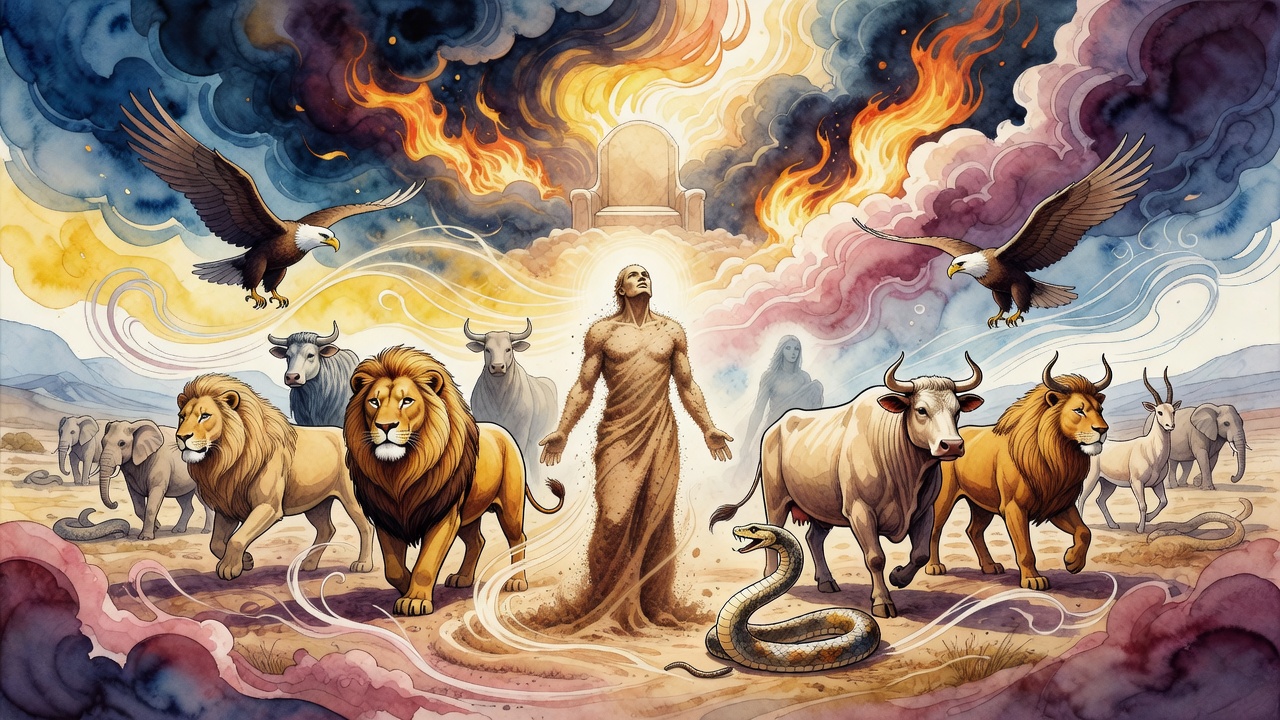
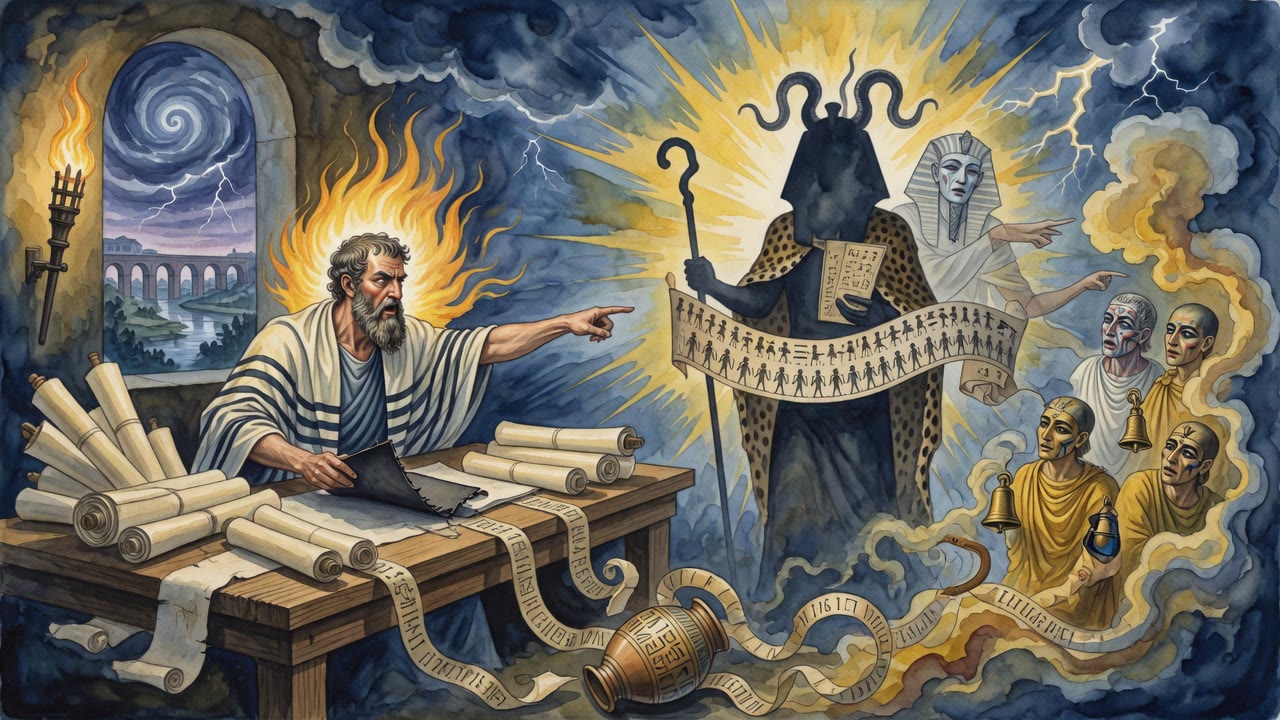
The serpent slid to the Tree of Knowledge with a question that still dripped venom. "Hast thou seen the son of Amram?" He wanted Moses. He wanted the man who had taken a reed from living wood to write Torah, the man whose staff had once been a snake in Pharaoh's court and then a rod again in a prophet's hand.

The Serpent Hunted Moses Across Creation Click for full size

The tree did not help him. "Since the day on which he came to me to get a writing reed, wherewith to write the Torah, I have not seen him." Respect lived even in a tree with a history of deception. Moses had borrowed a tool and left. The serpent tasted old bark and found no trail of blood.

Mountains That Remembered the Tablets

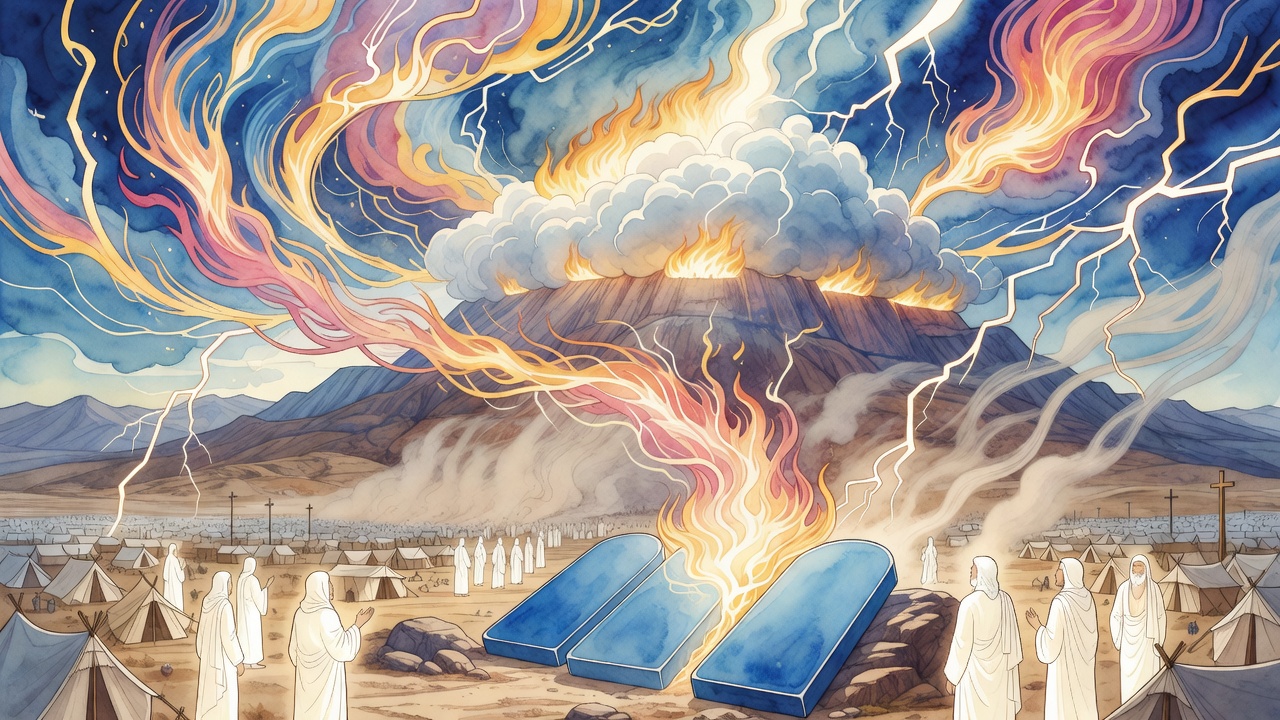
He turned to the mountains, ancient and silent. "Have you seen the son of Amram?" The peaks answered with the last mark Moses had cut into them. "Since he hewed the two tables out of us, we have not seen him."

The luchot, the tablets of the covenant, had come from their stone. The Ten Commandments had left wounds that the mountains wore as honor. They would not guide a hunter to the man who had carved law out of their ribs. Chips of old cutting still lay in high crevices like mute witnesses.

The serpent hissed and moved on. Creation was closing ranks. Every place Moses had touched remembered the work more than the man's present location. The world had become a series of locked doors labeled with completed tasks. Venom is useless against a door that only opens for finished holiness.

Deserts That Missed Their Shepherd

He entered the deserts where Israel had wandered forty years. "Have ye seen the son of Amram?" The sands replied, "Since he has ceased to lead Israel to pasture upon us, we have not seen him."

They spoke of him as a shepherd, not as a tyrant. He had led a flock through waterless miles, fought enemies, protected families, and refused to turn authority into a private throne. That is how later memory, including Josephus writing for Rome, would defend him. Moses persuaded himself and the people that he acted under God's will. He did not invent a kingdom of Moses. He spent himself on a hard road.

The desert missed the man who had pastured a nation on its back. The serpent found only absence shaped like praise. Wind moved over dunes that still held the shape of old encampments and offered the snake no trail of flesh. Where tents had stood, only heat remained, and heat does not answer venom with coordinates.

Why the Search Failed

To speak against Moses had always been to speak against God. The people once joined the two targets in one bitter sentence in the wilderness (Numbers 21:5). Faith in the faithful shepherd is faith in the Creator. Rebellion against the shepherd is rebellion against the One who spoke the world into being. There is no neutral strip of sand where a mouth may curse the prophet and keep clean hands toward Heaven.

The serpent's hunt sits on that same seam. He is not looking for a private rival. He is looking for the human channel of Torah, the son of Amram who took a reed, cut tablets, and shepherded a people until the desert itself learned his schedule.

Tree, mountain, and waste would not sell him. Each answered with the last holy use Moses had made of them, then closed. The search becomes a map of Moses' work rather than a path to Moses' body. The more the serpent asks, the more creation recites a resume.

The Son of Amram Beyond the Reach of Venom

Moses had walked a waterless, sandy country as general, counselor, and servant. He did not pocket the journey for himself. That is why creation answers the serpent with completed labor instead of coordinates. The reed is gone from the tree because Torah is written. The stone is gone from the mountain because the tablets were hewn. The flock is gone from the desert because the pasture years have ended.

The serpent coils in places that still smell of those acts and finds no throat to strike. Moses is not hiding in a cave of cowardice. He is simply finished with the stages the snake can reach. Law has been cut. The flock has been led. The reed has done its work. A life spent under divine conviction leaves few loose ends for old enemies to pull.

Venom asks again into empty air. Creation keeps its silence. The son of Amram remains the man who borrowed the world for God's errands and returned each piece marked with purpose the serpent cannot undo. Tree, peak, and waste hold the memory. They will not hold the man for a bite.


← All myths
From the tradition

Sources

3 sources

The texts behind this telling. Some cards carry a translation of the source; others are our own retelling of it, and each card says which. Every card links out to the original.

Legends of the Jews 7:80Legends of the Jews

Retold in our words. Read the original at the link below.The Legends of the Jews by Louis Ginzberg (1909) · Public Domain

Legends of the Jews turns to The Serpent Searches Creation for Moses Son of Amram.

So, where does he begin his search? He starts with the tree of knowledge. Remember that tree? The one that bore the fruit of the knowledge of good and evil? He figures, surely, this ancient being must have seen MOSES.

"Hast thou seen the son of Amram?" he asks, dripping with venom, no doubt.

The tree replies, "Since the day on which he came to me to get a writing reed, wherewith to write the Torah, I have not seen him."

Wow. Even the Tree of Knowledge acknowledges MOSES' importance. He needed a reed from it to write the Torah! And the tree, despite its own history with deception, offers no help to the serpent. It's almost… respectful.

Undeterred, or perhaps even more agitated, the serpent turns to the mountains. Surely, they have witnessed the passage of this MOSES. These colossal, ancient formations, witnesses to millennia, must hold the answer.

"Have you seen the son of Amram?" he hisses at the silent peaks.

But the mountains echo the tree's response. "Since he hewed the two tables out of us, we have not seen him."

Again, the response is telling. The mountains acknowledge MOSES' profound impact. He carved the luchot (tablets) of the covenant from their very being! The tablets containing the Aseret haDibrot (Ten Commandments). Yet, they offer no further information, no clue to his whereabouts.

Finally, in desperation, the serpent slithers into the vast, unforgiving deserts. If anyone has seen MOSES, it would be the desert. The place where the Israelites wandered for forty years, led by none other than – you guessed it – MOSES.

"Have ye seen the son of Amram?" he demands of the shifting sands.

And the deserts reply, "Since he has ceased to lead Israel to pasture upon us, we have not seen him."

The desert's response is particularly poignant. It speaks of MOSES as a shepherd, a leader guiding his flock. He provided for them, even in the most desolate of places. And now, that presence is gone.

What are we to make of all this? The serpent's desperate search, the world's consistent, almost reverent, deflection? It highlights MOSES' unparalleled significance. He's not just a man; he's a force of nature, a figure whose actions resonate throughout creation. The tree, the mountains, the desert – they all bear witness to his impact, yet they guard his secret.

Perhaps the real lesson here is that true greatness, true righteousness, can't be found through malice or deceit. The serpent’s quest is doomed from the start, not because MOSES is hidden, but because the serpent’s very nature prevents him from understanding what he seeks.

Full source
Against Apion 16:1Against Apion

Retold in our words. Read the original at the link below.Against Apion, trans. William Whiston · Public Domain

Josephus wants to set the record straight about Moses. He argues that when our ancestors decided to leave Egypt and return to their homeland, it was Moses who led them, saving them from immense hardship. He emphasizes the sheer difficulty of this journey – traversing a waterless, sandy desert, battling enemies, and protecting families. In short, Moses had to be a brilliant general, a wise counselor, and a selfless leader.

Here's the thing: Moses didn't use his authority for personal gain. He didn't become a tyrant. Instead, he focused on piety and the well-being of the people. Because of his incredible actions and the wisdom he showed, the people saw him as a divine leader and counselor.

How did Moses manage to inspire such devotion? Josephus explains that Moses was convinced his actions aligned with God's will. As Josephus puts it, Moses "persuaded himself" that he was acting according to God's plan, which is to say he was deeply and utterly convinced he was doing God's work. He then instilled this belief in the people. He understood that if people believed God was watching them, they would be less likely to sin. Moses, Josephus insists, was no impostor. He was a true leader, comparable to the legendary figures of other cultures, like Minos, who claimed divine inspiration for their laws.

Of course, other cultures also claimed divine inspiration for their laws. Some Greeks said their laws came from Jupiter, while Minos claimed Apollo and the oracle at Delphi were the source of his. But Josephus challenges us: which laws were truly the best? Which leader had the strongest reason to believe God was their author? Comparing the laws themselves would reveal the truth, he implies.

Then Josephus gets to the heart of the matter: the nature of Jewish governance. He points out that other nations have monarchies, oligarchies, or republics. But the Jewish system, according to Josephus, was unique. He calls it a "Theocracy" – a government where authority and power are ascribed to God. In fact, Josephus says that Moses "ordained the Jewish government to be a theocracy." It was about persuading everyone to recognize God as the source of all good things, both communal and personal, obtained through prayer in times of trouble.

Moses taught that nothing escapes God's notice – not our actions, not even our thoughts. He presented God as unbegotten, immutable, and eternally beyond human comprehension, known through His power but not in His essence. These ideas, Josephus notes, resonate with the wisdom of the greatest Greek thinkers like Pythagoras, Anaxagoras, Plato, and the Stoics. However, these philosophers were hesitant to share these truths with the masses, who were attached to other beliefs. Moses, on the other hand, managed to ingrain this faith in God so deeply that it endured through generations.

Josephus concludes by highlighting that Moses didn't just make religion a part of virtue; he made other virtues – justice, fortitude, temperance, and communal harmony – parts of religion. Everything, every action, every word, was connected to piety toward God.

The key, says Josephus, is that there are two ways to learn morality: through instruction and through practice. Other lawgivers separated these two. Some, like the Spartans and Cretans, emphasized practice, while others, like the Athenians, focused on laws but neglected practical application. Moses, however, integrated both, creating a system where belief in God permeated every aspect of life.

What does all this mean for us today? Josephus reminds us that true leadership isn't about personal gain or power. It's about serving others, seeking God's will, and creating a society rooted in justice, compassion, and unwavering faith. It’s a powerful message, one that continues to resonate across the centuries.

Full source
Mekhilta Tractate Vayehi Beshalach 7:19Mekhilta DeRabbi Yishmael

Retold in our words. Read the original at the link below.Mechilta, translated by Rabbi Shraga Silverstein · CC-BY

The Mekhilta draws a parallel that cuts both ways. In the previous passage, the rabbis established that believing in Moses equals believing in God. Now they demonstrate the reverse: speaking against Moses equals speaking against God.

The proof text comes from the wilderness: "And the people spoke against God and against Moses" (Numbers 21:5). The Mekhilta applies the same logic as before but in the negative direction. If the Israelites spoke against God, it would be obvious that they also spoke against Moses, the servant is a lesser target than the master. So why does the verse mention Moses by name alongside God?

The answer mirrors the earlier teaching with devastating precision. We are hereby apprised that one who speaks against the "faithful shepherd" speaks against Him who spoke and brought the world into being. The principle works identically in both directions. Faith in the prophet is faith in God. Rebellion against the prophet is rebellion against God. There is no neutral ground.

The Mekhilta establishes that in Jewish theology, prophetic authority is not separate from divine authority, it is an extension of it. Moses does not speak on his own behalf. His words carry the full weight of the Creator. To grumble against Moses in the wilderness was not merely disrespecting a human leader. It was an act of defiance against the divine source of his mission. The mouth that complains about the prophet is, in truth, complaining about God.

Full source