5 min read

They Cried at Night and the Decrees Fell Silent

Under a ban on Torah, circumcision, and Sabbath, sages cried in the streets at night. The edicts fell, while other ages still tasted God as a near enemy.

Curated by Arthur · Told by Maggid ·
Table of Contents
  1. The Night Cry in the Streets
  2. When the Lord Was Like an Enemy
  3. Years Counted from a Broken House
  4. What the Matron Understood
  5. After the Holiday
They Cried at Night and the Decrees Fell Silent Click for full size

The Night Cry in the Streets

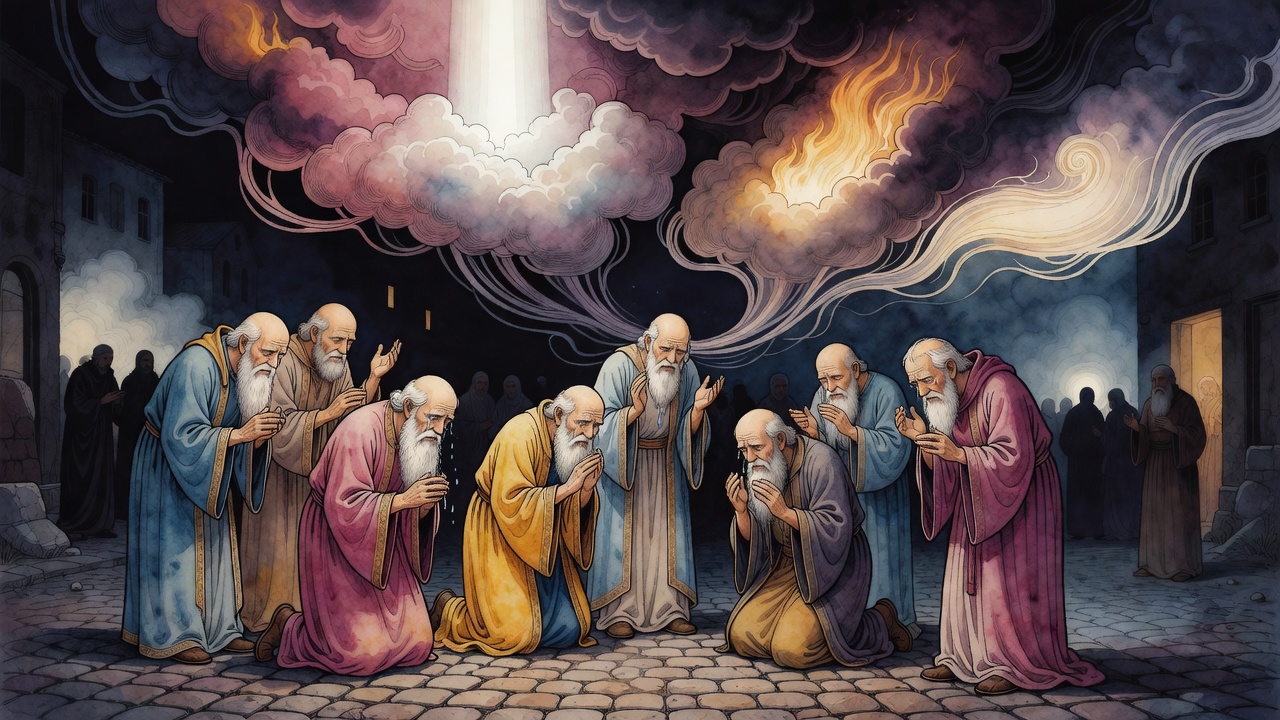
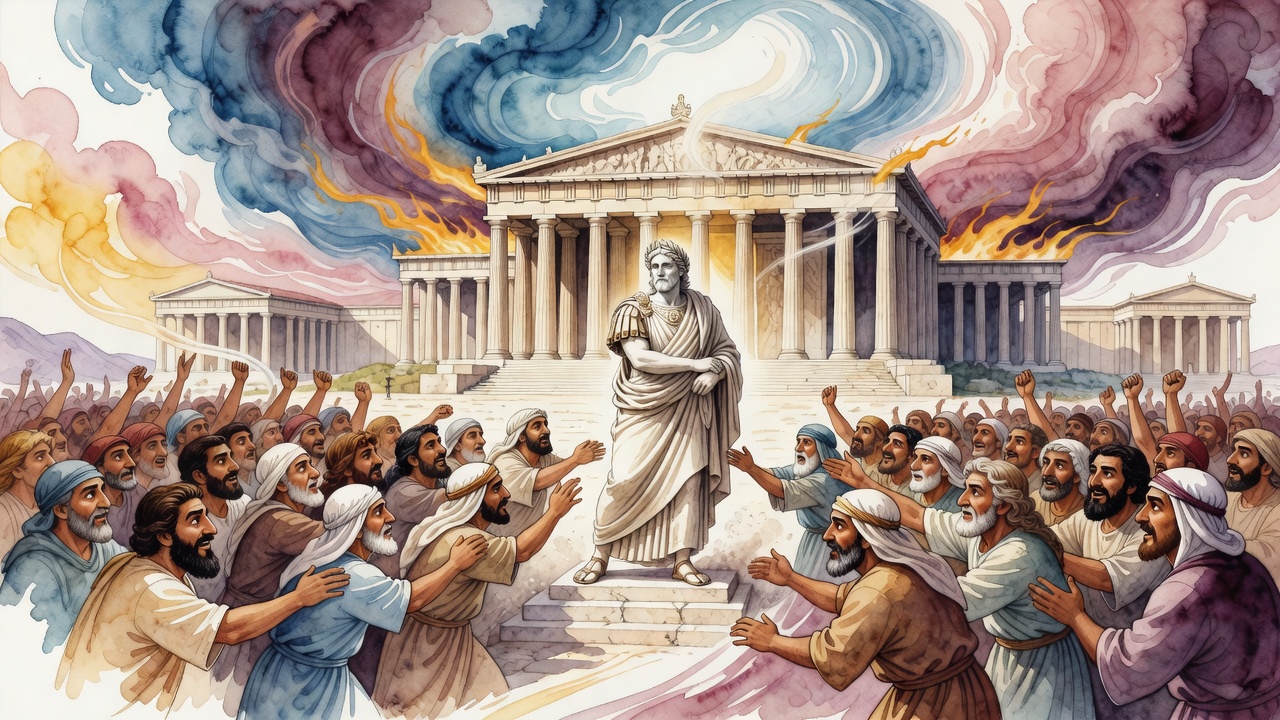
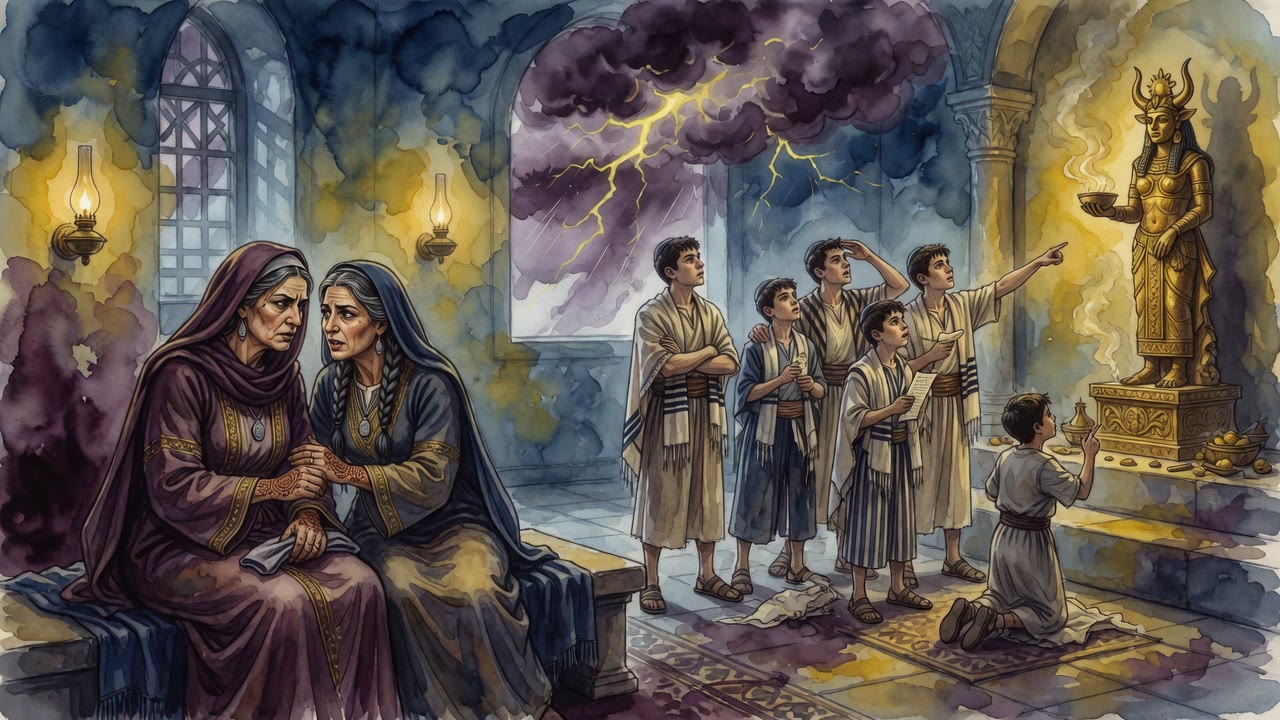
The ban was simple and meant to unmake a people. No study of the Law. No circumcision of sons. Sabbath must be broken. Judah ben Shamua and his companions went to a matron whose house the city's great men frequented. She did not offer a petition in soft daylight. Go and cry aloud at night, she said.

They did. Voices rose between houses: Are we not all brethren? Are we not children of one Father and one mother? Why are we treated differently from every nation and tongue, that you issue such cruel edicts against us? The cry was political theater and prayer at once. By morning the decrees were annulled.

The twenty-eighth of Adar became a day of good news, a holiday stamped on the calendar because a night of public grief had worked. Windows opened. A official who preferred quiet streets discovered that quiet can be more expensive than justice. The matron, when thanked, only shrugged. She knew how sound travels through the rooms of the powerful.

When the Lord Was Like an Enemy

Not every generation receives a quick annulment. Eikhah Rabbah reads the line, The Lord was like an enemy (Lamentations 2:5), and hears a careful almost. They did not go to extremes against justice, and justice did not go to extremes against them. Scripture says like complainers, like those who move boundaries, like a wayward cow.

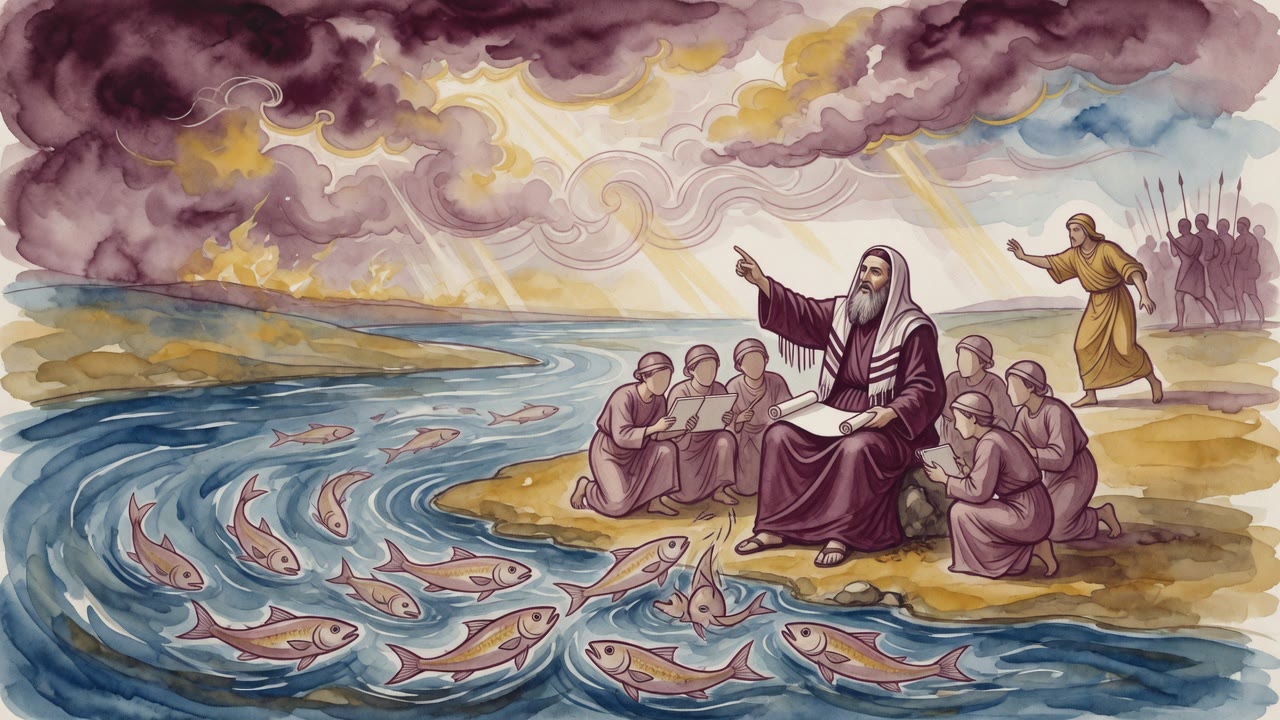
The attribute of justice answers in the same register: He drew His bow like an enemy. The word "like" is a thin mercy. Demolition still comes. Palaces fall. Strongholds crack. Mourning multiplies in the daughter of Judah. Israel is exiled in strands: beyond the Sambatyon, under cloud, to Daphne of Antioch.

The night cry of Adar and the long cry of Lamentations are not the same story. One ends in a holiday. The other teaches how close God can stand to the posture of an enemy without becoming a second power of chaos. A poet who survived a burning street understood both texts in his body.

Years Counted from a Broken House

Seder Olam Zutta counts the foreign government and the years from the Temple's building until Vespasian destroys it and exiles Israel. Families from the house of David and Judah are said to go as far as Hispania. Fifty-two years after the destruction, Beitar falls. Empires trade blows. Sons of sages are buried on the hill of Arbel.

The chronicle is dry until you put a body in it: a father telling a son the year number that begins with fire. Agripa's line and the praised names that follow sit in that counting. Leadership continues under foreign years. The calendar of ruin becomes the calendar of memory.

A child in Hispania asked where home was. The parent answered with a year-count and a hill name he had never seen. That is how exile talks when the decrees do not fall in a single night. Secanias and Ezekias still receive the sages' praise while the map is owned by others.

What the Matron Understood

She knew the celebrated men of the city slept lightly when streets filled with voices. A daylight plea can be filed. A night cry becomes a civic problem. Judah ben Shamua's circle risked shame and worse to make brotherhood audible to ears that preferred Jewish silence.

The good news of the twenty-eighth of Adar is not that evil forgot how to legislate. It is that a people refused to practice disappearing. When later books say God was like an enemy, they still keep the "like." When chronicles number years from destruction, they still name sons who plant bones in the Land.

Resistance is not always a sword. Sometimes it is a calendar date won by shouting after dark. The matron's counsel belongs beside the sages' laws. Strategy is also Torah when it keeps the Sabbath, the covenant mark, and the book alive for another generation.

After the Holiday

Children later asked why the twenty-eighth of Adar mattered. Adults answered with a street and a ban and a woman's advice. They did not pretend every decree ends that way. They held the night cry beside Lamentations and beside the long count from Vespasian so hope would not turn into a lie and grief would not turn into atheism.

Somewhere a scribe wrote that the edicts were annulled. Somewhere else a poet wrote that palaces fell. Both lines belong to Israel. The task is to know which night you are standing in, and still open the mouth.

On later twenty-eighths of Adar, someone always told the children that the holiday began with sore throats. Holiness is not only parchment. Sometimes it is a voice raw from shouting brotherhood into streets that preferred Jewish silence. A grandmother would end the story by tapping the table twice: once for the night that worked, once for the nights that still required a mouth open in the dark.

When the holiday came round again, someone always began with the matron's short counsel and ended with sore throats. Children laughed until they understood the ban had been real. Then they grew quiet, the way people grow quiet when they realize a date on the calendar is a scar that learned how to sing. The decrees had fallen once. The mouth still practiced opening in the dark.


← All myths

From the tradition

Sources

3 sources

The texts behind this telling. Some cards carry a translation of the source; others are our own retelling of it, and each card says which. Every card links out to the original.

Ein Yaakov, Rosh Hashanah 1:27Ein Yaakov, Rosh Hashanah

Retold in our words. Read the original at the link below.En Jacob, Agada of the Babylonian Talmud, S. H. Glick (1916-1921) · Public Domain

(23) (Fol. 19) On the twenty-eighth of Adar, the good news came to the Jews that they need no longer abstain from studying the Law, for the king [of Syria had earlier] issued a decree, permitting them neither to study the Law, nor to circumcise their sons, and compelling them to desecrate the Sabbath. What did Juda b. Shamua and his friends do? They went and took counsel of a certain matron, whose house the celebrated people of the city frequented. She said to them: "Go and cry aloud at night." They did as she advised and cried aloud: "Oh, heavens! Are we not all brethren? Are we not all the children of one Father? Are we not aU the children of one mother? Why should we be treated differently from all other nations, and from all other peoples speaking other language, inasmuch as ye issue such cruel edicts against us?" Whereupon the decrees were annulled, and that day was then appointed a holiday.

Full source
Eikhah Rabbah 2:9Eikhah Rabbah

Retold in our words. Read the original at the link below.The Sefaria Midrash Rabbah, 2022 · CC-BY

“The Lord was like an enemy. He demolished Israel, demolished all its palaces, destroyed its strongholds. He multiplied mourning and moaning in the daughter of Judah” (Lamentations 2:5).“The Lord was like an enemy.” Rabbi Aivu said: They did not go to extremes vis-à-vis the attribute of justice, and the attribute of justice, too, did not go to extremes in their regard. They did not go to extremes vis-à-vis the attribute of justice, as it is stated: The people were like complainers” (Numbers 11:1). “Complainers” is not written here, but rather, “like complainers.” “The princes of Judah were like those who move boundaries” (Hosea 5:10). “Those who move boundaries” is not written here, but rather, “like those who move boundaries.” “For like a wayward cow [Israel has strayed]” (Hosea 4:16), “For a wayward cow” is not written here, but rather, “like a wayward cow.” The attribute of justice, too, did not go to extremes in their regard. “He drew His bow like an enemy.” “An enemy” is not written here, but rather, “like an enemy.”“He demolished Israel, demolished all its palaces.” Rabbi Berekhya in the name of Rabbi Ḥelbo in the name of Rabbi Shmuel bar Naḥman: Israel89The Ten Tribes. was exiled to three places. One was on this side of the Sambatyon River,90A river described as carrying stones in its current, so that it was unpassable, except for on Shabbat (see Bereishit Rabba 11:5). as it is written: “To say to the prisoners: Emerge, to those in darkness: Reveal yourselves” (Isaiah 49:9). One, beyond the Sambatyon River: “They will graze along the ways” (Isaiah 49:9); those upon whom a cloud descended and enveloped them. “And on all the bare hills will be their pasture” (Isaiah 49:9), those who were exiled to Daphne in Antioch.91Some suggest an alternate version of the text, based on the Jerusalem Talmud (Sanhedrin 11:5): Israel was exiled to three places: One beyond the Sambatyon River, one to Daphne in Antioch, and one that the cloud descended and covered them… “To say to the prisoners: Emerge,” this is to those who were exiled beyond the Sambatyon River. “To those in darkness: Reveal yourselves,” these are the ones upon whom the cloud descended and covered them. “They will graze along the ways and on all the bare hills will be their pasture,” these are those who were exiled to Daphne in Antioch (Etz Yosef). “He multiplied mourning and moaning in the daughter of Judah;” [the people were] tormented with afflictions.

Full source
Seder Olam Zutta 9:2Seder Olam Zutta

Translation of the source text.Seder Olam Zuta, Rabbi M. Grossberg. London, 1910 + JewishMythology.com faithful English Beta translation · Public Domain

Agrippa son of King Herod reigned, and after him his son Monobaz reigned. Shemaiah died, and after him Shekhanyah arose; the sages praised him. In the 103rd year of the kingdom of the converts, which was the 420th year from the building of the Temple and the year 3,828 from the creation of the world, Vespasian came and destroyed the Temple. He exiled Israel, and many houses from the house of David and Judah, to Aspamia, which is Spain. That was the 180th year of the Romans who had ruled before the Temple. In the fifty-second year after the destruction of the Temple, Betar was destroyed. In the 166th year after the destruction of the Temple, the Persians came against the Romans. Shekhanyah died, and after him his son Hezekiah arose; the sages praised him. Hezekiah died and was buried in the Land of Israel, at the hill of Arbel that belonged to Joshua son of Seraph the priest, east of the city. His son arose after him, and the sages praised him. When he died, Nathan was left in his mother's womb; he is Nathan de-Tzutzita. Nathan died, and after him his son Rav Huna arose; the sages praised him. Akub died, and after him his son Nahum arose; the sages praised him. Rav Huna, Rav Hanana, Rav Mattana, and Rav Hananel were his sages. Nahum died, and Yohanan arose; the sages praised him. Rav Hananel was his sage. Yohanan died, and after him his son Shefat arose; the sages praised him, and Rav Hananel was his sage. Shefat died, and after him his son Anan arose; the sages praised him, and Rav Shmuel was his sage. Pasa bar Netzer went up and destroyed Nehardea. Rav Huna died and was buried in the Land of Israel beside Rabbi Hiyya the Great. After him his son Nathan arose; the sages praised him. Rav Yehudah bar Yehezkel and Rav Sheshet were his sages. The Persians inherited the kingdom in the year 245 after the destruction of the Temple, and the Persians decreed persecution against the Jews. Nathan died, and after him his son Nehemiah arose; the sages praised him. Rav Shezvi was his sage. Nehemiah died, and after him his son Akaviah arose; the sages praised him. Rava and Rav Adda were his sages. In his days Shapur went up against the Arameans and conquered them. Mar Ukvan de-Tzutzita died and was buried in the Land of Israel. After him Huna, his brother's son, arose; the sages praised him. Abaye, Rabbah, and Rav Yosef bar Hama were his sages. In his days Shapur went up against Nisibis and conquered it. Huna Mar heard of it, and after him his brother Ukva arose; the sages praised him. Rav Hananel was his sage. Ukva died, and after him Abba, his brother's son and son of Mar Ukvan, arose. Rava and Ravina were his sages. In the year 416 after the destruction of the Temple, the world stood without a king. Abba died, and after him his brother Rav Kahana arose. Rav Safra was his sage. Rav Kahana died, and after him his brother Rav Safra arose. Rav Aha of Difti was his sage. Mar Zutra died, and after him his son Kahana arose. Ravina was his sage. Rav Kahana died, and after him Rav Huna Mar his brother arose. Rav Aha of Difti bar Hanilai was his sage. He died, and after him Rav Huna, his father's brother, son of Rav Kahana, arose. Rav Mari and Mar Hanina Rabbah were his sages.

Full source