5 min read

Three Men Named the Same Mountain Across Centuries

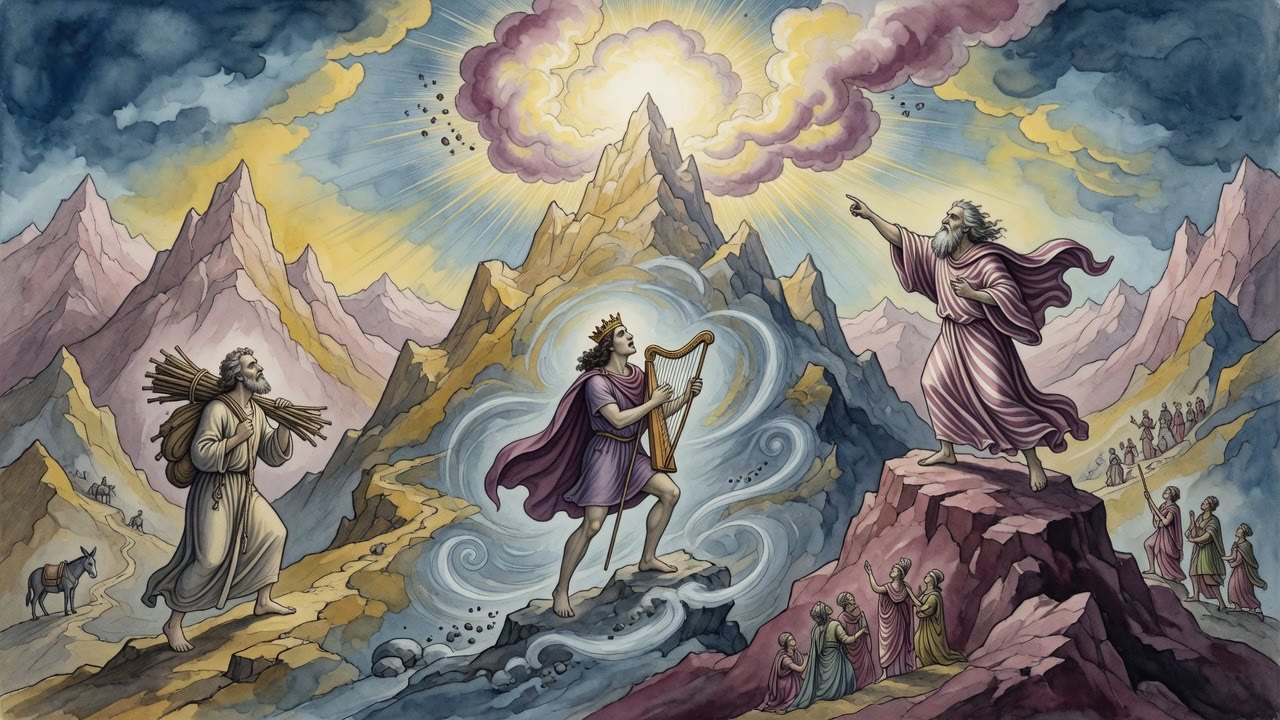
Abraham named it after binding his son. David asked who could ascend it. Isaiah said nations would stream toward it. All three pointed at one place.

Curated by Arthur · Told by Maggid ·
Table of Contents
  1. The First Name
  2. The Second Name
  3. The Third Name
  4. The Fears They Shared

The First Name

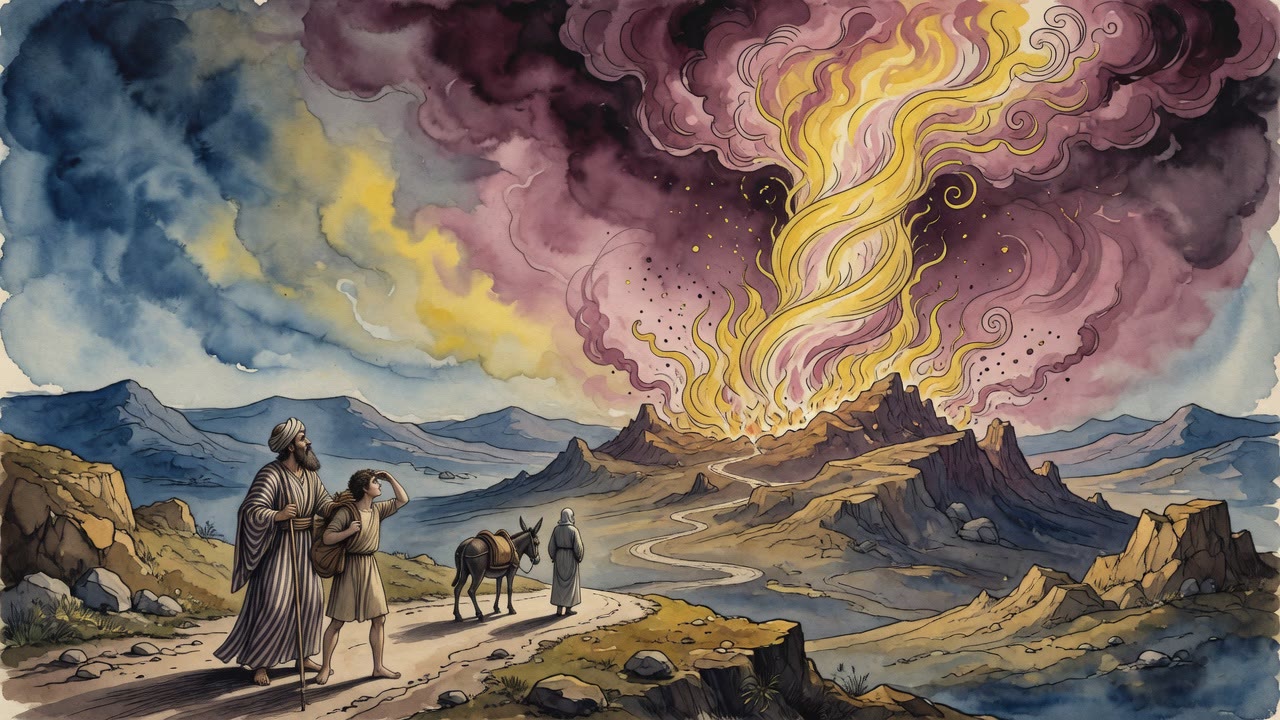
Abraham came down from Moriah with his son alive beside him and named the place. He called it Adonai Yireh, the Lord will be seen, or the Lord will provide. Both meanings live in the same Hebrew word, and the tradition has never settled on which one Abraham meant, because both were true at the same moment: God was seen there, on that mountain, in the form of an angel and a ram caught in a thicket, and God provided there, the alternative to a son's death arriving at the last possible breath.

The verse adds a proverbial confirmation: In the mountain of the Lord it will be seen. This was not Abraham editorializing. It was a statement about the mountain's future, what the place would continue to be, what would happen there after Abraham descended. He named it once and the name described a permanent quality rather than a single event. The Lord would be seen on this mountain not only that day but on all the days that followed.

The Second Name

David asked a question that functioned as a name. Who will ascend the mountain of the Lord, and who will stand in His holy place? Psalm 24, which the rabbis attributed to David, takes a mountain and makes it a moral threshold. Not a geographic feature. A standard. Who can stand there? What disqualifies a person from the approach?

The psalm answers its own question: the one with clean hands and a pure heart, who has not lifted his soul to falsehood, who has not sworn deceitfully. The mountain Abraham named for provision and divine presence, David named for what a person must be before drawing near. He was not describing the same mountain Abraham described and arriving at different conclusions. He was describing the same mountain from the other direction, not what God does on it but what a person must be to stand on it.

The Yalkut Shimoni, reading across centuries, noted that Abraham and David and Isaiah were pointing at the same place. This is not a coincidence the tradition treats lightly. The same spot where Abraham tied the wood and raised the knife became the mountain David asked who could ascend, became the mountain Isaiah said all nations would one day stream toward at the end of days.

The Third Name

Isaiah called it the mountain of the Lord's house, and said it would stand at the head of all the mountains, raised above all the hills, and all nations would flow toward it. What had been a private moment between Abraham and God, what had been a moral question David asked in a psalm, Isaiah placed in the full context of history's end. The mountain was not only a site of past revelation and present aspiration. It was the destination toward which all of history was moving.

Three names across many centuries, and no one who gave one of the names knew the others had named it too. Abraham had no Psalms. David did not know the text of Isaiah. Isaiah read what both of them had said and added his own name to the list. The mountain accumulated meaning the way certain places do, one significant encounter after another layering onto the same ground until the ground itself becomes inseparable from its history.

The Fears They Shared

The rabbinic tradition sets Abraham and David beside each other not only at the mountain but in their anxieties about the future. Both men, at different moments, wondered whether the promise would hold. Abraham, who had no children and had been told he would be the father of nations, asked God how he could know that he would inherit the land. He wanted a sign. God provided one. David, who had been promised an eternal dynasty, looked at his own failures and wondered whether the promise survived what he had done. He prayed, and the tradition preserved his prayer as an example for everyone who needed to return from distance.

Rabbi Yudan and Rabbi Aivu, in Bereshit Rabbah, read the two fears together. Abraham's fear was prospective: the covenant was new and he could not see its fulfillment yet. David's fear was retrospective: the covenant had been established and he had damaged it. Both men brought their fears to God. Both received answers. The mountain they shared was not only a geographic location but a posture: the place where what you cannot do alone gets done for you, if you arrive with what the psalm describes as clean hands and a pure heart.


← All myths
From the tradition

Sources

5 sources

The texts this telling draws on, in full. Open a card to read inline, or expand it for a wider, quieter read.

Yalkut Shimoni on Torah 816:1Yalkut Shimoni on Torah

this good mountain and the Lebanon. Everyone called it ‘mountain.’ Avraham called it mountain, as it says “On the mountain, the Lord will be seen.” (Bereshit 22:14) David called it mountain, as it says “Who will ascend upon the Lord's mountain…” (Tehillim 24:3) Isaiah called it mountain, as it says “And it shall be at the end of the days, that the mountain of the Lord's house shall be firmly established at the top of the mountains…” (Yeshayahu 2:2) The nations called it mountain, as it says “And many peoples shall go, and they shall say, "Come, let us go up to the Lord's mountain…” (ibid 2:3) Levanon refers to the Holy Temple, as it says “You are [as] Gilead to me, O head of the Levanon…” (Yirmiyahu 22:6) and it says “…and the Levanon shall fall through a mighty one.” (Yeshayahu 10:34) And why is it called Levanon?

Because it bleaches (malbin) the sins of Israel like snow, as it says “If your sins prove to be like crimson, they will become white as snow…” (Yeshayahu 1:18)

Full source
Bereshit Rabbah 44:9Bereshit Rabbah

Them is often remembered as paragons of faith, figures of unwavering strength. But what about their doubts, their fears about the future?

The ancient rabbis, in their beautiful and insightful way, explored these questions. In Bereshit Rabbah, a classic midrashic (rabbinic interpretive commentary) text – a collection of interpretations on the Book of Genesis – we find a fascinating comparison between Abraham and David. Both, it seems, shared a similar concern.

Rabbi Yudan and Rabbi Aivu, citing Rabbi Yoḥanan, point out that both Abraham and David expressed a desire to avoid having descendants who would displease God. It's not just about having children; it's about the kind of legacy they would leave.

Abraham, as it says, cries out, “My Lord God, what will You give me?” (Genesis 15:2). But the rabbis see a deeper meaning in his words. Abraham isn't just asking for offspring, but rather, as the rabbis interpret, saying, "Master of the universe, if I am destined to produce offspring and [they will ultimately] anger you, it is preferable for me that 'I go childless.'" He’s essentially saying, “If my descendants are going to be a source of pain to You, God, then I'd rather not have them at all.” A pretty powerful statement. David echoes a similar sentiment in the Psalms. “Search me, God, and know my heart; try me and know my thoughts” (Psalms 139:23). But it doesn’t stop there. The verse continues "and see if there is any grievous way in me." The rabbis, in their insightful way, see that he's asking God to examine his future descendants. David is pleading, “Know those who emerge from me.” The word sarapai, "my thoughts," can also mean branches emerging from a tree. If those "branches" – his descendants – are destined to stray, David prays, "lead me on the path to eternity" (Psalms 139:24). In other words, “Take my life instead.” A pretty extreme request, but one born from a deep sense of responsibility.

This idea of legacy and the potential for descendants to stray is a powerful theme in Jewish thought. It's a reminder that we're not just individuals; we're part of a chain, a continuation of generations.

But the passage doesn't end there. It explores another intriguing detail about Abraham's household. Abraham laments "the one who has charge of my house." Rabbi Elazar interprets this as a reference to Lot, Abraham's nephew. He suggests that Lot's soul shokeket – longs – to inherit from Abraham. But then the verse continues "Is Damascus Eliezer." Here, the rabbis offer two interpretations.

One suggests that Eliezer isn't a name at all, but a description: azarni hael – "the Almighty helped me." This refers to God's assistance when Abraham pursued the kings to Damascus. The other, offered by Reish Lakish in the name of bar Kappara, claims that Eliezer is a name. He points out that Abraham “marshaled his disciples, born in his house, three hundred and eighteen” (Genesis 14:14). The numerical value – the gematria – of Eliezer's name is precisely 318!

What does it all mean? Perhaps it's a reminder that even the greatest figures in our tradition grappled with complex questions about their legacy, their children, and their place in the unfolding story of humanity. They understood that true greatness wasn't just about personal achievement, but about the impact they had on the generations to come. And maybe, just maybe, that's a lesson we can all take to heart.

Full source
Midrash Tehillim 34:1Midrash Tehillim

Midrash Tehillim, a collection of homiletic interpretations of the Psalms, offers a fascinating perspective, suggesting that everything, absolutely everything, has its perfect, divinely ordained time.

The verse from (Ecclesiastes 3:11), "God has made everything beautiful in its time," really gets to the heart of it. Rabbi Tanchuma, quoted in the Midrash (rabbinic interpretive commentary), even takes it a step further. He suggests that God didn't just create the world perfectly the first time. Instead, He created and destroyed worlds that weren't quite right, iterating until everything was "fitting for Me."

Rabbi Simon offers a particularly intriguing example. He argues that Abraham, the patriarch of monotheism, should have been created before Adam. Why? Because Abraham was so righteous! But God, in His infinite wisdom, reasoned that if Abraham failed first, there would be no one to correct the course. Adam’s failure, however, could be redeemed by the arrival of Abraham later.

It isn't just about people. The Midrash beautifully illustrates this point by noting that hot fruits are eaten in winter, and cold fruits in summer. Everything is beautifully timed, perfectly suited for its moment. David, in his Psalms, even acknowledges this, saying, "Everything You have made is beautiful, and You have done it with wisdom," echoing (Psalm 104:24), "How great are Your works, O Lord! In wisdom You have made them all."

But here's where it gets interesting. David challenges God: What about foolishness? What pleasure is there in that? Imagine a man tearing his clothes in the marketplace, children chasing after him, everyone laughing. Is that pleasing to God?

God's response is a curveball: "David, you call this foolishness, but one day you will need it." It's a powerful reminder that even things we perceive as negative or nonsensical can serve a purpose in the grand scheme. As Solomon says in (Proverbs 13:18), "He who despises instruction will pay the penalty." But what's the penalty? According to the Midrash, it's being drawn towards that very thing you despised.

The Midrash then offers a fascinating, and somewhat unsettling, example: David's encounter with Achish, the king of Gath. Remember when David fled from Saul, as recounted in (1 (Samuel 21:1)1)? He sought refuge with Achish, in the very city of Goliath, whom David had famously slain!

God essentially says to David, "You're going to Achish? The same Achish whose brother you killed, whose blood hasn't even been avenged? With his sword in your hand, no less!" You can almost hear the exasperation in God's voice.

The situation escalates quickly. The Philistines recognize David and plot to kill him. To escape, David feigns madness, as described in (1 (Samuel 21:1)4). He scribbles nonsensical things on the doors, acts like a lunatic, even gets his family to join in the charade! Achish, thoroughly unimpressed, exclaims, "Do I have a shortage of madmen?"

And here's the kicker: The Midrash suggests that this "foolishness," this descent into apparent madness, is precisely what saves David. It's the very thing he questioned God about! From that joy and relief of escaping, the Midrash claims, David composed the psalm in question. God, in a way, validates this madness, saying, "David, madness is good."

The Midrash concludes by connecting this episode back to the beginning: "Do everything beautifully in its time." Just as God saw that everything He had made was "very good" in Genesis, even the seemingly negative, the foolish, the chaotic, has its place and purpose.

So, what does this all mean for us? Maybe it's a call to trust in a larger plan, even when things seem senseless or difficult. Maybe it's a reminder that even our perceived failures, our moments of "foolishness," can ultimately contribute to our growth and our destiny. Or maybe it's simply a comforting thought that, as the Midrash suggests, everything truly does happen for a reason, in its own perfect time.

Full source
Midrash Tehillim 26:3Midrash Tehillim

The sages of old wrestled with this very idea – the idea of being tested by God. And they found solace and guidance in the stories of our ancestors.

Midrash Tehillim, a collection of interpretations on the Book of Psalms, delves deep into this concept using Psalm 26 as its starting point. The psalmist cries out, "Test me, O Lord, and try me." It's a bold statement, isn't it? Almost like daring the Divine.

Why would anyone want to be tested? The Midrash (rabbinic interpretive commentary) answers by pointing to our forefathers. Think about Abraham. As (Genesis 22:1) tells us, God tested him, and he withstood the test of offering his son, Isaac. Or consider Isaac himself, who was also tested and stood firm. These weren't easy trials, but they revealed the strength and faith within them.

Then the Midrash turns to Joseph. "Refine my kidneys," the text implores, "refine me like Joseph, who was refined and found trustworthy." This idea of refinement is key. The kidneys, understood in ancient times as the seat of emotion and conscience, need to be purified. Joseph, after enduring betrayal and imprisonment, emerged as a leader of immense integrity. When tested, Joseph pleaded, "I have no strength, please do not judge me harshly," echoing (Psalm 143:2), "And do not enter into judgment with Your servant."

Now, here's where it gets really interesting. Even the great David wasn't perfect. The Midrash acknowledges this, citing I (Kings 15:5): "For David did what was right in the eyes of the Lord, except in the matter of Uriah the Hittite." Even with his flaws, David is held up as an example. He possessed qualities of kindness and truth, as (Psalm 26:3) says, "For Your kindness is before my eyes, and I walk in Your truth."

The Midrash uses this to teach us a vital lesson: "A person should not become arrogant and say, 'I am sure of myself.'" Even those who seem to possess unwavering faith and righteousness are still human, still fallible.

And that brings us to a profound insight from (Ecclesiastes 7:20): "For there is no righteous man on earth who does good and does not sin." It's a humbling reminder that we are all works in progress.

The Midrash then shifts to an analogy of a king and his workers. Solomon, known for his wisdom, says that a king who pays his workers what they're due is considered virtuous. But a king is even more praiseworthy when he shows kindness to workers who don't do their job well, paying them their wages nonetheless. This act of unearned generosity echoes the Divine attribute of mercy.

The Midrash ties it all together with a verse from I (Kings 8:57): "May the Lord our God be with us, as He was with our fathers." It's a prayer, a hope, and a recognition that we are part of a continuous chain of faith, striving to live up to the examples set by those who came before us.

So, what does all this mean for us today? Perhaps it's a call to embrace the tests that come our way, not with fear, but with a willingness to learn and grow. To remember that even our imperfections can be a source of strength and that kindness, especially when undeserved, is a reflection of the Divine within us. Maybe the tests aren't about passing at all, but about the person we become in the process.

Full source
Midrash Tehillim 40:4Midrash Tehillim

Midrash Tehillim, a collection of interpretations on the Book of Psalms, points us to King David as the ultimate example of repentance, of teshuvah (repentance). It says, "Many will see and be afraid. Whoever wants to do repentance should look at David." Why David? Because even this great king, a man after God's own heart, stumbled. He made mistakes, big ones. But he also turned back. He repented. And through his example, he offers us a path, a reassurance that we too can find our way back from even the deepest of errors.

The Midrash (rabbinic interpretive commentary) then connects this idea to the Exodus, recalling the moment when the Israelites witnessed the incredible power of God at the Red Sea. "And Israel saw the great hand that the Lord had inflicted upon the Egyptians," it says, quoting (Exodus 14:31). Immediately then, Moses sang… It's a reminder that witnessing redemption, seeing the possibility of change, can inspire us to our own song of repentance and praise. It’s like (Isaiah 55:4) says, "I have given him as a witness to peoples."

What about the really, really big picture? What about the suffering of exile, the long, hard journey of the Jewish people through history? Psalm 92 speaks of God's "many things," His wonders and thoughts towards us. The Midrash connects this to the idea of clarifying the exile, understanding its purpose.

Rabbi Yudan, Rabbi Addi, and Rabbi Hama, citing Rabbi Levi, tell us that even Abraham, our patriarch, didn't initially grasp the meaning of exile. He only understood it through divine revelation. As we find in (Psalms 66:12), "You made us ride through fire and water." This, the Midrash explains, refers to the exile. "We entered fire and water" – to Gehenna, which is often translated as hell, but here is understood more as a place of fiery trial and purification, a place of both fire and water.

Rabbi Berachiah even adds that Abraham stood silent all day, overwhelmed by the vision. God then prompts him, leading to the covenant described in (Genesis 15:18): "On that day, the Lord made a covenant with Abraham." It’s as if God is saying, "I see your confusion, your pain. But trust that even in this, there is a purpose. These trials, these exiles, are not meaningless. They are part of a larger plan."

The passage closes with a powerful thought: "Your wonders and thoughts towards us are amazing, for our sake, so that we will not be subjugated to Gehenna." The idea here is that God's interventions, His "wonders and thoughts," are ultimately for our benefit, to prevent us from being completely consumed by suffering and despair. Even in the midst of fire and water, there is a divine hand guiding us, a covenant protecting us.

So, what does all this mean for us today? Perhaps it's a reminder that even when we face our own personal "exiles," our own moments of intense struggle and pain, we are not alone. That just as God made a covenant with Abraham, promising redemption even in the face of exile, we too can find hope and meaning in our own journeys through fire and water. Maybe, just maybe, the very things that feel like our undoing are actually part of a larger plan, a path leading us towards greater understanding and a deeper connection with the divine. And like David, we can always turn back.

Full source