Parshat Bereshit6 min read

The Trumpet, the Chariot, and the Tree of Life in Eden

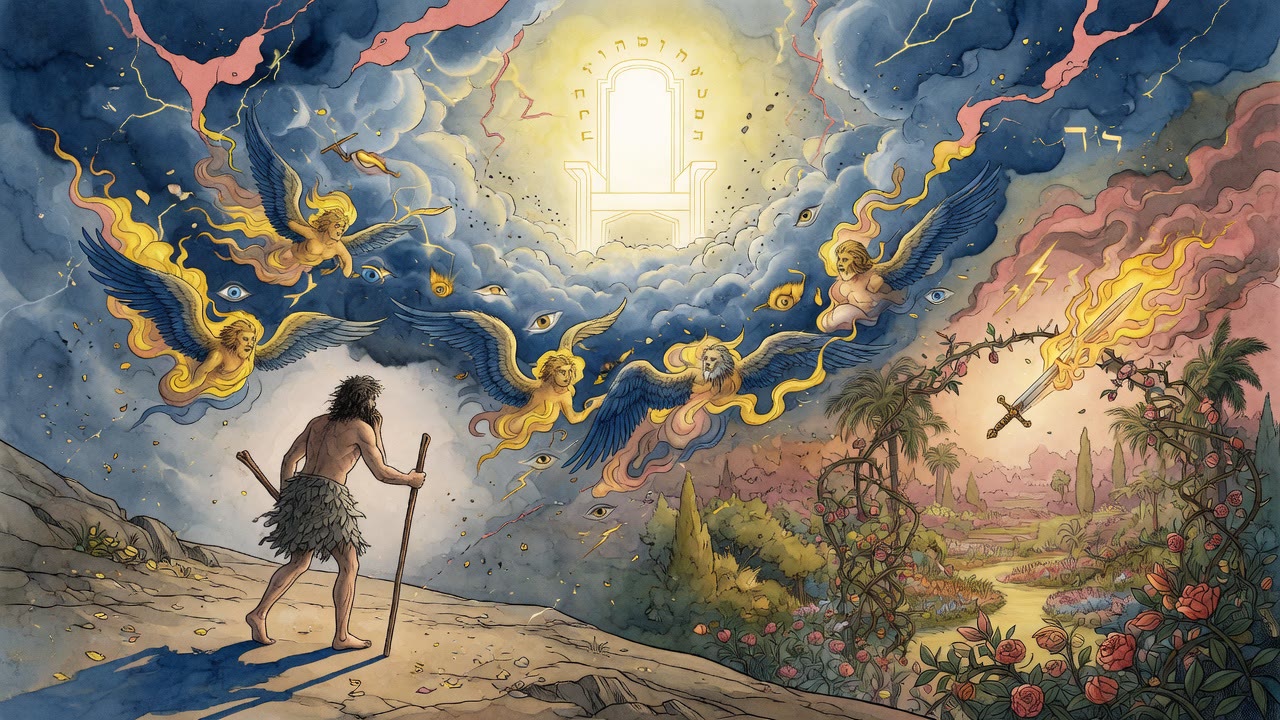
A trumpet splits the sky over Eden. A chariot of cherubim descends. Adam crouches in the leaves while the dead trees burst alive around the Tree of Life.

Curated by Arthur · Told by Maggid ·
Table of Contents
  1. The Trumpet of Michael Splits the Sky
  2. The Chariot of the Cherubim Descends
  3. The Dead Trees Burst Back to Life
  4. The Voice Asks Where He Is
  5. Yesterday and Today

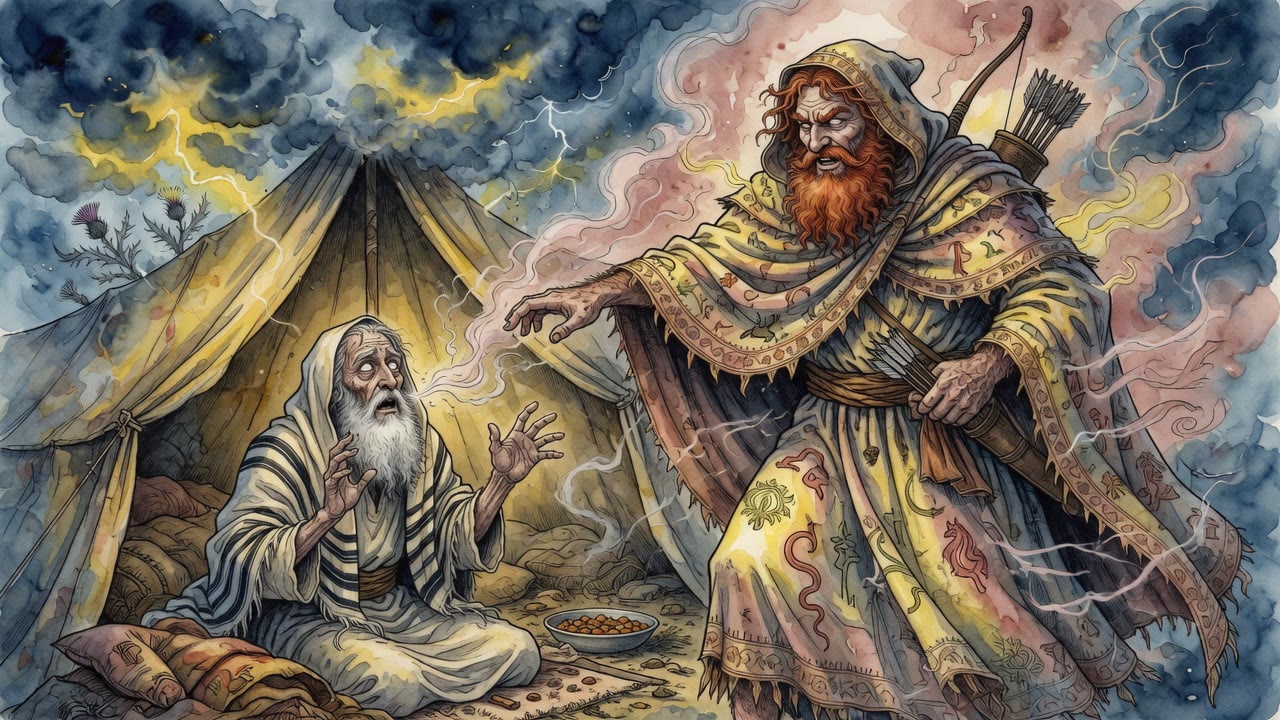
The leaves shook before the sound came, and then the sound came: a single trumpet blast that flattened the wind and froze every bird mid-song over the Garden. Adam dropped where he stood. He pulled Eve down with him, into the deep green between two trunks, and he pressed his back against bark and tried to make himself smaller than a man can be made.
The fruit was still bitter on his tongue. His hands still remembered the weight of it, the give of the skin, the wet snap. He had eaten yesterday. Today the sky was tearing open.

The Trumpet of Michael Splits the Sky

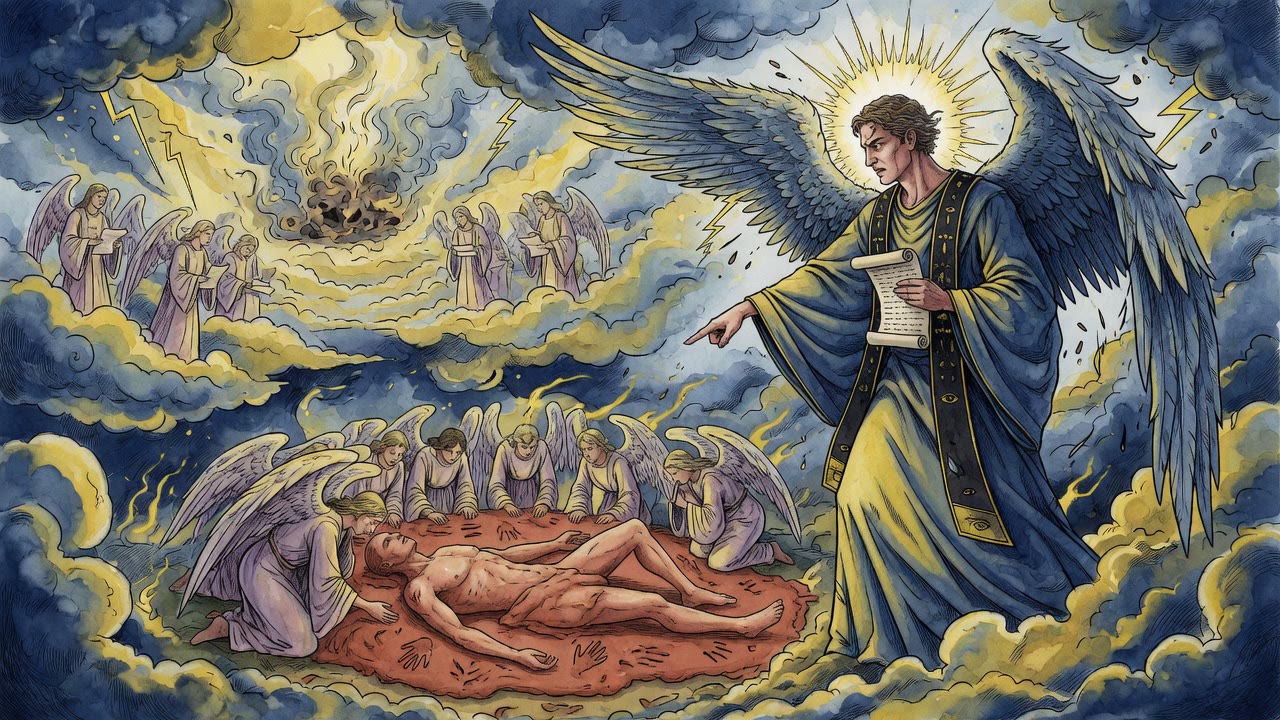
It was the archangel Michael who blew it. The note rolled across Eden and did not fade the way ordinary sound fades. It hung there, and out of it came voices, layer on layer of them, a chorus that seemed to come from every direction and from no direction, announcing what was coming the way heralds announce a king before the king is seen.

"Come," the voices said. "Come and hear the sentence pronounced upon the man."

Adam heard his own name inside that announcement and his stomach turned to water. He did not move to obey. He could not. Every animal instinct in the body that had been shaped from the dust told him to disappear, to fold himself into the foliage, to become root and shadow and nothing (Genesis 3:8). So he hid. A grown man, the first man, crouched in the bushes from the One who had breathed into his nostrils.

The Chariot of the Cherubim Descends

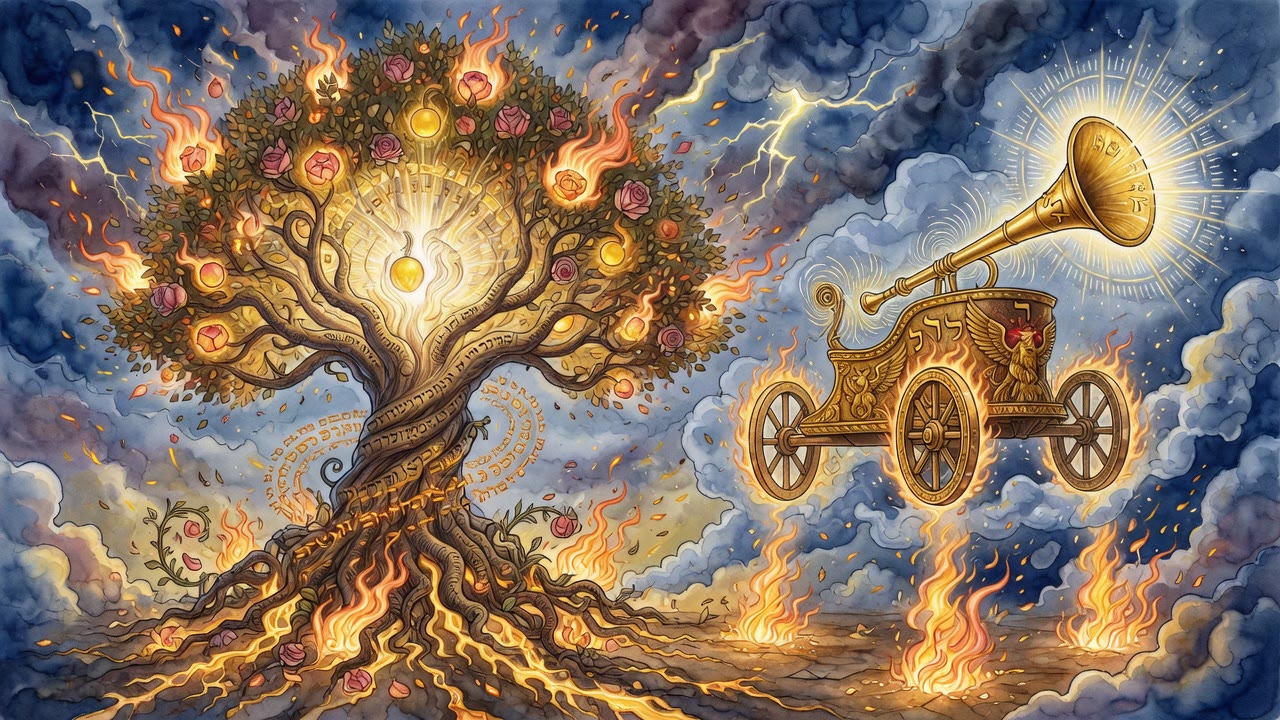
Through the gaps in the leaves he saw it lower out of the high air. A chariot. Not wheels and axle and rail, but a thing drawn by the keruvim (cherubim), the vast winged creatures that stand at the edges of holy places and turn back whatever has no business crossing. Their wings beat slow and enormous, and the wind of them bent the grass flat for a long way around.

Around the descending throne the angels came in a ring, and their mouths never closed, and what poured out of them was praise, a single unbroken river of it, so that the arrival of God in the Garden was not silence and not thunder but song without end.

Adam watched through a tremble of leaves and held his breath until his chest ached.

The Dead Trees Burst Back to Life

Then the strangest thing, the thing he would never be able to explain. As the chariot touched down, the trees came alive. Bare branches that had stood gray and brittle threw out leaves all at once, a green so sudden it looked violent, buds splitting and unrolling in the space of a single breath, as though every growing thing in Eden had snapped upright to attention before its Maker.

The Garden was greener in that instant than it had ever been. And in the middle of all that surging life, the throne was set down, and it was set beside the Etz Chaim (Tree of Life), the one tree whose fruit was not knowledge and not transgression but continuance, the tree that meant going on and on without end.

So judgment came to rest at the foot of the tree that promised never to die. Adam, hiding, did not miss the cruelty of the arrangement. The leaves around him were drunk on new life. He had never felt closer to death.

The Voice Asks Where He Is

And the voice came over the foliage, quiet now, after all that splendor, almost gentle, and it said one word that found him exactly where he crouched.

Where are you? (Genesis 3:9)

He knew, kneeling in the dirt with sap on his hands, that the One asking did not need to be told. The chariot had crossed the whole vault of heaven to land in this Garden. The cherubim had carried the throne to within a stone's throw of his hiding place. The question was not aimed at his location. It went straight through the bushes and through his ribs.

The Hebrew of it was ayeka, where are you, and folded inside that word, barely a breath away from it, sat another word, eikh, which means how. How. How have you come to this. How does a man go, in the span of a single day, from one thing to its opposite.

Yesterday and Today

"Yesterday," the voice pressed, "you were bound to My will. Today you are bound to the will of the serpent." Adam heard the two days set side by side like that, the loyal man of yesterday and the hiding man of today, and there was no answer he could give that would close the distance between them.

He came out of the bushes because there was nowhere left to be. He stood in the impossible new green with the Tree of Life blazing behind the throne, and he answered the only true thing he could, which was that he had heard the voice and he had been afraid and he had hidden himself. The sentence would follow. The gate would open and close behind him. The cherubim that drew the chariot would take up their station with a turning sword and keep him from the tree that meant forever.

The trumpet did not sound again. The trees kept their sudden leaves. And the first man walked out of the Garden carrying a single word he would never put down, ayeka, where are you, how have you come to this.


← All myths
From the tradition

Sources

2 sources

The texts this telling draws on, in full. Open a card to read inline, or expand it for a wider, quieter read.

Legends of the Jews 2:112Legends of the Jews

Not just any trumpet, but the trumpet of the archangel Michael himself. And then, a chorus of angelic voices, echoing across eternity: "Thus saith the Lord, Come ye with Me to Paradise and hearken unto the sentence which I will pronounce upon Adam."

Wouldn't you hide? Adam and Eve certainly did.

In Ginzberg's retelling in, Legends of the Jews, they were terrified. Can you blame them? The weight of their transgression, the bite of the forbidden fruit, must have felt unbearable in that moment. They tried to conceal themselves, to disappear into the lushness of the Garden.

Can you truly hide from the Divine?

The scene that follows is breathtaking. God arrives in Paradise, not in gentle silence, but in a blaze of glory. Picture this: a chariot, not of metal and fire, but drawn by the very cherubim, those powerful, winged beings we often imagine guarding sacred spaces. Angels surround Him, their voices a constant stream of praise, a harmony of the heavens.

And at God's arrival, a miracle. The bare trees, perhaps withered in response to Adam's sin, burst back into life, leaves unfurling, a evidence of the enduring power of creation. God's throne is erected by the Etz Chaim, the Tree of Life, a symbol of immortality and the potential for unending connection with the Divine.

Then, the voice, resonant and all-knowing: "Adam, where dost thou keep thyself in hiding? Thinkest thou I cannot find thee? Can a house conceal itself from its architect?"

The question hangs in the air, doesn't it? It's not just a question for Adam. It's a question for all of us. Where do we hide? What are the ways we try to conceal ourselves from the Divine gaze, from the truth of our own actions? And can we ever truly succeed in hiding from the One who created us, who knows us more intimately than we know ourselves?

Full source
Bereshit Rabbah 19:9Bereshit Rabbah

It's a feeling that, according to the ancient rabbis, even God experienced with Adam.

We find this idea explored in Bereshit Rabbah, a collection of rabbinic interpretations of the Book of Genesis. The passage focuses on the loaded question God asks Adam after he eats from the Tree of Knowledge: "Where are you?" (Genesis 3:9). Seems like a simple enough question. But the rabbis see so much more beneath the surface.

The Hebrew word for "Where are you?" is ayeka. And the rabbis, masters of wordplay and hidden meanings, couldn't help but notice its similarity to the Hebrew word eikh, meaning "how?" The text asks, “The Lord God called to the man [and said to him: Where are you [ayeka]?] – how [eikh] have you become like this?” It's not just a question of location; it's a question of being. "How could you fall so far?" God seems to be asking. "Yesterday," the text continues, "you were loyal to My will, but now to the will of the serpent." It's a poignant contrast.

Yesterday, Adam's potential was limitless; the verse says, he "extended from one end of the world to the other." But now? Now he's hiding "among the trees of the garden," diminished and ashamed.

Rabbi Abahu, quoting Rabbi Ḥanina, brings in another layer. He connects Adam to the Israelites, citing (Hosea 6:7): "But they were like men [adam] who violated the covenant." The Israelites, like Adam, were given a sacred trust, a covenant with God. And like Adam, they broke it.

The Midrash (rabbinic interpretive commentary) elaborates on this parallel. God placed Adam in the Garden of Eden, commanded him, and he violated that command. The result? Banishment, expulsion, and lamentation. We read in (Genesis 2:15), "He placed him in the Garden of Eden," and in (Genesis 2:16), "The Lord God commanded the man, saying." But then comes the transgression: "Did you eat from the tree that I commanded you not to eat from it?" (Genesis 3:11). The punishment follows swiftly: "The Lord God banished him from the Garden of Eden" (Genesis 3:23), and "He expelled the man" (Genesis 3:24). And over all of it hangs the question, the lament: Ayeka?

The same pattern, the Midrash argues, repeats itself with the descendants of Adam. God brought them into the Land of Israel, commanded them, and they violated that command. Again, banishment, expulsion, and lamentation followed. As (Jeremiah 2:7) states, "I brought you to a fruitful land." (Exodus 27:20) says, "You shall command the children of Israel." But (Daniel 9:11) laments, "All Israel has violated Your Torah." The consequences are dire: "Banish them from My presence" (Jeremiah 15:1), and "I will expel them from My house" (Hosea 9:15). And again, the cry of sorrow: Eikha?

The passage concludes by explicitly linking Adam's exile with the exile of the Israelites, referencing the Book of Lamentations (1:1): "How [eikha] does…it sit." The same word, the same pain, echoing across generations.

What are we to make of all this? It’s a powerful reminder that our actions have consequences, not just for ourselves, but for generations to come. It’s also a evidence of God's enduring love and, yes, disappointment. The question "Where are you?" isn't just a geographical inquiry; it's a soul-searching challenge. It's an invitation to return, to repair, to become who we were meant to be. And perhaps, most importantly, it's a call to recognize the echoes of Adam's story in our own lives, and in the story of our people. How can we avoid repeating the mistakes of the past? How can we live up to our potential, and ease the divine lament? That, my friends, is a question worth pondering.

Full source