6 min read

Tzafnat in the Slave Market and Doeg Dying in the Siege

Jerusalem falls in 70 CE. The high priest's daughter is put up for sale. A rich man starves in the siege with gold still in his hands.

Curated by Arthur · Told by Maggid ·
Table of Contents
  1. The Daughter of the High Priest
  2. The Wealth That Bought Nothing
  3. Kamsa, Bar Kamsa, and the Feast That Cost a City
  4. Two Stories, One Logic

The Daughter of the High Priest

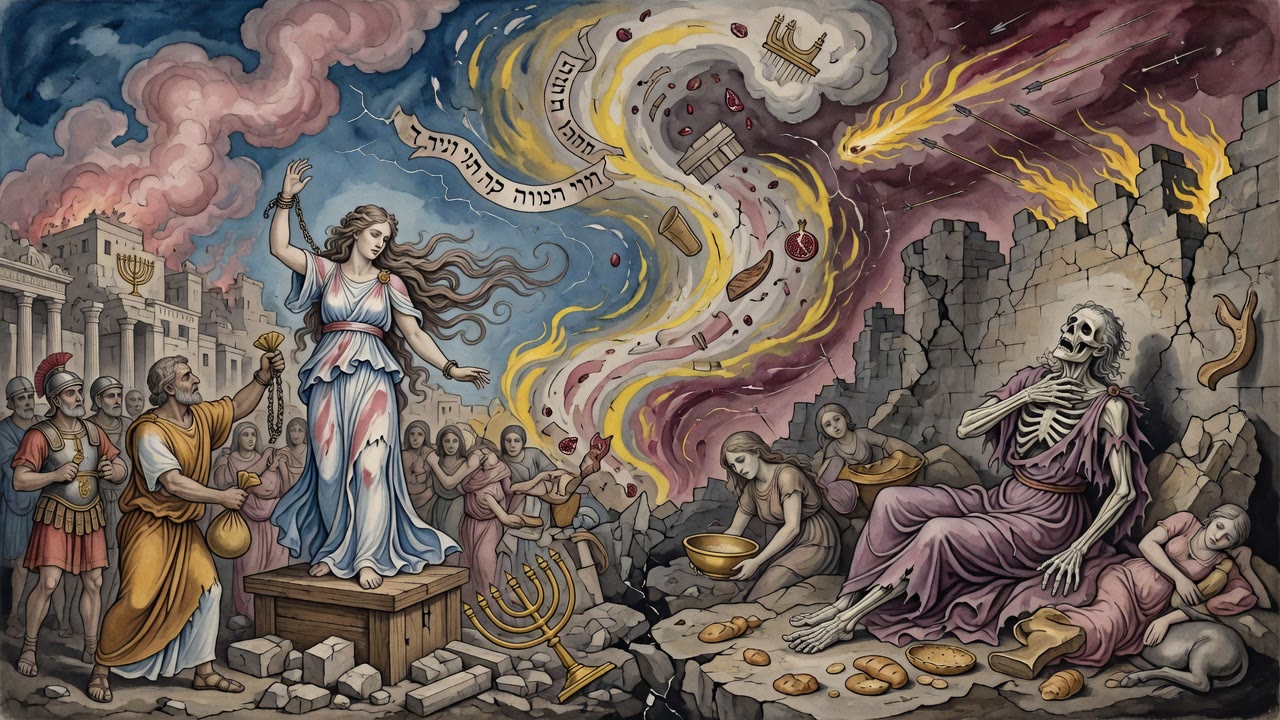
Her name was Tzafnat. Her father had been the high priest of Israel. She had grown up in the holiest household in the land, with incense in the air and the Temple courts at the end of every morning walk, and then Jerusalem fell in 70 CE and none of that mattered anymore.

She was brought to the slave market. The auctioneer began stripping her for the inspection that buyers demanded, removing garments one by one so the crowd could assess what they were purchasing. The fragment gives no speech to the buyers. It does not need to. Their presence is the market's permission, and their silence as the stripping proceeds is the sound of the world that had replaced hers.

When the seller reached for the last garment, Tzafnat took it herself. She tore it away before he could, and she spoke over the gaze of every person watching. No woman in the world, she said, was more beautiful than she was.

Then she threw herself to the ground and died.

The line is unbearable because it refuses to be humble. The daughter of the high priest, on the block in a Roman slave market, did not disappear into the logic of the transaction. She named herself before she ended herself, and the naming was not vanity. It was the last act of someone refusing to let a crowd of purchasers be the last word on who she was. The beauty she named was real. Her death made it unownable.

The Wealth That Bought Nothing

Doeg ben Yosef was a rich man in the wrong moment. When the Roman siege tightened around Jerusalem in the final weeks, wealth stopped meaning what it had always meant. He stood in the street with a full measure of gold in his hand and offered it to anyone who would sell him a mouthful of bread. No one sold. The city had no bread to sell.

He starved to death with his gold still in his hands.

His wife's story is darker in a different register. In the years before the war she had been pious in a specific way: each year she weighed her infant son on a scale and brought that weight in gold as a yearly offering to the Temple. Her piety had been expressed in the language of abundance, in the currency of a household that could afford to give the Temple its own child's weight in gold as an annual gift.

In the siege, the Temple was burning. Food was gone. The mother took her son, the same child she had weighed against gold for years, and in the madness of starvation she cooked him and ate him. Then she heard people outside and hid the remainder under the floor.

When they found her and asked what she had done, she said only: I saved half for you.

Kamsa, Bar Kamsa, and the Feast That Cost a City

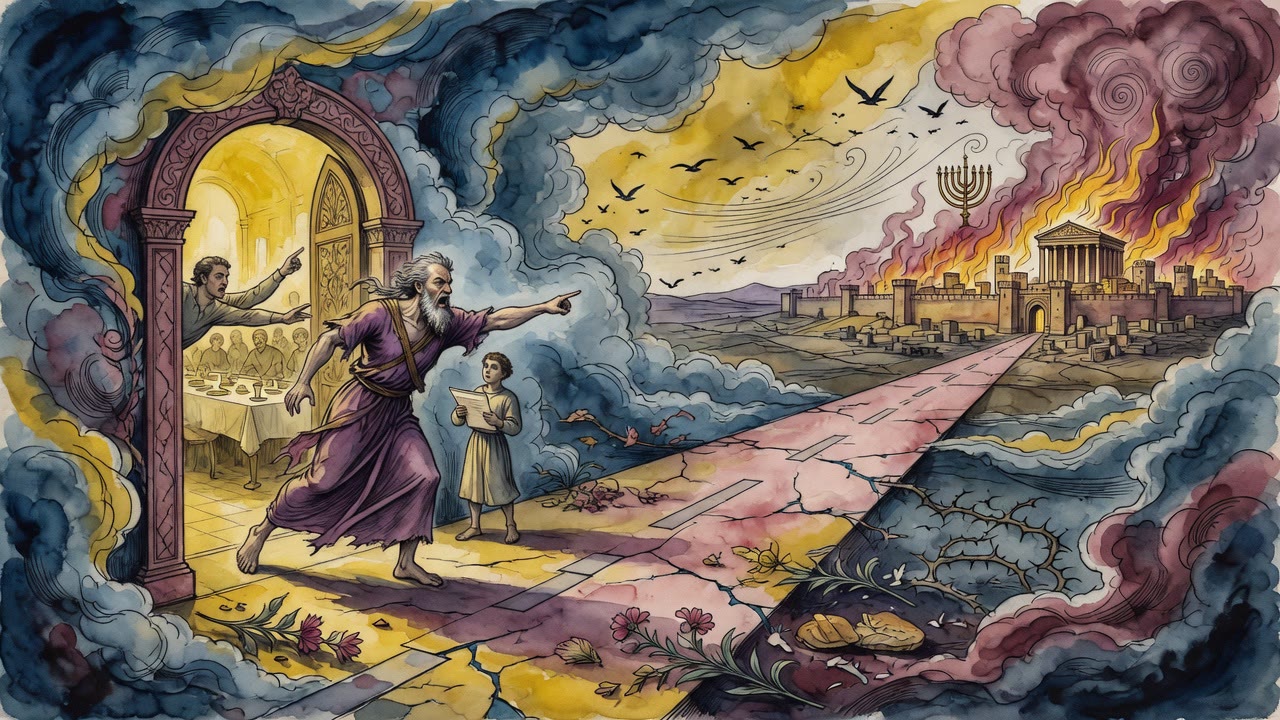
The third fragment in this cluster names the chain that led to all of it. A man sent an invitation to his friend Kamsa. His servant delivered it to Bar Kamsa, who was his enemy, by mistake. At the feast, the host saw Bar Kamsa at the table and told him to leave. Bar Kamsa offered to pay for his place at the table. The host refused. He offered to pay for half the feast. Refused. He offered to pay for the entire feast. Refused. He was thrown out in front of everyone.

Bar Kamsa went to the Roman emperor. He told him the Jews had rebelled. As proof, he said the Jews would refuse a Roman offering sent to the Temple. A lamb was sent and Bar Kamsa made a small blemish in it on the way, minor by Roman standards, impermissible under Jewish law. The rabbis at the Temple debated whether to accept the offering for the sake of peace with Rome. They did not. The emperor received the refusal as confirmation of Bar Kamsa's report.

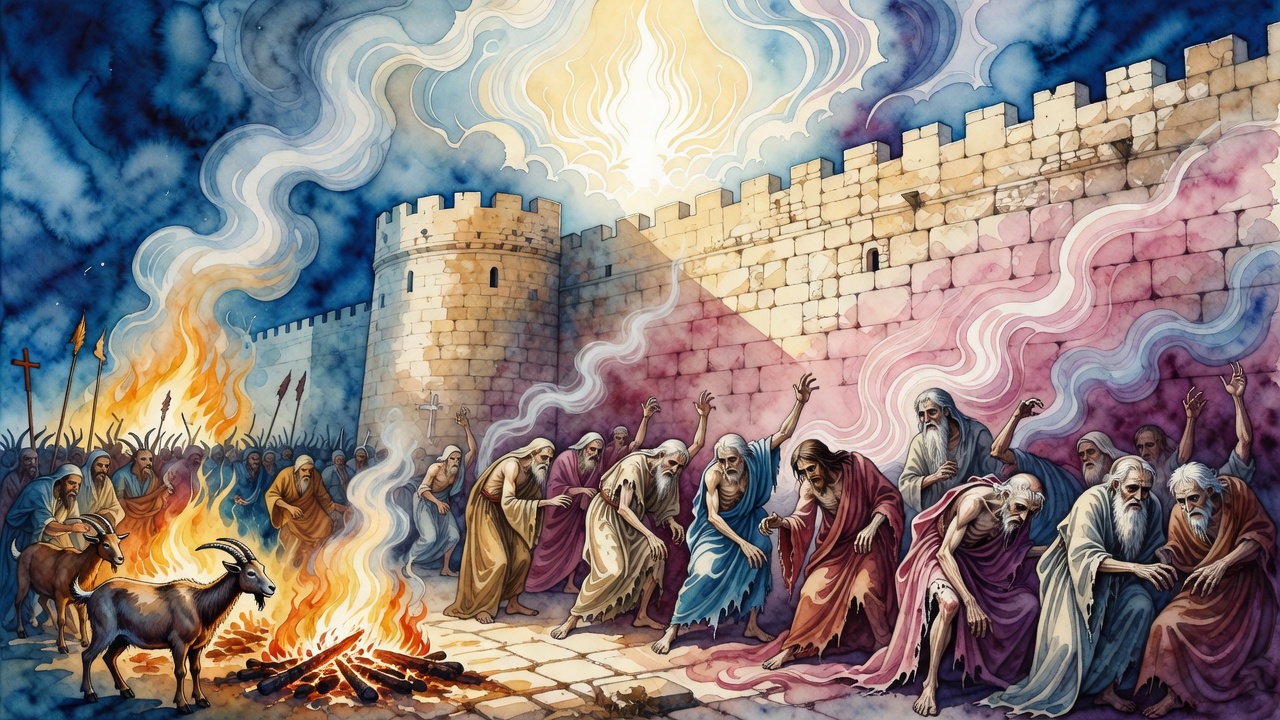
The siege began. The Temple burned. The families inside Jerusalem starved. The slave markets filled with daughters of priests.

Two Stories, One Logic

The Talmud later said that the Temple was destroyed because of sinat chinam, causeless hatred, and the story of Kamsa and Bar Kamsa was its evidence. A man humiliated at a dinner party. A host who would not take money for peace. A wound so unhealed that a man laid a city open to an empire to avenge it.

Tzafnat and Bar Kamsa stand at opposite ends of the same collapse. One is a victim of the catastrophe, sold at the gate of a city her grandfather had served. The other is its engineer, a man who turned personal grievance into geopolitical fact. The Talmud places both figures inside the same destruction, the daughter in the slave market and the schemer at the table, because the shame and the pride that produced the ruin were not opposites. They were different weights on the same scales.


← All myths

From the tradition

Sources

3 sources

The texts this telling draws on, in full. Open a card to read inline, or expand it for a wider, quieter read.

Gaster, Exempla of the Rabbis, No. 60The Exempla of the Rabbis (1924)

Her name was Tzafnat, daughter of Peniel, and her father had been high priest of Israel. She had grown up in the holiest household in the land, with the aroma of incense in her clothes and the gold of the breastplate flashing across the breakfast table.

Then Jerusalem fell. In 70 CE the Temple burned, the priests were killed or scattered, and their daughters were herded onto the slave markets of the Roman world, where women of noble blood fetched the highest price.

Tzafnat was put up for sale. The auctioneer began stripping her in the public square so that buyers could inspect the merchandise. Piece by piece, her clothing came off. When he reached for the last garment, she tore it off herself before he could touch her and stood fully exposed before the crowd. Then she spoke.

Behold, she said, there is no more beautiful woman in the world than I am.

It is an unbearable line, and the rabbis preserved it precisely because it is unbearable. They wanted the horror on the page. She was not boasting. She was taking the last scrap of power left to her, the power of naming what was being done, out of the auctioneer's mouth and into her own. The crowd had come to gaze; she made them witnesses.

This brief, devastating story in The Exempla of the Rabbis (Gaster, 1924) is a relic of what the destruction of the Second Temple actually did to families. The high priest's daughter ended up naked in a Roman market, and she refused to let the world look at her in silence.

Full source
Gaster, Exempla of the Rabbis No. 69 (1924); cf. Yoma 38bThe Exempla of the Rabbis (1924)

When the Roman siege tightened around Jerusalem in 70 CE, wealth stopped meaning anything. Doeg ben Yosef was a rich man, and in the final weeks of the siege he stood in the streets offering a full measure of gold for a mouthful of bread. No one sold.

He starved to death with his gold still in his hands.

His wife's story is darker. She had been pious in the years before the war, each year, she weighed her infant son on a scale and brought that weight in gold as a yearly offering to the Temple. The Temple had loved her and fed on her devotion.

In the siege, the Temple was burning. Food was gone. The infant she had weighed in gold year after year became the only meat she could find. She ate her own child.

Gaster's Exempla (No. 69, 1924) preserves the story as a warning about what happens when a city falls. (Lamentations 4:10) had already whispered it: The hands of merciful women have cooked their own children. The Churban, the destruction, was not only the collapse of walls. It was the collapse of every boundary a mother had believed she would never cross.

The sages told the story so that no generation would forget what siege actually costs. It is a warning and a grief folded into a single paragraph.

Full source
Exempla of the Rabbis, No. 70Exempla of the Rabbis (Gaster, 1924)

The story of Kamsa and bar Kam§a and the fall of Jerusalem. A man had company and had invited Bar Kamsa who was his enemy, by mistake. He afterwards turned him out in spite of his offer to pay all the expenses of the feast rather than be put to shame. Then Bar Kamsa went and denounced the Jews to the Emperor as having rebelled and as proof he asserted that they would refuse to accept an offering sent to the Temple. A lamb was sent which he mutilated on the way, in a manner not offensive to the Roman sacrificial laws but contrary to those of the Jews. For the sake of peace the Jews were inclined to offer it up, but Zachariah b. Abqulos prevented it as being contrary to the law. Le-

5*

- 68

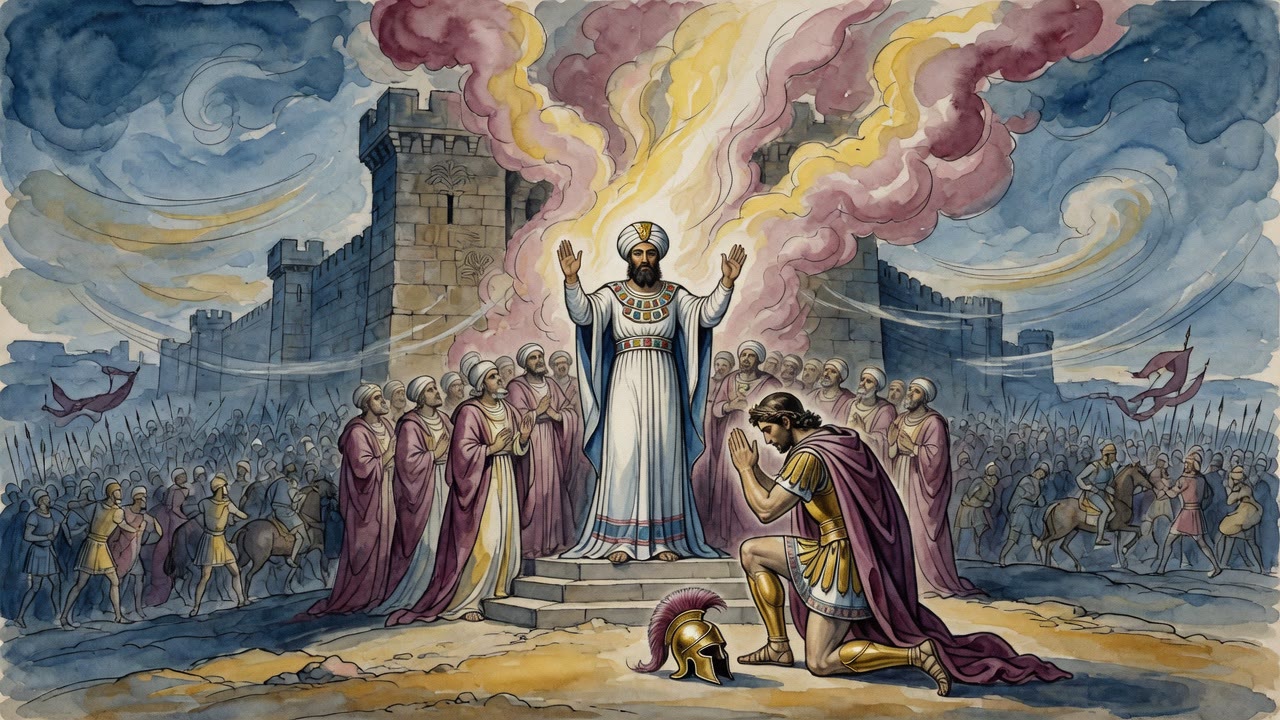
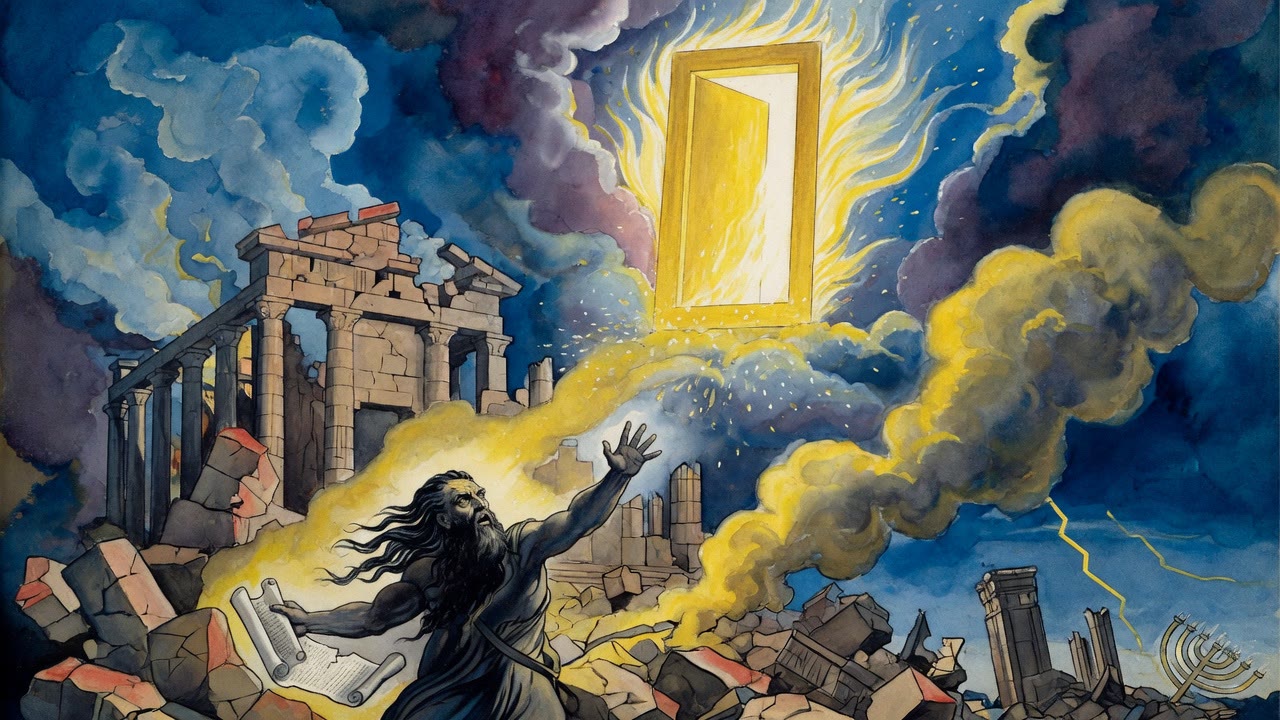
gions of Romans came to Jerusalem. The General shot arrows at the the corners and they all fell into Jerusalem. Asking a boy to say his verse the boy repeated the verse Ezek. 25. 14. This so impressed him that he became frightened and resigned the command, turned Jew, and became the progenitor of R. Heir. Then was Aspasianos sent, and the siege lasted for years. There were three rich men in Jerusalem: Nakdimon b. Gorion, Ben Kalba-Sabua, and Ben Sisith Hakaset who would have been able to provide Jerusalem with food during the whole siege but that the revolutionary party burned their stores in order that they might fight to the bitter end. The famine increased terribly and the people died in the streets. Then R. Johanan Ben Zakkai was smuggled by a ruse out of the town. Johanan went to the General who received him harshly. Johanan greeted him as Emperor. Soon afterwards the message of his election came. He was just then putting on his sandals, but he could not get the one on the second foot and he asked R. Johanan the reason, who said the good news had so elated him that his body had swollen up; let an enemy come before him and the foot would soon shrink to its normal size. The Emperor asked him why he had not come before. He replied that the rebels would not allow him to. Then he was asked: “If a snake is wrapped around a cask of honey, • do you not break the cask?" But he did not know the answer which should have been: “One takes pincers and lifts the snake away and so frees the cask without breaking it." The Emperor asked him what favour he could shew him and he merely asked to be allowed to settle in Yabne and that R. Sadok be cured, who had fasted 40 years to avert the destruction of Jerusalem and become a skeleton in consequence. This was granted him. Then was sent Titus the Wicked. He went blasphemously into the Temple and committed an immoral act on the scroll of the Law; then he took a sword and pierced the curtain in the middle of the Temple and by a miracle drops of blood oozed out. He said, “Now I have killed their God." When he re-

69

turned with all the spoil of the Temple a storm arose on the high seas and he said, “The power of their God is only in the waters. He has drowned Pharaoh and Sisera and now He wants to drown me. Let Him come and fight me on dry land/' And a voice came and said, “O thou wicked one! any one of my small creatures will suffice to war against thee." When he landed an insect got into his nostrils and from there to his brain and it gnawed for seven years. One day he passed a smith and the noise of the hammer silenced the insect. Then he called smiths who had continually to hammer; when the smith happened to be a heathen he paid him 400 Zuzim but when it was a Jew he said to him, “It is enough for thee to see the vengeance on your enemy," and paid him nothing. After a time the insect got accustomed to the noise of the hammers and there was no longer any relief. On his death he ordered his body to be burned and the ashes to be strewn over seven seas so that the God of the Jews should not be able to find him.

Full source