When Prophecy Was Trapped Inside Joseph's Dreams
Egypt's wise men misread seven cows as daughters, Pharaoh's firstborn dies the day Joseph is freed, and grain rots in every storehouse except one.
Table of Contents
 Click for full size
Egypt's Wise Men Saw Everything Except the Truth
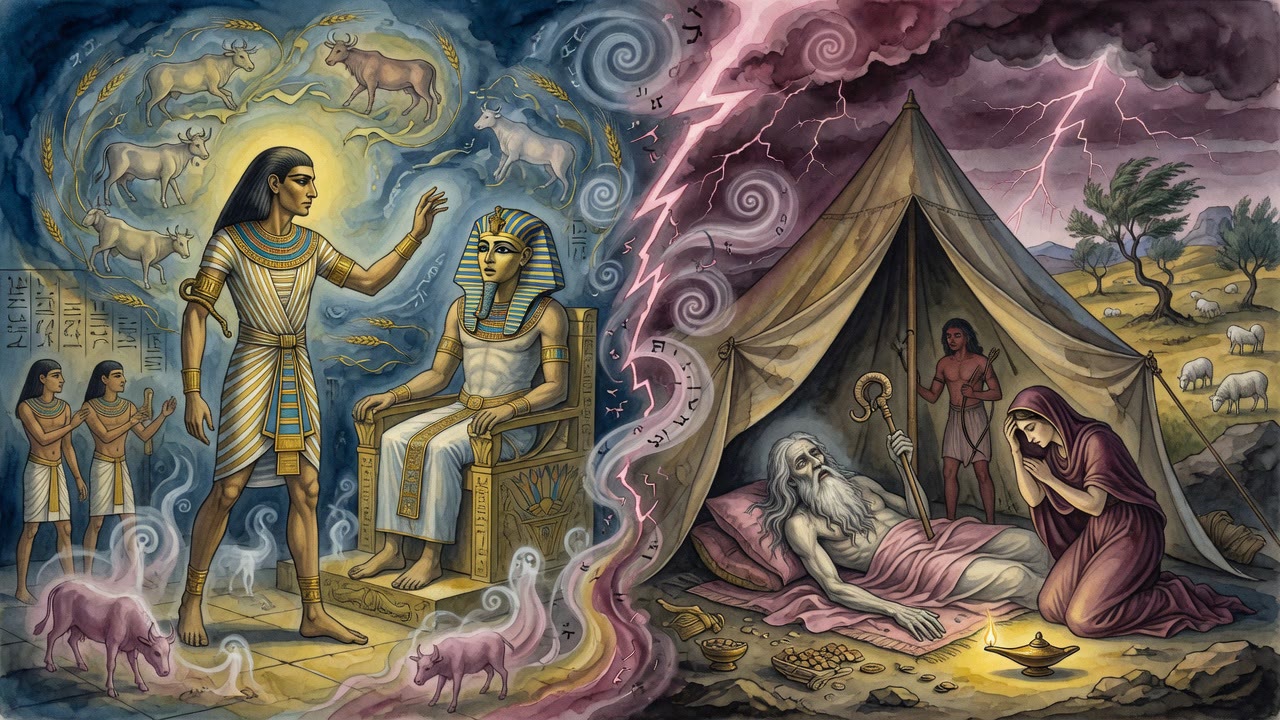
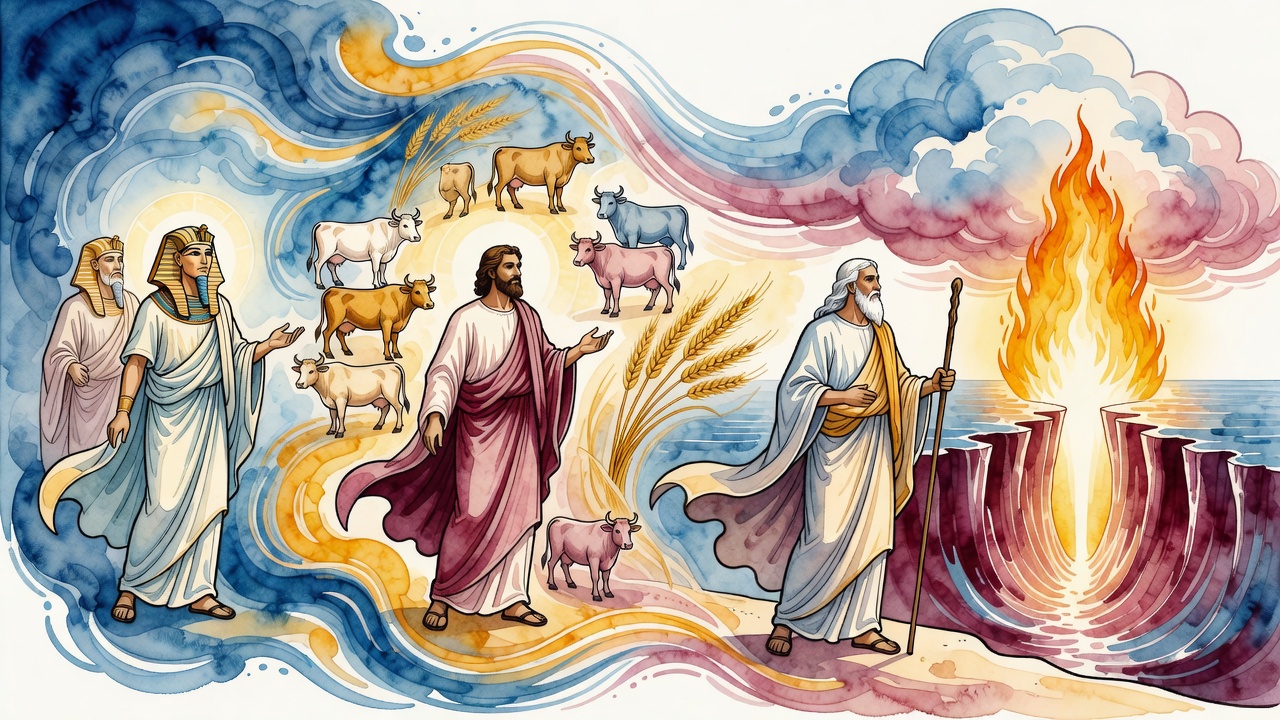
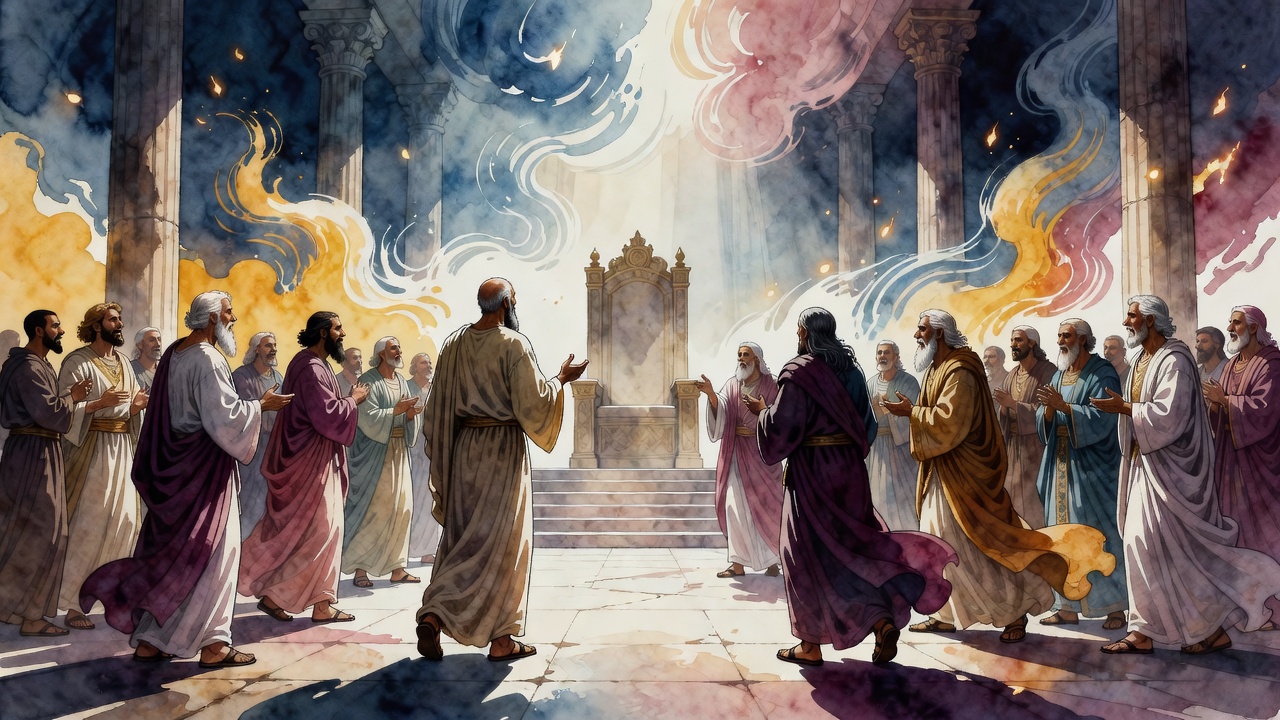
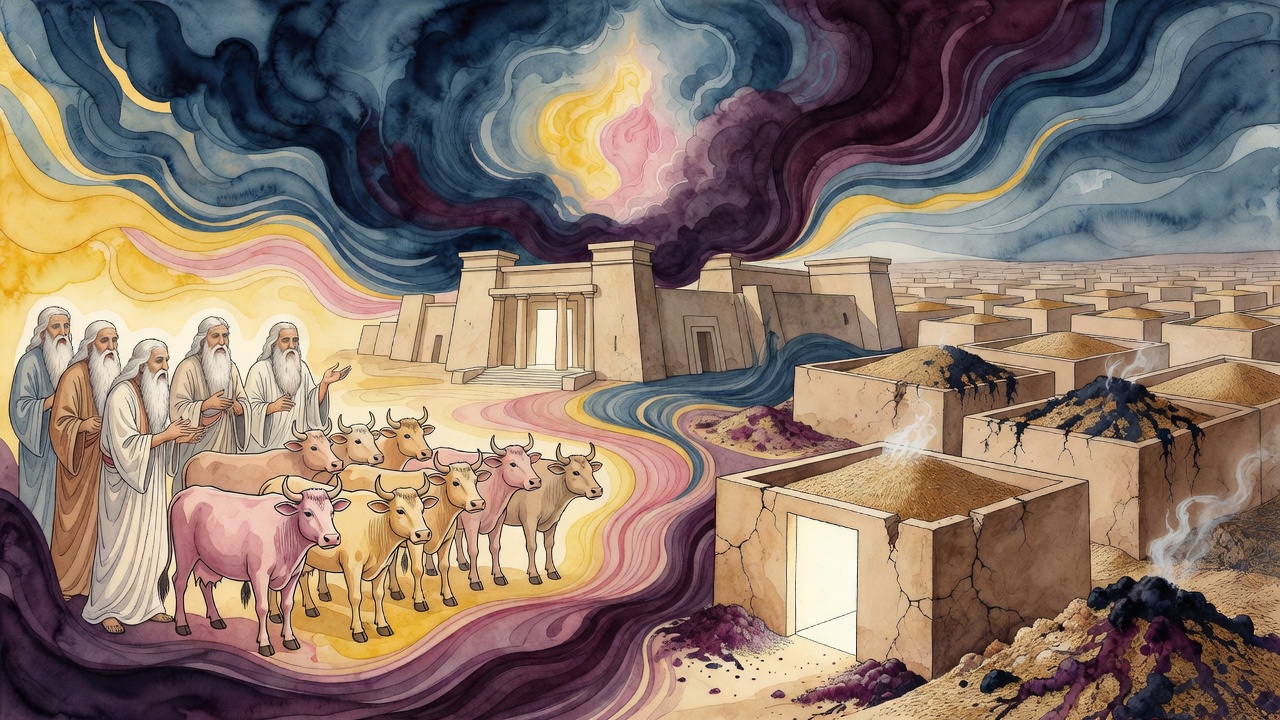
Seven fat cows came out of the Nile, and then seven thin cows came out after them, and the thin ones ate the fat ones and showed no sign of it. Pharaoh woke, fell asleep again, and dreamed of seven full ears of grain swallowed by seven blighted ones. He called all the magicians of Egypt, all the wise men, and told them his dreams. No one could interpret them for him.
The wise men were not incompetent. They were thoroughly competent at the kind of interpretation that a royal court requires: interpretations that are plausible, that flatter the ruler, that do not predict catastrophe, and that explain nothing. They said the seven cows were seven daughters Pharaoh would beget. Others said seven provinces he would conquer. Others named seven kings. Each interpretation was technically creative and completely wrong, because they read Pharaoh's dream as a private communication about Pharaoh's personal fortune rather than as a disclosure about the land itself.
The rabbis in Ginzberg's collected legends noticed the gap between the interpreters' apparent confidence and their actual blindness. A man who tells a king what the king wants to hear has not interpreted a dream. He has performed interpretation. Joseph, standing before Pharaoh two years after the butler forgot him, did not perform. He said what the dream meant: seven years of plenty followed by seven years of severe famine, and the famine would be severe enough that the years of plenty would be forgotten entirely.
The Day the Firstborn Died
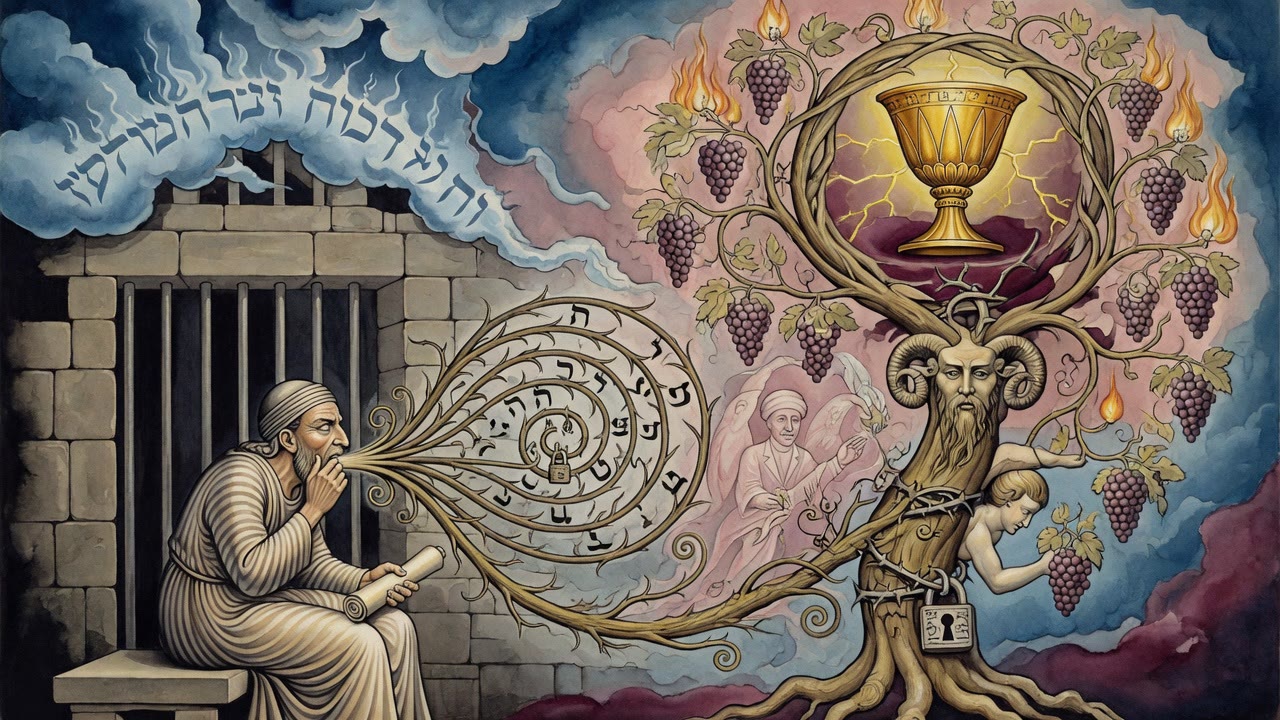
The night Joseph was released from prison was the night Pharaoh's butler finally remembered him. The butler remembered him because Pharaoh was troubled by his dreams and no one could interpret them, and the butler remembered the Hebrew prisoner who had correctly read dreams in the dungeon years before.
The legends preserved by Ginzberg add a detail that sharpens the timing: Pharaoh's firstborn son died on the same day that Joseph was released. The household of Pharaoh was in mourning while Pharaoh was also in crisis over his dream. The two catastrophes arrived together, the private grief and the prophetic demand, as if providence had arranged the pressure to be maximum at exactly the moment when Pharaoh's resistance to hearing something unwelcome was at its lowest.
Joseph emerged from prison, shaved, changed his clothes, and stood before the king who held every form of power the ancient world could concentrate in one man's hands. He told that man the truth, which the king's own wise men had refused to tell him, and Pharaoh heard it because he had nothing left to protect himself from it. The son was dead. The dream was terrifying. The prisoner was the only one in Egypt who spoke plainly.
The Grain That Rotted
During the seven years of plenty, Egypt stored grain across the land. The amounts were enormous. The preparation was thorough. And when the famine came, the stored grain in every storehouse except Joseph's had rotted.
This detail, preserved in the legendary traditions, explains why Egypt could not simply use the years of plenty to provide for the years of famine through its own foresight alone. The grain rotted because providence had arranged for Joseph's grain to be the only grain that remained viable. The famine's solution required that all roads lead to the Hebrew minister who had predicted it. There was no Egyptian workaround. There was no alternate supply. The world that came to Egypt for grain came to Joseph.
This is the mechanism by which a sold slave becomes the savior of his family and his people. Not through his own scheming, though he was clearly capable of scheming. Through the systematic removal of every other option until the option God had arranged was the only one remaining.
Asenath Pleaded at the Gate
When Joseph's brothers came to Egypt and he finally revealed himself to them, the moment was not only between brothers. Asenath, Joseph's Egyptian wife, had children with him, and those children had Egyptian mothers on one side of their lineage. When the brothers stood trembling before Joseph and he wept with a great cry, Asenath was there too.
The legends say that when the brothers had sold Joseph and the Ishmaelites were carrying him south, Asenath had been at her window and seen the caravan pass. She knew nothing about the boy in the caravan. She wept for him without knowing why. The legends connect that anonymous grief to the grace that came later: a woman who wept for a stranger without reason was given a reason for mercy later, and she pleaded before Joseph for the lives of the handmaids' sons, his brothers through the concubines, the ones whose status was most uncertain in the hierarchy of forgiveness Joseph was constructing.
Moses and the Angels of Egypt
Egypt had divine guardians, in the understanding of the ancient world: celestial powers who stood behind the earthly nation and fought its battles at the heavenly level when earthly battles were fought below. The plagues were not only agricultural and epidemiological disasters. They were victories over the patron powers of Egypt, each plague directed at a specific deity's domain.
Moses went up to heaven and found the angels of Egypt arguing against Israel's release. The celestial equivalent of Pharaoh's court was presenting its case, and the case was not obviously wrong: Israel had also sinned in Egypt. Israel had also worshipped there. Israel was not entirely clean. Why should this people be redeemed and not the nation that had held them?
The answer, in the legendary traditions, was not that Israel was more righteous. It was that the covenant was older than the sin, and the covenant belonged to God, not to the people's merit. Moses argued not Israel's case but God's case: "You made a promise to Abraham, Isaac, and Jacob. Your name is bound to that promise." The angels of Egypt could not answer that argument, because the covenant predated them.
Eldad and Medad Prophesied Outside the Tent
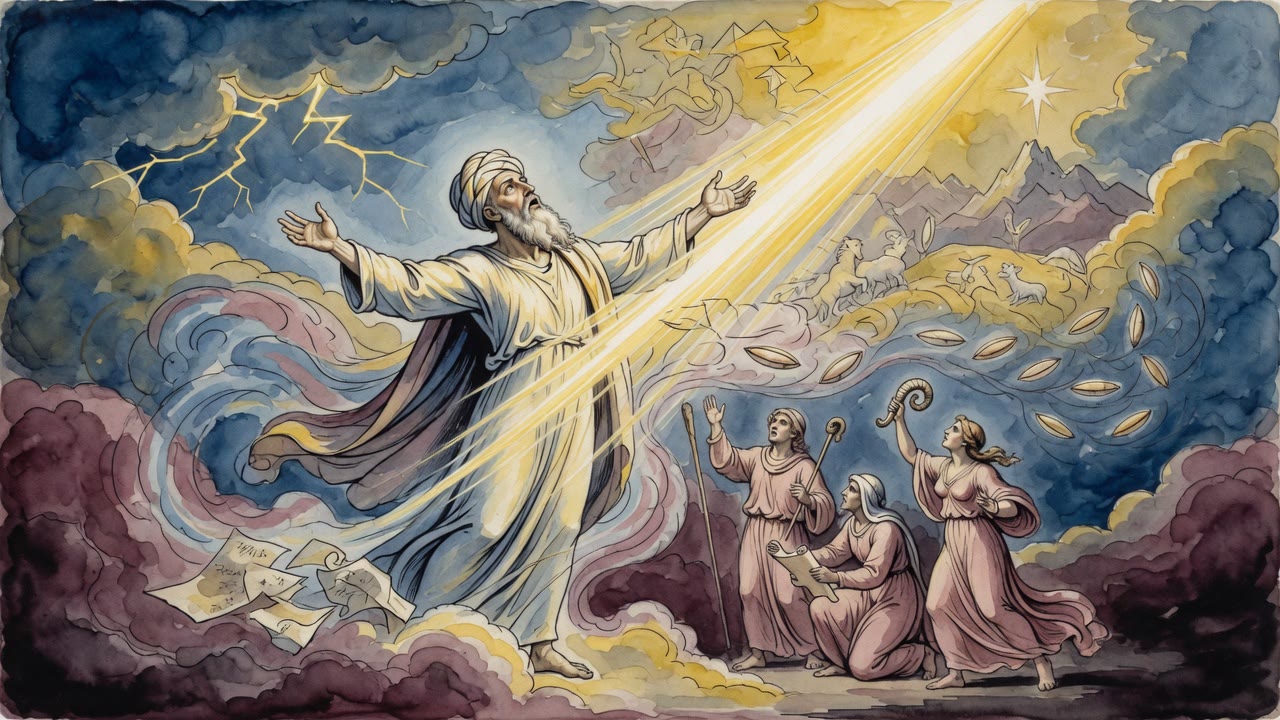
Among the seventy elders Moses gathered to share the burden of leadership, there were two who did not come to the tent. Eldad and Medad remained in the camp, and the spirit of prophecy came on them there anyway. They prophesied in the camp rather than at the appointed meeting place.
The legendary traditions identify Eldad and Medad as half-brothers of Moses, sons of Jochebed by a different father. Their prophecy was specific: Moses would die and Joshua would bring the people into the land. This was the content that made Joshua want Moses to stop them. Moses refused. The prophecy was true, and stopping true prophecy because it was uncomfortable would be the kind of action that undermines the very gift of prophecy itself.
Moses's response, that he would wish for all God's people to prophesy, is remembered as the most generous thing a person in his position could have said. He was the single greatest prophet Israel would ever have, and he expressed the wish that the gift be universal rather than concentrated. He did not protect his uniqueness. He offered it away.
← All myths