Parshat Matot6 min read

Zur Gave His Own Daughter and Scripture Wrote Him Third

The greatest of Midian's five kings walked his own daughter into the trap at Shittim, and the roll of the slain quietly buried his name third.

Curated by Arthur · Told by Maggid ·
Table of Contents
  1. The Markets Went Up at Shittim
  2. What Zur Handed Over
  3. The Spear Went Through Both of Them
  4. Moses Asked to See It Before He Died
  5. The Roll of the Slain Kings

The linen was cheap on purpose.

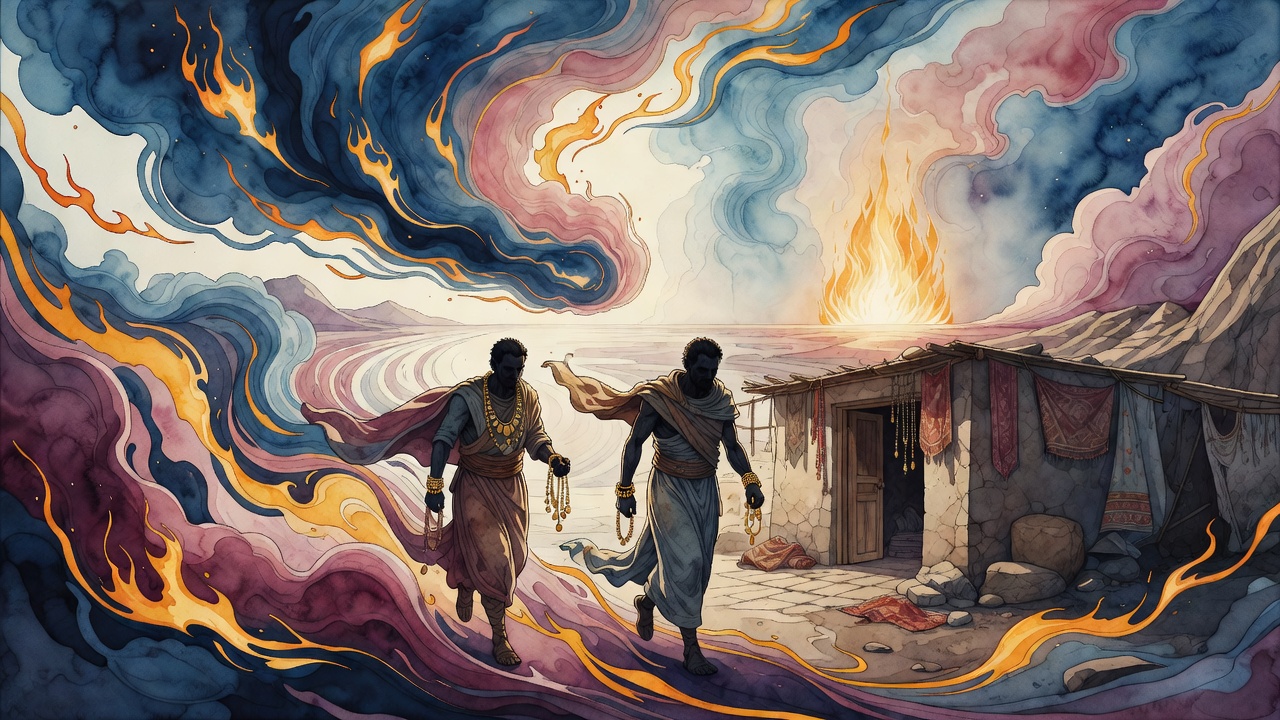
Zur Gave His Own Daughter and Scripture Wrote Him Third Click for full size

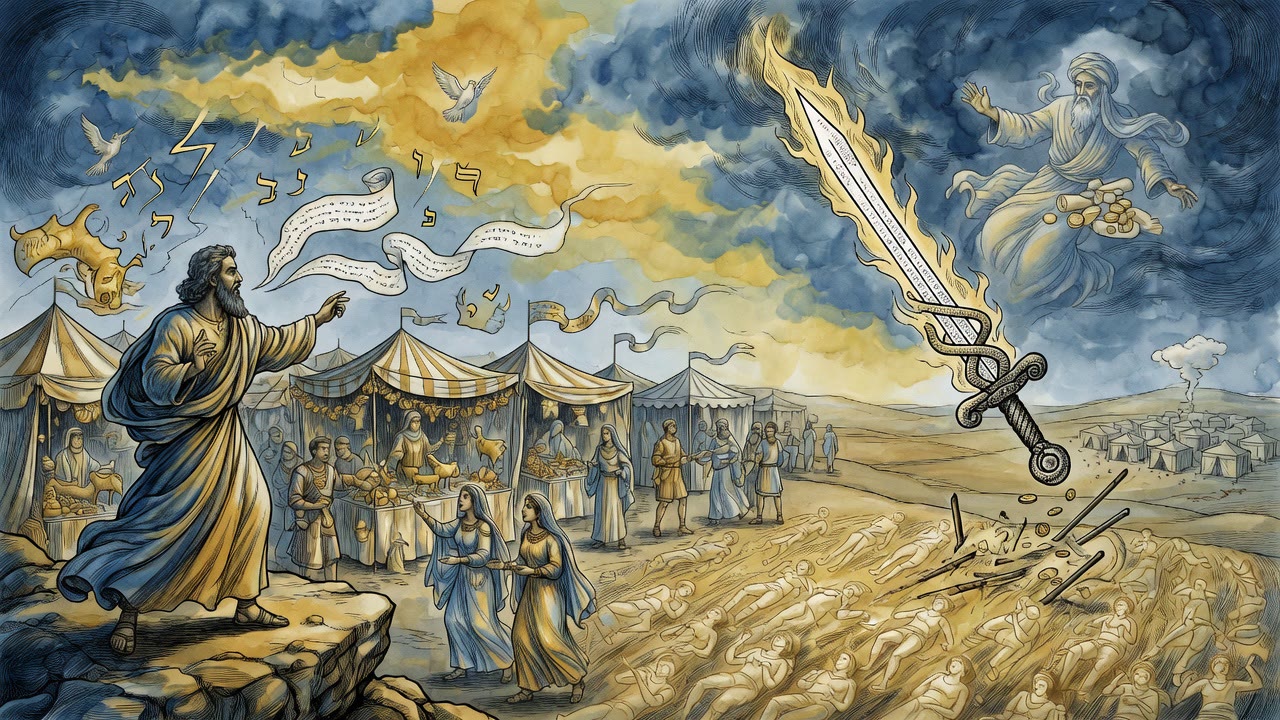
Old women worked the front of the stalls at Shittim, calling prices at the men who came down from the Israelite camp, and the younger women sat inside on cushions with the fine weave across their knees. The price dropped every time a man reached out to feel the cloth.

Israel had come off the wars against Sichon and Og with more plunder than the desert had ever shown them, and had wrecked half of it hauling it home, slitting garments open and gutting animals for the silver and gold. Forty years of manna, then this. The camp sat at Shittim, one syllable from sitoth, straying.

The Markets Went Up at Shittim

A man bought the cloth. Then there was wine, Ammoni wine, the wine of idolators, not yet forbidden, so he drank it. Then the woman reached into her clothes, set a small figure of Peor on the mat between them, and said, "Bow to this first."

Peor took no incense and no blood. A man uncovered himself in front of the idol, and that was the whole rite. Men who had stood at the mountain and heard the voice did it for a jar of wine and a length of flax. Then came the invitations to the banquets, and more of them veered off from the Torah of Moses.

Rabbi Elazar ben Shamua said it in carpentry. Pull a nail out of a door and the wood comes with it. Nobody walked away from Peor clean. Something came away attached.

What Zur Handed Over

Midian had five kings, and Zur was not merely one of them. He was the greatest, head of the nations of a father's house, which meant the other four had sat lower than he did their whole lives.

When the plan reached the tents of Midian, the objection was practical. Hired women could be smelled out. A prince of Israel would not throw his name away on a girl from a market stall. The plan needed a daughter of the royal house, a father who could be named.

Zur went and got Cozbi.

No wife stands in the doorway of that tent. No priest of Midian objects that a princess is not merchandise. Zur walked his own daughter out of the royal quarter and gave her to the scheme, and the four lesser kings kept quiet, because a king who will spend his own blood is a king nobody wants across the table.

The Spear Went Through Both of Them

The plague began while the judges were still being told to hang the guilty in the sun. Israel was dying at the rate of a battlefield. Into that, in broad daylight, Zimri, a prince of the tribe of Shimon, took Cozbi by the hand and walked her through the camp toward the tent of meeting while his own tribe cheered. Shimon had decided it was being singled out, and Zimri was answering for all of them.

Moses had nothing to say. Pinchas, grandson of Aaron, picked a spear up off the ground and went in after the two of them.

The killing was not clean, and it was not meant to be. The two were held together on the iron so nobody could later claim it had been something else. Their mouths were sealed shut. The lintel of the tent lifted itself so the camp could see through the doorway, and Zimri was turned over on top of Cozbi so every man outside knew whose bodies those were. Pinchas carried them out through a crowd of Shimonites who wanted him dead and could not lay a hand on him. The dying stopped at twenty-four thousand.

Moses Asked to See It Before He Died

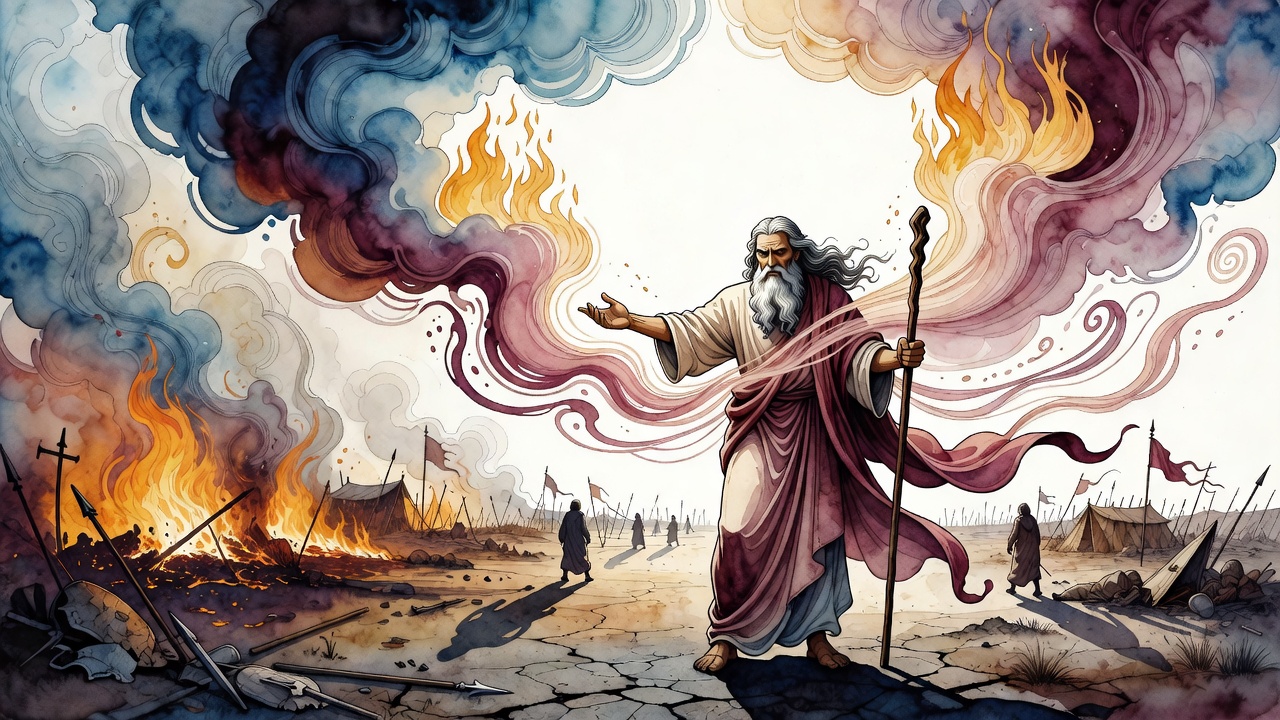
God gave Moses one more assignment. Take the vengeance of the children of Israel from Midian, and then be gathered to your people. The war was the last item on the list, and past it there was nothing but the mountain and the grave.

Moses did not stall the way he had stalled at the bush. He wanted this one. God does not withhold from a righteous man what he has asked to see with his own eyes, and what Moses asked for, at the end of a hundred and twenty years, was Midian brought to account and Balaam finished. Balaam had come to curse, failed, and sold Balak the market at Shittim instead. The righteous one rejoices when he beholds vengeance and washes his feet in the blood of the wicked. Moses was the righteous one. Balaam was the blood.

The Roll of the Slain Kings

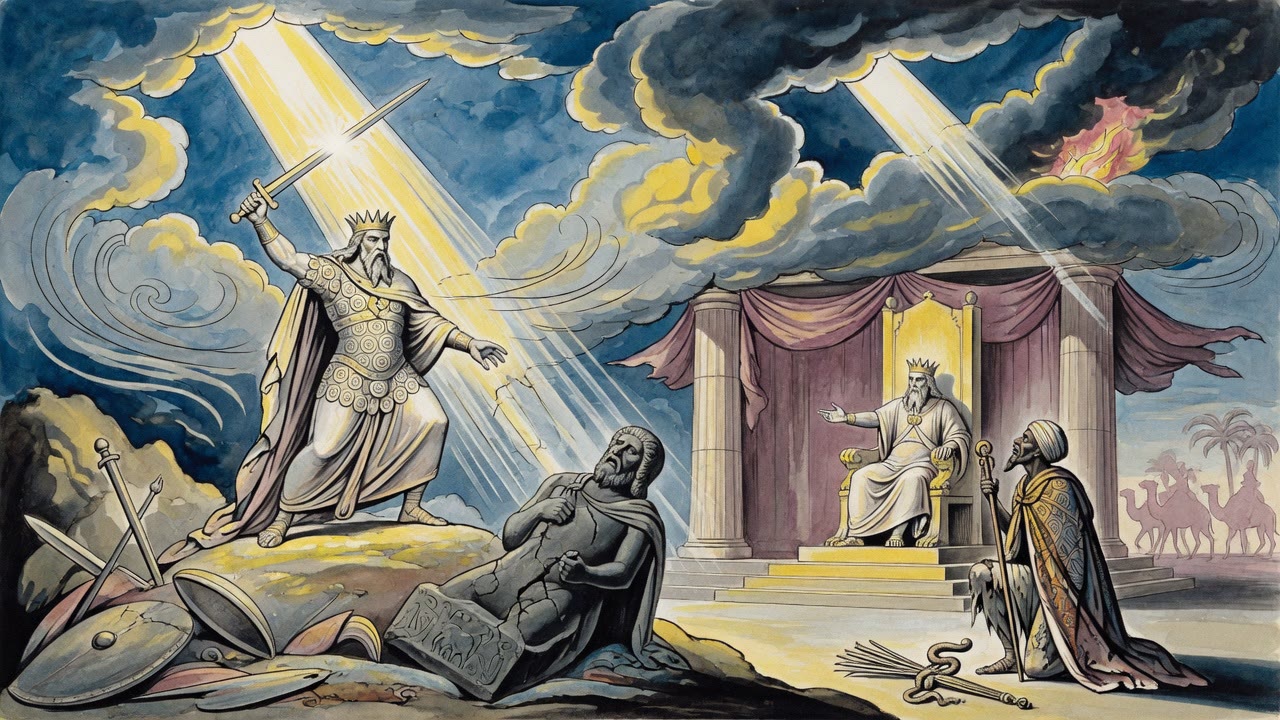
Twelve thousand went out, a thousand from every tribe, Pinchas at the head of them with the vessels of the sanctuary. The five kings died. Balaam died by the sword the same day, still in Midian, still collecting on his advice for breaking a people who could not be cursed.

Then came the counting, which took far longer than the fighting. The captives were sorted by whether a woman was old enough to have gone down to the stalls, and the small girls were kept alive and led off into the camp of Israel. Out of that sorting the sages later drew a rule about a girl who enters Israel before three years and a day, and whom she may marry among the priests. A war about ruin produced a law about belonging.

And then the scribes wrote out the list of the kings who had fallen. Evi. Rekem. Zur. Hur. Reba.

Zur was the greatest king Midian ever had, and his name sits third, wedged between two men who had spent their lives seated below him. Nobody struck it out. Nobody wrote a word of judgment next to it. He was moved down two places and left there, in the middle of a list, forever.


← All myths
From the tradition

Sources

4 sources

The texts behind this telling. Some cards carry a translation of the source; others are our own retelling of it, and each card says which. Every card links out to the original.

Midrash Tanchuma Buber, Pinchas 3:6Midrash Tanchuma Buber, Pinchas

Translation of the source text.Midrash Tanchuma (Buber), Public Domain, on Sefaria · CC-BY-SA

"And the name of the slain Midianite woman, etc." (Numbers 25:15). This is to inform you how far the Midianites had given themselves over: that they abandoned a daughter of kings to disgrace. "And the kings of Midian they killed [... and Zur]" (Numbers 31:8). Zur was the greatest of them all, but because he abandoned his daughter and exposed her publicly, Scripture diminished him and counted him third. But he was the greatest king of them all, as it is said: "head of the nations of a father's house in Midian he was" (Numbers 25:15).

Full source
Midrash Tanchuma Buber, Matot 6:1Midrash Tanchuma Buber, Matot

Translation of the source text.Midrash Tanchuma (Buber), Public Domain, on Sefaria · CC-BY-SA

Another interpretation of "Avenge the vengeance of the children of Israel" (Numbers 31:2). This is what Scripture says: "He does not withdraw His eyes from the righteous" (Job 36:7). What is the meaning of "He does not withdraw His eyes from the righteous"? The Holy One, blessed be He, does not withhold from the righteous what he desires to see with his own eyes. This teaches that Moses longed to see the vengeance upon the Midianites before he died. And concerning him it is said: "The righteous one will rejoice when he beholds vengeance" (Psalms 58:11). "The righteous one will rejoice", this is Moses. "When he beholds vengeance", the vengeance of Midian. "He will bathe his feet in the blood of the wicked one" (ibid.), this is Balaam.

Full source
Sifrei Bamidbar 157:6Sifrei Bamidbar

Retold in our words. Read the original at the link below.Sifrei by Rabbi Shraga Silverstein · CC-BY

It's a tough one, dealing with the aftermath of a battle against the Midianites. Specifically, verse 17 states: "And every woman knowing a man for carnal relations, kill."

Whoa. Heavy stuff.

The text then immediately clarifies in verse 18: "And all the little ones among the women who did not know carnal relations, keep alive for yourselves." So, what's going on here? What’s the criteria being used? Is it about women who have actually had intercourse, or women who are simply capable of it?

Sifrei Bamidbar, a rabbinic commentary on the Book of Numbers, grapples with this very question. The commentary points out that verse 18 makes it clear: the key is whether a woman is "fit for intercourse," meaning physically mature enough, regardless of whether she's actually had sexual relations.

But then the commentary asks, why is the word "kill" even repeated? Why not just say it once?

Well, the rabbis in Sifrei Bamidbar were meticulous in their reading of the Torah. They considered the possibility of a different interpretation. Without the second "kill," how would we know who should be killed along with the men? Would it be the women who had known men, or perhaps even all the children? The repetition of "kill" serves to connect the command to the preceding part of the verse, clarifying that the instruction to kill applies only to the women who were no longer considered virgins. It's about making sure the instructions are crystal clear, leaving no room for misinterpretation.

And then, almost unexpectedly, the commentary takes a fascinating turn. From this passage – this difficult, violent passage – R. Shimon b. Yochai, a towering figure in Jewish mystical tradition, derives a completely different principle. He rules that a female convert to Judaism who converted before the age of three years and one day is eligible to marry into the priesthood (Kohanim). From a text dealing with the brutal realities of war, a legal precedent is established regarding the status of child converts. How do we get there?

The connection lies in the idea of maturity and eligibility. Just as the verse differentiates between women who are capable of sexual relations and those who are not, R. Shimon b. Yochai applies a similar logic to conversion. A child convert under a certain age is considered to have converted without full understanding or agency, and therefore their status is unique.

It's a surprising, almost jarring juxtaposition. A passage about war and death gives rise to a ruling about marriage and religious standing. But perhaps that's the point. Even in the darkest corners of the Torah, even in the most troubling narratives, we can find unexpected sparks of wisdom and legal insight. It forces us to look beyond the surface, to confront complexity, and to find meaning in the most unlikely of places. What do you think?

Full source
Sifrei Bamidbar 131:2Sifrei Bamidbar

Retold in our words. Read the original at the link below.Sifrei by Rabbi Shraga Silverstein · CC-BY

The Book of Numbers, or Bamidbar in Hebrew, recounts a particularly troubling episode in the Israelites' wanderings. Specifically, our source today comes from Sifrei Bamidbar 131, and plunges us into the heart of a moral crisis at a place called Shittim. But the name itself hints at what’s to come. The text notes, with a grim sort of wordplay, that Shittim sounds like the Hebrew word sitoth, meaning "straying" – straying from God, from their purpose, from everything they were meant to be.

After great victories against Sichon and Og, kings of immense power, the Israelites found themselves swimming in spoils. They had conquered lands overflowing with resources, a stark contrast to the barren desert they had known. But instead of using their newfound wealth wisely, they became wasteful. The text says they "spoiled" the spoils, tearing apart garments and animals, caring only for silver and gold. It's a vivid picture of excess and a loss of perspective.

That's when the real trouble started.

The people settled in Shittim, and the Moabites and Ammonites saw an opportunity. They set up markets, strategically placing alluring women – older ones to lure the men in, and younger ones to seal the deal. These women offered flaxen garments at tempting prices. It was a classic honey trap, a carefully constructed scheme to lead the Israelites astray.

As the men indulged in food and drink, they were enticed by the women. One would offer wine, specifically "Ammoni wine," the wine of idolators, which hadn't yet been forbidden. Under its influence, the women would suggest bowing down to Peor, a local deity. The act of worship was particularly degrading: baring oneself before the idol. It’s a disturbing image, this blatant disregard for their covenant with God.

The downward spiral continued. The women encouraged the men to "veer off" from the Torah of Moses, as (Hosea 10:10) puts it. They were invited to idolatrous banquets, further entangling them in foreign practices. The lure of the forbidden proved too strong for many.

Rabbi Elazar b. Shamua offers a chilling analogy: just as a nail cannot be removed from a door without wood attached, an Israelite could not leave Peor without souls attached – without being stained by its corruption.

The text even includes a few shocking anecdotes that show just how pervasive this corruption became. One story tells of a man named Pinchas, who, after being assailed by the "spirit of Peor," defended himself with a spit. Another tells of a man from Ullas who hired his donkey to a gentile woman, and ended up participating in the idol worship himself, just to fit in. There’s even a tale of a governor who tried to worship Peor with a sacrifice, only to be met with scorn, as the locals explained that the true worship involved indecent exposure. Disgusted, he slaughtered them.

These stories, though brief, paint a disturbing picture of a society losing its way, succumbing to temptation, and abandoning its moral compass. It highlights the dangers of assimilation and the seductive power of idolatry.

The consequences were swift and severe. God commanded Moses to "take all the heads," the judges of the people, and hang them up. Moses instructed the judges to slay those who had joined themselves to Ba'al Peor. A plague broke out, and thousands died.

And then, we have the infamous story of Zimri, a prince of the tribe of Shimon. Defiantly, in broad daylight, he brought a Midianite woman, Kozbi, into the Israelite camp. It was a brazen act of rebellion, a slap in the face to Moses and the entire community. The tribe of Shimon even taunted Zimri, urging him on because they believed the other tribes were unfairly targeting them.

At this moment of crisis, Pinchas, the grandson of Aaron, stepped forward. Filled with righteous zeal, he grabbed a spear and entered Zimri's tent. In a single, decisive act, he pierced both Zimri and Kozbi, ending the plague.

The Sifrei Bamidbar describes a series of miracles that occurred during this act, emphasizing the divine intervention. The couple was held together, their mouths sealed, and they were transfixed in a way that left no doubt as to their sin. The lintel of the tent was lifted so that all could see, and Pinchas was protected from the wrath of Zimri’s tribe. The text even says that Zimri was overturned upon Kozbi, so that all could see that their death was ordained.

(Psalm 106:30-31) says, "Then Phinehas stood up and intervened, and the plague was stayed. And that was reckoned to him as righteousness, from generation to generation forever."

This narrative is brutal, shocking, and deeply disturbing. It serves as a stark warning about the dangers of temptation, the importance of moral leadership, and the consequences of straying from one's spiritual path. It raises difficult questions about zealotry, divine justice, and the role of violence in maintaining moral order.

It is a call to vigilance, a reminder to guard our hearts and minds against the allure of the forbidden, and to remain steadfast in our commitment to a higher purpose. How do we ensure that we don't repeat the mistakes of the past? How do we remain vigilant against the forces that seek to lead us astray? These are questions we must continue to confront, as individuals and as a community, if we are to learn from the tragic story of Shittim.

Full source