Parshat Lech Lecha5 min read

Abraham's Mule Smashed the Idols at the Inn

Before Abraham became the great icon-breaker, his mule panicked at a Syrian inn and broke three idols. The first crack came by accident.

Curated by Arthur · Told by Maggid ·
Table of Contents
  1. The Mule Did the First Breaking
  2. The Famine Tested the Promise
  3. The Cattle Had Their Mouths Bound
  4. The Exile Was Shortened for the Ancestors

Abraham rode to the inn with idols packed for sale.
Not yet the smasher. Not yet the man whose name would stand against the trade of his father's house. A young merchant with a mule, goods, and the practical worry of returning home with enough money. The inn was where merchants from Fandana in Syria stayed on their way to Egypt, and Abraham came ready to do business in the family line.

Then a camel belched.

The Mule Did the First Breaking

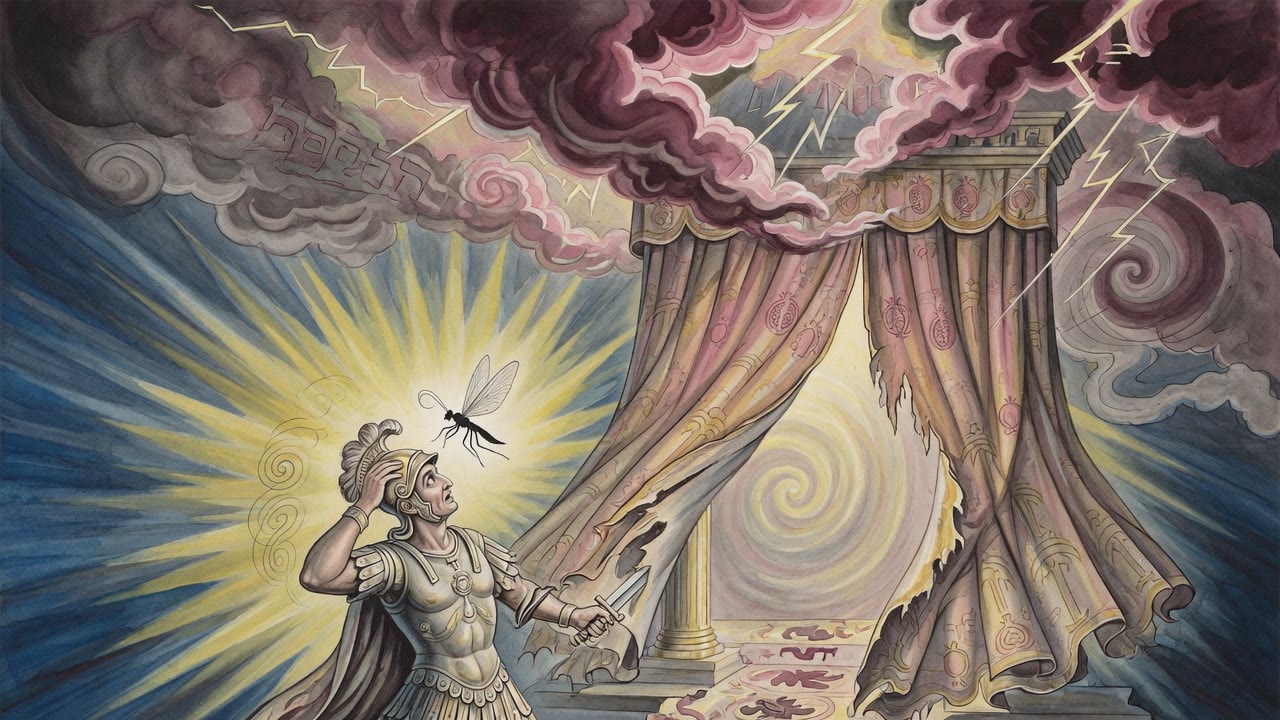
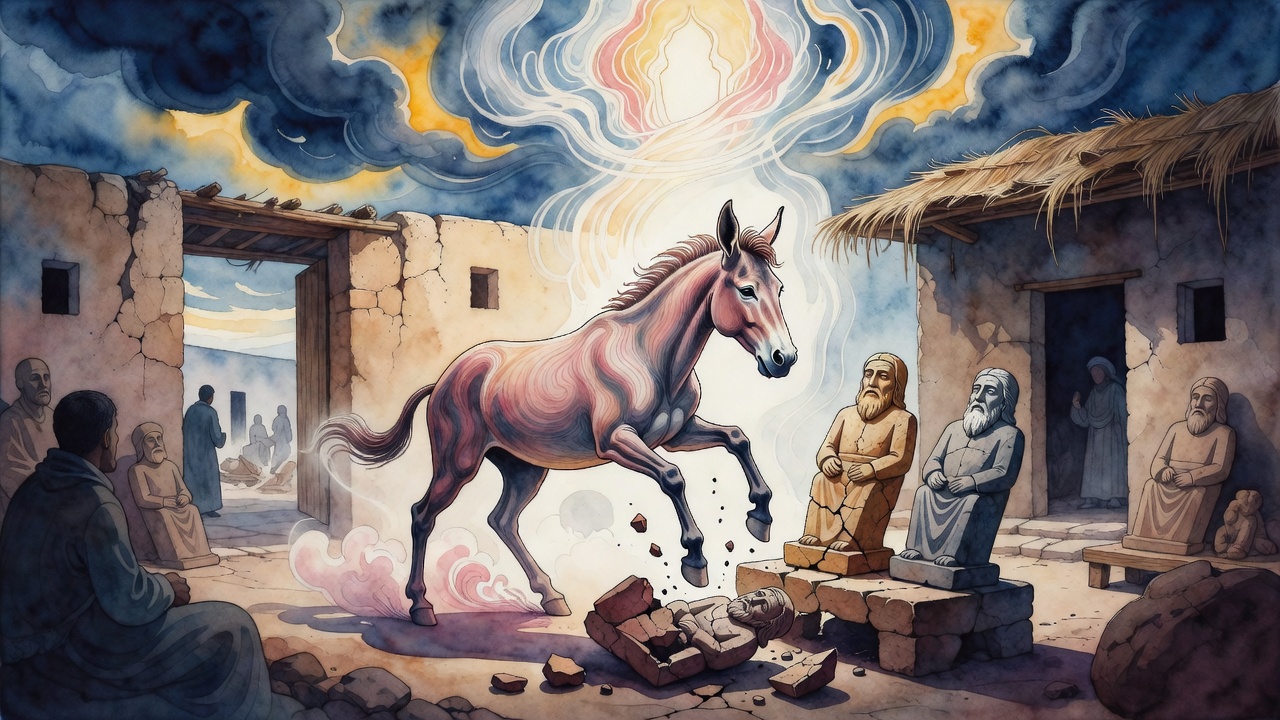
The sound startled Abraham's mule. The animal bolted through the inn, hooves and panic turning commerce into wreckage. Three idols smashed before anyone could turn the beast back.

There is a strange mercy in how undignified it was. No sermon. No public act of defiance. No young Abraham standing over broken images with a theological speech prepared in his throat. Just a noise from a camel, a frightened mule, and three gods lying in pieces on the floor.

Abraham still had to face the practical loss. Broken idols meant missing money. Missing money meant Terah's anger. So he did what a merchant does. He explained the trouble, worked the room, and sold the two unbroken idols. The merchants even paid him for the broken ones after he told them how much he feared returning with less than expected.

The idols failed twice that day. They could not protect themselves from a mule, and they still had market value as broken merchandise.

The Famine Tested the Promise

Later, when Abraham had already been called into Canaan, the land itself failed under him.

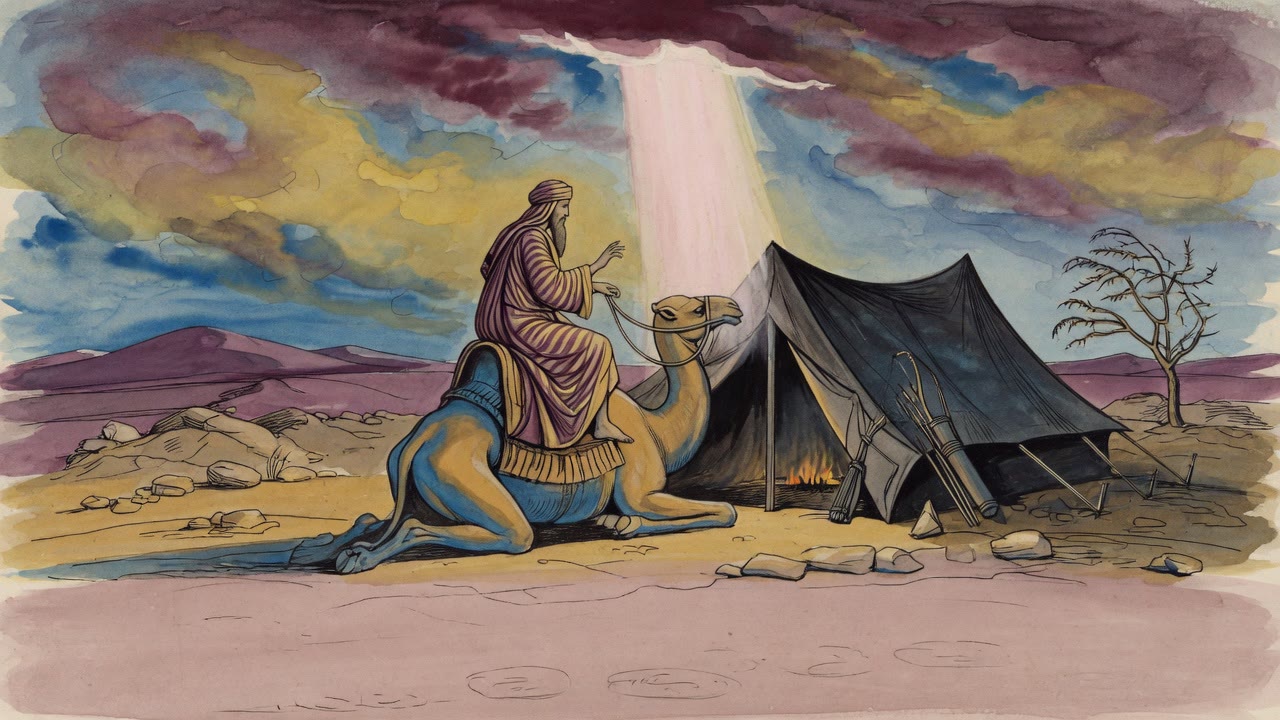
God had told him to go, and he went. Then famine struck that very land, not every land, but Canaan in particular. The promise was under his feet, and the promise could not feed him. Abraham did not rage at heaven. He did not say the call had been a trick. He moved toward Egypt because survival required movement, and because Egypt held its own wisdom, its priests, its systems, its claims about the world.

He went hungry into the country of abundance, ready to learn what could be learned and to teach truth where truth was needed. The former idol seller was no longer only a man trying to bring coins home to his father. He was becoming a man who could enter another civilization without letting that civilization define what was real.

The Cattle Had Their Mouths Bound

When Abraham returned from Egypt, wealth came with him. So did trouble.

His herds and Lot's herds filled the land until the pastures could not carry the household peacefully. Abraham's shepherds muzzled his cattle so they would not graze on land that was not theirs. Lot's shepherds let their animals feed freely and answered the accusation with a cruel piece of theology. God had promised the land to Abraham's seed, they said, and Abraham had no child. Lot would inherit. The cattle were only eating what would one day belong to their master.

The insult had teeth. It touched Abraham's barrenness, his future, and the promise itself.

God's answer defended both justice and timing. Yes, the land would be given to Abraham's descendants. Not now. The Canaanites and Perizzites still lived there and still had right of habitation. A promise for tomorrow does not license theft today.

The Exile Was Shortened for the Ancestors

Abraham's life kept placing delay beside promise.

He was promised seed before the seed came. He was promised land while others still held it. He was told his descendants would be strangers in a land not theirs, yet the later reckoning would be shortened by the merit of the fathers and mothers. The patriarchs were the mountains of the world, the matriarchs the hills, and redemption would come leaping over them.

That makes the mule at the inn more than a comic beginning. Abraham's first broken idols did not make him righteous in a moment. They introduced the pattern. False things break before the person holding them knows how to live without them. Then come famine, Egypt, family conflict, restrained cattle, waiting for a child, waiting for land, waiting through history itself.

The first crack came by accident. The life that followed turned accident into obedience.


← All myths
From the tradition

Sources

4 sources

The texts this telling draws on, in full. Open a card to read inline, or expand it for a wider, quieter read.

Legends of the Jews 5:71Legends of the Jews

Abraham saddles up his mule, ready to head to the local inn. This wasn't just any inn,. It was the place where merchants from Fandana in Syria stayed when traveling to Egypt. Abraham hoped to sell his goods there.

What were these "goods"? Well, they weren't exactly…kosher. Abraham was selling idols. Yes, you read that right. This is before his great awakening, before his rejection of idolatry. He was, in fact, participating in his father’s trade.

He arrives at the inn, ready to do business. But then, bam! Disaster strikes.

One of the merchants' camels lets out a mighty belch. Now, mules, as we know, can be a bit skittish. Abraham's mule, startled by the sudden noise, bolts! It runs wild, careening through the inn and, in the process, smashing three of Abraham’s idols. Can you imagine the scene? Chaos!

What a setback. You'd think Abraham would be out of luck. Three broken idols mean less money to bring home. His father would be furious.

But here’s where the story takes a surprising turn. The merchants, witnessing the whole spectacle, bought the two remaining, undamaged idols from him. Okay, that’s something. But here's the kicker: they also gave him the price of the broken ones! What?! Why?

Because Abraham, ever the salesman, explained his predicament. He told them how upset he was at the thought of returning to his father with less money than he had anticipated. He played on their sympathy.

And it worked! The merchants, perhaps amused by the situation, perhaps feeling a bit sorry for the young man, compensated him for his losses.

It's a fascinating little story, isn't it? It shows us Abraham before he was Abraham. A young man working through the world, trying to make a living, even if it meant participating in something he would later vehemently oppose. It reminds us that even our greatest heroes have humble beginnings, and that sometimes, even a camel's burp can lead to unexpected opportunities. Or at least, a slightly padded purse.

What do you think this story tells us about the nature of change? About how we all start somewhere on our journey?

Full source
Legends of the Jews 5:95Legends of the Jews

It wasn't a coincidence.

See, the famine that struck during Abraham's time? It wasn’t just a random act of nature. According to Legends of the Jews, specifically volume one, this famine only ravaged Canaan. And the reason for it? To test Abraham's faith.

He had already faced one major test: leaving his homeland at God's command. Now, he was being asked to trust again, even as the land he'd been promised was crumbling under the weight of starvation.

Did he complain? Did he question God's plan? Nope. The text emphasizes that he "murmured not, and he showed no sign of impatience toward God." for a second. It’s a powerful image of unwavering faith, isn't it? He had been asked to leave his native land for… a land of starvation!

So, what did Abraham do? He took action. The famine forced him to leave Canaan temporarily, and he headed to Egypt. But it wasn't just about finding food. There was a deeper purpose at play.

Abraham sought to "become acquainted there with the wisdom of the priests and, if necessary, give them instruction in the truth." This is fascinating. He's not just a passive recipient of knowledge. He's ready to engage, to learn, and even to teach. He wasn't just seeking refuge; he was on a mission.

It makes you wonder, doesn't it? What tests are we facing in our lives? And are we meeting them with the same faith and purpose as Abraham? Maybe, just maybe, the challenges we face aren't just obstacles, but opportunities to learn, grow, and share our own understanding of truth with the world.

Full source
Legends of the Jews 5:109Legends of the Jews

Even Abraham, our patriarch, wasn't immune.

The scene: Abraham, fresh from his sojourn in Egypt, returns home. Life should be good. But trouble is brewing. It starts, as it often does, with something seemingly small: cattle. Specifically, the cattle of Abraham and his nephew Lot.

In Ginzberg's retelling in, Legends of the Jews, strife erupted between the herdsmen. Abraham, ever mindful of ethical conduct, equipped his herds with muzzles, likely to prevent them from grazing on land that wasn't theirs. Lot, however, didn't follow suit.

Picture the confrontation. Abraham's shepherds, seeing Lot's cattle grazing freely, likely confronted Lot's herdsmen. And what was their response? It's a doozy. They essentially said, "Look, we know God promised this land to Abraham's descendants. But let's be real. Abraham is barren, a sterile mule, as they put it. He's not going to have kids. Lot is next in line. So, technically, our cattle are just eating what will eventually belong to us anyway!" Can you imagine the audacity?

It's a harsh statement, isn't it? A real low blow. They were questioning God's promise and Abraham's very future.

But here's where it gets interesting. God, as He often does, intervenes. "Verily," He declares, "I said unto Abraham I would give the land unto his seed, but only after the seven nations shall have been destroyed from out of the land. To-day the Canaanites are therein, and the Perizzites. They still have the right of habitation."

This is a key point. God reaffirms His promise to Abraham, but adds a crucial condition. The land won't be his immediately. There's a process, a timeline. The Canaanites and Perizzites, the current inhabitants, still have their claim.

This little story, tucked away in Legends of the Jews, is more than just a tale of squabbling shepherds. It's a reminder that even the most righteous among us face challenges, doubts, and familial tensions. And it's a evidence of God's patience, His unwavering commitment to His promises, and the intricate, often delayed, unfolding of His divine plan. It makes you think, doesn't it, about how we perceive promises – both given and received? And about the faith required when the fulfillment isn't immediate?

Full source
Pirkei DeRabbi Eliezer 48:3Pirkei DeRabbi Eliezer

The story starts with Rabbi Elazar, son of 'Arakh. He makes a rather pointed claim: God only told Abraham about his descendants’ future exile after Abraham was able to have children. As the verse says, "Thy seed shall be a stranger in a land that is not theirs" (Genesis 15:13). Rabbi Elazar figures that from Isaac's birth to the Exodus, it should be about 400 years.

Then comes Rabban Jochanan, son of Ẓakkai, a towering figure of the Talmudic era, with a challenge! He points to a verse in Exodus (12:40): "Now the sojourning of the children of Israel, which they sojourned in Egypt, was four hundred and thirty years." A discrepancy! So, how do we bridge this 30-year gap?

Rabbi Elazar comes back with a clever explanation. He argues that the Israelites were actually in Egypt for 210 years. He says, five years before Jacob even arrived in Egypt, Joseph already had two sons, Manasseh and Ephraim, who are counted as Israelites. This brings the total to 215 years. Now, here’s the kicker: Rabbi Elazar says, "215 years of days and nights. equals 430 years!" Essentially, he's suggesting a kind of doubling – a way to reconcile the numbers.

The story doesn’t end with just a mathematical equation. What’s really going on here? Why the seeming numerical gymnastics? The text offers a profound reason: "For the Holy One, blessed be He, reduced the time for the sake of the merit of the Patriarchs… and for the sake of the merit of the Mothers." God, in His mercy, shortened the period of suffering because of the righteousness of Abraham, Isaac, and Jacob, and also of Sarah, Rebecca, Leah, and Rachel. These founding figures are described poetically as "the mountains of the world" (the Patriarchs) and "the hills of the world" (the Matriarchs). And the verse from the Song of Songs (2:8) beautifully illustrates this: "The voice of my beloved! Behold, he cometh, leaping upon the mountains, skipping over the hills."

This image of God "leaping" and "skipping" speaks to a divine eagerness to redeem His people. The merit of the ancestors acts as a kind of spiritual catalyst, accelerating the process of redemption.

So, what does this all mean? It’s more than just a historical debate about timelines. It's a story about divine compassion, about the power of righteous ancestors, and about the idea that even in the face of suffering, redemption is always possible, sometimes even arriving sooner than expected. It reminds us that the actions of those who came before us can have a profound impact on our own lives, and that God is always attentive to the cries of His people. It gives us hope, doesn't it?

Full source