Parshat Balak5 min read

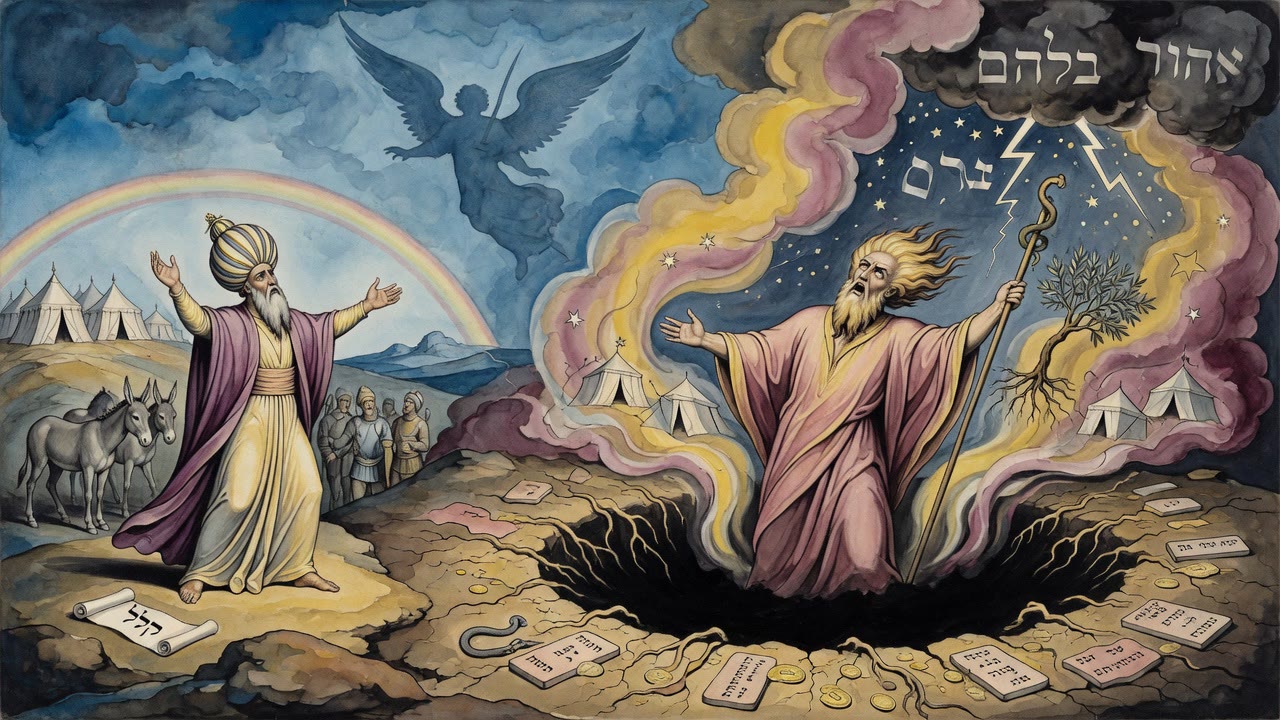
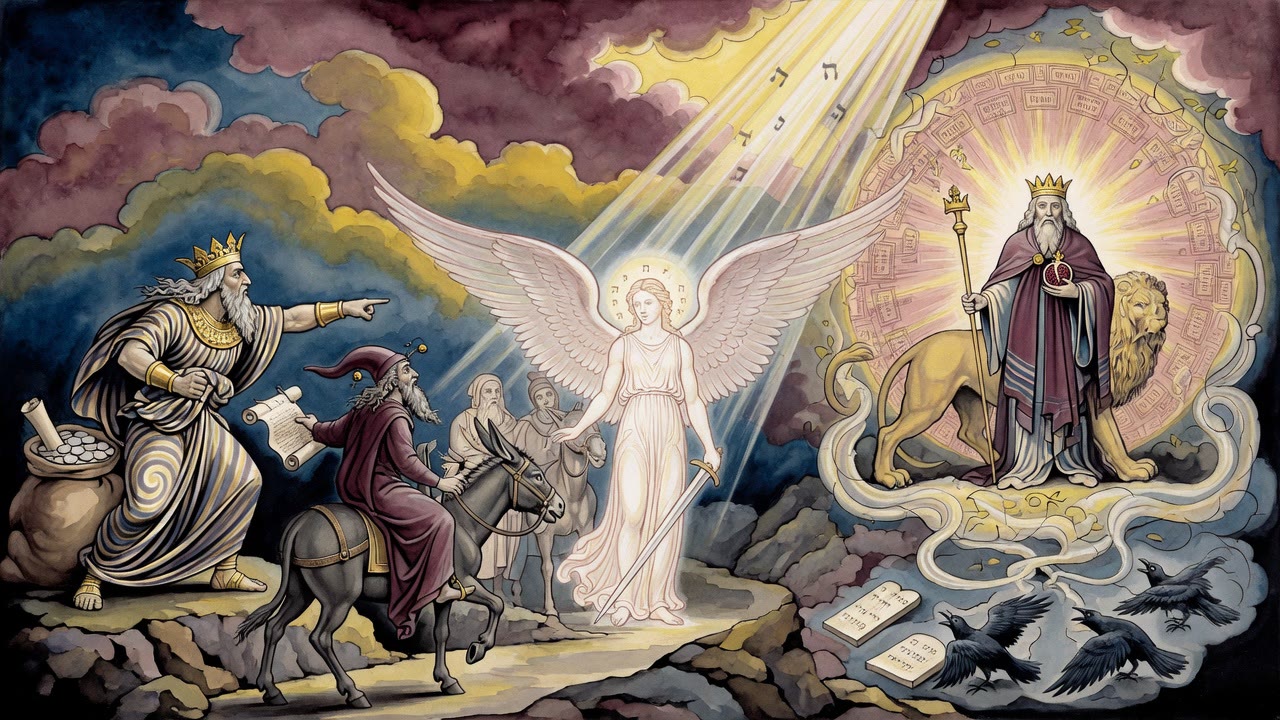
Balaam Confesses Ingratitude on Moab Heights

Balak sent a bird toward the springs of impurity to fetch older powers. It came back with its wings charred, and the altars kept smoking anyway.

Curated by Arthur · Told by Maggid ·
Table of Contents
  1. Kings Counting a People They Fear
  2. The Ingrates on the Ridge
  3. The Bird That Came Back Burned
  4. A People That Dwells Alone
  5. What the Heights Refused to Sell
Balaam Confesses Ingratitude on Moab Heights Click for full size

Kings Counting a People They Fear

Around counsel fires, kings muttered the same uneasy line: their God helps them as long as they keep His law, and while that holds, no one can break them. The words were half respect, half strategy. If law was Israel's wall, then a hired mouth might find a crack where swords could not.

Balak of Moab sent for Balaam.

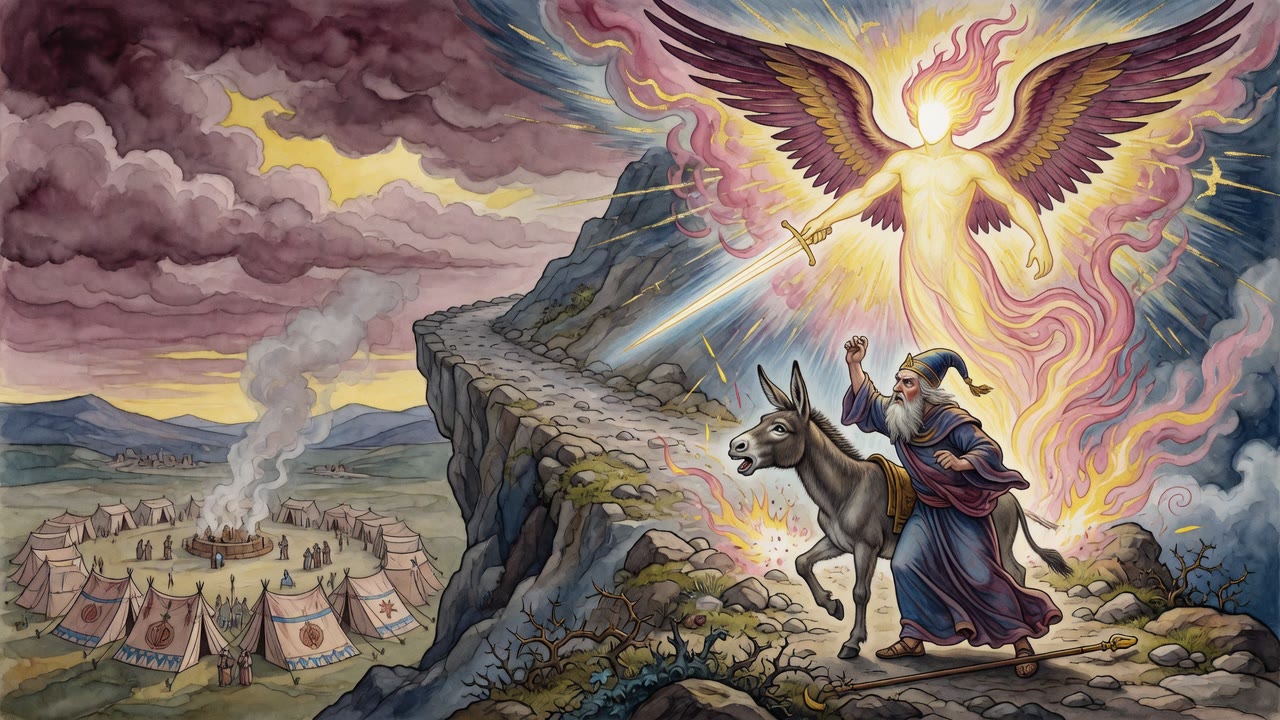
Silver has a smell that sorcerers recognize. Messengers rode hard. Promises stacked. Balaam came with a reputation for words that bend futures. Heights of Moab waited with altars already sketched in the mind. The camp of Israel spread below like a pattern no bird of prey quite understood, tents ordered, smoke thin and ordinary, danger invisible.

Balak pointed down the slope as if the sight itself were an insult. Balaam measured the distance between coin and conscience and found the usual fog.

The Ingrates on the Ridge

Before any curse left his mouth, Balaam turned on his employer with a bitter ledger. "You and I, Balak, are cut from the same cloth: both of us ingrates." He named the debt. Without Abraham, Balak's line would have burned with Sodom. God remembered Abraham and pulled Lot out of the fire; Moab's ancestor walked free on borrowed mercy. Without Jacob, Balaam himself would have no story, for Laban's house and the long chain that kept Balaam's world from collapsing ran through lives heaven had already spared.

Hired hate stood on rescued ground. The prophet-for-pay said it aloud, which is rarer than miracle. Balak's face tightened. Confession is poor entertainment for a king who wants a weapon. Still the truth hung between them like a third man on the ridge: you both live because someone else's merit opened a door.

Wind moved the dry grass. Below, a child laughed in the Israelite camp, unaware of the conversation that priced his future.

The Bird That Came Back Burned

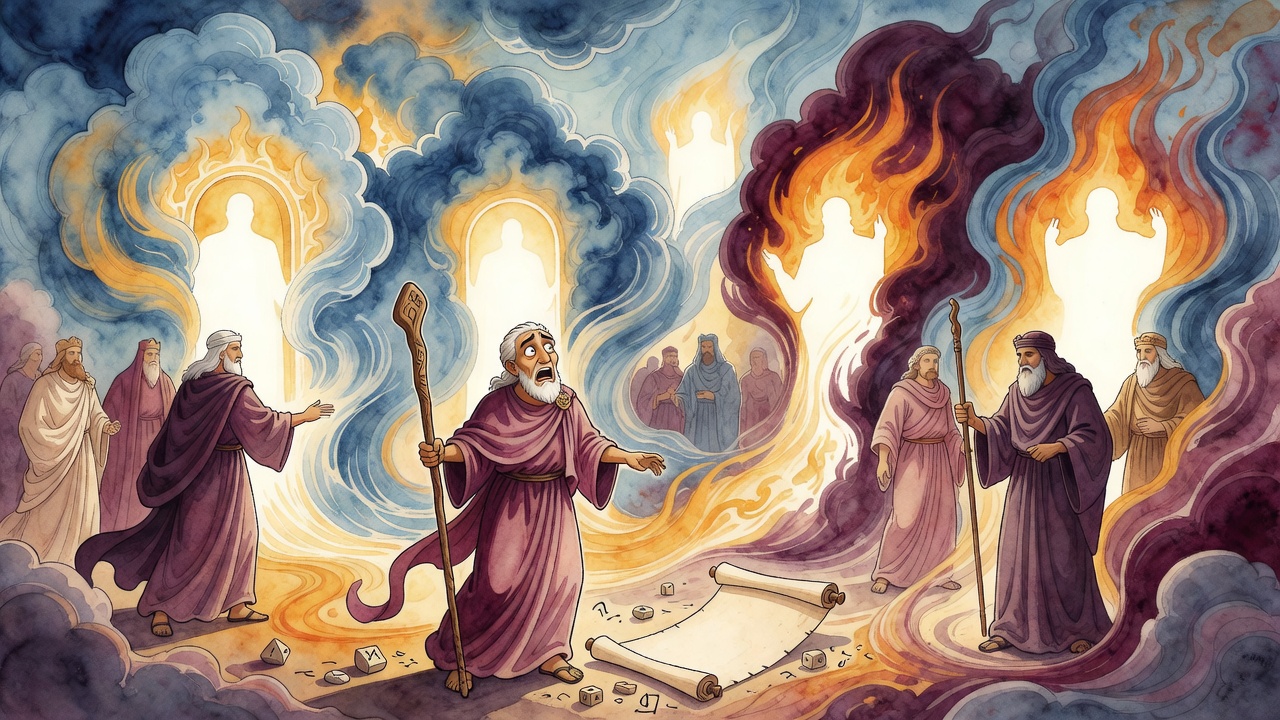
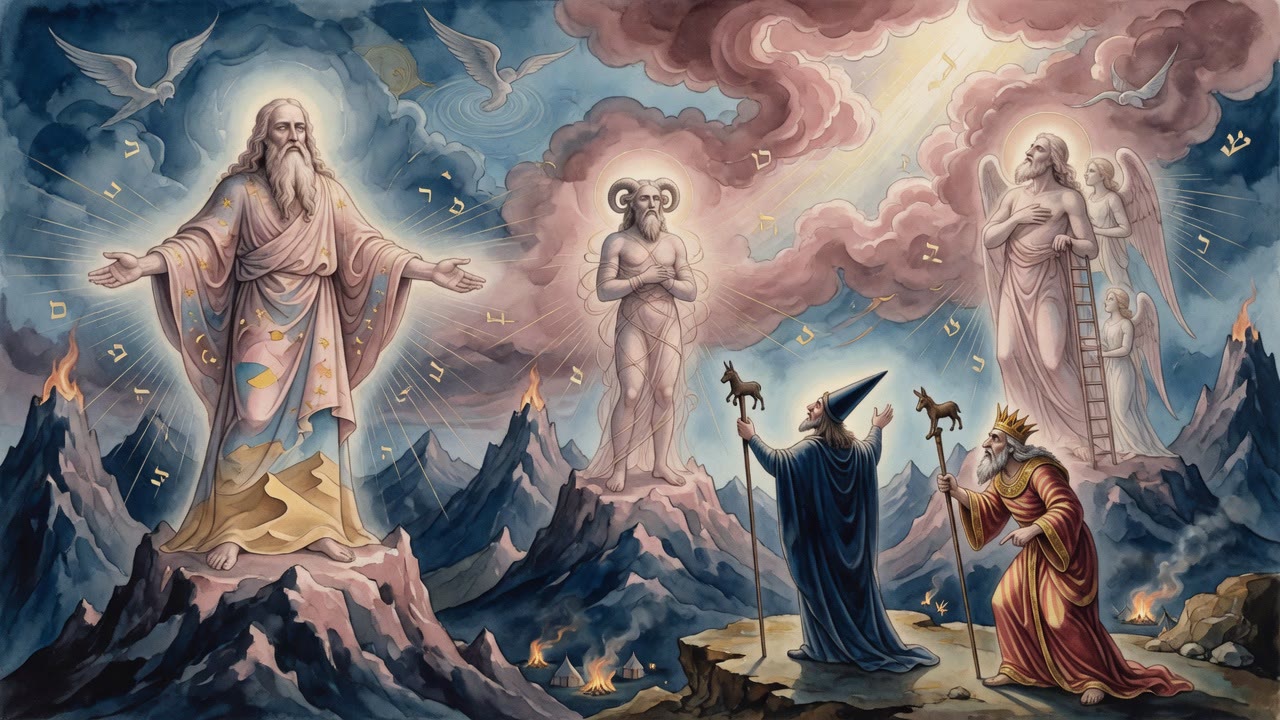
Balak tried another door. He sent a bird, the yadoa, toward the springs of impurity where old powers still muttered. The bird flew toward Uza and Azael, names bound in iron among mountains of darkness, sources of the craft kings hire when armies fail. Fire met it. Wings charred. It returned marked by the flame that guards the border between permitted power and the serpent's leftovers.

Sorcery filed a report written in ash: the road is closed. Balak's hands, which trusted birds more than mercy, held a ruined messenger. Balaam watched the burned feathers and felt the market for curses shrink in real time.

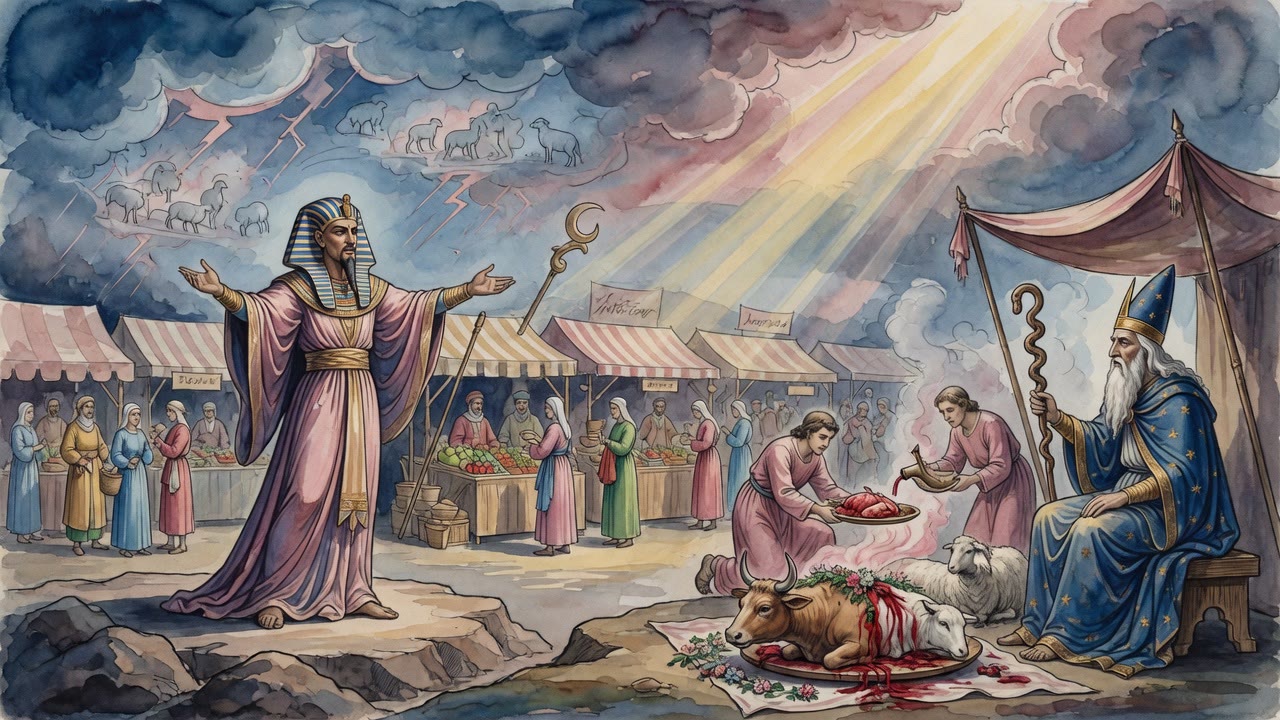
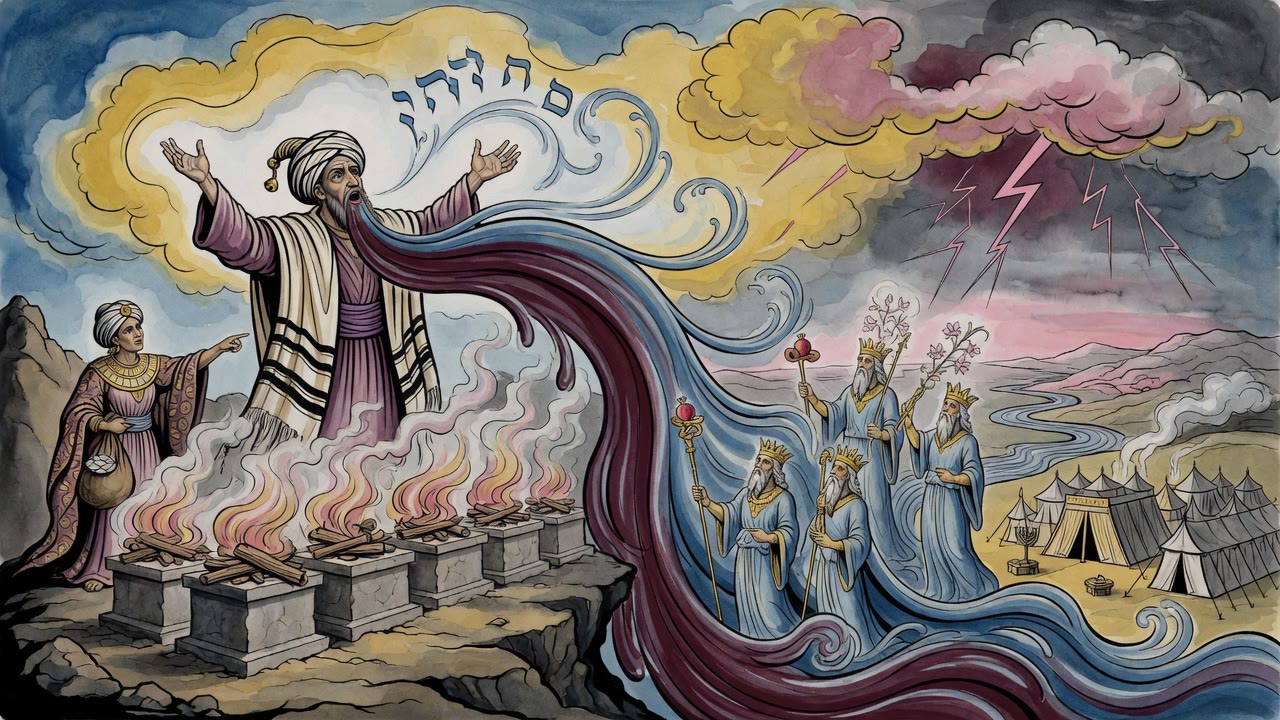
Altars still smoked. Seven and seven again. Animals died for a poetry that refused to invert. The heights kept their view and lost their bargain.

A People That Dwells Alone

Balaam looked down and the curse in his throat changed shape. "Behold, a people that dwells alone." Solitude here was not loneliness. When joy poured on Israel, the nations could not sip it. When the nations feasted in their seasons, Israel often sat among them without owning the feast. The Lord alone had led them; no foreign god shared the credit. Balaam's mouth, paid for ruin, became a trumpet for separation he could not unmake.

He saw them not as a swarm to be thinned but as a pattern kept by a hand higher than Moab's hills. Blessing rose against the grain of the contract. Balak raged the way men rage when the tool they bought develops a will.

Balak ordered another angle of view, as if geography could fix a closed heaven. They moved from peak to peak. Israel still looked ordered. Balaam's throat still found blessing where he had stored ruin. Each failure taught the same lesson with a different vista.

What the Heights Refused to Sell

Balaam left the ridge with payment that could not purchase the outcome. Balak's anger was a small weather system against a larger climate: a people guarded while they kept the law, a history that saved even the ancestors of their enemies, a craft that burned its own messenger, and a blessing that refused to be inverted by hire.

He thought of Laban's old tents and of Lot's escape, and the double debt made the silver in his bags feel like a joke told too late. A man can take payment and still lose the purchase. On Moab's heights the joke landed hard.

Below, tents held their pattern. Above, the air still smelled of failed magic and unwilling praise. The confession of ingratitude hung between the two men longer than any spell. Night covered the camp. Stars did their old work. Somewhere a burned feather drifted into a crevice and stayed there, a small black witness that some doors stay shut even when kings knock with gold.


← All myths
From the tradition

Sources

4 sources

The texts behind this telling. Some cards carry a translation of the source; others are our own retelling of it, and each card says which. Every card links out to the original.

Legends of the Jews 12:141Legends of the Jews

Retold in our words. Read the original at the link below.The Legends of the Jews by Louis Ginzberg (1909) · Public Domain

Legends of the Jews turns to Balaam and the King.

Well, some ancient texts give us a clue. Imagine a conversation around a crackling fire, maybe a worried counsel of kings, discussing this strange and powerful tribe that kept popping up on their borders. They might have said something like this:

"Their God helps them..as long as they observe His law, so that none can prevail against them." It's an admission of awe, grudging respect, and maybe even a little fear. They recognized the source of Israel's strength wasn't just military might, but something deeper, something…divine. This perspective comes to us through various midrashic (rabbinic interpretive commentary) sources, compiled and retold by Louis Ginzberg in his monumental work, Legends of the Jews. It’s a fascinating glimpse into how Israel was perceived by the outside world.

The speaker goes on, listing Israel's victories. "Balaam, the only prophet we heathens ever had, they slew with the sword, as they did unto Sihon and Og, the powerful kings of Canaan, whose land they took after killing them."

Balaam! Remember him? The non-Jewish prophet hired to curse Israel but who, instead, ended up blessing them (Numbers 22-24)? Even his death is evidence of Israel’s power. And then the swift defeat of Sihon and Og, legendary kings known for their strength and stature. These weren't just skirmishes; they were decisive victories that reshaped the landscape of the ancient Near East.

"Likewise they brought ruin upon Amalek, the great and glorious ruler they, and Saul their king, and Samuel their prophet."

Amalek. That name sends shivers down the spines of Jewish people to this day. Amalek represents the ultimate, unprovoked hatred of the Jewish people (Deuteronomy 25:17-19). The command to remember what Amalek did is a constant reminder of the eternal struggle against those who seek to destroy Israel. And the mention of Saul and Samuel highlights the pivotal moment when Israel transitioned to a monarchy, a turning point in their history.

The speaker continues, "Later they had an unmerciful king, David by name, who smote the Philistines, the Ammonites, and the Moabites, and not one of them could discomfit him."

David. The warrior king, the poet, the flawed but ultimately devoted servant of God. His victories established Israel as a regional power, a force to be reckoned with.

"Solomon, the son of this king, being wise and sagacious, built them a house of worship in Jerusalem, that they might not scatter to all parts of the world."

And then came Solomon, the wise king who built the Beit Hamikdash, the Holy Temple in Jerusalem. The Temple was meant to be a unifying force, a central point of worship that would keep the Jewish people together. But did it work?

The speaker concludes with a note of grim satisfaction: "But after they had been guilty of many crimes against their God, He delivered them into the hand of King Nebuchadnezzar, who deported them to Babylonia."

The Babylonian exile. A stark reminder that even divine favor is conditional. The destruction of the Temple and the exile to Babylon was a traumatic event that shook the Jewish people to their core. It forced them to confront their failings and to reaffirm their covenant with God.

So, what does this outside perspective tell us? It tells us that the nations around Israel recognized their unique relationship with the Divine. They saw their victories, their defeats, and their internal struggles. They understood that Israel's fate was intertwined with their adherence to God's law.

Full source
Midrash Tanchuma Buber, Balak 17:4Midrash Tanchuma Buber, Balak

Translation of the source text.Midrash Tanchuma (Buber), Public Domain, on Sefaria · CC-BY-SA

Another interpretation of (Numbers 23:7) “From Aram he leads me”: Balaam said to Balak: We are alike, the two of us, in being ungrateful, for were it not for our father Abraham, there would have been no Balak, as it is said (Genesis 19:29) “And it came to pass, when God destroyed the cities of the plain, that God remembered Abraham and sent Lot out.” For were it not for Abraham, Lot would not have escaped from Sodom, and you are one of the children of the children of Lot. And were it not for Jacob their father, I would not have endured in the world, for Laban saw no sons except by the merit of Jacob, since at first it is written (Genesis 29:9) “And Rachel came with the sheep.” Now if he had sons, how was his daughter a shepherdess? Once Jacob went there, sons were given to him, as it is said (Genesis 31:1) “And he heard the words of the sons of Laban,” and it says (Genesis 30:27) “I have learned by divination that the Lord has blessed me for your sake.” And were it not for their fathers, I and you would not have endured in the world.

Full source
Kav HaYashar 28:2-3Kav HaYashar

Translation of the source text.Kav HaYashar, Metsudah Publications, 2007; Kav HaYashar, trans. Metsudah Publications, 2007 · CC-BY

We know that Balak ben Tzippor tried to use sorcery against Israel by means of a certain bird called a yado’a. This is why he was called “ben Tzippor” (a tzippor is a bird in Hebrew). He dispatched this bird to the place that is the source of the impure force of sorcery to inquire what strategy he should use against them. But as the bird was on its way back he saw a tongue of flame overtake it and burn its wings. This filled him with great fear and trepidation, so he sent for Bilaam ben Be’or, who was firmly ensconced in the impure forces of sorcery.

The chief sources of sorcery are the angels Uza and Aza’el, who protested the creation of human beings and were subsequently cast down to earth by Hashem. They then became entangled with the filth of the primordial serpent, after which they laid their eyes on the daughters of the earth and turned to immorality. When the Holy One Blessed is He saw that they had begun leading people astray, He bound them in iron chains upon the Mountains of Darkness, where they remain.

Full source
Midrash Tanchuma Buber, Balak 19:3Midrash Tanchuma Buber, Balak

Translation of the source text.Midrash Tanchuma (Buber), Public Domain, on Sefaria · CC-BY-SA

"Behold, a people that dwells alone" (Numbers 23:9). When He gladdens them, no nation rejoices together with them; rather, all of them are smitten, [as it is said,] "The LORD alone did lead him, [and there was no foreign god with him]" (Deuteronomy 32:12). And when the nations rejoice in this world, they (Israel) eat together with every kingdom and rulership, and it does not go up against them from the reckoning, as it is said, "and shall not be reckoned among the nations" (Numbers 23:9).

Full source