Parshat Vayetzei6 min read

Gabriel Knots the Broken String in the Days of Awe

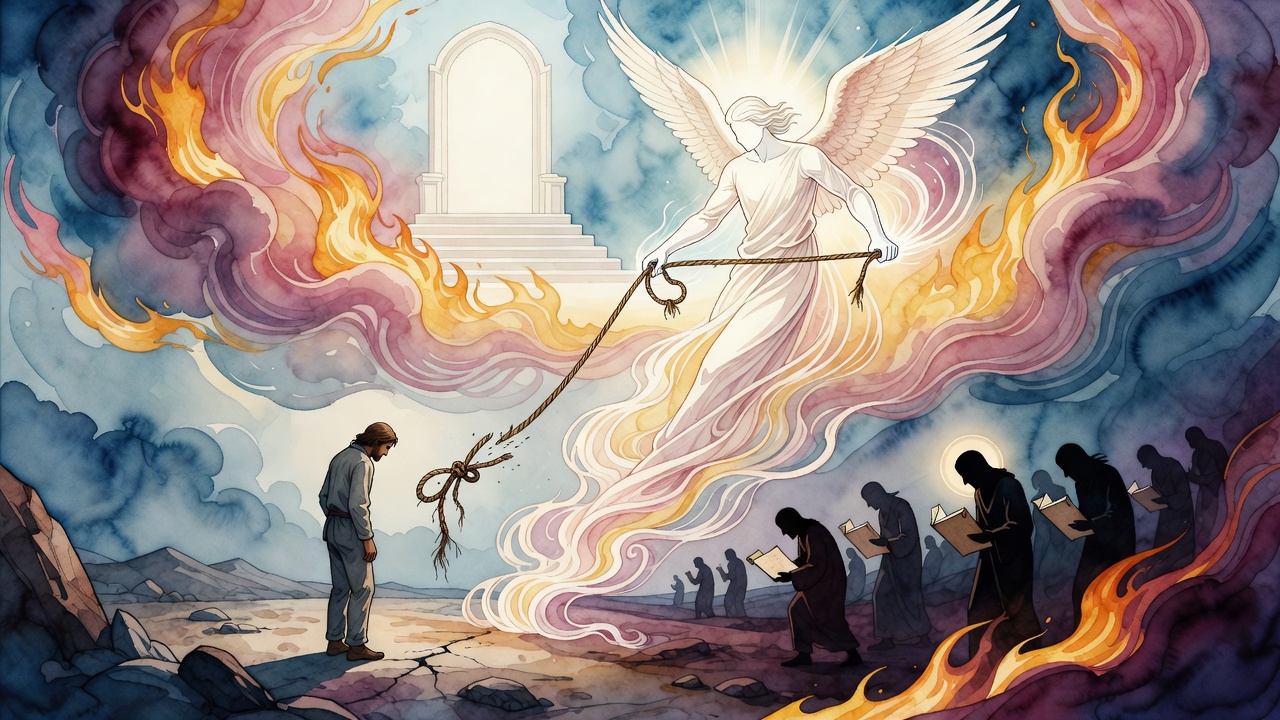
Every sin snaps the string tying a man to God, and the wicked read the silence as proof. Gabriel comes down in the Days of Awe to knot it.

Curated by Arthur · Told by Maggid ·
Table of Contents
  1. The Thread Tied at the First Breath
  2. The Man Who Walked Out of the Gate Untouched
  3. Rabbi Levi Counts the Silence
  4. The Sweetest Word Ever Set in a Human Mouth
  5. Gabriel Comes Down Between the New Year and the Fast
  6. The Knot That Pulls the Rope Shorter
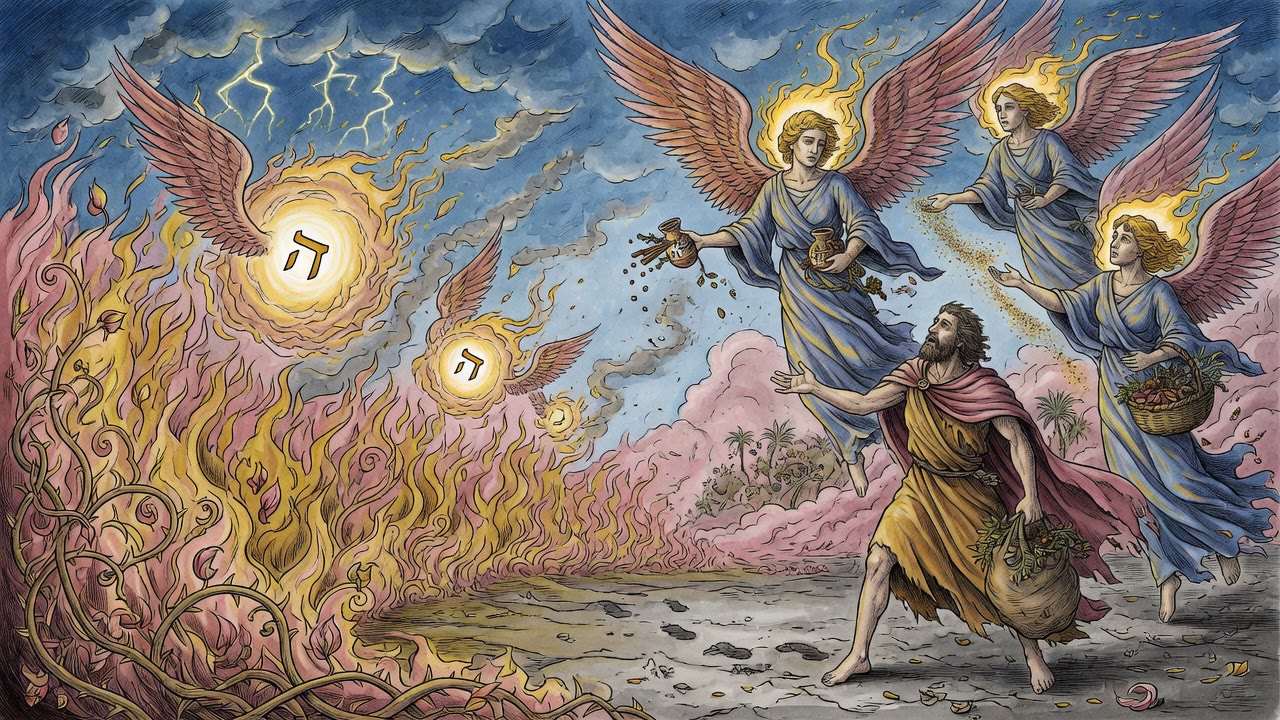
Gabriel Knots the Broken String in the Days of Awe Click for full size

The Thread Tied at the First Breath

The cord a midwife cuts is not the only one. There is a second, finer than a hair on a lamb's ear, running up out of the child's chest and never stopping. No hand has ever found it. Not a cable, not a chain. A string, and it holds because God has hold of the far end.

It snapped when the boy was nine, over a stolen fig and a smooth lie about where the fig had gone. The line let go without a sound, and nothing anywhere went cold. He ate the fig and slept well.

That was the trouble. The string had broken and the world had not so much as leaned.

The Man Who Walked Out of the Gate Untouched

Forty years on he kept two sets of weights, the honest ones out on the counter, the light ones in a pouch against his hip. A widow came for barley. He filled her sack against the light weights, watched her carry it out through the town gate, and waited.

He waited a week for something to fall on him. Nothing fell. He waited a season, and the season was good to him. By the third year he had stopped waiting and started teaching, at his own table, his sons watching his mouth.

"The arrogant walk in," he said, "and the arrogant walk out, and nobody ever asks them to pay."

His youngest son laughed. Inside a year the boy had a pouch of his own.

Rabbi Levi Counts the Silence

Rabbi Levi stood across the road from that gate with two students who had come about something else. He never got to their question. He was watching the man come out, unhurried, brushing chaff off a sleeve, whole and prosperous and fifty years old.

"Rabbi, he has been doing this since before I was born."

"I know what he has been doing."

"Then why is he still walking around?"

Levi kept his mouth shut, because the answer they wanted was that heaven had gone slow, and heaven had not gone slow. A sentence stood written against the man and had not been carried out. Because the sentence for an evil deed is not executed swiftly, the heart of the sons of man fills up with daring (Ecclesiastes 8:11). Every uncollected year fed that man another inch of nerve, and now his son had a pouch.

"So the waiting helps nobody," the student said.

"The waiting is a door," Levi said. "He has walked past it forty times."

The Sweetest Word Ever Set in a Human Mouth

Then Levi told them what stood behind the door.

God had given the children of Adam one word. Not a sacrifice, not a life rebuilt in advance as proof of intent. One word, and it works from inside a mouth. When the wicked one turns back from all his sins and does what is lawful and right, he shall surely live, he shall not die (Ezekiel 18:21). Then the line Levi could never get through without stopping. All his transgressions that he committed shall not be remembered against him (Ezekiel 18:22).

Not pardoned. Not weighed against the good and found lighter. Not remembered. The widow's barley, the pouch, the laughing boy, struck out of the record as though the clerk had never dipped his pen.

"His palate is most sweet," Levi said, jumping to the Song (Song of Songs 5:16). "He put teshuvah (תשובה), the turning back, into the world for the ones with the least claim on it, and priced it at one word."

Gabriel Comes Down Between the New Year and the Fast

The man across the road heard none of it. What reached him was smaller. Standing in his own doorway on the second day of the year, he watched his youngest son short-weight a sack for a stranger, exactly the way he had been taught, and something in his chest went out like a lamp in wind.

These were the ten days between Rosh Hashanah and Yom Kippur, the Yamim Noraim. He went into the storeroom, laid his hand flat on a sack he was never going to sell, and said the word. Alone, badly, out of order, and he meant it.

Above the roof, Gabriel came down.

He carried nothing to write with. He came looking for two ends, the way a workman comes to a job he has done ten thousand times that week. The upper end was where it had always been, in the hand that had never once let go. The lower end lay coiled around the man's ankles, gray with dust.

Gabriel did not splice them. A splice hides a break, and heaven has no interest in hiding breaks. He crossed the ends, pulled, and tied a knot.

The Knot That Pulls the Rope Shorter

It was ugly. Lumpy, thicker than the cord on either side, the kind of repair a shepherd makes with cold hands. Anybody looking at that string for the rest of the man's life would see exactly where he had failed. Gabriel tested it with a tug that lifted him half an inch off his heels.

It held.

And it was shorter. That is what a knot does. It eats length. The string running up out of that storeroom was shorter now than on the day the midwife missed it. He stood closer to God that night than on the day he was born.

He broke it again in the spring, over a sentence about a neighbor that he should have swallowed. Gabriel came back in the autumn, and the second knot went a hand's width below the first. By the time the man was old his string was a row of knots like the small bones down an animal's spine, ugly the whole way up, and so short that when he raised his arm in the dark he barely had to reach.


← All myths
From the tradition

Sources

3 sources

The texts behind this telling. Some cards carry a translation of the source; others are our own retelling of it, and each card says which. Every card links out to the original.

Zohar III:231aZohar

Retold in our words. Read the original at the link below.Sefaria-hosted English translation · CC-BY

It's not a cable, not a chain, but a string.

Where does this image come from? It's a beautiful folk allegory, one that resonates deeply, especially during the Yamim Noraim, the Days of Awe (Schwartz, Tree of Souls). These are the days between Rosh Hashanah, the Jewish New Year, and Yom Kippur, the Day of Atonement – a time of intense introspection and repentance, of looking inward and trying to become our best selves.

The story goes like this: When a person is created, they're tied to God with this string. It's a direct, unbroken link. But, inevitably, we sin. We make mistakes. We fall short. And each time we do, the string breaks.

But here's where the story takes a wonderfully hopeful turn.

During the Days of Awe, if we truly repent – if we engage in teshuvah (repentance), that powerful process of turning back, of returning to our better selves – the angel Gabriel himself comes down. And what does he do? He doesn't just re-tie the string. He makes a knot. A knot. It's not as seamless as the original connection, but it's stronger, more resilient. It represents the work we've done, the lessons we've learned, the commitment to not repeat the same mistakes.

Now, here’s the really fascinating part. Because, let’s be honest, who among us hasn't sinned more than once? Our strings, then, become filled with knots. And a string with many knots… is shorter than a string without knots.

So what does that mean? Repentance, all that effort of teshuvah, actually brings us closer to God. The very act of repairing our broken connection, of acknowledging our flaws and striving to do better, paradoxically strengthens our bond. The "brokenness" is not a hinderance but an enhancement.

That even when we stumble, even when we feel furthest from the Divine, the opportunity for return is always there. And, perhaps, that the journey back – the knotted, imperfect, but ultimately stronger connection – is even more meaningful than the original, unbroken string.

What kind of knots are on your string? And how can we use these Days of Awe to tie them tighter, to draw ourselves closer to the source of all being?

Full source
Kohelet Rabbah 11:1Kohelet Rabbah

Retold in our words. Read the original at the link below.The Sefaria Midrash Rabbah, 2022 · CC-BY

Ecclesiastes, or Kohelet, as it’s known in Hebrew, dives deep into this very conundrum. And in Kohelet Rabbah, a collection of rabbinic interpretations on Ecclesiastes, we find a particularly striking passage that gets right to the heart of the matter.

It all centers around the verse from (Ecclesiastes 8:11): "Because a sentence for an evil deed is not executed swiftly, therefore the heart of the sons of man dares to do evil.” The text goes on to explain: "Because a person sins and the attribute of justice does not afflict him, therefore [the heart of the sons of man] dares.."

What does this mean? Well, it suggests that when punishment for wrongdoing is delayed, people become emboldened. It's like the kid who gets away with sneaking a cookie from the jar; they’re far more likely to do it again.

It's more than just a simple cause and effect. The rabbis, in their wisdom, saw a deeper, more troubling consequence. They observed that the wicked, seeing no immediate repercussions for their actions, grow even more arrogant.

"What do they say?" the text asks, rhetorically. And then it answers: "The arrogant ones enter, the arrogant ones exit, and they pay no price."

Ouch.

They see the apparent lack of divine justice as a validation of their actions. They strut about, flaunting their ill-gotten gains, seemingly untouchable. They come and go as they please, without facing any consequences.

Why does this happen? Is God simply turning a blind eye? Is justice blind?

The sages certainly didn't think so. But they understood the human tendency to misinterpret delay as absence. We, with our limited understanding, often fail to see the bigger picture, the long-term consequences that may be unfolding.

Maybe the punishment is coming, just not on our timetable. Maybe the true cost of those evil deeds will be paid in ways we can't yet comprehend.

Or perhaps, the delay itself is a test. A test of our faith, our patience, and our commitment to doing what's right, even when it seems like the wrongdoers are getting away with everything.

This passage from Kohelet Rabbah reminds us that the world is complex, and that divine justice operates on a different scale than human justice. And it challenges us to remain steadfast in our pursuit of goodness, regardless of what we see around us. Because even when it seems like the wicked are prospering, the ultimate reckoning is coming.

Full source
Midrash Tanchuma Buber, Vayetzei 22:5Midrash Tanchuma Buber, Vayetzei

Translation of the source text.Midrash Tanchuma (Buber), Public Domain, on Sefaria · CC-BY-SA

Rabbi Levi said: See the word that the Holy One, blessed be He, gave to the children of Adam. What is written? "And when the wicked one turns back," etc. (Ezekiel 18:21). The Holy One, blessed be He, said: "All his transgressions that he committed shall not be remembered against him; by his righteousness that he did he shall live" (Ezekiel 18:22, that same place). This is the meaning of "his palate is most sweet" (Song of Songs 5:16).

Full source