Parshat Toldot6 min read

God Removed Five Years So Isaac Would Not See Esau

On the day Abraham died, Esau committed three crimes in a single afternoon. God quietly removed five years from Isaac’s life to spare him the sight.

Curated by Arthur · Told by Maggid ·
Table of Contents
  1. The Day Abraham Died and Esau Was in the Field
  2. Three Things Esau Did Before Nightfall
  3. God Removed Five Years Before Isaac Could Count Them
  4. The Famine Isaac Refused to Flee
  5. The Name the Patriarchs Were Never Given

Abraham was 175 years old when he died. Isaac was 75. The same day the old man was laid in the cave at Machpelah, his younger grandson sat over a pot of lentils. Lentils, round as a wheel, were what mourners ate: they have no mouth, the tradition says, just as the mourner has no words. Jacob cooked them in silence. Esau was somewhere else entirely.
The Day Abraham Died and Esau Was in the Field

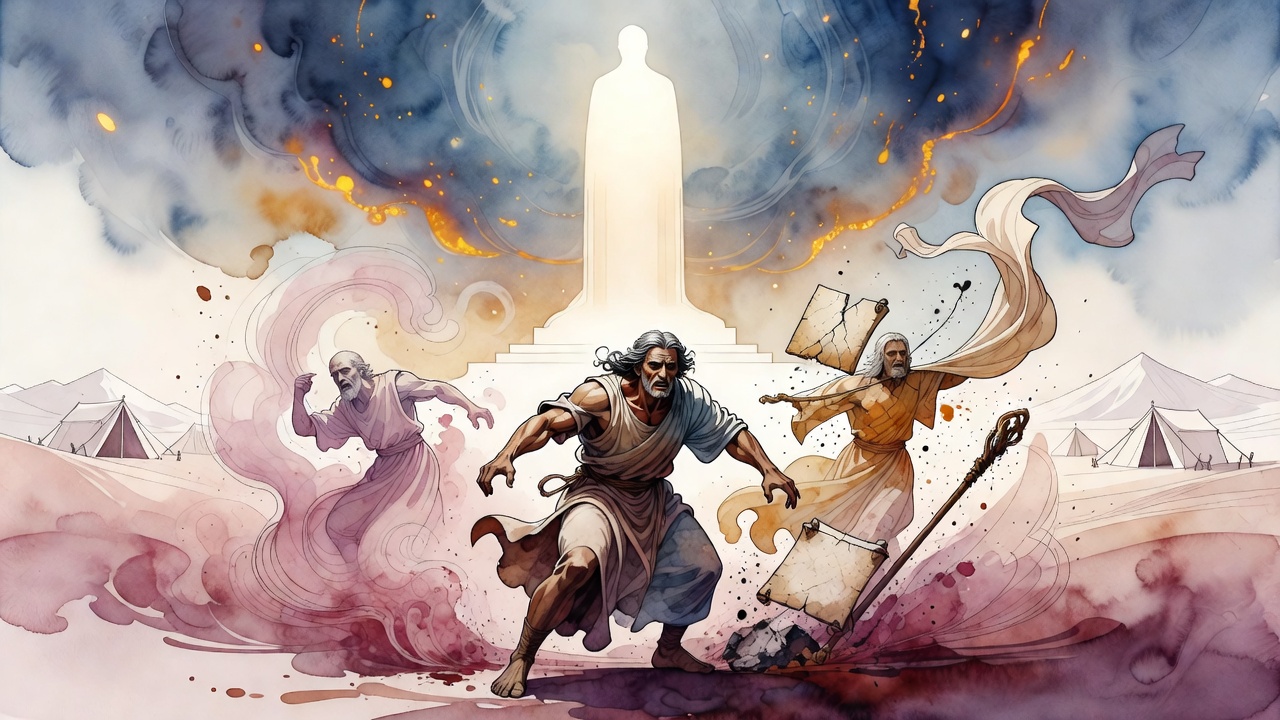
The Torah says Esau came in from the field exhausted (Genesis 25:29). That one word, exhausted, caught the attention of interpreters who noticed it elsewhere. The same word, in a different verse, belongs to someone who has done terrible things (Jeremiah 4:31). Esau's exhaustion was not the kind that comes from honest labor. On the afternoon of his grandfather's burial, while Jacob stirred the pot and Isaac sat with his grief, Esau was in the field committing three acts that the tradition does not soften.

He found a woman betrothed to another man (Deuteronomy 22:27). He killed someone. He stole.

Three crimes before nightfall. One day.

Three Things Esau Did Before Nightfall

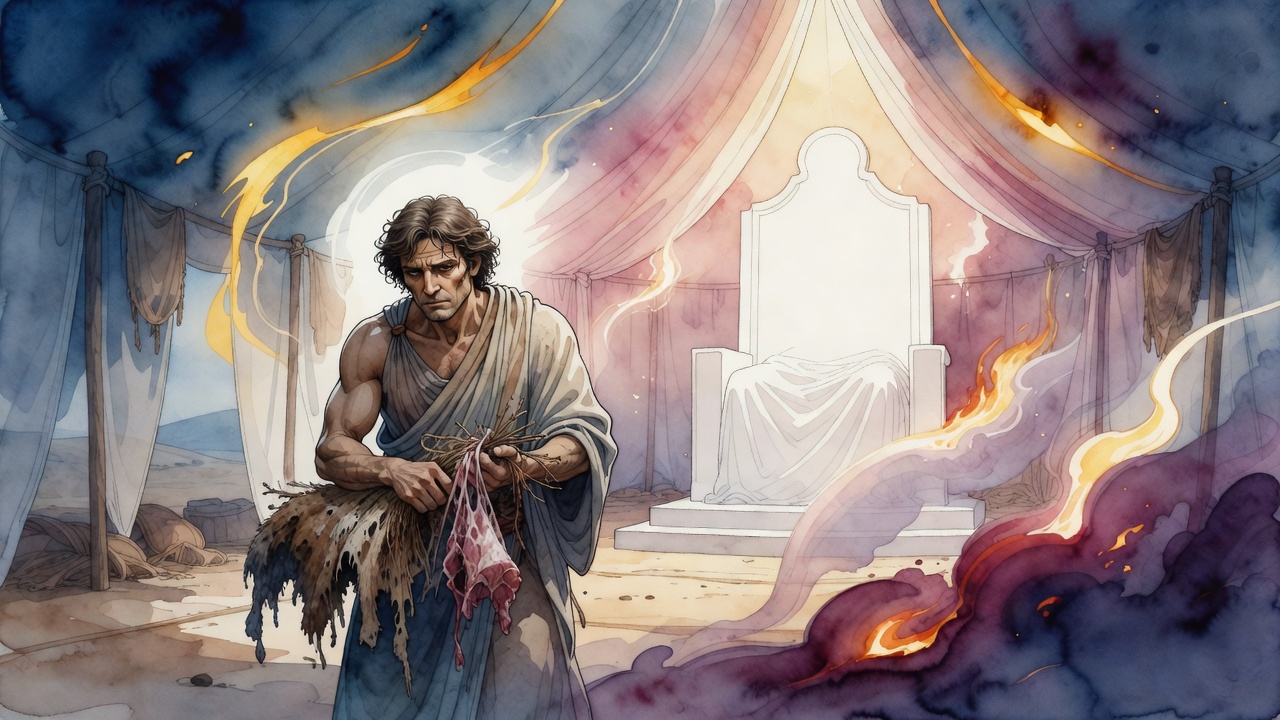
When Esau came home to Jacob's tent, he was not carrying guilt. He was hungry. He opened his mouth at the pot and said: pour it into me (Genesis 25:30). The word he used, haliteni, means to force-feed, the way one fills a camel's throat. He wanted to be filled. He did not ask what was in the bowl, did not notice the lentils or their color or what they meant. He ate and left. He sold the birthright to close the transaction and walked back out into the evening.

What he sold, he had already spent.

God Removed Five Years Before Isaac Could Count Them

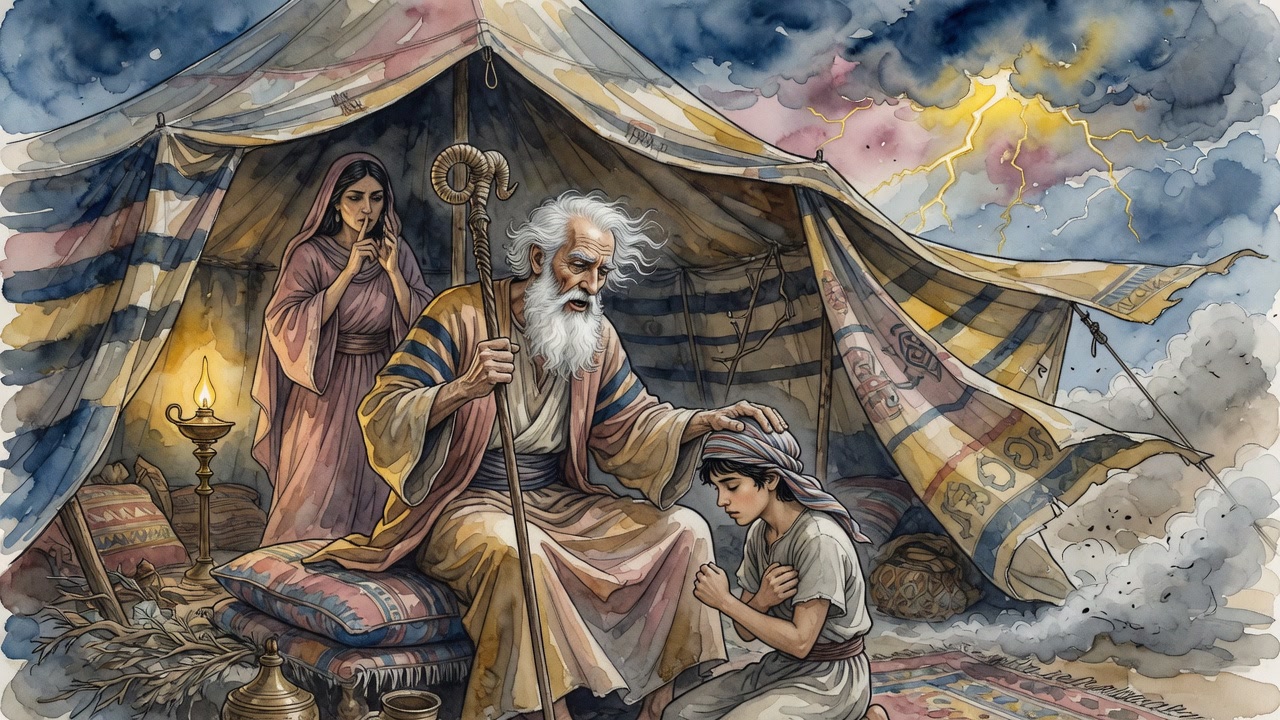
Abraham had been promised a good old age (Genesis 15:15). The phrase sits in the covenant like a guarantee. Three rabbis, transmitting the same tradition, asked what that promise actually required. Rabbi Yudan, Rabbi Pinhas, and Rabbi Simon each arrived at the same answer: it required that Abraham not live to see his grandson's worst day. God had arranged matters so that Abraham died just before Esau reached the age when his nature became impossible to ignore. Five years early.

The same logic extended one generation forward. God had planned for Isaac to live to 185. Isaac lived to 180. The five missing years were not an illness or an accident. God removed them deliberately, for the same reason the five were removed from Abraham: so that Isaac would not have to see what his son had done on the day the lentils were cooked.

The framing comes from Psalms: your kindness is better than life (Psalms 63:4). The death itself, arriving before the knowledge, was the kindness. Isaac was spared.

The Famine Isaac Refused to Flee

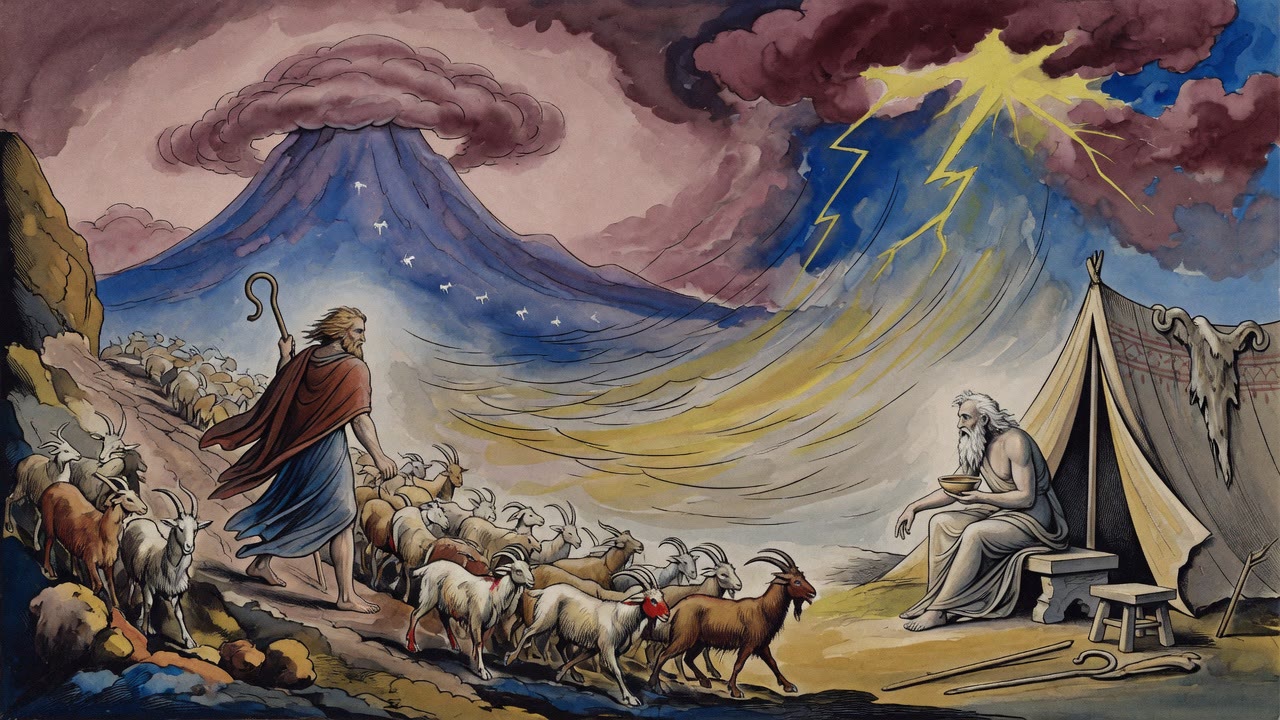
In the years between Abraham's death and his own, Isaac endured a famine as severe as the one that had driven Abraham down to Egypt (Genesis 26:1). God told him: stay. Reside in this land. Do not go to Egypt. Isaac obeyed. He stayed in Canaan and dug for water and found shepherds who claimed every well he opened (Genesis 26:20). He moved and dug again. He did not argue with the decree. He did not flee south to abundance. He remained in the place he was assigned, in the famine, with the contested wells, and he did not ask why.

The tradition counted ten famines across all of history, from the curse on Adam's ground through to the famine that will arrive at the end of days. Of all the figures who endured them, Isaac alone stayed when staying was the harder choice. This was his particular form of faithfulness: not the dramatic, knife-raised faith of his father, but the quiet, rooted staying of a man who does not leave.

The Name the Patriarchs Were Never Given

Centuries later, when God spoke to Moses from the burning bush and Moses asked for the divine name, God revealed something that had never been disclosed to Abraham, Isaac, or Jacob. God had appeared to them as God Almighty. Not by the deeper name, the four-letter name that Moses was now hearing for the first time (Exodus 6:3).

In that moment, God said something that sounds like mourning: alas for those who are lost and are not present. The phrase belongs to grief over the dead. But the patriarchs had died generations before. God was mourning what they never received, not their deaths but their incompleteness. Abraham had been told to walk the length of the land and then had to buy a burial plot for silver. Isaac had been promised the land and then had to fight shepherds for water. Jacob had been told the ground beneath him would be his and then had to buy a parcel to pitch his tent. None of them questioned. None of them demanded the full name, the full account, the full explanation of why the promises arrived so slowly and so partially.

They did not question, and God missed them for it.

Isaac died at 180. He never knew the five years were gone. He never knew what Esau had done on the afternoon of the lentils. He stayed in his land, endured his famine, bore his sons, and went to his grave without the name that Moses received. He was given kindness instead of years. He would have chosen the years. God chose for him.


← All myths

From the tradition

Sources

3 sources

The texts this telling draws on, in full. Open a card to read inline, or expand it for a wider, quieter read.

Bereshit Rabbah 63:12Bereshit Rabbah

Bereshit Rabbah turns to Five Years Stolen from Isaac Because of Esau's Sin.

In Rabbi Yudan, Rabbi Pinḥas, and Rabbi Simon, something was…off. The Holy One, blessed be He, originally intended for Isaac to live a full 185 years. Those missing five years? They were taken away because of Esau’s actions.

That. Your lifespan, shortened by the misdeeds of your offspring.

What terrible acts could warrant such a divine intervention? The Rabbis don't hold back. They accuse Esau of three grave sins: consorting with a betrothed woman, murder, and theft. Rabbi Yudan states in the name of Rabbi Aivu, and Rabbi Pinḥas in the name of Rabbi Levi, that Esau violated a betrothed young woman, citing (Deuteronomy 22:27), "For he found her in the field," which refers to a betrothed woman who was raped. The text then quotes (Jeremiah 4:31), "For my soul is wearied by the killers," to suggest murder, and (Obadiah 1:5), "If thieves came for you, if plunderers of the night…," to imply theft.

The implications are staggering. The text paints a picture of Esau as a man of violence and transgression. The Midrash then presents a powerful, almost plaintive question from God: “This is what I promised to Abraham, and said to him: ‘You shall go to your fathers in peace; [you shall be buried at a good old age]’ (Genesis 15:15) – is this ‘a good old age,’ that he sees his grandson engaging in idol worship, engaging in forbidden sexual relations, and shedding blood? It is preferable that he leave the world [without seeing it].”

It's a stark reminder that even the most blessed lives are intertwined with the actions of others. God's kindness, as expressed in (Psalms 63:4) ("For Your kindness is better than life"), takes precedence over a prolonged existence marred by witnessing such wickedness.

The Midrash then shifts its focus to the infamous scene where Esau sells his birthright for a bowl of red lentil stew. "Esau said to Jacob: Feed me now from that red, red [haadom haadom] dish, as I am weary. Therefore, his name is called Edom" (Genesis 25:30).

Rabbi Ze’eira offers a rather vivid interpretation of Esau's hunger, comparing his open mouth to that of a camel being forcibly overfed. He said to him: ‘I will open my mouth and you continuously pour,’ like what we learned: One may not forcibly overfeed a camel and one may not force feed it. However, one may place food into its mouth [malitin].

But the real interpretive fireworks come with the phrase "from that red, red [ha’adom ha’adom]". Rabbi Yoḥanan and Reish Lakish offer contrasting views. Rabbi Yoḥanan sees the "red, red" as referring to Esau himself and his Patron, implying that Esau sought to consume the stew and the Temples of Jacob’s God. Reish Lakish, on the other hand, interprets it as "from him, and from those like him [hadomin lo]," meaning his descendants.

Reish Lakish expands on this idea, creating a powerful image of Esau and his lineage defined by the color red: "He is red, his cooked food is red, his land is red, his warriors are red, his garments are red, One who is red exacts retribution against him, in red garments." He connects this color to various aspects of Esau's identity, from his birth ("the first emerged ruddy," (Genesis 25:2)5) to his land ("to the land of Se’ir, to the field of Edom," Genesis 32:4) to his eventual fate, suggesting that even divine retribution will be delivered in red.

What are we to make of all this? The Rabbis, through this Midrash, are confronting profound questions about justice, divine intervention, and the legacy we leave behind. It's not just a story about Esau's individual sins, but about the ripple effects of those actions, impacting generations and even shortening the life of his own father. It forces us to consider how our choices, both good and bad, echo through time, shaping not only our own destinies but also the lives of those around us. It is a somber reminder of the interconnectedness of life.

Full source
Bereshit Rabbah 64:2Bereshit Rabbah

Bereshit Rabbah turns to Righteousness of Isaac.

The Rabbis identify ten distinct famines that have struck the world throughout history. Ten! That's a lot of empty plates.* One during the time of Lemekh, stemming from the same cursed ground (Genesis 5:29). * One during the time of Abraham, which drove him down to Egypt (Genesis 12:10). * One during the time of Isaac, our initial point of reference. * One during the time of Jacob, mentioned when his sons traveled to Egypt for grain (Genesis 45:6). * One during the period of the Judges, as recounted in the Book of Ruth (Ruth 1:1). * One during the time of Elijah, a severe drought brought on by the prophet's decree (I Kings 17:1). * One during the time of David (II Samuel 21:1). * One during the time of Elisha, so severe that desperate measures were taken (II (Kings 6:2)5). * And finally, one that is "progressing and coming to the world," plus one in the future, echoing the prophet Amos's warning of a famine "not for bread, not [a] thirst for water, but to hear the words of the Lord" (Amos 8:11).

Rabbi Shmuel bar Nahman offers an interesting perspective: he suggests that the brunt of these famines should have occurred during Saul's reign, but because Saul was descended from a "frail" sycamore tree, God shifted the burden to the time of David. It's a curious image, implying that some generations are better equipped to handle hardship than others.

Then comes a challenging question: "Shila sinned and Yoḥana is punished?" In other words, how can one person's sin lead to another's suffering? Rabbi Ḥiyya Rabba answers with a parable. Imagine a glazier carefully transporting delicate glassware. To hang the basket, he uses a strong peg, one that can bear the weight. Likewise, catastrophes befall those who can withstand them, the "mighty people," as the text puts it. Rabbi Berekhya connects this to David's generation, citing (Isaiah 40:29): "He gives strength to the weary."

There's some debate among the Rabbis about the specifics. Rabbi Ḥelbo claims two famines occurred during Abraham's time, while Rabbi Aḥa distinguishes between the famine during Abraham's time and one during Lemekh's. The text further elaborates on the nature of some of these famines: the one during Elijah's time was a drought, while the one during Elisha's time was marked by panic and exorbitant prices.

Finally, the passage touches upon the famine during the time of the Judges, drawing a parallel to the story of Elimelekh in the Book of Ruth. Rabbi Huna, citing Rabbi Aḥa, describes the economic hardship of the time. However, this leads to a discussion about leaving the Land of Israel during times of scarcity. Rabbi Shimon clarifies that emigration is only permitted when food is completely unavailable. Elimelekh, who left the land, was punished for it, along with his sons.

So, what are we to make of this list of famines? Is it simply a historical record of hard times? Or is it a reminder that these cycles of hardship are intertwined with human actions, divine responses, and the enduring question of how we cope with adversity? Perhaps the most haunting aspect of this teaching is the famine that is "progressing and coming to the world." It serves as a stark reminder that the challenges of scarcity, both material and spiritual, are never truly behind us. They demand constant vigilance, compassion, and a willingness to learn from the past so that we might build a more just and sustainable future.

Full source
Shemot Rabbah 6:4Shemot Rabbah

This very human experience echoes in the ancient texts, specifically in a powerful passage from Shemot Rabbah, a compilation of rabbinic interpretations on the Book of Exodus.

" God, blessed be He, is speaking to Moses, expressing a sense of.. well, almost loss. "Alas for those who are lost and are not present," the text says, an expression usually reserved for mourning the deceased. But here, it's applied to the patriarchs. What's going on?

God continues, "Many times I have revealed Myself to Abraham, Isaac, and Jacob as God Almighty, but I did not make known to them that My name is the Lord as I made known to you, yet they did not question My ways." God is pointing out that while He revealed Himself to the patriarchs in a certain way, they didn't demand to know the full picture. They didn't challenge the divine plan in the same way Moses does.

The text provides examples. God tells Abraham to walk the length and breadth of the land, promising it to him (Genesis 13:17). Yet, Abraham struggles to even find a burial plot for Sarah, eventually having to purchase one. Did he question God? No.

Similarly, Isaac is promised the land (Genesis 26:3), but he faces conflict over water rights. "The shepherds of Gerar quarreled with Isaac's shepherds," the text reminds us (Genesis 26:20). Did Isaac question God’s promise? Again, no.

And Jacob, promised the very ground he lay upon (Genesis 28:13), had to buy a place to pitch his tent. Did he question God? He did not. As we find in Shemot Rabbah, they accepted their lot without demanding explanations, without questioning God's methods. They didn't ask, as Moses did, "What is Your name?"

But Moses? He questions God right from the start, asking about His name. And later, after speaking to Pharaoh, he cries out, "Since I came to Pharaoh to speak in Your name, he has harmed this people, and You did not deliver Your people!" (Exodus 5:23).

So, what's the point of this comparison? Is God rebuking Moses? Not exactly. The passage isn't about criticizing Moses, but about highlighting the different relationships God had with each generation.

The text continues by emphasizing God's covenant with the patriarchs: "I have also established My covenant to give them the land of Canaan" (Exodus 6:4). Because they didn’t question, God remembered His promise. "Moreover, I have heard the cry of the children of Israel," the text says (Exodus 6:5). Even though the Israelites in Moses' time weren't always behaving perfectly, God heard their cries because of the covenant He made with their ancestors. "And I have remembered My covenant," (Exodus 6:5) it is written.

This leads to the famous verses where God promises redemption: "Therefore say to the children of Israel: I am the Lord, and I will take you out from under the burdens of the Egyptians..." (Exodus 6:6-7). The word "therefore" (lakhen in Hebrew) is key here. Shemot Rabbah equates lakhen with oath-taking, referencing (1 (Samuel 3:1)4). God is swearing that He will redeem them.

According to Shemot Rabbah, the four promises of redemption – "I will take out…I will deliver…I will redeem…I will take" – correspond to the four decrees Pharaoh made against the Israelites. And, as many know, these four promises are mirrored in the four cups of wine we drink at the Passover Seder, fulfilling the verse, "I will raise the cup of salvation and call upon the name of God" (Psalms 116:13).

The passage concludes with God reiterating His promise to bring the Israelites into the land, fulfilling the oath He made to their forefathers. "I will do for them what I said to your ancestors – that I would give them the Land, and they would inherit it by their merit."

So, what can we take away from this? Perhaps it's a reminder that faith manifests in different ways across generations. Abraham, Isaac, and Jacob showed faith through acceptance and unwavering trust, even in the face of hardship. Moses, on the other hand, showed faith through questioning and demanding justice. Both approaches, it seems, are valid and ultimately lead to fulfilling God's promises. It’s a powerful reminder that our relationship with the Divine can be complex, nuanced, and deeply personal. And maybe, just maybe, our questions are as important as our unwavering faith.

Full source