5 min read

Israel Mixed Two Bloods on the Night of Freedom

Before the first Passover, Israel must circumcise to eat the lamb. Eden winds carry the roast scent, two bloods mingle, and God kisses each doorway.

Curated by Arthur · Told by Maggid ·
Table of Contents
  1. The Emblem at the Feast
  2. Elders Who Opened the Door of Belief
  3. Scent From Eden, Hunger in Goshen
  4. While Other Counselors Fell
Israel Mixed Two Bloods on the Night of Freedom Click for full size

The Emblem at the Feast

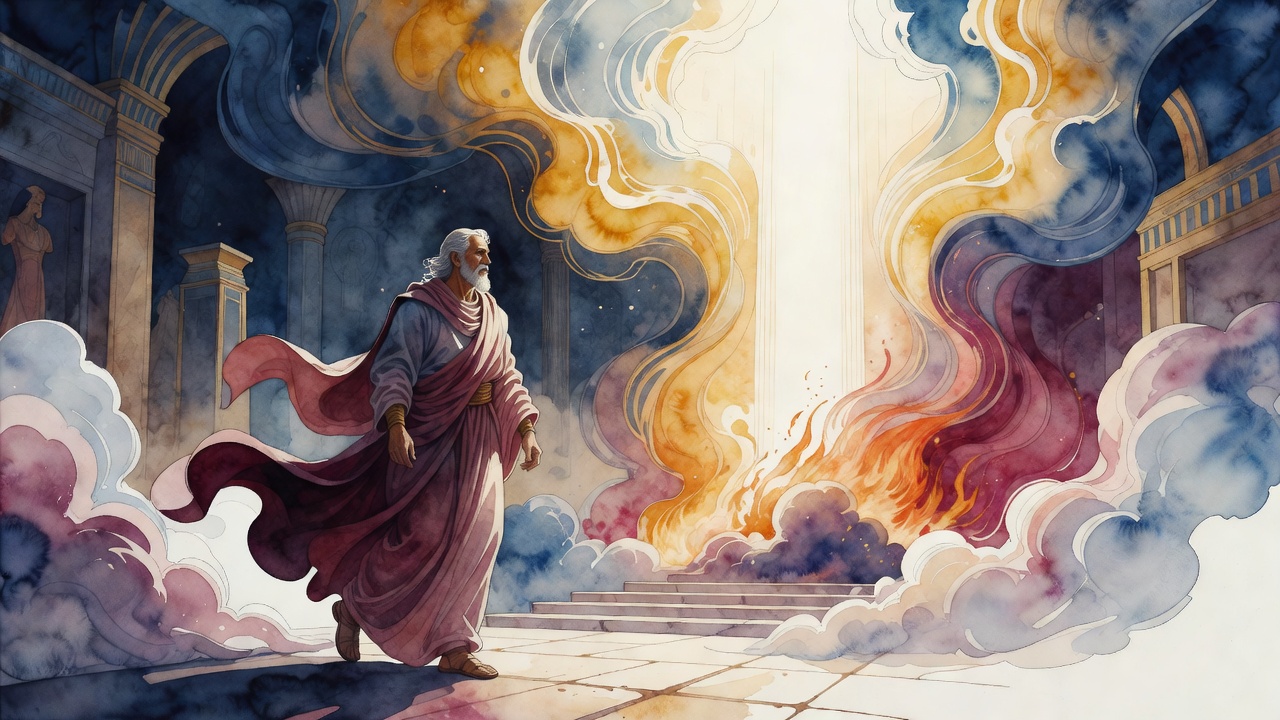
Moses stood among the elders with the statute still hot in his mouth. A king's feast was coming, tables set in the under-story of the command, guests hungry for meat they had not earned yet. No one enters without the emblem. The emblem is Abraham's covenant cut in flesh, so God had ruled. "No foreigner shall eat of it," and even the bought servant must be circumcised before the meat touches his mouth (Exodus 12:43-44).

In Egypt, Israel had let the covenant lapse under mud and quotas. Only Levi had kept it whole, Tumim and Urim as signs of a tribe that observed the word when other knives stayed sheathed. Redemption needed a people marked again. Moses put the demand back into the nation's body so the lamb could be food and not insult, freedom and not theft of a ritual they had abandoned.

Men who had not bled for the covenant in years bled now because the smell of roast was already in the future air.

Elders Who Opened the Door of Belief

Moses called the elders first. They had believed when he returned from the bush with Aaron at his side. They had gathered the people so the people could believe. Age held wisdom, Job's verse says, and heaven repaid that early faith by letting the elders lead the slaughter of the first Passover. The knife in their hands was a receipt for trust already given when trust was still expensive.

Without them, the midrash implies, the camp might have shrugged and kept its Egyptian habits one more night. With them, households took lambs, blood, fire, and the risk of cooking Egypt's god-animal in Egypt's streets while Egyptian neighbors watched and understood the insult.

An elder's hand on a lamb's neck is not only butchery. It is a public yes that younger men can copy.

Scent From Eden, Hunger in Goshen

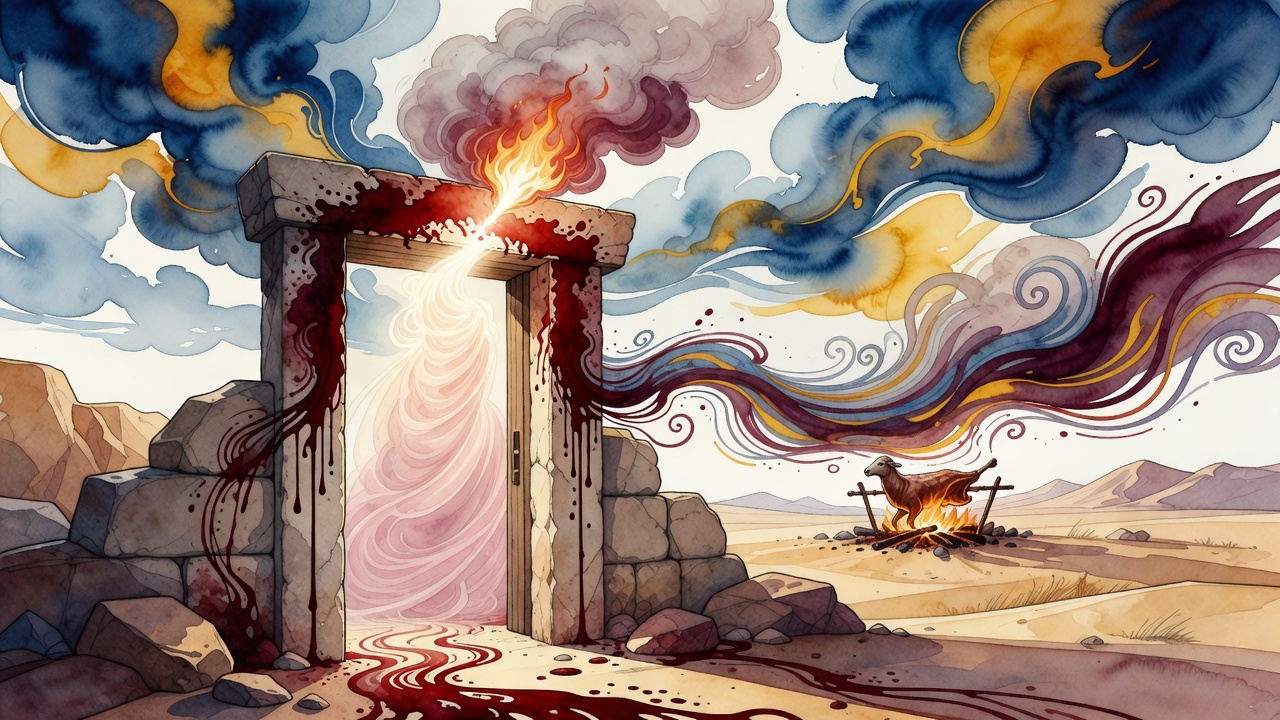
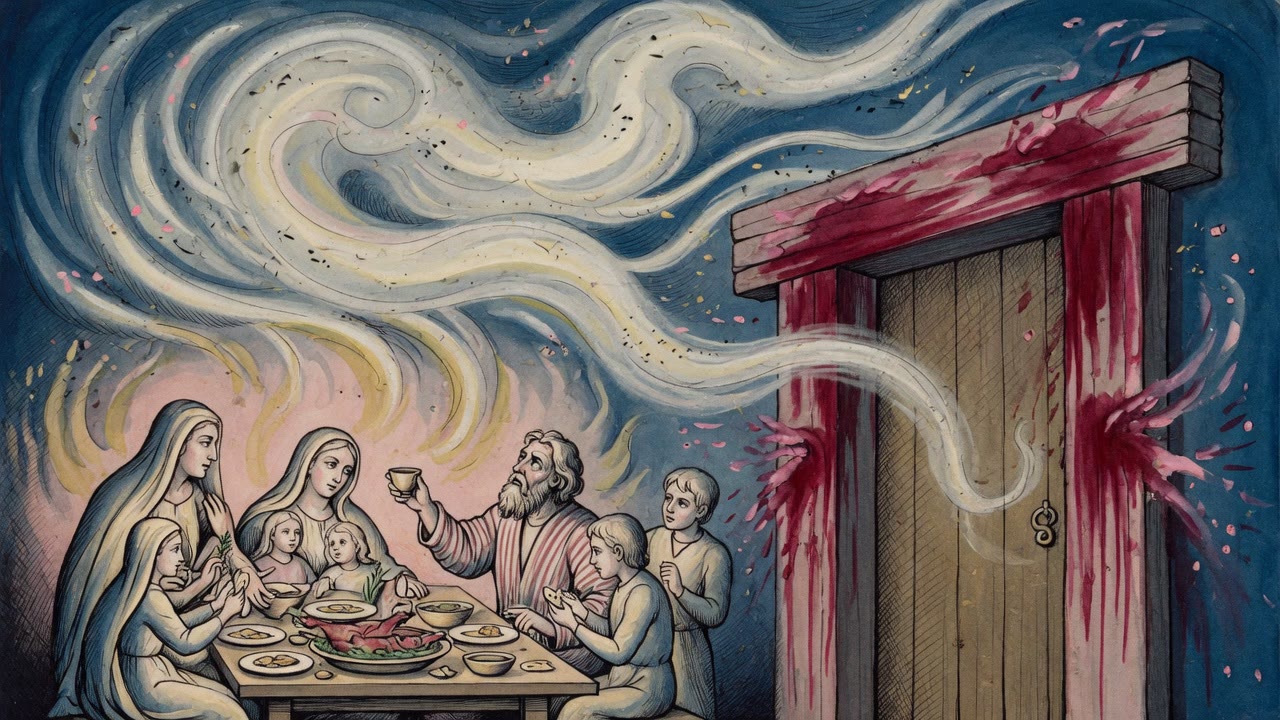
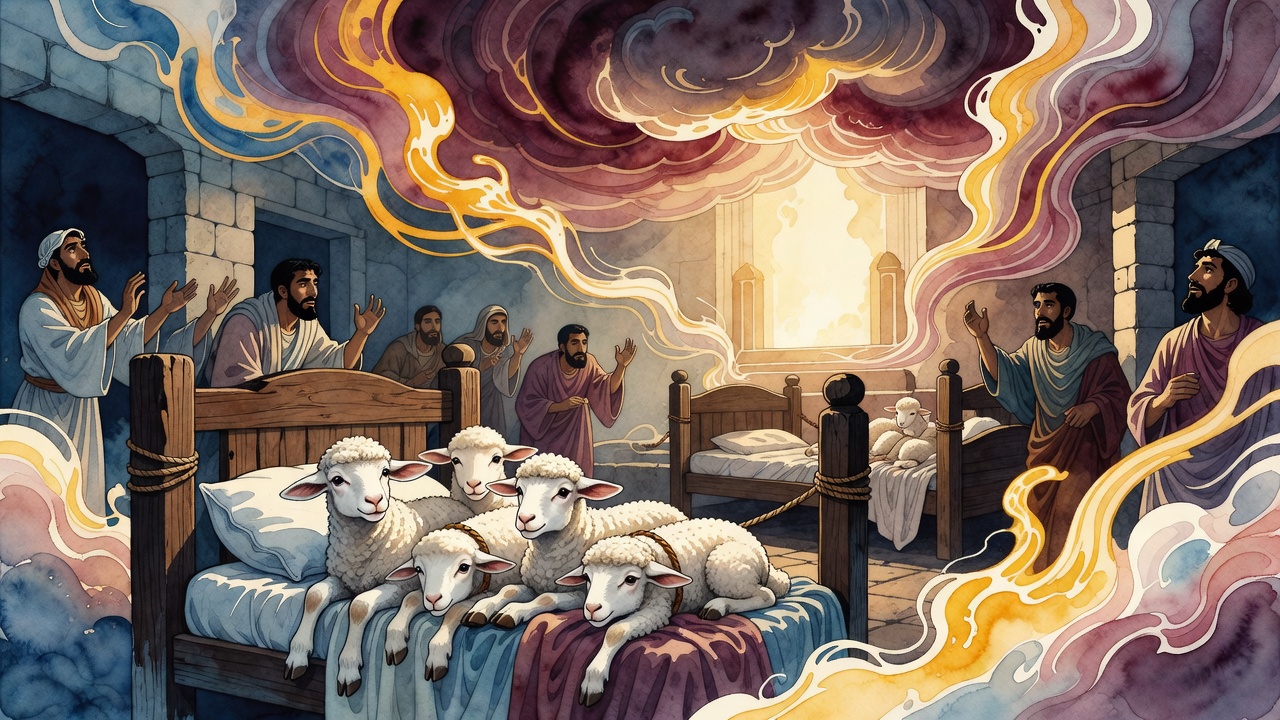
God sent the four winds from the Garden of Eden to cling to the roasting offering. North awake, south come. The aroma traveled forty days' worth of desire in a single night's air, sweet enough to make empty stomachs argue with fear. Israel begged for a taste. The answer stayed hard. Without circumcision, no eating. The people submitted. Blood of the lamb met blood of the covenant until the doorway ran with both, wet wood shining in torchlight.

"In your blood, you shall live; in your blood, you shall live." The doubled blood is not rhetoric. It is two liquids on one night: paschal and circumcision, freedom and belonging, meal and mark. God passed over, the midrash says, and kissed and blessed each one wallowing in that double life-sign as if the doorpost were a forehead and the nation a single child.

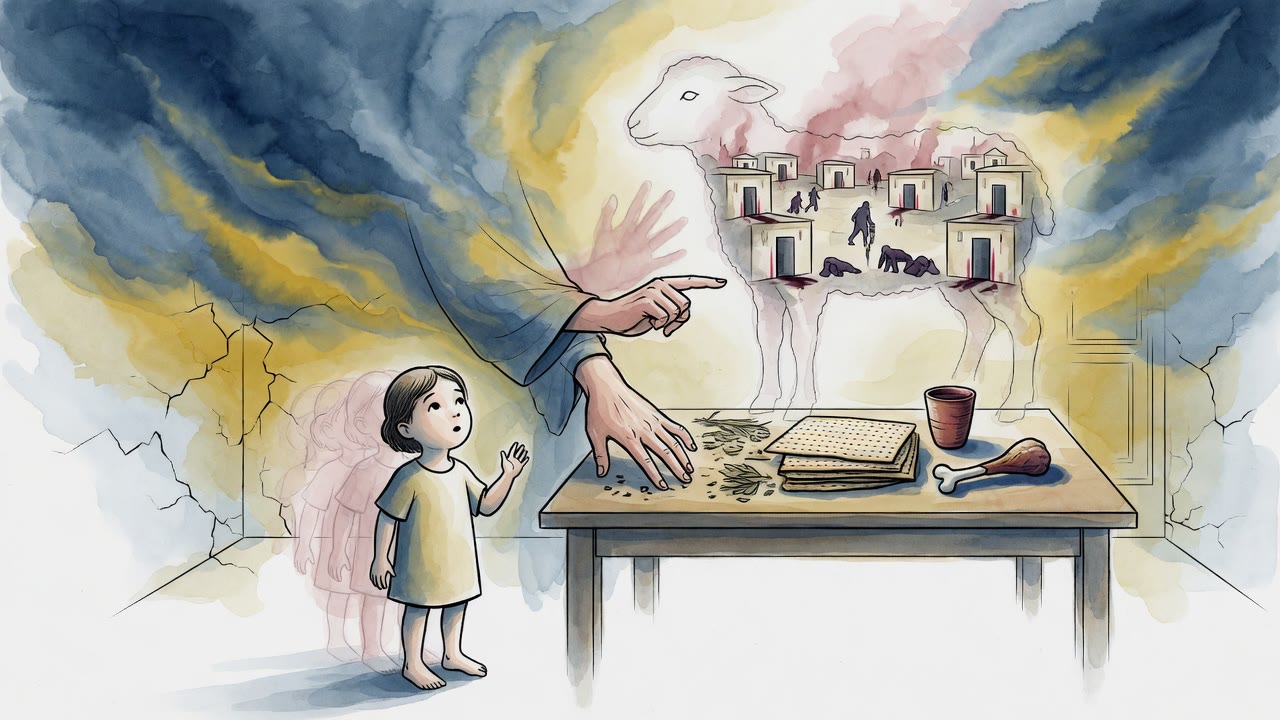
Inside, meat and bitter haste. Children asked questions that would become liturgy. Outside, a kingdom still thought slaves were inventory.

While Other Counselors Fell

Far from the doorposts, other stories were choosing sides. Yitro, once a counselor in Pharaoh's orbit beside Amalek's line of thought, would later hear of Amalek's fall and walk toward Israel's God with advice still warm in his mouth. Strike the cynic, the proverb says, and the simple grow wise. Amalek ends in erasure. Yitro ends in a tent of counsel beside Moses, rebuking the man who sits alone until he wears away.

The first Passover night is the hinge between empires that devour and a household that paints blood and walks out. Inside the houses, sandals strapped, staffs in hand. The two bloods dried on wood. Morning would open a road of cloud and fire. The elders' early yes and the nation's late cut and the lamb's death sat together on the lintel like a single sentence God could read in the dark without a lamp.

When the scream rose from Egyptian houses, Israelite houses stayed quiet except for chewing and the low sound of people who know they must leave before dough can rise. Freedom tasted like roast and salt and the sting of a new cut that had finally matched an old promise.

Some men fainted at the knife and still came back for the meal. Some mothers held boys and sang under their breath so the children would remember joy beside fear. The lamb bones stayed unbroken as commanded. Fat smoked. Blood dried in dark maps on the posts. When God moved through Egypt, the midrash's kiss on the doorway was not sentiment. It was selection made intimate: this house, this mark, this double life-sign, live.

By the time dough was bundled on shoulders, the two bloods had already done their work. Covenant restored. Feast permitted. Empire screaming one street over. Israel walked into a night that smelled of roast and desert wind, marked on the body and on the wood, owed to elders who believed early and to a God who would not let them eat freedom unmarked.


← All myths
From the tradition

Sources

3 sources

The texts behind this telling. Some cards carry a translation of the source; others are our own retelling of it, and each card says which. Every card links out to the original.

Shemot Rabbah 19:5Shemot Rabbah

Retold in our words. Read the original at the link below.The Sefaria Midrash Rabbah, 2022 · CC-BY

The story starts with a seemingly simple commandment: "This is the statute of the paschal offering." Rabbi Shimon ben Ḥalafta paints a vivid picture: God, blessed be He, instructs Moses to be especially careful about the mitzvah, the commandment, of the Passover offering. Only those who are circumcised can partake. "No foreigner shall eat of it," God says, "but anyone’s servant, bought for silver, you shall circumcise him – [then he shall eat of it]." (Exodus 12:43-44).

Why this emphasis on circumcision? The Midrash (rabbinic interpretive commentary) uses a powerful analogy. Imagine a king throwing a magnificent feast for all his beloved subjects. But, the king declares, no one without the proper emblem can enter. In this case, the "emblem" is the covenant of Abraham, signified by circumcision.

In our Rabbis, the Israelites in Egypt hadn't exactly been rushing to maintain this covenant. In fact, the Midrash states plainly that "Israel did not seek to circumcise in Egypt; in fact, they all abolished circumcision in Egypt," with one notable exception: the tribe of Levi. As (Deuteronomy 33:8-9) tells us, "And of Levi he said: Your Tumim [wholeheartedness] and Your Urim [lights]…[because] they observed Your word and kept Your covenant." The Tumim and Urim, often translated as perfection and light, were divinely inspired objects that were bequeathed to the tribe of Levi. The Midrash interprets these names as symbols of their steadfast commitment.

So, what’s a God to do when His people need redeeming, but lack the merit? God calls upon Moses, or some say it was Joshua, to circumcise the people. As (Joshua 5:2) says, "And again circumcise the children of Israel, a second time." But not everyone was thrilled with this proposition, shall we say.

Here's where it gets truly interesting. God decrees that they must perform the paschal offering. And once Moses does, God commands the four winds from the Garden of Eden to cleave to that offering. "Awake, north [wind], and come, south [wind]," as the (Song of Songs 4:16) puts it. The aroma of the offering becomes so potent, it travels for forty days! The people, famished by the tantalizing scent, beg Moses for a taste. But God is firm: "If you will not be circumcised you will not eat."

The result? The Israelites submit, and the blood of the paschal offering mingles with the blood of circumcision. And in that moment, a profound transformation occurs. God passes over them, taking each one, kissing and blessing them. As (Ezekiel 16:6) proclaims, "And I passed over you, and saw you wallowing in your blood [damayikh], and I said to you: In your blood, you shall live; I said to you: In your blood, you shall live." The Midrash understands damayikh, the plural form of blood, to signify both the blood of the paschal offering and the blood of circumcision.

So, what's the takeaway? This Midrash on Shemot Rabbah 19 isn't just a historical anecdote. It's a powerful reminder that redemption often requires commitment, sacrifice, and a willingness to embrace the covenant. It emphasizes that physical acts, like circumcision, can have profound spiritual consequences, especially when combined with sincere intention. It makes us consider the cost and the meaning of freedom, and reminds us that sometimes, the sweetest aromas come from the hardest-won battles.

Full source
Shemot Rabbah 16:1Shemot Rabbah

Retold in our words. Read the original at the link below.The Sefaria Midrash Rabbah, 2022 · CC-BY

The verse But the Midrash (rabbinic interpretive commentary), specifically Shemot Rabbah 16, doesn't just read it at face value. It asks: why the elders? Why were they the ones called upon to lead the people in this pivotal moment, the very first Passover sacrifice?

The answer, according to the Midrash, lies in their earlier faith. Think back to when Moses first encountered God at the burning bush. God instructed him, "Go, and gather the elders of Israel" (Exodus 3:16). And what did Moses do? He and Aaron did exactly that: "Moses and Aaron went and gathered all the elders of the children of Israel" (Exodus 4:29). And crucially, "the people believed" (Exodus 4:31).

The Midrash points out something deeper. It wasn't just that the people believed, but that the elders were the crucial link. If they hadn't accepted Moses's message, would the rest of Israel have followed? The text suggests, probably not. The elders, with their wisdom and experience – as the verse from (Job 12:12) says, "With the aged is wisdom and with the length of days understanding" – they were the gatekeepers of belief.

God, blessed be He, recognized this. He acknowledged that the elders were instrumental in the Israelites believing in Him. As Shemot Rabbah puts it, He said, "I will repay the elders for causing Israel to believe in My name." He understood that their acceptance paved the way for the entire nation to embrace the divine message.

Therefore, God decided to honor them. The redemption of Israel, the very first Pesach (Passover), would be enacted through them. They would be the ones to oversee the slaughter of the paschal offering, the symbol of their freedom. "Moses called all the elders of Israel," the verse repeats, emphasizing their central role.

So, what’s the takeaway? It’s a powerful reminder that leadership isn't just about holding a position, but about earning trust and inspiring belief. The elders of Israel weren’t just old; they were wise, respected, and their faith acted as a catalyst for an entire nation's liberation. Their story, as told in Shemot Rabbah, reminds us that true leadership often lies in the quiet, unwavering faith that inspires others to believe, even in the face of the impossible.

Full source
Shemot Rabbah 27:6Shemot Rabbah

Retold in our words. Read the original at the link below.The Sefaria Midrash Rabbah, 2022 · CC-BY

He appears in the narrative, offers Moses some crucial advice, and then… well, what do we really know about him?

The Book of Exodus tells us, “Yitro heard…” (Exodus 18:1). But heard what, exactly? Shemot Rabbah, a classic collection of rabbinic interpretations on the Book of Exodus, offers a fascinating answer: Yitro heard about the downfall of Amalek.

Why is that significant?

Well, the Midrash (rabbinic interpretive commentary) draws a connection between Yitro, Amalek, and a proverb: "Strike the cynic, and the naïf will become clever" (Proverbs 19:25). According to Shemot Rabbah, Amalek and Yitro were both advisors to Pharaoh. Imagine the scene: Pharaoh, seeking counsel on how to deal with the Israelites, turns to these two figures. But something dramatic shifts when Yitro witnesses God's victory over Amalek.

The Midrash emphasizes the utter destruction of Amalek. As it says, "For I will expunge the memory of Amalek" (Exodus 17:14). Yitro sees this, and it shakes him to his core. He reconsiders everything and repents. He thinks, "I must go only to the God of Israel."

The text asks, "From where do you derive that Amalek and the Midianites were enemies of Israel?" Well, the Torah offers clues. Remember the elders of Moab and Midian conspiring against Israel (Numbers 22:7)? Or the Midianites and Amalekites who would ravage Israel's crops (Judges 6:3-4)? These moments paint a picture of animosity.

And what about the wicked Bilam? When he "saw Amalek" (Numbers 24:20), he knew their fate was sealed. But when he looked at Yitro, something had changed. The Midrash compares it to a hunter who traps one bird, then tries to trap another that flies and lands on a royal statue. The hunter is now in a bind, fearful of harming the statue. Bilam, seeing Yitro's repentance, realizes he has "fled to a fine place and was spared." Bilam says about Amalek: “…its end will be destruction” (Numbers 24:20). But about Yitro? "Mighty is your dwelling" (Numbers 24:21).

The Midrash even connects Yitro to Abraham, who is also described as "mighty" (Bava Batra 15a, based on Psalms 89:1). It's a powerful image: Yitro, once an enemy, now aligned with the patriarchs.

So, "strike the cynic," says the proverb, "and the naïf will become clever." Amalek represents the cynic, while Yitro represents the naïf who learns from witnessing the cynic's downfall.

But the story doesn't end there. The Midrash draws another parallel, this time to Moses. "Rebuke the discerning" (Proverbs 19:25) refers to Moses, who is rebuked by Yitro for exhausting himself by judging the people alone. "Why are you sitting alone?" (Exodus 18:14), Yitro asks, warning, "You will wear away" (Exodus 18:18). Yitro advises Moses to seek God's guidance, saying, "Heed my voice, I will counsel you [and may God be with you]" (Exodus 18:19). And what does Moses do? "Moses heeded his father-in-law, and he performed everything that he had said" (Exodus 18:24).

What a powerful lesson! Yitro, the outsider, the former advisor to Pharaoh, becomes a source of wisdom and guidance for Moses himself. It challenges us to consider who we might be overlooking, and what wisdom they might hold.

Full source