Parshat Vayetzei5 min read

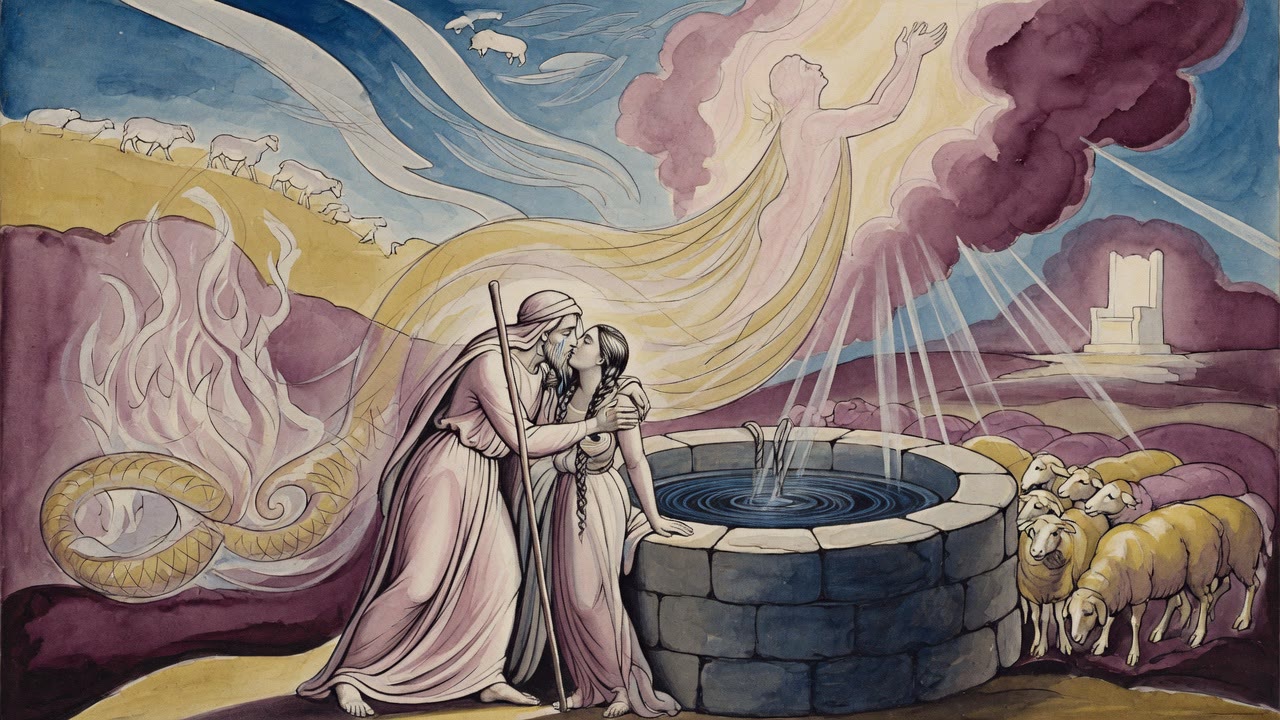
Jacob Kissed Rachel and Wept for Her Exile

The stone came off the well as if it had waited for his hands alone. Rachel stood there with her father's flock. The shepherds stared while he wept.

Curated by Arthur · Told by Maggid ·
Table of Contents
  1. Dust on the Well Stones
  2. Breath From Within
  3. Angels Without a Choice
  4. Love, Fear, and the Path of Compassion
  5. After the Flocks Watered
Jacob Kissed Rachel and Wept for Her Exile Click for full size

Dust on the Well Stones

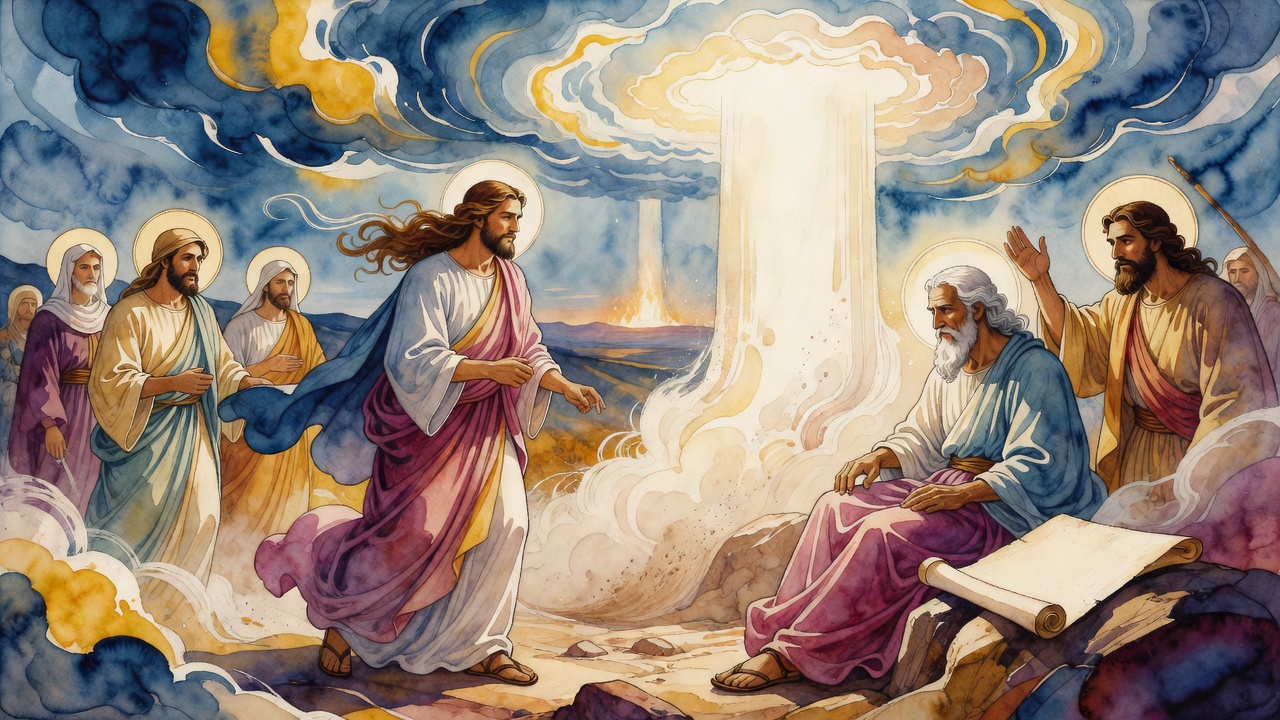
Jacob rolled the stone from the well's mouth as if the rock had been waiting for his hands alone. Rachel stood with her father's flock, eyes bright with the ordinary shock of a stranger's strength. He kissed her and lifted up his voice and wept. The shepherds stared. Rachel did not yet know the full map of that tears. Jacob felt, without a textbook, that he was greeting more than one woman: a future, a people, a presence that would walk into exile and need someone to cry for it out loud.

Breath From Within

Later masters would say the divine soul is truly a part of God above. Who blows, blows from within himself. When the breath entered the first human, it did not come as a borrowed tool. It came from the innermost. The soul descends through contraction after contraction, world after world, until it wears a body the mystics call a serpent's skin: thick, distant, necessary. Jacob's weeping at the well became, in that reading, compassion for the spark trapped far from its source, and for the Shekhinah (God's indwelling presence) that goes into exile with Israel.

Rachel, as Knesset Yisrael, stands for the collective soul under hard weather. The kiss is meeting. The tears are mercy drawn down from the Father of Mercies because someone finally felt the distance as pain rather than as theory.

Angels Without a Choice

Prayer, the same stream teaches, can lift even the animal soul. Angels burn with love and awe the way a lion is fierce and an ox is strong: hardwired, without the risk of refusal. Michael's camp serves in love. Gabriel's camp serves in awe. Day and night they do not invent their service. Human prayer is stranger. It takes the part of the self that wants food, status, and sleep, and teaches that part to face upward without lying about what it is.

Jacob at the well was not yet reciting a formal liturgy. He was already doing the work: feeling, choosing, letting the body's tears become a channel. The animal soul in him could have stayed only tired and strategic. Instead it wept.

Love, Fear, and the Path of Compassion

Rabbi Schneur Zalman would later call Jacob's attribute a road open to anyone: not only mystics, not only the already righteous. Meditate on the spark in serpent skin. Remember the acts that bind the King in the tresses of neglect. Let the result be rachamim, compassion for the Presence in exile, not a theater of self-hate. The kiss becomes speech meeting speech, human words of Torah touching divine command. The embrace becomes charity, the right arm of chesed in the world.

Fear alone can freeze a person at the well, unable to roll the stone. Love alone can make the kiss cheap. Compassion moves the rock and still weeps.

After the Flocks Watered

Rachel led him home. Laban waited with his own math. Years of labor would follow, and sons, and a night-wrestling that would leave him limping toward a new name. The tear-tracks from the well would dry and return in other forms: fear of Esau, loss of Joseph, the long road down to Egypt where prophecy would again seek open ground outside idol walls.

For one afternoon the well stones held a simpler proof. A man saw his future and the exile inside it, kissed the woman who carried that future in her ordinary courage, and cried without apology. Later books would stack sefirot (the ten divine emanations of kabbalah) and worlds under that moment. The moment itself needed only dust, water, sheep, and a throat that refused to stay dry.

Anyone who prays with a divided self still borrows that posture: roll what is too heavy, greet what is holy in human form, and let the animal soul learn the taste of tears that rise instead of sink.

Rachel asked him why he wept if the meeting was good. Jacob searched for a short answer and found none that would fit a first conversation. He said, because the road behind me was long, and the road ahead already feels longer, and you are the first true rest my eyes have had. She accepted that as enough. Laban would later price rest in years. The well did not price it. The well only offered water and a place to stand.

That night, sleeping under a stranger's roof, Jacob dreamed no ladder yet, only the flash of Rachel's face and the sensation of a stone rolling that should have needed many men. He woke with wet lashes and understood that his body had decided to care about more than survival. The divine soul, if that is the name for the part that recognizes home in a person not yet home, had already begun its work inside the serpent skin of fatigue and exile.

Years on, when he would bless sons and limp past angels, he would still date a certain kind of tenderness to the well: the moment prayer was not yet words on a page but tears that rose without permission. Anyone who later used his name as a path of compassion would only be returning to that dust, that flock, that public cry he did not swallow.


← All myths
From the tradition

Sources

3 sources

The texts behind this telling. Some cards carry a translation of the source; others are our own retelling of it, and each card says which. Every card links out to the original.

Tanya, Likkutei Amarim, Chapter 45Tanya (Likkutei Amarim)

Retold in our words. Read the original at the link below.Kehot Publication Society English Translation via Sefaria (CC-BY-NC) · CC-BY-NC

There is a direct road to God that does not require you to be a mystic or a righteous person. Rabbi Schneur Zalman of Liadi calls it the attribute of our patriarch Jacob: the path of compassion.

The practice begins with a meditation. Think about the divine spark within your soul. It descended from the Ein Sof (אין סוף), the source of all life, the Infinite who pervades and transcends all worlds. And now it is clothed in a "serpent's skin," this gross material body, at the greatest possible distance from God's light. Then recall all your unworthy actions, words, and thoughts since the day you were born, each one binding the King in chains, as the Song of Songs puts it: "The King is held captive by the tresses" (Song of Songs 7:6).

This meditation is not meant to produce guilt. It is meant to produce compassion, rachamim (רחמים). Not self-pity, but aching compassion for the Shechinah (שכינה), the Divine Presence that went into exile alongside your soul.

The Tanya reads the story of Jacob and Rachel as a cosmic allegory. "Jacob kissed Rachel and lifted up his voice and wept" (Genesis 29:11). Rachel represents Knesset Yisrael (כנסת ישראל), the collective soul of all Israel. Jacob, in his supernal attribute of Mercy, arouses compassion for her suffering in exile. His weeping draws down abundant mercy from the "Father of Mercies" above.

The "kiss" between Jacob and Rachel is the union of human speech with divine speech, your words of Torah meeting God's words of halachah (Jewish religious law). The embrace is the act of charity and lovingkindness. "Chesed (Lovingkindness) is the right arm" of the divine, says the Zohar. When you give charity, you are literally embracing God.

This path is open to everyone. You do not need to achieve mystical rapture. You need only to feel the exile, and to act.

Full source
Tanya, Likkutei Amarim, Chapter 2Tanya (Likkutei Amarim)

Retold in our words. Read the original at the link below.Kehot Publication Society English Translation via Sefaria (CC-BY-NC) · CC-BY-NC

The second chapter of the Tanya makes a claim so audacious it takes your breath away: the soul of every Jew is "truly a part of God above."

Rabbi Schneur Zalman does not mean this metaphorically. He cites (Job 31:2) and the morning liturgy, "the soul which You breathed into me is pure". And then invokes the Zohar's principle: "He who blows, blows from within himself." When God breathed the neshamah (נשמה), the divine soul, into the first human being (Genesis 2:7), that breath came from God's own innermost essence. Not from God's power, not from God's creativity, but from the deepest interiority of the Infinite.

The analogy is precise. A parent's child comes from the parent's brain, the Tanya says. So the soul comes from God's own wisdom. And since God's wisdom is not separate from God, "He is wise, but not through a knowable wisdom," as the Tikkunei (spiritual repair) Zohar states, the soul is not separate from God either. It is God, experiencing existence from inside a human body.

The Tanya then grounds this in Lurianic Kabbalah. The soul descends through a process of tzimtzum (צמצום), divine contraction, countless stages of concealment within the sefirot (ספירות), the divine attributes, passing through the four worlds of Atzilut (Emanation), Beriah (Creation), Yetzirah (Formation), and Asiyah (Action). Each stage dims the soul's light further, like sunlight passing through increasingly thick glass. But the source remains unchanged. The soul in your body right now is made of the same substance as the Ein Sof (אין סוף), the Infinite, only hidden behind layers of concealment.

This idea has radical implications. If the soul is literally part of God, then every act of sin is a form of self-exile. And every act of return, teshuvah (repentance), is not about earning God's favor. It is about remembering what you already are.

Full source
Tanya, Likkutei Amarim, Chapter 39Tanya (Likkutei Amarim)

Retold in our words. Read the original at the link below.Kehot Publication Society English Translation via Sefaria (CC-BY-NC) · CC-BY-NC

Angels are, in a certain sense, spiritual animals. The prophet Ezekiel saw them with the face of a lion, the face of an ox (Ezekiel 1:10). The Tanya takes this literally: angels have no free will. Their love and fear of God are instinctive, hardwired into their nature, the way a lion is fierce and an ox is strong.

Rabbi Schneur Zalman of Liadi explains that this is precisely why righteous human beings outrank the angels. The souls of the tzaddikim (a righteous person) (צדיקים) dwell in the world of Beriah (בריאה), the world of Creation, while ordinary angels inhabit the lower world of Yetzirah (יצירה), the world of Formation.

The difference comes down to what drives them. In Yetzirah, only the emotional attributes (middot) of the Ein Sof (אין סוף) shine forth. Love and fear. That is all the angels get. The camp of the archangel Michael serves with love. The camp of the archangel Gabriel serves with awe. Day and night, without rest, they burn with these emotions. But they never chose to burn. They simply do.

In the world of Beriah, something higher shines: Chochmah, Binah, and Daat (חכמה, בינה, דעת), the intellectual faculties of the Infinite. Wisdom, Understanding, and Knowledge. These are the root and source of the emotions, and this is where righteous souls go, because their love and awe of God flow from genuine comprehension of His greatness.

When a human being prays with intention, meditating on the vastness of the Infinite until love or awe ignites in the heart, that prayer elevates not only the divine soul but the animal soul as well. The body itself becomes a vehicle for something the angels can never achieve: love that was earned, not given.

Full source