Parshat Vayechi6 min read

Jacob's Last Oath and the Fathers Who Never Truly Die

A day had become the shadow of a bird crossing a field. At a hundred forty-seven, Jacob asked Joseph for one thing. Do not bury me in Egypt.

Curated by Arthur · Told by Maggid ·
Table of Contents
  1. He Passed Over the Firstborn and the King
  2. Bury Me Not in Egypt
  3. The Roads Beneath the Earth
  4. Swear to Me
  5. The Fathers Held the Living Back

Jacob had stopped counting his days the way a man counts coins. He knew what a day was worth now. Not the shadow of a wall, which keeps its shape against the sun, nor of a tree, which at least stays rooted while the light moves. A day was the shadow of a bird crossing a field, there and gone before you could name what passed over you.

Jacob's Last Oath and the Fathers Who Never Truly Die Click for full size

He was one hundred forty-seven years old, and he had already said the thing out loud, the way his fathers had said it. Abraham announced his own end with his own mouth. Isaac spoke of the day of his death before he blessed his sons. And Jacob, lying in a bed in Egypt, had said the words no man says by accident. "When I sleep with my fathers." No one who has ever lived slipped past what those words mean. There is no hoping around it.

He Passed Over the Firstborn and the King

So he sent for a son. Not Reuben, though Reuben was the firstborn, and the firstborn buries the father. Not Judah, though Judah carried the bearing of a king, and kings command what they wish. Jacob passed over both of them and called for Joseph.

Reuben could weep at the graveside. Judah could gather the tribes. Only Joseph held Egypt in his hand. Chariots moved when Joseph lifted a finger, granaries opened at his word, and a dead man cannot carry himself out of the country where he dies.

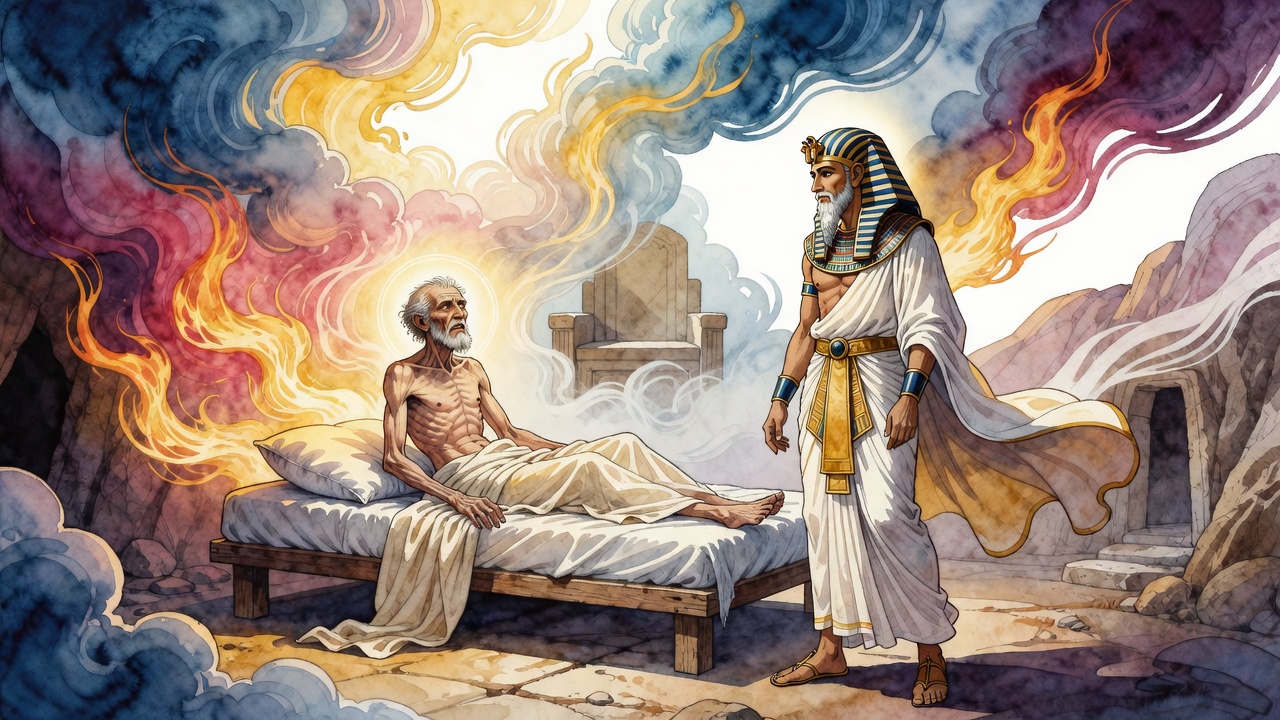
"If now I have found favor in your eyes," the old man said, and his voice was the voice of a father begging a mercy from his own child, "do not bury me in Egypt."

Bury Me Not in Egypt

Joseph had brought the whole family down to Egypt to keep them alive through the famine, and now the man who had come for bread refused to stay in the ground that fed him. It was not ingratitude. Jacob had reasons, and he laid them out like a man setting stones into a wall.

Egypt would one day be struck. Vermin would rise up out of that soil and swarm through it, and he did not want his body lying in earth that heaven had already marked for punishment. That was the first stone.

Then there was what the living might do with him. The Egyptians buried their dead and bowed to them, and if they took the father of Joseph, the man whose God had filled their storehouses, they might stand him up as a thing to worship. Jacob knew where that road ended. Years later Daniel would read Nebuchadnezzar's dream, and the king would fall on his face and order incense burned to him as to a god, and Daniel would refuse it, because the idol is punished along with everyone who kneels to it. Jacob would not become an idol. That was the second stone.

The third was stranger than the rest. If the fathers of Israel lay buried in Egyptian ground, the merit locked in their bones might spill over onto Egypt and lift that nation higher than it had earned. He would not spend himself redeeming the land of his exile. "Deal kindly and truly with me," he said, and he meant the only kindness that can never be repaid, the kindness done for the dead, who have nothing left to hand back.

The Roads Beneath the Earth

A promise sat hidden inside the request. The patriarchs did not cling to the cave at Machpelah for its view. They knew the dead buried in the land would be first to wake when the dead began to wake, first to breathe again on the day death itself was undone.

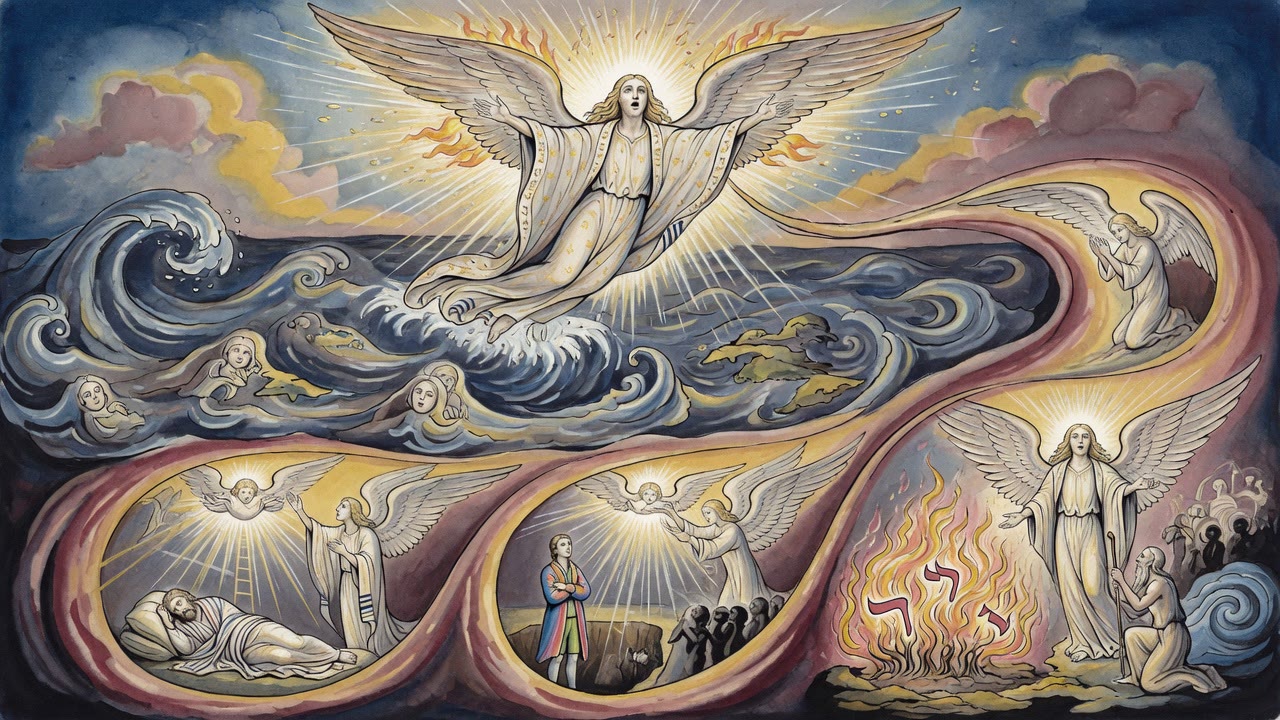
And the ones who died in exile. A man who dies outside the land and is buried outside it tastes death twice. But heaven does not leave its righteous in foreign dust forever. God hollows out passages beneath the earth, long tunnels running under the seas, and through them the bodies of the righteous roll and turn until they surface in the land, and only there does the breath come back into them. Jacob wanted to be laid where the waking begins, not smuggled to it later through the ground.

Swear to Me

"If you do this for me, well and good," Jacob told his son. "If not, my soul leaves this body now." He would not close his eyes on a promise he could not trust.

"I will do it," Joseph said.

"Swear to me." And Joseph swore. Then the old man turned in his bed toward the head of it, where the Divine Presence, the Shekhinah, hovered over him the way it waits above the pillow of every dying man, and Israel bowed himself down before it. When at last he stopped breathing, his sons did to him exactly what he had commanded. They carried him up out of Egypt and laid him in the cave with his fathers.

The Fathers Held the Living Back

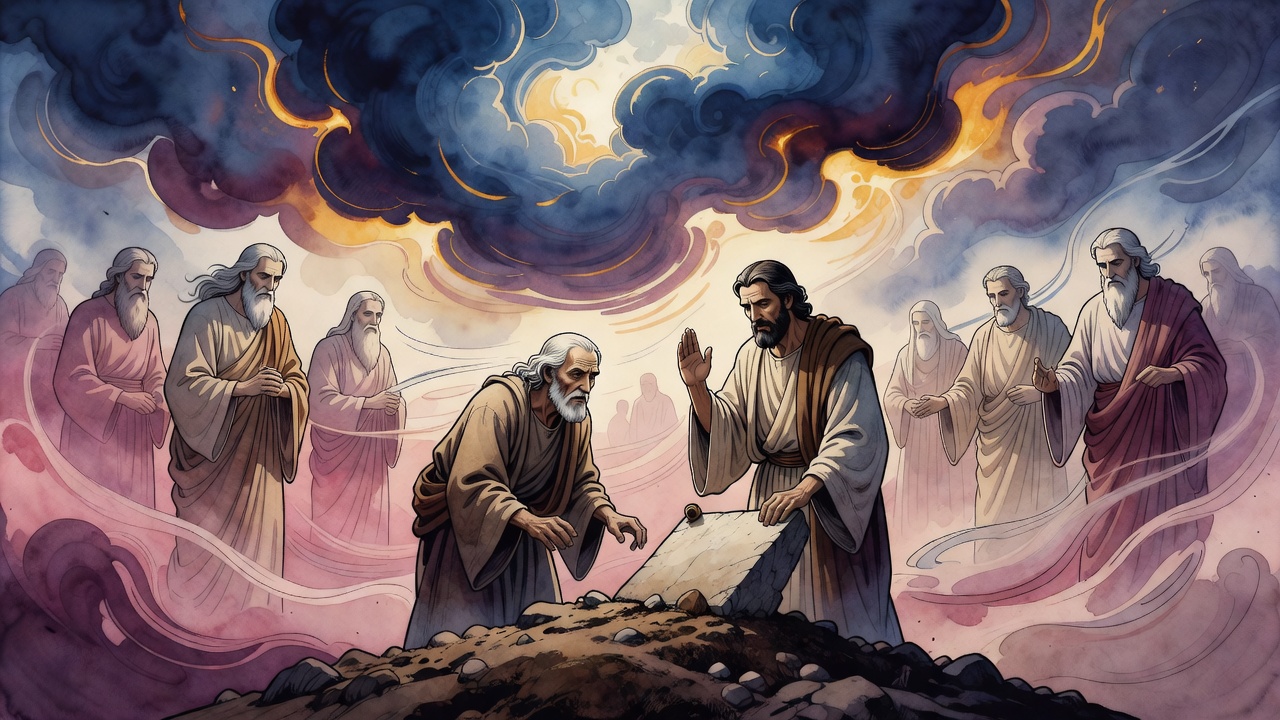
And the teachers who came after carried the claim past the grave itself. The dead of the nations, the ones who bow to idols, are dead and finished. The dead of Israel are not. Rabbi Meir said it without softening it. They go on living, held up by the merit stored in their own bones.

He could point to his proof. When Israel built the golden calf and heaven moved to wipe them out of the world, Moses did not argue their innocence. He spoke three names into the fire. Abraham. Isaac. Jacob. Three men long buried, and the sound of those names alone reached up and pulled the living back from the mouth of the pit. Dead men do not do that. These did.

It weighs on heaven to sign the death of a righteous man. So heaven does a strange mercy. It shows the tzaddik the reward waiting on the far side, opens the door wide enough that he glimpses what is already his, and only then does he loosen his grip and begin to long for the crossing. Jacob had asked for death once. "Now let me die," he had said years before, and God answered that he would live seventeen more years first. The years ran out. He sickened. He sent for Joseph. And a man whose sons carry his name and his seed up out of exile has not really ended. He has only gone on ahead of them, into the land where the waking begins.


← All myths
From the tradition

Sources

3 sources

The texts behind this telling. Some cards carry a translation of the source; others are our own retelling of it, and each card says which. Every card links out to the original.

Midrash Tanchuma, Vayechi 1Midrash Tanchuma

Retold in our words. Read the original at the link below.Townsend 1989 translation of Midrash Tanhuma, S. Buber Recension · CC-BY

And the time drew near that Israel must die (Gen. 47:29). It is stated in Scripture in reference to this verse: For we are strangers before Thee, and sojourners, as all our fathers were; our days on the earth are as a shadow, and there is no hoping (I Chron. 29:15). Our days are as a shadow. Would that they were as the shadow of a wall or a tree, but the fact is that they are as the shadow of a bird, as it is said: His days are as a shadow that passeth away (Ps. 144:14).

And there is no hoping implies that there is no one who can hope to escape death. All (our patriarchs) realized this and announced their deaths with their own mouths. Abraham said: I go hence childless (Gen. 15:2); Isaac declared: May my soul bless Thee before I die (ibid. 27:4); and Jacob said: When I sleep with my fathers (ibid. 47:30). When did he say this? When he was about to die. Thus it is written: And the time drew near that Israel must die.

Full source
Midrash Tanchuma, Vayechi 3Midrash Tanchuma

Retold in our words. Read the original at the link below.Townsend 1989 translation of Midrash Tanhuma, S. Buber Recension · CC-BY

And he called his son Joseph (Gen. 47:29). Why did he not summon Reuben or Judah? After all, Reuben was the firstborn, while Judah was a king. He ignored them and called Joseph instead. He did so to teach us that one must pay homage to the person who is in power at the moment; moreover, Joseph had the power to fulfill his desires. And he said to him: “If now I have found favor in thy sight … bury me not, I pray thee, in Egypt (Gen. 47:29). It was for your sake that I descended to Egypt, and it was because of you that I said: Now let me die. Even the soul of a man who dies on shipboard joins his fathers, and so when I sleep with my fathers, carry me out of Egypt and bury me in their burying-place (ibid., v. 30).” They cherished their burial place. The grave that I have digged (ibid. 50:5). And deal kindly and truly with me (ibid. 47:29). Is there false kindness that he should say to him kindly and truly? The proverb says: When your friend’s son dies, share his sorrow; but when your friend dies, cast off your sorrow. He said to him, in other words: “If you are kind to me after my death, that will be true kindness. Bury me not in Egypt, for it will eventually be smitten with vermin, and they will swarm over me.” Hence it says: Bury me not, I pray thee, in Egypt.

Another explanation as to why Jacob did not want to buried in Egypt. He was afraid that the Egyptians might use him as an object of idolatrous worship. Just as punishment is exacted from the worshipper of an idol, so is it exacted from the (idol) which is worshipped, as it is written: And against all the gods of Egypt will I execute judgment (Exod. 12:12). Similarly, you find that after Daniel interpreted Nebuchadnezzar’s dream: Then the king Nebuchadnezzar fell upon his face, and worshipped Daniel, and commanded that they should offer an offering and sweet odors unto him (Dan. 2:46). Daniel would not allow it. And why not? For just as the idolaters would be punished, so too would he be. You find this illustrated in what is written about Hiram, king of Tyre. After he proclaimed himself a god: Because thy heart is lifted up, and thou hast said: I am a god (Ezek. 28:2). The Holy One, blessed be He, said to him: Art thou wiser than Daniel? (ibid., v. 3). When Nebuchadnezzar decreed that offerings should be brought to him, he (Daniel) would not permit it, yet you call yourself a god. And so it is written there: I have cast thee to the ground, I have laid thee before kings, that they may gaze upon thee (ibid., v. 17).

Another explanation is that Jacob said: “Perhaps the Egyptians will be redeemed through me.” They are compared to asses, as it is said: Whose flesh is the flesh of asses (ibid. 33:20), and I am likened to a sheep, as is said: Israel is a scattered sheep (Jer. 50:17). And it is written elsewhere that The firstling of an ass thou shalt redeem with a sheep (Exod. 34:20). Hence, (Bury me not in Egypt) lest the Egyptians be redeemed through me. Therefore Bury me not, I pray thee, in Egypt.

Why were the patriarchs anxious to be buried in the land of Israel? R. Eliezer said: There is a reason for this. R. Hanina said: There is a reason for this; and R. Joshua the son of Levi said: There is a reason for this. What did they mean by “There is a reason for this”? It is written: I shall walk before the Lord in the land of the living (Ps. 116:9). However, our sages said in the name of R. Helbo that there were two reasons why the patriarchs longed to be buried in the land of Israel: The dead in the land of Israel would be the first to be resurrected in the Messianic age, and they would be the first to enjoy the years brought by the Messiah.

R. Hanina said: Whoever dies outside of the land of Israel and is buried there experiences two deaths, as it is written: And thou, Pashhur, and all that dwell in thy house shall go into captivity; and thou shalt come to Babylon, and there thou shalt die, and there thou shalt be buried (Jer. 20:6). Hence he experienced two deaths. That is why Jacob said to Joseph: Bury me not, I pray thee, in Egypt. R. Simon argued: If that is so, do not the righteous who are buried outside the land of Israel suffer because of that? What does the Holy One, blessed be He, do? He constructs subterranean passages through which they revolve until they reach the land of Israel. When they reach the land, the Holy One, blessed be He, instills within them the breath of life and they rise, as it is said: Behold, I have opened your graves, and I caused you to come up out of your graves, O My people. And I will bring you into the land of Israel (Ezek. 37:12), and after that is written: I will put My spirit in you, and you will live (ibid., v. 14). R. Simeon the son of Lakish said: The following verse teaches explicitly that when the righteous reach the land of Israel, the Holy One, blessed be He, instills the breath of life in them: He that giveth breath unto the people upon it, and spirit to them that walk therein (Isa. 42:5).

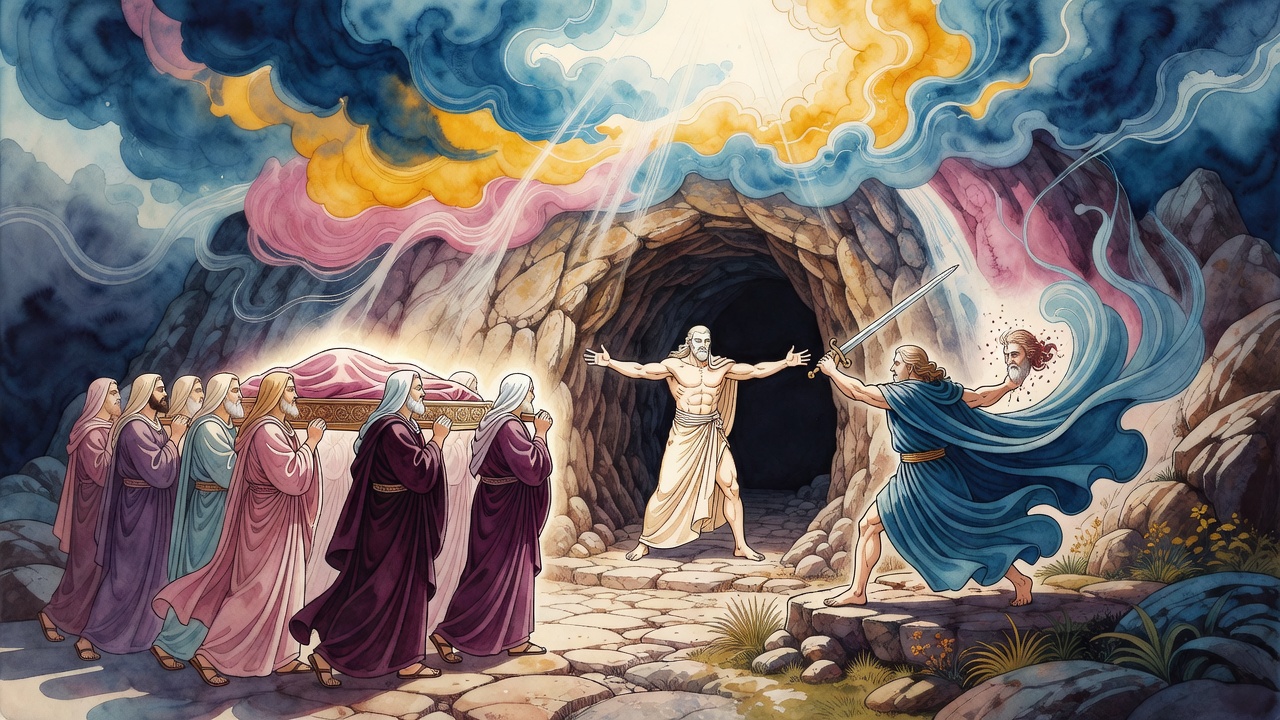
Rabbi (Judah the Prince) and R. Eliezer, while strolling outside the gates of Tiberias, saw a coffin being borne for burial in the land of Israel. Rabbi said to R. Eliezer: How does this one, who died outside the land, benefit from being brought into the land of Israel for burial? I apply to him the verse: Ye made My heritage an abomination (Jer. 2:7). During your lifetime you did not go up to the land, But when ye entered ye defiled My land (ibid.). R. Eliezer replied: Since he is now to be buried in the land of Israel, the Holy One, blessed be He, will forgive him, as it is said: The land maketh atonement for His people (Deut. 32:43).

When R. Yohanan was about to leave this world, he said to those who were to arrange his funeral: Bury me in colorful garments that are neither wholly white nor black, so that if I should stand among the righteous I shall not be humiliated, and if I stand among the wicked I shall not be embarrassed. When R. Josiah was about to depart from this world, he told those standing at his side: Summon my disciples. He said to them: Bury me in white garments, for I am not ashamed to stand before my Maker for any act that I have committed. It is told that when our holy Rabbi was about to depart from this world, he left three instructions. He told them: Do not move my widow from my home, do not permit eulogies to be recited in the cities of the land of Israel, and do not permit a stranger to bear my coffin. Permit only the ones who attended me in my lifetime to attend to me when I die. During his lifetime, he resided for seventeen years in Sepphoris. He applied to himself the verse And Jacob lived in Egypt seventeen years, and “(I,) Judah, lived in Sepphoris seventeen years.”

Our saintly Rabbi suffered from a toothache for thirteen years, and during that time no woman in the land of Israel died in childbirth or had a miscarriage. At the end of the thirteenth year, Rabbi became angry with R. Hiyya the elder. Elijah, of blessed memory, visited our Rabbi in the guise of R. Hiyya and touched his aching tooth. He was cured immediately. The following day, when R. Hiyya visited him, he asked: “How is your tooth?” He answered: “From the moment you touched it yesterday, it was cured.” Then R. Hiyya cried out: “Woe unto you, O pregnant woman in the land of Israel, woe unto you O pregnant woman in the land of Israel.” When R. Hiyya told him: “I did not touch your tooth,” our Rabbi realized that it was Elijah, of blessed memory, who had done so. From that moment on he began to pay homage to R. Hiyya.

But when I sleep with my fathers (Gen. 47:30). Jacob said to Joseph: “If you will do as I have asked, well and good, but if not, my soul shall depart at once.” “I shall do it,” he answered. “Swear unto me,” said Jacob. And he swore unto him. And Israel bowed down before the Shekhinah (the Divine Presence) that hovered over him. What is written after he passed away? His sons did unto him as he commanded them (ibid. 50:12). The Holy One, blessed be He, said: Death does not permit man to rejoice in this world, but in the world-to-come He will swallow up death forever (Isa. 25:8). When He does swallow up death, then I will rejoice in Jerusalem, and joy in My people; and the voice of weeping shall be no more heard in her, nor the voice of crying (Isa. 65:19).

Full source
Midrash Tanchuma, Vayechi 4Midrash Tanchuma

Retold in our words. Read the original at the link below.Townsend 1989 translation of Midrash Tanhuma, S. Buber Recension · CC-BY

And it came to pass after these things, that one said to Joseph: “Benold, thy father is sick” (Gen. 48:1). May it please our master to teach us whether a benediction may be recited over the light or the spices stationed at the side of a corpse? Our masters teach us: A benediction may not be recited over the light or the spices used at the side of a corpse. What is the basis of this decision? It is written: The dead praise not the Lord (Ps. 115:17).

R. Meir said: The idolatrous dead are truly dead, but the deceased in Israel do not actually die. They survive because of the merit (of their forebears). Thus, you find that the Israelites, who erected the golden calf, would have vanished from the world if Moses, our Master, had not mentioned the merit of the patriarchs, as it is said: Remember Abraham, Isaac, and Jacob, thy servants (Exod. 32:13). Therefore, it is difficult for the Holy One, blessed be He, to decree the death of the righteous, as it is said: Weighty in the sight of the Lord is the death of His righteous ones (Ps. 116:15). What did the Holy One, blessed be He, do? He revealed to the righteous the reward that awaits them in the world-to-come so that they would plead for their own death. When R. Abahu was about to depart from this world, the Holy One, blessed be He, disclosed to him the reward stored up for him and he was astounded by it. He said: “Is all this for Abahu?” Whereupon he applied to himself the verse And I said: “I have labored in vain, I have spent my strength for naught and vanity; yet surely my right is with the Lord, and my recompense with my God (Isa. 49:4). Immediately, he began to long for death.

Abraham also pleaded for death with his own lips, as it is said: What wilt thou give me, seeing I go hence childless (Gen. 15:2). Thereupon the Holy One, blessed be He, said to him: Thou shalt go to thy fathers in peace (ibid., v. 15). Isaac likewise sought death, as is said: That I may eat, and bless thee before the Lord before my death (ibid. 35:29). Similarly, Jacob asked for death, as is said: Now let me die (ibid. 46:30). The Holy One, blessed be He, told him: You have said: Now let me die, but you will live seventeen additional years. After that time had passed he became ill and died.

Full source