Parshat Miketz5 min read

Joseph Fed Benjamin Sevenfold Before the Cup

Joseph stored Egypt's grain, seized Simeon, and heaped Benjamin's plate seven times high before the silver cup closed the trap.

Curated by Arthur · Told by Maggid ·
Table of Contents
  1. Grain Behind Locked Doors
  2. Simeon as Price of Benjamin
  3. Seven Portions at the Table
  4. The Cup and the Bowed Faces
  5. What the Trap Measured
Joseph Fed Benjamin Sevenfold Before the Cup Click for full size

Grain Behind Locked Doors

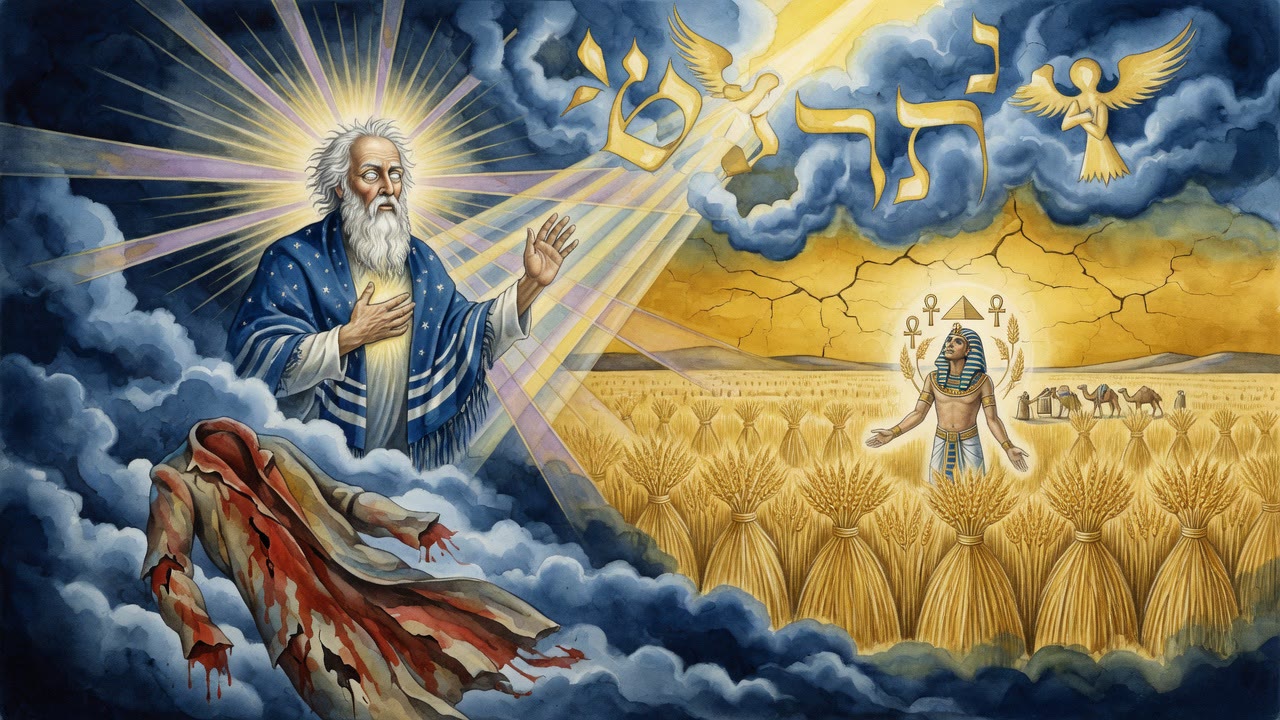
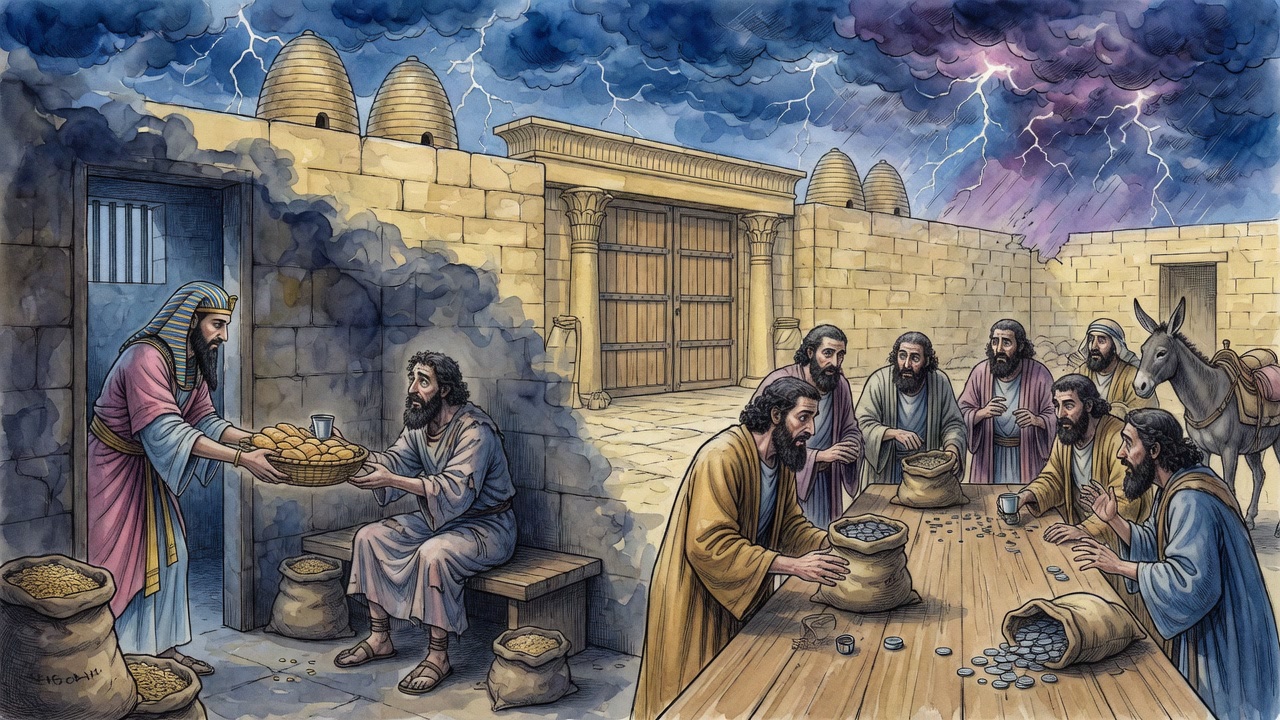
Joseph had gathered seed through seven fat years and locked it where panic could not reach. When famine bit Egypt he opened the first storehouses and sold grain for gold. The land that once threw him into a pit now bowed for bread. Canaan starved harder. Fields that had fed the house of Jacob returned only dust and thin stalks.
Jacob heard there was food in Egypt and sent ten sons. Benjamin stayed. Rachel's last living boy was not a coin Jacob would risk on the road. The ten arrived among other hungry men. Joseph knew their faces at once. They did not know the Egyptian who held the keys. Recognition burned one way only, like a lamp behind a curtain.

He had preserved the seed of the land. Now he would test the seed of his father's house. The storehouses were full. The brothers' hearts were still an open question.

Simeon as Price of Benjamin

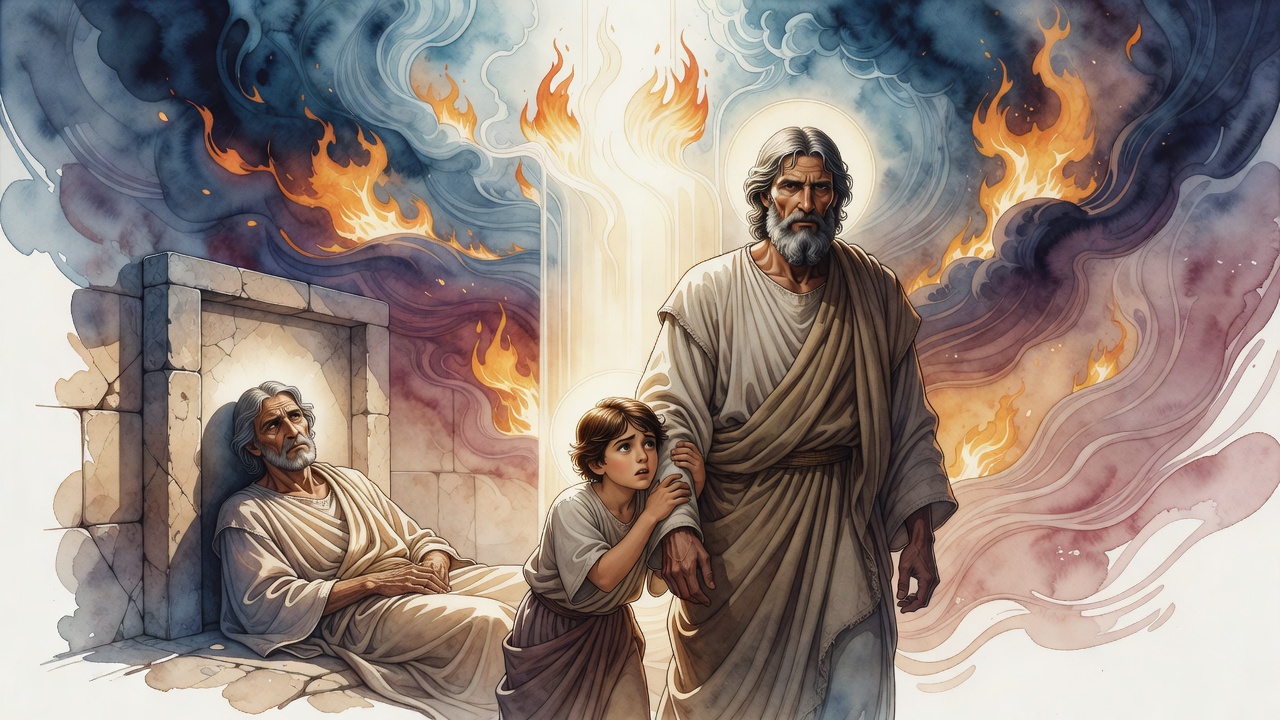
Joseph took Simeon and bound the demand to the youngest. Bring Benjamin or do not come back. Chains and protocol did the work a sword might have done. The news reached Jacob like a second funeral. "Me have ye bereaved of my children!" he cried. "Joseph is not, and Simeon also is not, and ye will take Benjamin away. On me hath your wickedness come."

He saw the sale of Joseph return as a chain on the living. He pictured fever on the road and an old man buried by sorrow. "My son will not go down with you lest perchance he fall sick," he said, "for their mother gave birth to two sons, and one hath perished, and this one also ye will take from me. If perchance he took a fever on the road, ye would bring down my old age with sorrow unto death."

The brothers stood under the weight of a father who finally named their wickedness out loud. Hunger argued against love. Love argued against hunger. Egypt waited with Simeon in its grip and grain behind locked doors.

Seven Portions at the Table

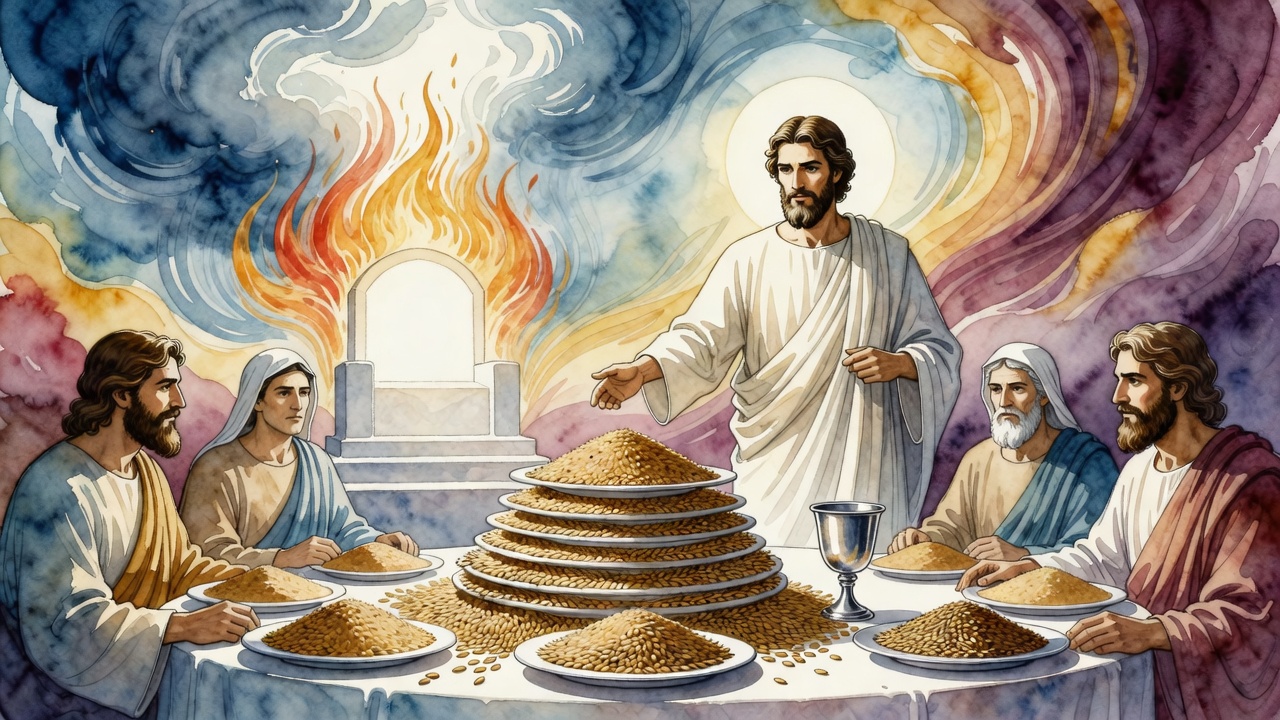
Hunger won. Benjamin went down. When the brothers stood before Joseph again the room held a feast and a test. They said of the man in power, "It is he," still not knowing the full truth. Joseph answered Benjamin with a blessing that landed like a hand on a scar. "The Lord be gracious to thee, my son!"

He brought Simeon out. Gifts from Canaan changed hands under ironical light. They ate before him, and he gave every man a portion, but Benjamin's portion was seven times larger than any of theirs. Meat and favor piled high where jealousy had once piled a pit.

Jealousy had sold a dreamer. Joseph watched for it now in the tilt of eyes toward a piled plate. They ate and drank and rose to their asses, not knowing the next move was already designed to learn whether thoughts of peace lived among them. Joseph's mind worked past the wine. He wanted their thoughts measured, not their hunger only.

The Cup and the Bowed Faces

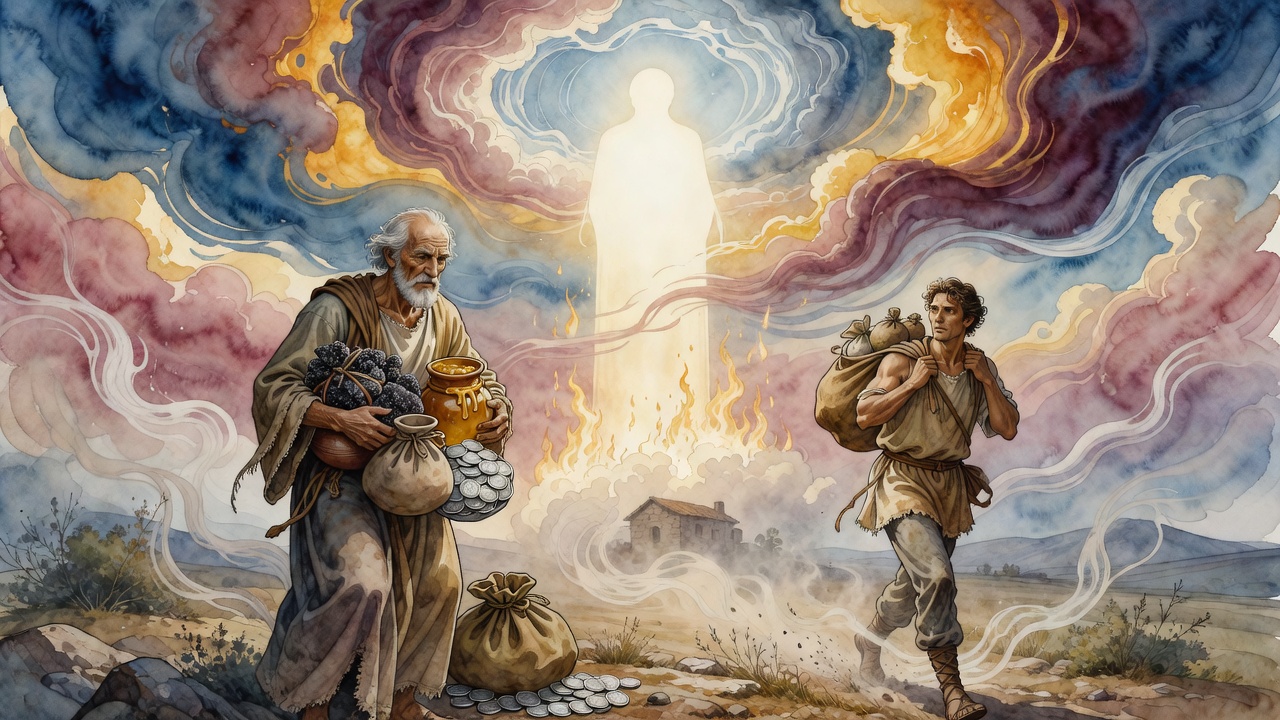
The silver cup found its way into Benjamin's sack by Joseph's plan. Guards overtook the road. The brothers returned to the city with shame riding every step. They bowed their faces to the ground before him. Total submission. The old sale of a brother rose in their throats like bile.

"What shall we say and how shall we defend ourselves?" they cried. "Our lord hath discovered the transgression of his servants; behold we are the servants of our lord, and our asses also." They offered bodies and beasts. Guilt drove the offer past dignity into total surrender.

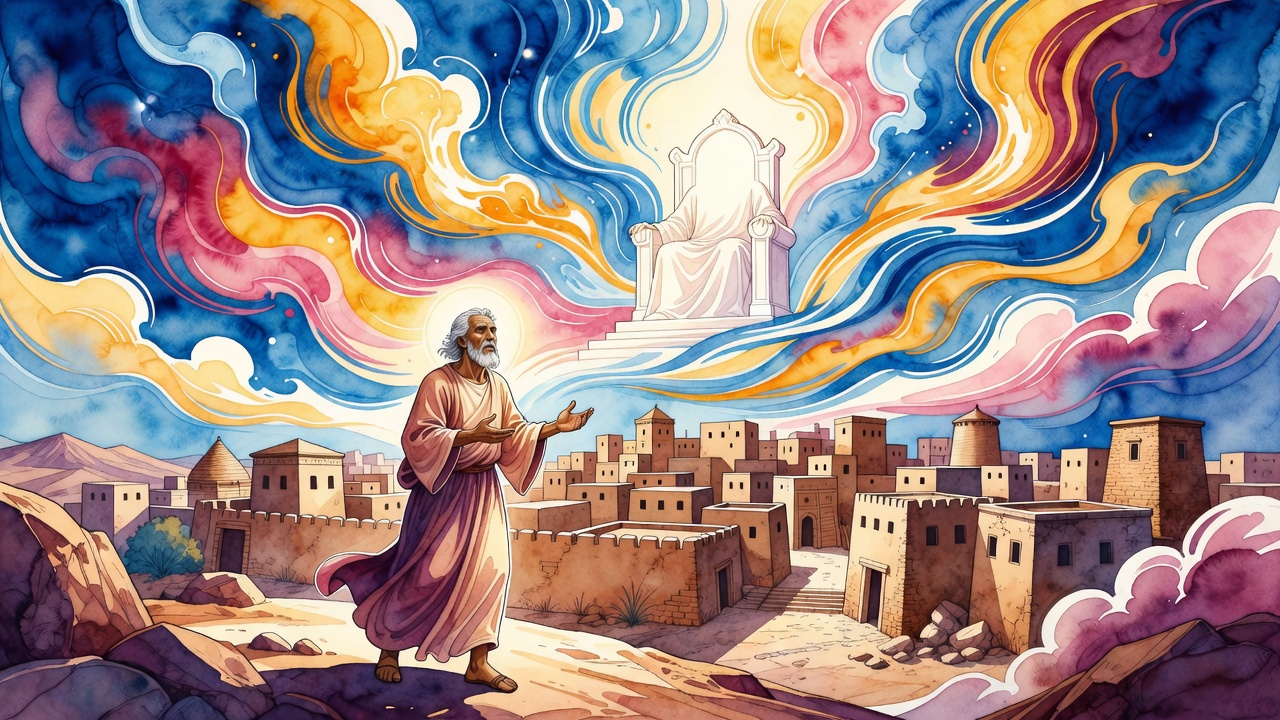
Joseph answered with fear of God on his tongue and a hard line in his hand. "I too fear the Lord; as for you, go ye to your homes and let your brother be my servant, for ye have done evil." The words cut two ways. Punishment for the cup. Space for the rest to prove whether they would abandon another son of Rachel the way they once abandoned Joseph.

What the Trap Measured

Years earlier they had sold a brother and dipped a coat. Now the same men stood under Egyptian power with Benjamin's life in the balance and Simeon's freedom newly tasted. The sevenfold plate had asked if envy still ruled. The cup asked if loyalty could outrun fear.

Joseph held the storehouses, the hostage, the feast, and the law of the house. The brothers held only the memory of a pit and the sound of their father's grief. Between those weights the next choice would decide whether the house of Jacob healed or split again on the same old crack.

Grain had brought them. Guilt kept them. Benjamin's seven portions and the hidden cup turned a famine errand into a courtroom where no judge wore a Hebrew name, and every brother finally felt how heavy a sold life can sit on the ones who sold it.


← All myths
From the tradition

Sources

4 sources

The texts behind this telling. Some cards carry a translation of the source; others are our own retelling of it, and each card says which. Every card links out to the original.

Book of Jubilees 42:6Book of Jubilees

Retold in our words. Read the original at the link below.Sefaria Community Translation · CC-BY

The Book of Jubilees certainly thinks so. It retells familiar biblical narratives, but with a unique perspective, filling in details and offering its own interpretations. to a snippet from Jubilees 42, which recounts the well-known story of Joseph in Egypt. Remember Joseph? Sold into slavery by his brothers, he rises to power, eventually becoming second-in-command to Pharaoh himself. It’s a classic tale of betrayal, redemption, and divine providence.

In our passage, Joseph, having wisely foreseen the coming hardship (thanks to those dream-interpretation skills!), had spent the seven years of plenty carefully gathering and storing the land's bounty. “Joseph had gathered the seed of the land in the seven years of plenty and had preserved it.” The weight of responsibility on his shoulders! He wasn’t just managing grain; he was safeguarding the future of an entire nation.

When the famine hit, the Egyptians, desperate for sustenance, turned to Joseph. "And the Egyptians came to Joseph that he might give them food, and he opened the storehouses where was the grain of the first year, and he sold it to the people of the land for gold."

Notice the practical details here. The Book of Jubilees doesn't shy away from the economic realities of the situation. Joseph isn't just handing out food; he's selling it. It highlights his role not just as a savior, but as a shrewd administrator.

Meanwhile, back in the land of Canaan, things are getting dire. "(Now the famine was very sore in the land of Canaan)," Jubilees tells us, echoing the sense of desperation found throughout the Joseph narrative in Genesis. Jacob, Joseph’s father, hears that there's food available in Egypt. So, what does he do? He sends his ten sons – remember, Joseph's brothers – to procure food. "And Jacob heard that there was food in Egypt, and he sent his ten sons that they should procure food for him in Egypt; but Benjamin he did not send."

Poor Benjamin. He's the youngest, and Jacob is understandably protective of him, especially after having "lost" Joseph years before. The absence of Benjamin in this initial trip sets the stage for even more drama later on.

And then comes the moment of recognition – or rather, the lack thereof. "(The ten sons of Jacob) arrived (in Egypt) among those that went (there.) And Joseph recognized them, but they did not recognize him."

Joseph, in his Egyptian finery, a powerful figure, sees his brothers – the very ones who sold him into slavery! – standing before him, begging for food. What must have been going through his mind? The Book of Jubilees doesn't tell us explicitly, but the tension is palpable. It’s a moment thick with irony, foreshadowing the complex emotional and moral reckoning to come.

This little passage from Jubilees 42, like the larger Joseph story, reminds us that even in times of hardship, providence can be at work. And sometimes, the people who hurt us the most end up needing our help. What do we do then? That’s the question Joseph, and perhaps we ourselves, must confront.

Full source
Book of Jubilees 42:15Book of Jubilees

Retold in our words. Read the original at the link below.Sefaria Community Translation · CC-BY

Book of Jubilees turns to Joseph Holds Simeon Hostage and Demands Benjamin.

The Book of Jubilees, a text preserved in Ethiopian manuscript tradition and valued by many others for its insights into ancient Jewish thought, gives us a glimpse into Jacob's anguished reaction. It's a raw, emotional outburst.

"Me have ye bereaved of my children!" Jacob cries. "Joseph is not, and Simeon also is not, and ye will take Benjamin away. On me hath your wickedness come."

You can almost hear the desperation in his voice, can't you? The loss of Joseph years ago, the current predicament with Simeon, and now this demand for Benjamin. It's almost too much for one person to bear. He sees it all as a direct result of his sons' "wickedness." Remember, they were the ones who sold Joseph into slavery in the first place. Jacob is understandably devastated.

But it's his next words that really tug at the heartstrings: "My son will not go down with you lest perchance he fall sick; for their mother gave birth to two sons, and one hath perished, and this one also ye will take from me. If perchance he took a fever on the road, ye would bring down my old age with sorrow unto death."

He's talking about Benjamin. Benjamin and Joseph were the only two sons of Rachel, Jacob's beloved wife who died giving birth to Benjamin. Losing Joseph was a deep wound, and the thought of losing Benjamin, the last connection to Rachel, is unbearable. He imagines all sorts of dangers – sickness, accidents – and the crushing grief that would surely follow.

He pictures himself, an old man already burdened with sorrow, being brought down to his grave by the loss of his youngest son. The phrase "bring down my old age with sorrow unto death" is a powerful one. It speaks to the depth of his despair.

Jacob's words are a reminder that even the great figures of the Bible, the patriarchs and matriarchs, were still human. They experienced the same joys and sorrows, the same fears and anxieties, as we do. They loved their children fiercely and grieved deeply at their loss. We often think of them as larger-than-life figures, but in moments like these, we see their vulnerability, their humanity. And perhaps that's what makes their stories so enduring and relatable.

Full source
Book of Jubilees 42:31Book of Jubilees

Retold in our words. Read the original at the link below.Sefaria Community Translation · CC-BY

Book of Jubilees turns to Joseph's Brothers Finally Stand Before Him Again.

The scene. The brothers stand before this powerful Egyptian official, not realizing it’s the very brother they betrayed years ago. The Book of Jubilees simply states, "And they said unto him: 'It is he.'" A simple, understated acknowledgement.

Then comes Joseph’s heartfelt response: "The Lord be gracious to thee, my son!" What a beautiful blessing, filled with emotion. It’s a moment of forgiveness and recognition, even if his brothers are still in the dark.

Joseph then brings them into his house, and the narrative tells us he brought out Simeon to join them. Why Simeon specifically? In the Genesis account, Simeon was held hostage. Perhaps the Book of Jubilees is subtly emphasizing Joseph's control and power in this situation, or perhaps it's highlighting the brother who might have felt the most guilt.

Next, a feast! "And he made a feast for them and they presented to him the gift which they had brought in their hands." A standard diplomatic gesture, no doubt, but loaded with irony. They are bringing gifts to the brother they once sold into slavery. How the tables have turned!

And here's a detail that's quite telling. "And they ate before him and he gave them all a portion, but the portion of Benjamin was seven times larger than that of any of theirs." Favoritism? Maybe. But more likely, it's a test. Is Joseph trying to gauge their reactions? Is he seeing if they still harbor the same jealousy and resentment that led them to sell him into slavery in the first place? This is definitely a plot point that adds to the tension.

After the meal, the brothers "ate and drank and arose and remained with their asses." A practical detail, reminding us of their journey and their livestock, grounding the narrative in the realities of their lives.

But Joseph’s mind is working. He's not just hosting a dinner party; he's on a mission. "And Joseph devised a plan whereby he might learn their thoughts as to whether thoughts of peace prevailed amongst them."

So, what's the takeaway here? The Book of Jubilees, in its concise way, highlights the emotional complexity of this reunion. It's not just about recognition, but about testing, forgiveness, and the long, slow process of rebuilding trust. It is a tale as relevant today as it was millennia ago. Does this version change your interpretation of the story?

Full source
Book of Jubilees 43:15Book of Jubilees

Retold in our words. Read the original at the link below.Sefaria Community Translation · CC-BY

That feeling, that primal dread of exposure, is at the heart of this little snippet from the Book of Jubilees, chapter 43.

The Book of Jubilees, for those less familiar, is a fascinating text. It's considered apocryphal by many, meaning it’s not part of the standard Jewish biblical canon. But it offers a unique, expanded retelling of the stories we know from Genesis and Exodus, often adding layers of detail and interpretation.

This particular passage jumps right into the aftermath of Joseph's big reveal. Remember? He’s the brother sold into slavery, who rises to power in Egypt, and then cleverly tests his brothers when they come seeking food during a famine. He frames them for stealing his silver cup, and bam! the truth comes out.

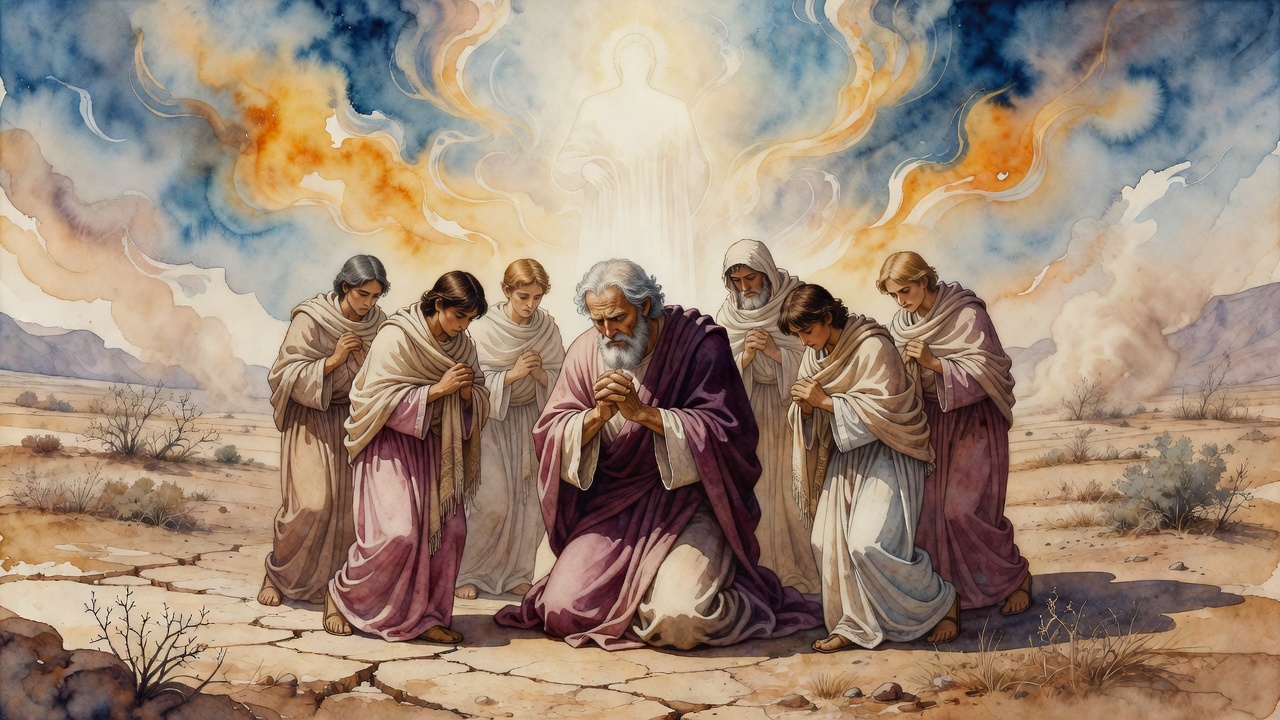
The brothers, utterly exposed, return to the city. Heavy with shame and fear, they arrive at Joseph’s house. The verse reads, "they all bowed themselves on their faces to the ground before him." Total submission. Utter humiliation. They know they're at his mercy.

And their plea? It's a tangled mess of guilt and desperation. "What shall we say and how shall we defend ourselves?" they cry. "Our lord hath discovered the transgression of his servants; behold we are the servants of our lord, and our asses also." They offer themselves, their livelihood, everything, hoping to appease Joseph. They even throw in their poor donkeys for good measure!

But Joseph's response is… unexpected. He doesn't immediately unleash his wrath. Instead, he says, "I too fear the Lord; as for you, go ye to your homes and let your brother be my servant, for ye have done evil."

There’s a lot packed into that short sentence. First, the acknowledgement of a higher power. "I too fear the Lord." Joseph isn’t acting solely out of personal vengeance. There's a sense of divine justice at play.

Then, the seeming harshness. "Let your brother be my servant." He's singling out one brother, presumably the one found with the cup, holding him accountable. But is this truly about punishment? Or is there something else going on? By allowing the other brothers to return home, Joseph is giving them a chance to prove they've changed. He’s giving them a chance to show loyalty to their brother, even at a cost. It's a test, perhaps even a path to redemption.

This passage, though brief, is a powerful reminder that even in moments of deep transgression, there’s still room for divine influence, for tests of character, and for the possibility of a new beginning. What would you do if you were Joseph in this situation? Or better yet, what would you do if you were one of the brothers?

Full source