5 min read

Joseph Hid Treasure That Waited at Baal Zephon

God told them to turn back toward Egypt and camp at the one idol left standing. Under it lay the silver and gold Joseph had stored away.

Curated by Arthur · Told by Maggid ·
Table of Contents
  1. The Light Question in the Dark
  2. Job Born as They Went Down
  3. Treasure Under the Idol
  4. Great Substance, Measured Twice

After the dead of Egypt still lay behind them, Israel received a baffling order.
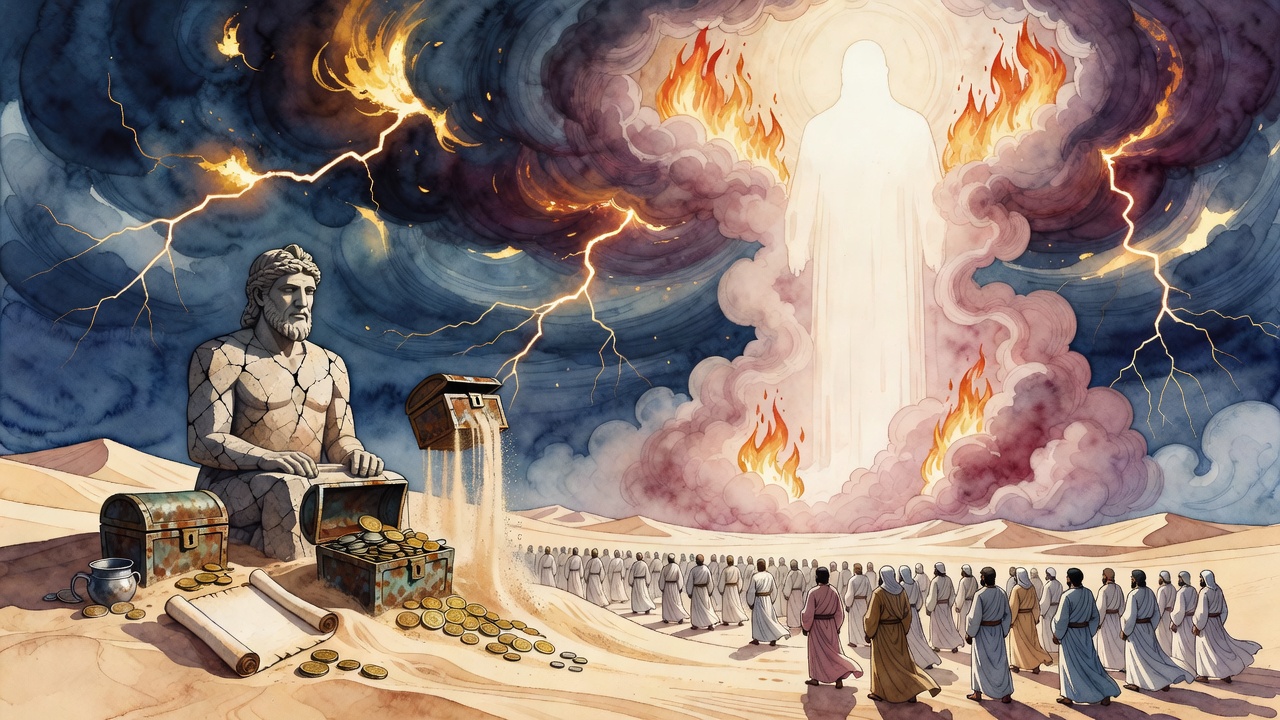
Joseph Hid Treasure That Waited at Baal Zephon Click for full size

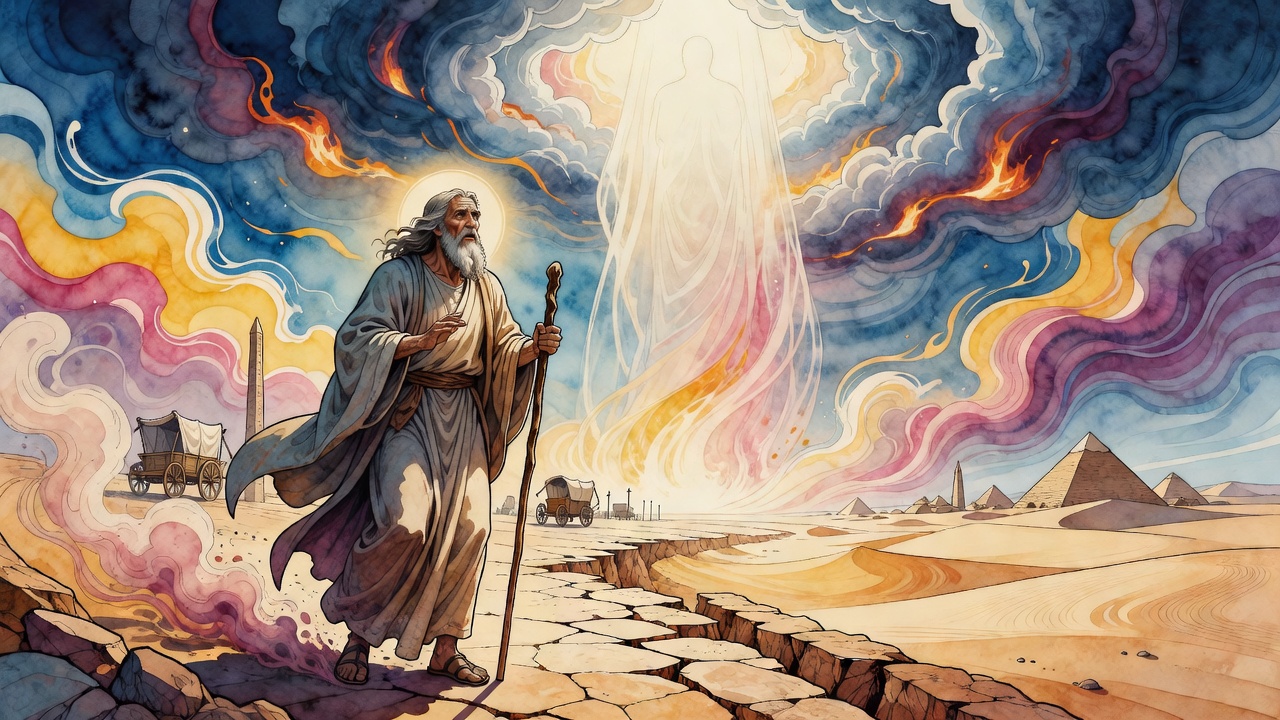
Turn back. Camp before Baal Zephon, the last idol Egypt had not smashed, the shrine that stood like a dare at the edge of freedom. The people looked at Moses as if the road had folded on itself. They had plunder in their packs from neighbors who had pressed gold into their hands, and a night of firstborn death still ringing in their ears. Why reverse toward the thing that had owned them?

Because a promise to Abraham still had a clause unpaid: they would leave with great substance. And because under that idol's shadow, the midrash says, lay wealth Joseph had buried long before, when he still ruled the granaries and could hide a fortune where only a later command would dig.

The Light Question in the Dark

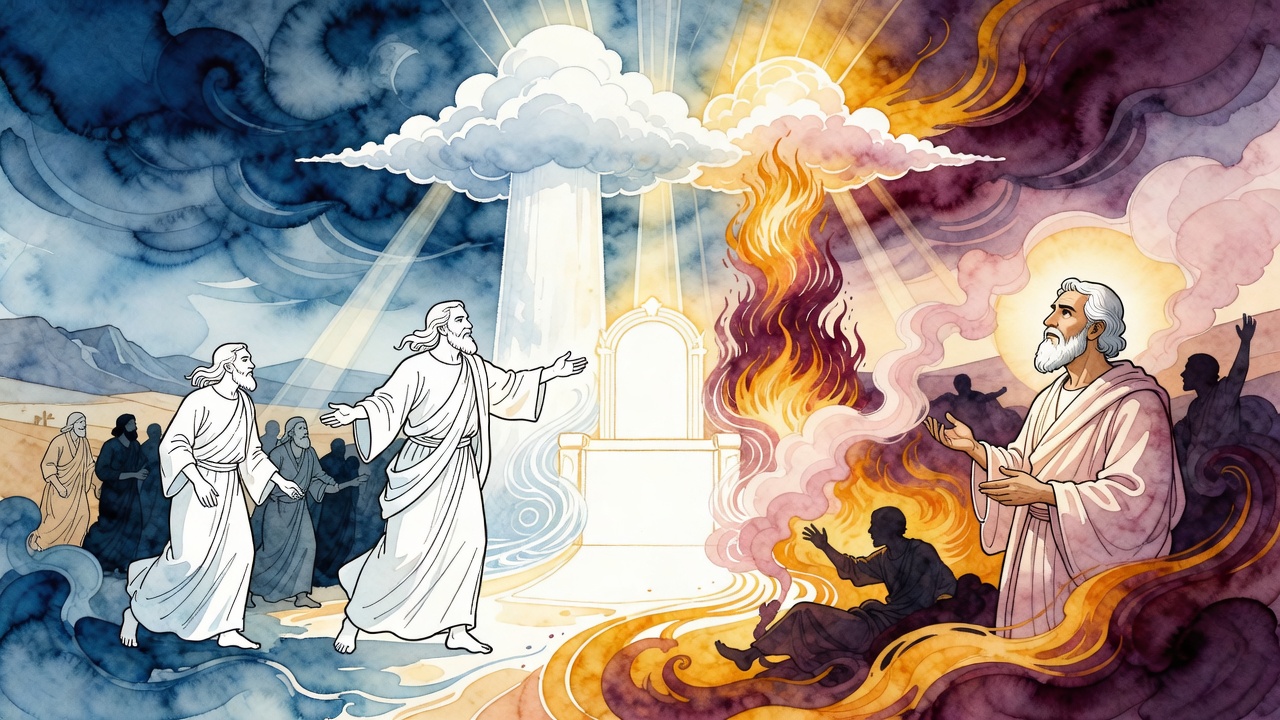
The long Egyptian night did not begin only with a new king who did not know Joseph. The sages trace a thinner crack earlier. When Abraham asked, "by what shall I know" that he would inherit the land (Genesis 15:8), that single hesitant question was treated as a light sin, enough to set the descent into slavery in motion. Guard yourself even against a light slip, they teach. Fear of heaven is not only for the crimes that fill a court. It is for the small doubt that opens a century of brick.

The covenant between the pieces already held four hundred years in its mouth when Abraham asked for a sign. A careful question helped unlock the door. The animals divided. The darkness fell. A smoking furnace and a flaming torch passed between the pieces, and the years of affliction were spoken into history as if they had always been waiting for a voice to admit them.

Abraham got his sign. His children would get the bill.

Job Born as They Went Down

The sages read the four hundred years as a chain of lifetimes, not a blank stretch. Tracing from the promise through Isaac at sixty and Jacob's hundred and thirty years of sojourning, they found a remainder of years that still had to be lived under Egypt's hand. Along that chain they uncovered a guest whose name seems to belong to another book. When Israel went down to Egypt, Job was born.

His trials would run in another land while Abraham's children groaned in brick and straw. The tradition refuses to let Egypt be a sealed box with only one plot. The same span that holds slavery holds a righteous sufferer whose mouth will later fill with arguments heaven does not crush. The chronology is crowded on purpose. No generation is only one story. While one people learns the weight of a light question asked by a grandfather, another man learns the weight of losses that arrive without a question he can answer.

Treasure Under the Idol

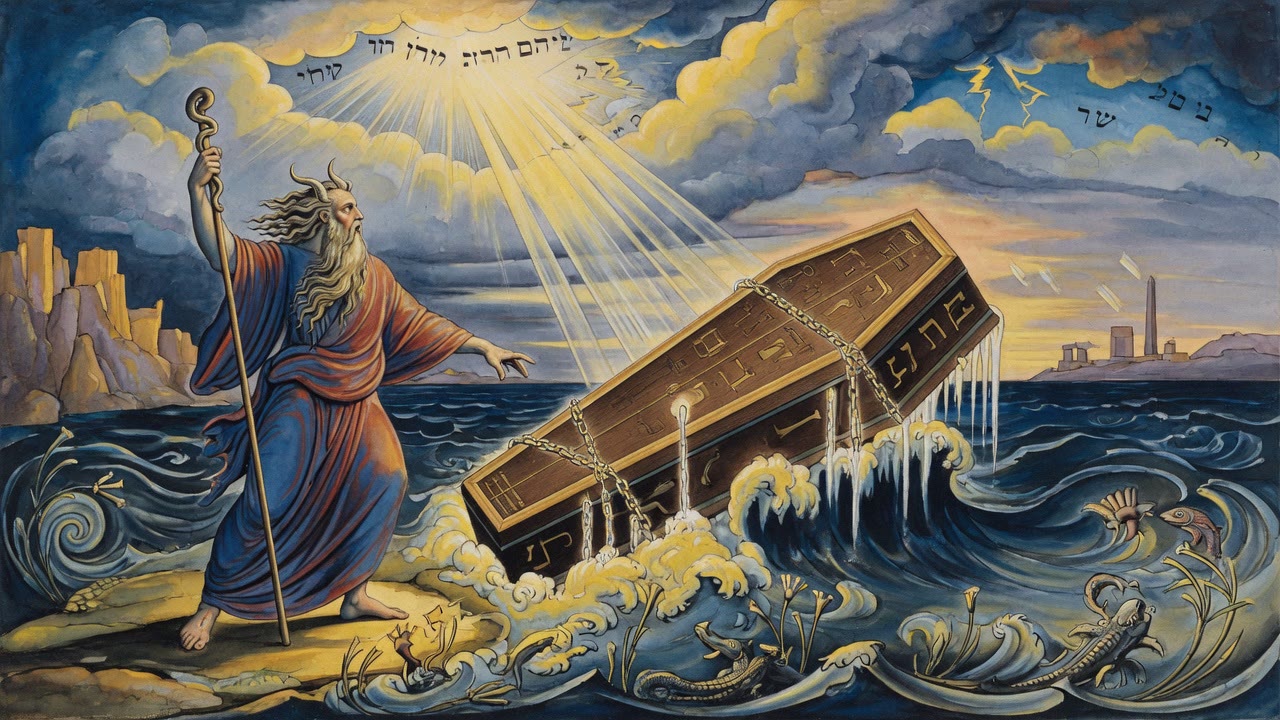
Joseph, who had ruled Egypt and made it rich through famine, had hidden wealth at Baal Zephon. When Israel turned back at God's command, they were not only bait for Pharaoh's chase, a camp arranged so the king would say the wilderness had shut them in. They were heirs collecting a deposit. The plunder of Egypt answered part of the "great substance" promised to Abraham. The treasure at the idol sealed the rest at an unlikely place and an unlikely moment, under the nose of a god that could not keep its own ground or its own gold.

Pharaoh harnessed his chariot. He saw the turnaround and thought the trap was his. He did not know the camp was also a claim ticket written in Joseph's hand and cashed in Moses' day.

The last idol watched the heirs of Joseph walk out heavier than they entered. Then the water rose, and the shrine's shadow fell behind a wall of sea.

Great Substance, Measured Twice

They would cross with gold from neighbors and with Joseph's buried store. They would cross because a grandfather once asked a careful question and a nation paid in years. They would cross while Job's lifetime, in the midrash's ledger, marked the same dark age from another angle, so that heaven's books never hold only one column of suffering.

Baal Zephon stood, then fell behind them as the path opened. Turn back, heaven had said. Sometimes the way out is a step toward the thing that thought it owned you, long enough to take what was yours from under its feet, and long enough for a pursuing king to ride into water that has already chosen sides.

Abraham's light sin. Job's parallel birth. Joseph's hidden substance. Three threads, one long count of years, and a camp that looked like retreat while it finished a promise spoken between divided animals in the dark.


← All myths
From the tradition

Sources

3 sources

The texts behind this telling. Some cards carry a translation of the source; others are our own retelling of it, and each card says which. Every card links out to the original.

Yalkut Shimoni on Torah 77:14Yalkut Shimoni on Torah

Translation of the source text.Torat Emet (Yalkut Shimoni) · CC-BY-NC

This is what Scripture says: "and let them turn back and encamp before Pi-hahiroth" (Exodus 14:2). Here was fulfilled "and afterward they shall come out with great substance" (Genesis 15:14). The Holy One, blessed be He, said to them: This is part of the promise I made to him. Let them turn back, for all the silver and gold that Joseph had gathered was placed in Baal Zephon, and when they turned back they took it, as it is said, "the wings of a dove covered with silver" (Psalms 68:14).

Full source
Yalkut Shimoni on Torah 77:13Yalkut Shimoni on Torah

Translation of the source text.Torat Emet (Yalkut Shimoni) · CC-BY-NC

It was said to Abraham our father at the Covenant Between the Pieces: "You shall surely know that your seed shall be a stranger" (Genesis 15:13) -- this is Isaac, as it is said, "for in Isaac shall your seed be called" (Genesis 21:12). "And Isaac was sixty years old when she bore them" (Genesis 25:26). Jacob our father said, "the days of the years of my sojournings are a hundred and thirty years" (Genesis 47:9); behold, one hundred ninety years. There remained two hundred and ten -- the sign of the years of Job, and in that very period Job was born: "and Job lived after this a hundred and forty years" (Job 42:16), and it says, "and the LORD gave Job twice as much as he had before" (Job 42:10). You find that when Israel went down to Egypt Job was born, and when they came up he died. Or might one think all four hundred years they were in Egypt? But behold, Kohath was among those who went down to Egypt: "and the years of the life of Kohath were a hundred and thirty-three years" (Exodus 6:18); "and the years of the life of Amram were a hundred and thirty-seven years" (Exodus 6:20); and the eighty years of Moses -- behold three hundred and fifty years. So what does Scripture teach by saying "and they shall serve them, and they shall afflict them, four hundred years" (Genesis 15:13)? As long as his seed was in a land not theirs, four hundred years. "And they shall serve them" -- these are the days of bondage; "and they shall afflict them" -- these are the days of affliction; all of them four hundred years.

Full source
Yalkut Shimoni on Torah 76:12Yalkut Shimoni on Torah

Translation of the source text.Torat Emet (Yalkut Shimoni) · CC-BY-NC

"And he said, O Lord GOD, by what shall I know?" (Genesis 15:8). A person should always guard in his heart that he not come to sin, even a light sin. Go out and learn from our first fathers, who went down to Egypt only because of a light matter, that Abraham said, "By what shall I know?" And in reward for the small measure of reverence with which Ishmael feared his father, the Holy One, blessed be He, did not grant any nation or kingdom permission to rule over his children. And in reward for the two tears that Esau shed (as below, 27:38), they were given Mount Seir, from which the blessed rains never cease forever. And in reward for taking his vessels and going off before Jacob his brother, he was given a hundred provinces. And because Jacob listened to Joseph, he was punished over him twenty-two years. And on account of the waters of Meribah, Moses and Aaron were punished. The Sages said: If fire has seized the moist, what shall the dry do? And concerning that hour Scripture says, "A prayer of Moses" (Psalms 90:1). The Holy One, blessed be He, returned to appease Moses, saying to him: Am I not He of whom you are My children and I am your Father, you are My brothers and I am your brother, you are My companions and I am your companion, you are My beloved and I am your beloved? Have I forbidden anything to you? I ask of you nothing but - just as I examined Myself and found eleven attributes, so I ask of you nothing but eleven attributes, and these are they: "He who walks blamelessly and works righteousness" (Psalms 15:2), and so forth. Again the Holy One, blessed be He, returned to appease Moses, saying to him: Is there before Me any favoritism - whether Israel or gentile, whether man or woman, whether bondman or bondwoman? Whoever performs a commandment, its reward is at its side, as it is said, "Your righteousness is like the mighty mountains" (Psalms 36:7), and so forth. From here they said: Whoever increases the honor of Heaven and lessens his own honor, the honor of Heaven is increased and his honor is increased; and whoever lessens the honor of Heaven and increases his own honor, the honor of Heaven remains in its place and his honor is lessened. There was an incident with a man who was standing in the synagogue, and his son was standing opposite him, and all the people were answering after the prayer-leader, Hallelujah, while his son answered words of frivolity. They said to him: See, your son is answering words of frivolity. He said to them: What shall I do to him? He is a child; let him play. The next day he did the same, and through all eight days of the festival, and the father said nothing to him. And that year did not go out, nor two, nor three, before that man died, and his wife died, and his son died, and his grandson died, and fifteen souls went out from his household, and there remained to him only one pair: one lame and blind, and one foolish and wicked. Again there was an incident with a certain man who regretted that he had not studied Scripture and Mishnah. Once he was standing in the synagogue, and when the one passing before the ark reached the sanctification of the Name, he raised his voice and said, Holy, holy, holy. They said to him: Why did you raise your voice? He said to them: I have merited neither Scripture nor Mishnah, and now that they have given me permission, shall I not raise my voice and let my soul return to me? And that year did not go out, nor two, nor three, before that man went up from Babylon to the Land of Israel, and they made him commander of Caesar's army, and appointed him head over all the fortresses in the Land of Israel, and gave him a place, and he built a city and dwelt in it, and they called it Kelanya, for him and his children and his children's children until the end of all the generations. There was an incident with a certain priest who fed his animal heave-offering, and a fire fell upon him and consumed from him thirty heaps and thirty garments and twenty-four jugs of wine and sixteen jugs of oil and the rest of the money he had. And he came and stood before the Sages and told them what had befallen him. He said to them: I am a priest, and I fed my animal heave-offering. And the Sages heard and said: Blessed is the Omnipresent, before whom there is no favoritism. And do not heave-offering and holy food that have no one to eat them go to nothing but burning? He said to them: Did you not teach me thus - bitter-vetch of heave-offering may be fed to beast and animal and fowl? They said only bitter-vetch, which from their beginning are food for animals, and in a year of famine they permitted human beings to eat them; therefore David decreed against them. From here they said: Whoever feeds his animal heave-offering, even from the heave-offering of outside the Land, of him Scripture says, "He who despises his ways shall die" (Proverbs 19:16). And it says, "And the holy things of the children of Israel you shall not profane," and so forth. We have learned from Abraham that from the beginning of his deeds he feared before the Holy One, blessed be He, as it is said, "Fear not, Abram" - one does not say "Fear not" except to one who truly fears Heaven. They made a parable: to what is the matter like? To a king who said to his son, Go out and kill these bandits, and if they fall into your hand do not benefit from their money, so that they should not say, the king's son went out to kill these bandits only in order to seize the money. He went out and killed them. On his return his father came out to meet him and said to him: My son, blessed are you, and may you have peace of mind in the world, for you took no benefit from their money at all; and now behold, I will repay you from my treasury with silver and gold and precious stones and pearls and every precious vessel in the world. To this Abraham our father was likened when he slew the kings. The king of Sodom came out to meet him and said to him: Give me the persons, and so forth. He said to him: Fool of the world, do I need silver and gold, precious stones and pearls and every precious vessel from what is yours? "From a thread even to a shoelatchet," and so forth. Therefore it is said, "I am a shield to you," and so forth. We have learned from Isaac that from the beginning of his deeds he feared before the Holy One, blessed be He. Isaac was seventy-five years old when Abraham our father passed away. He said: Woe is me, perhaps I do not have good deeds as Abba had, and what will become of me before the Holy One, blessed be He? Immediately the mercies of the Holy One, blessed be He, were stirred, and He spoke with him on that night, as it is said, "And it came to pass after the death of Abraham" (Genesis 25:11), and so forth. We have learned from Jacob that from the beginning of his deeds he feared Heaven, as it is said, "And they gave to Jacob all the foreign gods" (Genesis 35:4), and so forth. And so our first fathers, as it is said, "And Israel saw the great hand" (Exodus 14:31), and so forth - to teach you that in reward for the reverence and in reward for the faith with which they believed in Him from the beginning, the Holy One, blessed be He, is destined to come and redeem them from among the nations of the world, as it is said, "Writhe and burst forth, O daughter of Zion," and so forth.

Full source