Parshat Yitro5 min read

Moses Climbed Into Heaven and Took the Torah

Moses climbs into heaven, grips the Throne, crosses a gauntlet of fiery angels, and argues the Torah down to earth for people who can break it.

Curated by Arthur · Told by Maggid ·
Table of Contents
  1. The Giant on the Road
  2. Heaven Made Him Smaller
  3. He Turned the Law Against Them
  4. The Angels Gave Him Gifts
  5. He Carried It Down to People Who Could Break It

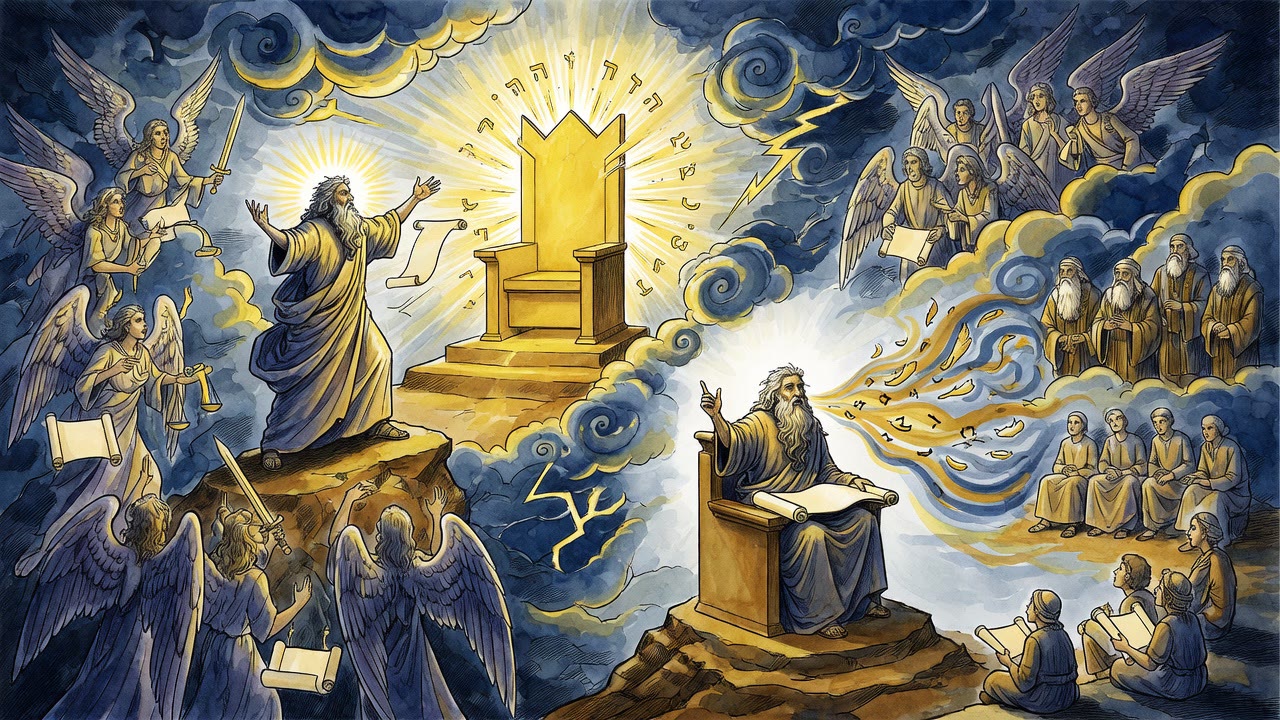
Moses climbed up into heaven to take the Torah, and the angels closed ranks to keep it.

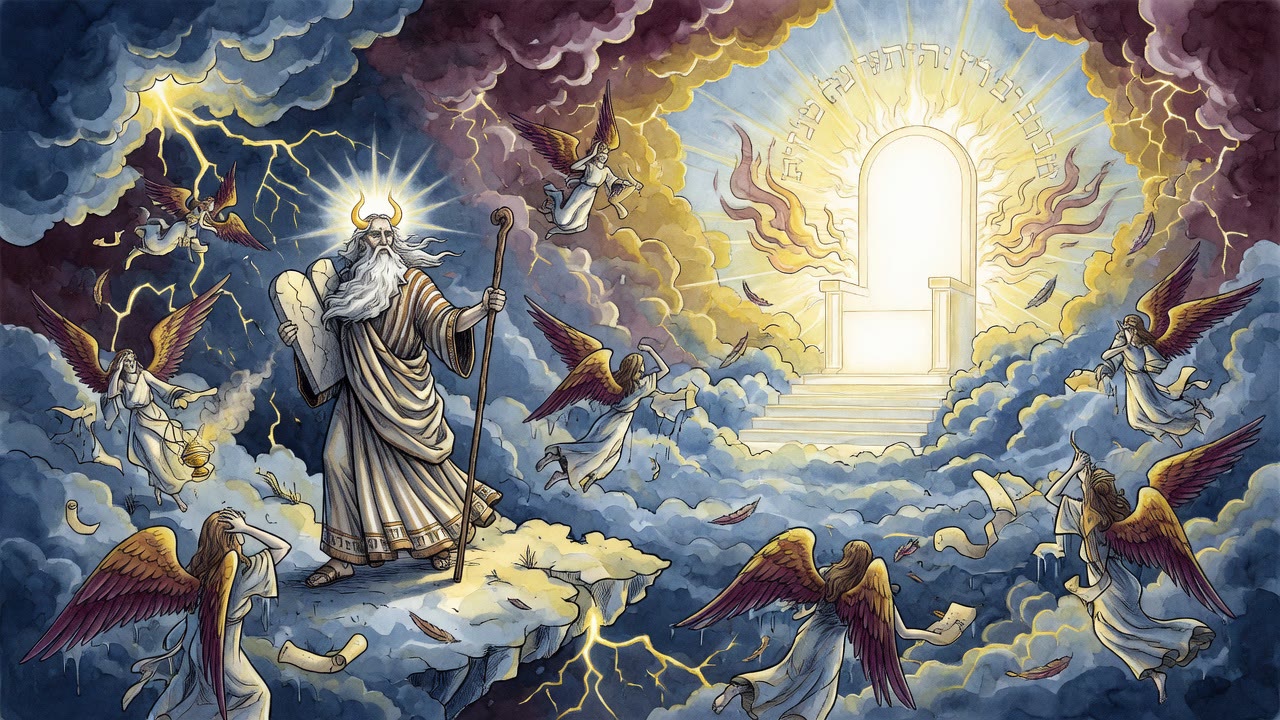
The scroll had been theirs since before there was a world to give it to, kept in the treasury of God while the angels sang around it without hunger, without sleep, without the smallest risk of ever doing wrong. Then a man came up through the fire, a thing of dust with lungs and a pulse, and reached for it. The court of heaven turned on him at once. "What is a creature born of a woman," they said, "doing among us with his hands on what is ours?"

The Giant on the Road

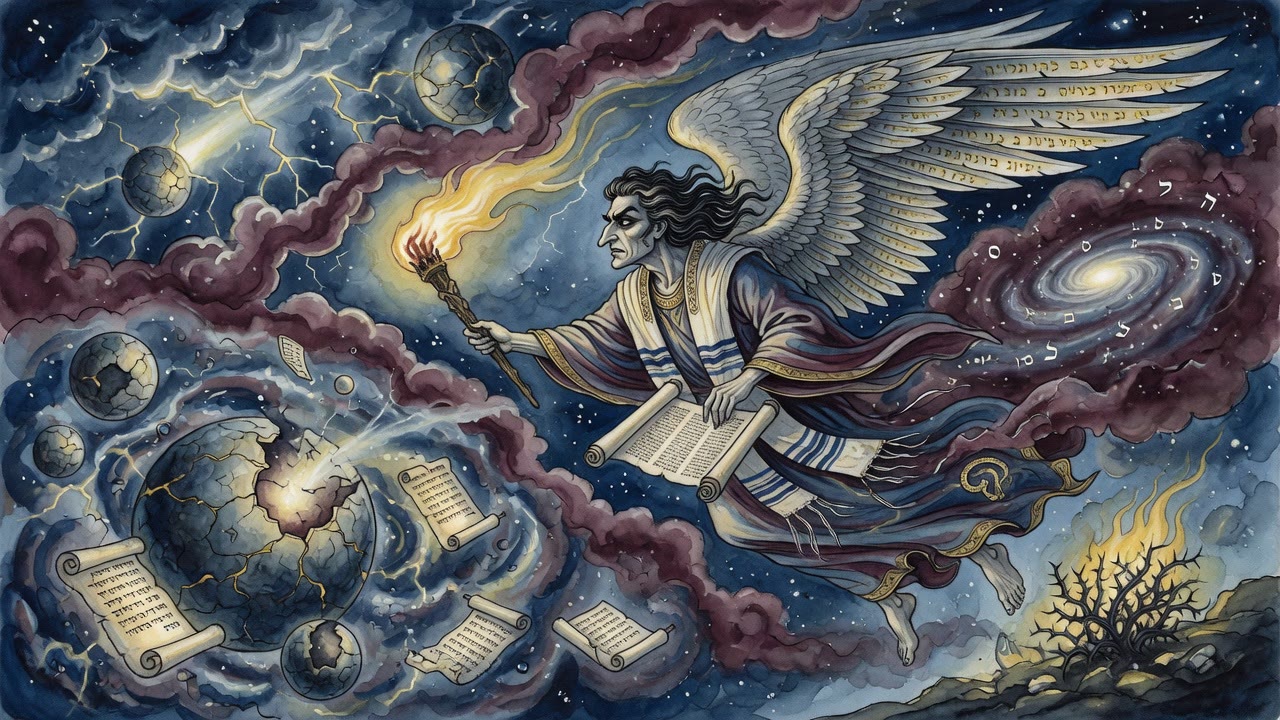
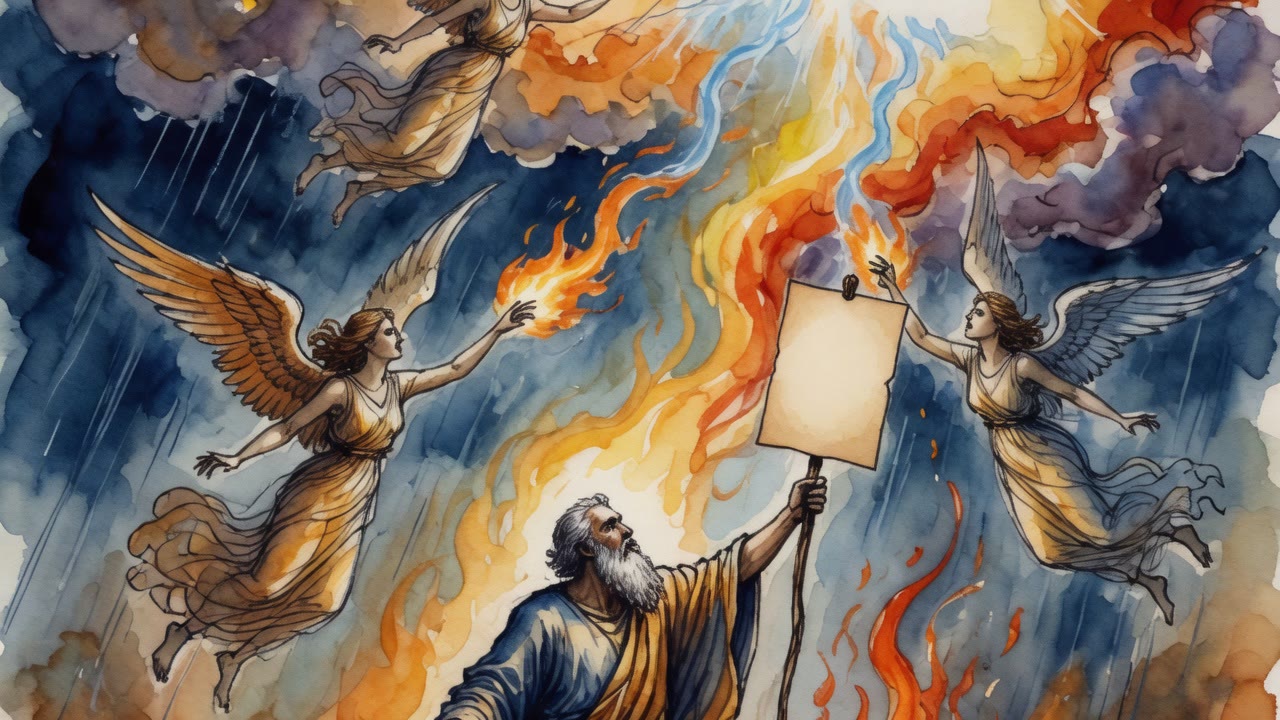
The climb nearly killed him before the argument even started. An angel named Hadarniel stood across the path, so vast that his voice fell through two hundred thousand firmaments and every word he spoke threw twelve thousand bolts of lightning. Moses, who had stared down Pharaoh without blinking, came apart and wept in the cloud like a lost child. The angel bent down and named him to break him: son of Amram, not a star, not a freed spirit, only a man with a mother and a father and a body that had no business this high. And past Hadarniel the road only worsened. Sandalphon rose behind the chariot, so tall it would take five hundred years to climb him, weaving crowns out of Israel's prayers, and beyond him ran a river of actual fire, and past the fire waited two angels named Wrath and Fury.

Heaven Made Him Smaller

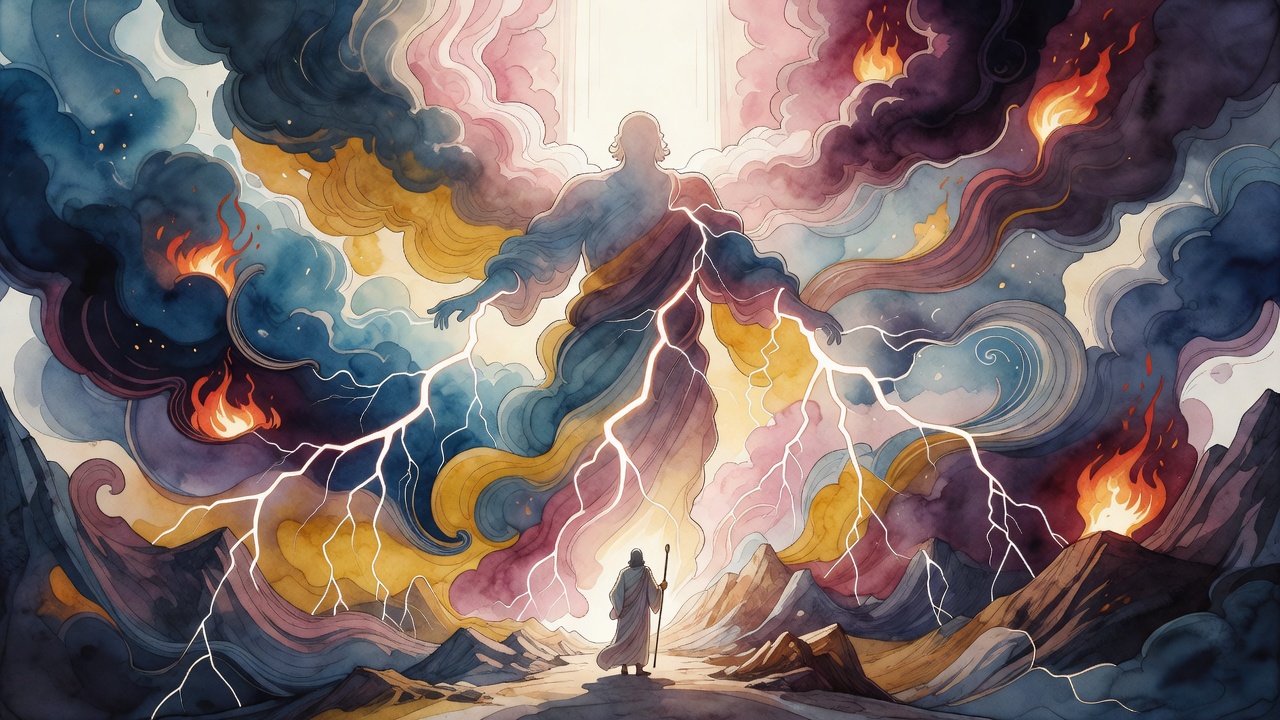
Up through seven heavens he went, past the angels of wind and rain, past the armies of punishment, past the Angel of Death himself, and at every gate his body grew more obvious and more out of place, a smudge of clay smearing through rooms of pure flame. The higher he rose the smaller he felt, until by the time he reached the throne the weakness the angels despised in him was the only thing he had left to stand on. It turned out to be enough.

He Turned the Law Against Them

God did not make Moses bigger or braver. God told him to hold on, and Moses gripped the Throne of Glory with both shaking hands, and from there he made his case. He opened the commandments and aimed them at the angels one by one. "The first names the God who brought you out of Egypt," he said. "Were you slaves in Egypt? It forbids other gods. Do you live among idol-makers who might tempt you? Keep the Sabbath. Do you wear yourselves out six days a week and need the rest? Honor your father and mother. Do you have parents? Do not murder. Do you stand in markets where tempers turn to blood? Do not steal. Do you own a thing in the world that hunger could drive you to take?"

The angels had no answer, because every answer was no. The Torah was a law for creatures who could fail, and they could not. It was never written for them.

The Angels Gave Him Gifts

Something turned in the court. The same beings who had crowded him and threatened to scorch him with their breath fell back, and one by one came forward and put gifts into his hands. The treasure had not become less holy. It had simply found the only place in creation where it had work to do. A law against murder is wasted on a being that cannot kill. It belongs with the ones whose hands shake.

He Carried It Down to People Who Could Break It

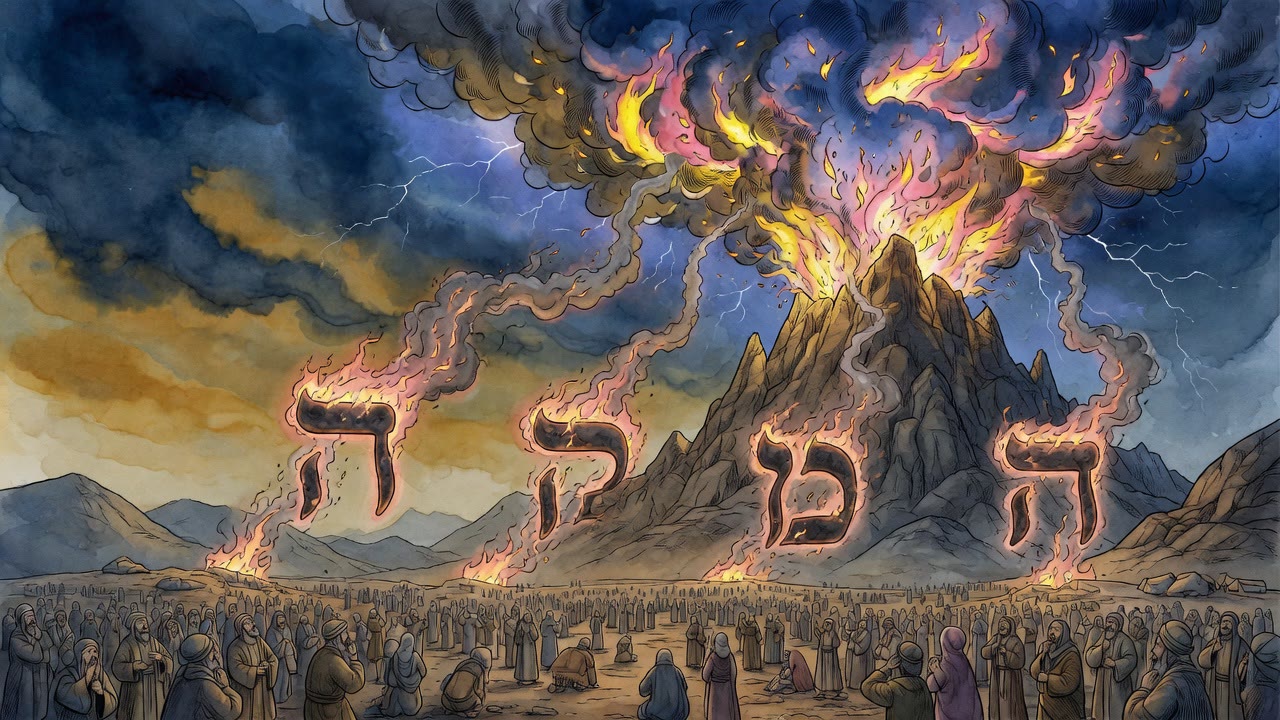
So Moses went back down. Hadarniel's lightning stayed above him. Sandalphon's impossible height stayed above him. The river of fire stayed above him. And the scroll came down the mountain into the hands of slaves and debtors and grieving parents and tired workers, people who would, within forty days, melt their gold into a calf and dance around it. That was why it had to be them. The Torah went to the only ones who needed it, because they were the only ones who could break it.


← All myths

From the tradition

Sources

9 sources

The texts this telling draws on, in full. Open a card to read inline, or expand it for a wider, quieter read.

Shabbat 88bTalmud Bavli, Shabbat

who proceed wholeheartedly and with integrity, it is written: “The integrity of the upright will guide them” (Proverbs 11:3), whereas about those people who walk in deceit, it is written at the end of the same verse: “And the perverseness of the faithless will destroy them.” Rabbi Shmuel bar Naḥamani said that Rabbi Yonatan said: What is the meaning of that which is written: “You have ravished my heart, my sister, my bride; you have ravished my heart with one of your eyes, with one bead of your necklace” (Song of Songs 4:9)?

At first when you, the Jewish people, merely accepted the Torah upon yourselves it was with one of your eyes; however, when you actually perform the mitzvot it will be with both of your eyes. Ulla said with regard to the sin of the Golden Calf: Insolent is the bride who is promiscuous under her wedding canopy. Rav Mari, son of the daughter of Shmuel, said: What verse alludes to this? “While the king was still at his table my spikenard gave off its fragrance” (Song of Songs 1:12).

Its pleasant odor dissipated, leaving only an offensive odor. Rav said: Nevertheless, it is apparent from the verse that the affection of the Holy One, Blessed be He, is still upon us, as it is written euphemistically as “gave off its fragrance,” and the verse did not write, it reeked. And the Sages taught: About those who are insulted and do not insult, who hear their shame and do not respond, who act out of love and are joyful in suffering, the verse says: “And they that love Him are as the sun going forth in its might” (Judges 5:31).

With regard to the revelation at Sinai, Rabbi Yoḥanan said: What is the meaning of that which is written: “The Lord gives the word; the women that proclaim the tidings are a great host” (Psalms 68:12)? It means that each and every utterance that emerged from the mouth of the Almighty divided into seventy languages, a great host. And, similarly, the school of Rabbi Yishmael taught with regard to the verse: “Behold, is My word not like fire, declares the Lord, and like a hammer that shatters a rock?” (Jeremiah 23:29).

Just as this hammer breaks a stone into several fragments, so too, each and every utterance that emerged from the mouth of the Holy One, Blessed be He, divided into seventy languages. The Gemara continues in praise of the Torah. Rav Ḥananel bar Pappa said: What is the meaning of that which is written: “Listen, for I will speak royal things, and my lips will open with upright statements” (Proverbs 8:6)?

Why are matters of Torah likened to a king? To teach you that just as this king has the power to kill and to grant life, so too, matters of Torah have the power to kill and to grant life. And that is what Rava said: To those who are right-handed in their approach to Torah, and engage in its study with strength, good will, and sanctity, Torah is a drug of life, and to those who are left-handed in their approach to Torah, it is a drug of death.

Alternatively, why are matters of Torah referred to as royal? Because to each and every utterance that emerged from the mouth of the Holy One, Blessed be He, two crowns are tied. Rabbi Yehoshua ben Levi said: What is the meaning of that which is written: “My beloved is to me like a bundle of myrrh that lies between my breasts” (Song of Songs 1:13)? The Congregation of Israel said before the Holy One, Blessed be He: Master of the Universe, even though my beloved, God, causes me suffering and bitterness, He still lies between my breasts.

And Rabbi Yehoshua ben Levi interpreted the verse: “My beloved is to me like a cluster [eshkol] of henna [hakofer] in the vineyards of [karmei] Ein Gedi” (Song of Songs 1:14). He, Whom everything [shehakol] is His, forgives [mekhapper] me for the sin of the kid [gedi], i.e., the calf, that I collected [shekaramti] for myself. The Gemara explains: From where is it inferred that the word in this verse, karmei, is a term of gathering?

Mar Zutra, son of Rav Naḥman, said that it is as we learned in a mishna: A launderer’s chair upon which one gathers [koremim] the garments. And Rabbi Yehoshua ben Levi said: What is the meaning of that which is written: “His cheeks are as a bed of spices, as banks of sweet herbs, his lips are lilies dripping with flowing myrrh” (Song of Songs 5:13)? It is interpreted homiletically: From each and every utterance that emerged from His cheeks, i.e., the mouth of the Holy One, Blessed be He, the entire world was filled with fragrant spices.

And since the world was already filled by the first utterance, where was there room for the spices of the second utterance to go? The Holy One, Blessed be He, brought forth wind from His treasuries and made the spices pass one at a time, leaving room for the consequences of the next utterance. As it is stated: “His lips are lilies [shoshanim] dripping with flowing myrrh.” Each and every utterance resulted in flowing myrrh.

Do not read the word in the verse as shoshanim; rather, read it as sheshonim, meaning repeat. Each repeat utterance produced its own fragrance. And Rabbi Yehoshua ben Levi said: From each and every utterance that emerged from the mouth of the Holy One, Blessed be He, the souls of the Jewish people left their bodies, as it is stated: “My soul departed when he spoke” (Song of Songs 5:6). And since their souls left their bodies from the first utterance, how did they receive the second utterance?

Rather, God rained the dew upon them that, in the future, will revive the dead, and He revived them, as it is stated: “You, God, poured down a bountiful rain; when Your inheritance was weary You sustained it” (Psalms 68:10). And Rabbi Yehoshua ben Levi said: With each and every utterance that emerged from the mouth of the Holy One, Blessed be He, the Jewish people retreated in fear twelve mil, and the ministering angels walked them back toward the mountain, as it is stated: “The hosts of angels will scatter [yidodun]” (Psalms 68:13).

Do not read the word as yidodun, meaning scattered; rather, read it as yedadun, they walked them. And Rabbi Yehoshua ben Levi said: When Moses ascended on High to receive the Torah, the ministering angels said before the Holy One, Blessed be He: Master of the Universe, what is one born of a woman doing here among us? The Holy One, Blessed be He, said to them: He came to receive the Torah. The angels said before Him: The Torah is a hidden treasure that was concealed by You 974 generations before the creation of the world, and You seek to give it to flesh and blood?

As it is stated: “The word which He commanded to a thousand generations” (Psalms 105:8). Since the Torah, the word of God, was given to the twenty-sixth generation after Adam, the first man, the remaining 974 generations must have preceded the creation of the world. “What is man that You are mindful of him and the son of man that You think of him?” (Psalms 8:5). Rather, “God our Lord, how glorious is Your name in all the earth that Your majesty is placed above the heavens” (Psalms 8:2).

The rightful place of God’s majesty, the Torah, is in the heavens. The Holy One, Blessed be He, said to Moses: Provide them with an answer as to why the Torah should be given to the people. Moses said before Him: Master of the Universe, I am afraid lest they burn me with the breath of their mouths. God said to him: Grasp My throne of glory for strength and protection, and provide them with an answer.

And from where is this derived? As it is stated: “He causes him to grasp the front of the throne, and spreads His cloud over it” (Job 26:9), and Rabbi Naḥum said: This verse teaches that God spread the radiance of His presence and His cloud over Moses. Moses said before Him: Master of the Universe, the Torah that You are giving me, what is written in it? God said to him: “I am the Lord your God Who brought you out of Egypt from the house of bondage” (Exodus 20:2).

Moses said to the angels: Did you descend to Egypt? Were you enslaved to Pharaoh? Why should the Torah be yours? Again Moses asked: What else is written in it?

God said to him: “You shall have no other gods before Me” (Exodus 20:3). Moses said to the angels: Do you dwell among the nations who worship

Full source
Legends of the Jews 2:79Legends of the Jews

The story, as retold by Ginzberg in Legends of the Jews, introduces us to this angel, a being named Hadarniel. This angel, it's said, towers over his brethren, exceeding them by sixty myriads of parasangs. Now, a parasang is an ancient unit of distance, so And that's not all. Every word that booms from his mouth unleashes twelve thousand flashes of fiery lightning! Can you imagine the sheer, raw power?

So, Moses arrives, ready to receive the Torah (the sacred Jewish scripture), and Hadarniel roars, "What are you doing here, son of Amram, here on the spot of the Holy and High?" The nerve! According to this account, Moses, understandably, gets a little freaked out. His eyes fill with tears, and he nearly plummets right out of the cloud.

God intervenes. "You angels," He says, essentially, "have been nothing but trouble since day one!" The text recalls how the angels initially protested God’s plan to create Adam, questioning humanity's worth. Remember that? "What is man that Thou art mindful of him!" they supposedly cried. And God, none too pleased, apparently incinerated a bunch of them with a flick of His "little finger."

God continues, reminding the angels that Moses is there on a mission, to receive the Torah and bring it down to the Israelites. He makes it clear that without Israel accepting the Torah, the angels themselves would lose their place in heaven. Heavy stuff!

Hadarniel, upon hearing this divine reprimand, quickly changes his tune. "O Lord of the world!" he exclaims. "I didn't realize he was here with your permission. Now that I know, I'll be his messenger, like a disciple before his master." It's a complete 180!

And so, this mighty angel, who moments before was ready to blast Moses into oblivion, humbly runs before him, leading the way. They reach the fire of Sandalfon, another powerful angel, where Hadarniel stops, warning Moses, "Go, turn about, for I may not stay in this spot, or the fire of Sandalfon will scorch me." Even mighty angels have their limits, it seems.

What does this story from Legends of the Jews (drawing, no doubt, on even older traditions) tell us? Perhaps it's about the importance of humility, even for the most powerful beings. Or maybe it’s about the unique and vital role of the Jewish people and the Torah in the cosmic order. Or perhaps it’s a reminder that even when faced with seemingly insurmountable obstacles – like a lightning-spewing angel – divine intervention and a little bit of understanding can change everything.

Full source
Legends of the Jews 4:167Legends of the Jews

A breathtaking collection of rabbinic lore compiled by Louis Ginzberg, during his ascent to the third heaven, Moses witnessed something truly extraordinary. Forget your typical angel with wings.

An angel so colossal that it would take a human being five hundred years just to climb to the top of its head! Just let that sink in for a moment. The sheer size is astounding. But it doesn't stop there.

This wasn't just some giant, silent figure. This being, this incredible malach (angel), possessed seventy thousand heads. And each head? You guessed it: each one had seventy thousand mouths, each mouth with its own tongue, and each tongue spouting forth endless praise.

Can you even begin to picture the sound? A harmony of devotion, a chorus of adoration, all emanating from a single being. The text emphasizes the sheer magnitude of the angelic host.

And he wasn't alone. He was surrounded by a suite of seventy thousand myriads of angels, all crafted from white fire. White fire! What an image that conjures.

So, who were these beings? Metatron, the angel who often serves as a guide in these heavenly realms, explained to Moses that they were the Erelim. The Erelim, Metatron tells us, are "appointed over the grass, the trees, the fruits, and the grain." They are the guardians and maintainers of the natural world.

But here’s the kicker: "as soon as they have done the will of their Creator, they return to the place assigned to them, and praise God." Their purpose isn't just to oversee the earthly realm. It's to serve, to obey, and then to return to their source, offering constant, unceasing praise.

It makes you think, doesn't it? These immense, multi-headed angels, whose sole purpose is to serve and praise. What does that tell us about the nature of service, about the power of praise, and about the infinite wonders that lie beyond our everyday perception? It's a story that invites us to consider our own place in the grand scheme of things, and perhaps, to find our own ways to offer praise, in whatever form that may take.

Full source
Pirkei DeRabbi Eliezer 18:10Pirkei DeRabbi Eliezer

If we look into the ancient texts, we find some pretty amazing answers. to Pirkei DeRabbi Eliezer, a fascinating early medieval text that retells and expands upon biblical narratives. In chapter 18, we find a description of God's choices, the places He specifically chose and set aside as unique.

First, the heavens. The verse reads, "The Holy One, blessed be He, created seven firmaments.." Seven heavens! That's quite a cosmology. But from all of them, God selected only 'Araboth (עֲרָבוֹת). What is 'Araboth? It's described as the place of the throne of glory of His kingdom. It’s the ultimate VIP section of the cosmos, if you will. As it says in (Psalm 68:5), "Cast up a highway for him that rideth on the 'Araboth, with Jah, his name." That verse paints such a vivid image, doesn’t it? God, riding through the highest heavens, on a highway built just for Him.

The special selections don't stop there.

Next, the earth. “The Holy One, blessed be He, created seven lands, and He chose from all of them the land of Israel only…” It's a powerful statement about the unique relationship between God and this particular piece of land. (Deuteronomy 11:12) reinforces this idea: "A land… the eyes of the Lord thy God are always upon it, from the beginning of the year even unto the end of the year." That constant divine attention… it's a powerful image of care and connection. It's echoed too, in (Isaiah 38:11), which states, "I said, I shall not see the Lord, even the Lord in the land of the living."

And finally, the wilderness. "The Holy One, blessed be He, created seven deserts, and of them all He chose the desert of Sinai only to give therein the Torah.." Sinai. That stark, unforgiving landscape… chosen as the place for the most profound revelation in Jewish history. What an amazing contrast. A barren desert becomes the epicenter of spiritual law and guidance. (Psalm 68:16) says, "The mountain which God hath desired for his abode."

So, what do we make of all this? Seven heavens, seven lands, seven deserts… and from each, a single, special choice. It speaks to the idea of divine selection, of imbuing certain places with unique significance. It suggests that within the vastness of creation, there are points of concentrated holiness, places where the connection between the earthly and the divine is particularly strong.

It makes you wonder, doesn’t it? What are the 'Araboths, the Israels, the Sinais in our own lives? Where are the places, literal or metaphorical, where we feel closest to something greater than ourselves? Maybe that's the real question Pirkei DeRabbi Eliezer is inviting us to consider.

Full source
Shabbat 89aTalmud Bavli, Shabbat

idols that you require this special warning? Again Moses asked: What else is written in it? The Holy One, Blessed be He, said to him: “Remember the Shabbat day to sanctify it” (Exodus 20:8). Moses asked the angels: Do you perform labor that you require rest from it?

Again Moses asked: What else is written in it? “Do not take the name of the Lord your God in vain” (Exodus 20:7), meaning that it is prohibited to swear falsely. Moses asked the angels: Do you conduct business with one another that may lead you to swear falsely? Again Moses asked: What else is written in it?

The Holy One, Blessed be He, said to him: “Honor your father and your mother” (Exodus 20:12). Moses asked the angels: Do you have a father or a mother that would render the commandment to honor them relevant to you? Again Moses asked: What else is written in it? God said to him: “You shall not murder, you shall not commit adultery, you shall not steal” (Exodus 20:13) Moses asked the angels: Is there jealousy among you, or is there an evil inclination within you that would render these commandments relevant?

Immediately they agreed with the Holy One, Blessed be He, that He made the right decision to give the Torah to the people, and as it is stated: “God our Lord, how glorious is Your name in all the earth” (Psalms 8:10), while “that Your majesty is placed above the heavens” is not written because the angels agreed with God that it is appropriate to give the Torah to the people on earth. Immediately, each and every one of the angels became an admirer of Moses and passed something to him, as it is stated: “You ascended on high, you took a captive, you took gifts on account of man, and even among the rebellious also that the Lord God might dwell there” (Psalms 68:19).

The meaning of the verse is: In reward for the fact that they called you man, you are not an angel and the Torah is applicable to you, you took gifts from the angels. And even the Angel of Death gave him something, as Moses told Aaron how to stop the plague, as it is stated: “And he placed the incense, and he atoned for the people” (Numbers 17:12). And the verse says: “And he stood between the dead and the living, and the plague was stopped” (Numbers 17:13).

If it were not that the Angel of Death told him this remedy, would he have known it? And Rabbi Yehoshua ben Levi said: When Moses descended from standing before the Holy One, Blessed be He, with the Torah, Satan came and said before Him: Master of the Universe, where is the Torah?He said to him: I have given it to the earth. He went to the earth, and said to it: Where is the Torah? It said to him: I do not know, as only: “God understands its way, and He knows its place” (Job 28:23).He went to the sea and asked: Where is the Torah?

And the sea said to him: “It is not with me.”He went to the depths and asked: Where is the Torah? And the depths said to him: “It is not within me.” And from where is it derived that the sea and the depths answered him this way? As it is stated: “The depth said: It is not within me, and the sea said: It is not with me” (Job 28:14).

“Destruction and death said: We heard a rumor of it with our ears” (Job 28:22).Satan returned and said before the Holy One, Blessed be He: Master of the Universe, I searched for the Torah throughout all the earth and did not find it. He said to him: Go to Moses, son of Amram. He went to Moses and said to him: The Torah that the Holy One, Blessed be He, gave you, where is it? Moses evaded the question and said to him: And what am I that the Holy One, Blessed be He, would have given me the Torah?

I am unworthy. The Holy One, Blessed be He, said to Moses: Moses, are you a fabricator? Moses said before Him: Master of the Universe, You have a hidden treasure in which You delight every day, as it is stated: “And I was His delight every day, playing before Him at every moment” (Proverbs 8:30). Should I take credit for myself and say that You gave it to me?

The Holy One, Blessed be He, said to Moses: Since you belittled yourself, the Torah will be called by your name, as it is stated: “Remember the Torah of Moses My servant to whom I commanded at Horeb laws and statutes for all of Israel” (Malachi 3:22). And Rabbi Yehoshua ben Levi said: When Moses ascended on High, he found the Holy One, Blessed be He, tying crowns to letters. On the tops of certain letters there are ornamental crownlets.

Moses said nothing, and God said to him: Moses, is there no greeting in your city? Do people not greet each other in your city? He said before Him: Does a servant greet his master? That would be disrespectful.

He said to him: At least you should have assisted Me and wished Me success in My work. Immediately he said to Him: “And now, may the power of the Lord be great as you have spoken” (Numbers 14:17). And Rabbi Yehoshua ben Levi said: What is the meaning of that which is written: “And the people saw that Moses delayed [boshesh] to come down from the mount” (Exodus 32:1)? Do not read the word in the verse as boshesh; rather, read it as ba’u shesh, six hours have arrived.

When Moses ascended on High, he told the Jewish people: In forty days, at the beginning of six hours, I will come. After forty days, Satan came and brought confusion to the world by means of a storm, and it was impossible to ascertain the time. Satan said to the Jews: Where is your teacher Moses? They said to him: He ascended on High.

He said to them: Six hours have arrived and he has not yet come. Surely he won’t. And they paid him no attention. Satan said to them: Moses died.

And they paid him no attention. Ultimately, he showed them an image of his death-bed and an image of Moses’ corpse in a cloud. And that is what the Jewish people said to Aaron: “For this Moses, the man who brought us up out of the land of Egypt, we know not what has become of him” (Exodus 32:1). One of the Sages said to Rav Kahana: Did you hear what is the reason that the mountain was called Mount Sinai?

Rav Kahana said to him: It is because it is a mountain upon which miracles [nissim] were performed for the Jewish people. The Sage said to him: If so, it should have been called Mount Nisai, the mountain of miracles. Rather, Rav Kahana said to him: It is a mountain that was a good omen [siman] for the Jewish people. The Sage said to him: If so, it should have been called Har Simanai, the mountain of omens.

Rav Kahana said to him: What is the reason that you do not frequent the school where you can study before Rav Pappa and Rav Huna, son of Rav Yehoshua, who study aggada? As Rav Ḥisda and Rabba, son of Rav Huna, both said: What is the reason it is called Mount Sinai? It is because it is a mountain upon which hatred [sina] for the nations of the world descended because they did not accept the Torah. And that is what Rabbi Yosei, son of Rabbi Ḥanina, said: The desert in which Israel remained for forty years has five names.

Each name has a source and a rationale: The Zin Desert, because the Jewish people were commanded [nitztavu] in it; the Kadesh Desert, because the Jewish people were sanctified [nitkadshu] in it. The Kedemot Desert, because the ancient [keduma] Torah, which preceded the world, was given in it. The Paran Desert,

Full source
Legends of the Jews 2:134Legends of the Jews

It's a monumental task. Well, the angels apparently had some thoughts.

The story goes that they were a little… skeptical. As we find in Legends of the Jews, a monumental compilation of Jewish folklore by Rabbi Louis Ginzberg, the angels turned to God, their celestial eyebrows raised. "How is it," they asked, "that Thou givest Moses permission to write, so that he may write whatever he will, and say to Israel, 'I gave you the Torah, I myself wrote it, and then gave it to you?'"

It’s a pretty bold question, isn’t it? They’re essentially asking: "Can we really trust Moses with this incredible responsibility? Won't he be tempted to, shall we say, embellish a little?" from their perspective. These are beings of pure spirit, inhabiting the divine realm. The idea that a human, even one as righteous as Moses, could be entrusted with such a task – to literally write down the word of God – must have seemed a bit… unsettling. Were they worried about the potential for human error? Or perhaps the potential for human ego to creep in?

God, in His infinite wisdom, had a ready answer. "Far be it from Moses to do such a thing," He declared. "He is a faithful servant!"

There’s so much packed into that simple statement. It's a powerful affirmation of Moses’ integrity, his humility, and his unwavering devotion to God's will. God isn't just saying that Moses won't mess it up; He’s saying that it’s fundamentally against Moses’ very nature to do so. He is a ne’eman, a trustworthy and loyal servant.

This little anecdote, tucked away in the vastness of Jewish lore, offers a fascinating glimpse into the relationship between the divine and the human, and the immense trust placed in Moses. It reminds us that even the angels, beings of light and knowledge, can have their doubts. And it highlights the extraordinary faith that God has in humanity, and in those chosen to carry out His will.

What does it say about our role in interpreting sacred texts? Does the angels' concern make us think twice about how we understand and transmit Torah today? Food for thought,.

Full source
Midrash Mishlei 21:3Midrash Mishlei

"A wise man scales the city of the mighty" (Proverbs 21:22): "the city of the mighty" is the heavens, which are the city of the angels; "a wise man scales" is Moses, who ascended to the heavens; "and brings down the strength in which it trusted" is the Torah. And from where do we know that the ministering angels are called mighty? As it is said, "mighty in strength, who do His word" (Psalms 103:20). And from where do we know that Moses ascended on high? As it is said, "And Moses went up to God" (Exodus 19:3). And from where do we know that the Torah is called strength? As it is said, "The LORD will give strength to His people" (Psalms 29:11).

Another interpretation of "And Moses went up to God": Rabbi Shmuel bar Nahmani said: Before the Torah was given, "The heavens are the heavens of the LORD" (Psalms 115:16), neither could these go down nor could these go up. A parable of a king who married off his daughter and set decrees, and said, "Let the sons of Rome not go down to Syria, and the sons of Syria not go up to Rome." When he married off his daughter, he lifted the decree of the proclamations. So, before the Torah was given from the heavens, "The heavens are the heavens of the LORD"; once the Torah was given, "And Moses went up to God," "And the LORD came down upon Mount Sinai" (Exodus 19:20).

It was taught in the school of Rabbi Yishmael: "And Jethro the priest of Midian heard" (Exodus 18:1), what report did he hear that he came? He heard of the war of Amalek and came, for it is written beside it; these are the words of Rabbi Yehoshua. Rabbi Eliezer of Modi'in says: He heard of the giving of the Torah and came, for at the hour when the Torah was given to Israel, all the kings of the earth trembled in their palaces, as it is said, "and in His palace all of it says, Glory" (Psalms 29:9). At that hour all the kings of the nations of the world gathered before Balaam the wicked. They said to him: "Balaam, what is the nature of this, that the whole world is quaking? Perhaps the Holy One, blessed be He, is bringing a flood of water upon the world to destroy it?" He said to them: "Fools of the world! The Holy One, blessed be He, already swore that He would not bring a flood of water upon the world, as it is said, 'For this is like the waters of Noah to Me' (Isaiah 54:9)." They said to him: "Perhaps He is not bringing a flood of water, but He is bringing a flood of fire?" He said to them: "Neither a flood of water nor a flood of fire; He is giving Torah to His people, as it is said, 'The LORD will give strength to His people.'" When they all heard this matter from his mouth, each one of them went to his place.

Full source
Sanhedrin 109aTalmud Bavli, Sanhedrin

whom shall we send the gift? They decided: We will send it with Naḥum of Gam Zo, as he is experienced in miracles.

When he reached a certain lodging, he sought to sleep there. The residents of that lodging said to him: What do you have with you? Naḥum said to them: I am taking the head tax to the emperor. They rose in the night, opened his chest and took everything that was in it, and then filled the chest with dirt. When he arrived there, in Rome, earth was discovered in the chest. The emperor said: The Jews are mocking me by giving me this gift. They took Naḥum out to kill him. Naḥum said: This too is for the best. Elijah the prophet came and appeared to them as one of Naḥum’s traveling party. Elijah said to them: Perhaps this earth is from the earth of Abraham our forefather, who would throw dust and it became swords, and who would throw straw and it became arrows. They examined the dust and discovered that it was indeed the dust of Abraham.

There was a province that the Romans were unable to conquer. They threw some of this earth upon that province and they conquered it. In appreciation for the gift that Naḥum of Gam Zo had brought on behalf of the Jewish people, they brought him into the treasury and said: Take that which is preferable to you. He filled his chest with gold. When he returned to that lodging, those residents said to him: What did you bring to the king’s palace? Naḥum said to them: What I took from here, I brought to there. The residents concluded that the earth with which they had filled the chest had miraculous properties. They took earth and brought it to the emperor. Once the Romans discovered that the earth was ineffective in battle, they executed those residents.

§ The mishna teaches that the members of the generation of the dispersion have no share in the World-to-Come. The Gemara asks: What sin did they perform? Their sin is not explicitly delineated in the Torah. The school of Rabbi Sheila say that the builders of the Tower of Babel said: We will build a tower and ascend to heaven, and we will strike it with axes so that its waters will flow. They laughed at this explanation in the West, Eretz Yisrael, and asked: If that was their objective, let them build a tower on a mountain; why did they build it specifically in a valley (see Genesis 11:2)?

Rather, Rabbi Yirmeya bar Elazar says: They divided into three factions; one said: Let us ascend to the top of the tower and dwell there. And one said: Let us ascend to the top of the tower and engage in idol worship. And one said: Let us ascend to the top of the tower and wage war. With regard to that faction that said: Let us ascend to the top of the tower and dwell there, God dispersed them. And that faction that said: Let us ascend to the top of the tower and wage war, became apes, and spirits, and demons, and female demons. And with regard to that faction that said: Let us ascend to the top of the tower and engage in idol worship, it is written: “Because there the Lord confounded the language of all the earth” (Genesis 11:9).

It is taught in a baraita: Rabbi Natan says: All of those factions intended to build the tower for the sake of idol worship. It is written here: “And let us make a name for us” (Genesis 11:4), and it is written there: “And make no mention of the name of the other gods” (Exodus 23:13). Just as there, the connotation of “name” is idol worship, so too here, the connotation of “name” is idol worship.

Rabbi Yoḥanan says: The uppermost third of the tower was burned, the lowermost third of the tower was swallowed into the earth, and the middle third remained intact. Rav says: The atmosphere of the tower causes forgetfulness; anyone who goes there forgets what he has learned. As a result of the building of the tower, forgetting was introduced into the world. Rav Yosef says: Babylonia and the adjacent place, Bursif, are each a bad omen for Torah, i.e., they cause one to forget his knowledge. The Gemara asks: What is the meaning of Bursif? Rabbi Asi says: It is an abbreviation of empty pit [bor shafi].

§ The mishna teaches: The people of Sodom have no share in the World-to-Come. The Sages taught: The people of Sodom have no share in the World-to-Come, as it is stated: “And the men of Sodom were wicked and sinners before the Lord exceedingly” (Genesis 13:13). “Wicked” indicates in this world; “and sinners” indicates for the World-to-Come.

Rav Yehuda says: “Wicked” is referring to sins they committed with their bodies; “and sinners” is referring to sins they committed with their money. “Wicked” is referring to sins they committed with their bodies, as it is written with regard to Joseph and the wife of Potiphar: “And how can I do this great wickedness, and sin against God” (Genesis 39:9). “And sinners” is referring to sins they committed with their money, as it is written: “And your eye is wicked against your poor brother, and you give him nothing…for it shall be reckoned to you as a sin” (Deuteronomy 15:9). “Before the Lord”; this is referring to blessing, a euphemism for cursing, God. “Exceedingly” means that they had intent and sinned and did not sin unwittingly or driven by lust.

It was taught in a baraita: “Wicked” is referring to sins they committed with their money; “and sinners” is referring to sins they committed with their bodies. “Wicked” is referring to sins they committed with their money, as it is written: “And your eye is wicked against your poor brother and you give him nothing” (Deuteronomy 15:9). “And sinners” is referring to sins they committed with their bodies, as it is written with regard to Joseph and the wife of Potiphar: “And sin against God” (Genesis 39:9). “Before the Lord”; this is referring to blessing, a euphemism for cursing, God. “Exceedingly [meod ]” is referring to bloodshed, as it is stated: “Moreover Manasseh shed very [meod ] much blood” (II Kings 21:16).

The Sages taught: The people of Sodom became haughty and sinned due only to the excessive goodness that the Holy One, Blessed be He, bestowed upon them. And what is written concerning them, indicating that goodness? “As for the earth, out of it comes bread, and underneath it is turned up as it were by fire. Its stones are the place of sapphires, and it has dust of gold. That path no bird of prey knows, neither has the falcon’s eye seen it. The proud beasts have not trodden it, nor has the lion passed thereby” (Job 28:5–8). The reference is to the city of Sodom, which was later overturned, as it is stated thereafter: “He puts forth His hand upon the flinty rock; He overturns the mountains by the roots” (Job 28:9).

The people of Sodom said: Since we live in a land from which bread comes and has the dust of gold, we have everything that we need. Why do we need travelers, as they come only to divest us of our property? Come, let us cause the proper treatment of travelers to be forgotten from our land, as it is stated: “He breaks open a watercourse in a place far from inhabitants, forgotten by pedestrians, they are dried up, they have moved away from men” (Job 28:4).

Rava taught: What is the meaning of that which is written: “How long will you seek to overwhelm a man? You will all be murdered like a leaning wall or a tottering fence” (Psalms 62:4)? This teaches that the people of Sodom set their sights on property owners. They would take one and place him alongside an inclined, flimsy wall that was about to fall, and push it upon him to kill him, and then they would come and take his property.

Rava taught: What is the meaning of that which is written: “In the dark they dig through houses; by day they shut themselves up; they know not the light” (Job 24:16)? This teaches that they would set their sights on property owners. They would take one and they would give him balsam, whose smell diffuses, and the property owner would place it in his treasury. In the evening, the people of Sodom would come and sniff it out like a dog and discover the location of the property owner’s treasury, as it is stated: “They return at evening; they howl like a dog, and go round about the city” (Psalms 59:7). And after discovering the location they would come and dig there, and they would take that property.

The Gemara cites verses that allude to the practices of the people of Sodom: “They lie at night naked without clothing, and they have no covering in the cold” (Job 24:7). And likewise: “They drive away the donkey of the fatherless; they take the widow’s ox as a pledge” (Job 24:3). And likewise: “They trespass; they violently steal flocks and graze them” (Job 24:2). And likewise: “For he is brought to the grave, and watch is kept over his tomb” (Job 21:32).

Rabbi Yosei taught in Tzippori the methods of theft employed in Sodom. That night three hundred tunnels were excavated in Tzippori in order to employ those methods. Homeowners came and harassed him; they said to him: You have given a way for thieves to steal. Rabbi Yosei said to them: Did I know that thieves would come as a result of my lecture? The Gemara relates: When Rabbi Yosei died, the gutters of Tzippori miraculously overflowed with blood as a sign of his death.

The people of Sodom would say: Anyone who has one ox shall herd the city’s oxen for one day. Anyone who does not have any oxen shall herd the city’s oxen for two days. The Gemara relates: They gave oxen to a certain orphan, son of a widow, to herd. He went and took them and killed them. The orphan said to the people of Sodom:

Full source
Legends of the Jews 4:164Legends of the Jews

Moses did not climb through heaven alone. God sent thirty thousand angels to escort him upward.

Moses, our leader, the one who spoke to God on Mount Sinai, is about to begin a journey unlike any other. God Himself commands Metatron, the Angel of the Face – a powerful angel who stands in God's presence – to escort Moses to the celestial realms. Not only that, but God orders thirty thousand angels to serve as Moses' personal bodyguard! Fifteen thousand to his right, fifteen thousand to his left.

Naturally, Moses is terrified. I mean, wouldn’t you be? Overwhelmed by the sheer magnitude of what's happening, Moses cries out to Metatron, "Who art thou?" And the angel replies with a revelation: "I am Enoch, the son of Jared, thy ancestor, and God has charged me to accompany thee to His throne."

Enoch! As Ginzberg tells us in Legends of the Jews, Enoch, of course, is the biblical figure who "walked with God" and then, mysteriously, "was not, for God took him" (Genesis 5:24). Jewish tradition holds that Enoch was transformed into the angel Metatron. What a family reunion this is turning out to be!

But Moses, understandably, still hesitates. "I am but flesh and blood," he protests, "and I cannot look upon the countenance of an angel." He knows his limitations. He remembers the awe-inspiring power he felt on Sinai. He knows the celestial realm is a whole other level.

This is where the story takes an even more incredible turn. To prepare Moses for this unprecedented encounter, Metatron transforms him. According to this legend, Metatron changes Moses' flesh into torches of fire, his eyes into Merkabah (the Divine Chariot) wheels – those mystical chariot wheels we read about in Ezekiel's vision – his strength into an angel's, and his tongue into a flame.

Wow.

Essentially, Moses is being upgraded, transformed into something beyond human, so he can withstand the intensity of the divine presence. Only then, with a retinue of thirty thousand angels flanking him, does Metatron lead Moses into heaven.

What does this story tell us? It speaks to the incredible potential within each of us, the ability to be transformed, to rise above our limitations, to connect with something greater than ourselves. And it reminds us that even the most righteous among us, like Moses, sometimes need help, guidance, and even a little celestial re-engineering, to reach their full potential.

It's a reminder that the journey towards holiness is rarely a solitary one. We are surrounded by a support system, seen and unseen – angels, ancestors, and perhaps even sparks of divine fire within ourselves – ready to help us ascend.

Full source