4 min read

Rabban Gamliel Forced Two Scholars Back Into Authority

Two seats sat empty in the study hall, and no student had noticed. Toward evening the two appointed men came back and sat down among the ordinary disciples.

Curated by Arthur · Told by Maggid ·
Table of Contents
  1. Independent No Longer
  2. The Rebuke at Dusk
  3. Havu, Give Yourselves Men
  4. Eyes Like Pools at Cheshbon
  5. The Seat That Owns You

Rabban Gamliel walked into the study hall and found two empty seats where authority should have been sitting. The students had not even noticed the absence. That, more than the empty wood, told him the appointment was already failing. Scrolls lay open. Arguments continued. The room had learned to live without its appointed eyes.
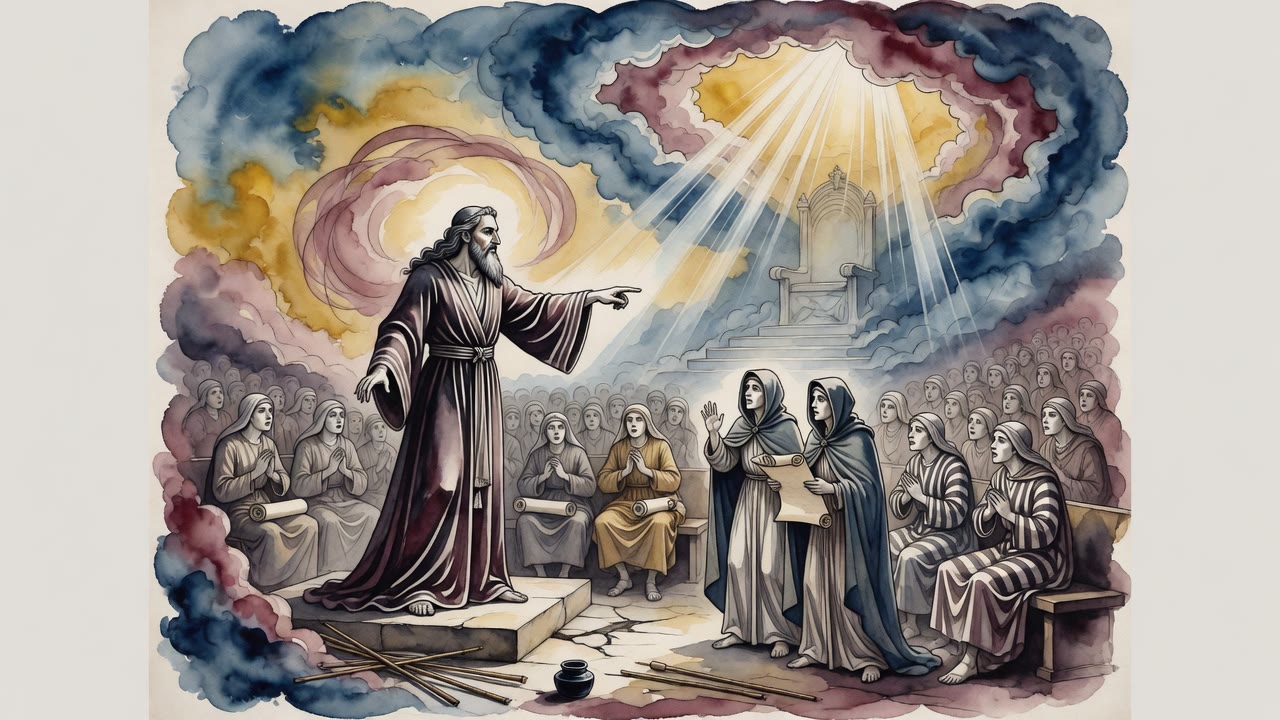
Rabban Gamliel Forced Two Scholars Back Into Authority Click for full size

Independent No Longer

He had appointed Rabbi Yochanan ben Nuri and Rabbi Elazar ben Chasma to lead. "At that time," the Sifrei reads over Moses old charge, the judges status changed. In the past they were independent. Now they were obligated to the congregation.

Toward evening the two returned and sat among the disciples as if the bench of authority were optional furniture. Gamliel had a signal for the room. If he entered and said, "Ask!" the air was clean. If he stayed silent, trouble sat somewhere in the rows. This day he saw the trouble in the very men he had lifted up.

He remembered the hour of their appointment and the way younger students had straightened when the new names were spoken. Authority had entered like a lamp on a high shelf. Now the lamp sat on the floor among ordinary stools.

The Rebuke at Dusk

He found them quiet among the students and named the crime precisely.

"By your behavior," he said, "you have made it known to the congregation that you do not wish to exercise authority over them."

Once you were independent; from now on you are obligated to the congregation for their good and welfare. Hiding in the general rows was not humility. It was desertion dressed as modesty. Gamliel did not strip the appointment. He enforced it.

Havu, Give Yourselves Men

When Moses told Israel to appoint wise, discerning, known men (Deuteronomy 1:13), the word havu pressed the people to give leaders from their own knowledge of character. Leadership is a deliberate setting-apart of what already belongs to a higher use.

Gamliel would not let the theft stand. Known men are known because they stay visible. Havu costs the givers and the given. Both sides pay. Only one side had tried to refund the payment in secret.

Eyes Like Pools at Cheshbon

"Your eyes are like the pools in Cheshbon by the gate of Bath-rabbim" (Song of Songs 7:5). The Sifrei reads the eyes as elders, leaders whose insight is water held still enough to reflect. Isaiah spoke of eyes closed by a spirit of deep sleep (Isaiah 29:10). Closed eyes are a failure of the gate.

Pools do not hide under other water. They sit where the city can find them. Gamliel dragged two scholars back to the surface where the community could draw from them. Bath-rabbim needs eyes that accept being looked at as well as looking.

The Seat That Owns You

When the two rose from the disciples row and took their places again, the hall learned the cost of "Ask!" Independence ends at the moment of appointment. What remains is service measured by whether the students notice when you are gone.

That day they had not noticed. Gamliel made sure they would. Authority, in this house, is not a prize. It is a debt that begins the hour your name is called and does not end when your feet grow tired of the raised seat.

Rabban Gamliel did not soften the order. The two scholars walked back into the room where authority still sat, and the assembly watched them take seats they had already left once.


← All myths

From the tradition

Sources

3 sources

The texts behind this telling. Some cards carry a translation of the source; others are our own retelling of it, and each card says which. Every card links out to the original.

Sifrei Devarim 16:3Sifrei Devarim

Retold in our words. Read the original at the link below.Sifrei by Rabbi Shraga Silverstein · CC-BY

The verse What follows is a commentary that really gets to the heart of leadership and community.

The Sifrei interprets the phrase "At that time" to mean that the judges' status had changed. "In the past, you were independent; now you are obligated to the congregation. From individual actors to pillars of the community.

To illustrate this point, the text shares a story about Rabban Gamliel, a prominent leader, and two scholars, Rabbi Yochanan ben Nuri and Rabbi Elazar ben Chasma.

The scene: Rabban Gamliel had appointed Rabbi Yochanan and Rabbi Elazar to positions of leadership in the academy. But one day, they were absent, and the students didn't even realize it. When the two scholars returned towards evening, they simply sat down among the disciples.

Now, Rabban Gamliel had a specific way of gauging the atmosphere of the study hall. If he entered and said, "Ask!" – inviting questions – it meant there were no troublemakers present. But if he remained silent, it signaled the presence of those who might disrupt the learning.

On this particular day, Rabban Gamliel entered and found Rabbi Yochanan and Rabbi Elazar sitting quietly with the students. He then gently rebuked them: "By your behavior, you have made it known to the congregation that you do not wish to exercise authority over them." He reminded them of their new role, echoing the verse: "In the past, you were independent; from now on, you are obligated to the congregation for their good and welfare."

What's so powerful about this exchange? It highlights the responsibility that comes with leadership. It’s not just about personal scholarship or individual pursuits anymore. It’s about serving the community, even when it means sacrificing a bit of personal freedom.

The Sifrei then expands on the verse "Hear among your brothers" to emphasize the need for careful and deliberate judgment. The text urges the judges, "Be deliberate in judgment. If a (similar) case comes before you one, two, or three times, do not say: I've already ruled on this several times, but be deliberate in (the) judgment (of each case)." Don't become complacent! Each case deserves fresh consideration.

This idea is echoed by the men of the Great Assembly, a legendary group of sages. They famously said: "Be deliberate in judgment, and set up many disciples, and make a fence for the Torah."

The idea of "making a fence for the Torah" might sound strange at first. It essentially means creating safeguards and interpretations that protect the core principles of the Torah. It's about ensuring that the Torah remains relevant and accessible to future generations.

It demands a shift in perspective, from individual pursuits to communal welfare. It calls for careful judgment, continuous learning, and a commitment to safeguarding the values we hold dear. A timely reminder, wouldn't you agree?

Full source
Sifrei Devarim 13:1Sifrei Devarim

Retold in our words. Read the original at the link below.Sifrei by Rabbi Shraga Silverstein · CC-BY

1: (Devarim 1:13) "Havu for yourselves": "Havu" connotes "counsel," as in (II Samuel 16:20) "Havu counsel for yourselves," (Shemoth 1:10) "Havah, let us plot (i.e., take counsel) against it."

Full source
Sifrei Devarim 41:15Sifrei Devarim

Retold in our words. Read the original at the link below.Sifrei by Rabbi Shraga Silverstein · CC-BY

The verse from Song of Songs (7:5) reads, "Your eyes are like the pools in Cheshbon by the gate of Bath-rabbim." What could this possibly mean?

The text explains that "Your eyes" refers to the elders, the appointed leaders of the congregation. But it’s not just about seeing; it’s about insight. As Isaiah (29:10) says, "The L-rd has poured upon you a spirit of deep sleep, and He has closed your 'eyes' from seeing." This isn't a physical blindness, but a spiritual one. The elders, the wise ones, are meant to truly see, to understand beyond the surface.

What about the "pools"? Ah, The Sifrei tells us that just as you can't plumb the depths of a pool, you can't fully fathom the words of the sages. There's a depth, a complexity, that requires contemplation and study. It's not about a quick dip; it's about immersing yourself.

Then there’s "Cheshbon." Cheshbon, in Hebrew, means "accountings." Here, it signifies the careful deliberations and wise counsel that the elders undertake. It’s the process of thinking things through, weighing different perspectives, and arriving at a thoughtful conclusion. The Sifrei specifies that these "accountings" happen in the houses of study, specifically “by the gate (of study) frequented by the many (scholars)", bath-rabbim. It emphasizes the importance of communal learning, of many voices contributing to the understanding of Torah.

But the imagery doesn’t stop there! The verse continues, "Your nose is like the tower of Levanon which looks towards Damascus." What does a nose, a tower, and Damascus have to do with anything?

The text connects this to Eliyahu (Elijah) the prophet. If you dedicate yourself to studying Torah, you should hope for the arrival of Eliyahu. This connection is drawn from God's command to Eliyahu in I (Kings 19:15), "Go, return on your way, to the desert of Damascus." So, the "tower of Lebanon which looks toward Damascus" becomes a symbol of anticipation, of looking forward to the future redemption that Eliyahu will herald.

And this idea of redemption is further emphasized by Malachi (3:22-24): "Remember the Torah of Moses, My servant… Behold, I am sending you Eliyahu the prophet before the coming of the day of the L-rd, and he will turn back (to the L-rd) the hearts of fathers with (their) sons, and the heart of sons with their fathers." This reconciliation, this turning back to tradition, is the ultimate purpose of the Torah – “which I command you this day."

So, what’s the takeaway? It's not enough to simply read the words of the Torah. We must explore its depths, engage in thoughtful deliberation, and anticipate the future redemption. The wisdom of the elders, the depth of the text, and the hope for Eliyahu – they’re all interconnected, guiding us on our path. The study of Torah isn't just an intellectual exercise; it's a journey of the heart and soul, a continuous process of turning back to ourselves, to our tradition, and ultimately, to the L-rd.

Full source