Parshat Vayigash6 min read

Serah Sang Joseph Alive Before Jacob Believed

Afraid the shock would kill their father, the brothers gave Serah a harp and one line of song. Joy woke the holy spirit that grief had choked for years.

Curated by Arthur · Told by Maggid ·
Table of Contents
  1. News That Could Kill
  2. The Woman at the Egyptian Window
  3. The Harp Before the News
  4. Proof After the Melody
  5. Cedars for a Future Dwelling
Serah Sang Joseph Alive Before Jacob Believed Click for full size

News That Could Kill

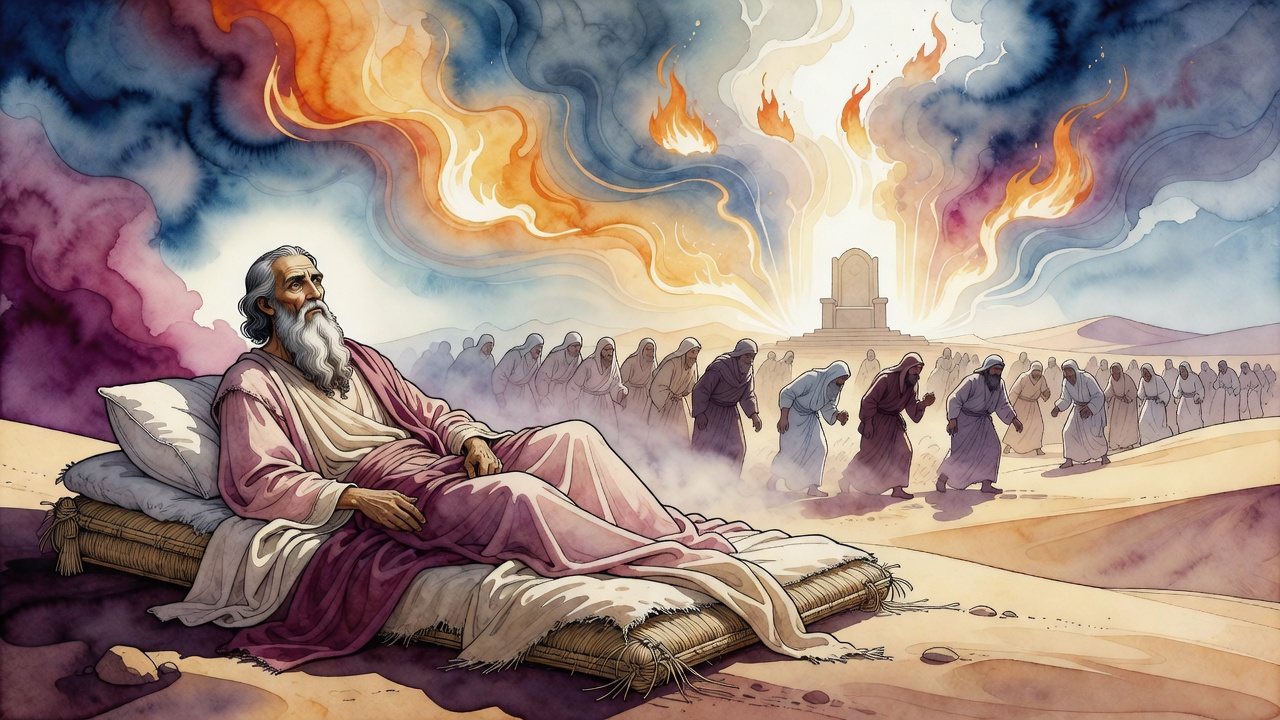
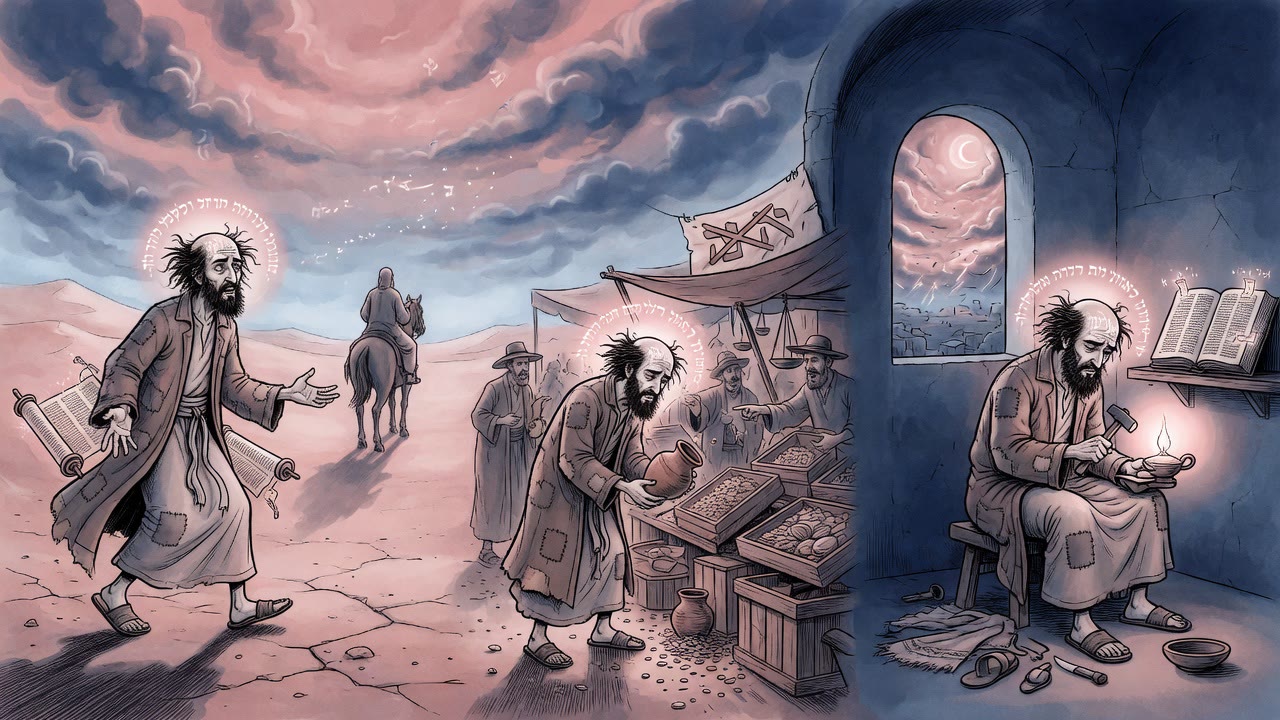
Jacob sat in his tent as if grief were furniture. Years of sackcloth had made him brittle. He believed Joseph dead, and the belief sat on him like a cloak he never took off, even in sleep. Outside, dust rose on the road from Egypt. His sons were coming home with the truth, that the dreamer they had sold now ruled the land of the Nile, and the truth frightened them more than the old lie ever had.

They could not fling it at him like a stone. Joseph himself had warned them not to startle their father. Shock can kill as cleanly as a blade, and a heart trained only in loss may break on joy. They needed a softer door into a room full of mourning.

The Woman at the Egyptian Window

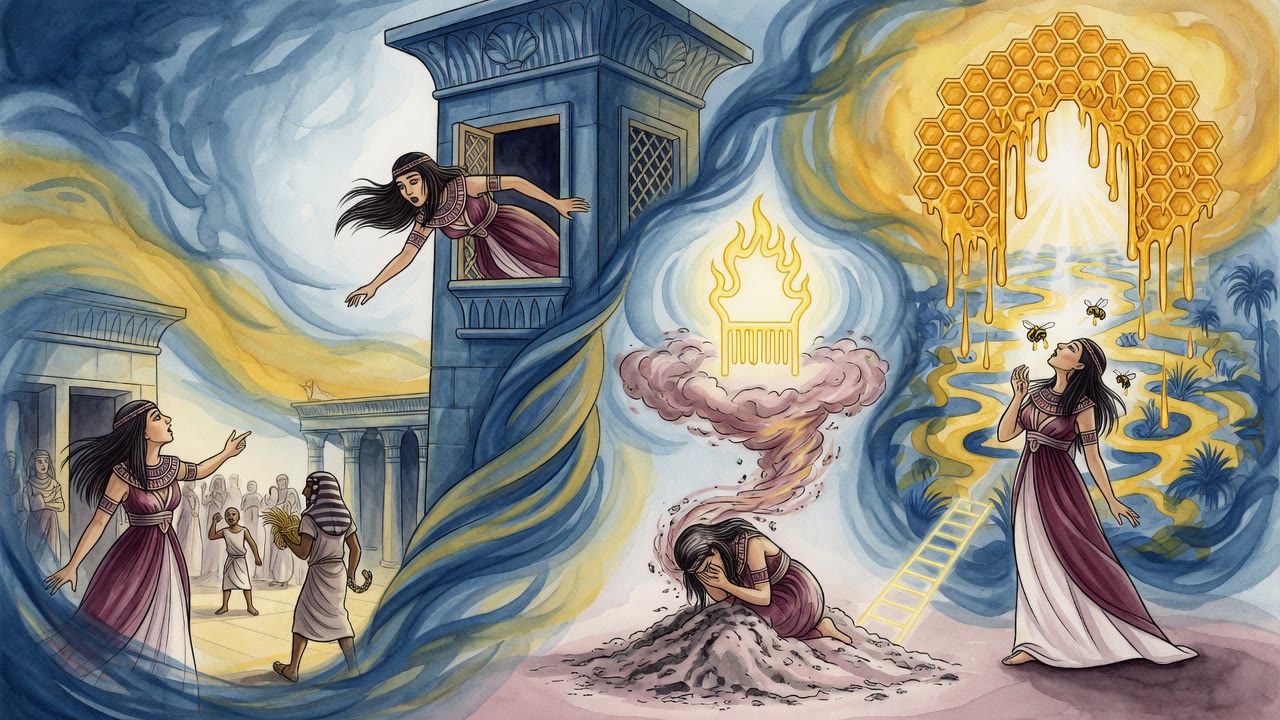
Egypt had already taught Joseph's house how sealed doors open. Asenath, daughter of Potiphar, lived shut in privilege with seven handmaidens and a beauty the tellers set beside Sarah, Rebekah, and Rachel. Suitors pressed, even Pharaoh's son. She refused them all. When her father spoke of marrying her to Joseph, her mouth filled with scorn. "Why should I marry a vagabond, a slave, a son of a Canaanite herdsman?" She repeated every rumor, even the lie about his master's wife.

Then she looked from the window. Joseph's carriage passed below, and the sight of him broke her arguments in a single glance. "Poor, foolish me," she said. "I permitted myself to be misled." She wondered whether such beauty could belong to a mere mortal, and she turned toward God with a regret sharp enough to cut. Joseph, wary of the women of Egypt and the vows of his upbringing, ordered her away at first. But the heart that had mocked a Hebrew slave had begun to break open. A sealed door had learned how to swing.

The Harp Before the News

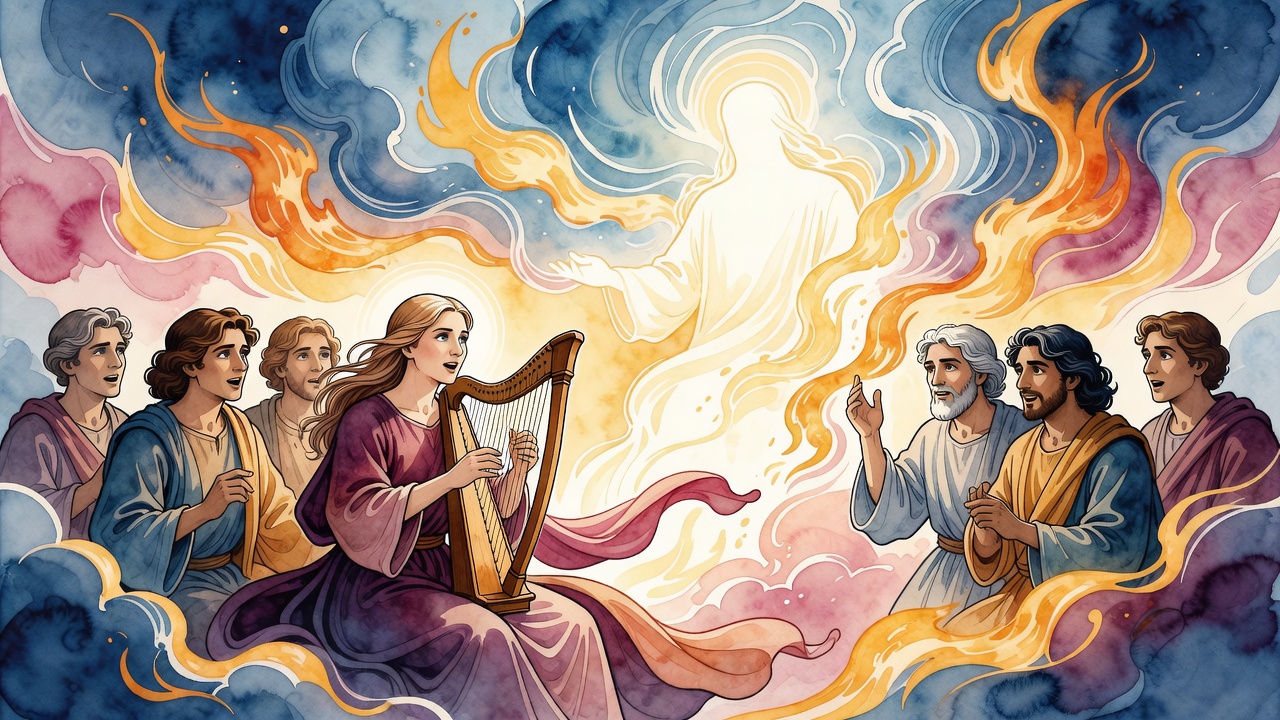
Now a harder heart waited in Canaan, sealed not by pride but by mourning. The brothers went to Serah, daughter of Asher, known for beauty, wisdom, and skill with the harp. They put the instrument in her hands and gave her one line to sing until the line became breathable. "Joseph, my uncle, liveth, he ruleth over the whole of Egypt, he is not dead!"

Serah entered Jacob's tent the way a physician enters a sickroom, measuring every step. She sat. Her fingers found the strings. The melody rose light enough not to bruise, firm enough not to lie, and she sang the impossible sentence again and again, not as a report but as weather changing inside the room.

Something stirred in Jacob that had not stirred in years. For a long age his prophetic sight had gone dark, the channels of vision choked by the coat and the beast he still saw behind his eyes. Joy wakes the Ruach HaKodesh, the holy spirit, and Serah's song rekindled what sorrow had smothered. He knew she sang truth before any man opened his mouth.

He blessed her with a force that matched what she had given him. "My daughter, may death never have power over thee, for thou didst revive my spirit." The blessing did not stay polite speech. Death never took her. Serah entered Paradise alive, the girl with the harp who carried resurrection into a tent on a single refrain.

Proof After the Melody

Only then did the sons appear, arrayed in finery, laden with gifts from the storehouses of Egypt. "Glad tidings," they said. "Joseph our brother liveth. He is ruler over the whole land of Egypt, and he sends thee a message of joy." Jacob flinched toward doubt. These mouths had deceived him once with a coat, and the liar's punishment is disbelief even when he finally speaks true.

Joseph had planned for that flinch. He told the brothers to remind their father what the two of them were studying the day the boy walked off to find his brothers among the flocks, the law of the eglah arufah, the heifer whose neck is broken in the valley. They repeated the lesson. The last doubt fell. "Great is the steadfastness of my son Joseph," Jacob cried. "In spite of all his sufferings he has remained constant in his piety."

Cedars for a Future Dwelling

Jacob prepared to go down, and fear walked beside him step for step. How could he leave the land where the Shekhinah (God's indwelling presence) dwelled for a country of idols and slave pits? At Beer-sheba he offered sacrifices and waited, remembering the ladder of his youth. The Presence answered, calling his name twice in love, promising to go down with him into Egypt and to bring his children up again when the hard years ended.

Before leaving he cut cedars that Abraham had planted at Beer-sheba and carried the living timber south, wood that would one day become boards for the Tabernacle when a free people needed a dwelling for glory in the wilderness. Judah went ahead to Goshen to build a house of study so Torah would not pause at the border. And when Joseph heard his father was near, the ruler of Egypt harnessed his own chariot with his own hands and drove out like a boy running.

The road into Egypt opened under a canopy of provision. Abundance had come through the Hebrew slave before famine finished its work, mercy running ahead of judgment, provision before the long bondage that would follow. The brothers' mouths had once sold a dreamer. A harp had to unsell the death, and a granddaughter's song went first so that a father could survive his own joy.


← All myths
From the tradition

Sources

3 sources

The texts behind this telling. Some cards carry a translation of the source; others are our own retelling of it, and each card says which. Every card links out to the original.

Legends of the Jews, I. Joseph, Jacob Receives The Glad TidingsLegends of the Jews

Retold in our words. Read the original at the link below.Project Gutenberg eBook #1494, The Legends of the Jews, Volume 2 · Public Domain

That’s kind of the place Jacob was in. Years had passed since he last saw his beloved son, Joseph. He believed Joseph was dead, and the grief was a heavy cloak he wore every day. But his sons were about to return from Egypt with news that would shake him to his core.

In Ginzberg's retelling in, Legends of the Jews, Jacob's sons knew they had to tread carefully. How could they just blurt out that Joseph was alive and well, ruling all of Egypt? Jacob was so fragile, so burdened by sorrow. They feared the shock might overwhelm him. Plus, Joseph himself had warned them not to startle their father with the joyous news.

So, what did they do? They hatched a plan. They enlisted the help of Serah, the daughter of Asher. She was known for her beauty, her wisdom, and her skill with the harp. They gave her a harp, and told her what to sing: "Joseph, my uncle, liveth, he ruleth over the whole of Egypt, he is not dead!"

Serah, sitting before Jacob, her fingers dancing across the strings, the melody lilting and hopeful. "Joseph, my uncle, liveth..." She repeats the words, and something begins to stir within Jacob. A flicker of joy. A spark of hope.

As we find in Midrash Rabbah, joy is a powerful catalyst. It awakens the Ruach (spirit) HaKodesh, the holy spirit. For years, Jacob's prophetic visions had ceased, choked by his constant grief. But Serah's song, her melody of hope, rekindled that spirit within him. He knew she spoke the truth.

Jacob, overcome with gratitude, blessed Serah, "My daughter, may death never have power over thee, for thou didst revive my spirit." And according to tradition, that’s exactly what happened. Serah never died; she entered Paradise alive!

With Jacob softened by Serah's song, his sons finally appeared. They were arrayed in finery, laden with gifts from Joseph. "Glad tidings!" they proclaimed. "Joseph our brother liveth! He is ruler over the whole land of Egypt, and he sends thee a message of joy!"

Initially, Jacob was skeptical. After all, hadn’t they deceived him before? As the saying goes, "it is the punishment of the liar that his words are not believed even when he speaks the truth." But then, they showed him the presents, the tangible proof of Joseph's power and love. Still, a sliver of doubt remained.

Joseph, wise beyond his years, had anticipated this. He had instructed his brothers to remind Jacob of a specific moment: when Joseph had taken leave of him years ago to check on them, Jacob had been teaching him about the law of the eglah arufah (עגלה ערופה), the heifer whose neck is broken in the valley.

The moment they repeated this, the last vestige of doubt vanished. Jacob exclaimed, "Great is the steadfastness of my son Joseph. In spite of all his sufferings he has remained constant in his piety!"

Jacob prepared to journey to Egypt. But first, he needed to know if it was God's will. How could he leave the Eretz Yisrael (ארץ ישראל), the Land of Israel, the land of his fathers, the land where the Shechinah (שכינה), the Divine Presence, dwelled? How could he go to an impure land, a land of slaves?

He offered sacrifices, awaiting a Divine vision. He remembered his vision at Beth-el, and expressed his fears to God. Would he be repeating the mistakes of his father? Would his descendants be trapped in Egypt forever?

Then, the Shechinah addressed him, calling his name twice as a sign of love. God reassured him, telling him not to fear the Egyptian slavery. God would be with him. "I will go down into Egypt with thee."

Before leaving, Jacob went to Beer-sheba to cut down the cedar trees Abraham had planted there, taking them with him to Egypt. These trees, symbols of continuity and faith, would later be used to build the Tabernacle.

Judah was sent ahead to Goshen to prepare a dwelling and a Bet Midrash (בית מדרש), a house of study, so Jacob could immediately begin teaching his sons. He chose Judah for this task to atone for his earlier suspicions about Joseph's disappearance.

Finally, the moment arrived. Joseph, upon hearing of his father’s approach, prepared his chariot with his own hands, eager to greet his beloved father.

What a powerful story about hope, faith, and the enduring bonds of family! And isn't that something we can all take comfort in?

Full source
The Midrash of Philo 1:2The Midrash of Philo

Retold in our words. Read the original at the link below.The Works of Philo Judaeus, trans. C. D. Yonge, London, H. G. Bohn, 1854-1890 · Public Domain

There's a perspective, woven into ancient Jewish thought, that offers a slightly different angle?Now, midrash (מדרש) itself, broadly speaking, is a way of interpreting and expanding on the Hebrew Bible, drawing out deeper meanings and lessons. This particular midrash, attributed to the philosopher Philo of Alexandria (though its exact origins are debated), gives us a fascinating idea.

The central theme? Divine mercy always comes before judgment. It suggests that God's first impulse is to do good. Destruction, punishment – those are secondary, almost a last resort. The Midrash emphasizes that God is primarily concerned with bestowing blessings.

It goes further. According to Philo's Midrash, when terrible events are looming, God actually makes sure an abundance of blessings precedes them. It’s like a buffer, a cushion of goodness.

The text gives a powerful example: Egypt. Before the devastating seven-year famine that Joseph prophesied, Egypt experienced seven years of incredible fertility. Remember the story? Those years of plenty were a direct result of "the beneficent and saving power of the Creator." It's a dramatic illustration of this principle at work.

And here's where it gets even more interesting. The Midrash doesn't just see these blessings as random acts of kindness. It also suggests that God uses them to teach us. These blessings, this abundance, should inspire us to turn away from sin, to avoid actions that would corrupt the good fortune we've been given. "And in the same way in which he showers benefits upon men, he also teaches them to depart and to abstain from sin; that these blessings may not be turned into the contrary."

The Midrash uses another intriguing analogy: the "freedom of their institutions" allows cities to flourish and develop a sense of virtue. So that when they do wrong, they recognize it as aberrant and know that the fault lies within themselves and not with the Divine. "Not at all looking upon the divinity as the cause of them, for that has no connection with wickedness or misery, for the task of the Deity is only to bestow blessings."

This idea challenges us to look at our own lives differently. When we experience blessings, are we using them to grow, to become better people, to create a more just and compassionate world? Or are we squandering them, allowing them to lead us down a path of corruption and selfishness?

Perhaps, this Midrash suggests, the presence of good, even before hardship, is a call to action, a reminder of our potential for righteousness, and an opportunity to choose a path aligned with the divine.

Full source
Legends of the Jews, I. Joseph, AsenathLegends of the Jews

Retold in our words. Read the original at the link below.Project Gutenberg eBook #1494, The Legends of the Jews, Volume 2 · Public Domain

The Jewish tradition has some fascinating stories about that, and one of the most intriguing is the tale of Asenath and Joseph. It's a story about beauty, prejudice, divine intervention, and ultimately, transformation.

The story, as retold by Ginzberg in Legends of the Jews, paints Asenath as a woman of extraordinary beauty. Think Sarah, Rebekah, and Rachel rolled into one! She's the daughter of Potiphar, a prominent Egyptian nobleman, and lives a life of privilege, secluded in her own palace with seven handmaidens. Suitors, including Pharaoh's own son, clamor for her hand, but she rejects them all. She wants nothing to do with marriage.

Then, Joseph arrives. Remember Joseph, the dreamer who was sold into slavery by his brothers? He's now a powerful figure in Egypt, thanks to his ability to interpret Pharaoh's dreams. Joseph announces he's coming to visit Potiphar, and Potiphar, eager to cement the connection, proposes a marriage between Joseph and Asenath.

Asenath is not impressed.

"Why," she asks, according to Ginzberg, "should I marry a vagabond, a slave, a son of a Canaanite herdsman?" She's bought into the rumors and the prejudices. She sees him as an outsider, someone beneath her. She even brings up the accusation that he tried to violate his master's wife! "I'd rather marry Pharaoh's son!" she declares.

But then she sees him.

Peeking from her window, Asenath is struck by Joseph's "divine beauty" and "indescribably noble carriage." It's a complete turnaround! Suddenly, she's filled with regret. "Poor, foolish me," she laments. "I permitted myself to be misled." She realizes the rumors were wrong. She even wonders if he's "a son of God," because such beauty, she believes, couldn't possibly exist in a mere mortal. She begs God for forgiveness, promising to marry Joseph if given the chance.

Joseph, however, is initially wary. He notices Asenath watching him and orders her away. He's committed to staying away from the Gentile women of Egypt, a principle instilled in him by his father, Jacob. He knows his beauty attracts unwanted attention, and he wants to avoid temptation.

Potiphar explains that Asenath is a virgin who has never looked upon another man. He asks Joseph to allow her to pay her respects. Joseph relents, and Asenath greets him with "Peace be with thee, thou blessed of God Most High." Joseph returns the greeting, but when Asenath tries to kiss him, he refuses.

"It is not meet," he says, "that a God-fearing man…should kiss a woman of a strange people, who blesses dead and unprofitable idols." Ouch! He's drawing a clear line, emphasizing the difference between his beliefs and hers. He sees her as someone who worships false gods and engages in practices that are spiritually harmful.

Asenath is heartbroken. But Joseph, seeing her distress, softens. He blesses her, asking God to "pour out His spirit over her and make her to become a member of His people and His inheritance, and grant her a portion in the life eternal."

This is where the story takes a truly fascinating turn. According to late antique traditions, Asenath does indeed convert to Judaism and becomes Joseph's wife. The Book of Asenath, an apocryphal text, expands on this, describing her repentance and conversion in detail, even featuring an angel who instructs her. She becomes a righteous woman, and their descendants are said to include important figures in Jewish history.

It also speaks to the power of transformation and the possibility of finding common ground, even between people from very different backgrounds. It’s a beautiful tale of how love, combined with faith, can bridge divides and lead to unexpected blessings. Asenath's journey reminds us that even those who seem furthest away can be brought closer, and that the most unlikely unions can sometimes be the most blessed.

Full source