5 min read

Solomon and the Stones That Built Themselves

Solomon leaves his palace half-built for thirteen years while God's House rises in seven, stones lifting themselves onto the courses without a rope.

Curated by Arthur · Told by Maggid ·
Table of Contents
  1. Seven Years Against Thirteen
  2. Hands That Were Not Only Human
  3. The Stone That Knew Its Place
  4. The Cluster on the Wood
  5. What the Finished House Held

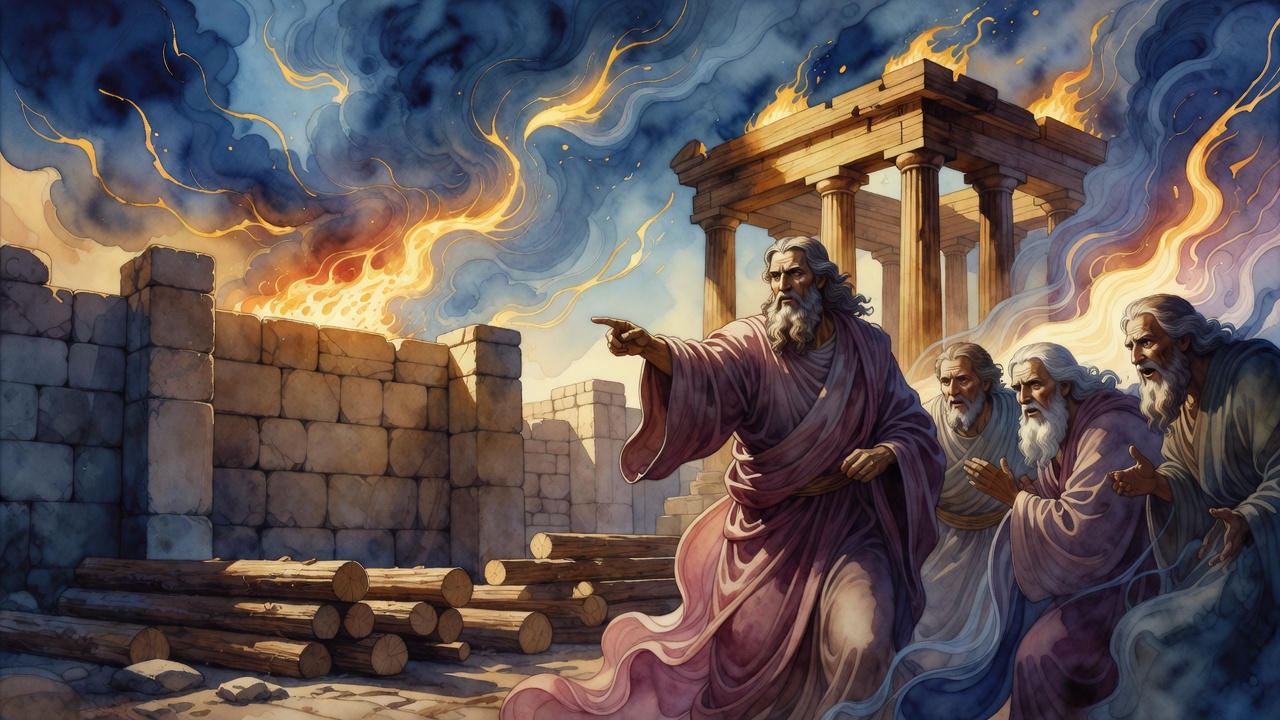
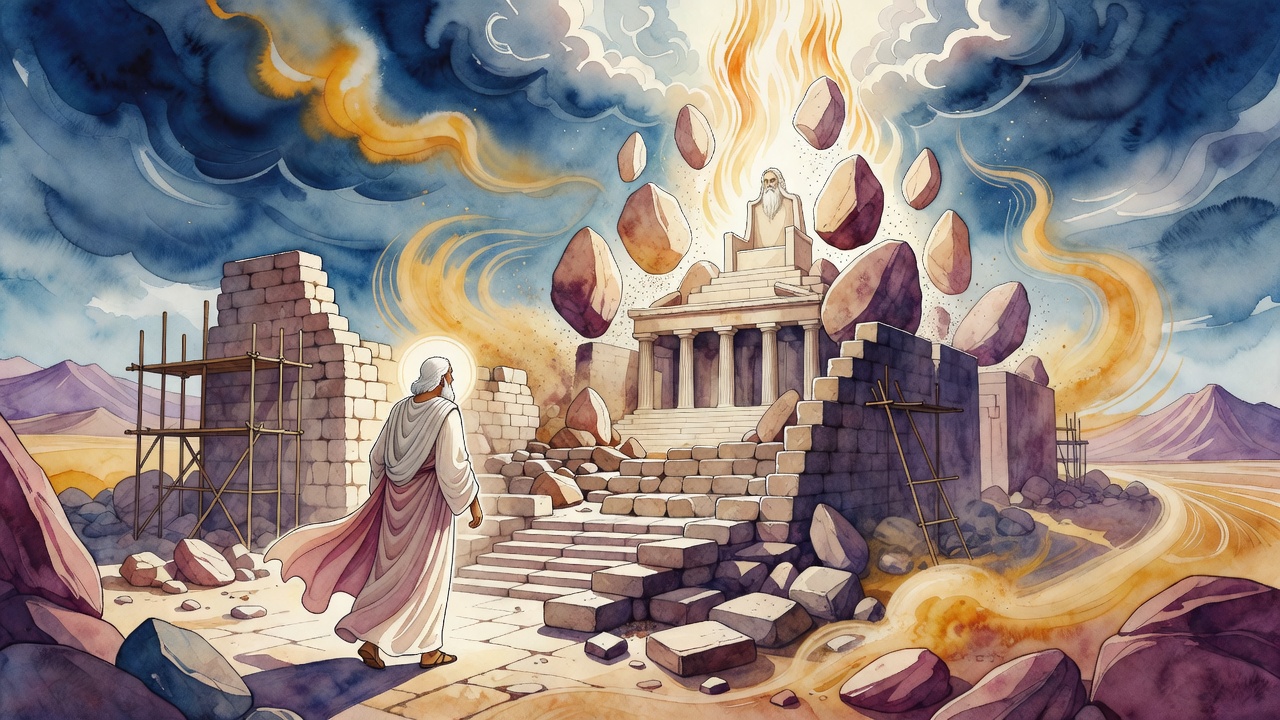
On the ridge above the city a stone rose without a rope. No lever. No shouted count. It left the pile, hung a moment in the air, and set itself into the course as if a hand the builders could not see had already measured the gap.
Solomon and the Stones That Built Themselves Click for full size

Solomon stood among the scaffolds and did not look toward his unfinished palace.

Seven Years Against Thirteen

They would later set the numbers side by side like a charge sheet. He built the House of God in seven years (I Kings 6:38). He built his own palace in thirteen (I Kings 7:1). Anyone counting bricks for a king's comfort would ask which project he loved more.

The answer lived in the pace. On his private halls Solomon dragged his feet. On the Temple he moved like a man who knew every idle day was a theft from the Name. Diligence stood before kings, the proverb said. Here the king stood before a higher King, and the work would not wait on royal leisure.

His own roof could wait with rain in the rafters. The House for the Holy One could not.

Hands That Were Not Only Human

Laborers still hauled and cut. Mortar still stained wrists. But the work had helpers no payroll named. Spirits came. Demons came. Ministering angels came. If the whole realm assists a mortal king, how much more will every force assist the honor of the King of kings.

A mason reached for a block and found it already rising. Another set his mallet down because the stone had chosen its seat. The House was not written as "the House that they were building" alone. The verse says the House "in its construction," as if construction were a thing happening to the stones as much as a thing men did to them (I Kings 6:7).

Solomon could say, in the doubled language of the dedication, that he had built a built building. He had raised what was already raising itself.

The Stone That Knew Its Place

Whole stones, transported and set without the scream of iron on the site, climbed into rows. One stone would lift itself and settle on the course above. Builders learned not to be astonished when the next block moved before they touched it.

Memory ran sideways to another pit and another night. In Babylon a stone sealed a den of lions for Daniel, though Babylon is soft earth without mountains of its own. The stone flew from the Land of Israel and settled at the mouth of the pit. An angel descended in the image of a stone lion. If heaven moved rock for one righteous man in a foreign den, how much more would rock move for the House of the Holy One on the mountain.

Solomon watched a course close without a crowbar and kept his palace waiting another season.

The Cluster on the Wood

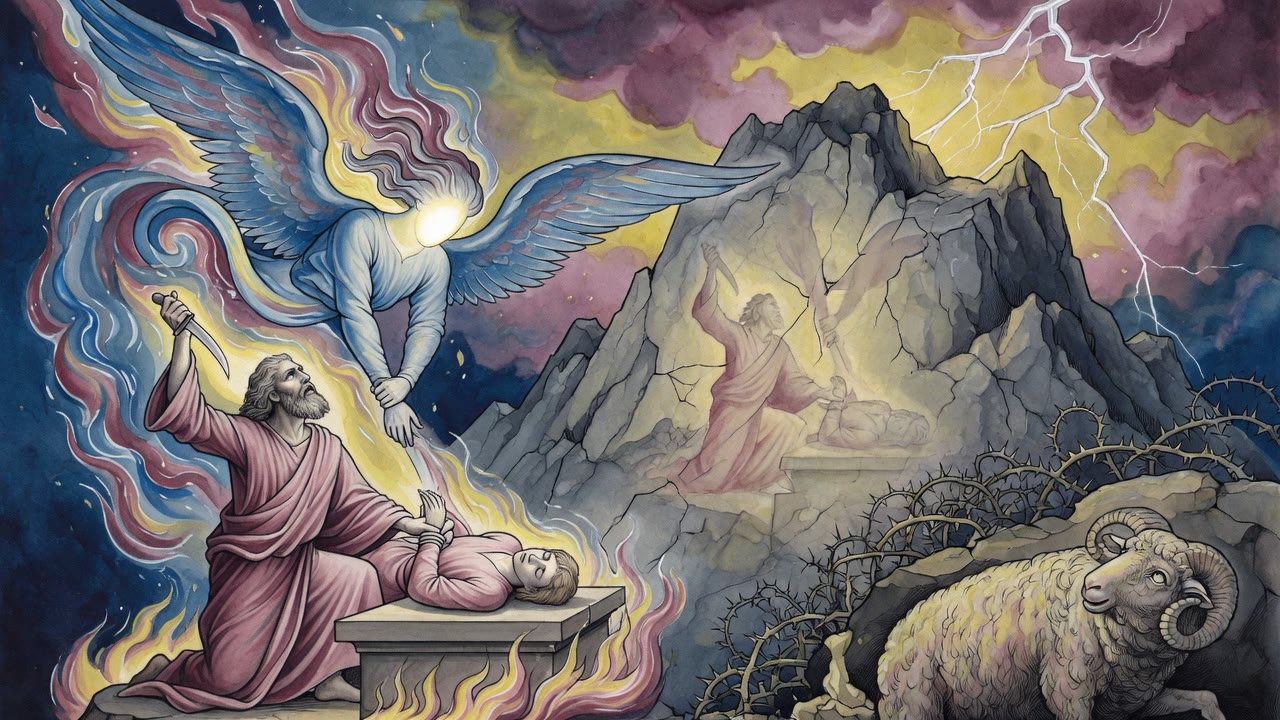
Long before those walls, on a height that would never forget smoke, Isaac had lain bound on the altar like a cluster of henna laid out for the fire. In that cluster the language of atonement still burns: hakofer, the one who covers sin. A body offered and not finished, a son who did not run, a father who did not refuse the knife until heaven stopped the hand.

That pressure never left the mountain. When Solomon's stones rose of their own will, they rose for a God who had already accepted a binding and returned a living son. The House would stand as a place where offerings speak, where the memory of a cluster on wood becomes cedar and gold and a court that can hold a people under judgment and mercy.

Nearby in the old story, Jacob had once entered his father's tent with a face contorted by fear of shame, kid skins on his arms, reaching for the blessings that are the eye of the world. Deception and dread walked into the same family line that would one day need a House. The stones that lifted themselves did not erase that contortion. They gave it a place to be answered with sacrifice and song.

What the Finished House Held

When the last course locked, Solomon still owed his own halls six more years of work. The people could see which roof had claimed his hurry. Angels who had helped the Temple did not linger to polish the king's private lintels.

In a later night of terror, Egyptians would try to hide their firstborn among Israelite children, stuffing a doomed son between the beds of the living. The angel would still find the hidden boy and strike. Israel, the sources say, remained as if lying in affection, close as henna between the heart and the cloth. Judgment moved through houses. Love stayed with its own.

On the ridge the self-built House stood quiet after seven years of impossible speed. Solomon turned, at last, toward the slow beams of a palace that had never learned to rise without a rope.


← All myths
From the tradition

Sources

2 sources

The texts behind this telling. Some cards carry a translation of the source; others are our own retelling of it, and each card says which. Every card links out to the original.

Shir HaShirim Rabbah 1:5Shir HaShirim Rabbah

Retold in our words. Read the original at the link below.The Sefaria Midrash Rabbah, 2022 · CC-BY

Shir HaShirim Rabbah turns to Temple, Wisdom of Solomon.

Shir HaShirim Rabbah, a collection of rabbinic interpretations on the Song of Songs, dives into this very question. It begins by interpreting the verse, "Have you seen a man diligent in his labor? He will stand before kings" (Proverbs 22:29), applying it directly to Solomon. The Midrash (rabbinic interpretive commentary) connects Solomon's diligence to his work on the Temple, noting, "He built it in seven years" (I (Kings 6:3)8).

Then, a twist! The text immediately contrasts this with another verse: "Solomon built his palace in thirteen years" (I Kings 7:1). Thirteen years for his own palace, but only seven for the House of God? Was Solomon more invested in his personal comfort than in serving the Divine?

The Rabbis don't shy away from this apparent contradiction. Huna, quoting Rav Yosef, suggests that while Solomon might have been a little…sluggish…on his own palace, when it came to the Temple, he was incredibly diligent. Why? Because everyone lends a hand to the king, but all the more so should everyone assist in honoring the King of Kings, the Holy One, blessed be He! According to this interpretation, even spirits, demons, and ministering angels would have eagerly participated.

Yitzchak, son of Rav Yehuda bar Yehezkel, offers another perspective, focusing on the verse "I have built [bano baniti] an abode for You" (I (Kings 8:1)3). He cleverly interprets bano baniti as "I have built for you a built building," implying the Temple practically built itself!

And it gets even wilder. Rabbi Berekhya points out that I (Kings 6:7) doesn't say "The House that they were building," but rather, "The House, in its construction [nivna]." He understands nivna as a reflexive term, meaning "it built itself." The stones, according to this understanding, lifted themselves into place.

Rav then chimes in, "Do not be astonished by this!" He draws a parallel from the Book of Daniel (6:18), where a stone miraculously appears to seal the lion's den. "One stone was brought and placed at the entrance to the den." Rav asks, were there stones in Babylon? No way! They had to have flown in from the Land of Israel. Rav Huna, again quoting Rav Yosef, even suggests an angel in the form of a stone lion sealed the den! If such miracles could happen for the righteous Daniel, surely, miracles could happen for the building of the Temple.

The passage then shifts back to Solomon, addressing a controversy: at one point, the Sages considered stripping Solomon of his portion in the World to Come. A Divine Voice intervened, declaring, "Do not touch My anointed ones" (Psalms 105:15). Rabbi Yehuda bar Simon notes that Solomon is listed as the head of a royal lineage (I (Kings 14:2)1), and Rabbi Yudan bar Simon reminds us that the Divine Spirit rested upon him, inspiring him to write Proverbs, Song of Songs, and Ecclesiastes.

So, what does it all mean? This passage from Shir HaShirim Rabbah isn't just about the physical construction of the Temple. It's about the dedication, the miraculous assistance, and the Divine inspiration that went into creating a sacred space. It's about the delicate balance between human effort and divine intervention. And, perhaps most importantly, it's a reminder that even figures as towering as King Solomon are subject to scrutiny and judgment, but also capable of redemption and lasting impact. It makes you wonder, what are we building, and how are we building it?

Full source
Shir HaShirim Rabbah 1:14Shir HaShirim Rabbah

Retold in our words. Read the original at the link below.The Sefaria Midrash Rabbah, 2022 · CC-BY

Beautiful. But what does that imagery evoke?

Shir HaShirim Rabbah, a Midrashic (rabbinic interpretive commentary) collection (meaning a collection of interpretations and stories) focusing on the Song of Songs, unpacks this verse in a fascinating way. It doesn’t just take the words at face value; it sees layers of meaning, connecting them to pivotal moments in Jewish history.

"A cluster of henna [hakofer]," the Midrash states, "this is Isaac, who was bound on the altar like a cluster." Hakofer, it explains, also means "to atone" [mekhaper]. Suddenly, the image shifts. The henna, a symbol of beauty and adornment, becomes a symbol of Isaac's sacrifice, his willingness to be offered as an atonement for the sins of Israel. Think about the Akeidah, the binding of Isaac. It’s one of the most powerful and unsettling stories in the Torah, a moment of ultimate faith and ultimate test.

The interpretation doesn't stop there. "In the vineyards of [bekharmei] Ein Gedi," the Midrash continues, "this is our patriarch Jacob, who entered with his face contorted [bikhrum] in fear of being humiliated before his father." We're reminded of Jacob's deception, how he disguised himself to receive the blessing meant for Esau. He "donned garments made from a kid [gedi izim] and took the blessings that are the eye of [ein] the world. Ein Gedi becomes a reference to the "eye" (ein) of the world, the blessings Jacob sought.

Rabbi Ḥunya, in the name of Rabbi Aḥa, offers another layer: "There is nothing dearer to a woman than a cluster of henna. Where does she place it? Between her breasts." This brings us back to the intimate, loving relationship at the heart of the Song of Songs. The henna, placed close to the heart, becomes a symbol of closeness and affection.

Building on this, Rabbi Ḥunya, this time in the name of Reish Lakish, shares a powerful analogy: "The congregation of Israel said before the Holy One blessed be He: ‘Master of the universe, You afflicted the Egyptians with their firstborn, you embittered their soul, but me, “lying between my breasts.”’"

What does that mean?

The Midrash explains that during the plague of the firstborn, some Egyptians tried to save their children by hiding them in Israelite homes. But the angel of death, according to the tradition, would still find them. However, God’s relationship with Israel was different, one of protection and love. Even if an Egyptian child was within their midst, God’s loving embrace shielded them. As Rabbi David Luria explains, even in the midst of divine judgment, God maintained a special, affectionate relationship with the Israelites.

So, what started as a seemingly simple love poem blossoms into a profound meditation on sacrifice, deception, and ultimately, the enduring love between God and the Jewish people. It's a reminder that even in the darkest of times, even when we feel like we're being tested or punished, we are still held close, "lying between [God's] breasts," safe and cherished. It asks us, what does it mean to be held close? And what responsibilities does that closeness bring?

Full source